Logos representative only and should not be seen as an endorsement / preference / recommendation
Updates for the week ending Sunday, June 18th
This summary is published every Monday, and is a list of SL viewer / client releases (official and TPV) made during the previous week. When reading it, please note:
It is based on my Current Viewer Releases Page, a list of all Second Life viewers and clients that are in popular use (and of which I am aware), and which are recognised as adhering to the TPV Policy. This page includes comprehensive links to download pages, blog notes, release notes, etc., as well as links to any / all reviews of specific viewers / clients made within this blog
By its nature, this summary presented here will always be in arrears, please refer to the Current Viewer Release Page for more up-to-date information.
Official LL Viewers
Current Release version 5.0.5.326444, released on May 18, promoted May 23 – formerly the Maintenance RC viewer overview – download page, release notes – No change
Alongside all of the resident-led events and activities planned to mark SL’s 14th anniversary, one set of events are liable to draw considerable interest from Second Life Users: the round of Meet the Linden sessions hosted at the SL14B Auditorium.
As with recent SLB events, Meet the Lindens will comprise one session a day, from Monday, June 19th through Thursday, June 22nd, and offer Second Life users the opportunity to hear from – and likely ask questions of – Linden Lab staff.
Patch and Dee Linden with Saffia Widdershins (l) and Zander Greene (r) at Meet the Lindens event during SL13B in 2016
This year all of the Meet the Linden sessions will take place between 14:00 and 15:00 SLT, with the schedule lining up as follows.
Day (14:00 – 15:00 SLT)
Lindens
Monday 19th June
Patch Linden, Senior Manager, Product Operations, and Dee Linden, Land Product Specialist
Tuesday 20th June
Landon Linden, VP of Operations and Platform Engineering; Oz Linden, Technical Director, Second Life
Wednesday 21st, June
Xiola Linden, Lead Community Manager
Thursday 22nd June
Oz Linden, Technical Director for Second Life and Grumpity Linden, Senior Producer at Linden Lab
Again, all these sessions will take place at the SL14B Auditorium.
Revised after realising slight opsie with the dates…
The planets – actual size. Jupiter is the biggest – and most likely the oldest – of our solar system’s family of gas and solid body planets. Credit: NASA
Jupiter is the most massive planet of the solar system and its presence had an immense effect on the dynamics of the solar accretion disk (the disk of dust and stellar material which surrounded and formed the Sun). Knowing the age of Jupiter is key for understanding how the solar system evolved toward its present-day architecture. Although models predict that Jupiter formed relatively early in the solar system’s history, until now, its formation has never been dated. Now, an international study suggests it was the very first planet to form.
The team, comprising scientists from the US Lawrence Livermore National Laboratory and Germany’s Institut für Planetologie at the University of Münster, believe that Jupiter’s core started forming within the first million years of the solar system’s existence. By looking at tungsten and molybdenum isotopes on iron meteorites, the team found that meteorites are made up from two genetically distinct nebular reservoirs that coexisted but remained separated between 1 million and 3-4 million years after the solar system formed.
“The most plausible mechanism for this efficient separation is the formation of Jupiter, opening a gap in the accretion disk, preventing the exchange of material between the two reservoirs,” said Thomas Kruijer, lead author of team’s paper, published in the June 12th Proceedings of the National Academy of Sciences.
“We do not have any samples from Jupiter (in contrast to other bodies like the Earth, Mars, the moon and asteroids),” he continued, when discussing the paper. “In our study, we use isotope signatures of meteorites (which are derived from asteroids) to infer Jupiter’s age. Jupiter is the oldest planet of the solar system, and its solid core formed well before the solar nebula gas dissipated, consistent with the core accretion model for giant planet formation.”
Even now, Jupiter sucks up material falling towards the Sun from further out in the solar system. This August 2009 image shows the result of an object striking the upper reaches of Jupiter’s southern hemisphere (south is at the top in the photo). The object was most likely a comet or asteroid a few hundred metres across. Credit: NASA
The team showed through isotope analyses of meteorites that Jupiter’s solid core formed within only about 1 million years after the start of the solar system history, rapidly growing to a mass of around 20 times that of Earth, then expanding more gradually to around 50 Earth masses over the next 2-3 million years. This rapid formation meant Jupiter acted as a barrier against inward transport of material from the outer reservoir of nebula material to the inner one, potentially explaining why our solar system lacks any super-Earths (a solid planet with a mass and size greater than Earth’s) orbiting the sun – Jupiter effectively vacuumed up the material.
The common belief among planetary scientists has leaned towards the gas giants of the outer solar system having formed relatively early in the solar system’s history, before the complete dissipation of the solar nebula—the gaseous circumstellar disk surrounding the young Sun – which occurred around 10 million years after the solar system formed. These finding fully support that belief, but has been able to far more precisely pin-down Jupiter’s birth date.
“Our measurements show that the growth of Jupiter can be dated using the distinct genetic heritage and formation times of meteorites,” Kruijer said.
Chinese Resupply Vehicle Competes 2nd Lab Refuelling
China’s automated Tianzhou-1 re-supply vehicle has carried out a successful second rendezvous with the currently uncrewed Tiangong-2 space laboratory, and completed out a further refuelling operation of the orbital facility.
An artist’s impression of Tianzhou-1 (left) docked with the slightly larger Tiangong-2 orbital laboratory. Credit: CMSE
Launched in April 2017, Tianzhou-1 (“Heavenly Ship 1”) is the first of a series of resupply vehicles based on China’s first orbital module, Tiangong-1, designed to deliver up to 6.5 tonnes of equipment, supplies and fuel to orbital facilities – most notably China’s space station, construction of which is due to commence in 2018.
The 10.6m (34ft) long, 13 tonne Tianzhou-1 being prepared for installation into its launch shroud, April 2017. Image: CCTV
Tianzhou-1 is currently on an extended mission with the Tiangong-2 (“Heavenly Palace 2”) orbital facility, during which automated dockings at each of the laboratory’s two airlock systems are being practised, as is the transfer of fuel to the laboratory. The latter is a complicated, 29-step process, but one vital to the success of an orbital facility, where fuel is used in very small motor systems to help it maintain the correct orientation whilst in orbit and – potentially – help periodically boost the facility orbit to counter the microscopic (but cumulative) effect of atmospheric drag encountered whilst orbiting the Earth.
However, as such “boosts” to a space station’s orbit are more normally provided by an attached vehicle (the space shuttle used to do it for the International Space Station, for example, and the role has been taken over by the resupply craft which periodically visit the ISS). To this end, part of the Tianzhou-1 mission has also been to practice manoeuvring both the vehicle and Tiangong-2 when the two have been docked. In addition, Tianzhou-1 has been carrying out its own free flight mission when not docked with the laboratory.
Like the European Automated Transfer Vehicle (ATV), Japanese H-II Transfer Vehicle (HTV) and American Cygnus resupply craft used in support of ISS operations, Tianzhou-1 is not designed to return to Earth. Instead, the vehicle will be allowed to burn-up as it re-enters the denser part of the Earth’s atmosphere at the end of its mission.
Following the Tianzhou-1 mission, a further crew of Chinese tiakonauts is expected to visit Tiangong-2 laboratory.
Kepler’s Latest Findings
NASA will announce the latest crop of planet discoveries from the Kepler Space Telescope on Monday, June 19th.
An artistic concept demonstrating gravitational microlensing. As an exoplanet passes in front of a more distant star, its gravity causes the trajectory of the starlight to bend, and in some cases results in a brief brightening of the background star as seen by a telescope, enabling scientists to search for exoplanets that are too distant and dark to be detected any other way (Credit: NASA / JPL / T. Pyle)
Kepler has been hunting for extrasolar planets since its launch in 2009, although the programme was almost cut short in 2013, following the failure of two of the reaction wheels (essentially gyroscope systems) used to stabilise the platform and allow it to gather data.
However, in November 2013, a new mission for the platform, dubbed “Second Light” and more generally referred to as the K2 mission, was proposed and, after a successful period of test in early 2014, officially got under way on May 26th, 2014.
Most recently, Kepler has been using gravitational microlensing in an attempt to locate planets orbiting stars so far away, the dimming of the star’s light by a transiting planet cannot easily be detected.
Kepler was the first mission capable of seeing planets the size of Earth around other stars in the “habitable zone” — the region at a distance from a star where liquid water could exist without freezing or boiling away immediately.
Thus far Kepler has found 4,496 exoplanet candidates. Some 2,335 have been confirmed and 21 are Earth-size planets in the habitable zone. Further, 520 of these exoplanet candidates have been found during the K2 mission, with 148 confirmed as having planets.
Second life celebrates its 14th year as an open virtual world on Friday, June 23rd, 2017. This means that once again, the Second Life Birthday Community Celebration is taking place in-world to mark the platform’s anniversary.
SL14B officially opened its gates at midday SLT on Sunday, June 18th, and events run through until Sunday, June 25th. The regions will then be open for viewing for a further week, although there will be no major entertainments or activities during that time. I’ve been fortunate enough to help out in the background for the event, and so have been watching the infrastructure and exhibitor builds take shape, and I have to say that people have really risen to this year’s theme of Carnivaleqsue.
The infrastructure builds at this years events comprise the expected roads and stages – the Cake Stage, Live Stage, DJ Stage and Stage Left – together with the Auditorium build, Welcome Area, Time Capsules display, and Max Mystery Land. With the exception of the Tim Capsules display, each covers between one and two regions (with the Cake Stage centred on its usual four regions), and offer some amazing interpretations of the celebration theme, and I have little doubt they’ll all be seeing a lot of use during the festivities.
For the DJ Stage, Cynimon Catnap offers a lush forest environment with tall trees and rich colours – and which hides what feels like an entire circus within it. Giraffes offer a welcome, giant carved lions give airborne acrobats the chance to test their skills, while paths wind among the trees, leading the way to carousels, Ferris wheels, bumper cars – and hidden glades where people can escape the inevitable rush. And, of course, topping it all, literally as well as figuratively, is the DJ Stage, standing atop – what else? – the circus ringmaster’s beautifully adorned top hat!
Facing the DJ Stage across the width of the SL14B regions is the Welcome Area, by Darkstone Aeon. This is intended to be the starting point for visits to SL14B, containing information, Teleport boards, details of scheduled events and more. All this is set within a rocky environment, with an oriental lean to it. Great Chinese-style dragons (always at the centre of festivals) undulate over and through (literally!) the landscape, or stand on high peaks keeping an eye on everything. Follow the steps cut into the rock and the paths and ways carefully, for there is much to see here. Should you grow tired, or wish an alternate view of the region – be sure to take one of the dragon or balloon rides!
To the south, and between both the DJ Stage and the Welcome Area, you’ll find the Auditorium, once again built by ADudeNamedAnthony. This year we have a design of clean, modern lines which carry within them a hint of Art Deco. Surrounded by broad avenues and bracketed by parkland, the Digital City venue would look at home in almost any city environment. Within it can be found the main auditorium, which will be home to talks and presentations throughout the week, supported by two smaller forum halls.
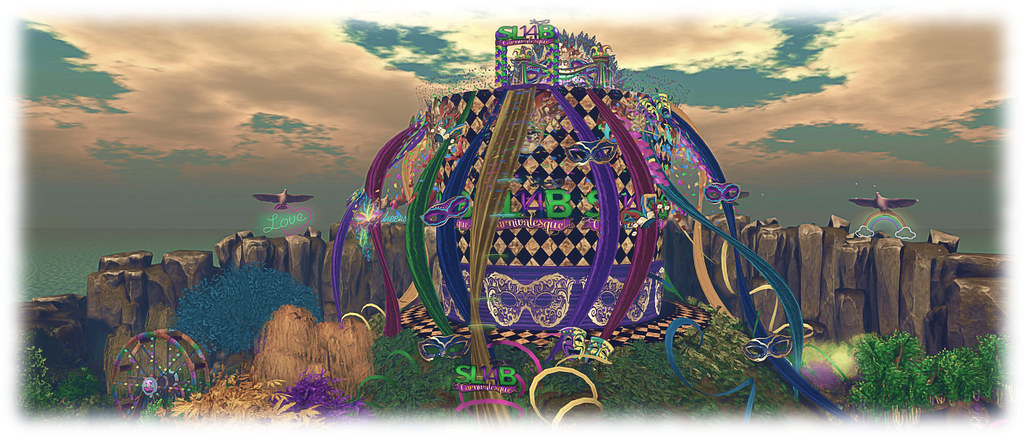
South of the Auditorium rises the Cake Stage. This is once again another of Mikati Slade’s gloriously colourful and distinctive designs, occupying the central corners of four adjoining regions. It will feature many activities and parties throughout the week including the Lab’s Masked Ball (Monday, June 19th 11:00 13:00 SLT) and Come As You Were party (Wednesday, June 21st 18:00 – 20:00 SLT) – find out more about these two events here.
East of the Cake Stage, and occupying two regions, is the Live Music stage, designed by Chic Aeon. A curious design, the live stage sits within a mini urban setting which merges glowing building blocks with Monopoly like buildings. Caught in darkness (set your viewer to midnight if your environment doesn’t automatically change), it offers the neon feel of a city, beyond which, when facing the right direction, the glowing mass of the Cake Stage rises.
To the west and a little south of the Cake Stage is Stage Left, designed by Faust Steamer, and while I shouldn’t perhaps have favourites, I have to say it is one of the two infrastructure builds I particularly like at SL14B. Those who recall Faust’s Stage Left from SL13B are sure to be blown away by this year’s design, which again takes a fantastical twist on the carnivale theme for the celebrations, throwing in a Hindu incarnation of Cerberus, together with some Chinese influences.
The scale of this build is just amazing; to really appreciate it, you have to cam out; to understand the sheer power evoked by it, simply stand next to the teleport dias / pool and look up as the great armoured beast lowers its middle head to look at you. This build also uses a local experience for teleporting – jump into the teleport pool and allow the experience too be lifted to the stage up on the beast’s broad back.
The other build we particularly enjoyed in our pre-opening ramblings and photo-gathering is the Max Mystery Land (aka Community Park), designed by Lim Pikajuna. Occupying a single region at the southern end of the Community Celebration estate, this offers all manner of entertainments above ground, in the air, underground and even under water. A theme park on (and in) a mountain, Max Mystery presents visitors with sky cars, go karts, pedaloes, boat rides, underwater bumpers cars, a disco, a mono-rail – there’s even a chapel!
In addition to all this comes the exhibitor builds and displays. As usual, these are an eclectic, tumbling mix of designs and expressions, encompassing art in all its forms, promoting communities, commemorating individuals, showcasing skills, and of course offering fun and amusement or opportunities for quiet contemplation. Many have entered into the theme of the celebrations with gusto and imagination, making wandering the exhibitor regions a delight. Some have opted for displays pretty close to previous years’ offerings, and one or two still have yet to learn that slapping textures on prims that reach up into the sky might be eye-catching, but not necessarily in a positive way.
I’ll have more to say on exhibits and art at SL14B in the week. For now, I’ll leave you with the key SLurls – you can find a full list on the SL14B website, where you can also find the celebrations schedule (use the drop-down menu for individual stage, etc., schedules).
It’s time to kick-off another week of storytelling in Voice by the staff and volunteers at the Seanchai Library. As always, all times SLT, and events are held at the Library’s Second Life home at Bradley University, unless otherwise indicated.
Sunday, June 18th
13:30: Tea-time with Dad: Gemma’s Choice
John Morland reads Kipling’s Just So stories.
18:00: The Wind in the Willows
Meet little Mole, wilful Ratty, Badger the perennial bachelor, and petulant Toad. Over one hundred years since their first appearance in 1908, they’ve become emblematic archetypes of eccentricity, folly, and friendship. And their misadventures – in gypsy caravans, stolen sports cars, and their Wild Wood-continue to capture readers’ imaginations and warm their hearts long after they grow up.
Begun as a series of letters from Kenneth Grahame to his son, The Wind in the Willows is a timeless tale of animal cunning and human camaraderie – although some in current times unkindly see it as a kind of allegory for the privileged ne’er-do-well upper class (in the form of Toad) with the aid of the middle class (Badger, rat and Mole) to keep the proletariat (weasels and stoats) in their place.
I suggest you join Caledonia Skytower for Magicland Storytime, and go with Mr. Grahame’s intention with the tales – as a ripping yarn for young hearts and minds.
Monday, June 19th 19:00: The Book of Skulls
Gyro Muggins reads Robert Silverberg’s novel.
Four friends, college room-mates, go on a spring break trip to Arizona: Eli, the scholar, who found and translated the book; Timothy, scion of an American dynasty, born and bred to lead; Ned, poet and cynic; and Oliver, the brilliant farm boy obsessed with death.
Somewhere in the desert lies the House of Skulls, where a mystic brotherhood guards the secret of eternal life. There, the four aspirants will present themselves–and a horrific price will be demanded.
For immortality requires sacrifice. Two victims to balance two survivors. One by suicide, one by murder.
Now, beneath the gaze of grinning skulls, the terror begins. . . .
Tuesday, June 20th 19:00: The Ordinary Princess
Faerie Maven-Pralou reads MM Kaye’s 2002 novel.
In true fairytale style, the seventh princess is blessed with gifts by a host of fairies, but as her father fears, it goes wrong and one slightly bitter fairy ‘blesses’ her with ordinariness.
So no golden curls, stunning beauty and sublime grace for Princess Amethyst Alexandra Augusta Araminta Adelaide Aurelia Anne. Her dark hair and freckles make Amy (no ordinary princess can be called anything else) stop every suitor from pursuing her. She decides to run away and make her own life, away from boring princes and a confined life.
A life in the forest is bliss, but eventually Amy realises she will need some money, and must find work. So it is that she becomes the fourteenth assistant kitchen maid at a neighbouring palace. And there – much to everyone’s surprise – she meets a prince just as ordinary (and special) as she is!
Wednesday, June 21st 19:00: The Girl Who Drank the Moon
Caledonia Skytower reads Kelly Barnhill’s 2017 Newbery Medal winner.
Every year, the people of the Protectorate leave a baby as an offering to the witch who lives in the forest. They hope this sacrifice will keep her from terrorizing their town. But the witch in the forest, Xan, is kind and gentle. She shares her home with a wise Swamp Monster named Glerk and a Perfectly Tiny Dragon, Fyrian.
Xan rescues the abandoned children and deliver them to welcoming families on the other side of the forest, nourishing the babies with starlight on the journey.
One year, Xan accidentally feeds a baby moonlight instead of starlight, filling the ordinary child with extraordinary magic. Xan decides she must raise this enmagicked girl, whom she calls Luna, as her own.
To keep young Luna safe from her own unwieldy power, Xan locks her magic deep inside her. When Luna approaches her thirteenth birthday, her magic begins to emerge on schedule–but Xan is far away. Meanwhile, a young man from the Protectorate is determined to free his people by killing the witch. Soon, it is up to Luna to protect those who have protected her–even if it means the end of the loving, safe world she’s always known.
Thursday, June 22nd 19:00: Ron Rash’s The Southern Thing
With Shandon Loring.
Seanchai Moves To Holly Kai Park
This week marks Seanchai Library’s last week of reading at Bradley University. From Sunday, June 25th, Seanchai Library will commence reading from their new home at Holly Kai Park – read the official press release and the Holly Kai blog post for more.
Please check with the Seanchai Library’s blog for updates and for additions or changes to the week’s schedule.
The featured charity for May through July is Alex’s Lemonade Stand Foundation, raising awareness of childhood cancer causes and funds for research into new treatments and cures.
The majority of the notes in this update are taken from the TPV Developer meeting held on Friday, June 16th, 2017. The video of that meeting is embedded at the end of this update, my thanks as always to North for recording and providing it. Timestamps in the text below will open the video in a separate window at the relevant point for those wishing to listen to the discussions. Note that the timestamps may not be in chronological order, reflecting the fact that some topics were discussed more than once during the course of the meeting.
There was no deployment to the main (SLS) channel on Tuesday, June 13th. Nor, as the channel was updated in week #23, was there a restart.
On Wednesday, June 14th, two of the server RC channels were be updated as follows:
LeTigre received a new server maintenance package (#17.06.12.327066), comprising additional internal logging and features and improvements to region start
BlueSteel received a new server maintenance package (17#17.06.13.327122) containing internal fixes
[15:20] The Magnum RC was initially updated with a newer version of the new operating system update (#17.06.12.327060), which included a fix for BUG-100737 “Shoutcast receivers unable to relay on RC Magnum” (see part 1 of this report for more on this issue). However, this deployment had to be subsequently rolled-back as the corrective intent of the BUG-100737 didn’t work as expected. This update will likely be re-deployed to Magnum ion week #25 (commencing Monday, June 19th).
SL Viewer Pipelines
Asset HTTP Viewer
[1:39] The Asset HTTP viewer should be promoted to release status at the start of week #25 (week commencing Monday, June 19th). The promotion has been delayed while the viewer goes through a complete regression test (something the Lab does every X number of viewer releases). This viewer sees delivery of all remaining asset types (wearables, gestures, animations, sounds, etc) over HTTP via the CDN.
[11:39] This viewer should hopefully see faster first-time playback of sounds and animations, as these will be obtained via the CDN, which should be faster than being obtained through the simulator. It also means obtaining assets should also be a lot more reliable when you’re in a busy region, because – again – the assets are not coming via the simulator, but through a CDN node.
The Lab will – several months hence from now – remove the server-side UDP messaging support for these asset types. This will in turn mean that any viewers not updated to the HTTP support at the time the messaging is removed from the simulator will no longer be able to receive these asset types.
Maintenance RC Viewer
[5:25] The Maintenance RC viewer updated on Thursday, June 15th to version 5.0.6.327125. This includes an update to prevent the viewer crashing if it receives a UDP message from the simulator that it doesn’t recognise, by having the viewer ignore all unrecognised messages.
Voice RC Viewer
[5:04] The Voice RC viewer has been updated, but the update has a high crash rate and so the update is unlikely to see the light of day.
Alex Ivy 64-bit Project Viewer
[2:23] The next version of the 64-bit project viewer is completing testing. This includes the new Windows SL Launcher and updater, together with a 64-bit version of the Havok sub-libraries. As noted in my last TPV Developer meeting update, the launcher is essentially a 32-bit executable that checks a Windows system to see if it is 32-bit or 64-bit, and then endeavours to download the correct version (32- or 64-bit) of the viewer if an update is available, install it and then launch it. SL Launcher is only required for Windows as the Mac version of the viewer will only be provided in 64-bit once the Alex Ivy viewer reaches release status.
A follow-up build for RC release has apparently been built, and this should appear soon after the project update, and work has commenced on updating the wiki build instructions for building the viewer to match the 64-bit build process.
[38:26] The wiki instructions are being updates to reflect the requirements of the 64-bit build, so care should be taken when following them for other builds.
360-degree Snapshot Project Viewer
[6:21] The 360-snapshot viewer is now up-to-date and includes code to generate a 360 equirectangular images and their metadata, which can then be uploaded to suitable websites supporting 360-images. The update will appear once it has cleared the Lab’s QA testing.
There is still further work to be done on this viewer – the UI is going to be updated to allow integrated uploads of 360-images to SL Place Pages (and this may be done for Flickr, etc), and SL Place Pages will be updated to accept 360-degree images from the viewer.
TP Throttle
[13:28] The Lab is still looking at throttling the speed at which teleport requests can be re-tried when trying to access a busy region. An initial change is currently on the LeTigre RC, and further changes are liable to be made. As previously noted, these updates shouldn’t impact manual teleports, but may affect teleport HUDs which are scripted to repeatedly re-try teleports in rapid succession until one is successful (requiring the scripts running them to be modified so they don’t exceed the throttle).
This change is being made because a high incidence of failed teleport requests hitting a busy region places an additional load on the region’s simulator, adversely affecting performance for those already in the region.
Other Items
Uploading Meshes Rigged to Attachment Points
[17:48] This subject came up at the Content Creation User Group meeting as a part of the discussion on animating weapons to follow hands. There was some confusion on whether mesh objects rigged to attachment points could be uploaded, after it was reported that the LL viewer supported it, and Firestorm didn’t (see FIRE-21000 – which now has a fix). While there is a server-side validation error which can cause some issues when uploading meshes (fix in progress) which might cause upload problems, it is believed that the current behaviour here should be that new objects rigged to attachment points should be blocked from upload, but existing items rigged to attachment points previously uploaded to SL will still work.
Supplemental Animations and Animation Priorities
[24:17] The question was asked if there was any historic reason for not being able to change the priority of an animation post upload (see SVC-8094). It is thought this might be because the priority is set within the animation asset, which cannot be edited. However, it is hoped the forthcoming server-side supplemental animation updates will help eliminate some of the conflicts created by priority clashes.
Providing a Means to Compile Experience Scripts in the User’s Inventory
[35:21] Some people working collaboratively on experiences are finding it problematic when having to update scripts used by the experience, but which are contained in another user’s objects for that experience, as it requires a lot of swapping and changing, rather than simply editing the script in question (see BUG-8180).
While the Lab understands these difficulties, it was a conscious decision to have experience management work as it does, and while at some point in the future they might revisit things, doing so isn’t on the short-term roadmap.
Resetting Scripts in No-Mod Objects
[36:47] This is a request the Lab is unlikely to implement, because it would violate the expectations of the script authors.











 Inara Pey: Living in a Modemworld