Space Sunday: other worlds, near and far

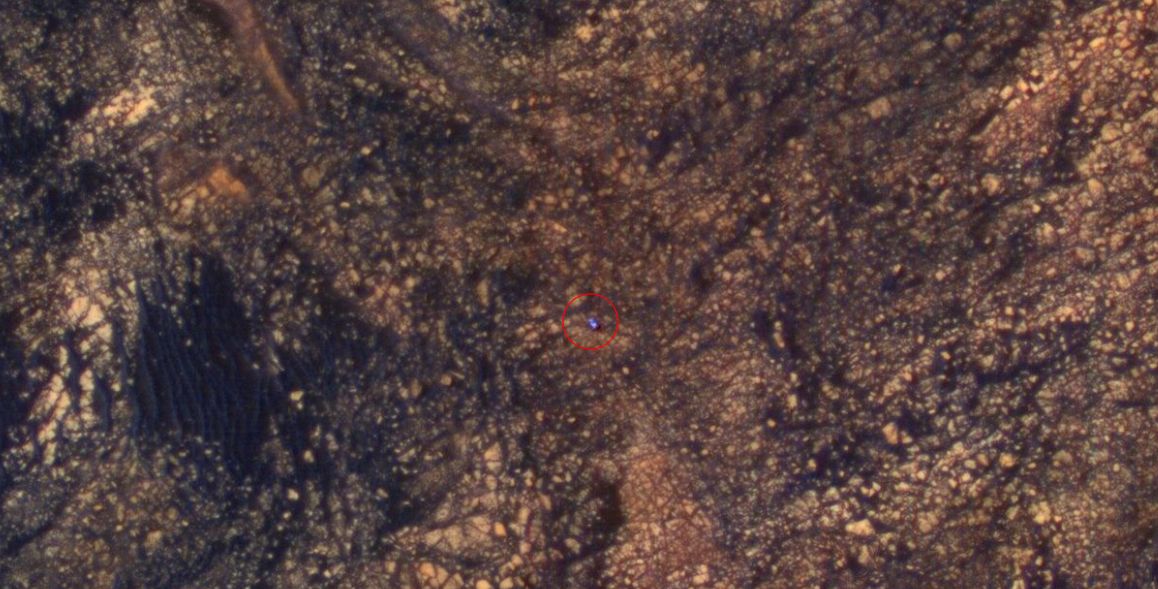
Curiosity on “Mount Sharp” as seen by the Mars Reconnaissance Orbiter. Credit: NASA/JPL / MSSS  (click for full size)

NASA’s Mars Science Laboratory rover, Curiosity continues to climb Aeolis Mons (“Mount Sharp”), and in doing so, it has been once again imaged from orbit by the HiRISE camera system on NASA’s Mars Reconnaissance Orbiter (MRO). The image was captured on June 5th, 2017 (Curiosity’s 1717th Martian Sol), at the same time the rover was engaged in taking colour images of its surrounding using its mast-mounted Navcam system.

MRO has actually been imaging Curiosity roughly once every three months, as the orbiter’s track around Mars carries it over “Mount Sharp” and the rover’s route up the mound’s flank. However, these aren’t simply happy snaps of the rover’s progress: MRO is actively monitoring the terrain around the rover to allow scientists to check for changes – such as movement among sand dunes – and to help plan the rover’s route up the slopes.

The June 5th image, released by NASA on June 20th, has been colour enhanced to better reveal Curiosity as a bright blue feature. To give an idea of scale and resolution, the rover is some 3 metres (10ft) in length and 2.8 metres (9 ft) wide.
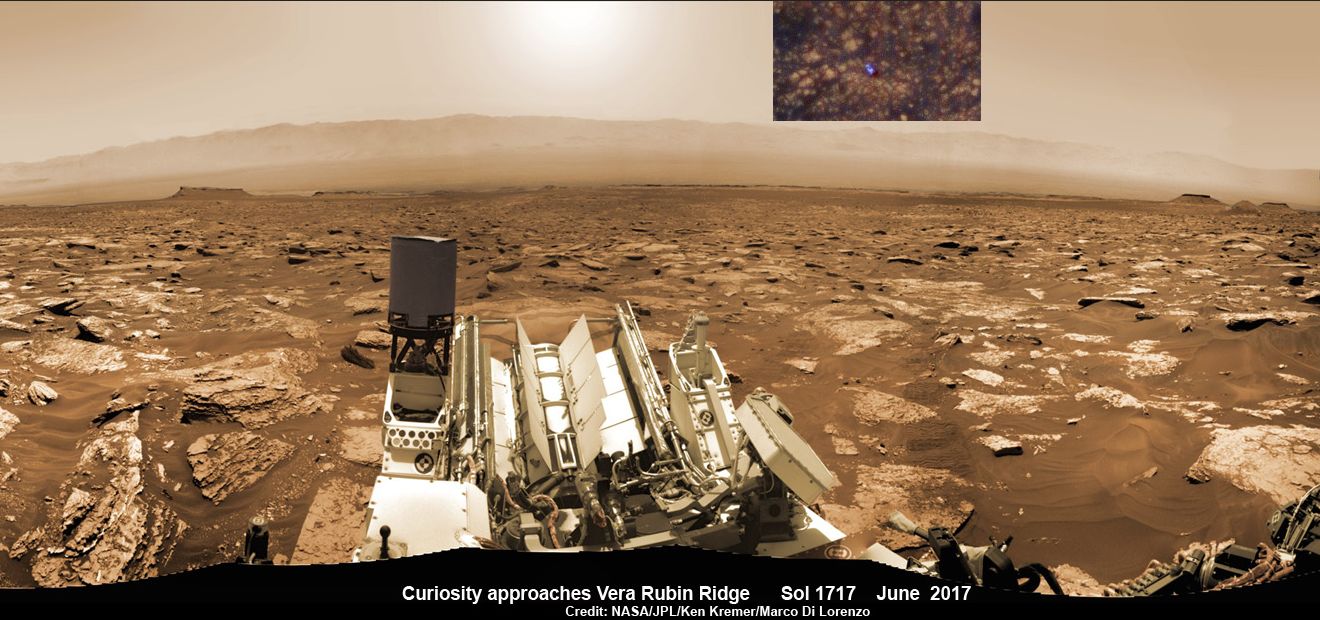
A mosaic of images captured by Curiosity using the Navcam system, looking back along the rover’ route up “Mount Sharp” towards the distant rim of Gale Crater. The images making up the view were all captured on June 5th, 2017 (Sol 1717 for the rover), the same day as MRO imaged the rover from orbit. Credit: see image

Curiosity is currently traversing ground between two points of scientific interest: the “Bagnold Dunes”, an area of sand dunes which are slowly progressing down the side of “Mount Sharp” as a result of both wind action and gravity; and a high-standing ridge which runs parallel to the eastward side of the dune field. Dubbed the “Vera Rubin Ridge” after the American astronomer who pioneered work on galaxy rotation rates, this ridge line is of interest to scientists because it has been shown to exhibit signatures of hematite, an oxidized iron mineral which can provide clues to the environmental conditions on this region of “Mount Sharp” when it formed.

The route to the ridge is slightly circuitous. At the moment the rover is heading east-north-east around a small set of dunes. Once clear of them it will turn south-east and drive to where a potential safe route up onto the ridge has been identified. The drive is further slowed as Curiosity periodically pauses to capture images of the feature to help scientists characterize any observed layers, fractures, or geologic contacts and better understand determine how the ridge formed, and its relationship to the other geologic units found within Gale Crater.
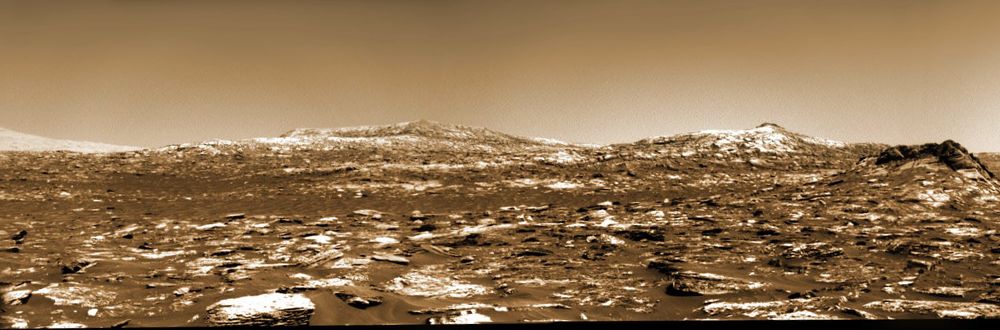
The route ahead: a June 14th (Sol 1726) mosaic captured by Curiosity, showing “Vera Rubin Ridge”, which was roughly 370 metres (114 ft) away from the rover at the time the images were captured. Credit: NASA/JPL / MSSS / Ken Kremer / Marco DiLorenzo

At the same time NASA released the image of Curiosity seen from orbit, half a world away, attempts to correct a wheel problem the solar-powered Opportunity Mars Exploration Rover (MER) had been experiencing appeared to end in partial success.

“Oppy” had suffered a failure with its left-front wheel steering actuator on June 4th, leaving the wheel angled and unable to straighten. After numerous attempts to correct the issue, a new approach tested on June 20th resulted in the wheel turning correctly and resuming its proper alignment with the other wheels. However, what originally caused the actuator to fail remains unknown, and there is concern that it might recur.

To limit the risk of this happening and possibly stranding “Oppy”, the rover will avoid all use of its front wheel steering, and will only use its rear wheel steering when absolutely necessary. To maintain manoeuvrability, it will instead rely on “tank steering” – effectively running the drive motors for the wheels on one side of the rover in opposition to those on the other, allowing Opportunity to turn left or right more-or-less on the spot, a technique the rover is designed to use. This should allow the rover to continue its current survey of “Perseverance Valley” in preparation for a descent into Endeavour Crater.

“Planet Nine” Set to Become “Planet Ten”?

I’ve written extensively in these pages about the hunt for “Planet Nine” (or “Planet X” or “George”, “Jehoshaphat” or “Planet of the Apes” as some would have it): the Neptune-sized world believed to be orbiting the sun at a distance of at least 200 astronomical units (AUs – one AU being the average distance of the Earth from the Sun) in a highly eccentric orbit.  The search for that world is still continuing, but if a new study is confirmed, that mystery world may well have to give up its “Planet Nine” title for another.
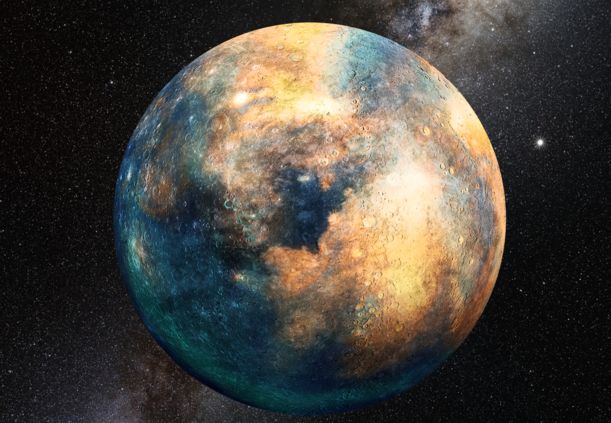
A planetary mass object the size of Mars would be sufficient to produce the observed perturbations in the distant Kuiper Belt. Credit: Heather Roper/LPL

Kat Volk and Renu Malhotra of the University of Arizona’s Lunar and Planetary Laboratory, offer compelling evidence of a yet-to-be-discovered planetary body with a mass somewhere between that of Mars and Earth, orbiting the Sun much closer than the mysterious “Planet Nine”, at around 50 AU distance.

Whilst carrying out a detailed studying of Kuiper Belt Objects (KBOs) – the disk of rocky asteroids and comets surrounding the Sun from a distance of around 30 AU to about 50-60 AU, Volk and Malhotra discovered a consistent anomaly. Whilst most KBOs surround the sun with orbital inclinations that average out to what planetary scientists call the “invariable plane of the solar system”, they discovered that the more distance KBOs – those around 50 AU or over from the Sun are tilted away from the invariable plane by about eight degrees.

The pair surveyed around 600 of the 2,000 observed KBOs, and found all of those on the outer reaches of the Kuiper Belt to be inclined from the invariable plane by roughly the same amount and in numbers that tend to preclude a statistical fluke. In modelling possible causes for this, they discovered that an object with a mass of Mars, orbiting about 50-60 AU would cause just such a disruption, as would a Earth-sized body slightly further away.

However, Volk and Malhotra carefully avoid any suggestion there is a Mars- or Earth-sized body is awaiting discovery, noting that the disruption might also be the result of several large (but not planet-sized) masses lying within the outer fringes of the Kuiper belt. Even so, a single body would seem more likely, and given it is effectively sitting within the galactic plane – an area so densely packed with stars that solar system surveys tend to avoid it – could explain why it has been able to remain undetected.
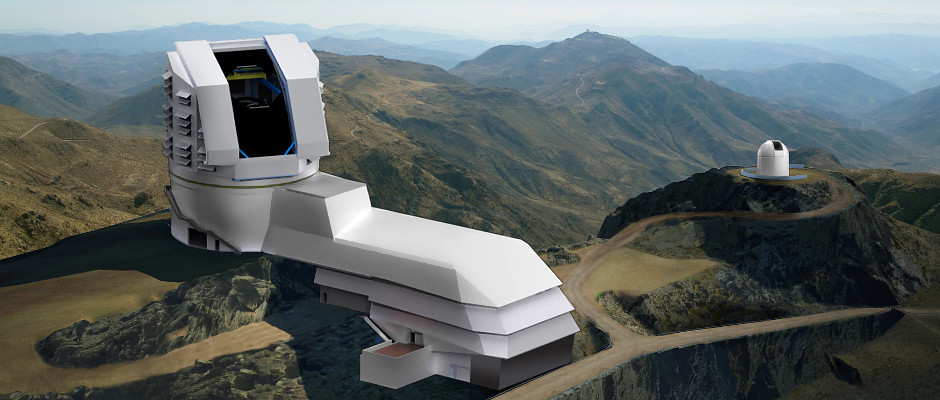
An artist’s rendering of the LSST atop Cerro Pachón mountain, Chile. When LSST starts taking images of the entire visible southern sky in 2022, it will produce the widest, deepest and fastest views of the night sky ever observed. Over a 10-year time frame, LSST will image several tens of billions of objects and create movies of the sky with unprecedented detail – and might reveal whatever is causing the odd perturbations among the KBOs studied by Volk and Malhotra. Credit: Large Synoptic Survey Telescope Project Office

But it might not remain hidden for much longer. 2020 should see the Large Synoptic Survey Telescope (LSST) come on-line. This 8.4 metre (27.6 ft) primary mirror telescope is due to commence a 10-year sky survey in 2022. Among other things, it is expected to increase the number of KBOs so far observed from 2000 – to over 40,000 as it carries out real-time surveys of the sky, night after night. In doing so, it could well find any planet-sized body lurking near them.

Continue reading “Space Sunday: other worlds, near and far”

Kultivate Select Summer themed exhibition in Second Life

Kultivate Select Gallery

Sunday, June 25th marks the opening of the Kultivate Select Gallery’s June exhibition at Water Haven.

All artists invited to exhibit at the gallery must have previously exhibited with Kultivate, and are asked to display in accordance with any theme set for the exhibition – this month’s being “Summer”.

The June exhibition features the artists Bri Graycloud, CalystiaMoonShadow, captainofmysoul, Catalina Staheli, Inara Pey, John Brianna, Karma Weymann, talligurl, Tisephone and Veruca Tammas.The opening for the exhibition is at 13:00 SLT, and will feature live vocal artist Nina Bing, who will be performing through to 14:00 SLT.

Kultivate Select Gallery

SLurl Details

Seanchai Library Comes to Holly Kai Park

Seanchai Library, Holly Kai Park

It’s time to kick-off another week of storytelling in Voice by the staff and volunteers at the Seanchai Library. As always, all times SLT, and events are held at the Library’s new home at Holly Kai Park, unless otherwise indicated.

I’m absolutely delighted to see Seanchai at the Park, becoming part of our family and helping to expand our support of the arts in second Life. The familiar programme of weekly storytelling from Seanchai will continue via their new headquarters at the park, while they’ll also be able to run special events using the park’s grounds and our sky platforms.

So, without further ado, here’s the first week of events from Seanchai Library.

Sunday, June 25th, 13:30: Tales of Ships, the Sea and Other Wetness

Join Library staff and guests in a celebratory 90-minute event to launch their new season at their new home at Holly Kai Park .

Monday, June 26th 19:00: The Book of Skulls

Gyro Muggins reads Robert Silverberg’s novel.

Four friends, college room-mates, go on a spring break trip to Arizona: Eli, the scholar, who found and translated the book; Timothy, scion of an American dynasty, born and bred to lead; Ned, poet and cynic; and Oliver, the brilliant farm boy obsessed with death.

Somewhere in the desert lies the House of Skulls, where a mystic brotherhood guards the secret of eternal life. There, the four aspirants will present themselves–and a horrific price will be demanded.

For immortality requires sacrifice. Two victims to balance two survivors. One by suicide, one by murder.

Now, beneath the gaze of grinning skulls, the terror begins. . . .

Tuesday, June 27th 19:00: The Ordinary Princess

Faerie Maven-Pralou reads MM Kaye’s 2002 novel.

In true fairytale style, the seventh princess is blessed with gifts by a host of fairies, but as her father fears, it goes wrong and one slightly bitter fairy ‘blesses’ her with ordinariness.

So no golden curls, stunning beauty and sublime grace for Princess Amethyst Alexandra Augusta Araminta Adelaide Aurelia Anne. Her dark hair and freckles make Amy (no ordinary princess can be called anything else) stop every suitor from pursuing her. She decides to run away and make her own life, away from boring princes and a confined life.

A life in the forest is bliss, but eventually Amy realises she will need some money, and must find work. So it is that she becomes the fourteenth assistant kitchen maid at a neighbouring palace. And there  – much to everyone’s surprise – she meets a prince just as ordinary (and special) as she is!

Wednesday, June 28th 19:00: The Girl Who Drank the Moon

Caledonia Skytower reads Kelly Barnhill’s 2017 Newbery Medal winner.

Every year, the people of the Protectorate leave a baby as an offering to the witch who lives in the forest. They hope this sacrifice will keep her from terrorizing their town. But the witch in the forest, Xan, is kind and gentle. She shares her home with a wise Swamp Monster named Glerk and a Perfectly Tiny Dragon, Fyrian.

Xan rescues the abandoned children and deliver them to welcoming families on the other side of the forest, nourishing the babies with starlight on the journey.

One year, Xan accidentally feeds a baby moonlight instead of starlight, filling the ordinary child with extraordinary magic. Xan decides she must raise this enmagicked girl, whom she calls Luna, as her own.

To keep young Luna safe from her own unwieldy power, Xan locks her magic deep inside her. When Luna approaches her thirteenth birthday, her magic begins to emerge on schedule–but Xan is far away. Meanwhile, a young man from the Protectorate is determined to free his people by killing the witch. Soon, it is up to Luna to protect those who have protected her–even if it means the end of the loving, safe world she’s always known.

Thursday, June 29th

19:00: Moby-Dick Part 1

“Call me Ishmael.” So begins one of the greatest works of imagination in literary history, Herman Melville’s magnificent Moby-Dick or, The Whale.

As Ishmael is drawn into Captain Ahab’s obsessive quest to slay the white whale Moby-Dick, he finds himself engaged in a metaphysical struggle between good and evil. More than just a novel of adventure, more than a paean to whaling lore and legend, this is a haunting social commentary populated by some of the most enduring characters in literature.

The crew of the Pequod, from stern, Quaker First Mate Starbuck, to the tattooed Polynesian harpooner Queequeg, are a vision of the world in microcosm, the pinnacle of Melville’s lifelong meditation on America.

Written with wonderfully redemptive humour, Moby-Dick is a profound, poetic inquiry into character, faith, and the nature of perception. Join Shandon Loring as he commences a reading of this magnificent tale.


21:00: Seanchai Late Night

Contemporary science fiction with Finn Zeddmore.


Please check with the Seanchai Library’s blog for updates and for additions or changes to the week’s schedule.

The featured charity for May through July is Alex’s Lemonade Stand Foundation, raising awareness of childhood cancer causes and funds for research into new treatments and cures.

SL project updates week 25/2: Content Creation UG w/audio

The Content Creation User Group meeting, at the Hippotropolis Camp Fire Circle (stock)

The majority of the following notes are taken from the Content Creation User Group meeting, held on  Thursday, June 22nd , 2017 at 1:00pm SLT at the the Hippotropolis Camp Fire Circle. The meeting is chaired by Vir Linden, and agenda notes, etc, are usually available on the Content Creation User Group wiki page.

Audio extracts are provided within the text, covering the core project LL has in hand. Please note, however, that comments are not necessarily presented in the chronological order in which they were discussed in the meeting, but are ordered by subject matter.

Server Deployments Week 25 – Recap

As always, please refer to the server deployment thread for the latest updates.

  • On Tuesday, June 20th, the Main (SLS) channel was updated with a new server maintenance package (#17.06.12.327066), containing fixes to help with the caps (capabilities) router (see here for details).
  • On Wednesday, June 21st, the RC channels were updated as follows:
    • BlueSteel and LeTigre should receive the same server maintenance package (#17.06.19.327206) containing internal fixes
    • Magnum should receive a server maintenance package (#17.06.19.327192) intended to fix BUG-100830 (“HTTP_CUSTOM_HEADER no longer works on RC 17.06.13.327111”) and BUG-100831 (“Lelutka Simone bento head spits a script error when attached on 17.06.13.327111 regions (Magnum & Cake)”).

Animated Objects

Vir has been trying to get animated objects using the avatar skeleton to scale in a reasonable way and that linksets are correctly referencing the same skeleton, and things are handled corrected when they are attached or detached. He’d also be interested in hearing from makers of the “current generation” of pets on how they work – how do they maintain ground contact, how they follow along, how the physics is getting managed, so that he can look into trying to make animated mesh objects operate in a compatible manner.

So, if you are a pet maker and can help Vir in this, please either attend the Content Creation User Group meetings, or contact him directly.

Attaching Animated Objects to Avatars and Avatars to Animated Objects

One of the popular aspects of pets today is the ability to attach them to an avatar (so you can carry them, have them sitting on your shoulder, etc), and this is seen as a potentially important aspect of animated mesh. However attempting to do so does present issues, as it would mean linking two avatar skeletons in some manner, something that is not currently possible. While there are some potential ways this could be done, it could add considerable overhead to the existing project, and also brings potential challenges with it – such as ensuring an attached skeleton is correctly oriented, determining the potential performance hit, etc..

Similarly, BUG-100864 suggests a means of going the other way – linking an avatar to an animated object – such as being able to walk up to a free-roaming horse on a region and being able to mount it and ride it, for example. However, this also raises some of the same concerns.

While not ruling either out, Vir is focused on bringing forward a relatively basic means of animating mesh objects using the avatar skeleton, one which can offer a series of potential uses whiles conceivably allowing existing mesh creations (such as pets) to easily be converted to use it. As such, he sees it as a foundation project, which can then be expanded to incorporate other capabilities in the future, rather than trying to pack everything into a single project which could run the risk of very long development times or becoming overly complicated with all it is trying to achieve right from the start.

Baked Textures on Mesh

Work is still focused on the baking service infrastructure updates required to support baking textures on mesh avatars. These are quite extensive, involving changes to the underpinning tools, the servers (including updating Linux), and so on.

Rigging To Attachment Points

There has been some confusion of late as to whether rigging to attachment points is allowed or not. From the Lab’s perspective, it is not allowed for uploaded since the introduction of Bento, but should still work for legacy items. However, what appears to be a server-side glitch in the last couple of weeks seems to have exacerbated the confusion.

Vir’s recommended rule-of-thumb for TPVs to test against the Lab’s official viewer and ensure behaviours match, otherwise confusion could occur down the road once the current glitches have been corrected. To help with matter, he’s going to refresh his mind on what limitations are enforced server-side, and hopefully bring a list of them to the next meeting to help TPVs ensure they are following the requirements in order to avoid future problems.

Other Items

Mesh Body Dev Kits / Clothing Making / “Standardised” Mesh Avatar

This topic took up the core part of the meeting, and as such, the following is an attempt to precis the core points into a readable summary

At the moment, all mesh bodies in Second Life are unique to their creator, utilising their own core shapes and skin weightings, which have a considerable amount of IP bound up in them. Because there is no available “standardised” mesh model available in Second Life, it means that the body creators need to provide developer kits to mesh clothing and attachment makers, which include this core information –  skin weights (in Blend or Maya or DAE or OBJ files) for rigging clothing and the shapes, which potentially makes it very easy for someone to create their own avatar bodies.

To try to reduce this risk, mesh body makers tend to have license agreements clothing makers are required to agree to, and by sometimes limiting who may or may not be deemed eligible to obtain such a kit.   This has  caused some friction / frustration in the cloth making community.

One suggestion put forward to help reduce fears on the part of mesh avatar creators and allow clothing makers more readily support avatar body brands, was that avatar makers should perhaps consider offering only the body shape to clothing makers – and then offer a fee-based rigging service to clothing makers. This would remove the need for avatar makers to give out their skin weight files, offer them a revenue stream and allow clothing makers more equitably create clothing for the more popular mesh bodies.

While there are no projects on the roadmap aimed at the SL avatar system, two other ideas were put forward which Vir agreed, could be worth consideration down the road:

  • One is a suggestion that LL look to emulate the ability in Maya and Blender to copy skin weights from an avatar model to an item of mesh clothing by running an algorithm to match the weighting from the avatar to the nearest vertices in the clothing. This would allow the clothing to fit almost any mesh body “automatically”, removing the need for clothing makers to specific weight their clothing to each of the mesh bodies they wish to support.
  • The development of a news “SL mesh avatar” designed to operate alongside the existing system avatar (so no content breakage for those preferring to continue using the current system avatar). If this avatar had a sufficient density of vertices, it offers two potential uses:
    • Mesh body makers could use its weightings with their custom shapes to produce individually unique mesh bodies, but which all have a “standardised” set of skin weights, reducing the amount of work involved in creating them (or they could continue to use their own custom skin weights if they wished
    • It could offer clothing makers a single source of skin weights for clothing, simplifying clothing making, which – if combined with the vertices matching algorithm mentioned above – would help ensure the clothing “fits” custom weighted mesh bodies.

The vertices matching algorithm idea might be the more difficult of these two ideas to implement – were either to be considered. However, the development of a mesh avatar that could exist alongside the system avatar could have a lot of merit and help “standardise” the more technical aspects of mesh avatars without impacting their individual shape / look.

Further, as mesh objects can support multiple UV sets, it would be possible for such an avatar to use the legacy UV map use to define the texture spaces on the three parts of the system avatar (thus allowing it to use existing skins, etc), or it could support more “advanced” UV maps (so skin creators could finally design skins with two arms, rather than having the one arm “mirrored” on the avatar, as is currently the case.

Why isn’t Scaling Bones by Animations Allowed?

Scaling bones using animations has never been supported in SL, although Vir isn’t clear on why (and pseudo bone scaling via animations has been possible through attachment point scaling or animating the point positions). However, one of the things that makes designing avatars harder is multiple ways to manipulation and aspect of a bone, because of the potential for conflicts. An example of this is bone translations, which can be affected by both animations and the shape sliders, and so can cause issues.

However, during the Bento project, the advantages of allowing translations through animations was such that the Lab opted to permit it, even allowing for the potential for issues. As scaling bones through animations could bring about a similar level of possible complexity to avatar design (as bones can obviously be scaled via the sliders, this could be the reason scaling bones via animations hasn’t been supported. Currently, this is unlikely to change, if for no other reason it would require a change to the animation format, which currently has no means to interpret bone scaling.

Singularity’s look at Sansar and Second Life

Writing in Singularity Hub, the on-line publication of Singularity University, Aaron Frank, principal faculty at the university lecturing on augmented and virtual reality, offers an interesting piece that covers both Second Life and Sansar.

New Virtual World Sansar is Ready to Pick Up Where Second Life Left Offwhich appeared on Friday, June 23rd, may have another slightly misleading title (see Sansar: thoughts around Kotaku’s hands-on), starts with a look back to May 2006, when the story of Anshe Chung’s rise to millionaire status marked her appearance on the cover of Bloomberg Businessweek. The event marked the start of SL’s broader rise in the consciousness of the media (and the general public), and Mr. Franks quickly runs through what followed, culminating in the so-called “failure” (i.e. writing-off by the media) of Second Life – before pointing out that for a “failed” venture, it is still here and still generating an economic throughput sufficient enough for some users (land owners in particular) to draw down a collective US $60 million in income from the platform in 2016.

Aaron Frank

True enough, nothing new here for those of us familiar with Second Life, and the Lab’s popular talking-points for the platform. These include referencing SL’s 2016 “GDP” of half a billion dollars, references to the use of the platform by Texas A&M University, which are again doubtless familiar to many SL users. But as well-trod as these point might be, it’s still good to see another writer willing to look openly at the platform within feeling the need to rub against the “seedier” (as others might wont to have it) side of Second Life.

After his look at Second Life, Mr. Frank takes a dive into Sansar – carefully noting it is the Lab’s new venture while avoiding any reference to it being in any way a “replacement” – because, as we’ve established elsewhere, it isn’t.

Here we’re again treated to a run through familiar territory: the description of spaces visited, the nod towards emerging mechanics on the platform (bouncing and throwing basketballs), the fidelity of the rendering, the spatial sound, etc. Before moving to equally familiar statements about the core differentiator between Sansar and SL (other than the former’s “built for VR” aspect) – the underpinning revenue generation model, before touching on the familiar analogies between Sansar and WordPress.

But within the familiar there are a couple of points worth noting, and which may have been missed along the way, despite being mentioned elsewhere. The first is the re-affirmation that Sansar spaces could be as big as four kilometres on a side – the equivalent of 16 SL regions by 16 SL regions.  While this has previously been intimated, it still seems to be something that is missed in some quarters, so seeing it referenced again here in no bad thing.

The SingularityHub article reminds us that spaces in Sansar could cover an area equivalent to 256 regions in SL: four kilometres on a side

The other element is the confirmation that scenes can be interconnected. This is something that has again been stated by the Lab in the past, but is also something that may have been missed in SL circles – a certain amount of the negativity towards Sansar has been the idea that spaces within it are all “standalone”.

Obviously, “interconnected” does not mean Sansar spaces are in any way contiguous with one another as Mainland and places like Blake Sea in Second Life are. However, it does suggest the ability to at least hop from one Sansar experience to another in a similar manner to teleporting in Second Life. In this, it’s also interesting to note that Ebbe Altberg himself first referred to teleporting between Sansar spaces in an interview a year ago, and it’s interesting to note Cecilia D’Anastasio referred to teleporting between Sansar scenes in her piece for Kotaku (linked to earlier in this article). Of course, this could mean going via the Sansar Atlas, which we’ve already seen – but “teleporting” does seem to suggest a more direct route than leaping via a directory of spaces.

Also noted in the article is something I’ve touched on before – that “creator” in Sansar has a wider meaning than we’re accustomed to seeing in Second Life. In the latter, “creator” is pretty much focused on those who ho design and make the goods we use to dress our avatars and furnish our land; it not a terms closely linked with those who obtain land in SL and design environments using the goods they have purchased from creators. Within “Sansar” the term clearly applies to both in equal measure, which also offers a broader scope for the idea of “democratising content creation” (after all, a region, even if designed using good purchased from others is as much a part of SL’s content as the goods themselves).

The Sansar Marketplace. Credit: Linden Lab, via SingularityHub

Towards the end of the article, there is a discussion on the cultural changes technology has brought about , with Mr. Franks notes with this that, “Society has become native to virtual living.”

And we have; the creative freedoms we have today to socialise across geographic boundaries, to share out thoughts through blogging, our images via photo sharing, our lives through video – and to combine all three – really didn’t exist on the scale we see today when Second Life started out. But that doesn’t mean that the world at large is ready to leap into Sansar (or any similar platform), be it with or without VR hardware, simply to carry on / do more of the things people are already doing through other means. As such, Sansar could  – in terms of the general populace and acceptance / use – face as big a mountain to climb as Second Life did.

But then, if Sansar lays claim to enough of those market verticals where it appears to have clear potential, and can leverage revenue from them, Sansar need not actually need to go “mass market” in the manner once envisioned for Second Life in order to be a success; it could do very nicely as a lead player in a variety of market niches.

Caravanserai: a Silk Road Celebration of the Arts in Second Life

Caravanserai 1: a Silk Road Celebration of the Arts

The desert sands lead on, but look ahead –
a palace of bright tents and green date palms
where camel backs can crumple knee bones down.
An oasis waits beneath the desert moon.

East meets west in a special celebration on Saturday, June 24th, 2017. Commencing at 07:00 SLT, Caravanserai 1 sees Dr Chris Mooney Singh (Singh Albatros) of The Writers Centre, Singapore and Scott Grant (Kaylee West) of Monash University in Melbourne Australia come together to create an event celebrating the connective cultural thread that is the legendary Silk Road.

In a desert oasis setting, they have brought together artists from around the grid for storytelling, drama, song, and machinima, to be followed by a panel discussion on the value of virtual arts in education.

Caravanserai’s intent is to celebrate the sharing of different cultures by transporting guests to an earlier time when the Silk Road contributed hugely to artistic and cultural understanding and world culture. Travellers going both directions would seek shelter in oasis’ or a caravanserai: an inn with a central courtyard for wayfarers in the desert regions of Asia or North Africa. These places of rest supported the flow of commerce, information, and people across the network of trade routes covering Asia, North Africa, and South-east Europe, especially along the Silk Road. In that pre-television, pre-internet time, it is easy to imagine people from many different traditions gathered around a fire with refreshments, sharing songs and tales of their lands and travels.

Caravanserai 1: a Silk Road Celebration of the Arts


This free performance is open to all Second Life Residents and is both part of this year’s SL MOOC, and benefits Feed A Smile.

For the event, much of which is presented in Voice, Singh narrates the programme, featuring his own adaptation of The Elephant and the Six Blind Men, original songs, special musical guest – gypsy violinist Navtali Torok, and James Elroy Flecker’s 1913 verse drama The Golden Road to Samarkand, he is also joined by actors Pip Albatros, Corwyn Allen, and Mavromichali Szondi.

There will be a screening of a machinima based on the Edwin Thumboo poem Ulysses by the Merlion and  there will be time for Questions and Answers as part of the panel discussion portion of the programme. The event will close out with a final song before the caravan comes full circle, and guests disembark for their native lands once more.

About SL MOOC

SL MOOC is a month-long cavalcade of education which focuses on active learning, reflection, sharing, and collaboration. The aim of the courses and workshops offered is for the participants to learn through meaningful connections and social interactions, building on the strength of virtual worlds as learning tools.

About Feed A Smile

Feed A Smile is a programme run by Live and Learn Kenya (LLK) to provide nutritious warm lunches for over 400 children every day, paid for entirely from donations to the project. It is part of a broader programme managed by LLK, which includes finding sponsors to finance the education of children in Kenya and helping to provide them with everything they need: uniforms, shoes, text books, school supplies, etc., and the building of the Nakuru school, Kenya.

In addition, the organisation also provides medical and dental care for children, including check-ups and vaccinations. 100% of the donations received by LLK are transferred directly to Kenya to care for children, provide education, medicine, food, shelter and foster care. Nothing is lost to salaries, fees or administrative costs at LLK.

SLurl Details

  • Caranvanserai 1: A Silk Road Celebration of the Arts (Monash University, rated: General)