SL project updates 20/3: TPV Developer meeting

Nitroglobus Roof Gallery: Black and White Women – blog post

The majority of the notes in this update are taken from the TPV Developer meeting held on Friday, May 19th, 2017. The video of that meeting is embedded at the end of this update, my thanks as always to North for recording and providing it. Timestamps in the text below will open the video in a separate window at the relevant point for those wishing to listen to the discussions.

Server Deployments Re-cap

  • There was no Main (SLS) channel deployment or restart on Tuesday, May 16th.
  • On Wednesday, May 17th, the three RC channels were updated as follows:

SL Viewer

[1:00] The Voice RC viewer has an elevated crash rate, and the Lab currently haven’t determined why.

The Maintenance RC viewer updated to version  5.0.5.326444 on Thursday, May 18th. This viewer currently has a lower crash rate that the other RC viewers (although it has not been out that long), so might be a candidate for promotion. I have an overview of this viewer for those interested.

64-bit Viewer

[2:23] The last major functional addition for the 64-bit Alex Ivy viewer is currently with the Lab’s QA. If all goes well, a further project viewer update should arrive in week #21 (commencing Monday, 22nd May).

This introduces a new executable to the viewer – SL Launcher – which runs an update check at start-up. If there is a new version of the viewer available, the Launcher manages the download and installation – including ensuring Windows users get the right version for their operating system (32-, or 64-bit).  If there is no new version to install, or once the viewer installation has completed, the Launcher will launch the viewer as a child process, and will shut down when the viewer exits at the end of a session.

The plan is to move the crash data capture package to the Launcher in the future, which will give full end-to-end monitoring of the viewer in the event of a crash.

360 Snapshot Viewer

[6:07] The work on the 360 snapshot viewer is once again progressing. A new library has been added, which provides the appropriate meta data so that websites supporting 360-degree viewing can correctly such images taken by the viewer on upload, eliminating the need to process them separately via the web service currently supplied by the Lab.

This work is currently being tested, and should find its way into a project viewer update some time in the next two weeks or so, with a release candidate hopefully not too far behind that.

Region Crossing Hand-off / Caps Router Issues

[7:43] Fantasy Faire experienced very high levels of region crossing hand off problems with avatars trying to move between the various regions. A similar issue has surfaced at the just-opened Home and Garden Expo.

While it issue isn’t new, the Lab found a cause is the Caps Router running out of connections due to the number of avatars it is attempting to serve. New monitoring has been put in place which will determine how many connections the Caps Router is using, and when it is approaching its limits. The data gathered will be used to help better determine how many connections are needed, allowing the Lab to adjust the number supported.

This work is going to be carried out incrementally, starting with an initial RC deployment in week #21 containing conservative adjustments in the hope of avoiding creating additional bottlenecks in changing things too radically at one time. However, the hope is that the changes will in time result in two improvements:

  • It could result in an increase in the number of avatars a region can comfortably support
  • As this is an issue at the SERVER level (not the simulator), the changes should help reduce people on regions with few avatars on them experiencing issues as a result of the region being hosted on the same server as one (or more) regions with a lot of avatars on them.

As a result of understanding the problem, the Lab was aware the issue was impacting the Home and Garden Expo even before it had been reported.

Unsuccessful Teleports Impacting Region Performance

[14:20] During investigations into the region issues at Fantasy Faire, the Lab noted that a simulator running a busy region has to carry out a lot of work to determine whether or not someone can teleport into it, which can degrade overall simulator performance.

To combat this, the Lab is going to change the teleport re-try throttle following a failed TP. As viewer-initiated teleports are already somewhat throttled, the change should not affect them. However, it will likely mean that the very rapid retry TP HUDs (aka “TP hammers”) will break or degrade in their performance unless adjusted.

The hope is that by reducing the load placed on a simulator as it tries to deal with too rapid a succession of TP requests which cannot be granted as the region is full, overall performance will be improved and those already in the region will enjoy a better experience.

This change should be appearing in a server RC update soon.

Additional comments on teleport failures:

  • A queuing system will not be added, as this is deemed to be too difficult to implement and manage.
  • There is no relationship between the size of an avatar’s inventory and the frequency with which that avatar may experience teleport failures. However, the amount of items attached to an avatar, the scripts they are running, etc.
  • The Lab can monitor teleport failures in real-time.

Automatic Additional Logging after Region Crashes

[29:27] It was asked if additional logging could be automatically enabled on a region crash. This is something that cannot be done, and Oz’s belief is that doing so would result in an additional load on the simulator during recovery, and so not be a good idea.

Avatar and Object Rendering Cost Investigations

[31:00] The Lab is continuing work in reviewing the rendering cost calculations for in-world objects and avatars, work I first reported on in September 2016. However, the numbers aren’t at a point where any adjustments can be made to the calculations.

Fun Fact

Oz Linden marked his seventh anniversary at the Lab this week – so a belated happy rezday to him! Some of us can likely remember his 2010 appearance at the SLCC, when Esbee Linden introduced him to the audience in Boston 🙂 .
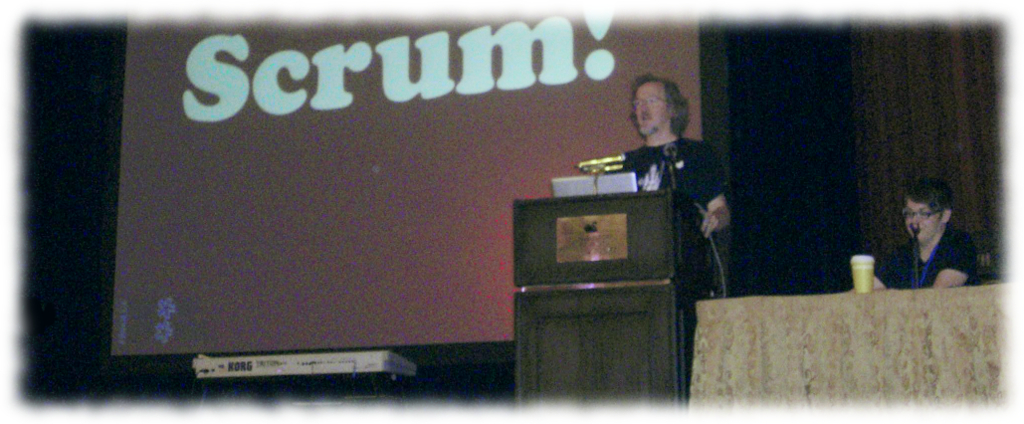
Oz at one of the viewer / open-source panels at SLCC 2010, with Esbee Linden just visible to the right


Unmasking A Cure 2017 in Second Life

Unmasking a Cure Medieval Faire

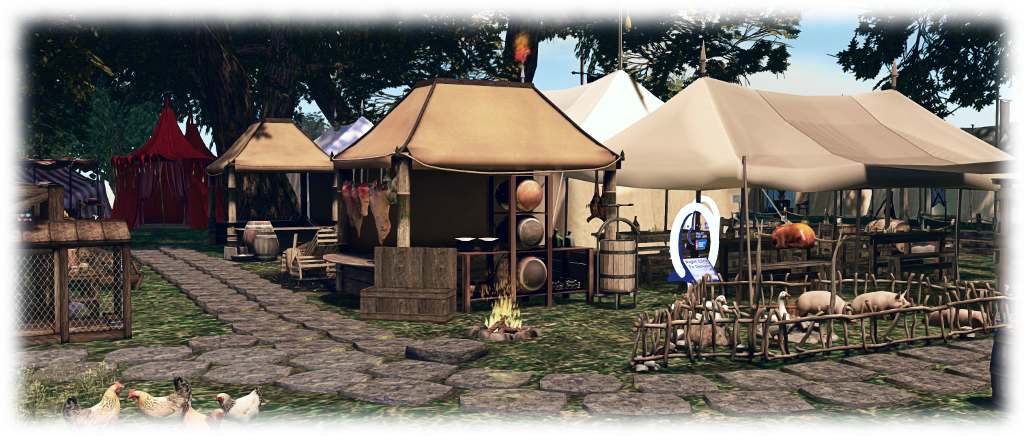
The 3rd annual Unmasking a Cure Medieval Faire  opened its gates on Friday, May 19th, and will run through until Sunday, June 18th, inclusive.  Whether you are into medieval role-play or not, the Faire is offering a host of events and activities right throughout the week, with something for just about everyone to try or enjoy – all with the aim of raising funds for RFL of SL.

Unmasking a Cure Medieval Faire

The event, organised by a dedicated team of Unmasking A Cure RFL Team volunteers, features a wide range of events and activities and a programme of entertainments. There is, for example, the 5th annual UAC Grand Joust, with eight preliminary rounds leading up to the Grand Joust on the final day of the Faire; a Trivi-a-thon on Sunday, June 10th starting at 08:00; and the 2nd annual Relay Run around the event race track on Saturday, June 25th at 19:00 SLT.

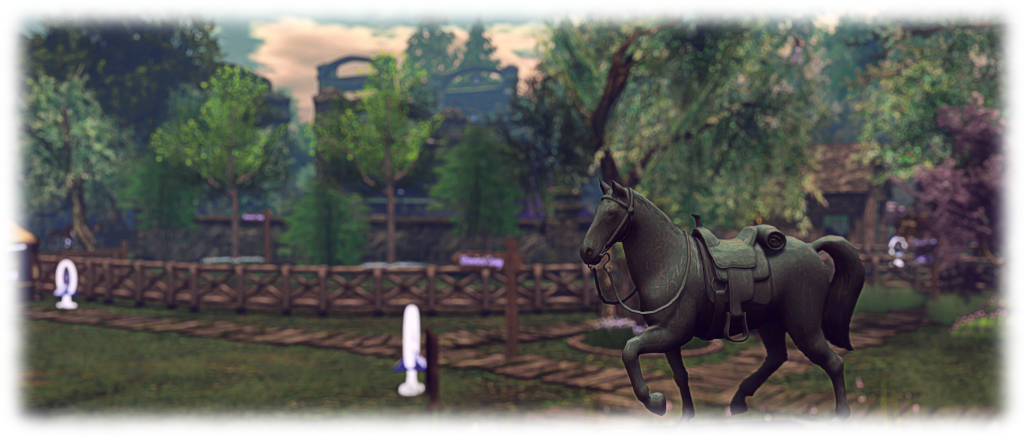
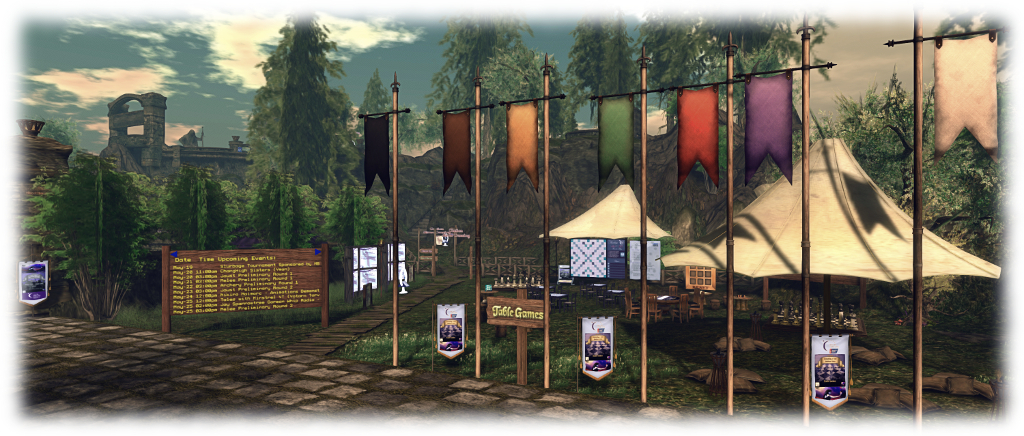
This year, the event is taking place across two regions hosting the jousting tilts, gorse racing course, the sword fighting / mêlée amphitheatre, the archery butts, gotya garden, and a traveller’s camp. Some 80 merchants are participating in this year’s event, and on the entertainment front, the ChangHigh Sisters will be performing alongside top names from the SL arena of live performers, and there will be a stable of DJs to keep folk happy throughout the month.

Unmasking a Cure Medieval Faire

The activities at the faire are open to all to try, while the merchants offer plenty of scope for shopping – including items available with proceeds to RFL of SL. Table games can also be found by those seeking quieter pursuits or a break from shopping.

Period role-plays are especially welcome, and are invited to visit the faire in character and explore the two regions. For those who would like to fully immerse themselves in the atmosphere, there is a limited number of furnished cottages and tents available for rent for L$250 a week or L$1,000 for a month, with proceeds going to RFL of SL.

For full details of the event, please refer to the Unmasking A Cure website.

Unmasking a Cure Medieval Faire

SLURL and Links

SL project updates week 20/2: Content Creation User Group w/audio

The Content Creation User Group meeting, at the Hippotropolis Camp Fire Circle (stock)

The following notes are taken from the Content Creation User Group meeting, held on  Thursday, May 18th, 2017 at 1:00pm SLT at the the Hippotropolis Camp Fire Circle. The meeting is chaired by Vir Linden, and agenda notes, etc, are available on the Content Creation User Group wiki page.

Audio extracts are provided within the text, covering the core points of the meeting. Please note, however, that comments are not necessarily presented in the chronological order in which they were discussed in the meeting. Instead, I have tried to place a number of related comments by Vir on specific topics into single audio extracts and with their associated notes, in the hope of making those topics easier to follow, and without changing the context of the comments themselves.  If you would prefer to listen to the discussion and comments in the order the meeting unfolded, I have embedded a video recorded at the meeting by Medhue Simoni. My thanks to him making it available.

Supplemental Animations

While this is now an adopted project, the focus has been on animated objects, and so there is no significant progress on this work at present.

Applying Baked Textures to Mesh Avatars

No movement on this.

Animated Objects

Vir has spent most of the week since the last meeting working on animated objects and developing prototypes and looking at proof-of-concept to see how objects might be animated using the avatar skeleton. He describes the results thus far as encouraging whilst also pointing out it is still early days with the work, so it is still far too early to determine what the final architecture will be.

The viewer already has a notion of an avatar without a human operator, which is notably seen when uploading an avatar mesh or animation. This notional avatar isn’t rendered graphically, but is oriented using transforms so that an object can use it as a source of joint motions. This is not necessarily how things will work with any finished product, but it is enough to demonstrate what might be possible.

Currently, Vir is working with single object rigged meshes, and would be happy to receive similar models, preferably with associated animation, if people have anything they believe would be useful for helping with these tests.

It is hoped that “being animated” will be an additional property which does not require a new mesh upload option, so that any rigged mesh for which you have Edit permissions for can be set to use the property  so that it can be driven by its own animations.  Currently:

  • This will likely mean the object will no longer be attachable to an avatar
  • It has yet to be determined if this property will be a new prim type or an additional field added to an existing object, etc
  • It will not require any changes to the current mesh uploader; the property to convert a mesh to an animated object can be set post upload.

A suggestion was made that the animated mesh should use its own skeleton when independently rezzed in-world, but a sub-set of a controlling avatar’s skeleton if it is attached. This would allow things like animated horses to be rezzed in-world and then sat on for riding or pets to be “picked up” and carried,  as is currently the case with some scripted animals already.

The testing carried out thus far hasn’t looked at animated attachments, although Vir appreciates the potential in having them. However, there are concerns over potential additional performance impacts, the risk of bone conflicts (what happens if your avatar is already using one or more bones some something and these same bones are used by an animated attachment).

While not ruling the potential out, Vir’s tests so far haven’t encompassed animated attachments to determine what issue might arise.  There are also other factors involved in avatar control which need to be looked at with animated objects: hover height, offsets, position, etc., all of which might affect how an animated object might be seen / behave.

Scripting / LSL Commands

The current work has not so far looked at LSL commands or command sets for the new capability. However the intent remains that scripts for controlling an animated object will be held within the inventory for that object, and able to call animations for the object also contained within the object’s inventory, so things are not straying too far from what can already be doing vis scripted control of in-world objects.

Performance Impact

Similarly, it is hard at this point to know what the likely performance hit might be. Bento has shown that adding more bones to the avatar skeleton doesn’t create a notable performance hit, so providing a skeleton for in-world objects shouldn’t cause any greater impact than a basic avatar. However, associating a rigged mesh object with than skeleton, then animating the joints, etc., will have an impact, particularly if a lot of animated objects are used in any given place.

This is something that will be looked at in greater detail once there is a project viewer available for testing alongside any server-side updates, although the Lab doesn’t intend to make it easy for a region to be spammed with multiple versions of an animated object, and this may in part be linked to the Land Impact associated with such objects.

Attachment Points on Animated Objects and Linksets with Animated Objects

While attachment points are also joints within the skeleton being used by an animated object, and so can be animated, they would not actually support having other objects attached to them, as the animated object doesn’t have links to other objects in the way an avatar does.

An animated objects could be a linkset of rigged meshes which are identified as a single object, with all of the rigged meshes referencing the same skeleton. Things might be more difficult if static mesh objects form a part of the object, as it is not clear how the positioning of these would be controlled, and more testing is required along these lines.

Body Shapes and Animation Scaling

Requests were made to allow animated objects to have body shapes (which would allow slider support, etc.), and  / or animation scaling.

Because of the changes that would be involved in both, coupled with the potential for conflicts in the case of animation scaling, Vir does not see either as being part of this work – as previously noted, assigning a body shape to an animated object would impact a number of other back-end systems (such as the baking service), adding significant overheads to the project.

As such, the Lab would rather keep the work focused, building on something that could be rolled-out relatively quickly, and then iterated upon. However, one option that might be considered is having some kind of root node scale, based on the scale of the animated object that would size the skeleton to the scale of the object, rather than vice versa, possibly by altering how the mPelvis bone is managed for such objects.

[56:37-1:02:30] The final part of the meeting delved into the relative efficiency of mesh and sculpts, and matrix maths on CPUs / GPUs, and the complexities of rendering animated objects, together with a reminder that object rendering costs are currently being re-examined.

Other Items

In-World Mesh Editing?

[41:00-55:55] Maxwell Graf raises the idea of having a simple in-world mesh editor / enhancements to the editing tools which would allow creators to adjust individual face, edge or point in an object, presenting a reason for mesh creators to spend more time in-world and which might allow non-mesh builders more flexibility in what they can do as well.

The current toolset  – mesh uploader and editing tools – would not support such a move. There are also a number of potential gotchas on a technical level which would need to be understood and dealt with, and in order for the Lab to consider such a project, any proposal would have to consider the smallest subset of capabilities available in dedicated mesh creation / editing tools like Blender and Maya that would be useful to have in-world, so that it might be possible to define the overall scope of the work required in terms of resources, etc., and what the overall return might be on the effort taken.

Based on the conversation, Max is going to try to put together a feature request / proposal, even if only for the purposes of future discussion.


Black and White Women in Second Life

Nitroglobus Roof Gallery: Black and White Women

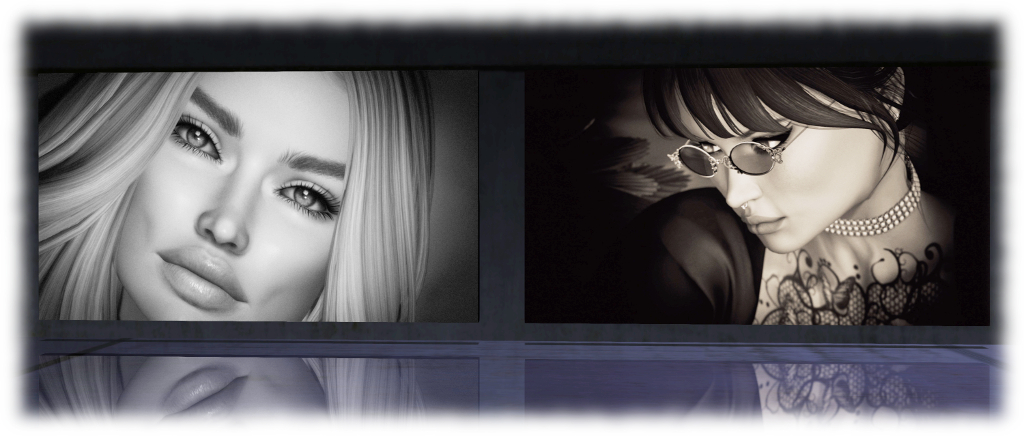
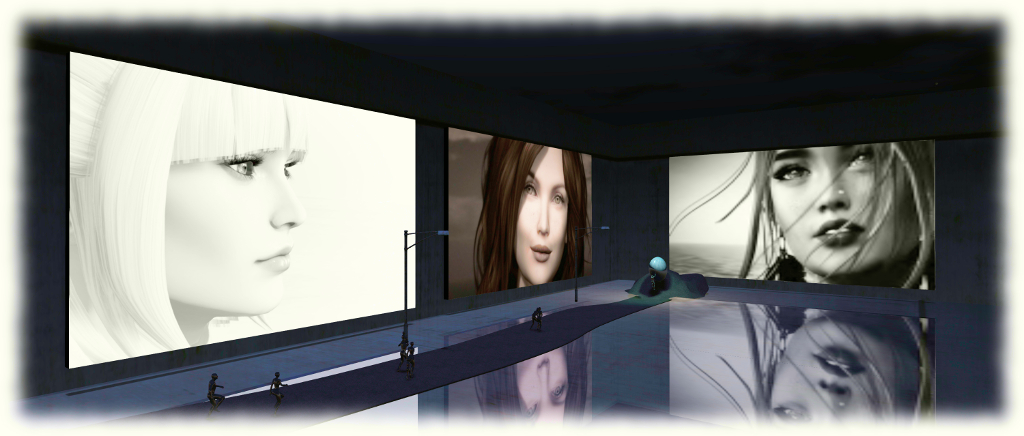
Now open at Nitroglobus Roof Gallery, curated by Dido Haas, is Black and White Women, and exhibition of photography by Christower Dae.

“Chris likes to explore, experiment, is curious and loves making pictures. Photography for Chris is immortalizing avatars in ambiguous attitudes,” Dido states in the liner notes for the exhibition. “His dedication to the avatar portraits, to the capture of those expressions that a skin can offer by giving (according to many people) a soul to the avatar and its personality begins.”

Nitroglobus Roof Gallery: Black and White Women

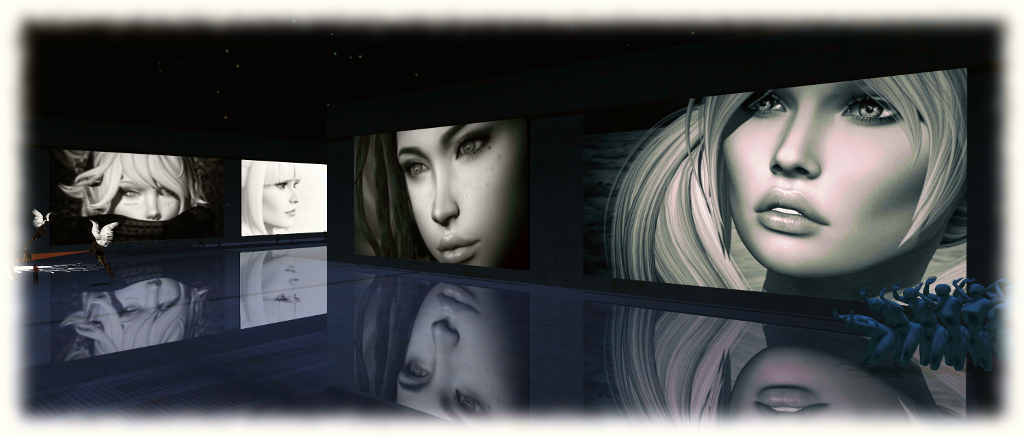
The result is a series of stunning avatar portraits presented in black and white, focusing on the female face. Presented in the familiar large format for Nitroglobus. However, these are no ordinary portraits. Each offers a considered, unique moment in time captured in the life of each subject; that all are presented in black and white services to heighten the beauty within it.

Each of the images is perfectly framed to offer a story; what that story might be is left entirely up to us: there are no visual clues within the pictures themselves; those which do offer any background do so in soft focus, ensuring attention remains on the face before us. Shown in close up, every detail of each face is presented to us: the brush of freckles across a cheek, the reflection of light within an eye, the spread of eyelashes, the fullness of lip – all are beautifully captured and rendered.

Nitroglobus Roof Gallery: Black and White Women

I’ve seen many images of avatars in Second Life, both through exhibitions and via Flickr, but Black and White Women is one of the more remarkable sets of such studies I’ve seen. The natural cast to each is – to repeat myself – genuinely unique. This is an eye-catching exhibition, one I recommend visiting.

Nitroglobus Roof Gallery: Black and White Women

SLurl Details

Second Life Maintenance RC viewer: parcel access, trash, and more

Update, May 23rd: version 5.0.5.326444 of this viewer is now the release version of the official viewer.

On Friday, May 12th, 2017, Linden Lab issued a new Maintenance release candidate viewer – now version – 5.0.5.326444 – featuring a number of bug fixes and improvements.

In particular the viewer includes updates to reflect the revised region / parcel access controls now deployed to the main grid. It also includes improvements to inventory management and purging Trash, and a range of other improvements and updates as well as numerous bug fixes.

As per usual, this is not intended to be an in-depth review of the viewer, but rather to highlight some of the new / updated features and an overview based on the release notes.

Region / Parcel Access Controls

The new region / parcel access controls are paired with a server-side update first announced in April, and the first part of which was deployed to the LeTigre server RC  channel on Wednesday, May 17th. Until these server-side updates are deployed grid-wide, this particular set of changes in the view may not function on all regions.

In short, the new controls mean that when a region holder / manager explicitly set a region for open access by visitors (via the Region / Estate floater), parcel holders on the region will no longer be able to override the setting at the parcel level and create ban lines around their parcel. They will, however, still be able to use their parcel ban list or deploy security orbs or similar (assuming the use of the latter is allowed under any covering covenant).

This means that with this viewer, both the Estate tab in the Region / Estate floater has been updated, and the behaviour of the Access tab in the About Land floater has changed.

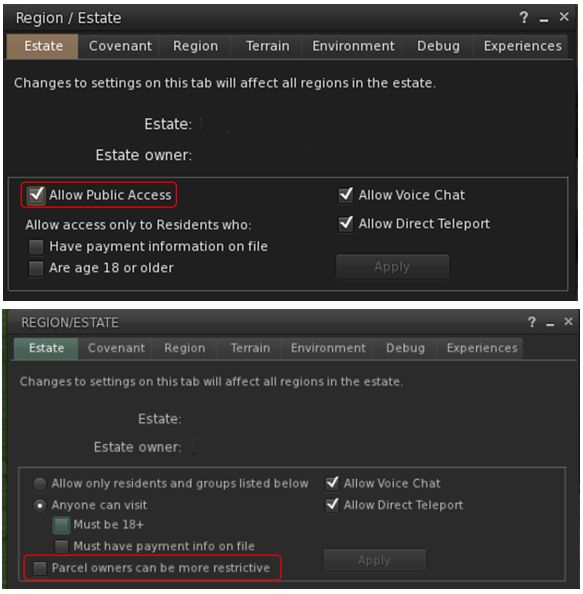
In the case of the Estate tab in the Region / Estate floater, the check box Allow Public Access has been removed, and a new option, Parcel Owners Can Be More Restrictive, has been added (see below).

With the new parcel access overrides, the old setting to Allow Public Access (top) has been replaced by a new setting, Parcel Owners Can Be More Restrictive (bottom), as found in the current Maintenance RC viewer

By default, Parcel Owners Can Be More Restrictive is checked, which means that as the updated settings are deployed server-side, parcel owners should see no difference in behaviour for their parcels unless an estate holder / manager opts to make changes at the estate level (as shown in the image above).

Should the option be unchecked, the estate holder / manager making the change will receive a model warning that they are about to make a change that could affect parcel settings in the estate.

The new modal warning estate holder / managers will see when changing the new access settings

Should they go ahead and APPLY  the change, two further things will happen:

  • Parcel owners will receive a new system notification for every parcel in the region they hold which has been affected by the change (below).
The new system notification displayed to parcel holders for every parcel in the region they hold which has been affected by a change to the region’s access settings at Estate level
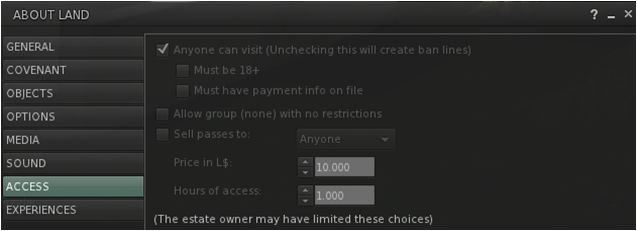
  • Any previously active banlines around affected parcel will be removed, and parcel owners will no longer be able to set parcel access restrictions via About Land > Access, as the options to do so will be greyed out (as shown below).
    When the Parcel Owners Can Be More Restrictive option is checked, the parcel-level access options in the About Land floater will be greyed out for parcel holders, preventing them from overriding the region-level access

    If a region which previously allowed parcel holders to set their own access restrictions is set to public access (by unchecking Parcel Owners Can Be More Restrictive and clicking APPLY), and then is reverted again (by checking Parcel Owners Can Be More Restrictive and clicking APPLY), all parcels on the region will revert to the access settings applied to them before any changes to region access were made at the estate level.

    Continue reading “Second Life Maintenance RC viewer: parcel access, trash, and more”

    Second Life – Ozimals closes

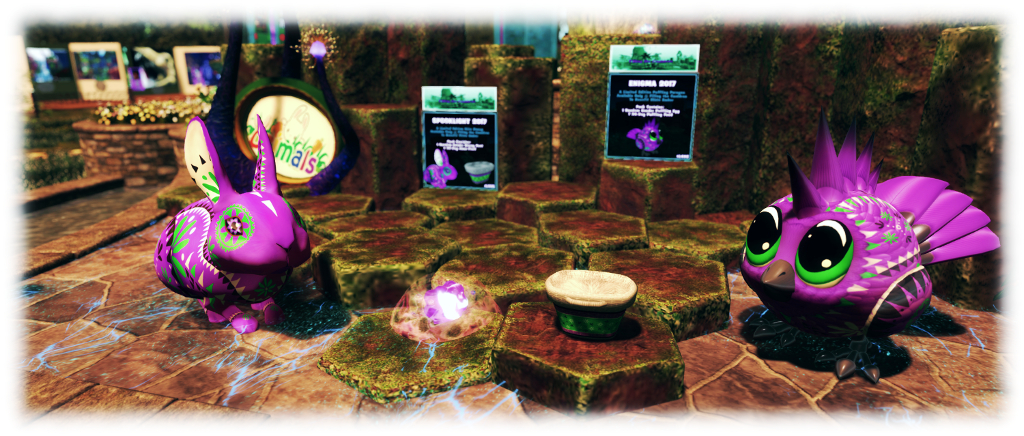
    Ozimals donated a limited edition bunny and Puffling to help raise funds during Filling the Cauldron, to help Second Life creator Elicio Ember and his family

    Update, May 18th, 2017: As per the  comment below from Neobokrug Elytis, further information pertaining to the situation has been published via Google Docs here: https://drive.google.com/file/d/0B-_7k-VigxufaTM5b18yVXpvZU0/view, offering additional information on the situation from the claimant’s perspectives.

    Update, May 17th: As per the comment below from Sue W, the Ozimal blog, including the post referred to in this article, has been cleared down.

    Sonya Marmurek indirectly brought this to my attention via an image posted to her Flickr stream: Ozimals, the brand of breedable rabbits and Pufflings is closing its doors with immediate effect.

    The cause is apparently a Cease and Desist letter forwarded to Ozimals founder Malkavyn Eldritch. No specific details of the cause of the letter have been made available. However, Malkavyn broke the news in an Ozimals blog post on Tuesday, May 16th, 2017, which reads in part:

    At 8:00 am on Monday, May 15, 2017, I received a Cease and Desist letter from legal counsel representing Edward Distelhurst and Akimeta Ltd. This letter demands that I cease all use of Ozimals intellectual property.

    I don’t personally agree with this claim, but I do not have the means to fight this in court, therefore I have no choice but to comply.

    As of the morning of Wednesday, May 17, 2017, my products and their associated games will cease to function.

    This means:

    All databases supporting the bunnies and Pufflings will be off-line.

    Support, both in-world and through the ticket portal, will cease.

    All Ozimals in-world groups will be closed.

    Pufflings will cease to function.

    Any bunny who is Everlasting will continue to function, as he or she does now: without cost.

    Any bunny who is not Everlasting will be unable to eat and will hibernate within 72 hours.

    This is not the first time Ozimals have faced a legal situation, having been involved in a lengthy dispute with Amaretto Horses which ran from late 2010 through 2013.

    Alongside her image, Sonya notes:

    If you read this before it’s too late, there’s free eternal timepieces and other goodies in the Ozimals main store to make sure you can keep your bunny pets with you even when the servers go down.

    Whatever the ups and downs or ins and outs of this situation, Ozimals have proven extremely popular across Second Life, and  Malkavyn closes his post with an apology and thanks to all those who have supported Ozimals over the years:

    It was never my intention for the time we’ve all spent with the bunnies and the Pufflings to end like this. I want to thank you from the bottom of my heart for all of the support this community has given me over the last seven years. I wish there was more I could say.