There are no scheduled deployments for week #16. The next deployment should be to the RC channels in week #17 (week commencing Monday, April 25th). This is liable to include at least one fix to help prevent simulator crashes.
SL Viewer Updates
Both of the current RC viewers were updated on Friday, April 15th.
The Maintenance RC, which includes fixes for crashes, memory leaks, input/cursor issues, graphics bugs. invisiprims, formatting, notifications and more, was updated to version 4.0.4.314012. See my notes on the invisiprim tweak here.
The Quick Graphics RC viewer, containing the new Avatar Complexity capabilities and the graphic presets support updated to version 4.0.4.313948.
Depending on the stats gathered on these versions, one of them might be updated to the de facto release viewer later in the week (although I’m guessing there may not be a promotion until week #17).
This leaves the complete list of official viewers as:
Current Release version: 4.0.3.312816 (dated March 23), April 1 – formerly the HTTP / Vixox RC viewer download page, release notes
TC viewers – as indicated above
Project viewers:
Project Bento (avatar skeleton extensions) updated to version 5.0.0.313876 on April 15 – an updated set of bones for the Bento skeleton.
Oculus Rift project viewer updated to version 3.7.18.295296 on October 13, 2015 – Oculus Rift DK2 support
Obsolete platform viewer version 3.7.28.300847 dated May 8, 2015 – provided for users on Windows XP and OS X versions below 10.7.
News is once again light at the start of the week. Expect more from the Bento and TPVD meetings at the end of the week 🙂 .
Update April 20th: Xiola has now blogged on this get-together.
Friday April 22nd marks Earth Day, when events are held all over the world in support of environmental protection.
First held in 1970, Earth Day is now marked in 193 countries around the world, and coordinated globally by the Earth Day Network. This year, Earth Day will also be marked by the formal signing of the Paris Agreement on climate change, negotiated earlier in the year, is due to be signed by 120 nations.
I’ve had my little birds flitting around Second Life, and I’ve heard from one of them that to mark Earth Day in-world, the Lab is planning another Meet the Lindens event for Friday, April 22nd.
The get-together will take place, I understand from around 10:00 through until noon SLT at the marvellous Calas Galadhon Park.
For those who haven’t visited Calas Galadhon, it is a stunning vision of the outdoors, covering 10 regions, and as such is the ideal location in which to get together with staff from the Lab (and perhaps a few Moles). I understand – although this is subject to confirmation – the main Calas landing point will be used for the meet-up.
There hasn’t been an official blog post on the meet-up as yet, but I understand that Xiola will be producing one in the near future – so keep an eye on the official blog for the latest on the meet-up. I’ll be updating this article once Xiola has posted 🙂 .
Devil’s Point is a Homestead region designed by Zakk Lusch and They Ellisson under their Ellisson brand. It was recommended as a place I should visit by friend and colleague, Mr Stavaros Gracemount (Stavaros). Given Stavaros is no slouch himself when it comes to region design (see this article for more), I knew the recommendation would be more than worth following-up.
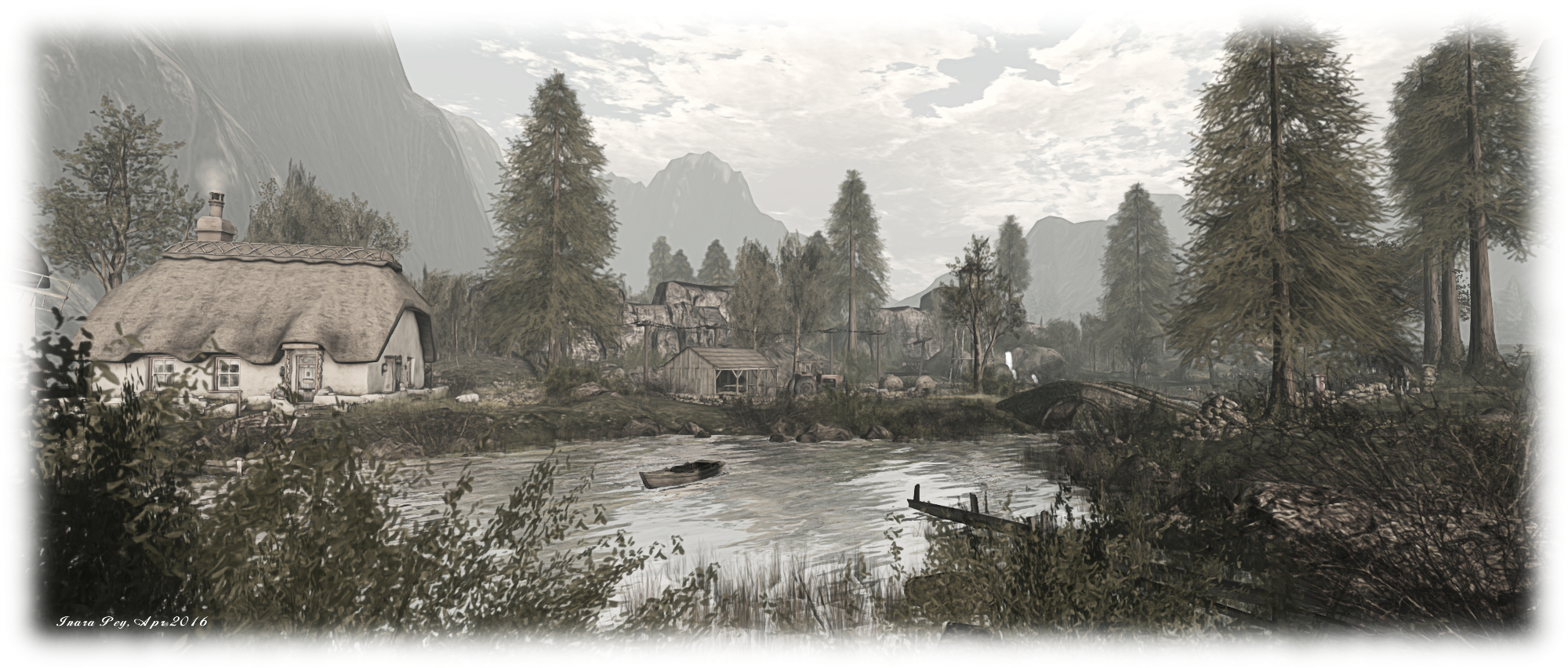
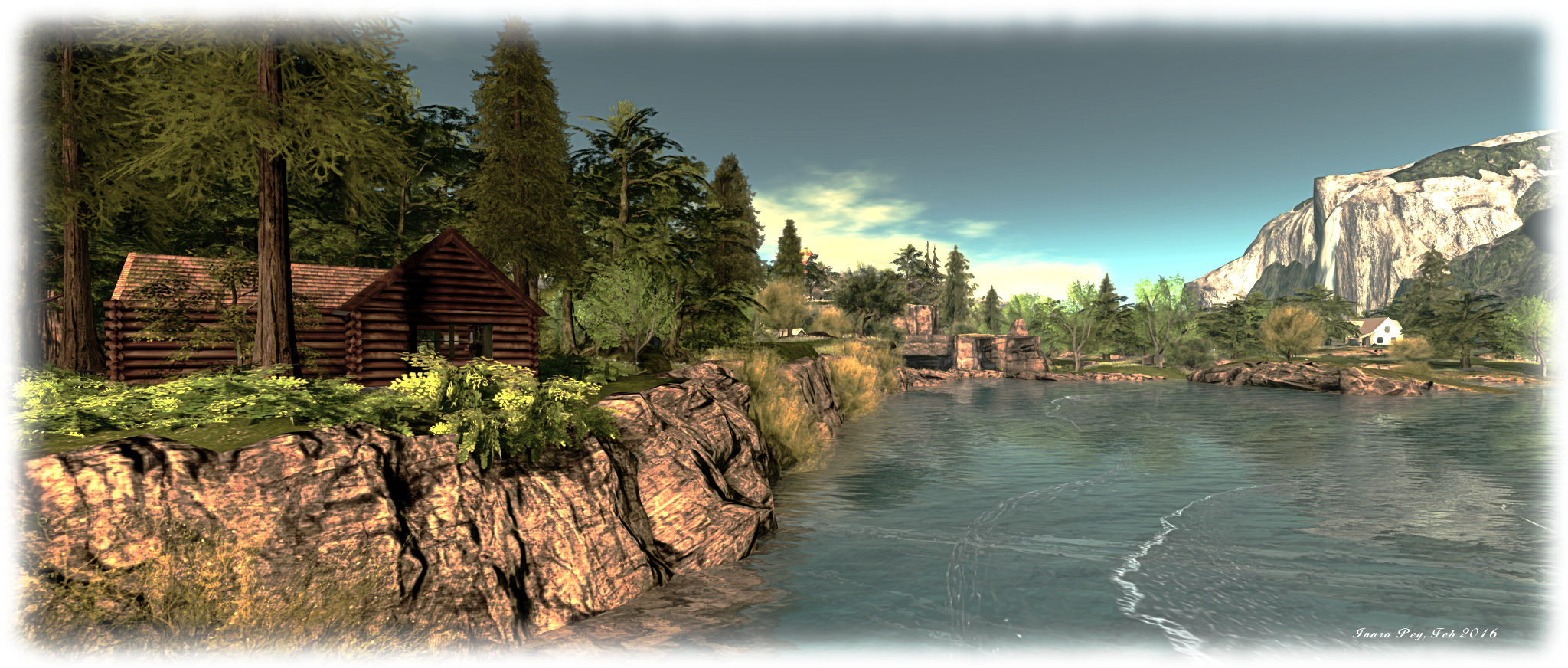
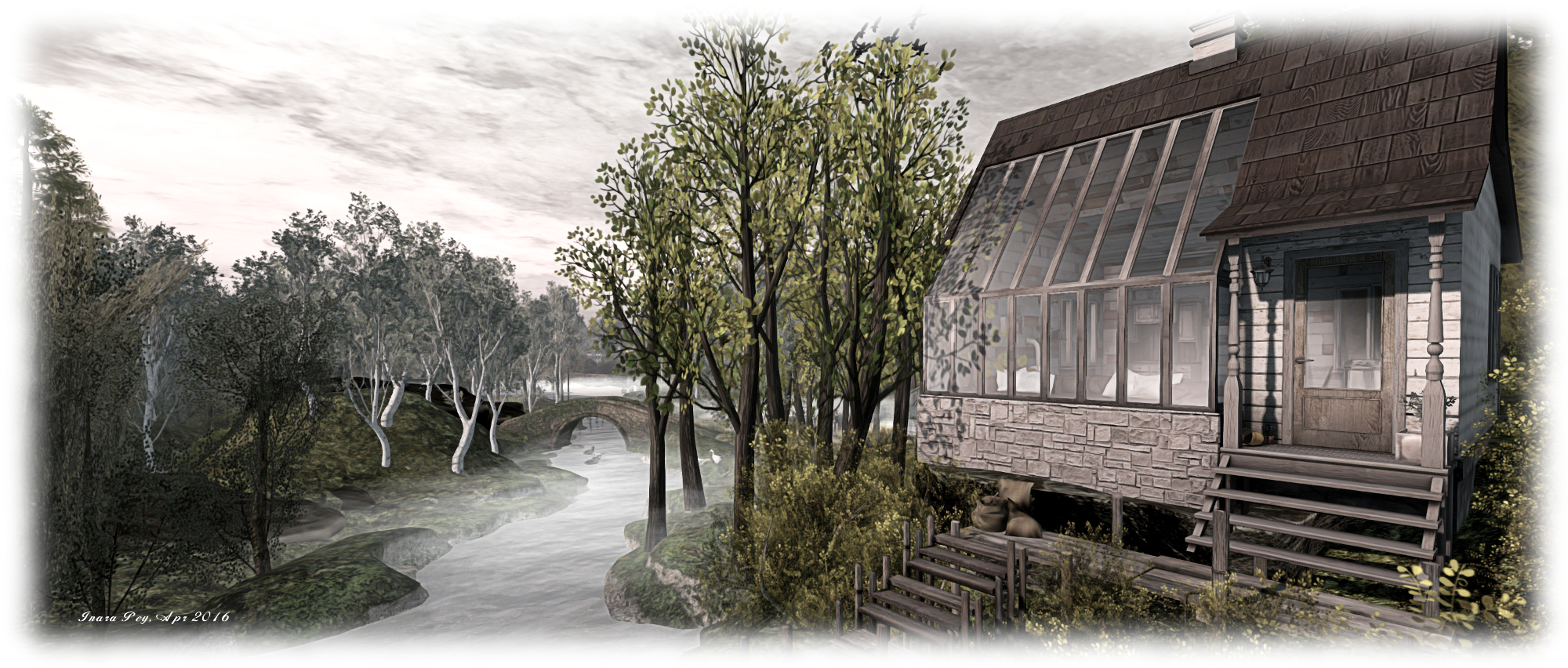
Oriented along an east-west alignment, Devil’s Point presents two rocky headlands split by the deep cut of a river. This emerges from underground close to the east side of the region before looping westward, gradually broadening between the craggy fingers of the headlands and forming a sandy cove as the ground on one side finally drops down to provide room for a house sitting on a paved terrace, a shop which is more than it seems and, behind them, a grassy knoll topped by an ancient henge.
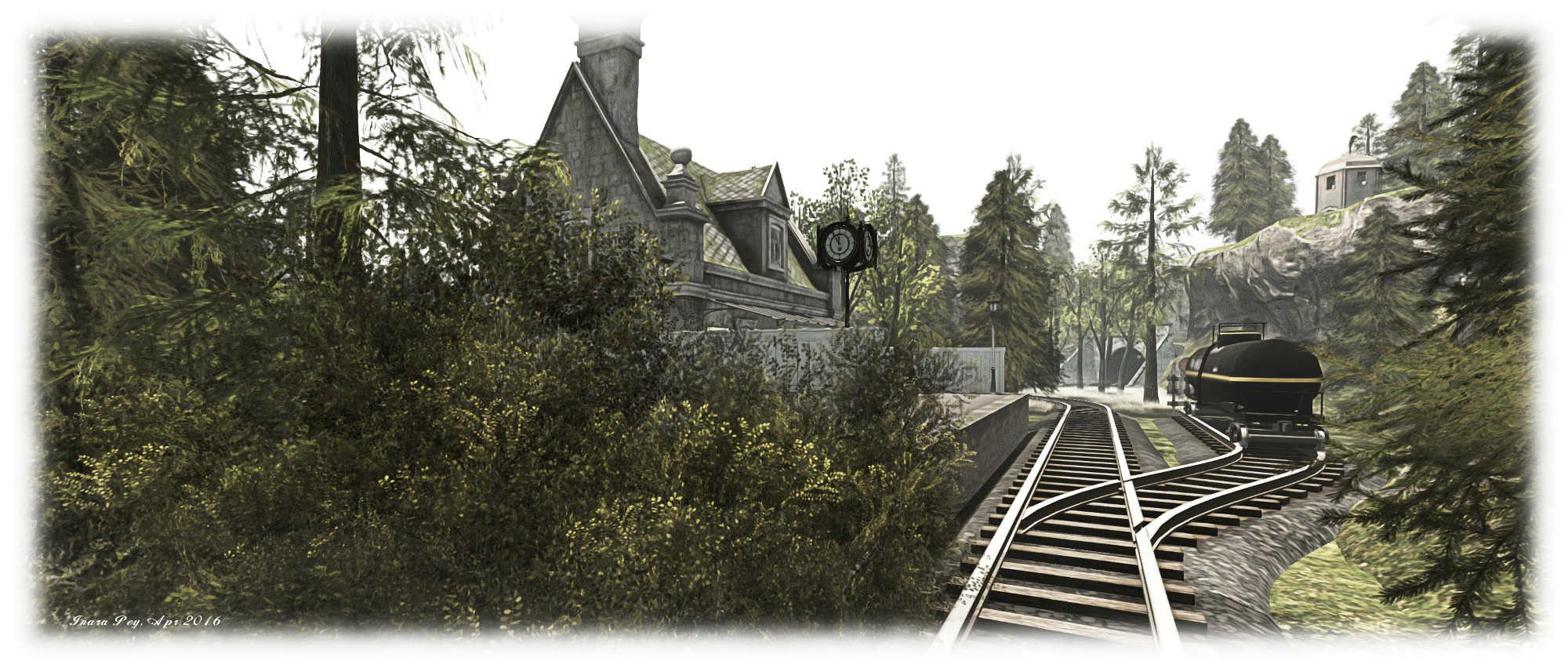
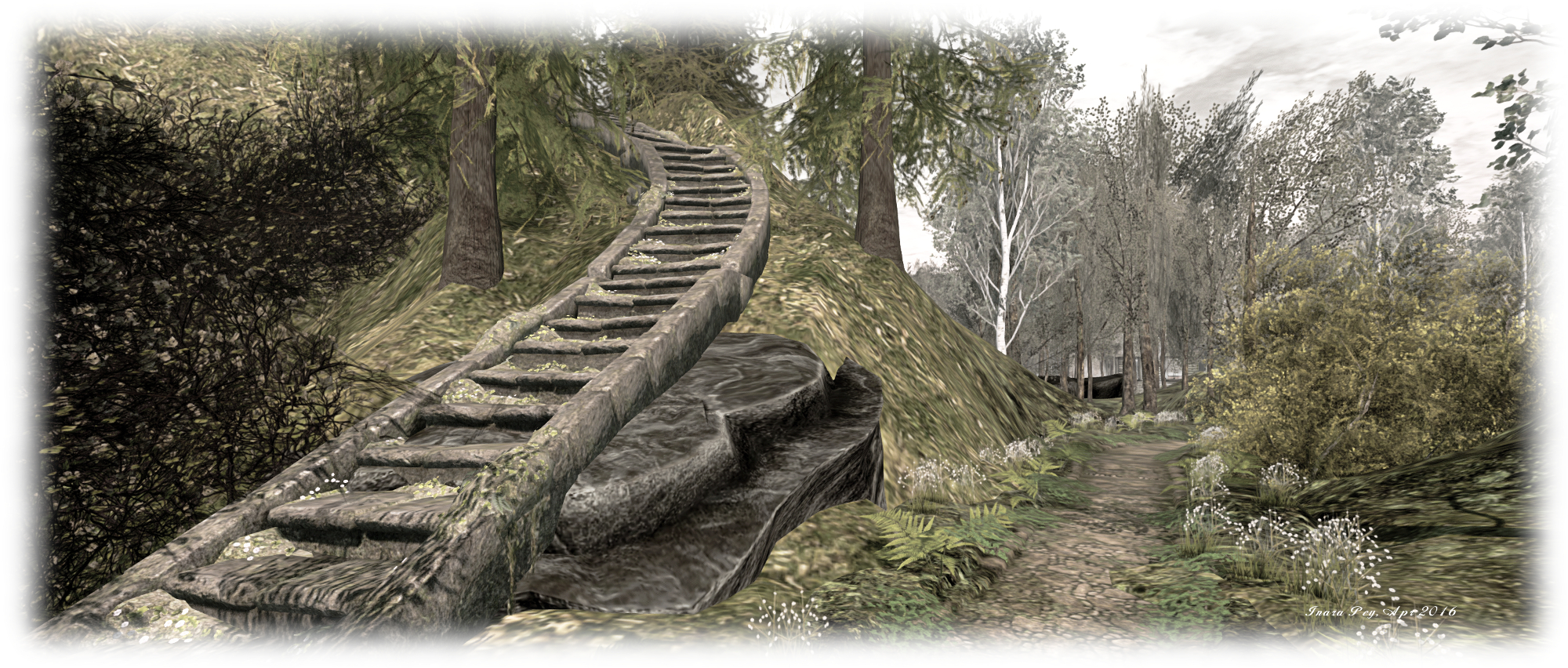
The house and shop aren’t the only buildings to be found here; several more at scattered along the valley and atop the craggy plateaus of the headlands. One of these, on the east side of the region and nestled between rocky shoulders, is a country railway station, the track snaking past it north-to-south, vanishing into tunnels on either side. Just across the river from the station sits a little cottage – although reaching it requires a walk along an old cobbled path to a little stone bridge. This will actually take you past a set of stone step leading the way up to another cottage, perched up on the rocks and which faces a windmill and two follies across the valley.
Designed to evoke a feeling of “the Old British Isles”, Devil’s Point certainly suggests it is a place perhaps sitting along the more rugged part of the Northumberland or Scottish coast. or maybe it faces out over the Atlantic from the Irish coast.
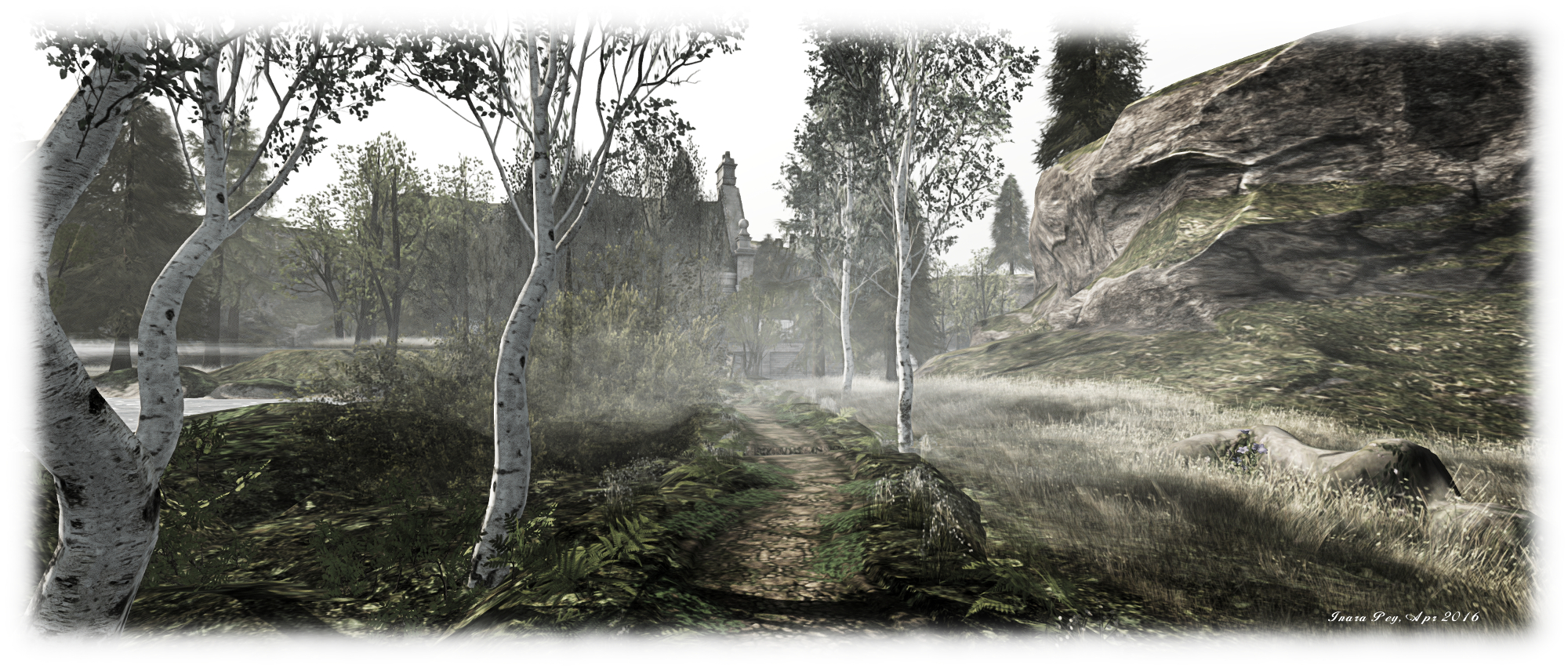
It’s also a place with a certain air of old mystery about it, perhaps mixed with a supernatural edge; an air somewhat heightened by the mist hugging the river valley. There’s the ancient henge, for example, which is mirrored by a circle of standing stone at the other end of the region, watched over by a small group of nearby deer. Down in the river valley, the tombstones in the little graveyard are carved with ancient runes, while on the other side of the river an ancient statue lies in repose amidst the grass and mist.
Which is not to suggest there is anything sinister here; Devil’s Point is mysterious, not sinister. It’s a place that invites the imagination to wander as much as the feet as you explore. Why was the old boat house down on the cove abandoned? Does the old-style thatched broom mounted above the door of the cottage near the station signify anything supernatural? And what about the robed and hood figure standing in the copse nearby, her face hidden behind a goats head mask? And what are we to make of the brewing going on a the “Apothecary’s” shop?
I’ve always enjoyed regions which offer the suggestion of stories to be discovered or created, and Devil’s Point is a place which does precisely this. It’s also a place that is very photogenic, lending itself perfectly to assorted Windlight options, this exercising both the eye and the imagination.
“This is the first sim I’ve opened,” Zakk told me as we chatted during my explorations. “and it’s great seeing playing coming and enjoying it.” Given the rugged beauty of the region, I sincerely hope it’s not the last design we see from him, and I have no hesitation in recommending at a place reads of these pages might like to visit.
This summary is published every Monday, and is a list of SL viewer / client releases (official and TPV) made during the previous week. When reading it, please note:
It is based on my Current Viewer Releases Page, a list of all Second Life viewers and clients that are in popular use (and of which I am aware), and which are recognised as adhering to the TPV Policy. This page includes comprehensive links to download pages, blog notes, release notes, etc., as well as links to any / all reviews of specific viewers / clients made within this blog
By its nature, this summary presented here will always be in arrears, please refer to the Current Viewer Release Page for more up-to-date information.
Official LL Viewers
Current Release version: 4.0.3.312816 (dated March 23) – no change
Maintenance RC viewer updated to version 4.0.4.314012 on April 15th – fixes for viewer crashes, memory leaks, input/cursor issues, graphics bugs, invisiprims, formatting and notifications (download and release notes)
Quick Graphics RC viewer updated to version 4.0.4.313948 on April 15th – comprises the graphics presets capability and the new Avatar Complexity settings (download and release notes)
Project viewers:
Project Bento (avatar skeleton extensions) updated to version 5.0.0.313876 on April 15 – (download and release notes)
Euorpa’s icy, mineral-stained surface as imaged by NASA’s Galileo mission – see below (credit: NASA / JPL)
In my last Space Sunday article, I covered the arrival of the BEAM inflatable module at the International Space Station, and the concerns for NASA’s Kepler “planet hunter” space observatory. As there’s been further news on both of these, I thought I’d start this Space Sunday with a quick round-up on them, starting with Kepler.
The Kepler observatory, located some 121 million kilometres (75 million miles) “behind” Earth as both orbit the Sun, has been engaged in a 7-year mission to try to locate planets – particularly possible Earth-type planets – orbiting other stars. As I reported last time around, despite one major setback which called a halt to the observatory’s primary mission in 2012, Kepler has been a remarkably successful mission, catalogue some 4,000 potential planets orbiting other suns, with over 1,000 subsequently confirmed as planets.
However, on April 7th, Kepler reported to mission managers that it has entered Emergency Mode – a status indicating a critical problem has occurred, causing the observatory to shut down all science operations and other systems, and was utilising its supplies of valuable propellant to maintain its orientation so it could communicate with Earth, rather than using its electric reaction wheels, powered by sunlight.
Keler 425b – the first Earth-like planet to be found orbiting within its sun’s habitable zone (credit: NASA)
Over the next several days, mission engineers were able to upload instructions to Kepler so that it could position itself in a “point rest state” where communications could be maintained without eating into further propellant reserves. Following this, a long, slow data download commenced, which allowed engineers to fully understand the extent of the problem – but not the cause. However, this has been enough for a path to recovery to be determined.
Kpler: being nursed back to health from 121 million km away (credit: NASA)
Since April 12th, commands have been sent to the observatory instructing it to bring it non-critical systems back on-line one at a time, monitoring responses as it did so. With each system successfully restored, Kepler has been gradually coming to life whilst eliminating potential causes of the original problem. There is still a way to go, but mission managers are now reasonably confident Kepler can be restored to a fully operational status.
“The recovery started slowly and carefully, as we initially merely tried to understand the situation and recover the systems least likely to have been the cause,” said Kepler programme manager Charlie Sobeck on April 14th. “Over the last day and a half, we’ve begun to turn the corner, by powering on more suspect components. With just one more to go, I expect that we will soon be on the home stretch and picking up speed towards returning to normal science operations.”
Meanwhile, BEAM – the Bigelow Expandable Activity Module – an inflatable prototype habitat module which arrived at the International Space Station on April 10th – was extracted from its ferry vehicle, the uncrewed Dragon resupply vehicle, on Saturday April 16th, and successfully secured against the airlock node of one of the station’s modules.
the extraction and relocation were undertaken remotely, using the space station’s robot arm commanded from Earth to lift the BEAM unit, still in its compact “flight” configuration just 2.4 metres (8ft) in length and 2.1 metres (7ft) diameter, from the unpressurised section of the Dragon cargo vehicle and then position it against the US Tranquillity Module of the space station, where it was secured by astronauts Tim Kopra and Jeff Williams.
Space station commander Tim Kopra took this photograph of the BEAM unit, in its compact state, being moved towards the Tranquillity module (seen on the left, directly under the robot arm) by the station’s robot arm, ready for it to be secured against one of the station’s airlocks (credit: NASA / Tim Kopra)
The module is not due to be inflated until early May, when it will increase in size to some 4m x 3.5m (13ft x 10.5ft) and provide some 16 cubic metres (565 cubic ft) of working space. It will be equipped with monitoring equipment to investigate how well it protects against solar radiation, space debris and contamination over a 12-18 month period. During this time, ISS crew members will enter the unit 3 or 4 times a year to collect deployment dynamics sensor data, perform microbial surface sampling, conduct periodic change-out of the radiation area monitors, and inspect the general condition of the module.
Animation showing the manoeuvre to position BEAM against the Tranquillity module
In May 2015, I wrote about the Lab’s work in adding Experience keys to their Learning Islands, the first in-world destination for new users joining Second Life through the Lab’s sign-up process. At the time, Peter Gray, the Lab’s Director of Global Communications, indicated the approach was one of a number the Lab were experimenting with, while subsequent to the article, Ebbe Altberg indicated that Lab was continuing with A/B testing of various approaches to getting new users started in Second Life.
Thanks to a nudge from Cube Republic, I’ve had the opportunity of trying-out one of the more recent aspects of this work, by paying a visit to one of a set of four Social Islands, which form the second stop incoming users make on their initial journey in-world, and which have been both redesigned by the Lab and which now also use Experience Keys to help new users gain greater familiarity with using Second Life.
The new Social Islands offer something of a Graeco-Roman feel (top image), presenting a number of circular structures linked by broad stairways and paths, sitting within a rocky island landscape. On arrival, newcomers receive a HUD which attaches to the to left of their screen before stepping through a set of welcoming messages to get them started in their explorations.
The initial HUD messages (click for full size)
The HUD has a number of easy-to-understand icons (? = help; speaker icon = toggle HUD sounds on / off; – = minimise the HUD; Next Step = click to page through instructions, where relevant), and updates with messages and instructions as the user explores the island.
Central to the islands is a pavilion, where information boards provide basic help and support, and which provides access to the various activities on the island. The first of these can be accessed directly from the pavilion, and present users with the opportunity to practice using their camera, find out about building in Second Life and also learn about buying goods in-world and via the Marketplace.
The central pavilion in the new Social Islands includes information boards and – for those who have been involved in SL for a long time, the return of a familiar character from the days of the old Orientation Islands (right)
Stairs leading down to the ground level from the pavilion provide access to further activities, such as learning to interact with in-world objects at a beach bar or by using swings in an orchard, or learning the basics of vehicle driving by steering a boat through a course set over shark-infested water (swimming very inadvisable!), and so on.
As the HUD indicates, completion of the various tasks earns the user Linden Dollars. These are not added to the avatar’s account balance, but are indicated by a second HUD, which is attached as soon as the L$ start being earned. The balance obtained can then be used in the island’s shop to buy clothing, shoes, hair, and skins and shapes as means of introducing people to the concept of buying goods in Second Life.
The Advanced Camera Movement challenge: use the camera control to move around the tower, touching and illuminating the red squares
A further section of the activities area offers a basic overview to in-world building, complete with a video overview courtesy of Magellan Linden and a couple of interactive elements. As an aside, I have to admit to being slightly bemused that a certain British Tabloid and a former south London community newspaper are featured in one of the demonstrations, simply because it was so unexpected.
The final part of the island is the portal area providing onward access to the rest of Second Life. This follows pretty much the same format as other versions of the Social island: a set of portals defined by category – art, role-play, popular places, editor’s picks from the Destination Guide, the Portal Parks, music and adult – which will deliver a user selecting one of them to one of several potential destinations. The portals are presented via a video providing more information on exploring SL, and users approaching them are presented with / advised to take a Landmark for the island so they can find their way back, if needed.
The new Social Islands include the same portal idea by which newcomers can continue their explorations of Second Life, but with some improvements over earlier versions




 Inara Pey: Living in a Modemworld