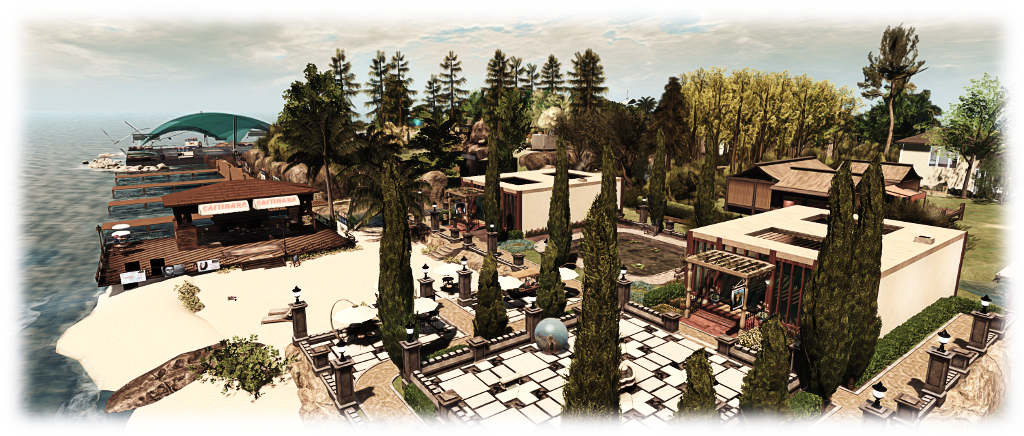
Holly Kai Park: the revised garden area with two studio, terrace and beach – click any image for full size
It’s now seven months since I took over as curator for the Art at the Park series at Holly Kai Park and generally looking after things there alongside Estate owner Nber Medici and park owner, Hollykai Resident.
Prior to opening our first exhibitions at the end of 2015, I worked on making some changes at the park. At the time, I didn’t want to make too many changes, because a lot of time and effort had been put into redeveloping the park in the first place.
Holly Kai Park: the art hill will be given a slight re-working in the near future to improve facilities
However, running six events at Holly Kai – particularly three large ensemble exhibitions – convinced me of two things. The first was that I simply don’t have the bandwidth to manage two series of art exhibitions with roughly monthly openings each. The second was that the park could do with some changes and swap-outs just to reduced the rendering load being placed on people’s viewers.
So, for the last few days, we’ve been engaged in revamping things. The work is still in progress, and due to the nature of some of the changes, won’t be finished for a while yet. For one thing, we have an exhibition running at the moment, and have no wish to disrupt that. However, a lot of the core changes have now been made.
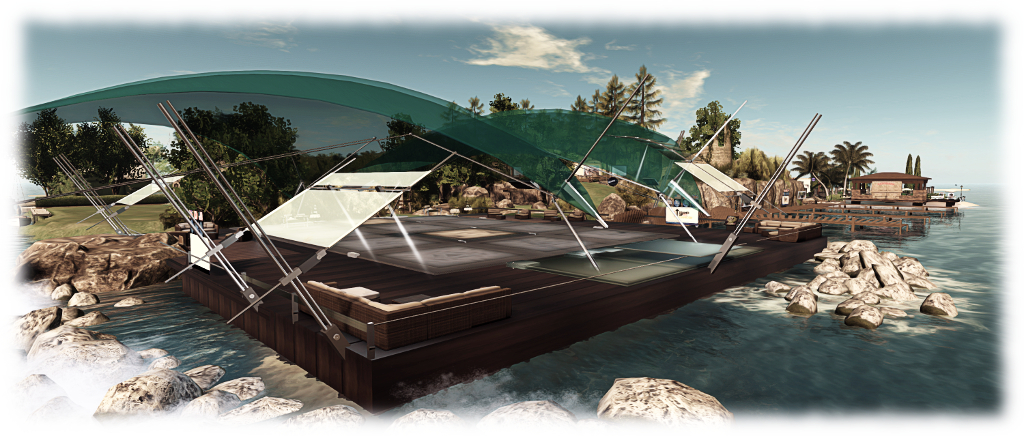
Holly Kai Park: the Pavilion has moved to the south-east corner of the region
In summary:
The Pavilion, Holly Kai Park’s live event venue, has been relocated to the south-west corner of the region, where it overlooks largely open water
Holly Kai Garden now serves two functions: it is the location for the studio and terrace of our new Artist-in-Residence, Silas Merlin, whom I am delighted to say will be joining us in due course. His studio now sits alongside mine, with an outdoor terrace display area facing it
Caitinara Bar has relocated to the Garden area, which now has its own beach front.
Holly Kai Park: the relocated Caitinara Bar on the new beach
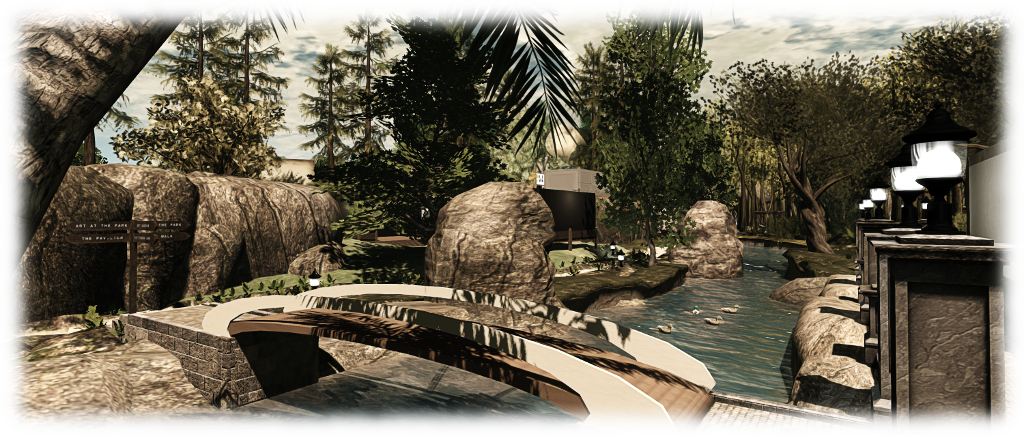
The Pavilion, Caitinara Bar and the garden all have their own landing points, and both the garden and the Pavilion are linked to the main landing point via bridges. Quite a lot of the high render cost foliage and trees have been replaced with items which are hopefully less of a burden on systems, while some of the park paths have been reworked to make them easier to follow.
Those those who enjoy sailing in the area, the west side beach is still available for moorings – 60 minutes loiter time with re-rez at the slips.
The Holly Kai River now completely surrounds the art hill in the park
There’s still some more work to be done around the art hill, but for now, the changes described here are all in place and ready for people to visit, We hope you like the updates, and look forward to see you at Holly Kai Park soon.
Update, June 3rd: the auditions will be held on Friday, June 3rd at Enter Bay City, between 12:00 noon and 14:00 SLT, and again on Saturday, June 4th 18:00 to 20:00 SLT at the same location.
While the traditional Second Life Birthday celebrations are now pretty much coordinated and run by the community – hence the title Second Life Birthday Community Celebrations, the Lab has a track record of sharing in the celebratory mood around the time of SL’s anniversary through various promotions, gifts, and so on, often as an overall part of the community celebrations.
In 2015, the Lab held an Anniversary Music Festival, for example (and among other events) – and they’re doing the same again in 2016, as Xiola Linden has blogged:
Last year’s auditions turned out to be an incredible showcase of some of the diverse musical talent in Second Life. It was its own mini-musical-fest – with nearly 50 musicians pulling out all the stops in front of the Second Life music community. This bite-sized showcase led to the final line up for Music Fest. It’s definitely worth reading this audition day wrap up from musician and Second Life Resident Zak Claxton on his blog from May of last year.
This year, once again we’re hoping to draw out all you guitarists, bassists, drummers, singers, tambourine shakers and other music makers to come audition for the festival. All genres are welcome! From bands to solo acts, opera to rock and roll – we encourage anyone to sign up for consideration. The Second Life Music Fest is an opportunity to perform at one of the biggest celebrations in Second Life, and it’s a paid gig!
ast year, the Music Fest was held during the SL12B Community Celebrations at the SL12B Ixtlan Stage, designed by Cube Republic
Those interested in taking part are invited to complete the audition application form – and to do so no later than Thursday, May 26th. The blog post notes that completion of the application does not signify a commitment on the part of the artist to take part, nor a guarantee they’ll be called upon to audition before a panel of judges comprising Lab personnel and residents.
Musicians who are selected to audition will receive word directly from the Lab via e-mail. Those successful in their 5-minute audition, as judged by a panel of Lab staff and residents, will be invited to perform a 30-minute set at the Second Life Music Fest, and (subject to the Lab’s terms and conditions) receive payment for doing so.
The auditions themselves will be on the following dates and times:
Friday, June 3rd 12:00 noon to 14:00 SLT
Saturday, June 4th 18:00 to 20:00 SLT
The venue for the auditions is currently TBA, and I’ll post news & update this post once the location as been announced.
So, if this sounds like it might be your kind of gig as a musician – follow the links and apply.
This summary is published every Monday, and is a list of SL viewer / client releases (official and TPV) made during the previous week. When reading it, please note:
It is based on my Current Viewer Releases Page, a list of all Second Life viewers and clients that are in popular use (and of which I am aware), and which are recognised as adhering to the TPV Policy. This page includes comprehensive links to download pages, blog notes, release notes, etc., as well as links to any / all reviews of specific viewers / clients made within this blog
By its nature, this summary presented here will always be in arrears, please refer to the Current Viewer Release Page for more up-to-date information.
Official LL Viewers
Current Release version: 4.0.4.314579 (dated April 28) – no change (download, release notes)
Quick Graphics RC viewer updated to version 4.0.5.315117 on May 11th – comprises the graphics pre-sets capability and the new Avatar Complexity settings (download and release notes).
We’re all by now familiar with the situation in Alberta, Canada, where a wildfire broke out on April 30th, 2016. By Wednesday, May 11th, and still out of control, it covered an estimated 241,000 hectares (930.5 square miles).
As the firs spread during the first weeks of May, so it engulfed the city of Fort McMurray, forcing the evacuation of almost 90,000 people.
Many of those affected by the fire have lost everything: homes, jobs, the basic necessities of life, and are having to be placed in temporary accommodation and shelters, prompting the Canadian Red Cross to launch the Alberta Fires Appeal.
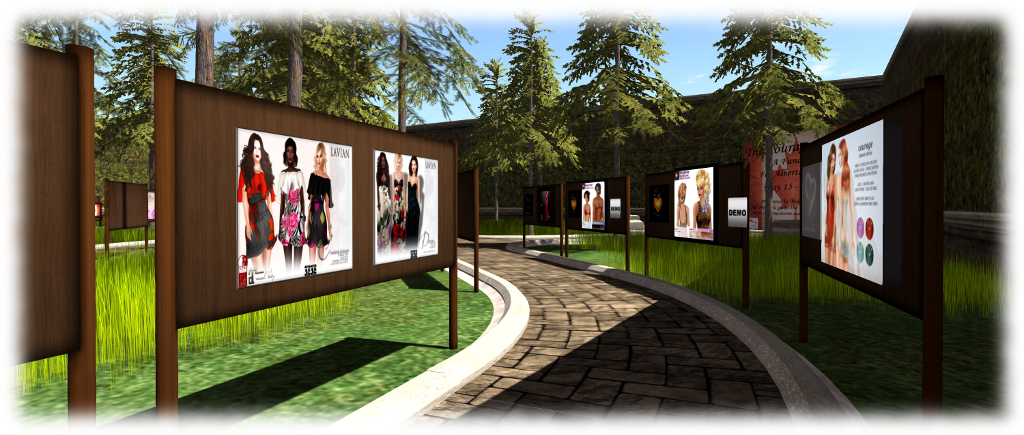
Within Second Life, and in response to a plea from a Second Life resident directly affected by this tragedy, Models Giving Back have launched The Courage Event. Between May 15th and the end of the month, 38 designers are providing over 50 exclusive items that will not be sold again, with proceeds from the sales going to the Canadian Red Cross and the Alberta Fires Appeal.
The funds raised will be donated in two lots; the first halfway through the event, in order to obtain the matching funds the Canadian Government is providing, and then the second donation will be made at the close of the event. Totals and donation receipts from the Canadian Red Cross will be posted on the Models Giving Back Revamped website, and on the Models Giving Back Facebook page.
The Courage Event. organised by Models Giving Back, runs from May 15th through to May 31st, with 38 designers offering over 50 exclusive, never to be re-sold items to raise money for the Canadian Red Cross Alberta Fires Appeal
In addition to the exclusive goods available at The Courage Event, visitors are able to donate directly to the Canadian Red cross via the Kiosks found throughout the event area, or by visiting the Alberta Fires Appeal website.
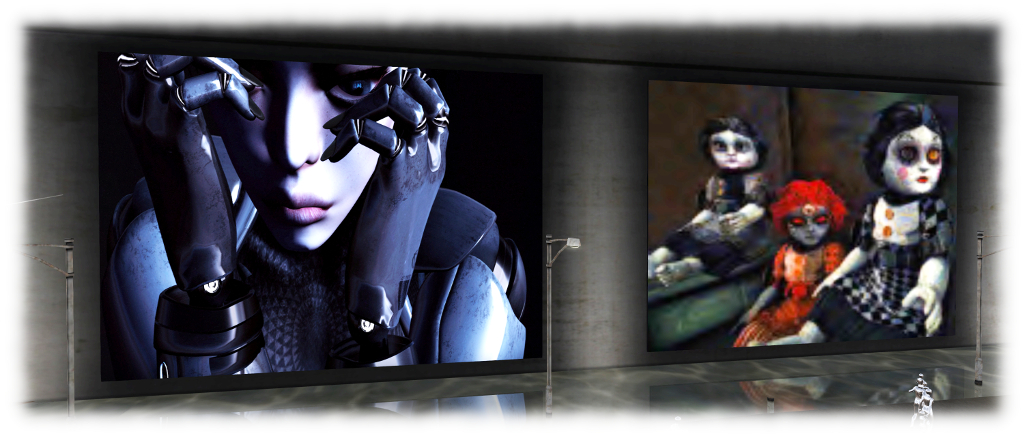
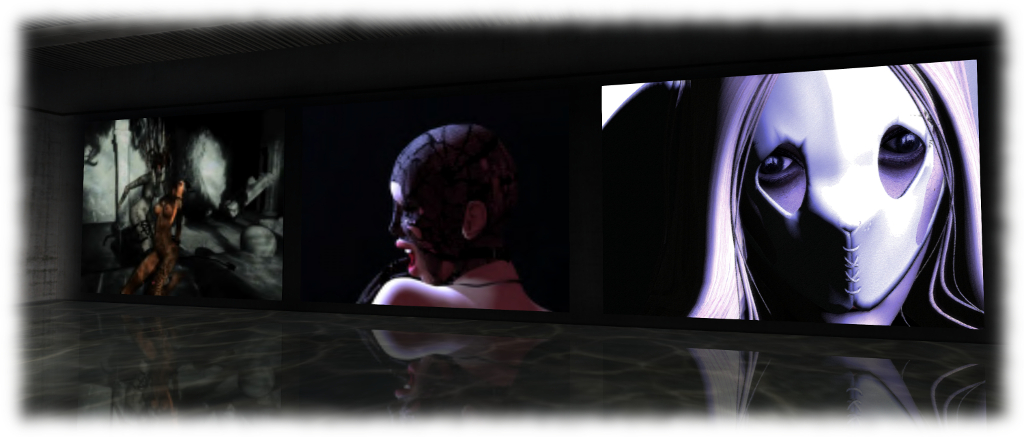
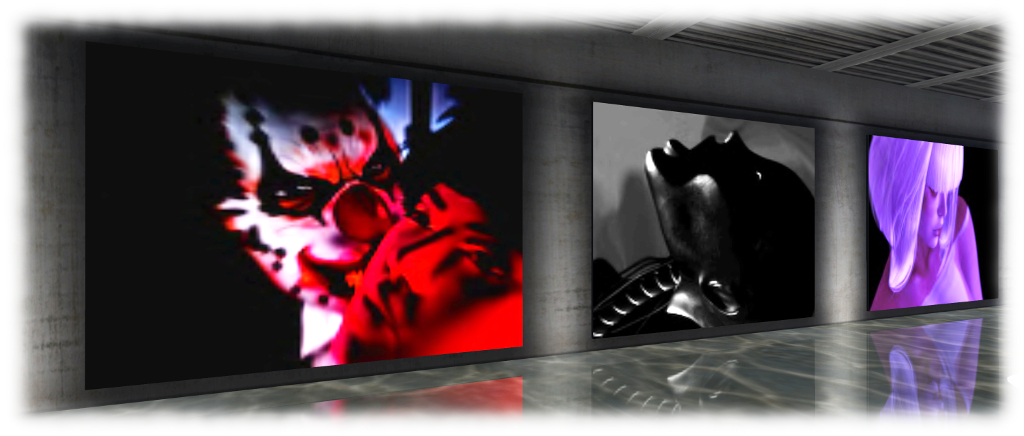
Currently open at Nitroglobus Hall, curated by Dido Haas, is Postcards from the Subconscious, a series of 15 images by Maloe Vansant and Burk Bode. Offered in the familiar large format seen at Nitroglobus, the pictures have a distinctly dark edge to them, which is not entirely what the artists intended.
“This exhibition is like a child. It was planned friendly and glamorous,” Maloe and Burk say of the works on display. “But as always our unconsciousness send us postcards. Feelings like bubbles coming up that told us we had to make just this picture and no other.”
The result is a series of images which, if not the stuff of nightmares, are certainly the kind thing which might creep into our dreams at three o’clock in the morning to poke at us as we sleep. At the same time, some of them provoke an entirely different response.
Take, for example, Ha Ha Said the Clown and The Dolls, both by Burk Bode. Here we have the embodiment of the hidden menace some of us see within a clown’s make-up, or the suggestion of possession contained within some gaudily painted dolls. At the same time, and while their titles might carry a hint of darkness, we have Maloe’s Crooked and Who’sThat Voice Inside My Head? Two pieces which seem to present a more contemplative frame of mood, largely free of menace, prompting a similar response in the eyes of their beholder.
All of this adds up to a fascinating exhibit, even if the artists feel it’s not entirely what they originally had in mind. “At the end our child is not what we planned it to be,” they note. “It became somebody dark and nasty. Looking at us like a misbehaving child and telling us: ‘I don’t like you’.”
Be that as it may, it is hard for parents not to love their children, however they turn out, as Burk and Maloe admit in their introduction to the exhibition. It’s also very hard not to be captivated and drawn into these images, Dark might be the subject matter, but the artistry is beautifully evocative and marvellously executed. Open through until June.
A revised infographic of the six largest dwarf planets, showing 2007 OR10’s revised 3rd place
While opinions may be in a state of flux over what constitutes a dwarf planet – the recent discoveries around Pluto’s interaction with the solar wind once again highlighting the debate, the fact remains that there are a fair few to be found in the solar system, with the largest five, as traditionally listed in descending order of volume, being: Pluto, Eris, Haumea, Makemake and … 2007 OR10.
These worlds are so small and so far away – in relative terms – that gathering data on them without actually paying them a visit, as we’ve done with Pluto, isn’t easy. In the case of 2007 OR10, this lack of information means it has been left without a name, only a designation related to its year of discovery.
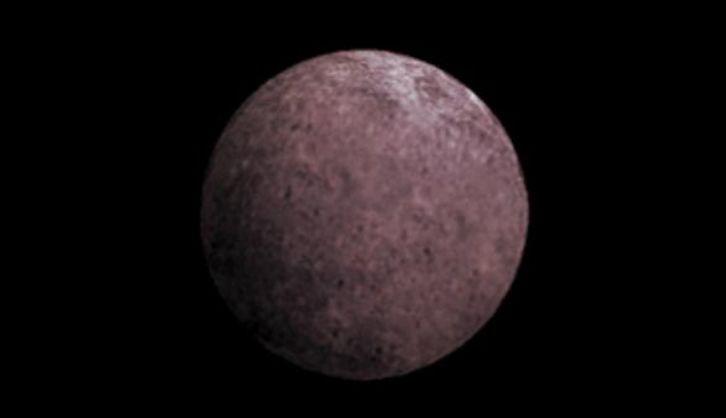
An artist’s conception of 2007 OR10. Astronomers suspect that its rosy color is due to the presence of irradiated methane. Credit: NASA
However, all this might now be changing after data gathered by the Kepler observatory (about which I’ve written in recent Space Sunday reports) has helped reveal the dwarf planet – which orbits the Sun once every 547.5 years – is actually the third largest such body beyond the orbit of Neptune, sitting behind Pluto and Eris, and thus it could be a lot more interesting than first thought.
Up until now, it had been thought 2007 OR10 was about 1280 km (795 mi) in diameter. However, such is the sensitivity of Kepler’s instruments in measuring light variations whilst seeking extra-solar planets orbiting nearby stars, that the observatory has been able to precisely measure variations in the brightness of this unusually dark little world. These measurements, combined with data obtained from the Herschel Space Observatory, suggest that 2007 OR10 is around 1535 km (955 mi) in diameter, or about 255 km (160 mi) larger than previously thought.
The upshot of this is the dwarf planet is liable to be a far more interesting place than previously thought, potentially covered in volatile ices of methane, carbon monoxide and nitrogen, and may even be somewhat active as a result of its interaction with the solar wind. It also means that it is really overdue for a decent name.
According to convention, the honour of naming it goes to the planet’s discoverers, in this case Meg Schwamb, Mike Brown and David Rabinowitz. They discovered it in 2007 during a search for distant bodies in the Solar System. In fact, Mike Brown has already suggested a name: Snow White, in recognition of the planet’s ice surface composition.
However, this hasn’t stopped suggestions rolling in from the general public – up to and including, “Dwarfy McDwarfface”, in recognition of the recent public voting on the name for the UK’s new polar research ship.
I have to admit that – and indifference to Mike Brown’s suggestion, which doesn’t take into account 2007 OR10’s likely rusty complexion – my personal favourite suggestion has to be that from Greenwood Space Travel Supply Co (shown above right), which puts forward a very strong case for the name of this little world. I’m also wearing my Dwarf Planet Pride Day badge with … pride!
Two Years of Weather Reporting on Mars
NASA’s Curiosity rover has completed its second year on Mars – its second Martian year, that is; August 2016 will actually mark the end of its fourth Earth year of operations in Gale Crater. This milestone is important, as it means that the rover has been able to accumulate data on two full cycles of Martian seasons and weather.
Gathering data over so long a period helps distinguish seasonal effects from sporadic events. For example, a large spike in methane in the local atmosphere during the first southern-hemisphere autumn in Gale Crater was not repeated the second autumn; it was an episodic release, albeit still unexplained. However, the rover’s measurements do suggest that much subtler changes in the background methane concentration may follow a seasonal pattern; while measurements of temperature, pressure, ultraviolet light reaching the surface and the scant water vapour in the air at Gale Crater show strong, repeated seasonal changes.
Monitoring the modern atmosphere, weather and climate fulfils a MSL mission goal, supplementing the better-known investigations of conditions billions of years ago. Back then, Gale Crater had lakes and groundwater that could have been good habitats for microbes, if Mars has ever had any. Today, though dry and much less hospitable, environmental factors are still dynamic.
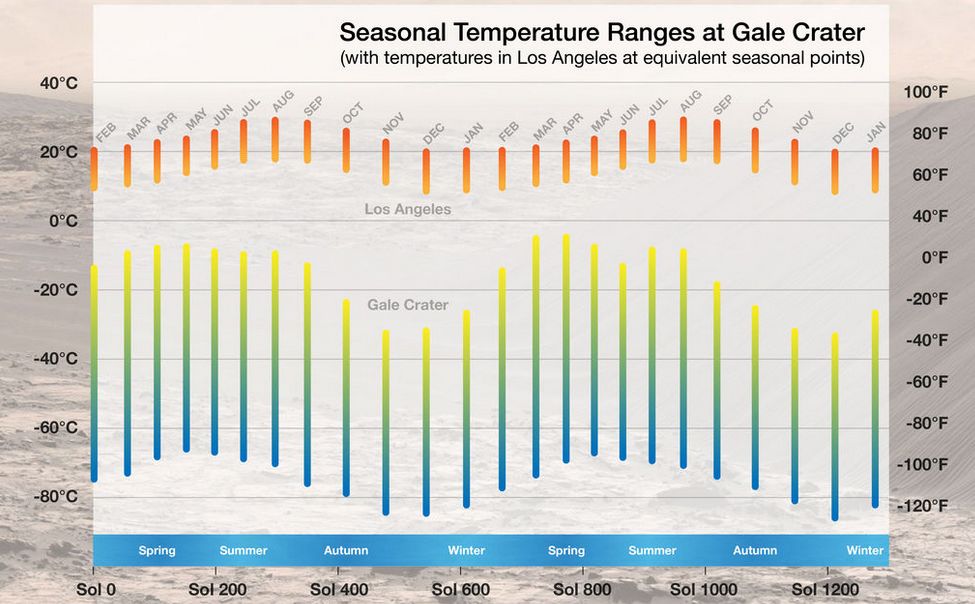
Curiosity’s Rover Environmental Monitoring Station (REMS), supplied by Spain’s Centro de Astrobiología, has measured air temperatures from 15.9o C (60.5o F) on a summer afternoon, to -100o C (-148o F) on a winter night.
Comparing temperatures at Mars’ Gale Crater (lower set of bars) to temperatures in Los Angeles. It shows key differences both in how much colder the Martian site is throughout the year, and also how much greater the difference between daily highs and lows. Mars has only about one one-hundredth as much atmosphere as Earth, and without that thick blanket of atmosphere the air temperature around Curiosity usually plummets by more than 55o C (100o F) between the afternoon high and the overnight low.






 Inara Pey: Living in a Modemworld