Techcrunch and THE examine Project Sansar

Project Sansar: increasingly in the tech media's media's eye
Project Sansar: increasingly in the tech media’s eye. Credit: Linden Lab

It appears that, in keeping with their word, the Lab is starting to allow journalists into Project Sansar. At the start of July, Ed Baig got a look inside Sansar for USA Today, as I reported here and here (with Ed’s own article here). now it is the turn of Techcrunch and, earlier in the month, Times Higher Education (THE), with pieces appearing in Russian, Polish and Brazilian outlets.

In Second Life creators look to revamp reality once again, this time in VR. Techcrunch’s Lucas Matney steps inside Project Sansar at the invitation of Ebbe Altberg, and his guide is the Lab’s VP of Product Bjorn Laurin (Born Linden). As with most articles we seen of late, nothing intrinsically “new” is added to what has so far been revealed about Sansar in terms of capabilities, approach or screen shots, but  there are some interesting tidbits, all the same. For example, early on he notes:

Traversing the worlds of Sansar and chatting with my guide, Linden Lab VP of Product Bjorn Laurin, was a mostly seamless experience but still an oddly unsettling one. It’s not that anything was particularly creepy about the place I was viewing through an Oculus Rift headset. Sansar is visually placid and often beautiful, but it’s also startlingly scalable and boundless. Scale is something that’s often taken for granted in an age of video game epics like Skyrim and GTAV, but when every horizon you see through your own point-of-view is conquerable, you’re left to either feel very bold or very lost.

Lucas Matney considers Project Sansar for Techcrunch

The two things that are interesting here are the comment about the “mostly seamless” experience of moving between “Sansar worlds” (“worlds” here, I assume, means Sansar “scenes” which have been “stitched together”  – to use the Lab’s terminology – to create an “experience”). This appears to imply that whatever mechanism is in place to move avatars between different connected scenes (teleporting?) is pretty smooth and that there may not be too much in the way of any interruption when moving between scenes. It’ll be interesting to discover if / how this might extend to vehicles at some point down the road as Sansar develops.

The second interesting part of the comment is the apparently limitless size Sansar presents to users, suggesting that as with Second Life, Sansar will convey a sense of massive spaces which might reach beyond their physical limits – so will people be looking out onto open “water” as with SL, or will the “land” appear to stretch off into the far horizon – or is it simply that the available Sansar scenes all make use of the upper bounding size (previously reported to be around 4 km / 16 SL regions on a side)? Either way, it may well be that environments in Sansar aren’t quite as “enclosed” – at least visually – as people might be fearing.

A further point of interest in the article takes the form of an astute observation perhaps overlooked when discussing Sansar’s potential for success:

Like Second Life, Project Sansar is not an experience that needs to be perfect at its initial launch or see a certain number of first week user numbers to be a hit. It just has to stay consistent, evolve with the hardware/interface trends of modern VR and steadily push boundaries as it updates.

Hence why the Lab isn’t trying to cross all the “T”s and dot all the “I”s with Sansar from day one, and why they do repeatedly warn SL users it is not going to necessarily be to their taste when the doors first open. VR is going to take time to mature – not just in terms of user conviction, but the very hardware and software itself. Things will change within the industry, probably quite rapidly (look at the pace of change of other “disruptive” technologies, such as the mobile ‘phone), thus it’s important for Sansar to be in a position to demonstrate it can meet user cases and needs – but also remain flexible and responsive to emerging technology and the new needs / opportunities arising from it.

In a time when we’re perhaps becoming inured (so to speak) with the comparisons to Sansar with the likes of WordPress and YouTube for content creation, it’s perhaps refreshing to have someone put their finger on the button of LL’s monetisation focus for Sansar, with Matney observing the company plans to essentially build “an app store for VR creative properties”. This is not only a neat way to encapsulate Sansar’s approach to monetisation, it also neatly folds back into the idea that “creator” in Sansar encompasses a broader cross-section of users than perhaps we consider to be the case in Second Life – as I mentioned in covering Ed Baig’s USA Today piece.

Alice Bonasio: looking at Sansar and VR for THE

One of the several target markets the Lab is looking towards for Sansar is that of education, and it is from this perspective that Alice Bonasio, writing for Times Higher Education, considered Project Sansar back at the start of July 2016.

Starting with a look at the success Second Life has enjoyed within education, Virtual reality really is heading to a university near you more generically considers the role of VR in education, and the manner in which Sansar might be a part of an education revolution – not just in terms of providing immersive teaching environments, but in the ability for universities and colleges, etc., to potentially monetise their environments.

It’s an interesting line to take, but what is perhaps of greater interest, in terms of gaining further understanding as to why Linden Lab felt they needed to push ahead with Project Sansar, is in the vision for education presented through the piece. In this, Alice Bonasio doesn’t just examine the Lab’s hopes for Sansar, she frames them in terms of experiments conducted by Jeremy Bailenson, founding director of Stanford University’s Virtual Human Interaction Lab. These experiments demonstrated some very real benefits of using VR / augmented capabilities can bring to the basic  tutor / student relationship, quite aside from all the deeply immersive potential offer by the technology.

Again, neither article offers anything specifically “new” in terms of how Sansar will look when the door opens or what the baseline capabilities will be when that happens in early 2017. However, they do both provide individual insights into the platform which make them both a worthwhile read, with Techcrunch’s Matney in particular ending with further food for thought, noting that while Sansar might not  require a huge audience from the get-go, it does nevertheless need to succeed in its central aim of providing a platform for “social VR” – and that’s no easy thing, because “social VR” isn’t really an understood medium right now (we can only guess at what it might be like and – equally importantly – how people might react to it). But as he notes in closing:

The early beta shows great promise and while a wide release of its desktop and VR versions is still likely months away, it’s clear that Linden Lab understands the daunting magnitude of both Project Sansar’s challenges and its potential.
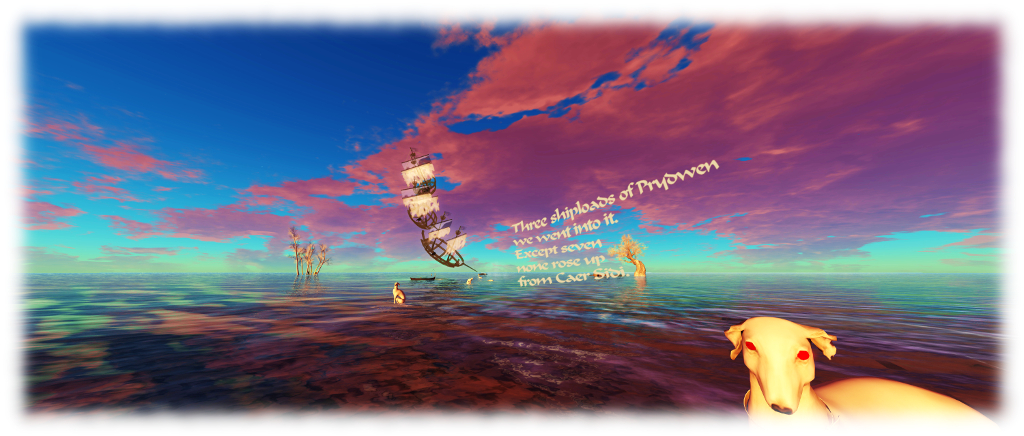
Preiddeu Annwn: immersive education in Second Life

Preiddeu Annwn: “Three fullnesses of Prydwen / we went on the sea.”

Preiddeu Annwn (or Preiddeu Annwfn, “The Spoils of Annwfn“), is one of the most famous gnomic / philosophical poems to be found in the Middle Welsh Book of Taliesin. In just eight irregularly versed stanzas, it records a journey the poet (possibly intended to be the 6th Century poet Taliesin, although the poem itself dates from around the 14th Century), made with King Arthur to the Otherworld (the Annwfn of the title)  – a place of eternal youth and delights, which is common to Welsh mythology (appearing in, for example, the Four Branches of the Mabinogi).

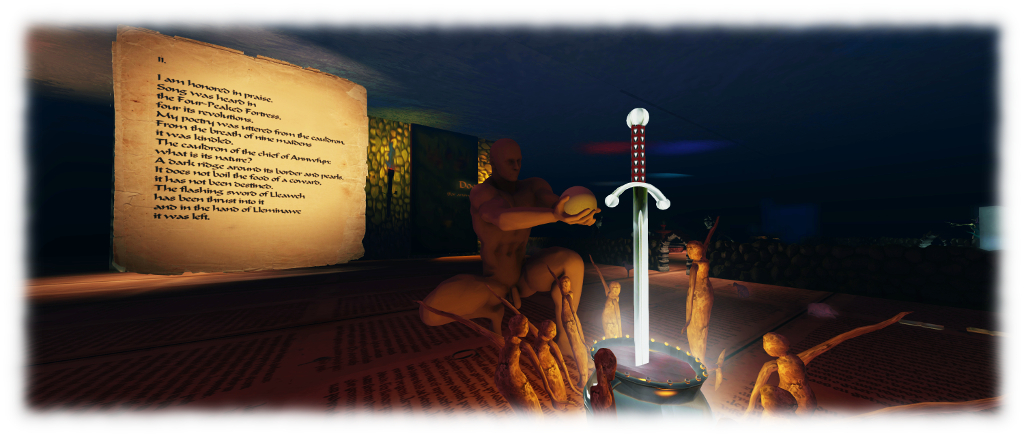
It is also now the subject of an immersive environment itself entitled Preiddeu Annwn, designed by Hypatia Pickens, a professor of English at the University of Rochester,  New York, and her students. Its function is to provide an interactive means by which the poem and its themes can be explored and better understood, both within itself and with regards to broader medieval Welsh mythology and medieval literature. It is also an extraordinary piece of scholarly art.

Preiddeu Annwn: “The cauldron of the chief of Annwfyn: / what is its fashion? / A dark ridge around its border / and pearls.

The arrival point offers a series of notes to visitors, including how to best experience the environment. It is more that worth the time to read these in order to make sure you enjoy the installation fully. Once you have done so, keep the instruction “follow the white dogs to where the boats are going [and] sit when you are asked to sit”, and then touch the teleport disc.

This delivers you to ground level, where waters ebb and flow over the eight stanzas of the poem beneath a beautiful sky, representing the start of Arthur’s expedition, and far on the horizon stand his three ships, white dogs pointing the way to them. In turn, the ships stand over the entrance to the Otherworld, on which your are to sit.

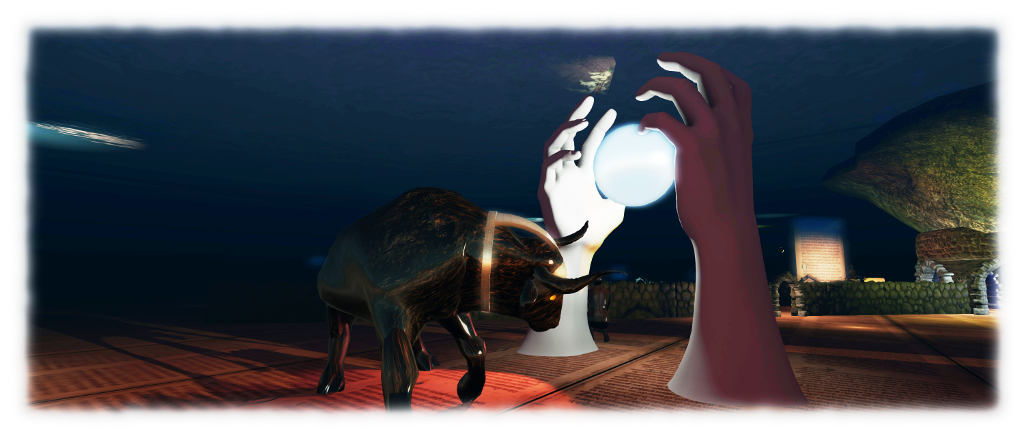
Preiddeu Annwn: They do not know the brindled ox, / thick his headband. / Seven score links / on his collar.

Doing so will deliver you to the Otherworld, in which the stanzas of the poem are presented through words and vignettes as an endless cycle, requiring considered exploration (the order in which you do so is yours to choose). As well as the poem, broader aspects of Welsh mythology are touched upon, such as the aforementioned Mabinogi. Do make sure you have media enabled (again, via the movie camera icon, top right of the viewer) to enjoy a reading of the poem by  Blake Harriman, set to music and vocals by Hypatia herself.

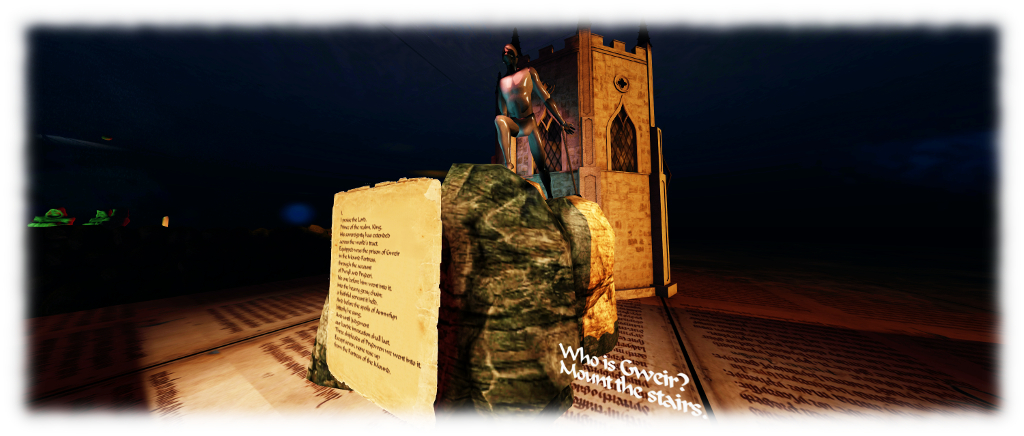
Eventually, however, you must make your way to Yyns Wair (“Gwair’s Island”, referred to in the poem as Cair Sidi – the Glass Fortress / “Fortress of Four-Peaks” encountered by Arthur and his men -, and believed to be modern-day Lundy in the Bristol Channel), in order to free Gwair / Gwier. This involves passing through the Door of Hell to explore the tower of Gwair’s imprisonment. which in turn gives you the opportunity to collect the poem, hear it recited in the original Middle Welsh by Hypathia herself, and read the thoughts of her students about the use of virtual environments in study.

Preiddeu Annwn: “into the heavy blue/gray chain; / a faithful servant it held”

Preiddeu Annwn has been made possible through the support of the Russell Hope Robbins Library at the University of Rochester. A medieval studies library containing holding in all aspects of medieval literature, history, art and theology, the Library is also represented in Second Life, and can be visited directly, or by “following the waves” once you have reached Yyns Wair within the Preiddeu Annwn installation.

All told, this is an extraordinary demonstration of the power of virtual spaces as a tool for education and the exploration of art, history, mythology and language, with the virtual Russell Hope Robbins Library equally so. I spent in excess of four hours in exploration and contemplation of both; anyone with any interest in medieval literature, Arthurian mythology, Middle Welsh or medieval history in general cannot help but be enthralled by both.

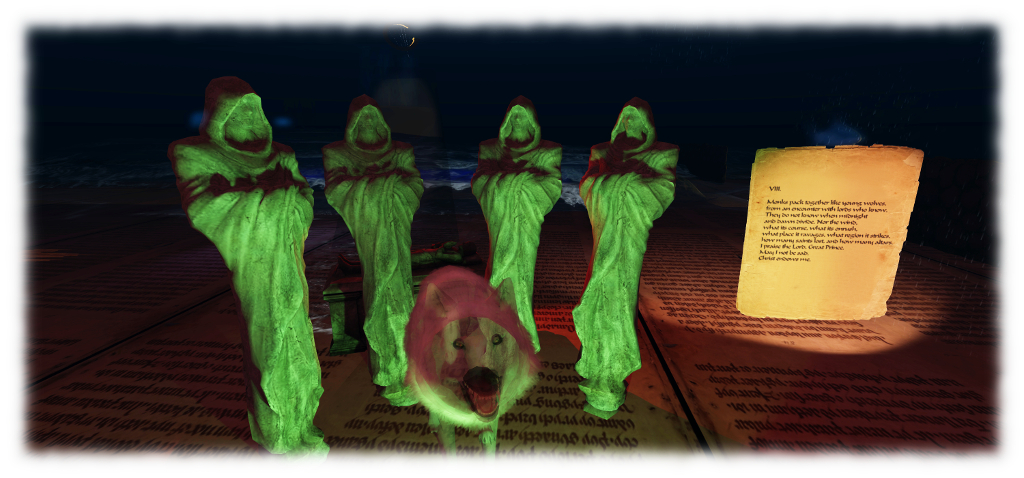
Preiddeu Annwn: “Monks pack together / like young wolves”

Related links

Windlight Feed A Smile fund-raiser: 180 meals for Kenyan children

via Winfdlight Magazine / Feed A Smile / Brique Topaz
via Windlight Magazine / Feed A Smile / LLK

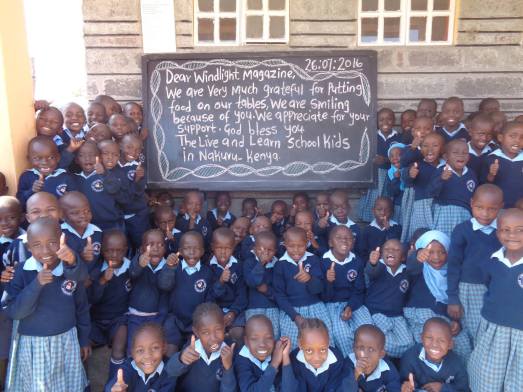
In July 2016, Windlight Magazine ran a hunt in aid of Feed A Smile, the a programme run by Live and Learn in Kenya (LLK) to provide nutritious warm lunches for over 400 children in Kenya every day, paid for entirely from donations to the project.

The hunt featured Prism Designs, Miss Darcy, FLOOD, Bindu Gallery, % Percent Furniture and Lighting, The Edge Gallery, CKB Gallery, Kaerri, Maven Homes, Windlight Workz, and Windlight Magazine. In organising it, Windlight Magazine pledged to match all donations made through the hunt, and to make a large donation at the end.

Enjoying the mael: 180 happy faces (via: Windlight Magazine / Feed A Smile / Brique Topaz)
Enjoying the meal: 180 happy faces (via: Windlight Magazine / Feed A Smile / LLK)

On July 27th, writing on behalf of Windlight Magazine John Brianna (Johannes1977 Resident) published a blog post on the results of the effort: funds to cover 180 meals for children in the Feed A Smile programme, who enjoyed their meal on Wednesday, July 26th.

Commenting on the effort, John said:

Putting this all into perspective, this is what  Second Life should be about, coming together to help others. We have seen it time and time again, with the recent Pulse fund-raisers, to the various charity organizations in Second Life (Rock Your Rack, Creations For Parkinson’s, Autism Speaks, Team Diabetes of Second Life, Homes For Our Troops), that the charitable spirit is alive and well in people.

The children themselves sent a special message of thanks to both Windlight Magazine and the residents of Second Life who supported the fund-raiser, which can be seen at the top of this piece.

Kudos to all involved!

About Feed A Smile

Feed A Smile is a programme run by LLK to provide nutritious warm lunches for over 400 children every day, paid for entirely from donations to the project. Over a third of the money directed at the programme comes from donations received through Feed a Smile in Second Life – and that’s a remarkable figure.

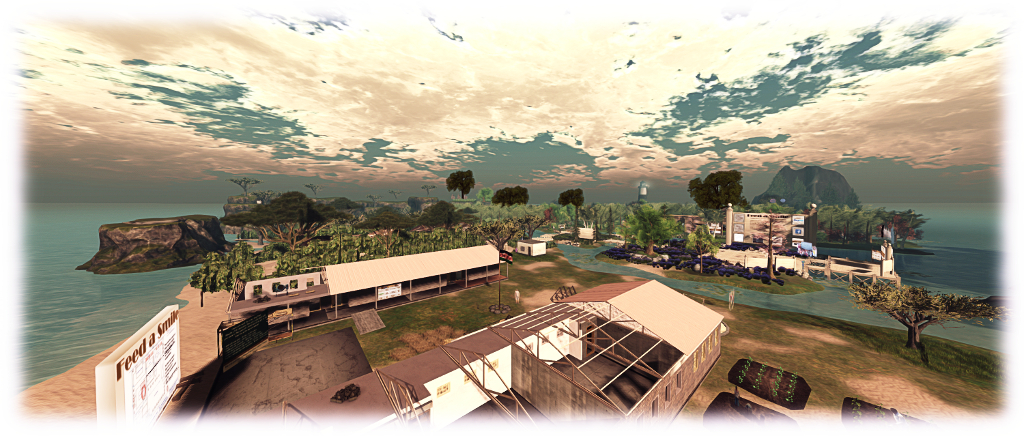
Feed A Smile in Second Life - in the foreground is a model (by RAG Randt) of the school in Nakuru, Kenya, Live and Learn Kenya (LLK) are building
Feed A Smile in Second Life – in the foreground is a model (by RAG Randt) of the school in Nakuru, Kenya, Live and Learn Kenya (LLK) are building

The money is raised through fund raisers like this, and through live music played at the Feed A Smile Region, which stages around 5 or 6 events weekly. At these music events, musicians donate their tips, and visitors are asked to donate just L$100 ($0.30), which is enough to purchase a filling meal for a child in Kenya, a fact that within itself is also quite mind-boggling!

If you would like to offer support to Feed A Smile through fund-raising, etc., please contact Brique Topaz in-world.

The Singularity of Kumiko: the film

TSK-27_001
The Singularity of Kumiko by Bryn Oh

In January, I relayed the news that Bryn Oh was one of 17 recipients of grants from the Ontario Arts Council. At the time she received news of the grant, Bryn indicated that some of it would be used in recreating and filming her outstanding The Singularity of Kumiko (which I wrote about here). On July 24th, and following a premier at Indie Teepee on July 21st, she formally released the finished machinima on YouTube.

In rebuilding the installation for the filming, Bryn has made a few changes, and as she notes in her post on the film (which I’m actually unable to link to directly, due to her post not having a title of its own, so I can only direct you to her home page),  she’s also incorporated scenes in the film which are not present in the in-world installation. None of these changes in any way alter the narrative arc of the piece; rather they allow the film to further stand as a valid and independent artistic interpretation of the installation.

This is the third grant Bryn has received from the Ontario Arts Council with respect to her work in Second Life, noting, “I also would like to thank the Ontario Arts Council for their continued support over the years … It is very rewarding and encouraging for me to know that such an establishment sees the virtual space as a powerful and unique tool for creating art.”

The Singularity of Kumiko was, and remains an extraordinary demonstration of immersive art and storytelling in Second Life, and one fully deserving to be preserved within this film. The installation itself remains open on Bryn’s home region of Immersiva. Regardless as to whether you have visited it before, please do take this opportunity to visit it in person whilst it is available.

SLurl Details

A Starship Enterprise in Second Life big enough for an avatar crew

"Space. The Final Frontier..."
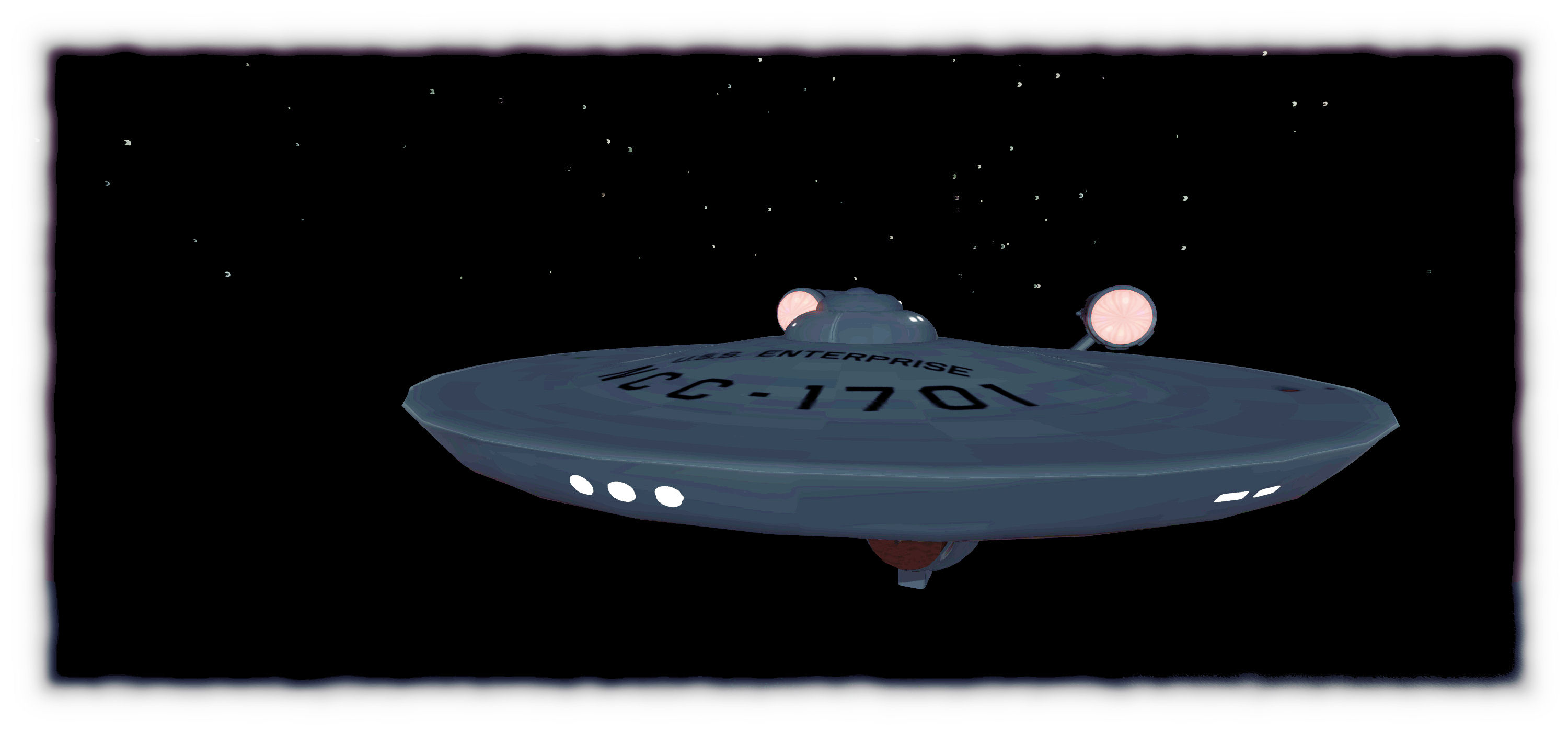
“Space. The Final Frontier…”

Cathy Foil is a creator of note. Among her many talents, she was the first to introduce fully sculpted foot in SL and put it in a high heel; she is the creator of the MayaStar mesh rigging plug-in for Maya, and she is, alongside the AvaStar folk, one of the prime movers in the Bento project. She is also a huge fan of The Original Series of Star TrekTM.

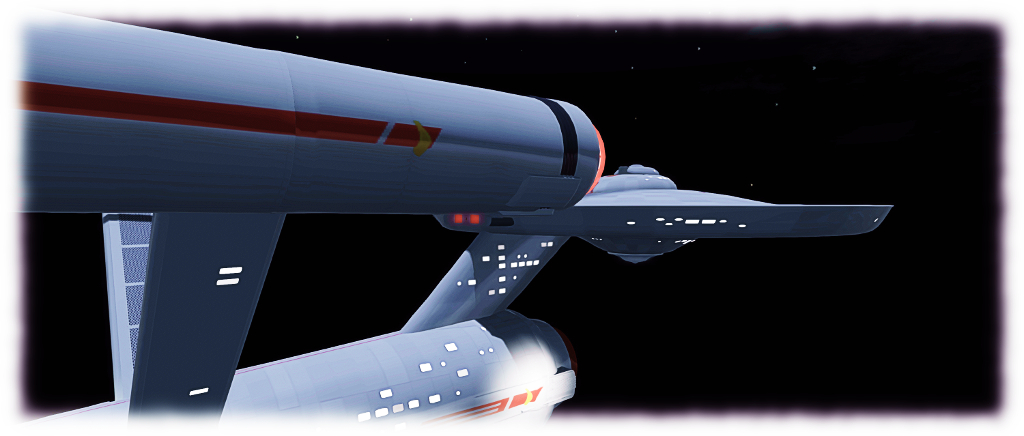
How big a fan, you ask? Well, let me put it to you this way: in 2008, before the birth of mesh in Second Life, she start started building an avatar-sized, scale replica of the Enterprise itself.  Almost two regions in length, with interiors from the Bridge to Engineering, it was a huge undertaking – albeit unfinished.

"These are the voyages..."
“These are the voyages…”

Part of the ship is currently once again rezzed in-world, although unfortunately in a location that is not open for public access. However, given July is being used to mark the 50th anniversary of Star TrekTM with the release of the 3rd film instalment from the “Abramaverse”, I took the opportunity to join Cathy on a tour of the original starship Enterprise NCC-1701.

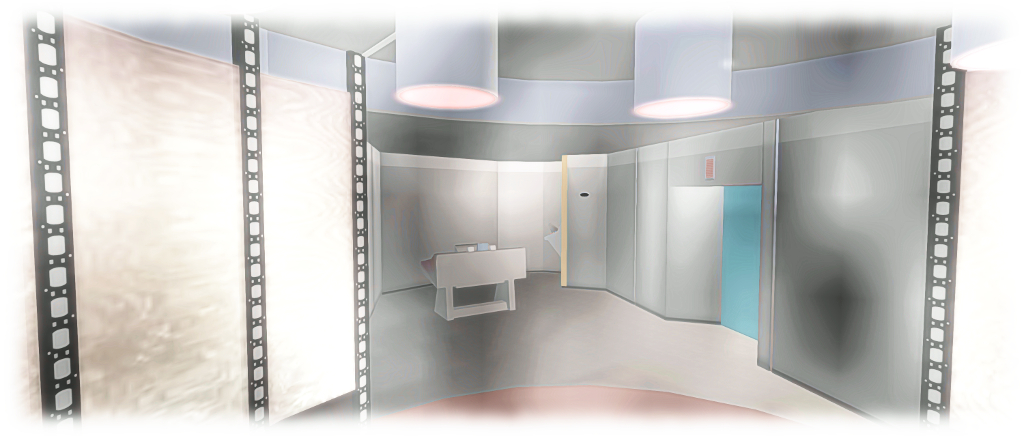
“You best be in Mouselook when we beam up to her,” Cathy informed me as we arrived at two innocent-looking transporter disks lying in the sand. Following her instructions I stood on a pad, brought up the menu and slipped into Mouselook before alt-clicking my destination: Mr. Kylie’s Transporter Room 6. For a second, nothing happened; then a familiar hum filling the air, the beach before me started to sparkle, my universe flickered for a second, then the sparkling and noise faded and the transporter room emerged out of the glow.

Beaming aboard the Enterprise
Beaming aboard the Enterprise: the transporter room materialises before my eyes

Never have I felt quite so “on” the Enterprise as I did at that moment; stepping off the pad, I expected to see Mr. Kylie himself behind the transporter station and then hear that magical high-pitched hiss of the doors as Kirk and Spock arrived.

“The entire project took about eighteen months to get this far,” Cathy said as I admired the transporter, the control console and monitoring station, all beautifully re-created in prims and sculpts. “Most of the ship is rendered as sculpts with prim walls and floors,” Cathy said, leading me to the door which did give that squeaky hiss of opening at we approached. “That way we could reduce the prim count and make things manageable.” Sculpts they may be, but sculpts designed with care: no waiting for things to pop into existence in my view at all during the tour.

"Captain Kirk to the bridge!"
“Captain Kirk to the Bridge!”

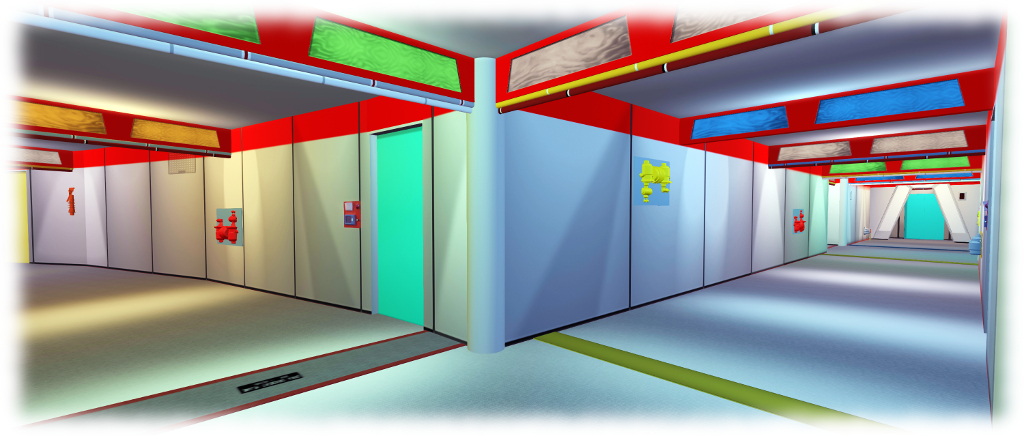
The corridors outside were equally marvels: the familiar bold colours born of 1960s colour television programming, the intercoms at junctions, the gaudy doors (behind which, and depending upon which deck you’re on, sit crew quarters, officers quarters, the sickbay,  briefing rooms, offices, and main engineering), doors hissing in greeting or departure as you enter / leave. At the end of many of the corridors sit the familiar triangle archway of a turbolift station.

“These are all a single sculpt,” Cathy told me, as we walked to one of the arches, triggering an automatic call for a turbolift. “It includes the walls that connect the archway to the sides of the corridor so everything blends.” The car arrived and we stepped in. Touching the familiar handles gave a choice of destination. We headed for the Bridge.

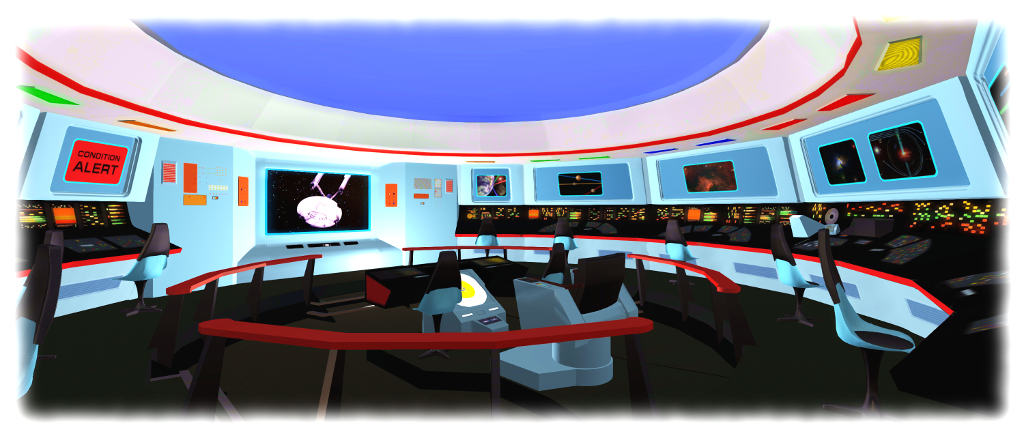
The Bridge
The Bridge

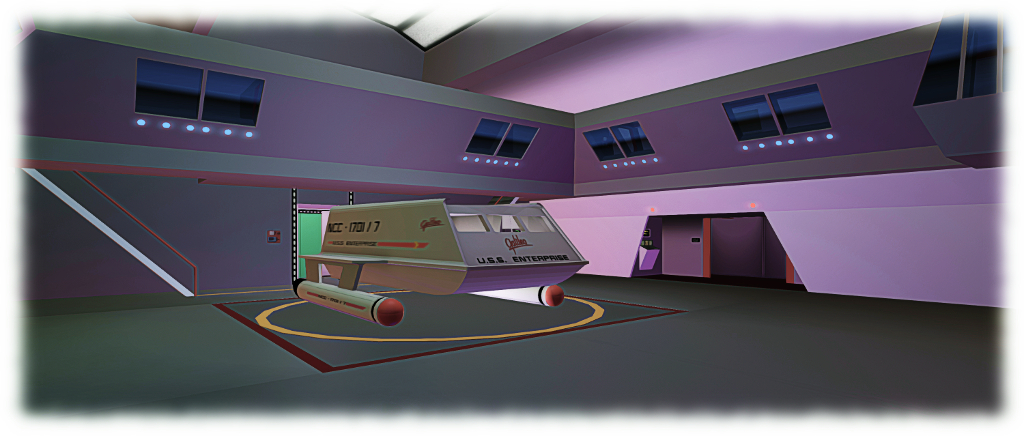
“Most of the ship, including the textures, I made,” Cathy said in answer to my question as another spine-tingling sound – that of a turbolift in operation – filled the air. “Lora Chadbourne also contributed the shuttlecraft bay and some of the consoles like the monitoring console in the transporter room, another builder produced the interiors of the warp nacelles.”

The detail is extraordinary. The bridge stations are all painstakingly reproduced, the centre seat has the expected wood trim, Spock’s science station has the familiar scanner. Elements within the bridge are interactive. Touch the helm console, and up come a range of options – go to warp, fire phasers or photon torpedoes, accelerate to warp 8, etc., while the viewscreen offers a range of images, including that of the destroyed USS Constellation, as seen in the episode The Doomsday Machine and the Romulan Warbird from Balance of Terror. And all around are the familiar background noises.

"Spock, analysis!" - a close-up of Spock's library computer station
“Analysis, Mister Spock?” – a close-up of Spock’s library computer station

This level of detail and interaction is present throughout the ship – as are the ambient sounds. Back in the transporter room for example, you can toggle switches and operate the famous transporter activation sliders, while in Engineering, you can examine the ship’s dilithium crystals in their rack. A clever “stacked” use of textures gives an excellent a 3D effect in grilles and grates.

Drop into the briefing room, and you can flick individual rocker switches, call up images on the tri-screen, or use the intercom to call someone elsewhere in the ship. Down the corridor at the ship’s medical facilities you can work out to “Bones” McCoy’s satisfaction or pop into his lab where he has one of the parasites from Operation: Annihilate! under observation – although the little bugger is not averse to getting loose! Against the back wall of the lab sits the decompression chamber from Space Seed nearby. With working food replicators in the mess hall (fortunately tribble-free) and all the ambient sounds from the original, this is s ship that is really alive.

"Ma poor bairns!" Scotty's Engineering - note the floor plans marking the layout
“Ma poor bairns!” Scotty’s Engineering – note the floor plans marking the layout

To ensure accuracy, Cathy used a mix of the Franz Joseph blueprints from the ship, together with plans from the studio in laying out the interior spaces, although as she notes, she had to upscale things a little. “The whole ship is like 115% to scale, she said. “Had to be bigger than 100% because average male avatar in SL is like 7 feet tall, and then there is the camera position on top of that!”

As note above, the ship isn’t a completed model. Circumstance brought the project to a halt in 2009 when the two regions over which the Enterprise was located were let go, ending all Trek role-play there. When touring the ship, signs that it is still a work-in-progress can be found on the floors, some of which are textured with copies of the original Desilu Studio set plans from the show. Rather than detracting from the model, these add a further layer of authenticity and care in its construction.

The shuttlecraft bay is awash with detail
The shuttlecraft bay

Continue reading “A Starship Enterprise in Second Life big enough for an avatar crew”

2016 viewer release summaries: week 29

Updates for the week ending Sunday, July 24th

This summary is published every Monday, and is a list of SL viewer / client releases (official and TPV) made during the previous week. When reading it, please note:

  • It is based on my Current Viewer Releases Page, a list of all Second Life viewers and clients that are in popular use (and of which I am aware), and which are recognised as adhering to the TPV Policy. This page includes comprehensive links to download pages, blog notes, release notes, etc., as well as links to any / all reviews of specific viewers / clients made within this blog
  • By its nature, this summary presented here will always be in arrears, please refer to the Current Viewer Release Page for more up-to-date information.

Official LL Viewers

LL Viewer Resources

Third-party Viewers

V4-style

V1-style

  • Cool VL viewer Stable branch updated to version 1.26.18.16 and the Experimental branch updated to version 1.26.19.18, both on July 23rd (release notes)

Mobile / Other Clients

  • No updates.

Additional TPV Resources

Related Links