Wednesdays mean Music with Anthony at our very own Caitinara Bar, Holly Kai Park: two hours of some of the best music in Second Life, provided by our resident mid-week DJ, Anthony Wesburn.
On Wednesday, February 10th, between the usual times of 16:00-18:00 SLT, Anthony will be playing a mix of songs to dance to, which this week will feature the songs of Super Bowl Half time performers.
So why not join us for numbers from the likes of Michael Jackson, Janet Jackson, Justin Timberlake, the Rolling Stones, the Black Eyed Peas, Madonna, Beyoncé, Bruno Mars, No Doubt, Diana Ross, James Brown, Sting and Gwen Stefani, and more!
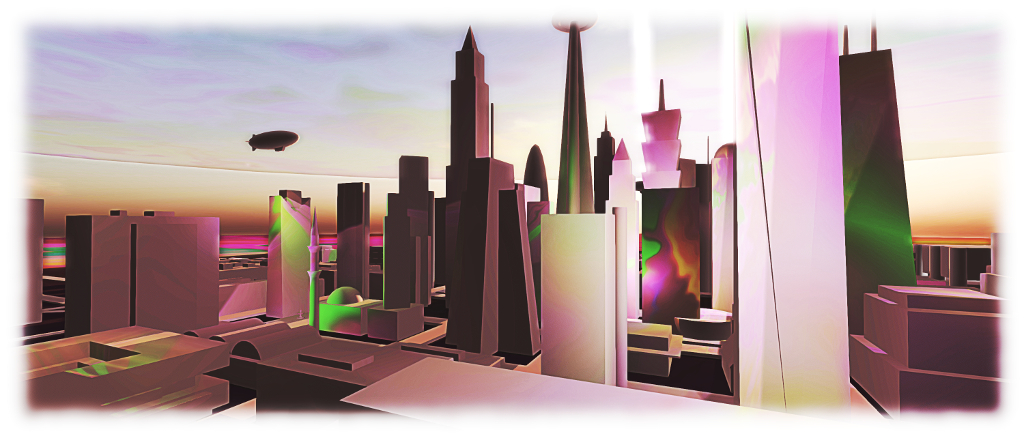
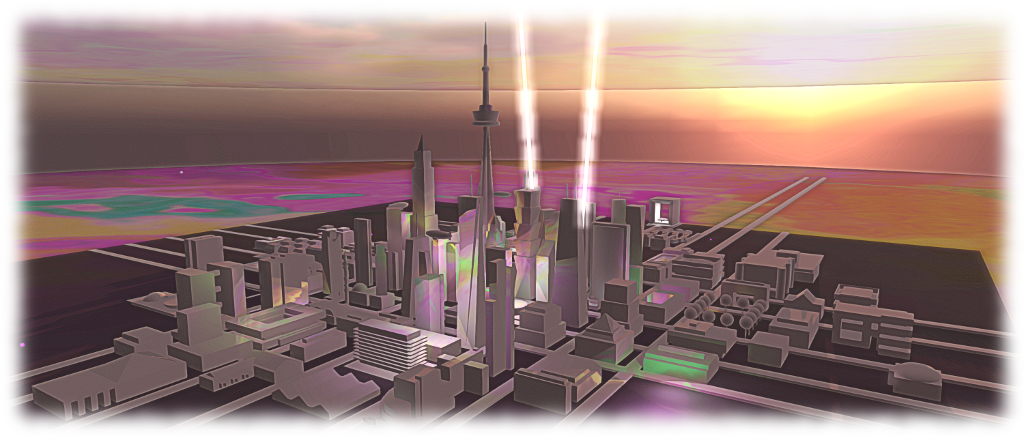
The City is a sprawling 4-region build designed by Betty Tureaud at the LEA. It is a place which at first might seem a little baffling to the casual visitor and those familiar with Betty’s work, which is generally hallmarked by the use of bright, usually shifting, colours and interactive elements.
Here, however, one arrives on a vast desert plain, vast and flat, with only a poem by Betty, delivered via note card, and a whispered instruction to follow the footprints for guidance. Do as the latter instructs, and you’ll come (by way of a skeleton, which has a story of its own to tell when touched) to a DC3 belonging to Adventure Airlines. This will, by the magic of teleporting, carry you away from the desert and to the edge of a city, rising like Las Vegas from a flat plain, albeit this one covered by the first signs of Betty’s familiar vivid colours.
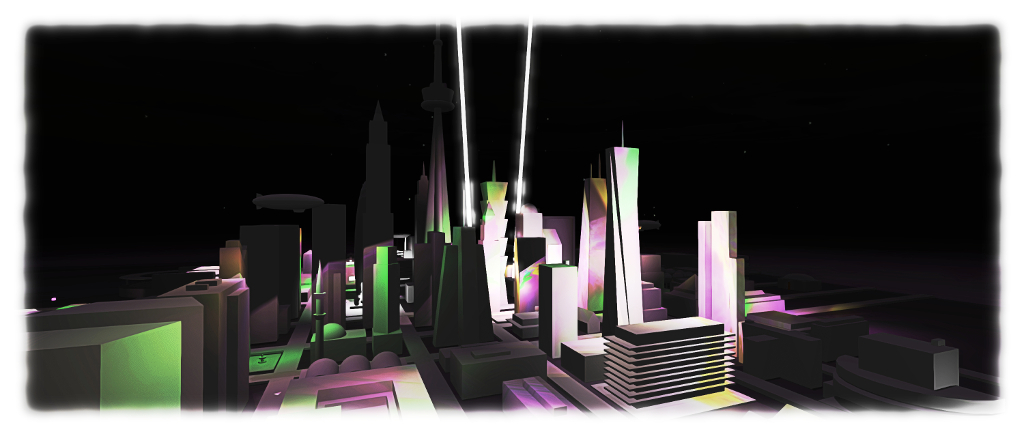
The City sits at the centre of the four regions, surrounded by the multi hued flat plain. To see this at its best, you will at least need to run your viewer with Advanced Lighting Model (ALM – Preferences > Graphics) enabled. This shouldn’t place too much of a performance load on older / less powerful systems, and it is necessary to have on in order to appreciate The City fully, with colours washing over the tall buildings and across the airships flying overhead.
Some of the buildings in The City may have various degrees of familiarity about them. The western edge is dominated by the instantly recognisable form of La Grande Arche de la Fraternité, located in the La Défense business district of Paris. Amidst the taller buildings one can also find New York’s Empire State Building, Toronto’s CNN Tower, Malmö’s Turning (or Twisting) Tower, Tapei 101, the tallest environmentally green building in the world and London’s Swiss Re building (often referred to as “the Gherkin” due to its distinctive shape), whilst the Guggenheim Museum, Copenhagen’s Opera House and more and be found as one wanders the streets (do beware of the trains!).
The building can all be touched, offering links to their respective Wikipedia pages in return. The CNN Tower also provides an elevator ride to it top. Other interactive elements can also be found as one tours – a football can be kicked around a stadium, seats in the parks can be sat on, and pink boxes scattered around the edge of The City offer a neat helicar designed by Betty which can be piloted and carry up to two people. As you travel back and forth between the regions straddled by the build, so to does the time of day change, allowing you to see it under different lighting conditions.
The City is very much an interactive installation, touching and clicking and having local sounds fully enabled is very much required when exploring. It offers an interesting way of discovering more about modern architecture and some of the world’s most famous buildings.
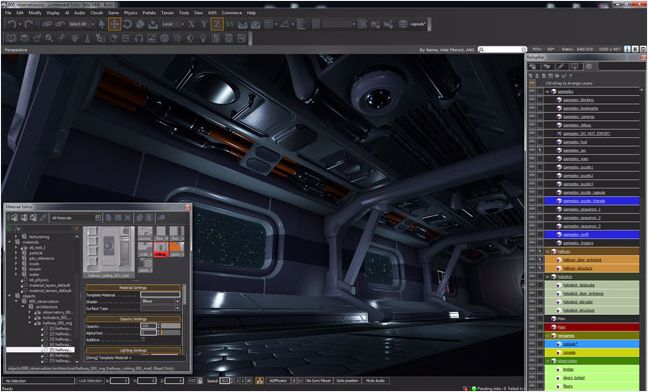
Lumberyard is the name of Amazon’s new game engine, released on Tuesday, February 9th. Based on Crytek’s CryEngine, which Amazon licensed in 2015, Lumberyard will apparently be developed in its own direction, independently of CryEngine and is being provided as a free-to-download tool (with optional asset packs) which can be used to develop games for PCs and consoles on a “no seat fees, subscription fees, or requirements to share revenue” basis.
Instead, Amazon will monetise Lumberyard through the use of AWS cloud computing. If you use the game engine for your own game and opt to run it on your own server, then that’s it: no fees. But if you want to distribute through a third-party provider, you can only use Amazon’s services, via either GameLift, a managed service for deploying, operating, and scaling server-based on-line games using AWS at a cost of $1.50 per 1,000 daily active users.Or, if you prefer you can use AWS directly, at normal AWS service rates.
Lumberyard includes a customisable drag-and-drop UI (image: Amazon)
As well as AWS integration and the development of new low-latency networking code to support it, and native C++ access to its service, Lumberyard has deep, built-in support for Twitch (purchased by Amazon in 2014 for $970 million), including “Twitch play”-style chat commands and a function called JoinIn, which allows viewers to leap directly into on-line games alongside Twitch broadcasters as they stream. The aim here, according to Mike Frazzini, vice president of Amazon Games, when talking to Gamasutra, is “creating experiences that embrace the notion of a player, broadcaster, and viewer all joining together.”
Described as a triple-A games development engine, Lumberyard has already seen many of the CryEngine systems upgraded or replaced, including the implementation of an entirely new asset pipeline and processor and low-latency networking code – hence why Lumberyard will diverge from CryEngine’s core development. And Amazon is promising more to come, including a new component system and particle editor and CloudCanvas, which will allow developers to set up server-based in-game events in AWS using visual scripting.
“Alien Abode” a game scene rendered in Lumberyard (:image: Amazon)
All of which adds-up to a very powerful games development environment – although Amazon are clear that right now, it is only in beta. This means that things are liable to undergo tweaking, etc., and that some capabilities – such as Oculus Rift support – haven’t been enabled for the current version of the engine.However, VR support is there, with Amazon noting:
We have been actively working on VR within Lumberyard for some time now, and it looks great. We are currently upgrading our Oculus VR support to Rift SDK 1.0, which was released by Oculus in late December. We wanted to finish upgrading to Rift SDK 1.0 before releasing the first public version of VR support within Lumberyard, which will be included in a future release soon.
Further, Amazon has already signed official tools deals with Microsoft and Sony, which means game developers licensed to develop games for the Xbox One and PlayStation 4 can immediately start using Lumberyard to develop games for those platforms.
There are – for some – a few initial downsides to Lumberyard where independent game developers are concerned. At launch, the engine only supports models created in Maya and 3D Max, although this may change – Blender support is promised for the future, for example. There is also no support for Mac or Linux, although Amazon have indicated that these will be come, along with iOS and Android support.
Use of the engine includes the right to redistribute it and pieces of the development environment within games, and allows game developers to any companion products developed for a game using Lumberyard with allow end users to modify and create derivative works of that game.
The CryEngine SDK is one of the Asset Packs available for download for use with Lumberyard (image: Amazon)
As noted above, the company has already started supplying asset packs developers can include in their games, Three packs are available at launch, including the CryEngine GameSDK, which contains everything required for a first-person shooter game, including complex animated characters, vehicles and game AI, and which includes a sample level.
Amazon clearly have major plans for Lumberyard, and some in the gaming media are already wondering what it might do to the current development environment, which is largely dominated by the likes of Unity, Unreal Engine, or even CryEngine itself, but which all require either a license fee or a royalty fee.
Is Lumberyard competition for the Lab’s Project Sansar? The engine certainly has the ability to create immersive environments, and Lumberyard will support VR HMDs as it moves forward, as noted.
However, everything about Lumberyard points to it being pitched as a professional games development environment with a dedicated distribution service through Amazon’s cloud services available for use with it. Hence, again, why Twitch is deeply integrated into Lumberyard – Amazon appear to be a lot more interested in building an entire gaming ecosystem. Amazon’s marketing is also geared towards gaming, as their promotional video (below) shows.
Which is not to say that it couldn’t be attractive to markets outside of gaming. As such, it will be interesting to see over time just who does take an interest in it – and how Amazon might support them.
Kiosks at the Isle of View are offering a range of gifts – candy, chocolates, bunting, teddy bear, roses – any of which can be purchased and sent to a loved one. All of the proceeds from gift purchases will go to Team Fox, the fund-raising arm of MJFF, and the Lab are also guaranteeing to match the final total raised and so double the donation.
And that’s not all. This year sees the return of two popular items from times past, as the blog post notes:
We understand that love is sometimes complicated. You have got to work hard to make it work – and we’re not afraid of a little tough love. On February 12th from 10am – 12pm and 2-4pm SLT we’ll be mixing things up with the return of Dunk-a-Linden and Hug-a-Linden booths! You may just meet your virtual Valentine while waiting for a chance to dunk or hug a Linden – and if you don’t – hey you still got to dunk or hug a Linden! It’s a win-win situation.
So make a note for Friday, February 12th!
To find out more about Team Fox, the MJFF and Team Fox in Second Life, you can read my article here. And don’t forget Team Fox is also supported by Creations for Parkinson’s in-world as well.
There are no server deployments planned for week #6. The reason for this is that most of the staff directly involved in developing and enhancing the platform – the engineering team, product teams, etc., are meeting to discuss plans for further enhancements and improvement to Second Life in the coming month, as existing projects such as Bento continue to unfold.
This more than likely means the next deployment will take place Wednesday, February 17th, 2016, to at least one of the RC channels.
This also means the detailed project information is liable to be a little light this week as well.
SL Viewer
The HTTP / Vivox RC viewer was updated post my last SL projects Updates in week #5. Version 4.0.2.310660, issued on February 4th. This update includes three new fixes:
MAINT-6055 [corehttp] Win or Mac – voice does not stay connected on resume from sleep
MAINT-6064 Voice disappeared after rejected IM call
MAINT-6108 Cannot turn off ‘Console Window on next Run’ option in develop menu.
There has been no promotion to release viewer for any of the current RCs, which leaves things as follows for the release channel and project viewers:
Current Release version: 4.0.1.310054, January 15 – formerly the Maintenance RC viewer download page, release notes
RC viewer (+ the HTTP / Vivox RC above):
Maintenance RC viewer version 4.0.2.310545 released on February 2 – 38 updates. fixes and tweaks (download and release notes)
Quick Graphics RC viewer updated to version 4.0.2.310127 on January 20 – Avatar Complexity and graphics pre-sets (download and release notes)
Project viewers:
Project Bento (avatar skeleton extensions) version 5.0.0.310099 released on January 20 – adds 90+ bones to the existing avatar skeleton (download and release notes)
Oculus Rift project viewer updated to version 3.7.18.295296 on October 13, 2015 – Oculus Rift DK2 support (download and release notes)
Obsolete platform viewer version 3.7.28.300847 dated May 8, 2015 – Windows XP and OS X older than 10.7 (download and release notes)
Open Development Meeting
The Open Development (also called the open source developer meeting), hosted in-world by Oz Linden, will be moving from Monday to Wednesday from February 17th, the time remains unchanged.
Core User Group Meetings
As a reminder, information on current LL technical user group meetings can be found on the SL wiki, and are summarised here. Meetings have an open attendance, but please note that are specifically for discussing the subjects listed. Question on matter such as support issues, the Terms of Service, LL’s general policies, etc., cannot be addressed at these meetings, which are chaired purely by members of the engineering and QA teams.
Tuesday, 12:00-13:00 SLT: Simulator User Group (formerly the Server / Sim Scripting group) – Simulator issues and technology. Held in text chat. Meeting SLurl
Wednesday, 07:00-08:00 SLT: Open Development – discussion of SL development, including open source contributions. Held in text chat. Meeting SLurl
Thursday, 13:00-14:00 SLT Project Bento – Avatar Skeleton Extension project. Held in voice + text chat. Meeting SLurl (Aditi): Mesh Sandbox 2
Thursday, Server Beta User Group (SBUG) – server changes and public beta testing. Held in text chat. Meeting SLurl (Aditi): Morris
There is also the TPV Developer meeting, held on alternate Fridays, which is specifically aimed at TPV Developers, and which is primarily held in voice.
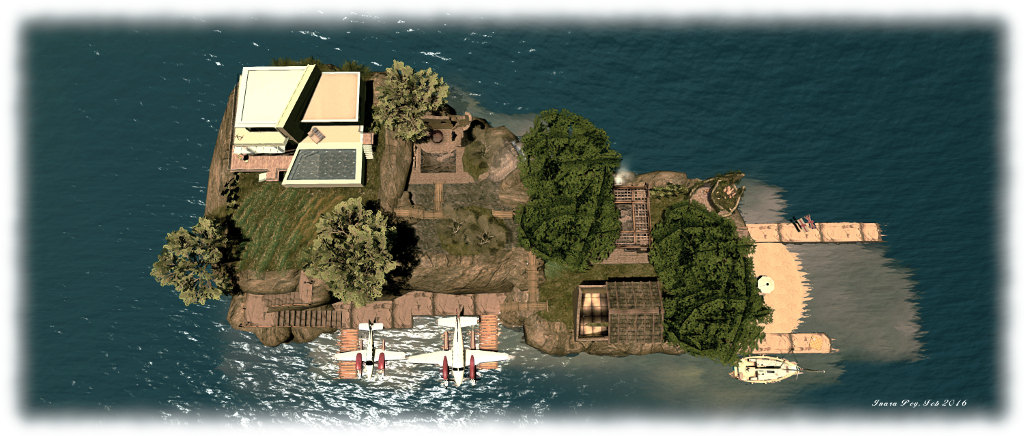
Overhead view of the revised island layout with the new beach location and moorings for our two ‘planes. Also visible is the more watery mid-level of the island
I’m always fiddling around with the island home – as regulars to these pages know only too well! While the changes made in December left us happy with the overall look and feel to the place, I still found one or two things niggling me. Fortunately, Caitlyn is very understanding of my need to fiddle, twiddle and generally play around with mesh and prims, so when the niggles reached a point where I wanted to start doing the fiddling and twiddling, she handed me the prim glue and loads of encouragement 🙂 .
Three things in particular had been playing on my mind: the boat and plane slips, which still looked a bit excessive to my eyes. So over the past few weeks as time has allowed, I’ve been introducing changes, adding new (and novel) moorings for our two motorboats (no, I’m not saying how the moorings are novel; we have to have some secrets!) and re-working the west and southern sides of the island, as well as the “mid level” part of the garden.
In particular, the west side of the island has had the beach and the winding rock path leading down to it from the house removed. While the path looked good, the physics on it also made ascents and descents along it look a bit awkward in my eyes, avatars often seeming to walk on air. It also, when all is said and down, took up a lot of space.
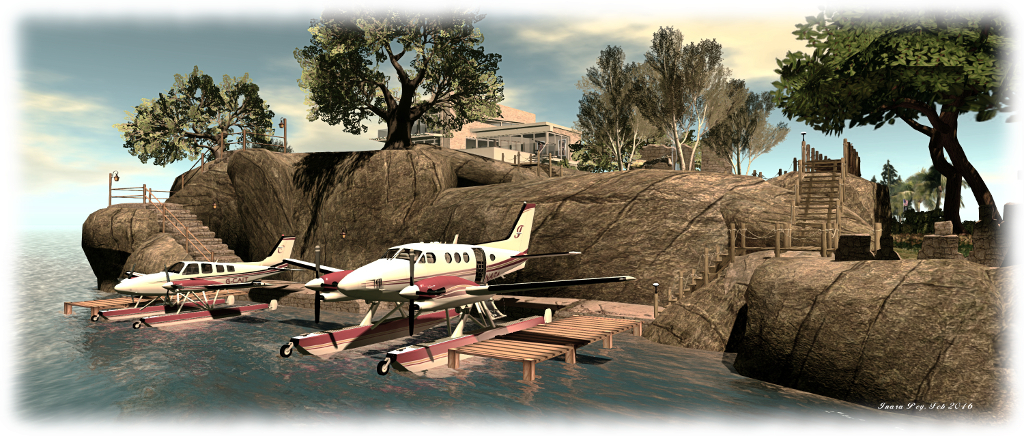
The ‘planes at their new mooring below the house
The path has now been replaced by a set of stone steps leading down the cliff in a switch back, while the beach has been replaced by a stone jetty and moorings for our two DSA aeroplanes. The TUFF stone steps kit proved very handy for all this, providing the means to add the steps and made the jetties. A mesh system, it is nicely modifiable, parts easily resized and re-textured. The latter being handy for us, as it allowed the steps and jetties to be textured to match the stonework of the rest of the island’s ruins (those interested in the kit can also see it at Rya Nitely’s in-world store).
Moving the ‘planes has allowed the southern end of the island to be tided-up, with the mass of moorings there replaced by a couple of stone jetties (courtesy of the TUFF stone steps kit again). These provide both moorings for our Loonetta 31 and the boats or seaplanes belonging to visiting friends, and protects our relocated beach from the tide.
The revised mid-level part of the island, partially flooded, but retaining the “bathhouse” and now with a little pot for the garden hammock
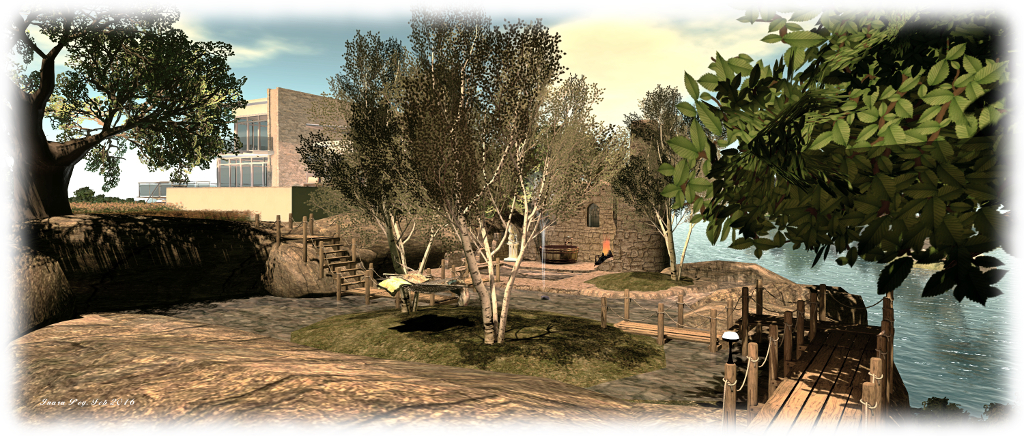
The other change we’ve made is to make the mid-level of the island a little more watery. After installing the outdoor bathing area, the falls and their source pond looked a little unnatural. Solution: “flood” the level with water from a smaller fall exiting from the upper cliffs, and provide a sense of it flowing down to the falls. Stone foundations have been added to the “bathhouse”, increasing the feel of it being part of the island’s old ruins, and board walks now provide passage over the water channels.
Overall, I think the tweaks suit the island, as does Caitlyn. Certainly, having an uncluttered southern end to the place, where we can sit on sun loungers and watch the passing vessels and occasional race through the regions, gives the place a much nicer appearance. And that now really does seem to be job done – so if you’re very lucky, this might be the last time I witter on about the island 🙂 .







 Inara Pey: Living in a Modemworld