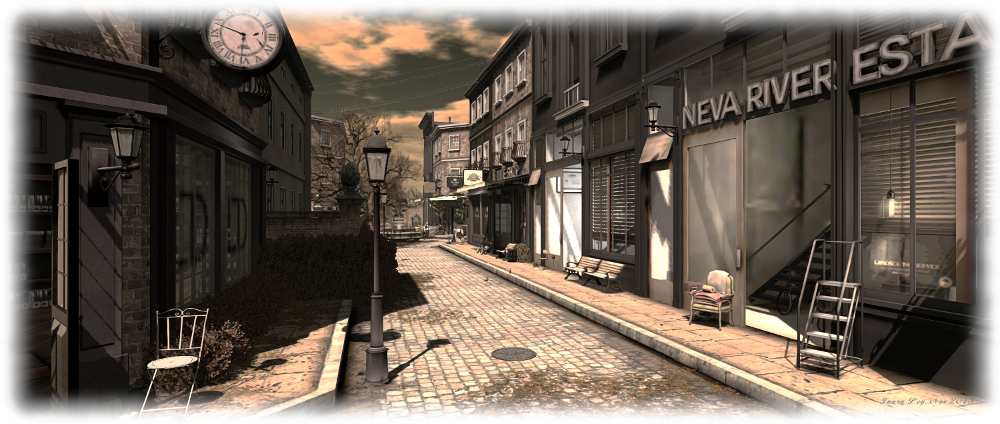
Saint Pete City is the latest region design by Neva Xenga (Neva Crystall) to open in Second Life. As the name suggests, this is an urban environment, one with a strong Dutch influence in terms of architecture and feel.
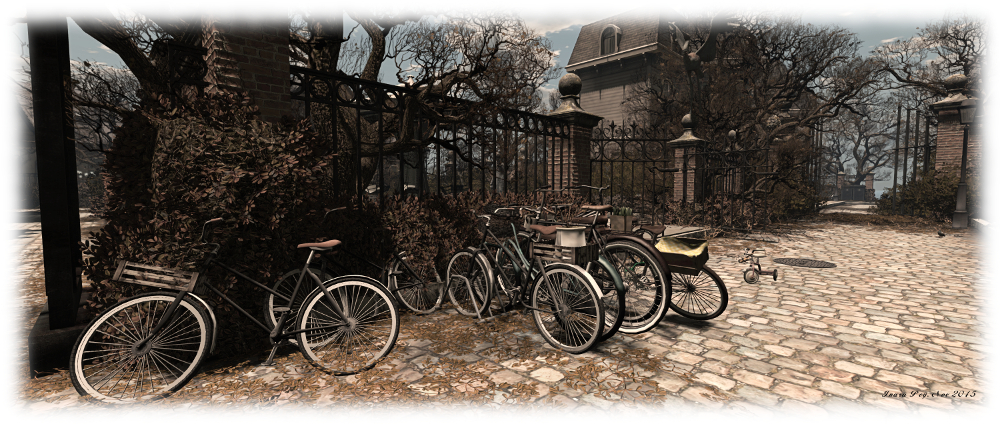
The landing point places visitors on a small coastal cove sitting between high shoulders of rock, a lighthouse standing guard to one side. Facing this across the street, is Saint Pete, awaiting your pleasure under a slightly sombre evening sky. Here the streets are largely cobbled, and the architecture very much modelled on that of The Netherlands, with copious numbers of bicycles scattered around to add to the feeling that one is not a great distance away from Amsterdam, Rotterdam or Utrecht.
Walk through the streets and you come across coffee shops, bric-a-brac stores, bookshops, a bicycle shop, hotel, art gallery (where some of Loverdag’s superb images are on display) – in short, everything you’d expect to find in a cosmopolitan environment. There’s even an old industrial unit, now empty and perhaps awaiting being put to a new use.
Such is the design of the region, it’s easy to imagine you’re walking through a much large area than is the case – a feeling enhanced on the west side of the region, where, between the town and a rocky plateau, sits a walk under denuded trees, apparently caught in early winter, with benches available for warmer days, when strolling couple might want to set and rest, all of which gives the feeling of walking from one part of town to another as one passes through it.
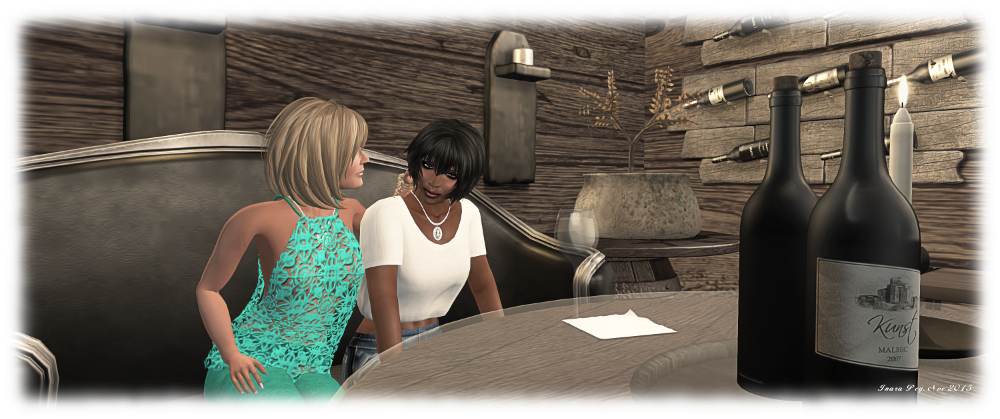
Many of the houses and stores here are empty, but others – such as the coffee shops and stores mentioned above are not, and visitors are welcome to enter them and sit or browse – and the wine shop / bar comes particularly recommended. For those with local sounds enabled, Saint Pete is another of the many regions in SL where care has been taken to create ambient sound scape to enhance the feeling of walking a busy community.
All of Neva’s sim designs demonstrate a wonderful eye for detail and offer environments rich for exploration and Saint Pete City really is no exception. Caitlyn and I spent a pleasant time wandering around, bumping into to people and enjoying the sights and sounds, and took time out to rest on one of the many benches found in the various squares, listening to the birds and the sounds echoing up the street, before rounding things off by sitting in the local wine bar, enjoying a glass of wine and one another’s company – just as we all might do while enjoying our time immersed in a visit to somewhere new.
This summary is published every Monday, and is a list of SL viewer / client releases (official and TPV) made during the previous week. When reading it, please note:
It is based on my Current Viewer Releases Page, a list of all Second Life viewers and clients that are in popular use (and of which I am aware), and which are recognised as adhering to the TPV Policy. This page includes comprehensive links to download pages, blog notes, release notes, etc., as well as links to any / all reviews of specific viewers / clients made within this blog
By its nature, this summary presented here will always be in arrears, please refer to the Current Viewer Release Page for more up-to-date information.
Project Azumarill (HTTP updates) RC viewer updated to version 3.8.7.306796 on November 2 – provides improved performance and stability. Impacts include: asset uploads, AISv3 inventory manipulation, VMM, Experience management, LSL compilation, Simhost event polling, etc. (download and release notes).
Project viewers:
Vivox Project viewer,version 3.8.7.307189, released on November 6 – correcting a number of Voice quality and connection issues on both Windows and the Mac (download and release notes).
Seanchai Library has announced the return of one of their popular seasonal presentations: The Dickens Project.
First presented in 2012 to mark the 200th anniversary of author Charles Dickens’ birth, The Dickens Project is an interactive, immersive event focus on what is probably his most well-known story, A Christmas Carol.
The 9-day festival will commence on Saturday, December 12th and will present over 15 hours of reading from various adaptations of the story, set within a special Victorian environment. Presentations will take place at different times of the day throughout the festival in order to make reading the readings accessible to residents from around the world. Those attending will be invited to tour the set, where they will encounter interactive information on the times and work of Charles Dickens, and a seasonal ball will round-out proceedings at the end of the festival.
There will be no charge for those attending readings, but donations will be accepted on behalf of the Community Virtual Library, a registered 501(c)(3) non-profit organization, connecting residents with information resources, reference services, and serving as a networking tool for information resource professionals.
Caledonia Skytower, Shandon Loring (centre) and Kayden Oconnell in an evocative shot of the virtual / live performance by Bear Silvershade
A Christmas Carol has been a seasonal favourite with people from all around the globe since its first publication. It has been serialised, dramatised, and made into numerous films over the decades, and has seen a number of television and radio serialisations. It’s also a story which succeeded purely as a result of Dickens’ own determination: he self published the book.
For an author if his stature at that time, such an act was unheard-of. Yet Dickens did just that. He hired an illustrator and supervised the work, he oversaw the book’s design and consulted on the advertising. His publishers Chapman and Hall, who had demurred on the project, served only as his printers and received a fixed fee from every book sold.
The Dickens Project also has its own uniqueness. In 2013, following the success of the 2012 festival and preceding that of 2013, there was a special performance of a Christmas Carol which crossed the digital and physical world divide. On December 1st 2013, Caledonia Skytower, in her alter ego of writer Judith Cullen, performed before a live audience at the Knights of Pythia Temple in Tacoma, Washington, USA, while on a large screen beside her, fellow presenters Kayden Oconnell and Shandon Loring appeared from within Second Life.
As noted above, this year’s production will take place in a period setting, with members of the Seanchai Library staff also dressed in period costume. In keeping with this, audience members will be invited (but not obliged) to also attend in dress suitable for the wintry setting of the story, and suitable for the Victorian era, to add to the general ambience.
The final schedule for The Dickens Project 2015 has yet to be set, but you can be sure that when it has been, I’ll be providing it through these pages together with SLurls to the event, and may also have some behind-the-scenes photos to hopefully whet appetites!
When discussing Mars exploration, it is easy to forget that NASA, the US space agency is far from alone. Both Europe and India are currently operating vehicles in orbit around Mars, while in 2004, the European Space Agency became only the third agency in the world to attempt a landing on Mars, when the British built Beagle 2 mission separated from its Mars Express parent craft but unfortunately failed to safely arrive on the surface of Mars.
Mars Express has gone on to be one of the most successful Mars orbital mission on record, carrying out a range of duties similar to those of NASA’s Mars Reconnaissance Orbiter (MRO), which it preceded to Mars by some two years. Now approaching the end of its 12th year in operation around the planet, Mars Express continues to return a wealth of data to Earth and also functions as a back-up communications relay for the two NASA rovers currently operating on the surface of the Red Planet.
An artist’s impression of Beagle 2 on Mars (image: European Space Agency)
Quite what happened to Beagle 2 remained unknown until early in 2015. It had been thought the tiny lander, just 1 metre (39 inches) in diameter but packing a huge amount of science capabilities into it, had been lost as a result of burning up in Mars’ tenuous atmosphere or as a result of its parachute landing system or air bags failing. However, as I reported in January 2015, images captured by NASA’s MRO revealed Beagle 2 had landed quite safely, but one of its solar panels failed to deploy, preventing the craft from communicating with Mars Express and Earth.
In 2018, ESA, working in conjunction with the Russian Federal Space Agency, Roscosmos, plan to overcome Beagle 2’s failure to gather science from the surface of Mars with a rover vehicle called ExoMars Rover, part of an ambitious 2-phase mission itself entitled “ExoMars”, and which commences in 2016.
ESA’s ExoMars TGO: due for launch in March 2016, part of a 2-phase mission to search for direct evidence of life, past or present, on Mars. In this artist’s impression, the capsule-like Schiaparelli has already been detached from the circular base of the vehicle (image: European Space Agency)
The first part of the mission will commence in March 216 with the launch of the ExoMars Trace Gas Orbiter (TGO), a telecommunications relay orbiter and atmospheric gas analyser mission. This will arrive in orbit around Mars in December 2016 and will proceed to map the sources of methane on Mars, as well as analyse and study other trace gases. Methane is of particular interest to scientists its likely origin is either present-day microbial life existing somewhere under the surface of the planet, or the result of geological activity. Confirmation that either is the cause would be of significant scientific benefit.
Whilst in operation in Mars obit, TGO will deploy Schiaparelli, an Entry, Descent and Landing Demonstrator Module (EDLM). This is intended to test some of the key technologies needed to safety see a rover-carrying lander onto the surface of Mars, such as the ability to control touchdown orientation and velocity. Most uniquely, the landing will take place during the Martian dust storm season, presenting scientist with the opportunity to characterise a dust-loaded atmosphere during entry and descent, and to conduct surface measurements associated with a dust-rich environment.
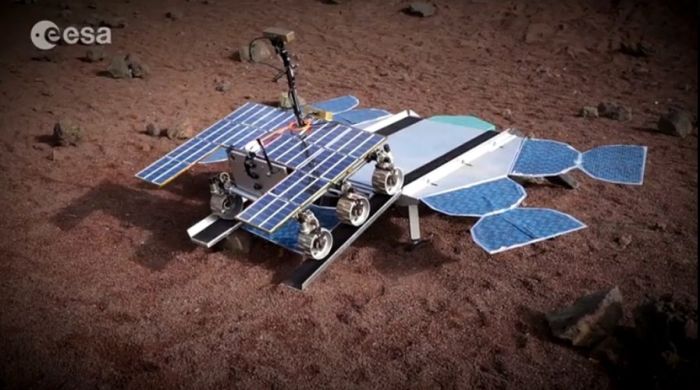
The Advanced Prototype ExoMars Rover undergoing remote deployment testing in 2015 (image: European Space Agency)
The 2018 ExoMars Rover mission, although yet to be finalised, is primarily designed to find evidence of microbial life, past or present, under the Martian surface. It is provisionally scheduled for launch in May 2018, although this may be delayed until August 2020, around the time NASA Mars 2020 rover mission is due to fly.
The ExoMars vehicle is somewhat larger than NASA’s solar-powered Opportunity rover, but at some 207 kg (456 lb), is about one-third the mass of Curiosity and the Mars 2020 rover. A unique aspect to ExoMars Rover is that it will carry a drilling system aboard which, for the first time, will allow samples to be obtained from almost 2 metres (6.5 ft) below the surface of Mars. The rover is expected to operate for around 6-7 months, but could remain operational for much longer. During that time, it should cover a distance of around 4 km (2.5 mi), after landing in early 2019.
The four proposed landing sites for ExoMars Rover. The colours on the map represent the relative elevations of surface features on Mars. White / Red refer to the highest elevation, such as the Tharsis Bulge and the great volcanoes to the north-west, and blue the low-lying regions, such as the far northern latitudes and the great impact basin of Hellas in the south-east, which likely caused the Tharsis Bulge upwelling
Second Life: “almost as diverse as the physical world we live in” – Ebbe Altberg
Martin Bryant, Editor-at-Large at The Next Web caught up with Linden Lab’s CEO, Ebbe Altberg, in Dublin at the start of November, where they had both been attending the 2015 Web summit conference.
During a 10-minute audio interview, Mr. Bryant offers a series of questions which, while they may not reveal anything new to those engaged in Second Life or following the unfolding news about “Project Sansar”, nevertheless cover interesting ground and offer food for thought on a number of fronts.
The recording is prefaced with a series of useful bullet points under the title Think Second Life died? It has a higher GDP than some countries, itself is an eye-catching title, which help put some perspective on just what Second Life has actually managed to achieve over 12 years, and sets the stage for the broader discussion.
The interview starts from the position that the media have tended to get Second Life wrong, noting that far from having failed or gone away, it is still operating, still engaged some 900,000 active users every month, just 200,000 a month down from when it hit a peak of around 1.1 million 7+ years ago. Not only do these figures tend to highlight Second Life’s (albeit very niche) ability to attract and hold an audience, they also put oft-repeated claims that people are somehow leaving Second Life en masse into perspective. The outward trickle of active users is there, but it’s hardly a the deluge all too often portrayed. And those who remain are still capable of powering an economy with a GDP of some US $500 million.
From here, the conversations travels by way of the kind of virtual goods on offer inside Second Life to arrive at a question about the “typical” Second Life user, which generates a well-rounded reply.
Well, it’s a huge variety … there’s no typical about it. It’s like asking, “what’s a typical person from Ireland?” There are educators, there are students, there are health professionals, there are patients, there are fashion fashionistas, there’s partiers, gamers, role-players. People just socialise around pretty much anything you can think of. It’s almost as diverse as the physical world we live in.
Further into the conversation, there is a re-emphasis that even with “Project Sansar” coming along, there are no plans on the part of the Lab to discontinue Second Life, with Ebbe again demonstrating a pragmatic view on the amount of investment users of Second Life have made in the platform.
Second Life will continue. We have no plans to shut down Second life or forcibly migrate users from one to the other. So users can ultimate choose where they want to spend their time. And there are probably so users that have spent so much time creating incredible communities around all kinds of interesting subject matter that might just fine it too much effort to do it all over again on a new platform. so they can stay in Second Life, that’s fine.
Obviously, if the vast majority of users in Second Life opt to make a full transition to “Project Sansar”, then it will call into question how long SL can remain a commercially viable platform – but is this likely to happen overnight? Probably not (which is not to say it won’t, at some point happen) over time). The transition is liable to be gradual, simply because it is going to take “Project Sansar” to grow to a level of sophistication offered by SL: as the Lab has made clear throughout 2015, everything isn’t simply going to be in place when the open alpha commences in early 2016 – that’s why they’re calling it an “alpha”.
An image from the Project Sansar: looking to the future of VR
The more detailed discussion of “Project Sansar” starts with a reiteration that it is being specifically – but not exclusively – developed to operate with coming plethora of VR HMDs and other devices, and that it will be “consumable” (i.e. accessed via) computers (initially PCs) and mobile devices. It is here that mention is made of something that may have been missed in broader discussions about the new platform: there will be no “one-size-fits all” client / viewer.
Instead, client functionality will be determined by client device capability. If you’re on a PC platform, you’ll have access to the full range of capabilities to both “consume” (that is, access, use and participate in) “Project Sansar” experiences and you’ll have access to the tools to enable the creation of those experiences. If you’re using a mobile device, you’ll be able to “consume” experiences, but not the tools to build them. Which makes sense.
Ebbe Altberg: offering a good perspective on LL, SL and “Project Sansar” for TNW readers / listeners
In discussing the likely impact of VR, Ebbe takes the pragmatic view that things aren’t going to happen overnight, just because the first generation of high-end headsets are going to appear in a few months; it’s going to take time for the market to grow, and there is still much more to be sorted out.
This is a view I hold myself, so no argument from me. However, where I do perhaps hold a differing view on things is to just how important avatar based virtual experiences are actually going to be outside of some very niche environments.
Even if VR isn’t overhauled by AR in terms of practical ease-of-use, widespread practical applications, convenience, and appeal, I also cannot help but feel consumer-focused VR might offer such incredible opportunities for immersion, entertainment, training, etc., that it will see the use of avatar focused virtual environments remain somewhat marginalised in terms of acceptance with the greater VR community, just as Second Life has been marginalised with the greater on-line social community.
Endless Summer, designed by Kiddo Oh, is the home to her Dead Dollz store and brand, offering mesh apparel for women. However, it is also much more than this; it is a region which has been beautifully crafted to offer visitors not only a store to browse, but a beautiful place to be explored and discovered.
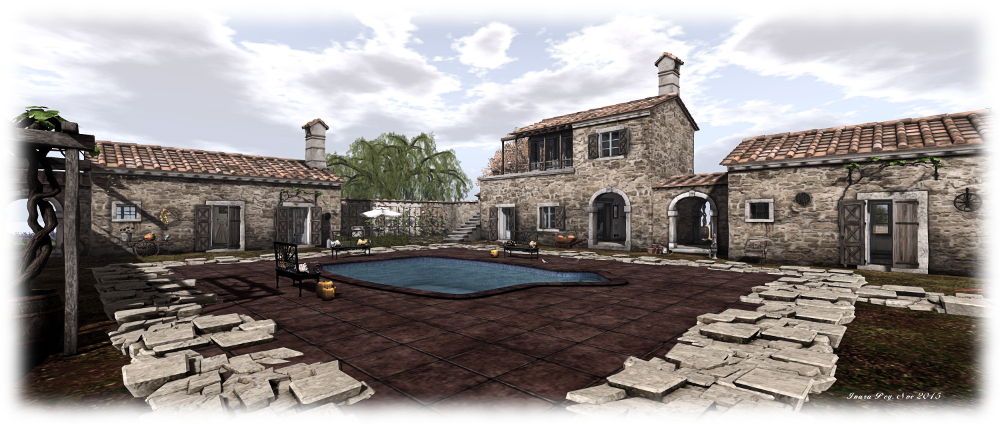
The main landing point is in the walled courtyard of Kiddo’s store, which presents the first hint that there is much to be enjoyed here. The store charmingly sits within a Tuscan villa complex built around the spacious courtyard, the walls of which are either whitewashed or stone (or a mix of both) depending on who last touched where. Between the villas and outbuildings, archways pass through the walls, enticing visitors to explore the land beyond.
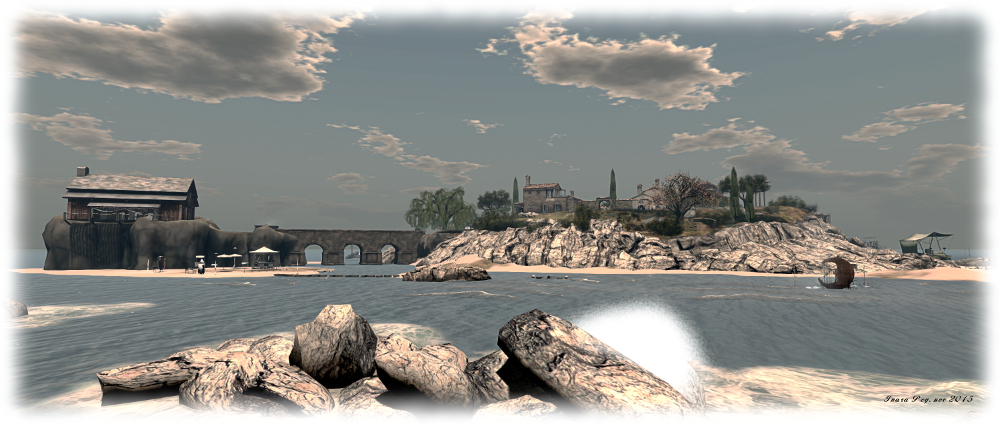
Through the arch to the north side of the store courtyard. closest to the landing point, a dirt track winds its way down a gentle slope to follow the line of the island’s rocky edge as it faces the sea, leading you to a stone bridge arching its way across a narrow channel of water to a smaller rocky plateau.
Here, within the appropriately entitled Trompe Loeil Wedding Barn, can be found Kiddo’s range of bridal gowns, a little brick-built café nestled close by offers a place for unhurried contemplation of which to purchase for that special day. Sheltering under the outcrop is a sandbar where a little ice cream concessions resides, complete with parasoled seating. However, to reach it, you’ll need to return to the main island and descend the steps next to the bridge and wade through the shallow waters of the intervening channel.
These steps also provide access to the ribbon of beach which almost encircles the rocky cliffs and slopes of the main island. Follow this to the west, and more will be revealed, be it the events stage looking out over the sea, the wooden stairs climbing back up to the plateau and store above, Kiddo’s workshop house lying just off the coast, or places to just sit and watch the ebb and flow of the tide.
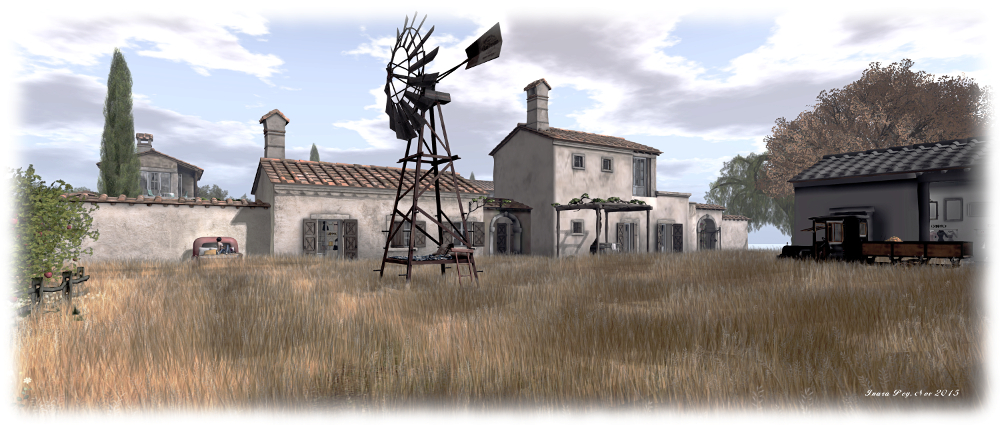
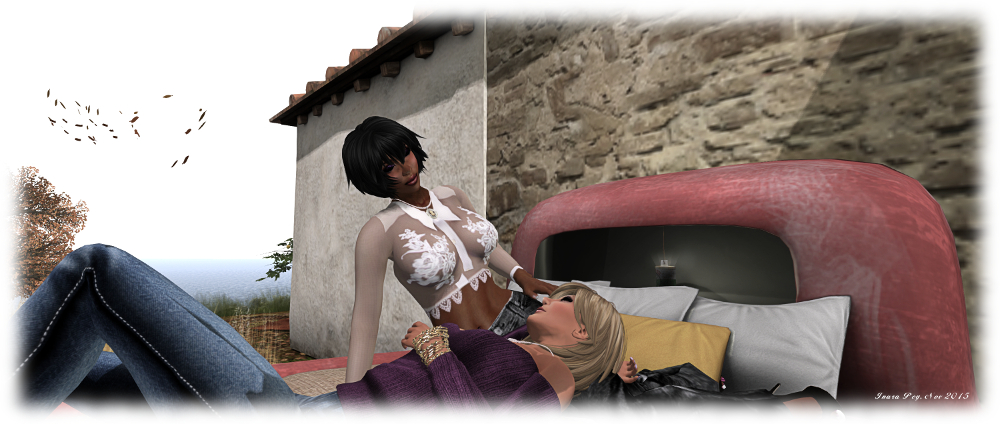
Around the villa complex, the fields give a hint of the time of year: grapes are heavy on the vine, apples sit ripening on the orchard trees, and corn cobs are almost ready for picking. A rippling lake of golden grass to the west of the store tells of a summer that has been rich in hot, dry days. A tall finger of a windmill rises from the midst of this grass offers a cuddle spot cradled between its feet, while the rear portion of an old pick-up positioned against the store wall nearby presents an alternative resting place for those returning from a walk around the island.
And this is just scratching the surface; there is more to be discovered as you explore, be it the little tram café or the love seats or the offshore lighthouse and shack as they enduring a very local downpour, or inside Kiddo’s store itself. This is a place as beautifully crafted as the rest of the region; one which encourages slow browsing, apparel displayed in such a way it’s as if one can reach out and touch items and feel the materials under fingertips.
All told, Endless Summer packs and incredible amount into it, and Kiddo deserves praise for creating an environment which is such a delight to the eye and camera, and fully deserving of the time taken in exploring it.
 Saint Pete City (Flickr) – click any image for full size
 Seanchai Library has announced the return of one of their popular seasonal presentations: The Dickens Project.





 Inara Pey: Living in a Modemworld