The end of the year always brings with it reviews of what’s happened during the unfolding 12 months. Some can be lengthy (*coughs at her own 3-part series of late), others brief.
The Lab is no exception to the rule, and in Second Life 2015 Mix – A Greatest Hits Compilation, they offer a thumbnail sketch of some of the more positive developments and events within SL which have marked the year.
Starting with the Project Bento announcement (a project I’ve been able to observe and will be bringing more background on in the future as well as tracking developments through regular project updates), the post provides a grab bag of technical changes to the platform.
These include the arrival of the Viewer-Managed Marketplace, which had its initial main grid beta launch back in April, following a long lead-in over 2014 / early 2015, with full migration starting in July, in one of the more successful Marketplace updates Second Life has seen. Also getting a mention are the arrival of Chromium Embedded Framework, through the CEF viewer, the notifications updates, and Hover Height, both of which were viewer updates suggested by users. Mention is also made of the 28 simulator updates made through the year,
Away from the technical updates, The blog post refers to the new “Classic” starter avatars, which were introduced in November.
PaleoQuest, the Lab’s dino-ish adventure game gets a mention in the official look back at the year, which i admit to rather enjoying
2015 saw a change in Premium membership perks, as they gradually turned away from the usual (and often basic) gifts and more towards more practical offerings, as the Lab’s blog post mentions. These have included things like the increase in the group membership allowance, and the removal of VAT on membership fees, which gave rise to speculation on what was going on to allow it.
Also getting a mention are the recent changes in land set-up and transfer fees, although how effective this will be is perhaps debatable, as I commented at the time, and also – with regards to grandfathered fees, seemed to have a slight edge of giving with one hand, taking back with the other.
Ending with a look at the Lab’s on-going engagement with the community through in-world meet-ups and other events, and giving a mention to forthcoming capabilities designed to help improve the user experience, such as Avatar Complexity, this may seem a lightweight look back at the year; however, it does constitute a fair round-up of the positives SL has seen internally through 2015. In the meantime, I’ll be offering my own more extensive review of things – SL, Sansar, VR, et al, as reported through these pages through the year, over the Christmas and New Year period.
There are rumours circulating that members of the Lab and a number of moles will be present at the Winter Wonderland, near the landing area and later at the snowball fight arena.
The rumours appear to originate with Patch Linden, who is reported to have been heard whispering:
Today at around 11am SLT we’re going to be doing a Linden/Mole meet and greet in the Winter Wonderland regions near the landing area. We’ll probably hang out there for a bit handing out gifts and then we’re going to spend the rest of the afternoon in the snowball arena.
So, if you’re looking for something to do, why not hop over to the Winter Wonderland and see if the rumours are true?
On Tuesday, December 22nd, the Main (SLS) channel received the same server maintenance project previously deployed to the three RC channels. This comprises crash and internal simulator fixes; LSL HTTP requests accessing data sources that require non-text Accept headers (such as the Destination Guide); and updates to group member counts to help deal with recent group database issues.
SL Viewer
With the no change window now in effect, no updates are anticipated with any of the current crop of official viewers until after Monday, January 4th, 2016. These are:
Release viewer, version: 4.0.0.309247, dated December 17th – formerly the Chromium Embedded Framework RC viewer – release notes
Project Azumarill (HTTP updates) RC viewer, version 3.8.7.308134 dated November 25th – release notes
Vivox (voice fixes) RC viewer, version 3.8.7.307744, dated November 17th – release notes
Quick Graphics (Avatar Complexity and graphics presets) RC viewer, version 3.8.7.306758, dated November 12th – release notes
Maintenance RC viewer, version 3.8.7.308556, dated December 3rd – release notes
Project Bento (avatar skeleton enhancement) viewer, version 5.0.0.309171, dated December 17th – release notes
Oculus Rift project viewer, version 3.7.18.295296, dated October 13th – release notes
Obsolete platform viewer (for users of Windows XP and OS X versions below 10.7), version 3.7.28.300847 dated May 8th – release notes
It is anticipated the HTTP RC viewer and the Vivox RC viewer will be released as a single RC viewer very early in 2016.
Project Bento
Abramelin Wolfe of Abranimations fame has issued a viewer demonstrating the enhanced Project Bento skeleton using mocap finger data – watch the avatar’s fingers!
Commenting on the video at the last Simulator User Group meeting for 2015, Simon Linden said, “that video is cool :)”!
Bone Translation and Rotation
As reported in my week 51 project updates, I reported how the Lab was asking for more detailed feedback on specific requirements animators and creators felt they might need with the Bento skeleton. The comment, made by Oz Linden, came after Vir Linden responded to feedback relating to bone translation through animations, rather than relying purely on rotation with the facial bones (as is currently the case).
These comments have led to more comprehensive feedback through the Bento discussion forum thread, including two videos by Raz Welles, and animated GIF examples from others, demonstrating the need for translation as well as rotation to achieve various results with facial expressions. However, the Lab would still prefer specific examples to be reported in detail (e.g. on the JIRA), with the appropriate files supplied, as Oz Linden again notes on the forum. He goes on to point out as well, that it isn’t just “new stuff” the Lab is looking to offer through Bento:
I’ve seen a number of posts here that include some variation on “we have always had to do XYZ this way because of the SOMETHING bug, and so we can’t do SO-AND-SO” (for example, joint offsets not loading correctly). If there are existing issues that are directly related to Bento (like joint offsets not loading correctly), we’d like to get them fixed so that we can get some of these obstacles out of the way. So, if you’ve got one, please describe it (see previous paragraph – concrete examples we can experiment with) by filing a BUG in JIRA (put [Bento] in the Summary). References to long-standing issues are ok; we’re not only trying to do new things, we’re trying fix at least some old ones too.
Some attending the Simulator User Group meetings have expressed a hope that Bento might offer (or pave the way for) animated objects which could use the skeleton. This would provide a means to provide NPCs and creatures which are not necessarily reliant on bots (see SH-2642 as a rough example of this kind of suggestion as well). responding to this at the Simulator User Group meeting on Tuesday, December 22nd, Oz said:
Skeletons for non-avatar objects are out of scope for this round. It’s an obvious improvement that would be good to do someday; whether and when is not currently knowable.
Asked if filing a feature request would be appropriate, he added, “I’m pretty sure we’ve got several variations on that request, but one more certainly won’t hurt.”
Overall the Bento discussion is healthy, although how it all translates into actionable items with regards to the new avatar skeleton extensions remains to be seen. As the Lab has indicated, hopefully there will still be plenty of opportunity to put forward and test further ideas, examples and suggestions during the first part of the New Year to help improve what is currently being offered.
Object_Rezzer_Key
Object_Rezzer_Key is a new parameter which is to be added to llGetObjectDetails() early in the New Year. It will allow a rezzed object to find the key of its parent rezzer, then use llRegionSayTo() to chat back to that parent. It’s an option which has come up for discussion at User Group meetings a number of times, and at the meeting on Tuesday, December 22nd, Simon Linden indicated that it is something he is currently working on.
The parameter will only work with new objects within a region (existing objects will return a null_key when queried), but it should work after restarts and region crossings (incl. teleports), and with objects which are initially attached and then dropped. Full details will be available when the parameter is officially added to llGetObjectDetails() – Simon offered this news at the User Group meeting by way of being a small gift to those who have been requesting it.
Further Scripting Options for Experiences?
Another set of requests frequently put forward is for further scripted capabilities to be added to Experiences – such as more permissions, camera function additions / fixes further attach / detach / switch object options and an increase in memory for compiling Experience scripts. On these, Simon would only say that he has been looking into increasing script memory for Experience, “and ran into a really sticky problem … how to deal with it when the object goes outside the experience… how it should behave when you go outside the experience area.”
Oz Linden also stated, “Without trying to guess which changes we might make (because I have no idea yet), it has been noted that Experiences gives us some more latitude to provide script capabilities we would not have before because of griefing potential.”
So, it will be interesting to see what might lie in store for Experiences once the Lab are willing to reveal more about what they have planned, and what actually made it into those plans.
The Drax Files Radio Hour is celebrating its 100th (ish!) episode during Christmas week 2015, and to celebrate, they’re holding a special live recording session, and inviting people to attend as part of the audience.
The podcast series first launched back in January 2014, although the initial idea for such a series goes back as far as the latter half of 2013. Hosted by Draxtor Despres and Jo Yardley, the show generally presents an hour long segment each week, focus on news, opinion, interviews and reports on all things virtual – virtual worlds, virtual reality, virtual living.
If I’m totally honest, the show was, early on, far too infatuated with all the hype surrounding the Oculus Rift, which led to a certain slant becoming increasingly (and sometimes painfully) apparent. However, this doesn’t negate the fact that overall, the series has presented some pretty thought-provoking and also very informative podcasts. Virtual harassment, virtual identity, examinations of the Lab and Second Life, digging into the Terms of Service, looking at virtual worlds and education – all these and more have been covered, while interviews with folk from the Lab, from education, the worlds of VR, AR, and interactive fiction, and (again) more have offered many defining moments for the show.
For the 100th show recording. Drax and Jo will be talking with Oz and Vir Linden, Jessica Lyon and Ed Merryman from Firestorm, and Kiana Writer and Kess Crystal from MadPea Games, in a far-reaching discussion encompassing a look back over 2015, a look ahead to 2016, and embracing the upcoming Gateway trial programme, the recently announced Project Bento, and maybe a little more besides.
Drax tells me that those attending the recording get a free Drax Files cap
The show will be recorded at the Firestorm Amphitheatre on Wednesday, December 23rd, starting a 12:00 noon SLT. however, those wishing to be a part of the audience as advised to get there a little ahead of time to both secure a seat and help ensure the recording can start relatively promptly.
Lit Up Singapore is an annual international literature festival held in Singapore, organised by Word Forward and The Writers Centre, Singapore Ltd. Founded in 2009, the festival features writers and performers from around the world who come together to celebrate literature, story telling, the spoken word as performance art, and more.
Second Life storyteller Singh Albatros contacted me about Lit Up 2016, which is set to include a unique collaboration between himself and four noted Second Life Machinima makers, something which may open the door for closer ties between The Writers Centre in Singapore and Second Life.
Following the successful UWA 3d Art and Machinima Challenge, Pursue Impossible, the organisers of Lit Up have invited the makers of the top three winning machinima films – Kobuk Farshore, Tutsy Navarathna and the team of Lilia Artis and Haveit Neox – to each produce a short machinima film based on Singh’s poems and micro-fictions.
Kobuk Farshore, Tutsy Navarathna and the team of Lilia Artis and Haveit Neox have all been invited to collaborate in making films to be shown at Lit Up Singapore 2016
“We are delighted the artists have accepted the invitation and commission,” Singh told me. Better known in the physical world as respected storyteller Chris Mooney-Singh, he is the festival’s Artistic Director, and recently his verse novel Foreign Madam and the WhiteYogi was highly commended in the prestigious Victorian Premier’s Literature Award’s Unpublished Fiction category.
He continued, “We’ll be conferring further with all four after the holiday period, and as Writer in Residence at The Writers Centre Singapore, I am excited to see how these top artists each interpret my work; it will be a fascinating project, and something unique: debuting a virtual collaboration for a physical world festival.”
Chris Mooney-Singh, Writer in Residence at The Writers Centre and Artistic Director for Lit up 2016, together with his digital alter ego, Singh Albatros
“These diversely talented machinima makers have each been offered a commission to create something for a cutting edge live literature digital arts festival in Singapore,” Lit Up’s media contact, Rahimah Rasith, said of the invitation, when announcing the news on December 16th, 2015.
“In a sense we feel we have been passed the torch by the UWA’s Art Challenge director Jay Jay Zifanwe and the University of Western Australia in forging a creative alliance,” she continued. “Following UWA’s lead we hope to execute other in-world events and stream them live to Facebook.”
If there are sufficient funds available, it is hoped that the festival will be able to fly all four of the machinima artists involved in the collaboration to the 2016 event in November 2016, where they will be able to meet with members of the Writers Centre and with Chris, in addition to seeing their films premiered at the festival and participate in panel discussions on the relationship between virtual art and the physical world.
Kobuk Farshore’s winning entry in the UWA’s MachinimUWA VIII: Pursue Impossible – one of the prize winners offered a commission for Lit Up 2016
This could be the start of an exciting new collaborative effort between art and media spanning the physical and digital worlds, and I look forward to covering this project, and any developments which spin out from it, in the future. In the meantime, I extend my thanks to Singh for contacting me about the project, and extend my congratulations to the four machinima makers.
Scene IV – The Death is the title of the fourth and final part of Ux Hax and Romy Nayar’s 4-part series of scenes entitled Escenas / Scenes, now open at MetaLES. Taken together, all four parts are apparently intended to tell a story, although they are not necessarily being presented in chronological sequence – and the first, second and third parts have certainly been intriguing, with their rich influences of the major arcana from the tarot.
This tarot theme continues, and is perhaps most evident in this final scene, which is subtitled The future dawns, the loneliness will be difficult for us – although how we construct a story from it might well be down to each of us to determine. As with the first three parts of the series, this piece is on a truly gigantic scale; something which quickly becomes apparent on arrival, where you find yourself standing on top of a huge table, complete with an equally large bowl of fruit and two toppled goblets. But these draw the attention only briefly; it is the individuals around or near the table which capture and hold the eye.
Sitting to one side of the table is Death, skull covered by a cowl, left arm outstretched, on which sits our friend, the crow, messenger of the underworld. Resting her hand lightly on that of Death, and seated alongside him, is a woman dressed in a bridal gown and veil, a goblet of wine delicately held in her other hand.
At the head of the table, helping himself to a bunch of grapes is the Devil, whom we originally encountered in the second part of this series. On the table in fromt of him lie the other cards of the major arcana previously seen in Escena / Scenes – the Hermit, the Chariot, the Scales of Justice, the Wheel of Fortune, the Fool and the Tower. Facing the Devil, and standing at the far end of the table, stands Temperance, pouring forth another goblet of wine.
Of all the characters here, only the veiled woman might seem a little out-of-place. At least until one considers the High Priestess of the tarot. Originally called La Papessa, or “The Popess”, a woman shown in papal gowns, and a triregnum. Later, it became the High Priestess, and catholic influences removed, to be replaced with more subtle hints – the pillars of Boaz and Jachin, which also have symbolism within freemasonry, and between which the High Priestess is usually depicted as sitting.
In this tableau, it would seem the bridal gown might be symbolic of La Popessa, and the idea of the church as the “bride” of Christ, echoing the more catholic elements of the early tarot, which the tall candelabras standing either side of the chairs on which she and Death sit might be seen as symbolic of the pillars of Boaz and Jachin. There is also, perhaps, something else here: a subtle inference of the relationship between religion and death.
So what are we to make of all of this, the four scenes taken together? One possible interpretation might be that taken as a whole, this could be seen as a commentary on our relationship with death: the one aspect of the tarot which has been present throughout, if not always visible until this point in time. His is a presence which can be seen is the old woman’s struggles to escape the hole in EL Tiempo / The Time: in the presence of the Hanged Man himself in Decisiones / Decisions: and the vanishing / materialising cradle in El Miedo / The Fear. They are images which remind us that Death is ever-present, and can call on us at any time.
Hence the use of the tarot, and the religious symbolism such as the allusion to the church through the High Priestess and the boxed presence of what appears to be a set of rosary beads on the table. Through the one, we attempt to divine our fate, and through the other, we seek comfort from our fear of death. Yet the fact remains, Death is always our companion; never seen, but always present, playing our fates like a deck of cards. And thus he presides at this table, and through the unfolding tableaux Ux and Romy have presented.
But that’s just one idea; you might well see things differently.
 The end of the year always brings with it reviews of what’s happened during the unfolding 12 months. Some can be lengthy (*coughs at her own 3-part series of late), others brief.
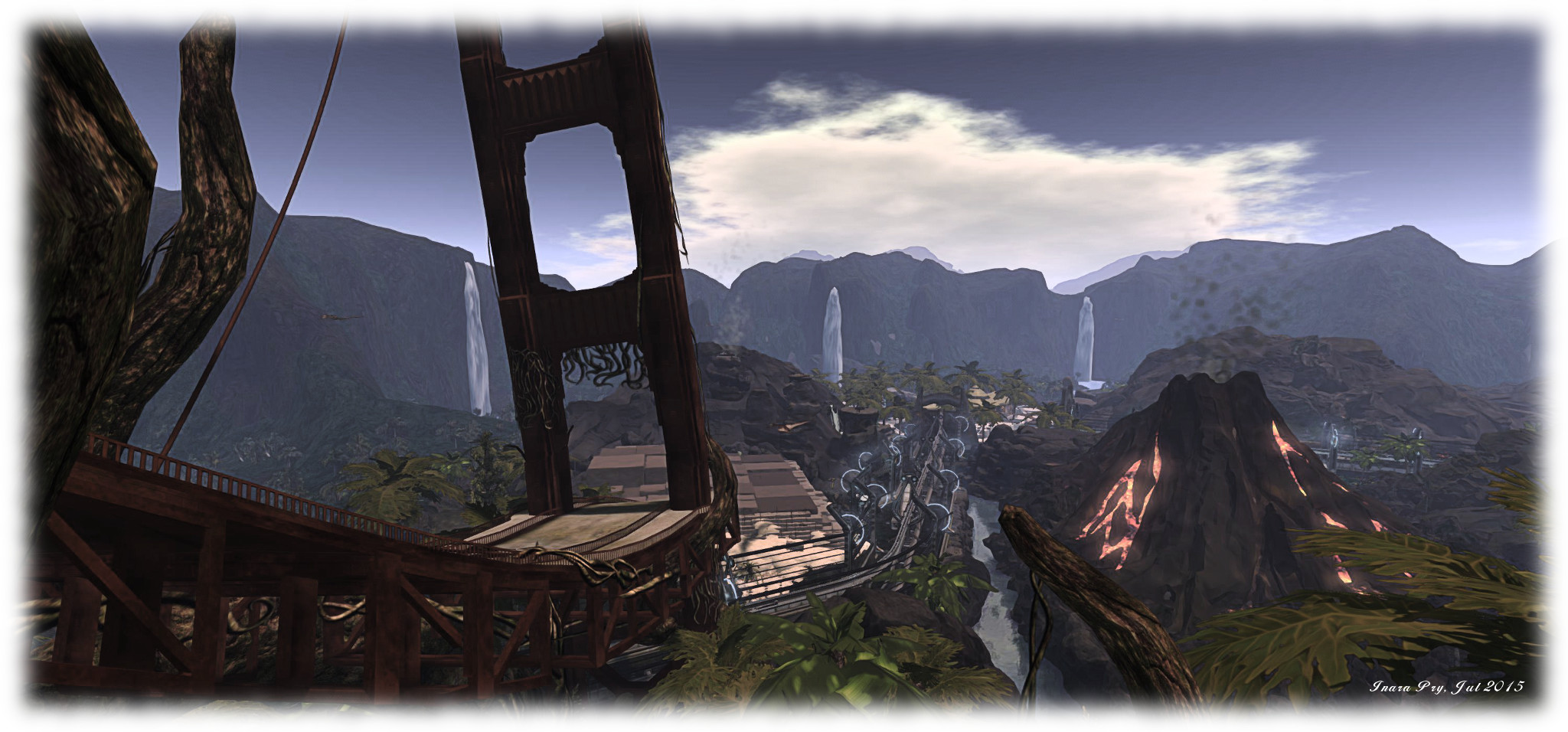 PaleoQuest, the Lab’s dino-ish adventure game gets a mention in the official look back at the year, which i admit to rather enjoying


 Inara Pey: Living in a Modemworld