Sundry thoughts on regions, revenue, tier and platforms

A quiet afternoon at Hollywood Airport

The year-end brought with it a round-up of Second Life in terms of region numbers, courtesy of Tyche Shepherd and her excellent Grid Survey. 2014 continued to see the downward count in the number of private regions in SL, with some 673 regions vanishing through the course of the year (from 19,273 at the start of the year to 18,600 at the end of the year).

Expressed as a percentage, this means that the main grid has shrunk by 3.5%. That compares to an 8.2% shrinkage in 2013 (from 20,992 to 19,273 regions, a loss of 1719) and a 12% reduction in 2012 (23,857 to 20,992, a loss of 2865 regions).

There are likely to be a number of reasons for the slow down in losses, all interacting with one another. While  one ideologue opted to pooh-pooh it, in September 2011 I pointed to one contributing factor to the then increasing rate of decline in region numbers as likely being due to physical world economic issues. With their disposable income diminishing, people were finding an outlay of $125 a month for virtual land increasingly hard to justify, and so were divesting themselves of it; something which likely continued through 2012 and early 2013.

Private regions numbers through 2014 (source: Tyche Shepherd, SLU forums)
Private region numbers decline through 2014 (source: Tyche Shepherd, SLU forums)

While I’m not about to say we’ve turned the corner where the physical world economic situation is concerned, it is probable that by late 2013 we’d reached a point where those still with a residential homestead of their own were more willing to grit their teeth and pay for the land they hold, thus contributing to the slowing of shrinkage.

So what does that mean for the year ahead? While nothing is guaranteed, I tend to sway towards the view that the decline in region numbers will continue to slow, but at less than the rate we’ve seen in from late 2013 through 2014. I’m also inclined to think we won’t see any significant rise in region numbers through 2015 (unless some kind of external factor comes into play or the Lab does opt to do something quite unexpected to cause people to suddenly want lots of land).

One thing the slow-down will hopefully do is decrease future calls for tier cuts. As I explained back in January 2013, unless the Lab have a substantive means of compensating for the revenue loss resulting from any “reasonable” tier, any such cut will likely hurt the company (and SL) more than help. Nor is the Lab’s profit margin anywhere near the levels sometimes mentioned (e.g. the 200% recently claimed in this blog), such that they could simply “absorb” any tier cut without feeling the impact.

The decline in private regions, January 2012 through December 2013 (source: Tyche Shepherd, SLU forums)

In 2008, estimates put the Lab’s earnings at around $90-95 million, and their possible profit margin at between $40-$50 million (48-50%) – see the articles here and here. I assume these estimates are for gross profits, as neither makes allowances for tax.

More to the point, there seems to be a slight flaw in both estimates: they only appear to reference the costs involved in running simulator servers. No mention is made of the various back-end services such as group chat, group management, asset management, login, transaction management and payment, (and today, the avatar baking service), the various web services (Marketplace), and so on. While the costs associated with all of these are obviously going to be a lot lower than those for the simulator hosts, they shouldn’t be entirely discounted. There’s also third-party support costs (in 2008-2010, for example, the Lab was paying Rivers Run Red and 80/20 Studio; today there’s the costs involved in using the Highwinds CDN service).

Continue reading “Sundry thoughts on regions, revenue, tier and platforms”

SL project updates 2015 week 2: server, viewer, experience keys, group chat

The Chamber Library
The Chamber Libraryblog post

Server Deployments – Week 2

There were no server deployments to either the Main (SLS) or RC channels for the week.

Upcoming Deployments

There is likely to be a server-side RC deployment in week 3 (week commencing Monday, January 12th). Details on what it will contain have yet to be finalised, however, during the Server Beta User Group (SBUG) meeting on Thursday, January 8th, Maestro Linden indicated it would contain miscellaneous fixes an improvements which will likely include:

  • A fix for BUG-8002
  • Removal support for legacy viewer-side avatar baking
  • Region crossing improvements.
Simon Linden - tidying-up avatar region crossings
Simon Linden – tidying-up avatar region crossings

The region crossing improvements are for avatars only (not vehicles), and are described by Simon Linden as, “all internal and pretty minor, so please don’t get hopes up for performance improvements,” and being about “clean-up and small polishing.”

A number of regions on Aditi are running the updates  – DRTSIM-273 – (Ahern, Bonifacio, Morris and Rizal), and a group test was carried out during the SBUG meeting with people walking / flying and TP’ing between these regions and between them and other regions without the updates as a further check that the changes wouldn’t result in any failures / breakage. “I’m most worried about some data subtly changing or getting lost between crossings, Simon added in this regard, following the test. “but I haven’t seen anything like that.”

Details on the updates related to legacy avatar baking will be posted with the package release notes, when available.

SL Viewer

On Monday, January 5th, the HTTP pipelining RC viewer was updated to version 3.7.24.297623, bringing it up to par with the current release viewer, and therefore matching the Experience Keys RC viewer which slipped out just before Christmas.

Experience Keys / Tools

“It’s really quite close,” Oz Linden said of the Experience Keys / Tools project at the SBUG meeting. “We’re upgrading and testing some back end infrastructure to support it; when that’s ready, we’re good to go.”

As indicated in my original overview of Experience Keys / Tools, the tools come with a number of safeguards to reduce the risk of them being used for mischief. In addition, and as a further discouragement, those wishing to use the tools to build experiences will be required to pay a fee. This has now been set by the Lab, but is not at this time being made public. Expect to hear more about it when the tools are formally released.

In the meantime, you can read more on the project in these pages using the Experience Keys tag, and those wishing to try-out beta Experiences can do so via the Seamless Experiences section of the Destination Guide. You do not need to have the Experience Keys project viewer in order to do so – although it does provide you with access to more information about any Experience you try – see my project viewer overview for details (do keep in mind that both this and the project overview linked-to above are now several months old, and certain details may have changed in the interim; I’ll have a further article on Experiences when they are launched).

Group Chat

Simon Linden is continuing to work on group chat. No major news at this time, other than he’s been carrying out further digging into why some servers seem to get “stuck” every two weeks or so and require a restart. Further data was gathered during the region crossing tests mentioned above.

Other Items

Alpha Map Support for Mesh

I first reported on this matter, which forms feature request BUG-8100 – in week 52. Since then, the idea has received a lot more feedback and further thought. However, following initial triage, the JIRA was closed by Kyle Linden on Wednesday, January 7th, with the standard, “We’ve reviewed your request and determined that it is not something we can tackle at this time.”

A second helping of Cheeky Tiramisu

Cheeky Tiramisu
Cheeky Tiramisu

One of my favourite places for meeting people in-world is the Cheeky Tiramisu café, owned and operated by Yasyn Azemus. I originally blogged about it way back in December 2012, and while I’ve met with many friends and interviewees since then, I’ve never actually written any more about it, except in passing. This being the case, I set out recently to rectify matters.

The region in which the café sits has divided into a number of islands, around the between which lay open water, all of which is enclosed by surrounding off-sim mountains. As was the case when I first blogged about the region, it is currently in the grips of a snowy winter; however it does change through the year to match the seasons.

Cheeky Tiramisu
Cheeky Tiramisu

The café itself occupies the largest of the islands, occupying the south-east quarter of the sim. here you’ll find a welcoming places to sit and chat with friends and acquaintances, either inside the beautiful brick-and-wood café building (designed by Yasyn), or out on the front terrace or the rear deck, both of which are warmed by blazing braziers. For those seeking a little more privacy, there are a number of seating spots and cosy areas to be found with the café‘s grounds, including a reading nook beside a warm spring.

Follow one of the paths through the grounds, and it will take you down a set of steps to the water’s edge and a floating deck complete with a pedalo you can use to explore the island from the water (you can also rez a rowing boat at a little wooden pier on one of the waterways dividing the islands). Or, if you follow the path onwards from the steps and across a rope bridge, you’ll find a sheltered garden with shine and, beyond it, a Japanese bath house

Cheeky Tiramisu
Cheeky Tiramisu

Walk inland from the café, and a series of bridges in varying styles will lead you to the other occupied islands. While these may at first appear to be residential in nature, all are in fact open to the public. The water mill, for example, houses a small tavern specialising in wine (and with dancing on the porch), while Kio’s little house built out over a pond offers another warm welcome to visitors.

Rezzing is allowed with the region (15 minute auto return), and those wanting to use a few props for photography are welcome to do so – but do please clean-up behind you, auto return notwithstanding.

Cheeky Tiramisu
Cheeky Tiramisu

As noted at the top of this piece, Cheeky Tiramisu is a quiet favourite of mine; so if you are looking for a little P&Q while in-world, why not pay it a visit?

Related Links

Oculus VR: of debuts and acquisitions

The Oculus Crescent Bay prototype showing the Samsung Gear-type head harness with motion tracking sensors on the back and the integrated headphones

As is to be expected, Oculus VR are attending the International Consumer Electronics Show 2015, which is once again being held in Las Vegas, Nevada, through until January 9th, 2015, where the latest headset prototype  – Crescent Bay  – is undergoing its “public debut”, and the company’s CEO, Brendan Iribe took time out to discuss the prototype and more with Techcrunch’s Darrell Etherington.

“Crescent Bay is a huge leap from Oculus Rift DK2,” Iribe informs Etherington at the start of their 6-minute discussion. “And it increases all the different parts, whether it’s resolution, precision, the positional tracking, the latency, the optics themselves, everything really takes a big jump, and it really finally delivers what we’ve been talking about for a long time, this pursuit of presence. It finally delivers on that presence that we feel is good enough for consumers.”

So, does that mean he’s revising his comment at November’s Web summit conference about the consumer version of the headset being “many months” away?

Oculus is again a major presence at the International CES in Las Vegas

Well, probably not. While no outright statement on time frames is given, it’s fair to say the the company is still putting a consumer release as some way down the road.

For one thing, the next immediate target is getting an audio SDK to developers to allow them to get to grips with the capabilities of Crescent Bay’s 3D immersive audio system. However, it’s liable to be another “few months” before that happens. For another, while the company feel they are now “close” to having a headset that is, technology-wise, to being consumer-ready, Iribe also notes the audio is at a “minimum” the company requires of a consumer product, and also that no decision on what they’ll actually be shipping as a consumer product as yet been made: it might be “just” the headset, or it might be the headset and an input system / device.

When speaking to Peter Rubin at the Web Summit in Dublin in November (linked to above), Iribe made it clear that input had become a “big focus” for the company, which they were “R&Ding”. He restates part of this to Etherington, which suggests they may still be leaning towards headset + input system / device, although he also noted that the company is not yet ready to discuss matters of input in public.

In terms of a suitable software library being available in time for any launch so – another consideration in determining when to launch the consumer product – Iribe indicates the company is “very happy” with the progress that is being made, suggesting this is less of a concern as they gradually move towards a consumer release.

Continue reading “Oculus VR: of debuts and acquisitions”

Revolution: One Billion Rising in Second Life 2015

The press release for One Billion Rising in SL 2015 has been posted to the One Billion Rising in Second Life blog,  announcing the event will take place on Saturday, February 14th, 2015, and will carry the theme of revolution.

The release reads in full:

On 14 February 2013, one billion people in 207 countries rose and danced to demand an end to violence against women and girls.

On 14 February 2014, we escalated our efforts, calling on women and men everywhere to Rise, Release, Dance, and demand Justice!

Now, on February 14th 2015, we are calling for a revolution for change.

Change can happen if grassroots movements and marginalized communities are in the lead.

Change can happen if we demand accountability – making sure our justice calls last year are realized. We are going to continue to demand justice, and will continue to highlight the issues surrounding the social injustices inflicted on women, and to keep highlighting where these issues connect. We will continue to challenge institutions, governments, policies, laws – and make these systems, which are responsible for creating situations of poverty and violence, accountable.

Change can happen if we harness our creativity and energy. We will highlight, create and envision new, brave and radical artistic initiatives to bring in the new revolutionary world of equality, dignity and freedom for all women and girls. There is nothing more powerful than art as a tool for transformation.

Change can happen if…WE ACT NOW. AND WE ACT TOGETHER.

In Second Life, we will be marking the occasion (as we did last year) with a twenty-four hour one day event that will allow women and men to gather. There will be music, there will be art installations and exhibitions, there will be poetry sessions, there will be storytelling events, there will be live dramatic performances, there will be dancing – and there will be information kiosks that will share information about organisations devoted to promoting justice for women across the globe, and stories of events that will be happening around the world.

The Second Life event will feature a four-region stage where 200 people can dance together, surrounded by an area of art installations and informational exhibits. A variety of performers will play over the 24-hour period, enabling people all over the world to attend this virtual event no matter their timezone. The regions will have a General maturity rating to allow all residents an opportunity to participate. Pictures are welcome on the event’s Flickr group.

This is not an event to raise money – although you will find information about organisations that need funding. But our primary goals are to draw people together and to raise awareness.

What can you do?
You can attend the event!

You can send us information about groups known to you that we can add to the informational kiosks. How can you do this? You can write to 1billionrisinginsecondlife@gmail.com or post on our Facebook page.

You can spread the word about One Billion Rising in Second Life amongst your friends, your communities and through social media.

You can volunteer to help us organise the event – by completing this form. We need greeters, security, stage managers, media liaison and information processors, who will help build the information that will go into our displays.

You can add your reasons for rising to our special Why I’m Rising page.

If you would like to be a sponsor for the event, contact Samantha Ohrberg.

If you would like to be part of our special Press Day, you can complete this form.

We look forward to seeing you all in 2015!

About One Billion Rising
One Billion Rising was the biggest mass action in human history. The campaign, launched on Valentine’s Day 2012, began as a call to action based on the staggering statistic that 1 in 3 women on the planet will be beaten or raped during her lifetime. With the world population at 7 billion, this adds up to more than ONE BILLION WOMEN AND GIRLS. On 14 February 2013, people across the world came together to express their outrage, strike, dance, and RISE in defiance of the injustices women suffer, demanding an end at last to violence against women.

Last year, on 14 February 2014, One Billion Rising for Justice focused on the issue of justice for all survivors of gender violence, and highlighted the impunity that lives at the intersection of poverty, racism, war, the plunder of the environment, capitalism, imperialism, and patriarchy. Events took place in 200 countries, where women, men, and youth came together to Rise, Release, and Dance outside of court houses, police stations, government offices, school administration buildings, work places, sites of environmental injustice, military courts, embassies, places of worship, homes, or simply public gathering places where women deserve to feel safe but too often do not. The campaign was covered widely by media in all corners of world including The New York Times, The Guardian, NPR, and many more.

Visit www.onebillionrising.org to learn more.

Of impulse purchases and power boats

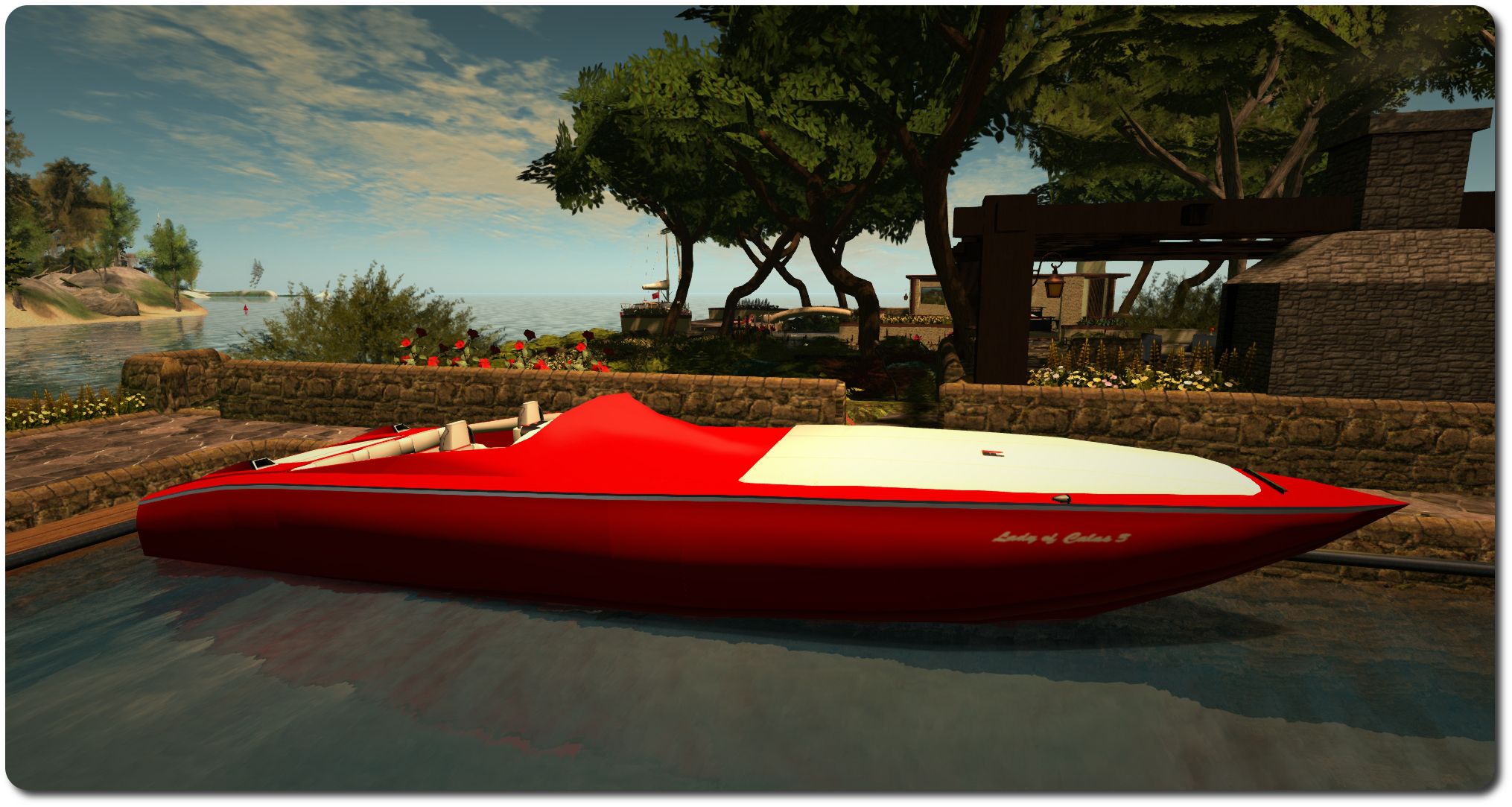
The Kv23H FoilStream at home
The Kv23H FoilStream at home. The white canvas is covering the bow seating area

As regular readers know, I’m pretty into sailing and cruising in SL. However, while I have a couple of very nice E-Tech boats, they are somewhat big and tend towards the primmy. So I’ve recently been spending time hopping around SL and trawling the Marketplace for something smaller, lighter and mesh built I could buy.

This actually proved harder than I’d imagined. Not because there is a shortage of smallish cruisers and nice little tenders to be had; quite the reverse. There are some lovely boats to be found; I just have this obsession with a red & white colour scheme, and those I saw either didn’t quite fit, or required DIY retexturing well beyond my comfort level. So I ended up making an impulse purchase simply because the colours were close enough: Kv23H FoilStream by Ape Piaggio.

The Kv23H showing the forward seating area uncovered

Not, I hasten to add, that this should be taken to mean this is a “bad” build; far from it. Ape has worked hard to produce a superb racing boat / cruiser, capable of carrying up to five people, and sought out plenty of assistance in bringing it together – such as from Analyse Dean of Bandit fame. The result is a craft that is 31 LI, 100% mesh, packed with features, and – when needs be – bloody fast.

Seating areas can be found in the cockpit, and forward in the bow area, with a small cabin area in between. The pose system allows movement between the various areas (including the sunbathing pad over the working engine cover), without the need to stand, and is available to driver and passengers. Driving-wise, the UP / DOWN keys operate the throttle in 10% increments, LEFT / RIGHT allow you to steer. If you want some really high-speed boating, PAGE DOWN will deploy the boat’s cunningly-hidden hydrofoils (you must be at 30% throttle or lower for them to deploy). Once deployed, running the throttles up to anything over 70% will lift the boat up onto the foils and you’ll literally fly across regions; this is one bloody fast boat. So much so that after lifting, I’d strongly recommend dropping the throttle down to 50% for a smoother ride.

Up on the foils at 60% throttle

When you drop back to 30% or below, the boat will settle back into the water, and PAGE UP stows the foils once more. Handling-wise, the boat is really responsive at speed, but can be a handful at 10%-20% throttle. To assist with this, Ape has added a “parkmode” option in the menu, click it and keep your speed to 30% throttle or less and it smooths-out handling. There’s also a race mode, accessed through the menu, which makes the boat compatible with popular race systems and which enables damage, while the ACSS system really does help the driver with region crossings.

Two really handy capabilities with this boat are the “park camera” and the auto-mooring function. The former places the camera above the boat, looking down on it and – with practice – allows for a lot of close-in manoeuvring both forwards and backwards. Set the boat’s home mooring position, and the latter will automatically park the boat on your return, once you’re within 10 metres of the mooring point.

Roaming Second Norway

To list all the features would turn this article into a litany, so suffice it to say that you also additional options that can be deployed, a pose system for moving about the boat without standing up, a working engine cover, two working media systems – there’s even two painting systems (texture maps supplied), one of which you can use to produce your own commercial paint kits for the boat.

There are, to be fair, some niggles, none of which are serious, but do cause grumbles. Mouselook driving requires seat adjustment, for example, so you can actually see where you’re going. However, adjustments can’t be saved, so have to be made again after standing.  I found the camera to be oddly sensitive when carrying passengers at low speeds in regions with surrounding objects, being prone to slewing into the engine compartment even when crossing parcel boundaries (i.e. moving away from my home mooring). Conversely, travelling at speed on open water with passengers across multiple region boundaries has yet to give me any problems at all. A final very small issue is with the boat’s hull texture map: the left side hull texture and the transom texture are such that if you wish to add a name to them, you’ll have to reverse it to read from right to left; if you don’t the name will be backwards when the textures are applied to the hull.

The dashboard contains working dials and a nice map function that will mark your position within a region (the yellow square) - providing you're not zipping along at an insane speed!
The dashboard contains working dials and a nice map function that will mark your position within a region (the yellow square) – providing you’re not zipping along at an insane speed! However, you’ll likely have to raise the driver’s seated position if you want to ML drive, or sit and then adopt a standing pose via the menu

But, these are minor grumbles in the scheme of things. Overall, there is no mistaking the fact this boat is well made, comes very well equipped and represents excellent value for money. Any hesitation you might sense in this article is simply because this kind of muscle boat isn’t really “me”, so I’m having a hard time persuading myself I’ll actually use it, and may yet end up resuming my hunt for something more “my” style. Either that, or I’ll await Ape’s next project, her AD25H “Little Bee” speedboat, which is looking rather good!

However, if you want to see if the Kv23H is your kind of boat, you can take a demo version out for a spin from Ape’s test location in-world and can purchase it there or from the Marketplace.