SL projects update 25/1: server, viewer, pathfinding and surprise guest

The Simulator User Group meeting on Tuesday June 17th was busy even before the unannounced guest dropped in (see below)
The Simulator User Group meeting on Tuesday June 17th was getting busy even before the unannounced guest dropped in (see below)

Server Deploys, Week 24

As usual, please refer to the server deployment thread for the latest information.

Main (SLS) Channel

On Tuesday June 17th, the Main channel was updated with the Group Ban project, which was previously on the LeTigre RC.  As the name implies, this project adds the ability to ban users from groups (see also SL Viewer Updates, below) – release notes.

Release Candidate Channels

On Wednesday June 18th the three RC channels should be updated as follows:

  • LeTigre should receive a new server maintenance project this week, which comprises an anti-griefing measure – release notes
  • BlueSteel should remain on the Sunshine / AIS v3 project, the viewer for which was promoted to the de facto release viewer (version 3.7.9.290582) on Monday June 16th. In addition, BlueSteel should receive the Main channel update with the Group Ban project and the anti-griefing update deployed to LeTigre – release notes
  • Magnum should remain on the Experience Tools project. In addition, Magnum should will receive the Main channel update with the Group Ban project and the anti-griefing update deployed to LeTigre – release notes.

SL Viewer Updates

Release Viewer

On Monday June 16th, the MemShine release candidate viewer, (version 3.7.9.290582, was promoted to the de facto release viewer. This viewer includes the final Sunshine AIS v3 updates (promoting the Lab to issue a blog post announcing the long-running project Shining is now complete), and also a series of memory leak fixes to help stabilise the viewer and hopefully reduce the number of memory related crashes.

Group Ban project Viewer

As noted above server-side support for the Group Ban project is being deployed to the main grid. To coincide with this, the Lab issued the Group Ban project viewer (version 3.7.8.290887) on Tuesday June 17th, which provides the necessary viewer-side support for accessing group ban functions. Initial instructions for using the viewer can be found in the release notes, and I’ve provided an overview as well.

Group Chat

Simon Linden recently completed an initial amount of work on group chat, implementing some small-scale optimisations which, while not expected to have “fixed” group chat, should have improved some aspects of using it, reliability-wise. He’s more recently had to work on what have been viewed higher priority items, but is hoping to make a return to group chat in the very near future and dig into it some more. “I learned a lot on the first pass,” he said on the matter during the Simulator User Group meeting on Tuesday June 17th, “we got a lot more information on where the load is.  Thus I have hopes the next round will be better.”

Other Items

Pathfinding and Terrain Editing

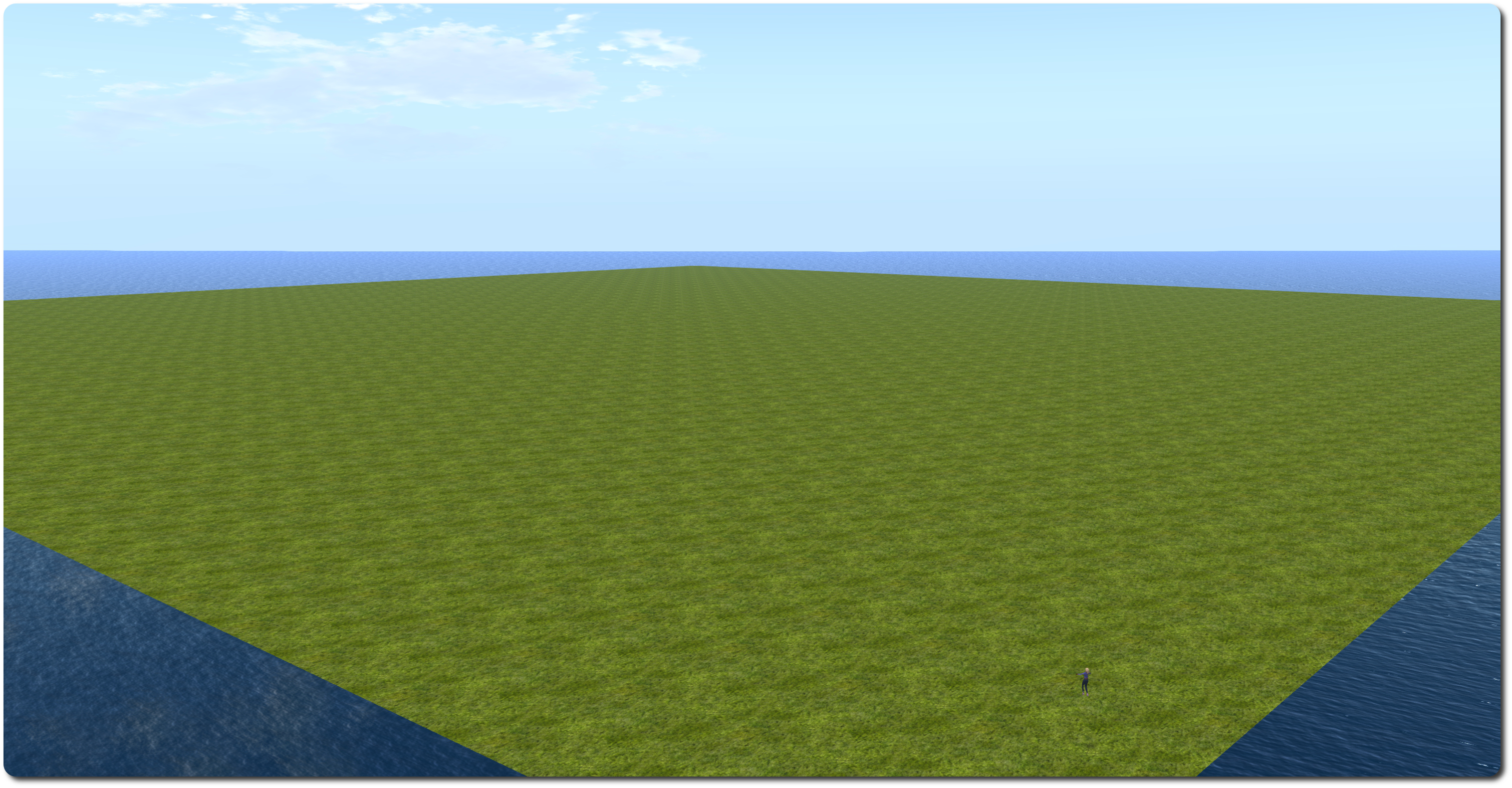
BUG-772 “Simulator refusing to rez objects after 10 hour timeframe” was raised at the Simulator User Group meeting on Tuesday June 17th. This is an issue where if you are carrying out terraforming work on a region with pathfinding enabled, and are also making frequent Pathfinding navmesh updates, your region will rapidly run out of memory. the way to avoid this is to complete the terraforming activity, then rebake the navmesh and restart the region.

LSL Enhancements

Ideas were tossed around the Simulator User Group meeting on the limitations of LSL, many of which may only be resolved through a complete re-build of LSL, something which is unlikely to happen, as Simon Linden indicated in the meeting, “I don’t think we’re going to touch the internal design of LSL if we can help it.” Which doesn’t mean there will not continue to be enhancements to LSL functions etc.

One suggestion made to get around some of the issues was for the development of a viewer-side scripting language which might handle certain local functions and abilities. Responding to this, Simon would only say, “That would be a wonderfully big project :).”

Continue reading “SL projects update 25/1: server, viewer, pathfinding and surprise guest”
Facebook and contests: the Lab comments

Following this and other blogs picking-up on the SL11B photo contest the Lab announced yesterday and the fact that it may be off-putting to some SL users (see: Lab launches SL11B L$10,000 photo contest), Pete Linden (Peter Gray, the Lab’s Director of Global Communications) posted the following comment on why Facebook has been used (which he also posted to Ciaran Laval’s blog):

 We realize that a number of Second Life users have reservations about using Facebook and other platforms. In this case, we chose to run the contest through our Facebook page simply because we have a tool on our page that facilitates running a contest with all of the legal stuff (technical term) we need in place to run something like this, and we thought it would be of interest to the more than 366,000 followers of the official Second Life page. Our aim certainly isn’t to discourage participation, and we’ll certainly explore alternative ways to run similar contests in the future.

The issue of “the legal stuff” is actually something I mentioned in my original post when ruminating on using alternatives such as Flickr, pointing out that “ensuring T&Cs are read might be a little harder.”

Given that the Facebook approach requires that people at least click-through the T&Cs prior to entering a contest does make the Lab’s position somewhat understandable. It doesn’t matter if people read them, the fact that they’ve clicked through them absolves the Lab of a degree of potential nastiness after the fact if someone decided to get severely upset (probably unlikely, but the kind of thing lawyers are paid to worry about and mitigate). Truth be told, a link on a Flickr group doesn’t provide the same level of in-your-face immediacy.

I did also flippantly mention the visibility aspect as well – particularly if a fair proportion of those 366,000 followers on Facebook aren’t active SL users. I’ve actually no problem with this; if the contest increases SL’s visibility among non-SL users, then so much the better. Particularly as we’re all pretty much agreed that SL needs more positive advertising, and a fun-looking competition among users does look and feel positive.

Nevertheless, it would be nice to see competitions like this, which are not constrained by external considerations (as was the case with last year’s Dell Alienware competitions), to be put forward in a way that encourages SL user participation, rather than potentially discouraging it. In this, it is pleasing to hear that the Lab is taking the feedback onboard and will seek alternatives for the future.

My thanks to Pete for providing the feedback.

Fallingwater joins Seanchai Library

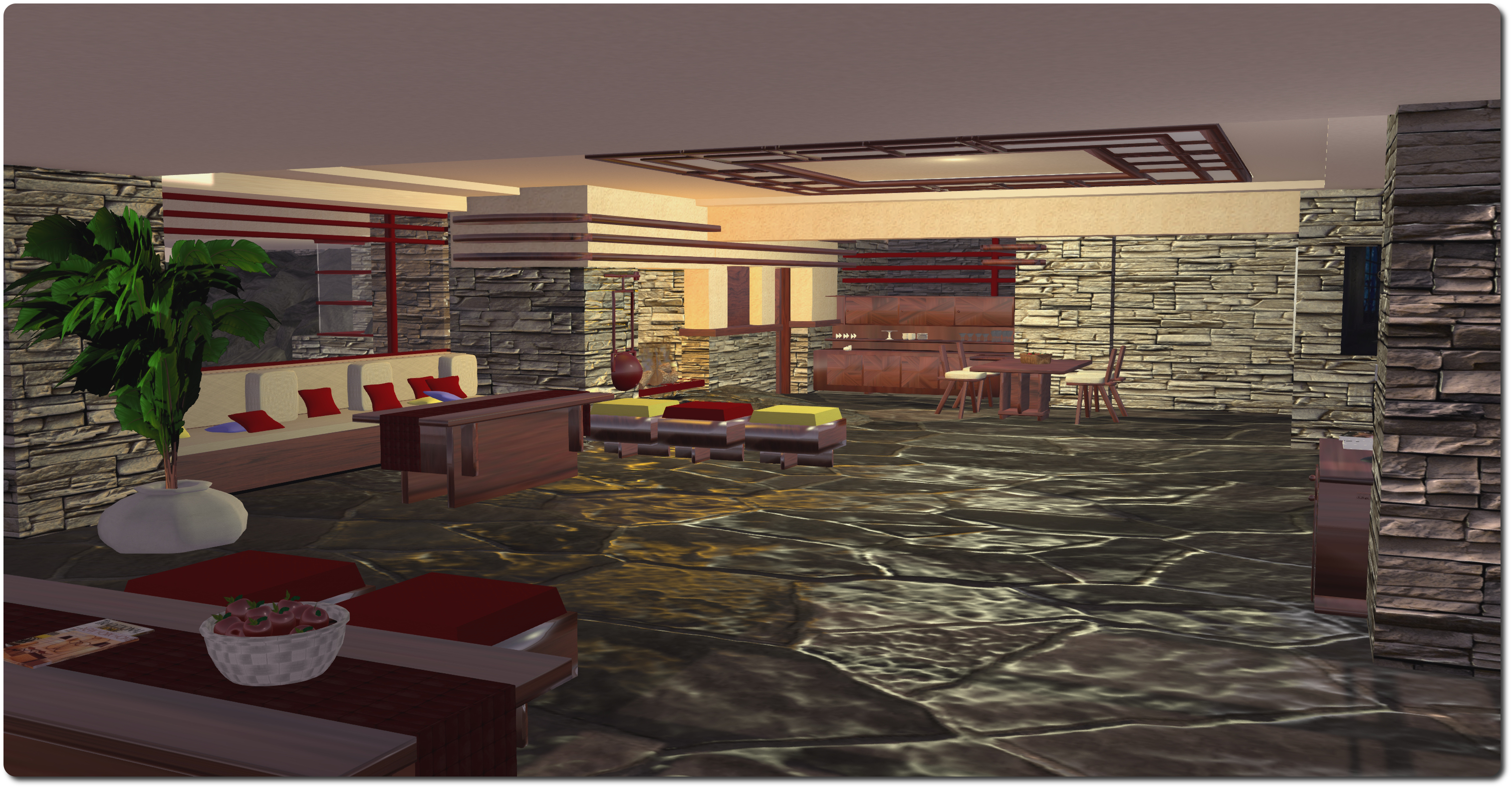
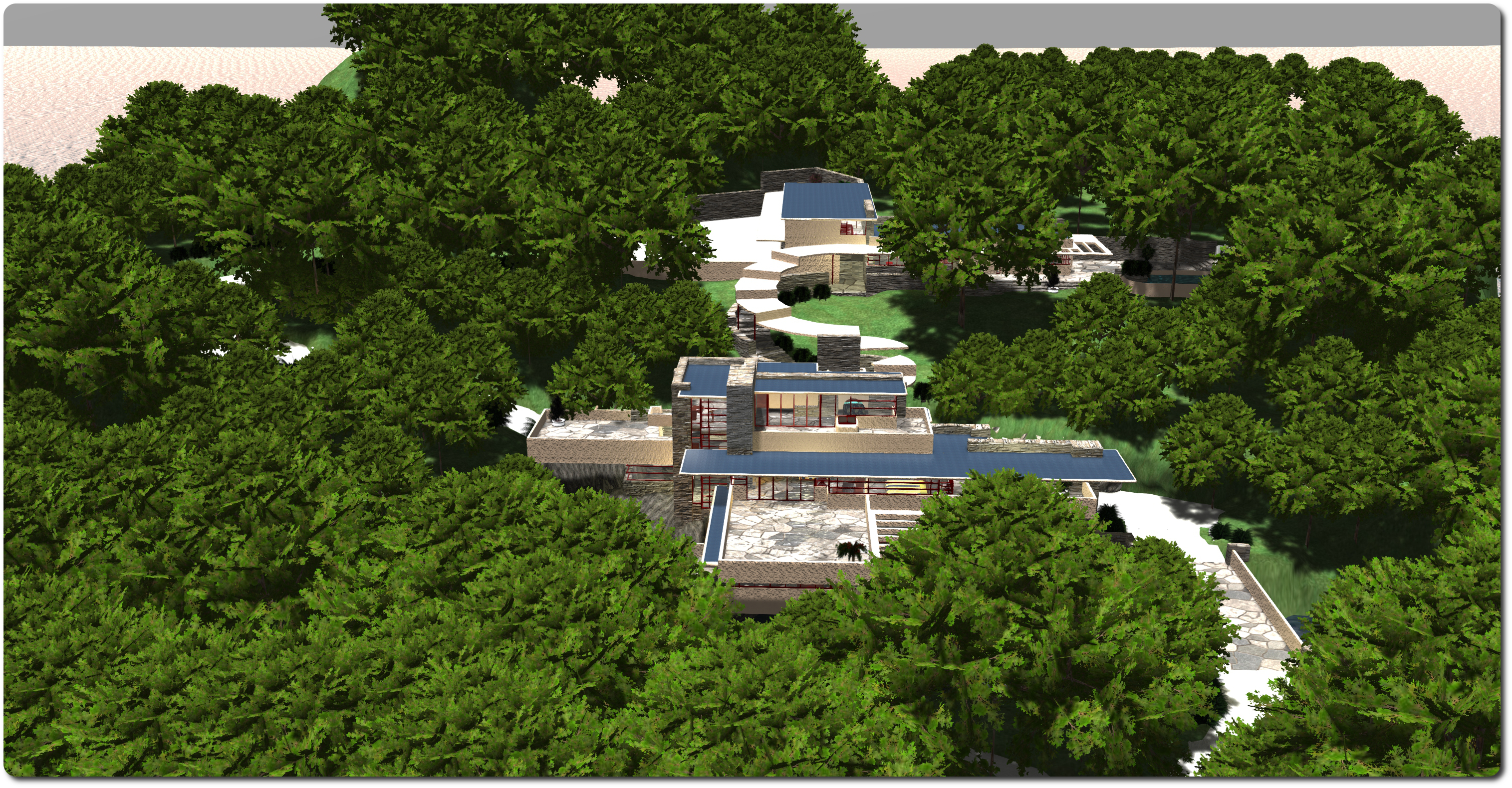
Fallingwater as it appeared as a standalone region on Kitely
Fallingwater as it appeared as a standalone region on Kitely (click for full size)

Regular readers here will be only too aware of my obsession with Frank Lloyd Wright’s building designs, and in particular that of Fallingwater, which I’ve used as a model for no fewer than three builds over the years: two in Second Life (both now gone, but one safely packed away) and one in Kitely, where it has had a full region to itself for the last two years.

As I’m rarely in Kitely nowadays, the model there hasn’t really seen that much use. So, to rectify this, and as a result of conversations between myself and Caledonia Skytower and Shandon Loring at Seanchai Library, Fallingwater (Kitely) has been relocated to the Seanchai core world, where it will be used as an additional set of venues for Seanchai’s storytelling in voice.

The Great Room at Fallingwater Kitely will soon be a venue for stories in voice!

The idea of relocating an entire region – buildings, furnishings, plants, tree, flowers and the rest on your own, and without having to pay for it to be done for you, is something liable to fill SL users with a feeling of foreboding. Fortunately, OpenSim users can make use of the OpenSim ARchive (OAR) capability to export and entire region / simulator’s contents to a local hard drive, subject to any permission protections used on their OpenSim grid.

A slight complication with Kitely is that it is not possible to target a single region within a group of regions  – “world” as Kitely call them – without also overwriting the others. As our aim was to make Fallingwater a part of the 4-region core Seanchai “world”, simply exporting it to OAR and then importing it into the Seanchai world would leave the other three regions replaced by default flat terrain.

There is a way around this, but it requires a small amount of fiddling, and the use of something like New World Studio (NWS) or  Sim-on-a-Stick (there are also user-offered services for those wishing to do something similar and who don’t have access to either). Using NWS (which ‘ve previously reviewed)  made the work of combining Fallingwater with Seanchai a simple 6-step process.

Combining Fallingwater with Seanchai's core 2x2 world on Kitely 1: my 2x2 region on my self-hosted New World Studio
Combining Fallingwater with Seanchai’s core 2×2 world on Kitely 1: my 2×2 region on my self-hosted New World Studio
  • First, I created a 4-region (2×2) set-up with New World Studio.
  • Second, using the OAR format, I exported Fallingwater from Kitely and Shandon exported the Seanchai 4-region world, which he passed to me as an OAR file
  • Third, I uploaded the Seanchai world to my 2×2 New World Studio set-up
Combining Fallingwater with Seanchai's core 2x2 world on Kitely 2: importing Seanchai's core 2x2 world
Combining Fallingwater with Seanchai’s core 2×2 world on Kitely 2: importing Seanchai’s core 2×2 world in NWS
  • Fourth, I selected the region Fallingwater was to overwritten and imported Fallingwater
  • Fifth, I exported the updated 2×2 set-up to an OAR file and passed it back to Shandon
  • Finally, Shandon uploaded the revised OAR into Kitely.
Combining Fallingwater with Seanchai's core 2x2 world on Kitely 3: replacing one of the Seanchai regions with Fallingwater
Combining Fallingwater with Seanchai’s core 2×2 world on Kitely 3: replacing one of the Seanchai regions with Fallingwater

The entire process of creating the New World Studio environment, exporting the OARs, uploading and merging them and then exporting the updated world literally took around 5 minutes. Granted, Shandon had some additional work to sort-out some items in the Seanchai world which were non-exportable due to permissions, but overall, the longest time in the process was sharing the OAR files via Google docs!

So Fallingwater has a new home on Kitely. However, the work isn’t finished. As well as the house, the plan now is to incorporate additional venues for stories and to blend the Fallingwater region more smoothly in with the existing Seanchai regions. I’ll post images of this as the work progresses!

Lab launches SL11B L$10,000 photo contest

SL11B contest
(image courtesy of Linden Lab)

On Tuesday June 17th, in the run-up to the SL11B events across the grid, the Lab has launched a birthday themed photo contest.

The blog post announcing the contest reads in full:

Starting today, you’re invited to take part in the Second Life: Celebrating Your Second Life Snapshot Contest, in honor of 11th Birthday of Second Life.

Participation is easy – submit your celebratory snapshots from inworld to the contest page on our Official Second Life Facebook Page. Click the contest tab, review the contest information and rules and start sharing. This year you will be able to submit up to one snapshot a day for the duration of the contest. Full rules, submission and voting dates, and details are all on the Facebook page.

Looking for some inspiration for pics? Then drop by Hairy Hippo Fun Land to grab your Limited Edition SL11B Robot Avatar. You can also get your free avatar off the Marketplace.

Browse the SL11B category on the destination guide to see what the community has planned to mark the event inworld.

Don’t forget that the Resident-driven Second Life 11th Birthday Community Celebration starts this coming Sunday the 22nd. Visit their website for the latest information.

You only turn 11 once, and we can’t wait to see what kind of celebrations and fun you create and share!

It is a shame that the Lab once again opt to use Facebook as the medium for a contest; doing so effectively slams the door on the contest for many who might otherwise take part, but who have no wish to be a part of the great Facebook machine.

Given other options are available which are not so controversial, it’s a shame that the Lab doesn’t give thought to them when running contests of this kind. Flickr, for example, would seem to be a suitable alternative. It already has a very large SL community, and establishing a group for competition entries isn’t exactly labour intensive, although ensuring T&Cs are read might be a little harder. People might also be more inclined to sign-up to Flickr if they don’t already have an account.

Of course, Flickr probably doesn’t get the same kind of visibility among non Second Life users that the SL Facebook page gets, but for the sake of encouraging more users to take part in something of this nature, does that really matter?

Lab announce Project Shining complete

On Monday June 16th, Linden Lab issued a blog post stating Project Shining is now complete. This is a major milestone for the Lab, with Shining representing some 2 years of effort and has involved significant work in three key areas:

  • Avatar baking (Nyx Linden) – also referred to as server-side baking or server-side appearance (SSA), which comprised a major project to shift the heavy lifting of avatar baking / appearance from the viewer to dedicated baking servers. for those need to know more, I offer the post I wrote back at the end of December 2012 as the project saw the release of its first viewer. Further information can be found under the Server-side Appearance tag
  • Interest List and Object Caching (Andrew Linden) – a project to improve how scene rendering is handled by both the server and the viewer, and improving the viewer to retain more information on regions in its cache and re-use that information more intelligently by the viewer
  • HTTP updates (Monty Linden) – a major update to SL’s communications infrastructure to make more and better use of HTTP in order to improve viewer / server communications and increase their reliability and their efficiency.
The state of play with some of the HTTP work in May 2013

Each of these sub-projects have comprised various stages and releases. Interest List and Object Caching, for example went through several rounds of updates alternating between server-side work and viewer-side work, with the final round of work, focused on improving how the viewer caches and reuses information, reaching a release status in May 2014.


The Project Interesting video released by the Lab in May 2014

The reason for the Lab’s announcement about project Shining is that Monday June 16th saw the release of the final set of Project Sunshine viewer-side updates in the form of the new de facto release viewer, version: 3.7.9.290582, which also includes significant inventory updates and improvements which have been referred to as AIS v3 (Advanced Inventory Service version 3, although this requires additional deployment of server-side updates across the grid). This viewer also includes a number of viewer memory leak fixes as well.

While the implementation and deployment of some elements of the work did experience some hiccups, overall, each element of Project Sunshine was implemented very successfully and with little or no disruption noticeable to users. Each has already yielded significant improvements to both the overall service and in the user experience, and the Lab are to be congratulated in bringing all three of the Project Sunshine activities to a successful conclusion. Here’s to the next round of projects – such a HTTP pipelining!

Why we’ll take VR and virtual worlds to other planets

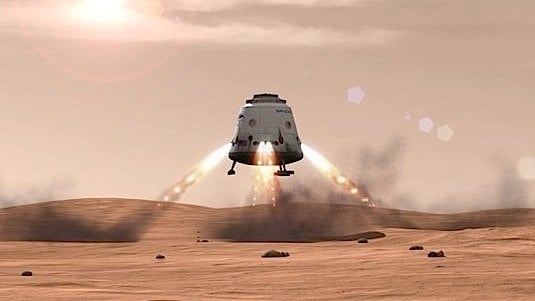
The first touchdown: human missions to the surface of Mars have long been dreamed about and planned for. Sometime in the next 30 years or less, they’ll become a reality. And VR, AR and virtual worlds are likely to play a role (image: SpaceX)

Sometime in the next thirty years, it is likely that humans will set foot on the surface of Mars. The mission that takes them there might be an international government-sponsored mission, or it might be the result of private endeavour. However it comes about, it will be the culmination of decades of planning, hopes and dreams stretching back beyond the birth of the space age.

There is much that a crew on such a mission will be taking with them in terms of hardware, equipment and technology. And it is very likely that when looking down the list of technologies they’ll take with them, one will be able to find virtual reality, virtual worlds and augmented reality – an in a variety of roles and uses.

Take the crew’s psychological health and well-being for example. A round-trip mission to Mars will take between two and 2.5 years to complete, depending upon the “class” of mission undertaken.

The two classes of Mars mission: opposition (l), which are launched when Earth and Mars are on the same side of the Sun, and conjunction class (r) are launched when the Earth and Mars are on opposite sides of the Sun both amount to a mission duration of 2- 2.5 years
The two classes of Mars mission: opposition (l), which are launched when Earth and Mars are on the same side of the Sun, and conjunction class (r) are launched when the Earth and Mars are on opposite sides of the Sun both amount to a mission duration of 2 – 2.5 years

Throughout that entire time, they’ll be completely isolated from everything we take for granted here on Earth – the freedom to wander outdoors, the sight of a blue sky, green hills, rivers, the sea, cities, lakes, people; they’ll be confined to enclosed spaces which really don’t offer too much in the way of privacy. They’ll even be confined to meals from a menu set months in advance, with no real option to give into a whim for a particular delicacy if it isn’t on their vessel.

For the majority of the mission time, the only people they’ll be able to directly converse with are their fellow crew members – with a minimum round-trip time delay in communications between Earth and Mars of 8 minutes (and potentially as much as 40 minutes through parts of the mission), having real-time conversations with loved ones on Earth simply isn’t going to be possible; they’ll have to rely on pre-recorded messages and video and e-mail.

In these circumstances, stresses are bound to develop, both for the individual members of the crew and, potentially, between team members, no matter how carefully selected for compatibility ahead of the mission or how well-trained. One way of potentially dealing with them is through the use of VR and virtual environments, as NASA and other organisations have been investigating for much of the last decade.

It’s not hard to imagine, for example, a crew going to Mars with a library of pre-filmed environments and events  which they can then explore and enjoy individually or together through the use of personal headsets – or for such a library to be updated with new items beamed via  something like OPALS to their craft. Such environments and activities could provide psychological relief from the confines of the space vehicle.

In June 2014, NASA’s OPALS system beamed the high-definition, 36-second movie “Hello, World” from the International Space Station (travelling at 28,000 kilometres an hour (17,500 mph) to a receiver on Earth in just 3.5 seconds (compared to the 10-12 minutes radio communications would have required. Systems like OPAL offer the key to providing very high bandwidth communications capabilities between Earth and Mars, allowing much more data to be passed back and forth (image: NASA)

Similarly, high fidelity virtual world environments which support direct interaction, such as through haptic feedback mechanisms, might provide the means by which crew members can “remove” themselves from the confines of their vehicle and enjoy a variety of activities, including something we take for granted in VWs today – the ability to create and build.

ANSIBLE (A Network of Social Interactions for Bilateral Life Enhancement) was an initial attempt by NASA, working with SIFT and All These Worlds, to explore how virtual worlds might be leveraged to provide astronauts with environments which could be shared or used individually, and which might offer a range of AI interactions as well.

A screen capture of the main ANSIBLE environment. While openSim probably won't be the VW of choice for a Mission to Mars, the ANSIBLE environment has been used as a means of assessing virtual world environments could each the psychological pressures face by a a confined crew on a long duration space mission
A screen capture of the main ANSIBLE environment. While OpenSim likely won’t be the VW of choice for a Mission to Mars, the ANSIBLE environment is perhaps the first step towards assessing how virtual world environments could ease the psychological pressures face by a confined crew on a long duration space mission (image: SIFT / All These Worlds)

An intriguing element with ANSIBLE was the exploration of the idea that virtual world environments could be asynchronously “shared” between crew members and their friends and family on Earth, allowing them to engage in shared content creation activities, for example, through the swapping back and forth of OAR files, the ability to engage in “shared” immersive games and so on. ANSIBLE researchers even suggested that used in this way, a personal virtual world space could enable an astronaut and their family “share” special occasions more personally than could be done via e-mail, radio or video.

Commenting on the used of immersive environments and haptic technologies in Moving to Mars: There and Back Again (Journal of Cosmology, 2010, Vol 12), Sheryl L. Bishop, Ph.D, noted, “Telepresence and full fidelity audio/video/3-D communication replay capability will provide for more effective psychological support and interaction for crew members and to families and friends back on Earth.”

In terms of crew welfare, virtual reality has another potential use: assisting in matters of fitness. Most current mission scenarios involve the crew travelling to and / or from Mars in a “weightless” environment. Such an environment can be detrimental to many aspects of human physiology – muscles, bones, heart, lungs, etc. It is therefore essential long exposure to weightlessness is countered by routine exercise of up to two hours every day.

Exercise is an essential part of life in micro-gravity, where muscles can easily atrophy, bones suffer calcium loss, the cardiovascular system weaken, etc., away from the pull of Earths gravity. VR could help make such exercise more interesting and help space crews “escape” to more Earth-like environments (image: NASA)

In the confines of a space vehicle, the opportunities for exercise tend to be limited and potentially boring. How much more pleasant it might be for an astronaut who, after lugubriously strapping themselves into a treadmill harness and making all the required tension adjustments ready for 30 or so minutes of going nowhere while staring at a bulkhead, could slip on a VR headset, and go for a run through a woodland park or along a beach, the sounds of nature or the waves in their ears?

Continue reading “Why we’ll take VR and virtual worlds to other planets”