Sherwood tales, balloons and a lighthouse

It’s time to kick-off another week of fabulous story-telling in Voice, brought to Second Life by the staff of the Seanchai Library SL. As always, all times SLT, and unless otherwise stated, events will be held on the Seanchai Library’s home on Imagination Island.

Sunday 2nd June, 13:30: Tea Time in Sherwood Forest

Robin-hoodJune arrives in the evergreen woods of Sherwood Forest, and with it comes a month of tales from Howard Pyle’s The Merry Adventures of Robin Hood, brought to us by Caledonia Skytower and Corwyn Allen, complete with original songs by Corwyn!

An American illustrator and writer, Pyle published The Merry Adeventures of Robin Hood of Great Renown in Nottinghamshire (to give the book its original full title) in 1883. With it, he helped solidify the heroic / romantic image of Robin Hood witnessed in works such as Sir Walter Scott’s Ivanhoe (1819). The stories Pyle built for the book were drawn from various ballads, which he drew together to form a cohesive tale, rewriting the songs to suit a younger audience and further establishing the role of Robin Hood as a heroic outlaw who robs the rich to feed the poor – a role in sharp contrast to the way in which the ballads actually portrayed him (which was principally as a through-and-through villain). So popular was Pyle’s work that it led to several more children’s books about Robin Hood over the next three decades, firmly establishing the legend as a respectable subject for children’s literature.

This week, Caledonia and Corwyn bring us How Robin Hood Became an Outlaw and Robin Hood and the Tinker.

Monday 3rd June, 19:00 – The Twenty-one Balloons (Part 1)

21-balloonsCaledonia Skytower starts a reading from William Pène du Bois’ 1947 children’s classic, The Twenty-one Balloons.

A steamship en route across the North Atlantic comes across the strange wreckage of twenty deflated gas balloons and rescue, much to their surprise, a lone man – one Professor William Waterman Sherman.

The professor had last been seen some three weeks previously, departing San Francisco aboard a giant balloon, determined to spend a year aloft and drifting on his own. Now, as word spreads that the professor has been found alive and well – and in completely the wrong ocean to the one he had last been seen flying towards – the world awaits the story of how he came to circumnavigate the globe in record time, only to be fished from the wreckage of twenty balloons when he had started with just the one.

And when he has sufficiently rested and recovered – and received a hero’s welcome on his homecoming – the good professor tells a tale most fantastic…

Tuesday 4th June, 19:00: Original Science-fiction

Join Jackson Arthur as he presents original works of science-fiction.

Wednesday 5th June, 19:00: Selections from Ermengarde the Expansive
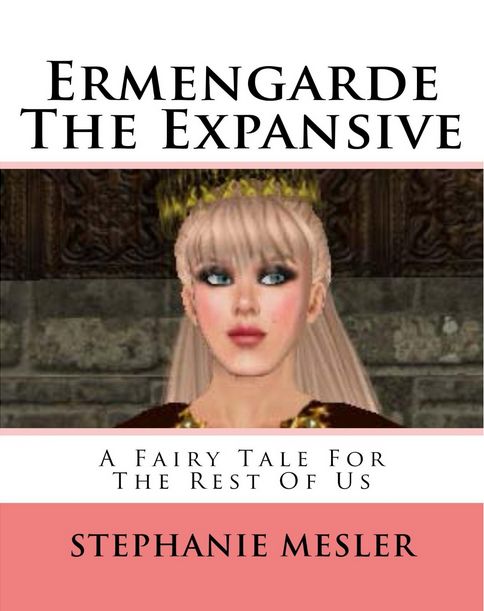
ermengardeFreda Frostbite reads selection from her new book Ermingarde the Expansive – a fairy tale for the rest of us.

“A fire-breathing dragon has entered your realm? No problem! A star falls from the sky? Catch it! Don’t like the prince you are obligated to marry? Dump him! Your daddy’s the king and he thinks you aren’t worth his attention much less capable of ruling the realm? Prove him wrong!

“Ermengarde the Expansive had a lot to overcome in spite if being born royal. Through strength and perseverance, she grew in power, stature, and, most importantly, self-esteem. Ermengarde is the princess our daughters could and should aspire to emulate.”

Thursday 6th June, 19:00: Poe’s Lighthouse
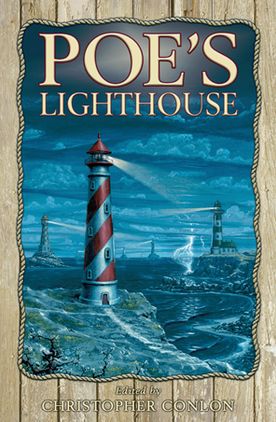
poe-lighthouse“The Light-House” is the unofficial title of Edgar Allen Poe’s last work, written some time between May and August 1849, shortly before his death in October of that year. Tale set within the confines of an isolated lighthouse and told, as were many of Poe’s tales, in the first-person.

The story opens on New Year’s Day in 1746. A storm is underway and the new custodian of the lighthouse writes a diary entry describing his arrival at this lonely outpost. In it, he entry expresses a mixture of annoyance, anticipation and a measure of paranoia / concern as to the safety of the buiulding itself, which grows somewhat in the two entries which follow. And while there is a heading for the 4th entry, no account of the day is actually given; the page is blank.

Much has been written and discussed about “The Light-House” over the years. Was it the start of a novel to which Poe never returned prior to his death? Was it actually a short story, the last entry intentionally blank to signify the narrator’s death, thus leaving the tale already complete when Poe died?

However, Christopher Conlon wasn’t interested in dry discourse about what “The Light-House” might or might not be when he established his challenge of Poe’s Lighthouse. Instead, he set some two dozen authors, including Mike Resnick, John Shirley, Chelsea Quinn Yarbro and Carole Nelson Douglas, the task of continuing Poe’s work and turn it into a complete story. His only stipulation: that they use Poe’s language, his images, his ideas; that they truly work together with the master.

Join Shandon Loring as he delves into this anthology of tales, all commencing with the same subject, but each one unique to itself.

Please check with the Seanchai Library SL’s blog for updates and additions to the week’s schedule.

In May, library guests are invited to support Seanchai Library’s featured real world charity Heifer International. Have questions? IM or notecard Caledonia Skytower.

Related Links

SL10BCC: buildings rise, but parcels lay unclaimed

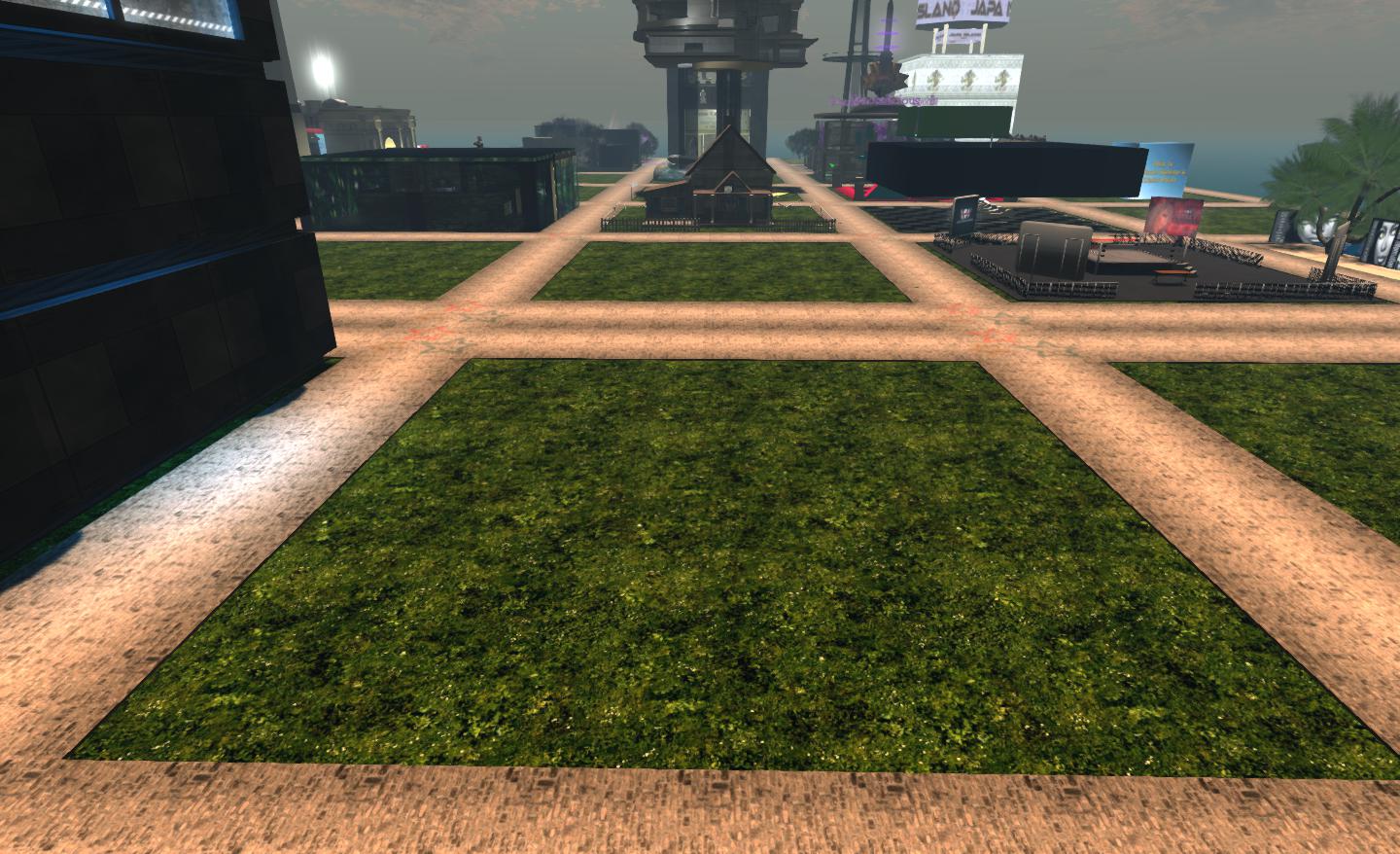
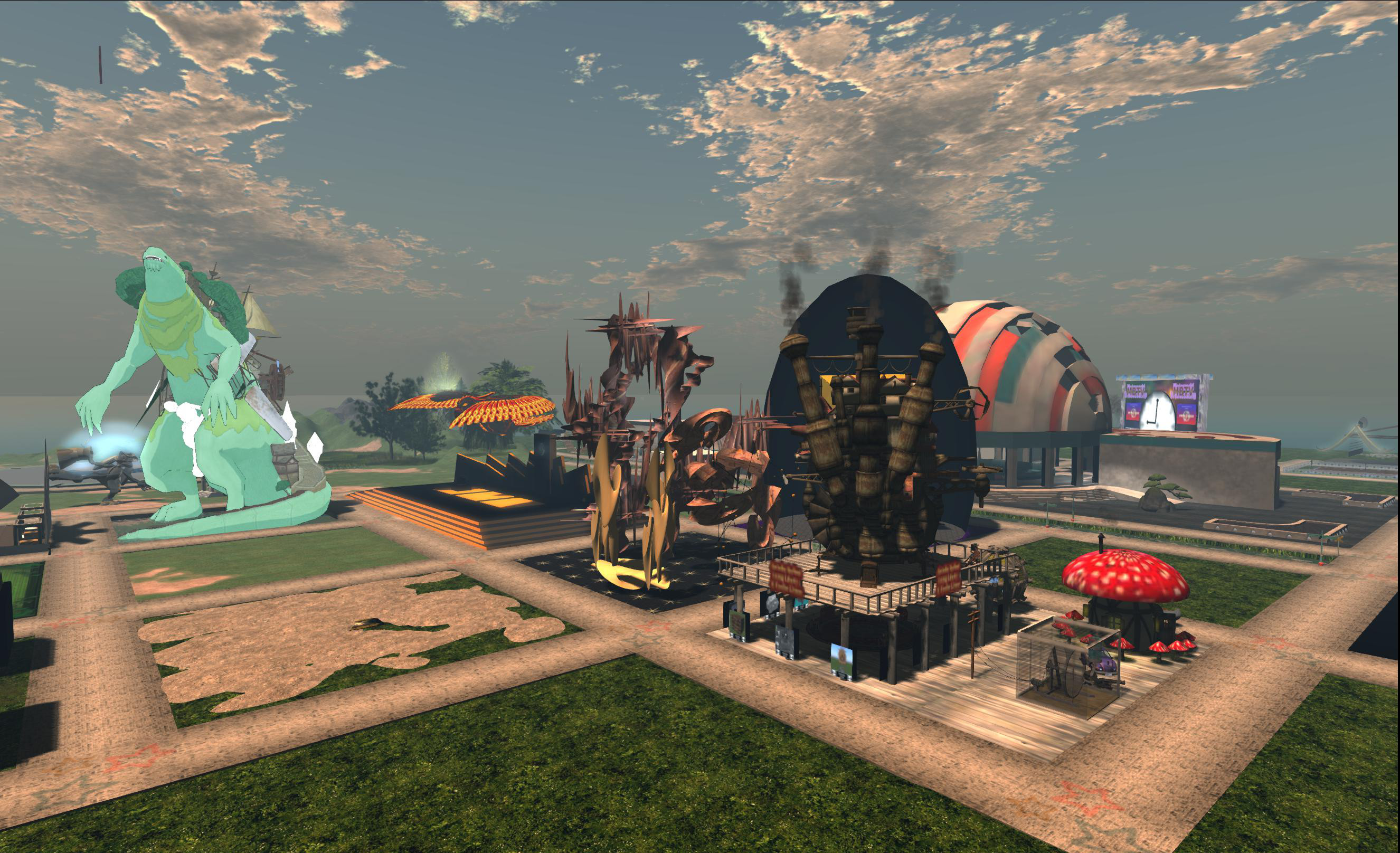
SL10B-CC_WordPressSunday May 26th saw the SL10BCC regions open to exhibitors and their helpers to start building / dropping in their exhibits. Since that time, the lonely patchworks of grass and water, neatly cut by sidewalks and piers I described in my last update have begun to vanish.

Like flowers bursting into bloom at the first touch of spring sunshine, so new builds have burst forth across the SL10BCC regions. Awesome builds, multi-hued builds, towering builds, quaint builds, charming builds, scary builds.

SL10BCC - building underway
SL10BCC – building underway

Everywhere is a hive of activity, as everyone works towards the deadline of June 13th, when the regions will all be closed ready for final testing and to allow the press and blogging community to preview all of the builds and the festivities to mark SL’s 10 birthday.

Well, almost everywhere.

Sitting between the builds are unattended parcels. Sad, forlorn parcels without even a prim to proclaim that they are loved and wanted. Even after a week of frantic building, they remain unclaimed.

Given the volume of applications received for exhibitor space, this cannot be allowed to continue. So the warning is going out far and wide:

If you have received an offer of a plot at SL10BCC and have not yet claimed it, you now have less than 24 hours in which to do so! Plots which remain unclaimed after Sunday June 2nd will be re-allocated!

Unclaimed and unloved. If you have received an offer of a plot at SL10BCC and have not claimed it, you now have less than 24 hours to do so - or risk losing it!
Unclaimed and unloved. If you have received an offer of a plot at SL10BCC and have not claimed it, you now have less than 24 hours to do so – or risk losing it!

If you have NOT claimed your parcel, then make sure you do so ASAP, by following these steps (as detailed in the Event Policies):

  1. Asking for an EA (Exhibitor Assistant) in the Second Life Birthday Community group chat (there may be a delay in getting a reply, as the EAs are working as quickly as possible but are busy, so please be patient).
  2. When an EA is available, they will tell you in the group chat to check your IMs.
  3. The EA will IM you. Let them know that you’re ready to proceed.
  4. Accept the group invite to Second Life Birthday Exhibitors group.
  5. Accept the teleport offer.
  6. The EA will give you a slice of birthday cake that contains helpful notecards and other goodies.
  7. The EA will ask for the following: Parcel Name, Parcel Description, Parcel Texture (full-permissions texture), Build Assistants (Maximum of 4), Music Stream URL, Media Stream URL, Deed any objects (A land radio or media player), and Landing Point
    NOTE: You can request these at a later time.
  8. The EA will tell you who your Sim Coordinator is.
  9. Set your group tag to Second Life Birthday Exhibitors group.
  10. Rez a prim on your parcel to claim it.
  11. Have fun.

Please, please, please note (10.). If you have gone through the above steps, but have not placed a prim on your parcel, then make sure you do at the earliest opportunity!

Again, parcels which remain unclaimed on Sunday June 2nd may well be allocated to others!

Related Links

SL projects Update 22 (3) SSB/A issue update, upcoming viewer releases

Server-side Baking / Appearance

Yesterday, I reported on the SUN-74 issue (Apparent avatar skin and eye texture asset corruption with Server Side Appearance), which can impact users with avatars wearing modifiable skin and/or eyes and/or hairbase who enter (via teleport or crossing a region boundary) an SSB/A-enabled region while using a non-SSB/A enabled viewer (e.g. such as Phoenix or the v1.23.5 viewer) and leave them with a corrupted copy of the worn skin / hairbase or eyes. At the time I noted that the matter was under investigation by Linden Lab, and no decision had been made on how to handle it.

Whirly Fizzle demonstrates the result of the SUN-74 issue
Whirly Fizzle demonstrates one aspect of the SUN-74 issue – on a non-SSB/A viewer, her MOD skin has turned black / invisible and her MOD eyes have turned white as a result of entering an SSB/A-enabled region and responding with YES to the given prompt.

Speaking at the TPV Developer meeting on Friday May 31st, Oz Linden provided an update on the issue and spoke more generally on the issue of the use of olfder (non-SSB/A capable viewers) going forward:

We don’t actually know what’s ultimately going to be done about that; that’s a subject of vigorous discussion that’s going on even as we speak, so we’ll see how that plays out. I think it’s fair to say that regardless of what happens with that particular issue … I will just make the observation that there are still people really, really old viewers [and] there is no way, no way at all, that we could even begin to test for compatibility back with all of those viewers.

As it is, as recently as this last week there were 1,665 different viewer version strings reported as connecting to the main grid (these include 151 versions of Singularity, 50 versions of Phoenix, 262 labelled as Firestorm, and so on). Some of these may be “one offs” self-compiled builds (which may or may not have the most recent updates to support something like SSB/A), but even so, given the overall number of viewer strings, it is understandable why the Lab view attempt to ensure so many different viewer versions were fully compatible with anything on the grid is a next to impossible task.

This does not mean that the Lab is going to ignore SUN-74, right now they are still investigating the problem and trying to reproduce it in a consistent manner (which is apparently proving difficult for a number of reasons, not the least of which is that some older viewers simply crash when attempting to repro the corruption). However, what it does underline is the need for people to upgrade to an SSB/A-enabled version of their preferred viewer sooner rather than later.

The reason for this is that very soon the Lab will start undertaking more widespread testing of the new service by enabling it across a number of regions across the grid. These regions may not necessarily be constrained to any of the usual RC channels, but could well be a mix of regions from all of the various simulator channels, making them harder to identify and avoid. This testing will be to gain greater insight into how the service stands up under “real avatar loads” – something which is impossible to carry out to any great depth on Aditi, as there simply isn’t the volume of users active there.

Once this more widespread testing starts, then it is entirely possible that users who remain on non-SSB/A capable viewers are going to encounter issues and problems beyond seeing grey avatars which the Lab are not going to address, simply because the issues can be resolved by a viewer update.

So the word really is, update, update, update.

Continue reading “SL projects Update 22 (3) SSB/A issue update, upcoming viewer releases”

Materials processing reaches beta – overview and more

After recent delays as the code passed through QA, the Materials Processing viewer unexpectedly reached beta release on Friday, May 31st with the release of version 3.6.0.275764, accompanied by a blog announcement from the Lab.

What is Materials Processing?

In case you’ve missed the news to date (if you already are, feel free to skip to the info on the viewer :)).

Materials processing brings normal and specular maps to object surfaces in Second Life (prims, sculpts and mesh – but not avatar skin / clothing layers). The capability has been developed as a collaborative effort between TPV developers (notably from the Exodus, Catznip and Firestorm teams), content creators and Linden Lab.

Note: The following two sections are not intended to be a technical discussion on computer graphics mapping or a detailed analysis of normal & specular maps. It is intended purely as a broad, non-technical of the latter.

Normal Maps in a Nutshell

Normal maps (sometimes referred to as bump maps, although they are more rightly the most common form of bump map) are a means of faking high levels of detail on an otherwise bland surface by means of simulating the bumps and dips that create the detail. Normal maps can be created in several ways.

For example, when working with 3D models, a common method is to make two models of the same object: one a very complex, highly detailed model with a high polygon count, the other a much lower polygon count model with significantly less detail. An overlay process is then used to generate a normal map of the detailed model’s surface features which can be applied to the less complex model, giving it the same appearance as the highly detailed model, but for just a fraction of the polygon count, reducing the amount of intensive processing required to render it.

Using a normal map to enhance the detail on a low-polygon model. The image on the left shows a model of some 4 million triangles. The centre image shows a model with just 500 triangles. The image on the right shows the 500-triangle model with a normal map taken from the model on the left applied to it (credit: Wikipedia)

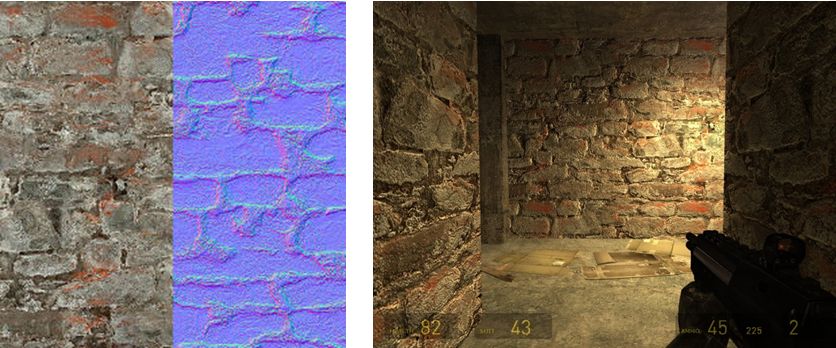
Another common way to produce a normal map is to generate it directly from a texture file. Most modern 2D and 3D graphics programs provide the means to do this, either directly or through the use of a plug-in (such as the nVidia normal map filter for Photoshop or the GIMP normal map plugin). When combined with diffuse maps, the normal map creates the impression of surface detail far greater than can be achieved through the use of the texture alone.

Normal map from a texture: left – the original texture (diffuse map) and its normal map shown as a split view; right – the material resultant from applying both maps to surfaces inside a game (credit: Valve Corporation)

Specular Maps in a Nutshell

In the real world, every highlight we see in an object is actually the reflection of a light source. Surfaces and surface details reflect light differently to one another, depending on a range of factors (material, lighting source point(s), etc.). Specular maps provide a means of simulating this by allowing individual pixels in an object to have different levels of brightness applied to them, giving the illusion of different levels of light being reflected by different points on the object.

When life gives you lemons: a mesh lemon with (l) a normal map applied, and (r) a normal and a specular map together. Note how light is apparently being reflected across the surface of the latter (credit: Mind Test Studios)

Like normal maps, specular maps can be produced in a number of ways, both within 3D graphics modelling programs and in tools like PhotoShop. As shown above, they can be combined with normal maps and textures to add detail and realism to 3D models and flat surfaces.

Second Life itself already includes a very dynamic example of how materials can be combined to create in-world effects in the form of Linden Water. This is created using an animated normal map to create the wave-like effect for the water, while an animated specular map adds the highlights and reflections. The result is a very realistic simulation of moving water able to catch and reflect sunlight.

Some key points about materials processing:

  • Effects will currently only be visible when using the Materials Processing beta viewer
  • In order to be visible in your world view, whether you are creating objects using materials processing OR whether you simply want to see them in-world, you must have the Advanced Lighting Model (previously “Lighting and Shadows” and often referred to as “deferred rendering”) option in Preferences > Graphics enabled
    • Note that this does not mean you also have to enable shadows themselves – you can leave the drop-down set to None and still see materials in use in-world, thus minimising any impact on your frame rates
    • The Lab has done a lot of work on the rendering pipeline to improve performance; as such, if you’ve not run with the Advanced Lighting Model / deferred rendering enabled on your computer due to previous performance issues you might find you can now enable Advanced Lighting Model in your viewer without experiencing a dramatic loss of frame rates
  • When creating objects which use materials processing, note that they will automatically move to the “mesh” accounting system for land impact, which can affect  the impact value assigned objects and models
  • Materials capabilities do not work when under Linden water.

Continue reading “Materials processing reaches beta – overview and more”

Touring da Vinci’s World

I recently previewed Sniper Siemen’s new LEA exhibit, Da Vinci’s World. If you’ve not already visited, I really do urge you to do so: the exhibit runs through until the 21st July and is a fabulous piece.

In the meantime, I put together a little video from snaps I took when preparing my original article – please hit the YouTube cogwheel and up the quality to 720p for best results.

Related Links