JIRA: feedback from the Lab

The dust is slowly settling from the recent announcement vis the effective closure of the Public JIRA for bug and issue reporting and the implementation of the simplified Bug Tracker approach and associated changes.

Comments passed from front-line staff by Linden Lab make it reasonably clear that the new approach to bug reporting and management has impacted more than just those users who have in the past been actively and positively engaged in the Lab’s JIRA; the Lab itself is undergoing something of a shift in how issues are handled, and that is it likely to be a few weeks before matters settle down internally.
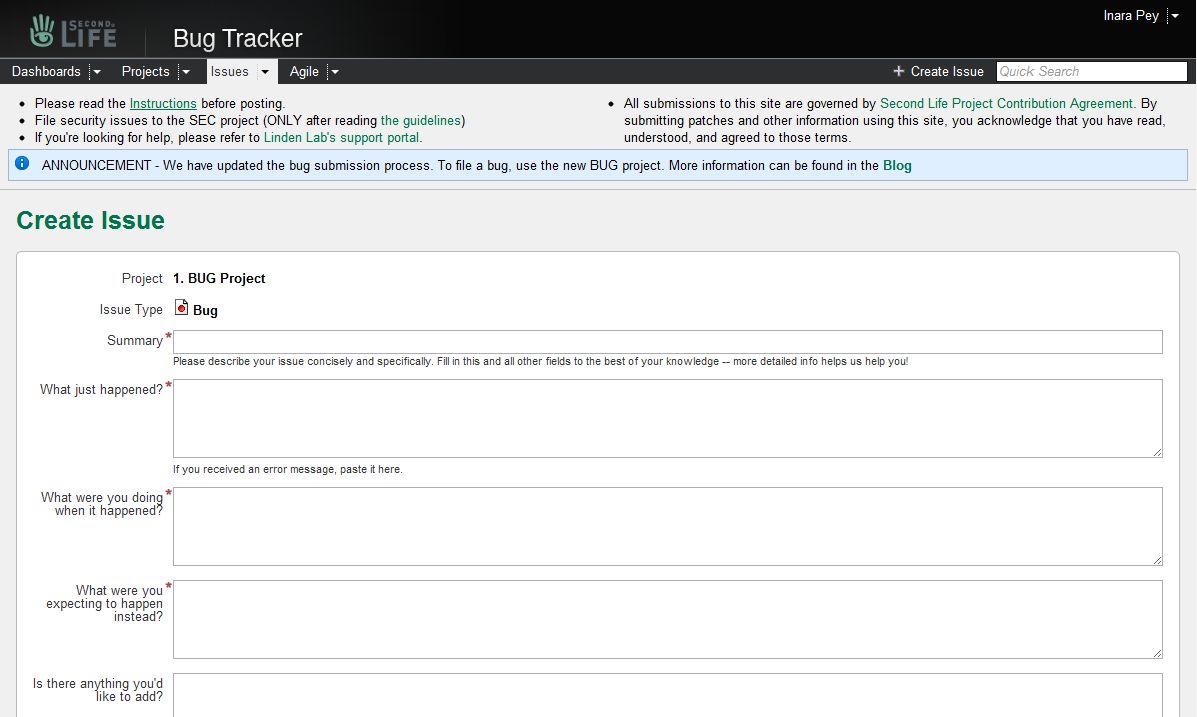
JIRA change: seen as a disappointing move by many

The Lab is also adamant that the overall aim of the change is to try an improve the utility of the bug reporting and management process from their own perspective – part of which was to eliminate the issue of having the JIRA used either as a forum for discussion and / or for posting irrelevant / angry statements, neither of which were seen as assisting the process of problem management and issue resolution. However, there has been an acknowledgement in some quarters as to whether or not the new system will increase or decrease the effectiveness of bug tracking  / management over time is an open question at the Lab, and that depending upon how the new system is seen to work over the next weeks / months, further changes may be made.

“JIRA Support Groups”

During the TPV/Dev meeting on September 7th, Oz Linden indicated that there are two “user groups” which are being established in relation to the new changes, and which the Lab will use to allow those residents with a demonstrable need to access a JIRA system and who are known to do so “responsibly” to have greater access to the new system.

Commenting after it became apparent during the meeting that some in attendance already had greater access to LL’s JIRA than others (including the ability to still comment on JIRA items), Oz said:

It should be noted that not all of you have exactly the same privileges. As part of this change [to the JIRA system] I created some access groups that do have somewhat deeper access … I haven’t actually figured out exactly what got set-up in the end … so be a little careful about asserting that, “Anyone can do such-and-such”, because if you’re in the active contributors’ group or the support helpers’ group, you have privileges other people don’t have … As I said, these changes have only been in effect less than 24 hours now [at the time of the meeting] … because there are a couple of levels of indirection involved, it’s not trivial to figure out what privileges a given person has – which is weird, but there you go … So, I have put in place a mechanism that I hope will make it easier for those of you who are actively collaborating with us on making the world better to continue doing so. It will probably take some time for all the bugs in that accommodation to be worked out.

Later in the meeting, he indicated one of these two groups, the “active contributors’ group” is being aimed towards the likes of TPV developers and those who have contributed to Second Life in terms of code and fixes, etc., in order to try to ensure they continue to have access to the new system which is beneficial to them (and more particularly, to LL) in order to better resolve bugs.

Similarly the “support helpers’ group” will be overseen by Alexa Linden and will comprise those who have demonstrated their value in assisting with the broader triage process (such as identifying duplicate issues, recognising where short-term workarounds for problems may exist, etc.).

Both groups were referred to as having greater ability to search reports in the new system, although the precise function and capabilities of these groups is liable to mature alongside the new system. While some people have already been added to the groups, this has been done as something of a “first pass” and appears to have been based upon first-hand knowledge of those involved. How additional people will be added to each of the groups is not entirely clear, although it is evident that in order to qualify for consideration, an individual must have a track record of positive and beneficial engagement in the JIRA process to triage and / or resolve issues.

Also during the meeting, Oz encouraged TPV developers who are concerned about the negative impact of the change and who have “Legitimate use cases that serve the needs of Second Life in general and Linden Lab in particular,” which may not be met by the new system, to write them up “In non-emotive form, … [but] in terms of how they are useful to Second Life residents and how they provide utility to Linden Lab … a calm exposition of the value to Linden Lab of doing something different would be.”

Forum Discussion Option

The JIRA situation was also raised at the Simulator User Group Meeting, also held on September 7th, Simon Linden put forward a suggestion that perhaps the forums could be used in some capacity. He was encouraged by those attending the meeting to pass the idea back to the Lab itself, with Toysoldier Thor suggesting a new Forum category of “Post-JIRA Forums” to facilitate general discussions. During the Content Creation User Group meeting held on the 10th September, Alexa Linden further indicated that the possible use of the forums was being considered.

Going Forward

The debate on the positive / negative aspects of this change are liable to continue for some time to come. That steps were taken to create two new “JIRA support groups” ahead of the launch of the new system tends to demonstrate that some within LL were not blind to the part played by users in the overall management and resolution of bugs. The hope appears to be that these new groups will offset the more negative aspects (lack of access, ability to contribute, etc.), presented with the launch of the new system.

Whether this proves to be the case will come down to how effectively the groups are managed, the level of access those within the groups are given, and whether or not the new system itself achieves the level of improved utility in the reporting, triaging and resolution of bugs the Lab hopes will be the case. Currently, it would appear that none of this is liable to be objectively known for the next several months.

Related Links

Keisei: garden haven and photographer’s delight

See also: My updated May 2013 review.

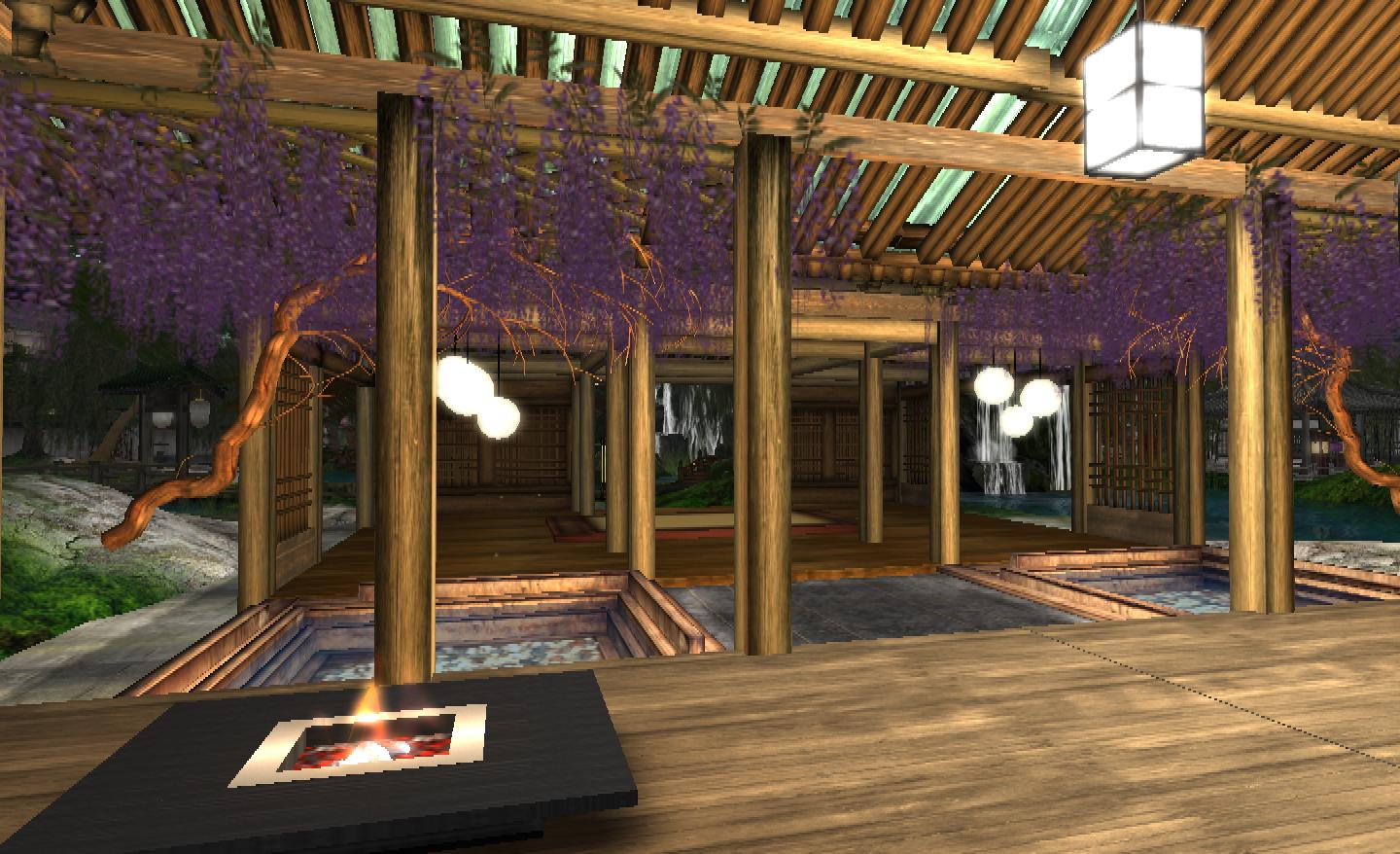
I was unaware of Keisei until Honour McMillan recently posted images in her blog. Once I’d seen them, however, it went right to the top of my list of SL destinations to visit. Anything having an oriental theme is going to get my attention, and Keisei is just that.

The region, rated as Moderate. is predominantly Japanese in nature, although there are small Sino touches which I find attractive as well. From the landing point, you’re free to wander where you will, with footpaths to guide you, or you can use the teleport board to pin-point selected destinations.

Keisei; Inara Pey, September 2012, on Flickr, on FlickrKeisei (Flickr)

There is a lot to see and enjoy here, and the landscape has been put together to encourage photography – and to encourage experimentation with Windlight settings; so much so, that I could have happily spent hours in Keisei snapping away and tweaking my settings through Phototools (which I think I’m finally starting to get my head around, although I have a long way to go yet before I can pull off anything half-decent).

Water is very much a feature here, with streams, pools and waterfalls in abundance. There are places to sit and admire the gardens, places to climb, and places to sit in quiet contemplation. Keisei is also the home of  Shiraito-no-Taki Hanamachi, located to the North-west of the region.
Keisei; Inara Pey, September 2012, on Flickr, on FlickrKeisei (Flickr)

To the North-east side of the region sits Enkatsu Yama, the private home and garden of Famke Faith (also known as Phoenix DaVinci). The outer ward of this is open to the public, and visitors are welcome to stroll around and enjoy the tranquillity. Beyond the inner gates,  guarded by two Chinese looking lions, sits the house proper in a private ward, where visitors are asked not to stray.

Sim extenders are used to great effect around Keisei, giving the feeling  that this is a small, coastal community, lost in time and free from the hustle and bustle of modern life. Out in the bay to the west of the region lies a wood-framed light house, waiting to guide ships to a safe berth.

Keisei; Inara Pey, September 2012, on Flickr, on FlickrKeisei (Flickr)

There are a number of Windlight presets in operation around the sim, so you’ll likely get requests to change your Windlight as you go – it’s worth doing, as some of the presets really do set off the sim’s landscaping and architecture perfectly. The music streams also vary from parcel to parcel – so if you use a viewer with an active media filter, be prepared for a few prompts from this as well. The music I heard was again in keeping with the tranquil nature of the sim, and didn’t detract in any way from my enjoyment as I explored.

This is a wonderfully relaxing sim to visit and, as mentioned, a photographers delight. My thanks to Honour for raising my awareness as to its existence.

Keisei; Inara Pey, September 2012, on Flickr, on FlickrKeisei (Flickr)

Related Links

Curiosity: MAHLI put through its paces

September 7th through 9th saw the robot arm systems go through a range of “reach tests”  which also allowed Curiosity it complete another series of “firsts” from Mars as the Mars Hand Lens Imager (MAHLI) was used to capture a range of images of the rover to help with calibrating the system and to check-out Curiosity’s condition. All of these images were taken with the protective cover on MAHLI’s lens in the open position, and revealed the clarity with which the system can capture images.

There was a slight delay in progress on Sol 31 (Sept 6th), after a temperature reading from the arm caused Earthside concerns and the cancellation of planned activities while the matter was investigated and successfully resolved. Sol 32 (Sept 7th) saw the tests planned for the 6th Sept successfully completed, which included the capture of the images of the rover’s mast and the turret on the end of the robot arm I’ve previously reproduced here. A series of vibration tests were also carried out, designed to characterise the function of the sample processing device in the turret (the vibrations will cause the system to act like a sieve, separating-out very fine Martian surface material out from the rougher samples prior to delivery to the on-board science systems, CheMin and SAM).

The reach tests for the robot arm are designed to test the arm based on a range of calibration motions carried out on Earth intended to approximate how the arm should work on Mars. The tests are important because the arm, with the mass of the turret on the end, has only been operated in Earth’s gravity and engineers need to confirm that the arm is actually functioning as anticipated in the lower Martian gravity environment and after both an 8-month cruise through interplanetary space and the rough dynamics of the EDL phase of the mission. Adjustments carried out as a result of the reach tests will allow the arm and turret to be operated with the degree of precision required for the forthcoming science elements of the mission.

The Trivia Report I Forgot

On some of these MSL reports, I’ve published a small piece of trivia about the mission. One that I had lined-up, but then missed Pressing, was that fact that among all the science hardware on Curiosity there is … a 1909 Lincoln VOB penny.

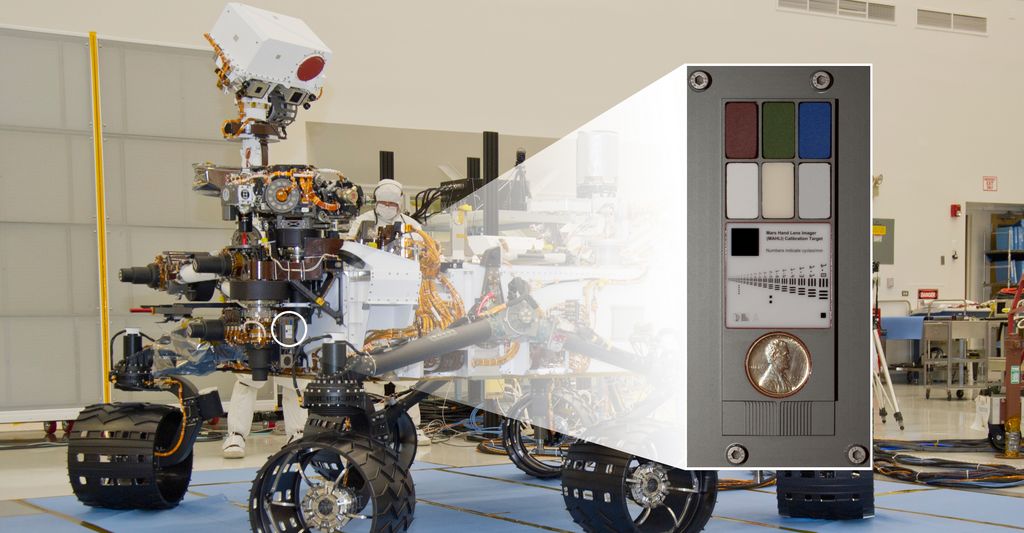
MAHLI calibration target, complete with the first coin on Mars, a 1909 Lincoln penny

The penny is part of the calibration target for MAHLI, which is mounted on the front of the rover’s body. The target also includes colour chips, a metric standardised bar graphic, and (just below the penny) a stair-step pattern for depth calibration.

The penny itself is a nod to geologists’ tradition of placing a coin or other object of known scale as a size reference in close-up photographs of rocks, and it gives the public a familiar object for perceiving size easily when it will be viewed by MAHLI on Mars. The coin  was supplied by MAHLI’s principal investigator, Ken Edgett, and was minted to mark the centennial of Abraham Lincoln’s birth.

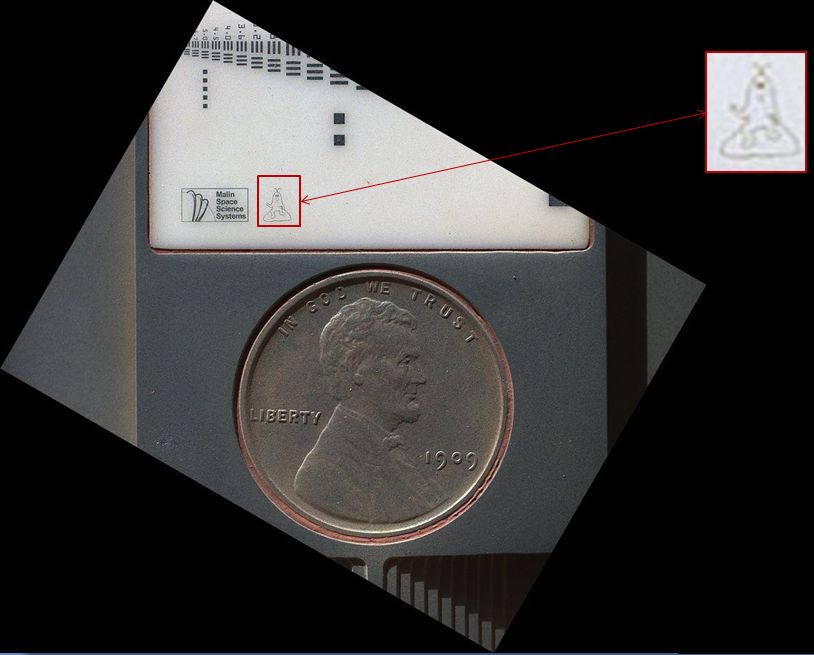
The Lincoln penny seen on Mars by MAHLI; note the fine film of Martian dust on the coin. “Joe the Martian” can be seen above the penny & inset. The main image was captured with MAHLI some 5cm (2 inches) from the target, and on a low resolution setting

Also on the calibration target is an image of “Joe the Martian”. This is also from Ken Edgett, and is actually his own creation, first drawn when he was nine years old when the NASA Viking missions in the 1970s inspired him to want to become a planetary researcher. The character was later used in a children’s science periodical, Red Planet Connection when Edgett directed the Mars outreach program at Arizona State University in the 1990s.

Both the penny and the character are designed to engage public interest in the mission, and both will be imaged throughout Curiosity’s operations on Mars, allowing people to see how weathered they become over time due to exposure to the Martian environment.

Taking a Look Underneath

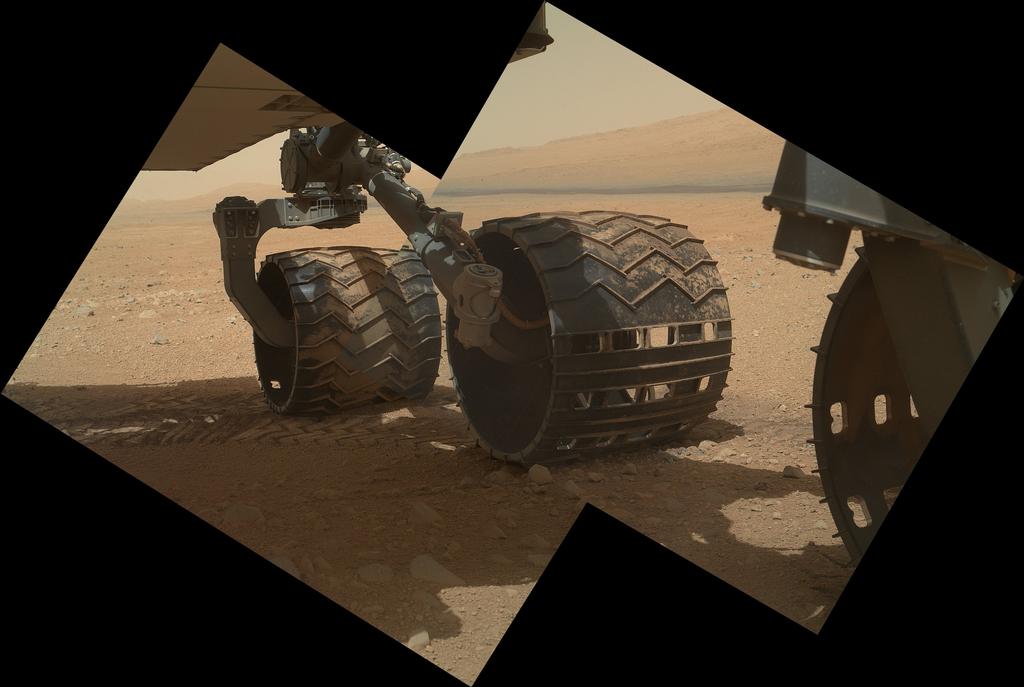
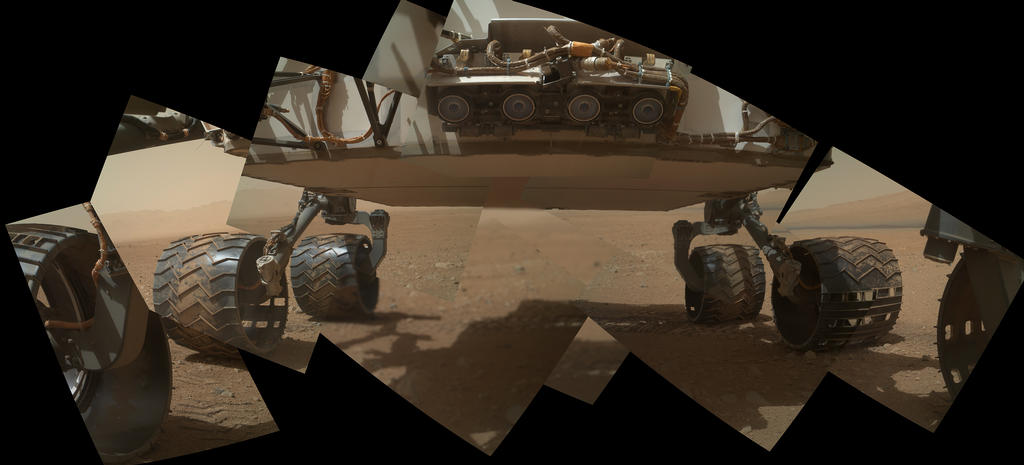
On Sol 34 (Sept 9) MAHLI was used to take a series of images looking underneath the rover’s belly, allowing engineers to take a first-hand look at the overall condition of the wheels and underside of the vehicle and confirm there is no hidden damage which might cause problems later.

Curiosity’s wheels – note the Morse code JPL cut-outs – with “Mount Sharp” as a backdrop

These images also help demonstrate the extreme flexibility of MAHLI, which can image objects from as close as 2.1 cm (just under an inch) right out to infinity, allowing it to be used for close-in precise work related to surface science, and for producing more general images which can be used in a range of activities from confirming the rover’s status through to helping to plan for the drive to “Mount Sharp”.

Taken together, the MAHLI images are remarkable because no other planetary or robotic mission has been able to image itself so comprehensively. Being able to do so not only assists engineers in assessing the rover’s condition throughout the mission, it helps to further engage public interest in what Curiosity is doing by “personalising” the images it can return from Mars.

MAHLI mosaic of Curiosity’s underside. The four “eyes” at the top centre are the rover’s forward Hazcams, used in vehicle navigation, looking to the front and to the left / right of the rover’s path

Curiosity reports in this blog

Images courtesy of NASA / JPL.

Recent SL viewer activities

It’s been a while since I’ve reviewed any of the official SL viewers from LL, so here’s a quick round-up of recent releases.

New Log-in / Account Creation Prompt

The new account creation prompt, displayed if the viewer does not locate any user settings files on a computer, and which first appeared in the 3.4.1.263582 release (August 16th), now looks to be the default option for all development / project viewers. It is part of both the most recent Mesh Deformer project viewer (3.4.1.264215, August 31st), and the new HTTP Group Services project viewer (3.4.1.264495, September 7th). However, it has yet to filter through to either the Beta or release versions of the Viewer.

Account creation prompt: now standard on all development / project releases of the SL viewer released since August 16th (click to enlarge)

Mesh Deformer Project

August 31st saw a new release of the Mesh Deformer (3.4.1.264215), which includes a revised mesh uploader floater with deformation options for the male and female shape.

New deformation options

According to Nalates Urriah, the new options invalidate all test items so far provided for the project, and new samples are now required, although no comments to this effect appear to have been made on the JIRA or elsewhere, so they may have been confined to a user group meeting. Details on how to provide test items can be found in Oz’s forum post on the matter. The JIRA (STORM-1716) for this project is still open for viewing and comment.

Group Services Project Viewer

As noted this week, there is now a Group Services (group management) project viewer available for testing the new HTTP group management service. The server-side of this project has yet to be rolled-out to Aditi, so it cannot be tested as yet. However, Baker Linden, who is developing the service, is apparently updating the JIRA, SVC-4968 (which is still publicly viewable) with the project status, and has indicated he’ll post when the server-side elements are available for testing.

The viewer is available in Windows, Linux and OSX flavours.

HTTP Libraries Viewer

The HTTP Libraries project viewer (3.3.3.262585) appeared on July 27th. This project, which Monty Linden is driving, is currently aimed at improving texture downloading and rezzing as a part of the Shining project.

HTTP Libraries project viewer: improved texture loading and rezzing

Texture loading / rezzing would appear to be significantly faster on this viewer compared with other offerings, although there also appear to be what might be placebo effects associated with it. Some people have reported that floaters, etc., seem to load more slowly, and some have reported various performance improvements outside of the HTTP library changes.

Beta Viewer and Release Viewers

The Beta viewer (3.4.0.264445 at the time of writing) continues to be focused on pathfinding, with fixes and updates going into it on a weekly basis – which is why the pathfinding tools have yet to release a release version of the viewer.  The removal of JIRA numbers from the release notes now means that tracking issues previously being watched is that much harder (even if the JIRA themselves are no longer accessible, having the JIRA numbers still visible facilities easier identification of issues being specifically tracked).

Similarly, the release viewer (3.3.4.264214) appears to be focused on bug fixes and general improvements, with the release notes currently benefiting from the retention of JIRA numbers, making scanning for specific fixes easier.

Performance

I carried out basic performance tests on the viewers listed above using Dimrill Dale as my sample sim, during a period when there were the same number of avatars in the region (5, including myself). Tests were carried out in the same location on the region, looking in the same direction and with the same viewer settings (e.g. Graphics on high, Draw Distance set to 260m, using default time-of-day, with deferred disabled / with deferred enabled and lighting set to Sun/Moon+projectors, etc.). While all such tests are rough-and-ready, these did tend to show that all of the viewers offer the same performance on my default PC (see the sidebar panel on the right of this blog’s home page for system details). My results were:

  • Non-deferred: 18-20fps
  • Deferred with Sun/Moon+ projectors: 8-10fps

Similar figures were also obtained using the current Firestorm and Exodus viewers, although with deferred enabled and Sun/Moon+projectors active, Firestorm was slightly down at an average of 17-18fps, the other viewers being closer to an average of 19-20fps.

Viewer release summary 2012: week 36

This summary is published every Monday and is a list of SL viewer / client releases (official and TPV) made during the previous week. When reading it, please note:

  • It is based on my Viewer Round-up Page, a list of  all Second Life viewers and clients that are in popular use (and of which I am aware) and which are recognised as being in adherence with the TPV Policy
  • By its nature, this summary will always be in arrears
  • The Viewer Round-up Page is updated as soon as I’m aware of any releases / changes to viewers & clients, and should be referred to for more up-to-date information as the week progresses
  • The Viewer Round-up Page also includes comprehensive links to download pages, blog notes, release notes, etc., as well as links to any / all reviews of specific viewers / clients made within this blog.  

Updates for the week ending: 9 September, 2012

  • SL Viewer updates:
    • Current release rolled to 3.3.4.264214 on September 5 – release notes
    • Beta version rolled to 3.4.0.264445 on September 5 – release notes
    • Development: rolled to 3.3.5.264487 on September 5
    • Group Services project viewer 3.4.1.264495 released on Sept 7, but awaiting server-side roll-out on Aditi
  • Zen Viewer rolled to 3.4.1.1 on September 7 – core updates: Flickr upload option added to snapshots floater; Latest Mesh uploader with avatar shape deformation; whisper/mumble option for OpenSim; performance updates – release notes
  • Cool Viewer:
    • Stable branch rolled to 1.26.4.29, on September 8- core update: Re-reverted to v3.4 latest fixes to llTargetOmega()
    • Experimental release rolled  to 1.26.5.8 also on September 8 – core update: Fixed the bug that caused objects not to be rendered in sims with mesh support disabled (such as in Inworldz)
    • Release notes for both
  • GroupTools rolled to installer release 2.2.10.0 on September 5
  • LittleSight Android client rolled to version 1.3.0 on September 9 – core update: addition of pay-to-teleport function.

Related Links

Group management project viewer released

As I recently noted, Baker Linden has been working on the large group management / editing issues, developing a new HTTP-based service to replace the current UDP service which has significant issues handling groups with more than 10-11K members. At the TPV/Developer meeting on the 24th August, he indicated that a project viewer would be available in the near future.

On Friday September 7th, he updated the JIRA on the issue with notes that the project viewer is now available for Windows, Linux and OSX.

In commenting on the JIRA (SVC-4968), Baker notes that the server-side code for the new service has yet to be deployed to Aditi, where initial testing will take place, and adds that he’ll be providing an update on the status of the server code once the situation has been clarified. He goes on to add:

There may be some issues during testing. When getting the member list of a large group, other info (group title, group info, etc.) may not properly load. This is an issue with the speed of Aditi’s SQL server and shouldn’t occur once live on Agni. To receive the rest of the data, wait for the member list to appear (this can be upwards of a few minutes), go back to the My Groups panel of the people floater and view the group profile again. The query will be cached this time, and the member list will appear quicker than it did before (depending on your connection speed). The rest of the information should be received this time.

If you find any problems while testing, please send me a message in-world (on Agni).

Large group loading: part of the group management problem

As noted in my previous report, in the first implementation, the data will be uncompressed. This means there will still be some delays in group loading (Baker previously estimated that a 40K member group is around 5Mb in size and could take up to a few minutes to download, depending on someone’s connection speed). Data compression is being looked at for a future release, although as noted in the comments on my last article, some are wondering why paging group data isn’t being implemented (does the viewer API support it?).

Another point of note is that the new service is not compatible with V1 code, so adoption by V1-based viewers is liable to require some backporting. This is important, as once the new HTTP service is rolled out, the older, more limited UDP service will be capped at groups containing 10,000 members – larger groups will not function.

There is still no definitive time scale for the roll-out of the new service. However, it seems likely that once available on Aditi, the server code will remain there for testing for at least a couple of weeks prior to it being added to a RC channel on the main grid. How long the testing period across both will be is open to question, and a lot will depend on feedback as to how well the new service performs.