Rollin’ rollin’ rollin’

Rollin’, rollin’, rollin,
Though the plains are dusty

Keep that rover movin’
NASA.

Rocks and wind and cold nights
Crossing that ol’ crater
On your way to Glenelg now, in style.
All things you’re doin’,
Sampling, scraping, dating
Will help our understanding of Mars.

(With apologies to Ned Washington!)

Over the course of the last several days, NASA has completed initial calibration and characterisation of Curiosity’s robot arm and initial testing of several of the turret-mounted scientific instruments.

These tests have included discovering the arm’s range and accuracy of movement in the low Martian gravity and temperature environs, as well as commissioning the turret-mounted Mars Hand Lens Imager (MAHLI) camera and the Alpha Particle X-Ray Spectrometer (APXS) which is designed to determine the elemental composition of a target rock. Both are now all but cleared for science operations, although some further tests are planned.

On September 11th, Sol 36, the arm went through a series of “reach tests” using MAHLI to ensure that the arm can accurately position equipment over inlet ports on the rover’s body for the transfer of materials gathered from the surface of Mars.
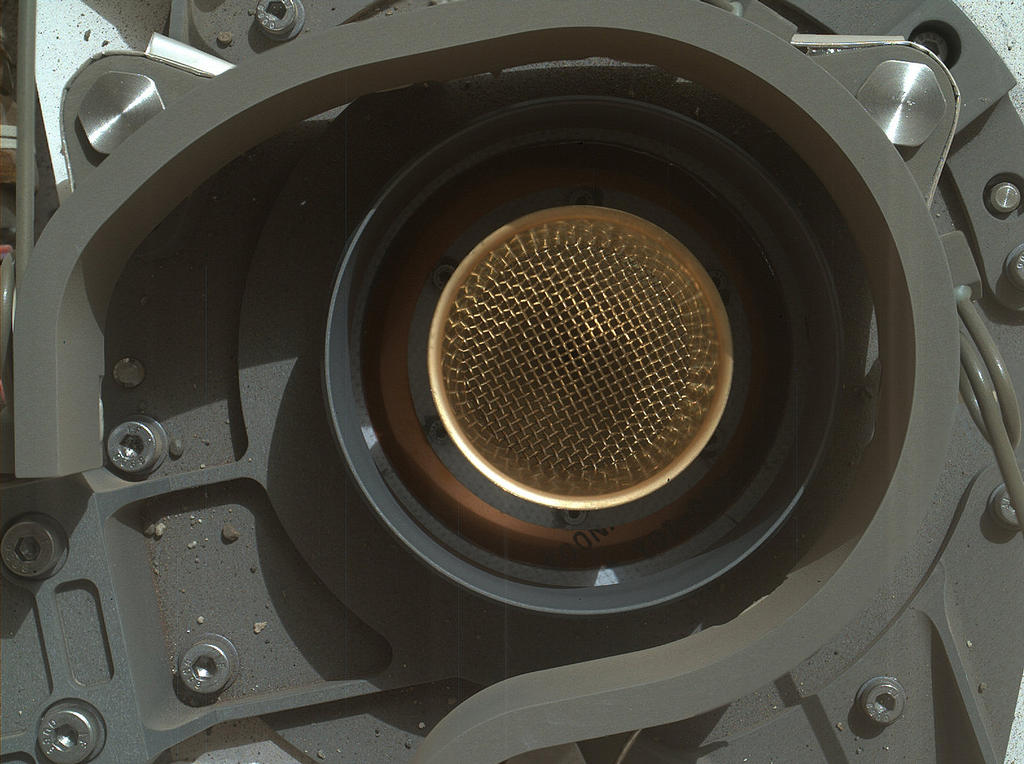
Open wide! The CheMin sample inlet port, imaged by MAHLI on Sol 36. The 3.5cm (1.4 in) diameter  mesh-covered funnel will be used to supply Martian “fines” to the CheMin spectrometers for analysis

The Canadian-made APXS has previously been used to gather atmospheric readings, but the tests performed on September 10th, Sol 35, marked its first use on a solid target, using a calibration target mounted on the rover. The results showed APXS to be in excellent health. “The spectrum peaks are so narrow, we’re getting excellent resolution, just as good as we saw in tests on Earth under ideal conditions,” Ralf Gellert, the principal investigator for APXS reported. “The good news is that we can now make high-resolution measurements even at high noon to support quick decisions about whether a sample is worthwhile for further investigations.” This latter point is important, as X-ray detectors best work cold, and so was thought that APXS might find the midday periods of a Martian Sol a little too warm to produce reliable results.

APXS imaged by the 34mm Navcam on Sol 32 (September 7th), during initial visual check-outs of the arm and turret systems. This image confirmed APXS was not caked with dust blown up by the Descent Stage motors during Curiosity’s arrival on Mars.

After its initial check-outs, MAHLI was further tested in its ability to produce 3D images of surface objects, again using the calibration target mounted on the front of the rover. MAHLI is the second imaging system Curiosity carries that is capable of producing colour 3D images, the other being the Mastcam system, which was tested prior to the rover departing Bradbury Landing. Both systems produce 3D images through accurate positioning of the cameras, either by manoeuvring the robot arm (for MAHLI) or the entire rover (for Mastcam).

Transit of Phobos

Earlier this year, I covered the Transit of Venus, an astronomical event only visible from Earth every 105 or 121 years. Mars has similar events, which include transits of the Earth across the face of the Sun and, more particularly, transits of its own small moons, Phobos and Deimos. Transits of Phobos occur twice every Martian year, and on Sol 37 (September 12th), Curiosity’s Mastcam was used to capture images of a Phobos transit. The full-resolution images from this are liable to take a few days to download and be processed, but the plan is to produce a movie of the transit from the images captured.
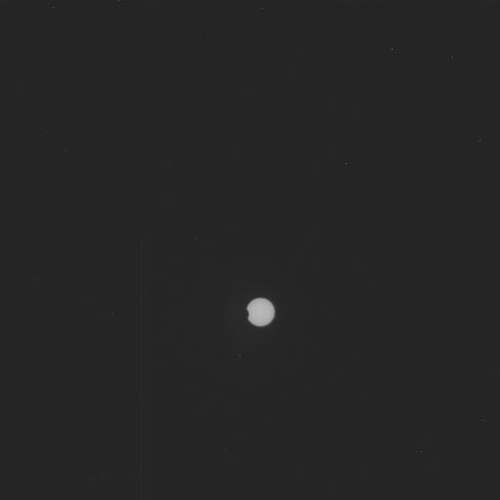
A raw (unprocessed) low-resolution image of the transit of Phobos – the 11km wide moon, some 6,000km above the surface of the planet can just be seen on the edge of the solar disk

Next Stop: Glenelg – or a rock

With the arm characterisation tests now all but complete, Curiosity was ordered to resume its drive towards Glenelg, an area of Gale Crater some 400 metres from Bradbury Landing. The drive commenced on Sol 38 (September 13th), when the rover completed a drive of 32 metres, a further increment in the daily distance covered as confidence is gained in Curiosity’s autonomous driving capabilities. Even so, it will still be another few weeks before the rover arrives at Glenelg, and the drive may again be interrupted if a suitable rock candidate is identified for direct in situ testing of APXS and MAHLI. If deemed suitable, the rock may also be used to test the rover’s turret-mounted drill, although testing of this may be held-over until Glenelg is reached towards the middle of October.

David Oh from the MSL team provides a superb summary for the week, and insight into working as a part of the Curiosity team.

Curiosity reports in this blog

Mission Trivia

Curiosity has now driven142 metres (466 feet) since its arrival on Mars.

Images courtesy of NASA / JPL.

Opening Pandoria’s box

Pandoria
Pandoria

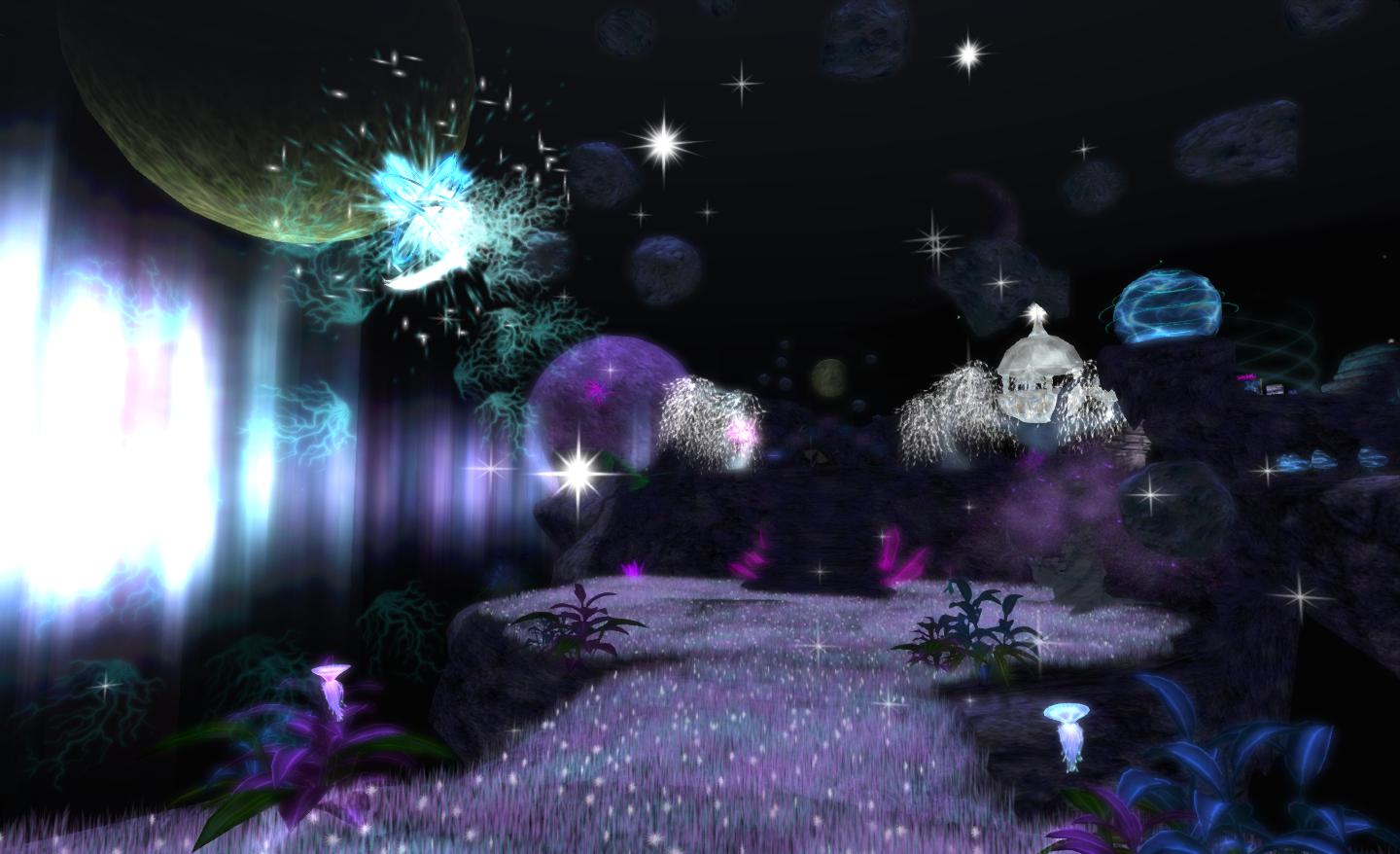
Pandoria is the creation of Bonny Greenwood, owner of Mindgardens Creations. It is described as a “celestial cosmic adventure full of many treasures, ambient music, amazing beauty and more!” – and it lives up to this description in full.

Located high in the sky over Magic Valley, where the Mindgardens store can also be found, Pandoria is a mixture of romance and meditation surrounded by planets, stars and a glittering white aurora.

Pandoria
Pandoria

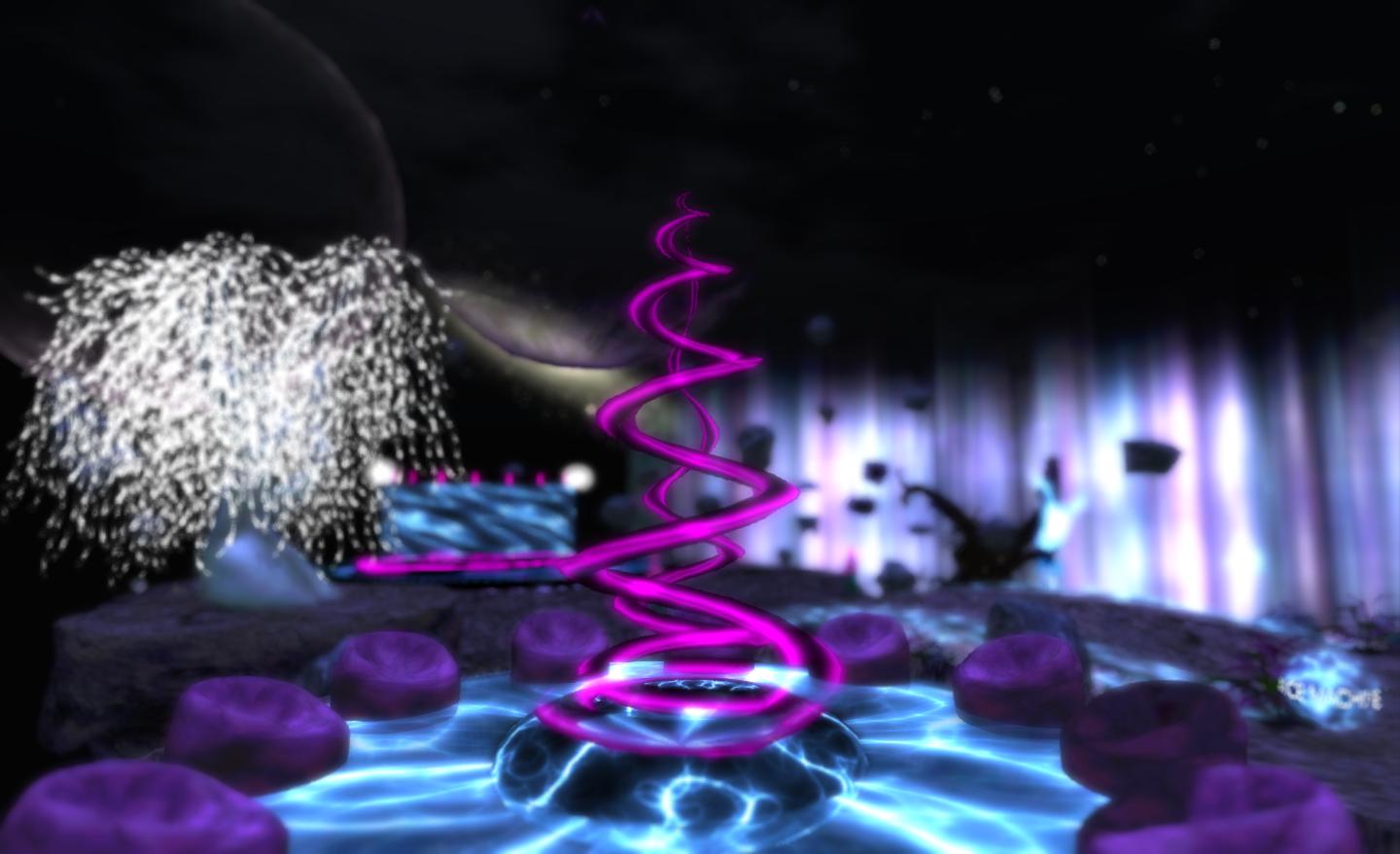
This is a place one can enjoy alone, although it naturally lends itself to being a shared experience, whether or not romance and dancing is involved – and there are places here to dance. The music stream is well-chosen (the occasional “important messages” barely noticeable), and lends itself fully to one’s enjoyment while exploring the glittering islands in the sky.

For those wishing to clear their minds, there are places to meditate, while for those seeking entertainment, there is also a place to sit and play a quiz. For my part, Pandoria was a chance to wander alone and let my thoughts stray where they will. There is a very faint echo of Inspire Space here, another favourite venue of mine, but so faint as to encourage a feeling of warm familiarity, even on a first visit to Pandoria, rather than anything else.

Pandoria
Pandoria

Pandoria is a visual box of delights. It may not be big, but that’s part of the beauty, you don’t have to walk far to find something to captivate or enchant, although teleporters offer you the chance to see more elsewhere, whether it’s the Moonlit glades of Magic Valley itself or the underwater mermaids caverns or the Mindgardens Creations store itself.

This is a magic place to visit and will, it appears, become the venue for events in the near future – a calendar is available on the Pandoria blog, and a stage area can be found on the sky islands. I’m looking forward to seeing what entertainments and activities do occur; Pandoria is liable to be a place to which I’ll be returning a lot.

Pandoria
Pandoria

Related Links

Saint Torley’s Day 2012

Torley Linden, rightly one of the most popular Linden Lab employees, famous for his infectious good-humour, his love of watermelons and talent for music, is to be the focus of the 5th resident-run Saint Torley’s Day, organised by the First Church of Rosedale and the Four Kittens of the Apocalypse.

The many faces of Torley Linden

The event will take place this Sunday, the 16th September, 2012, commencing at 12:00 SLT. Celebrations will comprise:

  • 12:00-13:00 –  a special service will take place at the Rheta Shan Memorial Chapel of the First Church of Rosedale. Please note that the church is in the Promised Land of Zindra, so participants will need to be adult-verified or have payment information on file
  • 13:0-14:00: a party featuring Second Life artist Kaklick Martin and Torley’s own compositions, hosted by Alchemy Epstein and Nakira Tennen; to be held at the Four Kittens of the Apocalypse, Penning.

The press release announcing the event reads in part:

“Torley Linden has written innumerable posts on the company’s official blog and created hundreds of video tutorials. He listens and responds to residents, holding weekly office hours and keeping tabs on Second Life content all over the Web, including blogs, Flickr, Twitter, Vimeo, and YouTube. His Saint Day is the Sunday closest to his “rezday” (the day he first entered Second Life), September 15; 2011 will mark the end of his eighth year ‘in-world.’”

The event is intended to be a warm celebration of Torley’s work as Resident Enlightenment Manager, as such those attending the party are encouraged to “wear the most pleasingly garish shades of neon pink and green they can find”, and expect the “‘melon-go-round’, the grid’s most heavily armed watermelon piñata, and more surprises”.

So get your shades, grab a watermelon and join the festivities!


Watermelon Wine by Torley Linden

For further information, contact Samantha Poindexter in-world.

The organisers stress this event is not affiliated with or sponsored by Linden Lab.

With thanks to Samantha Poindexter.

Belated avatar baking service update

The server-side elements of the new avatar baking service (part of the Shining Project) continue to progress, alongside what Nyx Linden has referred to as, “Some pretty scary viewer re-architecting” which is being undertaken by the Lab in order to try to isolate some of the avatar baking aspects from the rest of the viewer code base. As such, he’s anticipating the eventual code merge to be “fairly significant” when it does happen, although at the time of commenting (the last TPV/Dev meeting, September 7th), the code was not in a condition where it could be used by any of the TPVs.

Bake fail: a familiar problem for many

Overall, the viewer elements of the project are the priority, with the aim remaining to get the viewer code completed first, and to make it available to TPVs so that test viewers can be built. This is likely to happen before the code is ready for any formal release, the aim being to allow TPV devs to carry out test merges and to let LL know anything else has been broken as a result of the changes made to the code in order for the new service to work.

Once the code is available for testing both within the viewer and on test regions on Aditi, Nyx will be looking for “as many people as possible to pile-on” and test the code in order to see how the service works and how it may break, so that  by the time the viewer code is merged for release purposes, it will be as robust as possible.

Test Avatars

To assist with the work, Nyx is also looking for volunteers willing to take part in the initial round of testing using avatars wearing multi-layer outfits (e.g. outfits combining undershirt, shirt and jacket layers, etc; outfits using multiple elements of the same layer; outfits with system skirts and glitch pants, outfits using alpha and/or tattoo layers, and so on). Anyone interested in joining-in the testing should contact Nyx via e-mail or by sending him an in-world notecard, specifying the avatar name and details of the outfit itself. When volunteering, bear in mind that:

  • The outfit must be a Viewer 3 outfit, and your viewer must support the Current Outfits folder (which is used to drive the new service from the viewer end)
  • Testing will be on Aditi, and as such, the avatar and outfit must be available on Aditi. If necessary, you may need to update your Aditi inventory to make the outfit available.

Going Forward

The plan is still to have the new code support both the “current” method of avatar baking  and the new baking service, until such time as the new service is fully deployed. This means that if a user is in a region that does not make use of the new baking service, avatar baking will continue to be handled using the viewer-side mechanism. However, if the user is on a region that utilises the new baking service, avatar baking will be handled through that, with a flag set via the region capabilities being used to distinguish whether or not the new service is available.

There is still no definitive time frame for the project because of the complexity involved in both developing the viewer code (which is currently using a branch of the SL development viewer, but will obviously be moved to whatever code release is current) and with the development of the new server-side service. As such, it is still liable to be at least another month or so before the code is ready for significant testing on Aditi.

Related Links

This is a little overdue due to problems earlier in the week accessing the recording of the TPV/Dev meeting (which I was unable to attend in person). Thanks to Oz for sorting the problem out, allowing me to catch-up on overdue updates on this and JIRA matters etc.

Making Changes

I’ve been tweaking the blog a lot of late; some of it may have been noticeable (particularly for those on the RSS feed, which seems to pop out a “new post” notification every time I sneeze when tweaking bits of the blog – my apologies for that), other changes hopefully not so blatant!

Today I’m launching the new theme and updates, and would welcome constructive feedback on the revised look and feel of the place. Key changes are:

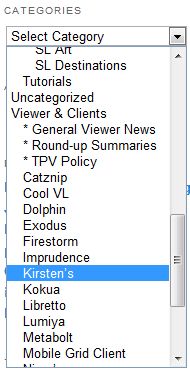
  • New Categories menu (sidebar)

    A new theme with greater white space within the text and an updated font, both of which I hope will improve readability

  • Inclusion of the sidebar on every page, rather than just the home page, which I hope will assist in better navigation
  • New hierarchical Categories menu, with additional sub-categories to improve topic selection (e.g. Viewer and Clients has been updated to allow you to pull-up all reviews on a specific viewer, rather than relying on tags, plus three new sub-categories added for viewer round-up summaries, general news on viewers of any flavour (rather than reviews) and news and updates relating to the TPV Policy)
  • New sidebar DESTINATIONS REVIEWS category for accessing reviews of SL destinations and other virtual worlds / immersive environments I’ve visited.

Hopefully, these changes will help make the blog more readable and more effective as a resource  / reference tool for those who use it that way.

I’ve retained the menus as well, but the new theme allows me to move them to the top of the page. Hopefully this will make those items which include drop-down lists and sub-menus (e.g. Reviews) to be more usable than the older layout, which sometimes required page scrolling in order to properly display a sub-menu.

I’ve included a little poll here, please feel free to use it as an indicator of how well you like the new layout.

The poll is now closed. Results are shown below.

More on materials processing

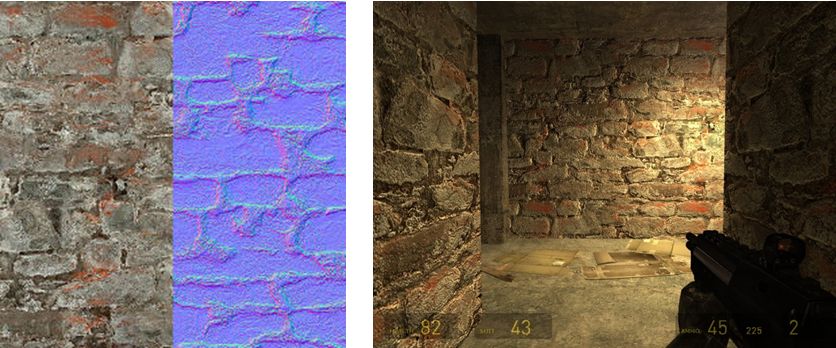
Materials processing was further discussed at the Content Creation Informal User Group meeting on September 11th. During the meeting, Oz confirmed that normal and specular maps will have their own rotation and offset controls from the start, which stands in difference to thoughts that they would initially be locked to the same rotation, etc., as the texture map used on an object or object face.

Materials processing: using a normal and diffuse (texture) map to generate a 3D effect on an in-world wall – coming to SL in the near future

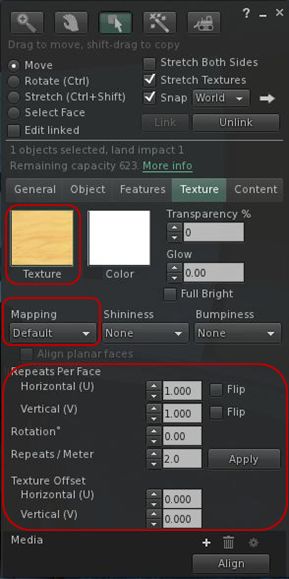
This means that the new materials processing maps will have the same positioning and scaling properties are currently available for texture (diffuse) maps, namely:

  • Mapping: one of Default or Planar
  • Horizontal  and Vertical Repeats: number of repeats of the image over the surface (used only in default mapping)
  • Rotation: degrees clockwise by which the map is rotated
  • Repeats per Metre: number of repeats of the image per in-world meter of the surface (used only in planar mapping)
  • Horizontal and Vertical Offset: distance in meters the image is shifted right (horizontal) or up (vertical) on the surface.
Options to be used by normal and specular maps as well as by textures

This obviously increases the amount of control content creators will have over the additional maps once the new capabilities are live, but it does open up more issues around incorporating the capabilities into the build floater. Thus, it was the build floater which once again became the focus of the conversation during the meeting.

How the build tools are presented to users has already been the subject of much broader consideration within the CCIIUG, although that discussion appears to have stalled for the time being. The materials processing process, however, requires a more focused examination of the build floater in terms of enabling the additional controls without either making the existing floater too large or overly complicated.

As such, two ideas were briefly discussed at the meeting, and further input to them both will doubtless be sought. The first involved having the additional options contained within the existing Texture tab as sub-tab options, while the second involved having all of the mapping options (Texture/diffuse, normal and specular) and their associated positioning and sizing options moved to a dedicated floater of their own.

Of the two options, both have merit and pitfalls. Sub-tabs mean keeping everything together on a single floater, but could lead to things becoming cramped or possibly confusing. Splitting between two floaters would provide more space with which to present options and controls, but could lead to a reduced in-world view should people find they need to work with both floaters open.

Given the small number of attendees at the meeting, neither option was discussed in-depth, and so, as mentioned above, this is liable to be a subject which is returned to in future meetings.

Rendering Pipeline Changes

As a part of this project there will be changes to the viewer rendering pipeline. While the project is still some way off in terms of delivery, Oz Linden used the TPV/Dev meeting of September 7th to advise TPV developers that they will need to ensure they are current with the 3.3.4 rendering code, which will form the basis for implementing the materials processing system changes.

Oz also indicated that while it would be “quite a bit of time” before the project reaches a development or beta viewer because the overall specification is not yet frozen (but is, in his words, “Very, very slushy”), it is hoped that a project viewer would soon be available to allow the new materials processing capabilities to be seen and tested.

In referencing the release of a project viewer, Oz advised against anyone trying to pull the code and using it in any viewer intended for wide distribution. This is because it is possible the material processing capabilities may change in very significant ways before they are ready for more general release, leaving the code presented in any project viewer as limited in both value and function.

Accounting System Costs

It is still unclear whether the new materials processing system will fall under the new land accounting system in terms of server and rendering costs. While questions have been asked in this regard, no definitive answers have yet been furnished by LL. This again is potentially due to the matter still being under consideration and the specification itself still being revised as impact and changes are considered.

Discussions on the project will doubtless resume at the next CCIIUG meeting.

Related Links