Once a suitable area has been located, the rover is liable to remain there for two or three weeks while samples are gathered and analysed.
Following the press conference and news of Curiosity’s discovery of a possible ancient stream bed, which took place on the 27th September, the rover continued towards Glenelg on the 28th September (Sol 52), carrying out visual odometry tests during the 37.3 metre (122 ft) drive. These tests, using the “JPL” Morse code letters cut into the rover’s wheels, were used to carry out an examination of the rover’s tracks and assess any wheel slippage which might be occurring in the independently-driven wheels and enable adjustments to be made.
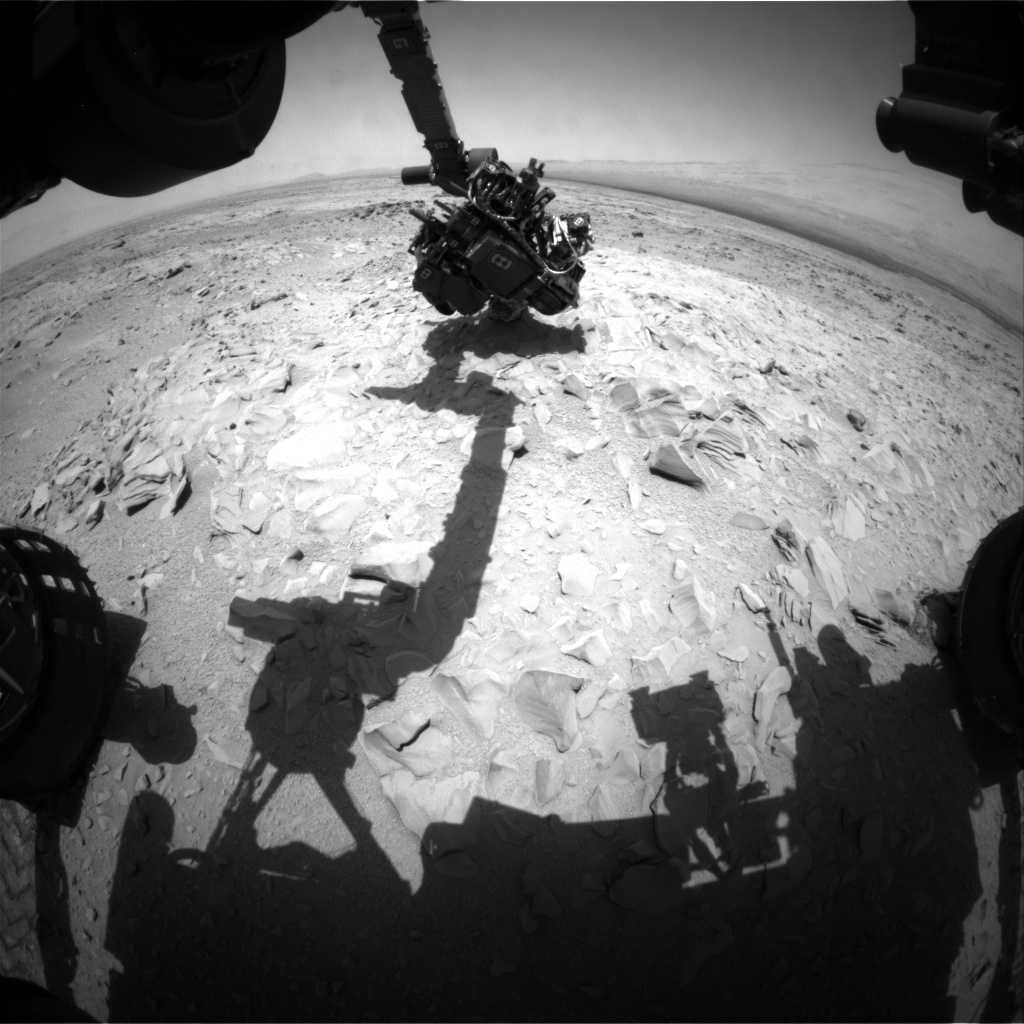
The drive came to an end as the rover came within a few metres of a further target for contact science operations, and halted close enough to be able to deploy the robot arm once more. Contact science commenced on Sol 54 (30th September), with raw images being returned by the rover’s Hazcams, Navcams and MAHLI. I’ll have more news on this work in the next summary report of Curiosity’s activities.
Mission Trivia
This weekend marked the start of spring in the Martian southern hemisphere, where Curiosity is located. To mark the event, the rover tweeted an invitation to all its followers to enjoy a little video…
Images and mission briefing video, courtesy of NASA / JPL. “Mars 2020: Springtime” by Nickjsky.

 Inara Pey: Living in a Modemworld