This is intended to be a weekly round-up of current public SL viewers (of which I’m aware). Links to my most recent reviews of said viewers will be included, but may not reflect the current release. As few Viewers are static, and releases are made according to individual development cycles, further versions of any given Viewer may well be released between these updates, and as such the information here may become out-of-date as the week progresses. Please check with the relevant download pages.
Changes since the last round-up shown in green.
SL Official Viewers
Available for: Windows, Linux, Mac
Current Release version: 3.2.6.248931 (download page)
Beta version: 3.2.9.249510 (released: Feb 6th) (download page)
Development version: 3.3.0.248913 (released: Feb 16th) (wiki page)
Simplified Inventory Project version 3.2.8.248008 (wiki page)
It’s fair to say that, since their arrival on the grid, I’ve not been a great fan of breedable animals in SL. There’s no particular logic to my position, it’s simply that the idea hasn’t appealed to me.
At least until now. You see, my viewpoint might just be changing, because there’s a new game in town when it comes to breedables – and I use that word both figuratively and literally.
BattleBeast Breedables have been hitting the news of late with announcements appearing on several blogs earlier in the month. They are an interesting concept that combines three popular elements in SL – the aforementioned breedable creatures, combat and role-play.
The breedables in question are dragons – which is why I was initially drawn to the project; I’m a dragon junkie, and have been ever since my father first introduced me to Smaug by way of bedtime stories when I was about seven, through to my discovery of Anne McCaffrey’s wonderful books and beyond..
The BattleBeast website gives a wealth of information on the concept, as well as a well-written backstory. The dragons themselves follow a path that will be familiar to those who have owned breedables before: they are hatched, grow, eat, mate, and so on. They also look pretty cool as well.
Standing with dragons: posing between two full-grown adults (click to enlarge images, as always)
But it is the added dimensions of combat and role-play that set BattleBeast Breedables apart from other systems. Not only can dragon owners breed and nurture their own dragons, they can challenge one another to duels and engage in tournaments that feature much that is familiar to the world of the dedicated combat gamer: experience points, stamina, health – and their dragons will gain experience and additional capabilities along the way. Just like real combatants, dragons will also need time to recover from their physical activities – and as an extension of the breedable element, dragons can be mated or paired to produce offspring that may demonstrate enhanced fighting characteristics.
A young dragon
Both combat and breeding also lead to further elements in the concept: those of role-play and affiliated activities. A lot of thought has gone into this, and it’s clear that the creative team behind the project very much hope that as it grows in popularity, the system will give rise to new and interesting communities, with people focusing on different aspects, be they breeding and selling dragons, developing affiliated products, or providing tournament venues, as well as seeing people own dragons themselves expressly for the purposes of combat.
With the public beta for the system now under way, I was fortunate enough to receive an invitation to meet with the team behind the project – Andi Canare, Wynter Sommer and BattleBeast Resident to talk a little more about the concept, the beta and dragons in general. I kicked things off by asking after progress with the beta itself.
Beta Battlers and Breeders
“It’s going great!” Andi said in reply to my question, “The response has been fun and enthusiastic [and] our group has experienced steady growth – so they are telling their friends! It’s been smooth sailing so far; we’ve been real happy with it.”
“Anyone in the main group can beta – which is about 200 people, I think,” BattleBeast – Battle to his friends – agreed. “People are setting up breeding areas and mating them, doing battles – we get a record of all the matings and battles on our server, so we can track how it’s coming along. Like any new project, there is a core group of the ‘hardcore’ beta testers, and we talk to them every day, and get suggestions, hear about bugs, etc. So far, I’d say we’re very pleased with beta, and very encouraged by the community response we’ve gotten.
“There are many aspects to the dragons,” he continued, “So beta is about confirming stability and adding features in all of them: the HUD, the animations, the flying controls, the mating and birthing, traits…” I asked if there had been any major problems arising from testing to date. “None that I’ve seen, no,” Battle replied, “We’re cautious but very optimistic. We’re in a very good place, in terms of lag, prim-count and manageability of them as breedables.”
When it comes to an end-date, the team are working to a schedule, and are eager to launch – but they’re also aware that it’s important to make sure capabilities and usability as they stand are nailed-down, and that users aren’t going to encounter anything that might upset their experience. As such, while they have earmarked an end-date for the beta, they’re taking the cautious route and not announcing it publicly for the time being – which is a wise path to tread.
Considering Combat
Combat sits very much at the heart of the system, and is something the team plan to evolve. Currently, combat is controlled from the sidelines, so to speak – there is no requirement for people to be mounted on their dragons, although they can if they wish. However, there are plans to add a riding element to the combat in the future should there be a demand to do so. Fights are very strategic in nature, with each player selecting an attack or defence move, and the dragons acting and reacting to these, with scores being kept over a series of rounds – what some gamers might call the “rock-paper-scissors” model. The approach has some advantages in SL – such as reducing lag. It also allows the team to code the dragons with optional attack animations that combatants may choose to use.
Meeting with BattleBeast (l), Andi (c) and Wynter (r) at the BattleBeast Breedables main store
However, more direct interaction, together with more tactical elements are already being considered by the team. “This is a foundation,” Battle explained, “And we’re listening carefully, and we’ll evolve it. We don’t pretend to know all about how people will use the dragons, but we want to be able to help them have choices to do so.”
A key aspect with tournaments is that they can be held anywhere where there is room and where basic rezzing permissions have been set – there is no need for any additional equipment or purchases, although the team are looking at producing a scoreboard, and one of the attractions with the dragons is the ability for others to produce additional equipment and other items through the system’s Affiliate Programme.
This freedom of venues means that users can establish themselves where they please – at home, on friends’ sims, and so on. It also helps open more of the role-play aspects of the system: rather than owning dragons themselves or running the more traditional breedable “farm/stores”, people can provide venues and facilities for owners to meet and trade, where auctions might be held and additional equipment and food purchased or dragons trained – and where tournaments can be held and/or challenges met. “We’re adding a tab on the HUD to let people find other combatants who are on-line to challenge,” Battle added as we talked, “[And] we have a capability in the dragons for a “team” association; so at some point we’ll publicise that, and help people organise teams, guilds, clans, and so on.”
As with other combat systems, levelling-up in BattleBeasts means unlocking new capabilities and traits in a dragon, enhancing its abilities. This also links back to the breedable aspect of the dragons – mating between dragons with enhanced fighting abilities will in turn produce offspring that have greater abilities. Thus, the breeding / combat elements can be seen as a cycle of nature and nurture, with an element of genetics mixed in as well – as the BattleBeast byline puts it: Better Breeding means Better Battle. Better Battle means Better Breeding.
Riding into Role-play
Role-play is seen as an equally important part of the system’s development as both combat and breeding and, as with those elements of the system, the team to receive feedback from their testers when it comes to role-play, as Battle explained, “Role-play is interesting, and an area where we expect our customers to nudge us into where they want the dragons to be. As we grow and our beasts evolve, our dragon owners will play a role in helping us.”
“’What do you need from us?’ will be heard within our group,” Andi added. “It’s all about the BattleBeast Experience.” As such, the team see the role-play opportunities not only linked directly with the combat and breeding elements, as with the examples mentioned above, but also something that might attract role-play groups quite unconnected, initially, with combat or breedable animals in the usual sense. “We’ve had some good pirate and Gorean inquiries already,” Battle informed me, underlining the point.
“We have lots of suggestions about interacting with the dragons, and most of those come from a role-play perspective,” Wynter adds, bringing quick agreement from Battle. “They will follow their owners in flight now… that seemed pretty common, across all RP visions, and we’ve determined that giving a dragon owner the ability to order a dragon to ‘go fly and perch at X’ is a good thing to have, or ‘walk this path’. These are very doable, and we’ll be building on them.” In fact, the team are already involved in LL’s pathfinding project, which may well offer significant additional capabilities for their dragons – or any other animals that may be added to the range in the future; as Battle hinted at as we chatted, “That’s why we’re BattleBeasts, not Battle Dragons!”
Collaborative
In talking to the team, one cannot escape the fact that they view BattleBeasts as very much a collaborative effort with their growing community as much as they view it as a personal project: they’ll take practical suggestions from the community and see what can be done to facilitate them.
“Very much so!” Battle agrees. “We are open to taking this where they [the users / dragon owners] want it to be.”
“We are having a lot of fun getting input and suggestions from our Beta group! Everything is logged and prioritised,” Wynter adds. “Nothing is just thrown out as silly or crazy!”
“And we have a principle of doing this, to enable people to participate in secondary market items,” Battle continues, elaborating on something we’d so far only touched upon. “So if someone wants to make an accessory and it makes sense, we’ll work with them to have the dragon interaction work with their items. We’ve had a great response to our Affiliate Program. From a functionality perspective, it’s hard to see what those things might be. This one here, the Purple Fancy,” he indicates the dragon standing next to us, “We let it out into beta, and people were so excited to see it! We’re eager to see all of the other things already done as hidden traits!”
Purple Fancy
Purple Fancy brings us to back to the dragons themselves. Currently developed using sculpts, an adult weighs-in with a Land Impact of 21 – which is not at all bad, considering the complexity of the models; plans are under way to introduce mesh into the equation as well. In terms of growth, it takes six days for a dragon to develop from a hatchling to adolescent, at which point it can start fighting, and it will reach its full adult size in around 15 days of hatching. Adults can fight for 250 days, and can breed for 180 days. Another additional element in the system that’s not available as a part of beta testing is an “auto-combat” mode, which essentially places a dragon under automated control, allowing it to be used to help train other dragons for combat and tournaments, enabling them to level-up and gain enhanced capabilities prior to entering the arena.
The BBB HUD
Dragons can be managed through a variety of means: they are fully scripted, so menus can be used to control them and enable various capabilities, etc; when being ridden, they respond to the normal WASD / keyboard movement/flight controls. Then there is the BattleBeast HUD. This has two primary modes – MANAGE and BATTLE, with buttons to switch between the two – and is, if I’m honest, somewhat on the large size when opened-out. However, clicking on the BattleBeast shield will tuck it neatly away into the top left corner of the screen.
One of the things I personally like in the HUD is the FOLLOW option – by which a dragon will follow you in flight – which can make for some dramatic looking-shots!
Dragons at sunset
The care and attention paid to the project isn’t restricted to the in-world elements: the BattleBeast Breedables website is packed with information and very professionally presented. Like the rest of the project, it is also in a state of evolution; plans are currently in-hand to add a forum for users, as well as to provide front-desk support software and information updates on tournament results, trait discoveries and so on – all under Andi’s guiding hands.
Overall, BattleBeasts is a fascinating project; between them, Andi, Wynter and Battle have considerable exposure to, and experience in, the SL breedable markets, and it is clear this experience has been used to its fullest in developing BattleBeasts. Even so, bringing together breedable animals, combat and role-play in this way is a daring endeavour, the team’s clear and infectious enthusiasm notwithstanding. However, they’re not alone in such enthusiasm – it’s clear from the Group chats that all those involved in the current beta are similarly enthusiastic – dare I say enthralled – by the dragons, and I’ve little doubt that the system will have very wide appeal once officially launched. Plans for this are already in-hand, with a two-day celebration in the works that will feature battles, hunts, live music and festivities.
For my part, I have to say that after spending time flying around with my beta dragons and generally having fun with them, I’m close to being pretty hooked. I’ve wanted to be a Dragonrider since I was about 12 or 13. With BattleBeasts I may yet get the opportunity to be one – all I need to do is find a sim called “Pern” – after all, have dragon, will travel, as they say!
If you wish to try out the BattleBeast dragons for yourself and assist with the beta programme, sign-up to the BattleBeast Beedables group in-world. Beta packages are available via the Group Notices.
Baharat Atlas from Duché de Coeur contacted me last night concerning a Whitney Houston tribute event being held at the Duchy this weekend, the 18th and 19th February.
It’s been a little over two weeks since the Imprudence/Kokua team announced they’d be moving towards focusing on Kokua for future development, but work is progressing. On the 16th, ZATZAI (sean Greyhound) from the team put out a “small update” on progress, which reads in part:
Work continues on the new Kokua viewer. We’re moving forward using the v3.2 Linden viewer as a base, we feel this version of the viewer is stable enough and has solved enough of the UI problems from v2 that our users will be happy with it. It’s also what many of you recommended in previous blog comments and at our meetings. We’re currently focusing on releasing a stable viewer on at least three platforms, Linux 32bit, Linux 64bit and Windows 32bit. You can follow our progress by trying our experimental viewers if you’d like, but buyer beware, these are alpha viewers and you should read the warning label carefully before use. You’ll find the link to our experimental viewers page on our wiki below…
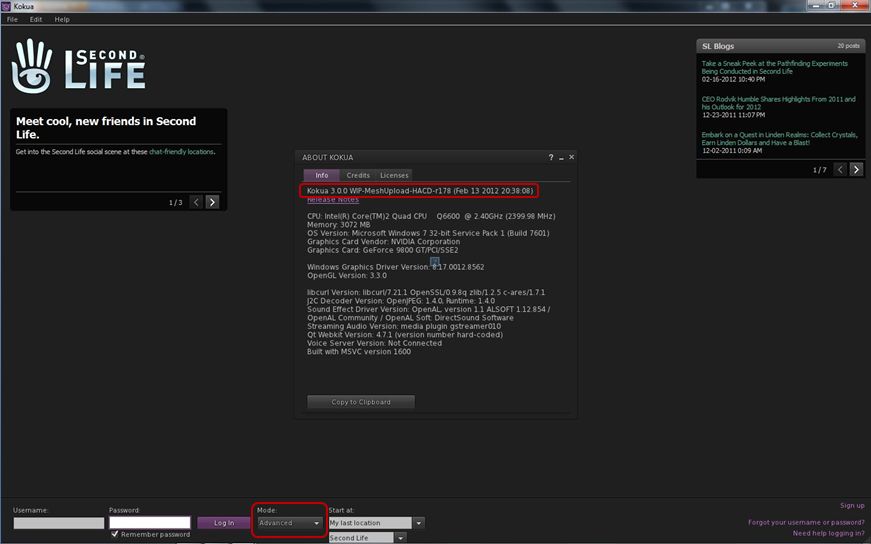
There follows a link to the Kokua wiki and links to the Windows and Linux release 3.0.0 downloads. However, before you get too excited, it should be pointed out that while the blog post refers to V3.2, the release available on the wiki, and the one immediately prior to it (0.1.1) are not based on the current V3.2 code, but rather on V3.0 code. Those installing and running either experimental will notice, for example, that the log-in splash screen still has the BASIC / ADVANCED mode toggle button.
Kokua *will* be moving to V3.2, but for now it is still based on V3.
I raised this point with ZATZAI, who was able to confirm after checking that, “The current Experimentals are indeed based on v3 … future ones (I don’t know how soon) will be based on 3.2+.” A clarification on the releases has since been posted on the blog entry itself.
So for those wishing to see a release of Kokua based on V3.2 code will have to wait just a little longer – and should keep an eye on both the blog and the wiki page!
How to Get Involved
For those who are further interested in the Viewer’s development, the team hold a weekly meeting every Wednesday at 20:00GMT on the Hoagie Sim in the 3rd Rock Grid. The meetings are for Dev and Project Contributor discussion and open to the public – although the meetings are not intended to deal with support issues. Transcripts of recent and past meetings cane be found on the wiki.
People can also join the Developer Mailing List (again: please note that this is not intended to deal with support issues).
It’s been over a year since Linden Lab last put out a Press Release – long enough for most of us to have given up looking at the official Linden Research PR page (I was checking monthly up until December, then lost the will after a year of silence). Fortunately, Tateru Nino has kept a weather eye on things, because yesterday, Linden Research did slip out a release, announcing the acquisition of LittleTextPeople, a move linked directly with the company’s upcoming new products, as the press release states:
Best known for Second Life®, Linden Lab will grow its digital entertainment offering by launching several new stand-alone products this year. Now part of Linden Lab, the talent and technology of LittleTextPeople will support the development of these new forms of interactive entertainment.
LittleTextPeople was founded by Emily Short, and Richard Evans. Short is perhaps best known for her work in Interactive Fiction, starting with her 2000 title Galatea, and her psychology-complex NPCs, while Evans was formerly the Senior AI Architect at Electronic Arts (spot the connection! 🙂 ), where he was involved in the development of The Sims 3.
The press release describes LittleTextPeople thus:
LittleTextPeople explores the gameplay possibilities of nuanced social interaction. The company’s core technology is a simulator able to model social practices and individual personalities. Combine the simulations with the expressive freedom of fiction and the result is gameplay that more closely resembles the rich emotional dialogue of a novel, rather than a fight scene in an action movie.
In breaking the news to a wider SL audience, Tateru’s piece has drawn very mixed reactions, some fairly negative, some speculating on how the acquisition might fit with LL’s plans for the development of NPCs (Non-player Characters) within SL. However, at this point in time, such commentary is only speculation – Linden Research give absolutely no indication that the experience gained via this acquisition will have wider application within Second Life. As Rod Humble himself comments in the press release:
“LittleTextPeople brings a depth and breadth of AI and interactive story development expertise that is a great fit for Linden Lab as we launch multiple new products,” said Rod Humble, CEO of Linden Lab. “The result of this investment will be a new type of digital entertainment that modernizes the novel as a shared story-telling experience.”
Note the emphasis on the intended product – “A new type of digital entertainment” – rather than any overt link to Second Life. However, one cannot deny that the acquisition may have a broader fit for Linden Lab further down the line as products and ideas mature, particularly as NPC capabilities are seen as a major development for SL during 2012 and elements of which are even now entering a test phase. As such, it may well be interesting to see where this relationship leads over time.
The negative reactions to Linden Research broadening its product brief appear to stem from the belief that doing so detracts from on-going development of Second Life. However, there would seem to be little in the way of substantive evidence that this is so. As evidenced by the Linden Research recruitment page over the last few months, the company is clearly recruiting fresh talent clearly aimed at the development of these new products while continuing to recruit talent for the development and support of SL. Similarly, as has been frequently pointed out, currently Linden Research is somewhat exposed in the fact that it does only have the one product – Second Life – in its portfolio. This weakens the company’s position somewhat in terms of attracting wider investment and places a lot of pressure on SL to perform well financially. Over time, and assuming the new products are successful, diversification should be beneficial for the company and Second Life in both of these areas.
Obviously, the main problem here is that, when all is said and done, we actually know very little about the new products themselves and how they will be marketed and their likely appeal. As such, it is possibly easier to voice concerns than might otherwise be the case.
Nevertheless, this is an interesting move, and one is curious as to what comes next where these new products are concerned – and how soon it will be before we do start seeing more substantial information emerging about their development.
NrianV Dean has been putting in a lot of work on Niran’s Viewer over the past couple of months, with new versions rolling-out fairly regularly. Many of these have experimental functions added to them – so much so that NiranV has taken to jokingly referring to the development work as coming from Niran’s Lab. He’s been keeping me appraised of updates and changed almost daily, but in-world projects and real life concerns of late have meant that I’ve not really been able to take Niran’s Viewer for a proper spin since release 1.13.
Releases 1.24 (Feb 14th) and 1.25 (Feb 15th – gives you some idea of the speed of updates!), have given me cause to play a little bit of catch-up. Release 1.24 was itself essentially a series of fixes and tweaks to the 1.23.5 release (also made on the 14th February), while version 1.25 adds version 0.2 of Qarl’s Parametric Deformer to the Viewer and includes some graphics related tweaks. You can therefore take this review as more-or-less a n outline of the key elements from all three of these releases (1.23.5 through 1.25).
If you’ve previously installed Niran’s Viewer – particularly 1.23.5, it’s probably best that you opt for a completely clean install of either 1.24 or 1.25, although I do comment on a couple of pre-1.23.5 updates as well.
There are two flavours of the Viewer EXE on offer – dedicated 32- and 64-bit variants. As Niran’s is compiled Large Array Aware, I’m not entirely clear on the difference, but I gather the 32-bit version of the EXE was a special request.
On start-up, there are no overt changed to the Viewer’s UI: as is common for Niran’s, the buttons are split between the left and right sides of the screen, the Navigation / Favourites bars are on, and the Destination Guide initially opens by default, as is common for most V3.2-based Viewers.Which is not to say the changes aren’t there.
Navigation Bar: Now You See Me, Now You Don’t
For those that both like to use the Navigation / Favourites Bar but at the same time find it slightly intrusive on their world view, Niran’s now includes a nifty auto-hide function. Enabled through PREFERENCES->VIEWER->UI SETTINGS, this will automatically hide the Navigation / Favourites Bar when the mouse isn’t positioned over it, and replace it with the Mini-location Bar. hovering the mouse at the top of the screen automatically displays the Navigation / Favourites Bar once more. Neat!
“Are you lookin’ (down) at me….?” – Camera Updates
On the subject of views, the Camera options have been altered. NiranV is keen to introduce more game-like elements to the Viewer – we’ve seen it with the experimental “Main Menu” (F1 – of which more below). Now with the camera, he’s replaced the traditional Front view with an overhead view. As a slight aside: does anyone actually use the Front View? I always tend to find myself orbiting the camera around myself.
Looking down on oneself
To me, the initial view is somewhat high, so many using the option are liable to find themselves using the Camera View Angle slider (PREFERENCES->ADVANCED-> CAMERA) to close the distance between themselves and their avatar.
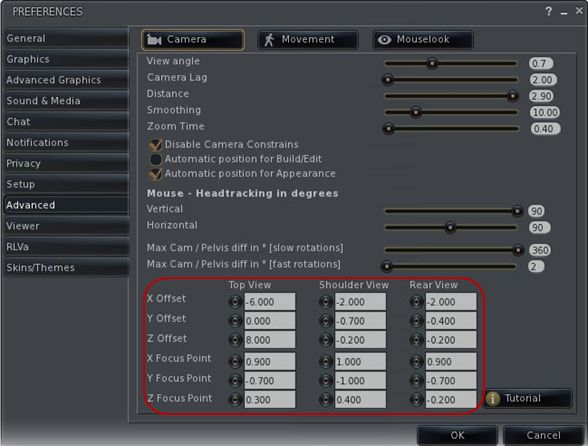
Staying with the Camera and Preferences, 1.24 introduces something I’ve been waiting for in Viewers for a goodly while: the ability to alter camera offsets without the need to twiddle about with Debug options. As many know, I’m a firm convert to Penny Patton’s Camera Offsets for SL (if you haven’t tried them, you should), so it’s great to see a Viewer that includes the ability to change offsets on-the-fly through Preferences. Kudos, NiranV!
Camera offsets within Preferences
Staying with Preferences
Regular Niran’s users will noticed as well that the entire Advanced tab has been revamped in this release, with Camera, Movement and Mouselook options separated into their own button-activated sub-tabs. This also marks a departure from the more usual “sliding panel” approach seen to date within Niran’s Viewer with regards to sub-tabs (and which can still be seen within the Viewer tab, for example. Referring to this re-vamp in his blog, NiranV states the new button approach may be added to the Viewer and Advanced Graphics tabs should it prove popular with users.
Also new to the Viewer (from version 1.22 onwards), and found in the Advanced Graphics tab are control from the new Visual Auto-mute function, complete with colour-codes guides to possible settings.
Visual Auto-mute controls
Avatar Animations
Work has been done around avatar animations with this release. Most notably for those developing animations, release 1.24 of Niran’s provides full support for uploading .ANIM files, as supplied by Jonathan Yap (see STORM-1803). Niran also adds his own touches in the form of options to control how your avatar reacts when being rotated. NiranV has included a couple of videos to demonstrate the functions, and I’ve taken the liberty of embedding one of them here.
Build, People and Rendering
Having just completed a vast amount of work on an obsession of mine, which involved working with some relatively small cross-section prims, I found myself constantly annoyed at the way in which the white stretch anchors repeatedly blocked access to the red, green and blue X, Y, Z stretch points on a prim. NiranV offers a solution to this problem: providing WASD is set to movement (rather than starting chat), you can press and hold the X key to eliminate the white “corner” anchors to ease access to the X, Y ands Z stretch points.
NiranV has also revised the People floater with this release, replacing the FRIENDS tab with an ACQUAINTANCES tab, his argument being most people we have on our lists are more like acquaintances than true friends, and one cannot fault his logic on this in many respects. Also with this release, the Acquaintances List will show the full set of permissions you’ve set for friends (ability to map you, etc.).
Finally, and also coming out of Niran’s Viewer Labs, is a new rendering option that may have potential use in the future. NiranV explains it thus on his blog: “One thing big has been done here except Tofu´s new project which has been merged, it’s called worldspace semi-random macro-dappling, which creates random big darkness spots on a SIM and your Avatar depending on the sun position. Later this could be combined with the cloud X and Y movement to create a good but faked cloud shadow effect!” At present only the depth / darkness of the effect can be altered – but it will be interesting to see where this goes.
The Main Menu
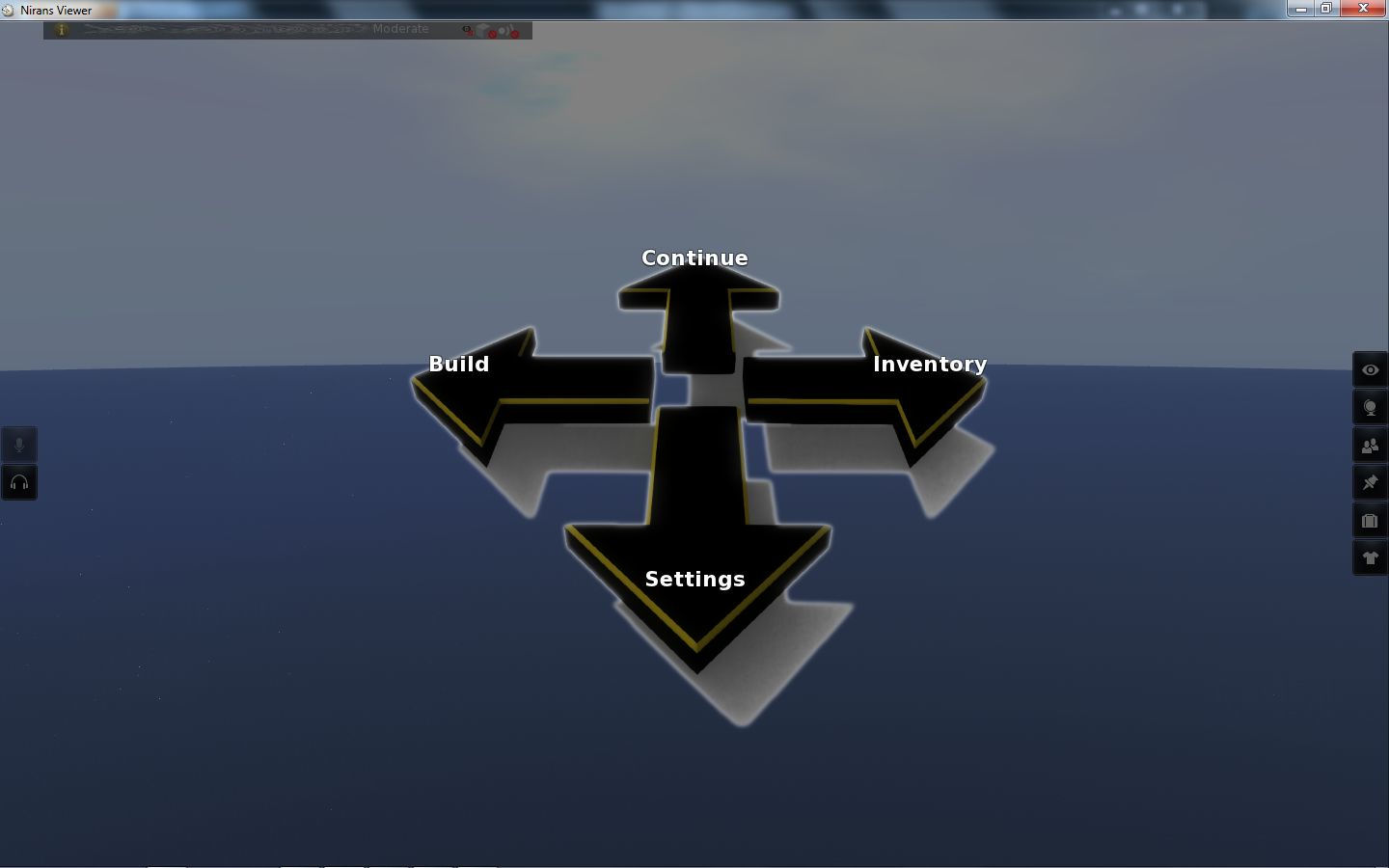
Finally, Niran has been working on his Main Menu idea for the last few releases. I first covered this in my review of release 1.13. Back then I commented on the fact that using ESC to invoke the menu wasn’t perhaps the best choice, given that key is traditionally associated with the Camera. NiranV took this on-board, and the menu has, for the last few releases, been accessed by pressing F1. The style of the menu has also been changed, as shown below.
Main Menu – “compass”
The look is apparently borrowed from a popular video game. I’ll be honest and stay that while I have no idea how well it has gone down with regular Niran’s users, I actually find it jarring and incongruous compared to the rest of the Viewer, factors that tend to make me shy away from using it.
Performance
Niran’s Viewer is intended for high-end machines and continues to get tweaked in that direct and further releases come out. As such, it’s a little unfair of me to comment on performance in some respects, because my hardware is well below the recommended hardware specifications for the Viewer (the closest I get to meeting them is that I’m running a quad-core CPU). My graphics card in particular now struggles mightily with Niran’s if I attempt to use deferred rendering & shadows, a factor that has, sadly, prevented me from using the Viewer quite as much as I might otherwise like.
That said, I’ve put the Viewer to several hours of reasonable use, bouncing around the grid, trying different environments, playing with the settings (as some of the screen caps here will show!) and generally poking and prodding, and the Viewer has taken it all in its stride (albeit without deferred rendering). The changes NiranV is introducing to the Viewer are both novel and leading-edge. There are some that are very practical – for me, the camera offsets in Preferences are a great addition, and those wishing to make use of the Visual Auto-mute option will find the inclusion of both that as a set of sliders and the annotation for settings that goes with it as being of benefit. Other additions – such as the top-down camera view are potentially more specialised, and it’ll be interesting to see how popular these prove to be for a wider audience of user.





 Inara Pey: Living in a Modemworld