Sitting in the mouth of the Couesnon River roughly a kilometre offshore from the mainland, and connected to it by a causeway, lays the magnificent Mont Saint-Michel. Occupied since before the Roman times, the islet (less than a kilometre square) rose to prominence in the middle ages as a religious centre, gaining strategic significance when it was annexed by William Longsword, Duke of Normandy in 933, and 100 years later when it supported William, Duke of Normandy’s claim to the English throne.
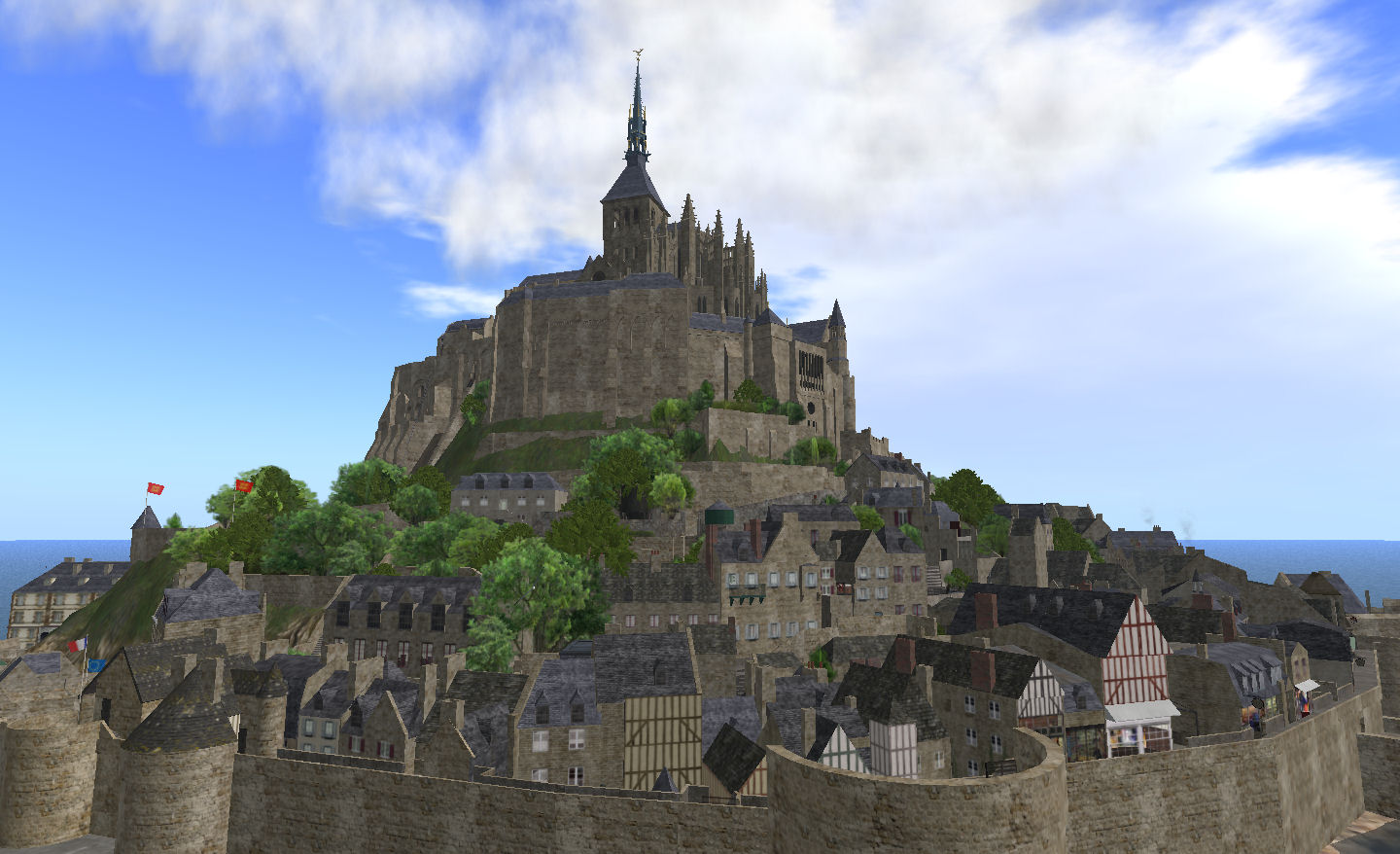
It’s also famous for being painstakingly reproduced to careful scale within Second Life by Moeka Kohime. Featured on the French version of the Second Life homepage, the sim is a magnificent testament as to what can be achieved when building in Second Life with the humble prim – or in this case, 14,328 humble prims.
Mont Saint Michel, Second Life
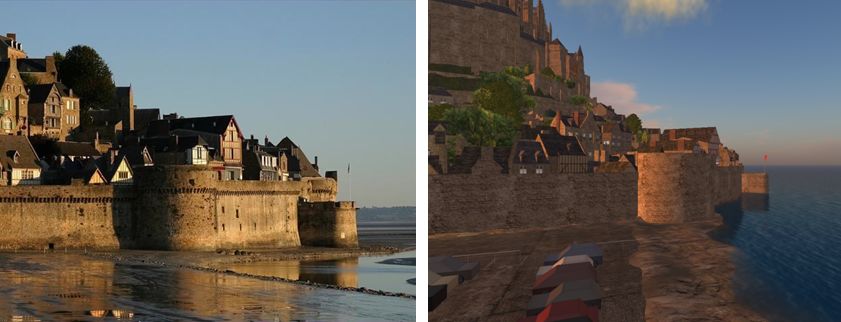
The Mont faithfully reproduces the original in almost every visual aspect; no mean feat given it occupies an area a quarter of the size of the original. Yet it is not just a mere “look but don’t touch” showpiece: it is also scaled to allow avatar access, providing a fully immersive experience for visitors who can walk through the narrow streets, browse shops and wend their way up to the magnificent monastery that crowns the island.
I’ve known about the Mont in Second Life for years – yet I’ve never visited it until this week; I now regret not having done so sooner. Arriving (via a friend’s Tp) in the causeway car park (something that will hopefully vanish in the near future, to reflect the fact that it is being replaced at the real Mont as a part of the project to return it to its original island status), which sits on an adjacent sim, I carefully crossed into *Edelweiss* and followed the walkway to the entrance.
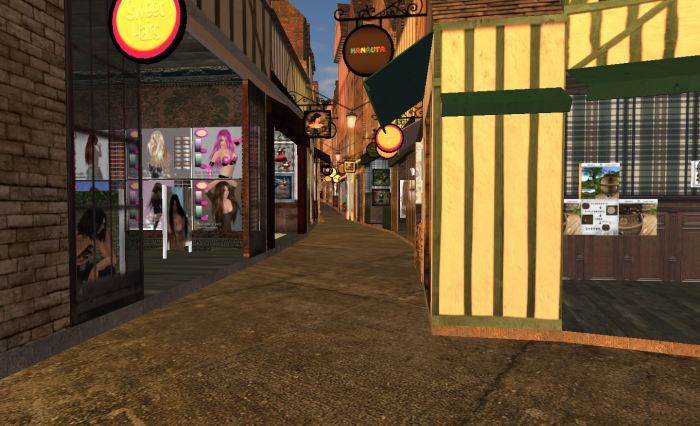
On entering the citadel, the attention to detail is immediately apparent – two massive wrought-iron bombard canon, left by the English after they failed to capture the island during the great siege of 1423-24, lay in the entranceway, just as they do in the original. Beyond these, past the information bureau is a small wooden bridge leading you into Le Grand Rue, and the sim’s shopping mall filled with boutique-style shops that fit the look and feel of the original Mont.
The streets of Mont Saint-Michel and Mont Saint Michel in SL
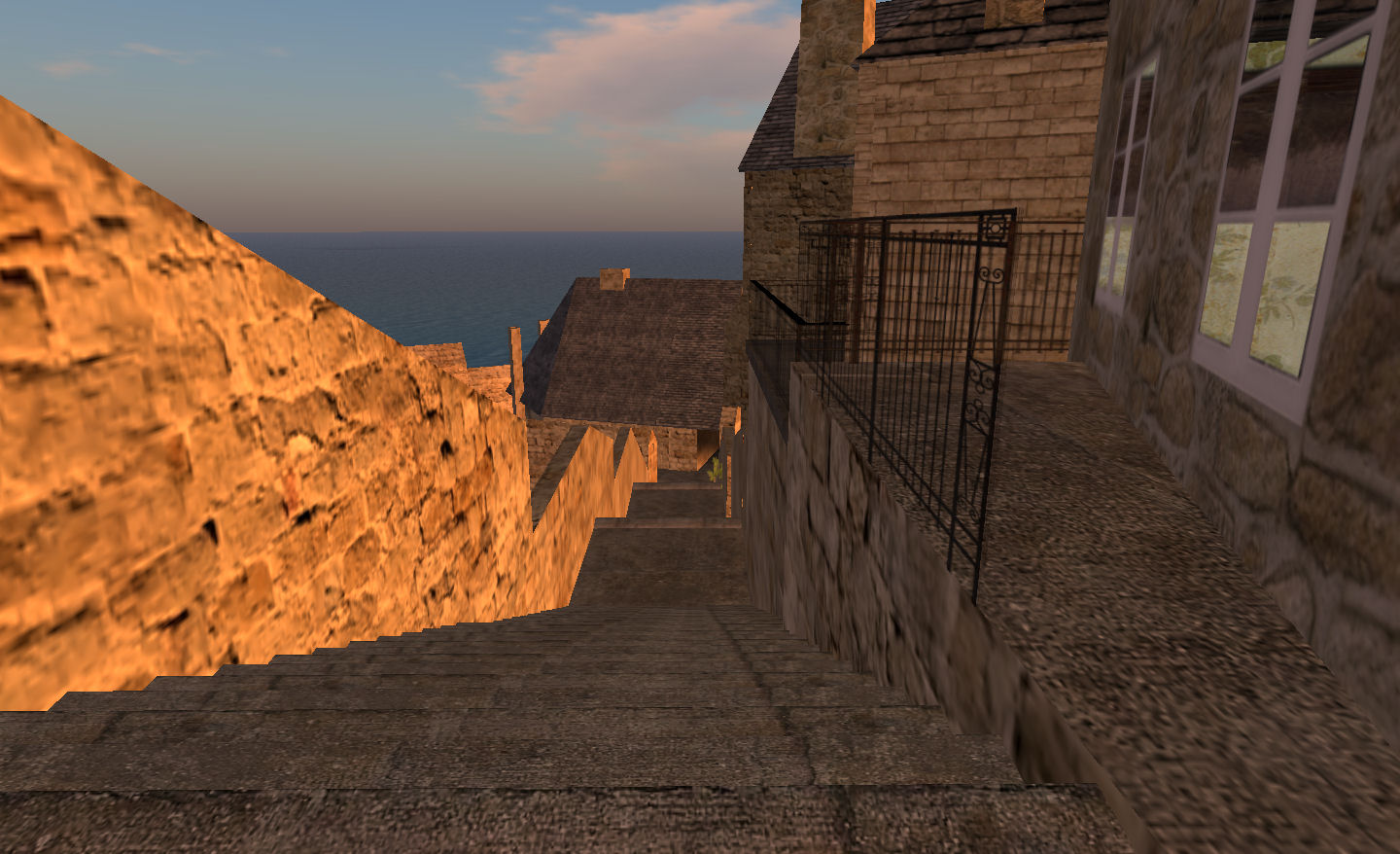
From here you can choose to either wander the Grand Rue, browsing the boutiques, or you can take one of the many stairways leading further up onto the island and towards the towering edifice of the abbey. This is one of the joys of the Mont is Second Life – it is a charming warren of walkways and passages that – as with the actual Mont – make exploring it full of anticipation: what lies under the next arch, at the top of the next stairway, around the next stone-walled corner? As you wander, you can peek through windows into the homes of the “locals” (none of the houses are actually occupied, but the detail again adds to the charm and realism of the place), or pause for a breather along the way at one of the many vantage-points and simply enjoy the view.
The sea walls
The monastery itself is beautifully reproduced in some detail, from the stepped entranceway through to the high cloister and its covered walkways and garden, suitable for quiet contemplation. The interior captures the magnificence of a medieval abbey, and one can almost imagine the monks chanting prayer, or quietly going about their business, conversing in hushed tones as they walk around the cloister. I have to admit that the mood for me was heightened as I was listening to Christopher Franke’s The Celestine Prophecy while exploring – but even without it, it’s hard not to fall into the atmosphere of the place.
Wandering the isle
There are a few things to be wary of: in a couple of places, the build exceeds the sim boundaries, and if you try to follow the outer sea wall all the way around the island, you’re going to find yourself inexplicably bouncing against empty air in a couple of places (and may get bounced right through a wall and down to the sim-edge below). Keep an eye on your bearings, and use the provided covered walkways to avoid this. The Mont was also constructed with the default camera angle in mind. As such, if you use adjusted camera positioning, either through a HUD or Penny Patton’s super Camera Offsets, you may experience the odd camera movement stutter or find your camera swinging unexpectedly through a house wall to give you a view of the interior. This is worth it however, as overall, you get a much more “involved” feel for the place with a decent set of offsets.
Of course, if you are good with navigation, the most immersive way of experiencing the island is through Mouselook – and I really recommend you try; the Mont comes alive in so many ways, and you really do not know what awaits you around the next corner. It is certainly worth keeping to Mouselook when walking around the monastery itself.
Cafe au lait among the rooftops
When you’ve done with your wandering, make sure you seek out the Café Poulard and have a well-deserved rest, either in the café itself, or out on the upper floor balcony with its sea view. It’s also a great place from which to camera around the island and make sure there is nothing you’ve missed in your wanderings, and which might be worth a Mouselook attempt to find when you leave the café.
If there is one thing perhaps missing from the build, it is the opportunity to learn about the history of the real Mont Saint-Michel; the museum is devoid of displays, information plaques are minimal, and so on. This is a shame, as the sim represents a superb place to enthral, educate and promote. Of course, no-one wants to be bashed over the head with facts and figures and historical diatribes, but it would be nice to see some context around the build and its real life counterpart.
Mont Saint-Michel is – to use the superlative yet again – a truly magnificent build. If you haven’t done so already, I’d recommend you do; you will not be disappointed, and you’ll be capturing a slice of history from two worlds in the process.
Cloisters – real and reproducedLe Grand RueMont Saint Michel
Addendum
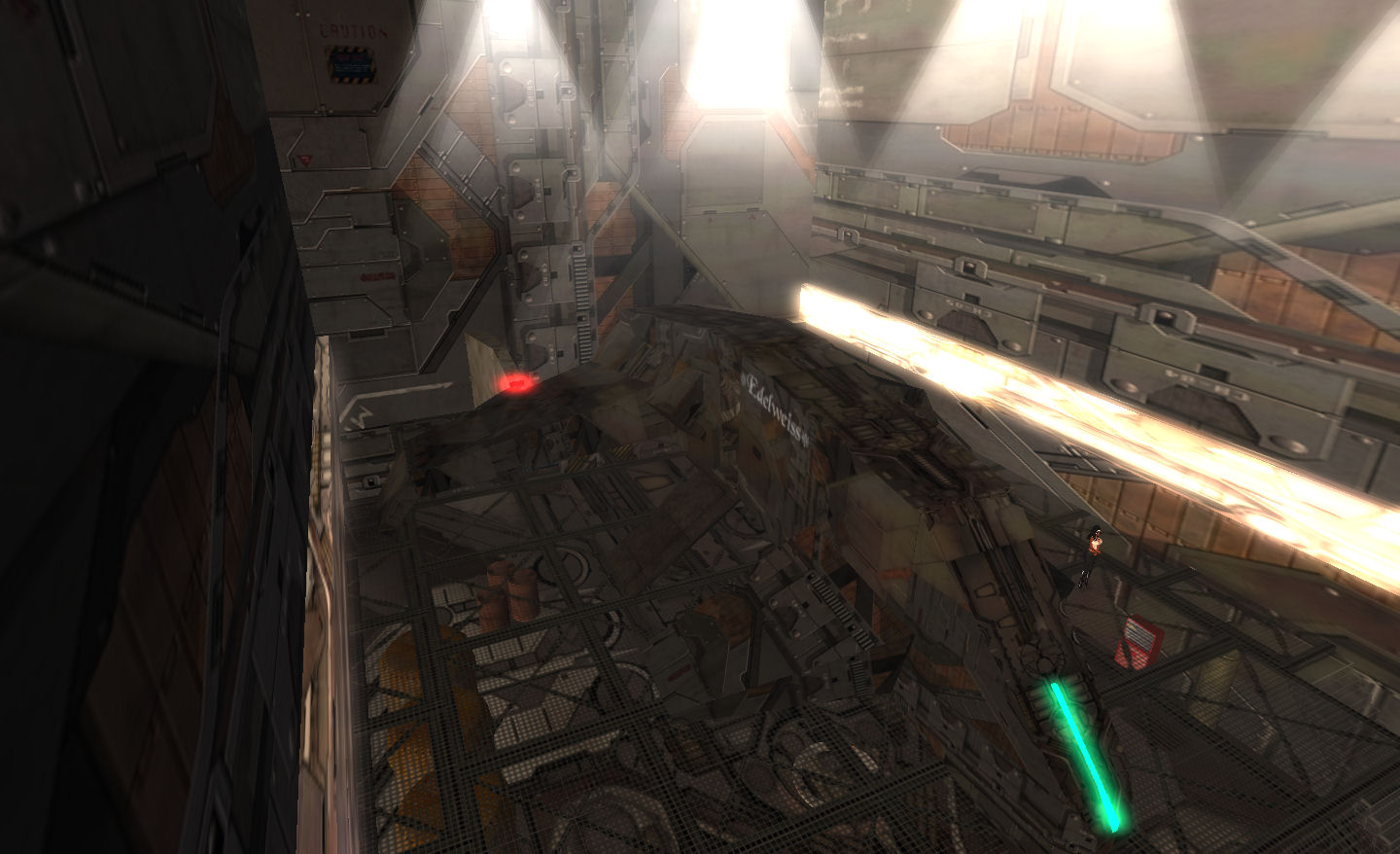
When someone says to me, when I mention Mont Saint-Michel, “Did you find the hanger and the spaceship under it?” I tend to think they are trying to tug on my leg in the hope that bells ring. When three people independently raise the same subject (one of whom swears they’ve never read my blog), I get the feeling that either there is something to the comments, or the world is out to get me.
The Edelweiss
Given the second reaction is pretty much my everyday state of being at the moment (you’d be the same if you’d had the same issue with technology this last week, believe me), I opted to go with “there is something to the comments. So off I zoomed to have a nose around. And guess what? There is a hanger hidden under the Mont – although I’m not sure if what is inside is a spaceship or so kind of futuristic aircraft.
The Edelweiss sits in a bunker under the Mont, apparently fuelled and ready for flight (although you don’t appear to be able to board her), lit from above by powerful spotlights.
It’s a strange thing to have under an abbey atop a small islet, and certainly well-hidden from casual eyes; had I not received three separate prompts on the matter, I’d have remained in ignorance of it being there. But it does raise an interesting question…given the accuracy of the rest of the build…is there yet something extraordinary to be found under the crypts of the real Mont Saint-Michel? Could it be that those 11th and 12th century monks who built the original abbey actually knew more than they were letting on?! The mind boggles! ;-).
That said, I’m not telling you where it is. Go and find it for yourself! ;).
Thanks to real life getting in the way, I didn’t make the June premiere of Month of Machinima, and have only just this weekend managed to sit down at the LEA with a small bunch of people and watch this month’s offerings on the theme of “Mixed Realities”.
Before getting to the films themselves, LL have added a further means to view movies; as well as the LEA theatre itself and the YouTube channel, you can now pick up an AviewTV pack scripted to play back the entries. For optimum viewing, however, I still recommend YouTube.
Now I have to say that “mixed realities” to me suggests films that combine mediums and ideas: machinima and real life; the “reality” and “fantasy” to create a visually compelling short film. A pity then, that of the month’s entries, there are two that come across as promotional videos – one for the sim in which it was filmed, the other for an in-world group of musicians. While undoubtedly skilfully executed, they seemed to fall wide of the mark when it comes to the month’s theme; as do a couple of other music videos which also seemed to fall wide of the mark, theme-wise.
In fairness, I have no idea how much support the event is getting – it could be that there were insufficient entrants that met this month’s criteria and the judges fell back on entries from May; however, with due respect to all concerned, I sat down to watch this month’s selection with a high degree of anticipation and came away somewhat disappointed.
RockseaTV offers a short film that is a lot – to me – closer to the mark, presenting and avatar’s daydream of falling into the real world. BaySweetwatertakes things a step further in Domo Arigato, Roboto-san, where we see footage of the Fukushima disaster, where robots were used in the aftermath, together with footage of a robot scooting around in Second Life – a celebration of both the use of automated machinery in the role of life-saving and the potential for Second Life to act as an immersive training environment for such tools and equipment.
My personal favourite for the month, however, is Magical Glorious Morn – a tale of an old man living in the bayou, who just might be plagued by unseen – and malicious – laughter. Is someone playing a prank? Are there in fact leprechauns tormenting him? Or is he simply going mad in his isolation?
Avination is another grid-based virtual world that is making something of a splash. As I’ve taken the time to re-visit InWorldz, I decided it would only be fair if I took a first look at Avination.
My first step was to sign-up via the very plush website (IW and others, take note!). If you want to keep your existing SL avatar identity, this is possible once you’ve signed-up – see below.
The sign-up process is painless: you supply a first name, select a last name from a defined list and follow the prompts as given. If you intend to swap your avatar name for your SL avatar name, make sure you click on the link in the grey area to the right of the first page of the sign-up process & make a note of the Second Life locations where Avination Terminals are located (displayed as a pop-up window).
One interesting step is that you are asked to opt to initially go in-world at either the general Welcome area or the Role-play Welcome area. Unlike other Grids, Avination has been created to fill the niche market area of role-play (of which more anon).
Once you have completed the e-mail verification process, you’re ready to log-into Avination. For this you can use the Aivation Viewer or a suitable SL Viewer 1.x TPV that supports multiple grids (I recommend Imprudence).
To use your existing SL avatar name, log-in to your Avination account at the website and enter your SL name under the Account Details. Once you’ve done this, go in-world in Second Life and locate an Avination terminal where you can link your SL details with your Avination account, and then change your avatar’s name to that of your SL avatar. Once done, you can use your SL name to log into Avination via a Viewer or the web site. As a side note, be aware that you can also use these terminals to transfer L$ from SL to their Avination as well – although not the other way around.
For the record, the system configuration I used for this review comprises: Intel Q6600 quad-core processor, 2.4Ghz / 3Gb RAM; Window 7 with SP-1 installed; Ge9800GT GPU with 1 GB RAM supporting OpenGL 3.3 & the most recent nVidia drivers; Imprudence 1.3.2 and Avination 0.1.0.
Logging In
Avination welcome area
On logging-in I arrived at the welcome area – a large plaza surrounded by shops. The people here were friendly, but there was a certain dearth of information on display. Surprisingly, when compared to elsewhere, I didn’t come across any freebies to help get newcomers started. OK the name of the game is commerce, but there is no harm in giving people the opportunity to improve their basic look before asking them to part with money to get a really good for themselves.
I deliberately hung back on arrival, acting the newcomer and keeping quiet to see what the response would be – in InWorldz, there was a time when it could be overwhelming. Here, while the was a lot of chatting going on, it seemed to be among those who obviously knew one another, with new arrivals overlooked. However, a mentor did eventually take pity on me and passed over a notecard of landmarks. It was then time to sort out Inara Mark 3 and start exploring.
The almost-me
Avination, unlike InWorldz, charges for uploads (C$10 each); this meant I needed funds – and I hit my first problem. While Aviation provide ATMs in SL to transfer funds to their grid, they don’t provide a direct exchange mechanism running the other way – you need to use a 3rd party solution. As the minimum transfer from L$ to C$ is L$1,000, and this was my first visit to Avination with no guarantee I’d be back, I frankly wasn’t willing to part with the funds. Had the exchange system been bi-directional, as with InWorldz, I wouldn’t have had an issue; but c’est la vie.
This left me with the ability to create a new shape (the default shapes selected when joining at not modifiable), and keeping the default skin rather than uploading my own. While the result was reasonably OK, I was very conscious that it wasn’t really *me*, and I think this somewhat divorced me from the experience at times – as if I was looking at things through the eyes of a stranger, so to speak. However, the choice to go this route was mine, and as they say, beggars can’t be choosers; so off I went to explore.
If you hate SL’s Search…
Aside from the list of LMs I was given, the sage advice I received when looking for stuff was to “use search”. Well, yes, if one accepts the fact that search suffers from the same plague as with other grids – and as SL once suffered: keyword gaming. It’s a trifle annoying typing in “hair” and getting dozens or more hits on everything and anything else but hair – but we lived with in it Second Life for years, so even this was a trip down memory lane – albeit with teeth clenched. That said, the search is more amenable than IW’s inasmuch as more tabbed categories work.
Appearances, Shopping and Content
“You may remember me from such grids as….” – familiar names abound in Avination
Avination is perhaps the most “SL-looking” of the developing Grids I’ve visited. Like the others, Windlight is available, textures generally load fast in both Imprudence and the Avination viewer, builds are comprehensive and well-made, and so on. But it is more than that when it comes to the “SL feel”.
For a start it is hard not to go too far before you trip over established names throughout Avination. Many major content creators from all fields are active here, and the range of “known” names seems to be far wider than that found in InWorldz.
There is also the fact that gaming and gambling are a lot more settled in Avination. This is not to say they don’t exist in IW or elsewhere, just that their presence is more obvious here. In this, Avination very much feels like SL circa 2007 – and it’s actually a pretty warm feeling, another trip down memory lane.
Currency and Land
Prices in Avination are comparable to SL in many areas – and may even be cheaper in some. The C$ itself is worth about the same as the L$ in real terms. Hair, for example, can be had for around C$50-C$100 (compared to L$150-L$200 in SL), while boots and shoes seem to fall I the C$150-C$300 and clothes range anything from C$150 through to C$500.
As mentioned above, there is a direct mechanism for getting money from SL to Avination via a series of SL-based ATMs. Once your accounts are linked between the platforms, the transfer is direct: simply pay an ATM for funds to move from L$ in SL to C$ in Avination. The minimum transfer amount is L$1,000 and the ATMs provide a fast pay pop-up for multiples thereof, as well as allowing you to enter any reasonable amount over the L$1,000 mark.
However, getting money from Avination and back to Second Life is not as straightforward. There are no corresponding terminals in Avination. Instead, the recommended route is to use the Virtual World Exchange (VirWoX).
VirWoX is internationally recognised as a currency exchange mechanism (L$ are traded on it) and can offer great flexibility of use. However, VirWoX requires an account registration and credit card, etc., details – and it is conceivable that this will put casual visitors and some potential users off. A direct ATM system would be far more preferable.
In terms of tier, Avination closely matches Inworldz prices: a full sim costing $60USD a month to lease (the same as an InWorldz mainland sim); however, there is no initial set-up fee payable. Full sims have 15,000 prims available, a-la Second Life, and prims can be stretched up to a maximum of 256x256x256m. While the prim count is lower than IW, this shouldn’t necessarily be seen as a point against Avination; we’ve yet to see how a sim with, say, 20-25,000 textured prims such as in an urban environment or on a rental sim and with multiple users (12+ avatars) routinely in the sim impacts Viewer lag.
Aviation also offers a combat role-play ready sim with the CCS system for $75 a month, matching InWorldz private island rate, but again with zero set-up fee. There is also an “XP upgrade” CCS sim available at an extra $50 a month – although what this includes is something I didn’t discover during my couple of days wandering around.
Rental costs on private sims are, as one might expect given the above prices, considerably lower than SL, even taking into account the owner’s own margin. A full sim can be rented, for example, for around C$3800 a week on average (compared to SL’s L$22,000 a week).
As with InWorldz, Avination has adopted the SL maturity rating system (PG. Mature, Adult), allowing a wide range of activities to take place in-world. It is also RLV (or RLV/a) enabled, so offers a further alternative for adult-themed play.
Stability, Physics and Other Bits
Avination is remarkably stable. I encountered precious few problems running either Imprudence or the native Viewer. In terms of frame rates, the Avination Viewer ran at between 28-30fps when I was alone on a sim, dropping to around 14fps on a sim with 10 people (Welcome Area). Imprudence offered up very similar rates. When I did try Phoenix, things weren’t quite as smooth: fps was around 12 when on my own, and fell to 5-6fps if anyone else was on the same sim. Rezzing within Phoenix was also generally slower.
One minor problem I did encounter was that under Imprudence I could not influence the local time of day settings (unless I used Windlight defaults); setting the sun to sunrise, sunset or night had absolutely no impact on my world view. The same problem wasn’t apparent in the Avination Viewer, however, which handled daylight changes perfectly.
A more annoying issue I had when using the Aviation Viewer was that sometimes on clicking vendor boards, etc, (to check / compare prices), and as I didn’t have sufficient funds to cover the cost of items, the “Buy currency” pop-up would be displayed. While this wasn’t in itself much of a surprise, the fact that 50% of the time closing the pop-up resulted in a Viewer crash was.
Avination has a credible physics engine, something vital for role-play and which gives it an edge over other offerings. I’m assuming this is a tweaked offering, rather than the default ODE engine supplied with OpenSim. Lag was generally less noticeable than with InWorldz, and region crossings were very stable; a slight pause on crossing the boundary, nothing more – certainly no rubber banding. Would that SL was as smooth.
Tattoo and Alpha Layers are supported, with the same limitation of only being able to wear a single layer of each that is common to all Viewers based on the SL 1.x code. Voice is also full enabled – something that can be very beneficial in role-play situations.
Website Showcase
An attractive element of Avination is the website – which is largely very well designed and informative, although it could benefit in having Surls in the Showcase section. While descriptions of various groups and businesses good to have, providing links to them would be very useful, even if one needs to copy-and-paste them into the map to make use of them (if live linking to a map a-la SL isn’t possible).
As with Inworldz, Avination has an active and engaging forum section on the website, which is also very well worth a look.
Behind the Scenes
Aviantion is run by Avination Virtual Limited, registered in the UK (Company Registration Number 07476485), and details of the individuals responsible for it are available on the website. There is a policy on content rights and protection which demonstrates that IP and other rights are taken as seriously as possible. Melanie Thielker, Avination’s CEO is well-known in OpenSim circles, adding further credibility to an already strong identity for the organisation.
General Impressions
Avination is very much like InWorldz in many respects, but with more of a “Second Life” feel to it than I found with InWorldz (and this is not meant negatively either way). Like InWorldz, Avination is growing, but is nowhere near comparable to Second Life.
The Builders Mall at Avination
Avination appears to have been somewhat more marketing-oriented than other grids; at the start of 2011 it engaged in an aggressive drive which saw the grid triple in size in terms of both regions and users in the space of a month (mid-January through mid-February); with regions topping out at 925 and user registrations at just a touch under 12K. Today these figures stand at 1042 regions and 30526 registered users, with some 7652 unique user log-ins every 30 days, giving an average daily concurrency of some 255 users. It’ hard to say precisely how this compares to InWorldz – which is not given to publishing monthly usage figures – but the overall user registration counts are roughly comparable at this time, with InWorldz just having the edge.
Like IW, Avination does face an uphill struggle to entice people who have been entrenched in Second Life to make the leap across to the grid and start investing their money in it as consumers. While an aggressive marketing campaign earlier in the year did spark a rapid growth as mentioned above, it would appear this has levelled-off somewhat of late. Getting people who are engrossed in SL both mentality and financially to shift focus – even part-time – is not an easy nut to crack, as I’ve mentioned in my look at InWorldz.
And with due respect to both Avination and InWorldz, the problem is further exacerbated in that while they both strive to be different and apart from SL, to the average user the differences may well appear cosmetic. When it comes to moving around, shopping and buying things, engaging in social activities, playing games, etc., there really isn’t that much of a difference. And this is where things might work against Avination and InWorldz. Not only have people invested a lot of time and money into their SL inventories, the fact that they can buy exactly the same stuff elsewhere isn’t necessarily an enticement for people to voluntarily uproot and leave SL, not even for the promise of lower tier – not unless LL go and do something unbelievably stupid to drive people away.
That said, one thing that might make Aviation a more attractive proposition to SLers who do pop over to give it a try would be a fully in-world bi-directional means of passing funds between L$ and C$ accounts without the need to go through an exchange mechanism like VirWoX. Doing so could well entice them to start spending in Avination – and thus giving them a reason to come back again later.
A lot of work has been put into making Avination a polished, professional package – and if I’m honest here, the likes of IW could learn a lesson or three from Avination in terms of website content and dynamics. This alone may help boost the numbers of people willing to get involved in it: attractive websites tend to, well, attract.
It’s fair to say that Aviation is an attractive proposition for those wishing to engage in the “business” side of grid-based virtual worlds beyond Second Life as well as to the role-play community. Not only is the company offering sims at prices that are somewhat lower than the likes of InWorldz (no set-up fee), they are part of a triumvirate of companies run by the Thielkers – the other two being a virtual environment software company and a hosting service (3D Hosting, operating out of Germany). The latter two companies have been in existence for over two years, and together provide Avination with a strong technical base and potential security against being held to ransom by third-party hosting services, etc.
Overall, I like Avination; it may not have given me the same buzz as InWorldz does, but it is a pleasant enough place and there is a lot going on. I can’t say I’ll be actively involved there – most of the people I know who are looking at other grids are, to be honest, sitting in InWorldz. Nevertheless, if you’re just beginning to venture out into the big wide world of grid-based virtual worlds, Avination, alongside InWorldz, is a good place to start.
As has been pointed out, one element I failed to mention above is the fact that like InWorldz, it is possible to buy currency via the website, using Paypal & ICE (cheques). This was not a deliberate exclusion on my part; rather it was a simple oversight.
Some time ago, LL opted to shift their method of accepting foreign payments away from PayPal. A deal was struck with Dragonfish – which in a sort-of bizarre twist, given LL’s attitude towards gambling – is operated by 888 Holdings the, er, online gambling giants.
There have been numerous issues with the payments system (which also appears to be linked to Cassava Enterprises, another subsidiary of 888 Holdings, registered in the tax haven we call Gibraltar). Now it appears as those woes might be growing.
As reported on the official forum, members in Europe using the payment system towards the end of last year are finding themselves subjected to directed mail shots to the e-mail accounts that they have specifically set-up for use with Second Life. What is more worrying is that in at least one instance, the mail sent to the SL-related mail account has called the recipient by their real first name. Elsewhere, another use who has used a partner’s Credit Card to make payments to LL via Dragonfish has found themselves receiving directed e-mail to their SL-related e-mail account addressing the card holder by name.
Frank Ambrose (FJ Linden) has attempted to pour oil on troubled waters by suggesting that those affected have been victims of malware / spyware on their own computers, and that no data has been leaked via Linden Lab or their “third-party” operative (Dragonfish). However, an increasing number of people are doubting this explanation, due to the number of coincidences concerned, perhaps the biggest of which is that the directed e-mails (mis-named “spam” in the forum posts) are from – wait for it – another on-line gambling organisation.
In other words, someone possibly in competition with 888 Holdings.
As Que Niangao points out in the thread, while it in not entirely above the realms of possibility, for FJ’s explanation to hold, the compromised computers used by those receiving the e-mail need to have been infected by some very elaborate spyware / trojan / key-logging system. However, a more reasonable explanation might be that the issue lies at the other end of the pipe and that while no-one is accusing 888 / Dragonfish / Cassava of deliberately passing on user information, it is possible that their own systems have or were compromised at some point.
Either way, it would seem that a more involved investigation is warranted – and neither Linden Lab nor 888 have anything to lose by ensuring the matter is fully and properly checked.
There is a danger in issuing what can be read as trite / suspicious and almost throw-away explanations (as some on both the forum and on Twitter are treating FJ’s response). That is that is deepens the belief that Linden Lab does little more than pay lip service to matters of privacy. This feeling has been rife among the user base for a good while now, and has been exacerbated by recent events around RedZone.
While no-one expects LL or 888 to hold a hand up and admit the specifics of any leak (should one have occurred), one does expect them to work fully and properly to ensure that all fears and concerns that their might be a leak are properly alleviated, and evidence given that customers’ data is in fact secure. If there has been a breach that is not connected to customers’ own computers, then it is also in LL’s best interests to ensure they understand what has occurred and when so they can inform users of the appropriate actions they need to take, if any.
A “Thanks but not our problem,” response – which is how FJ’s reply tends to read – doesn’t really help anyone.
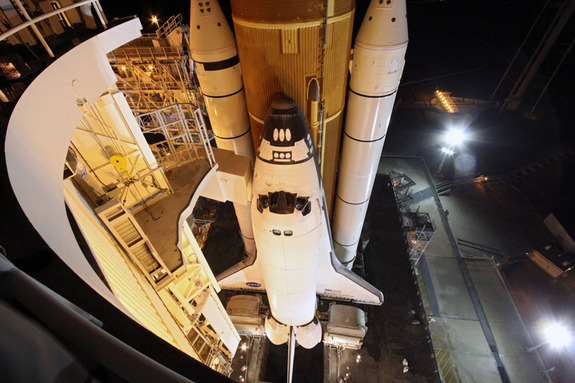
Endeavour on the launch pad prior to STS-134 (image NASA / Space.com)
The space shuttle Endeavour returned home safe and sound today, after her last 16-day flight into space – congratulations to Commander Mark Kelly and his crew on a remarkable mission which saw the last ever space walks to be conducted from a space shuttle, and the effective completion of the International Space Station – a task Endeavour herself started. Best wishes as well to Commander Kelly’s wife, Gabrielle Giffords, on her continued recovery following the terrible events in Arizona.
I’ve already written as to why the Endeavour is special to me, and I included a few facts about her, as well as posting some of my favourite images of her. To round-out her career, I thought I’d look at her “by the numbers”.
1: The number of times Endeavour has visited the Hubble Telescope in orbit. She undertook the first servicing mission (STS-61) in December 1993. The mission famously corrected the telescope’s faulty optics, effectively giving it a contact lens to wear.
3.5: The number of years it took construct Endeavour. Work commenced in September 1987, and was completed in April 1991.
The First: The crew of STS-49, Endeavour’s first mission into space
7: The number of times Endeavour landed at Edwards Air Force base, California.
10: The original anticipated lifespan (in years) for each shuttle vehicle in the fleet.
12: The number of times Endeavour visited the International Space Station. She started with the very first US mission to the station (STS-88, December 1998, carrying the Unity module), and finished with the final construction flight for the station, STS-134 in May 2011.
15 days, 17 hours, 38 minutes, 51 seconds: duration of Endeavour’s final mission.
19: The number of years Endeavour saw service. She first flew on May 7th, 1992, on mission STS-49, and was last launched on May 16th, 2011, returning home on June 1st on STS-134.
25: The number of missions Endeavour flew in her career.
100: total number of missions each shuttle was originally expected to undertake.
173: The number of crew Endeavour has flown into orbit. to orbit.
280: The total number of days Endeavour has spent in space.
4,429: The number of orbits Endeavour has made of the Earth.
The Last: the crew of STS-134, Endeavours final mission
6,154: The number of entries students gave to call the new space shuttle Endeavour after HMB Endeavour, the vessel captained by James Cook on his voyage to the South Pacific.
17,400: The speed (mph) at which Endeavour travels to remain in orbit (roughly Mach 25, five times the speed of a bullet).
122 million: total distance (rounded in miles) Endeavour has travelled during 25 missions.
$450 million: Average cost to launch a space shuttle.
$1,500 billion: Average cost of a complete shuttle mission.
$1,800 billion: How much it cost to build the Endeavour (in 1987 terms), or around 1/2 the cost of the original shuttle vehicles in the fleet, thanks to the use of “spare parts” that were available.
The last touchdown: Endeavour returns to Kennedy Space Centre, June 1st, 2011
The Mesh timeline has been published. Well, “timeline” is a bit of a stretch, but the details are now out. To save you from clicking a link, here’s the announcement in full:
“Of all of the things that excite us about Second Life, and there are many, Mesh is near the top of our list. Since the Mesh Project Viewer has been available, many content creators have given it a try on the test grid and we have only seen a small glimpse of the unlimited creative potential that this technology brings to Second Life. On behalf of everyone at the Lab, we want to thank everyone who have participated in the test and created these cool videos demonstrating the power of Mesh.
“So, now that you are excited about trying it out on the Main Grid, we wanted to share the launch time line, as promised.
“In July, we will enable a limited set of regions to use Mesh and will it roll out, in a phased approach, throughout August. By the end of August, everyone in Second Life will be able to import Mesh objects. Of course, if we run into unforeseen issues or bugs, then this time line will need to shift.
“We know that you must have a lot of questions regarding policies, costs, and how Mesh objects will be weighted. Although we cannot share these details yet, we will continue to keep you informed on our progress and other relevant news on this blog.
“So buckle up and get ready for a whole new wave of creativity in SL.”
Mesh has been a long time coming – and the announcement is somewhat welcome, a little more depth-of-detail would have been helpful. I’m assuming at this stage that the regions for the initial roll-out will be connected to a specific Server Release Channel. If so, will sim owners on that channel be given the opportunity to opt out until later in the roll-out? Mesh is obviously a complicated subject, hence the caveats in this announcement – but I certainly hope we’ll be seening a greater depth of information as July draws closer.
 Sitting in the mouth of the Couesnon River roughly a kilometre offshore from the mainland, and connected to it by a causeway, lays the magnificent Mont Saint-Michel. Occupied since before the Roman times, the islet (less than a kilometre square) rose to prominence in the middle ages as a religious centre, gaining strategic significance when it was annexed by William Longsword, Duke of Normandy in 933, and 100 years later when it supported William, Duke of Normandy’s claim to the English throne.




 It’s a strange thing to have under an abbey atop a small islet, and certainly well-hidden from casual eyes; had I not received three separate prompts on the matter, I’d have remained in ignorance of it being there. But it does raise an interesting question…given the accuracy of the rest of the build…is there yet something extraordinary to be found under the crypts of the real Mont Saint-Michel? Could it be that those 11th and 12th century monks who built the original abbey actually knew more than they were letting on?! The mind boggles! ;-).
 Avination is another grid-based virtual world that is making something of a splash. As I’ve taken the time to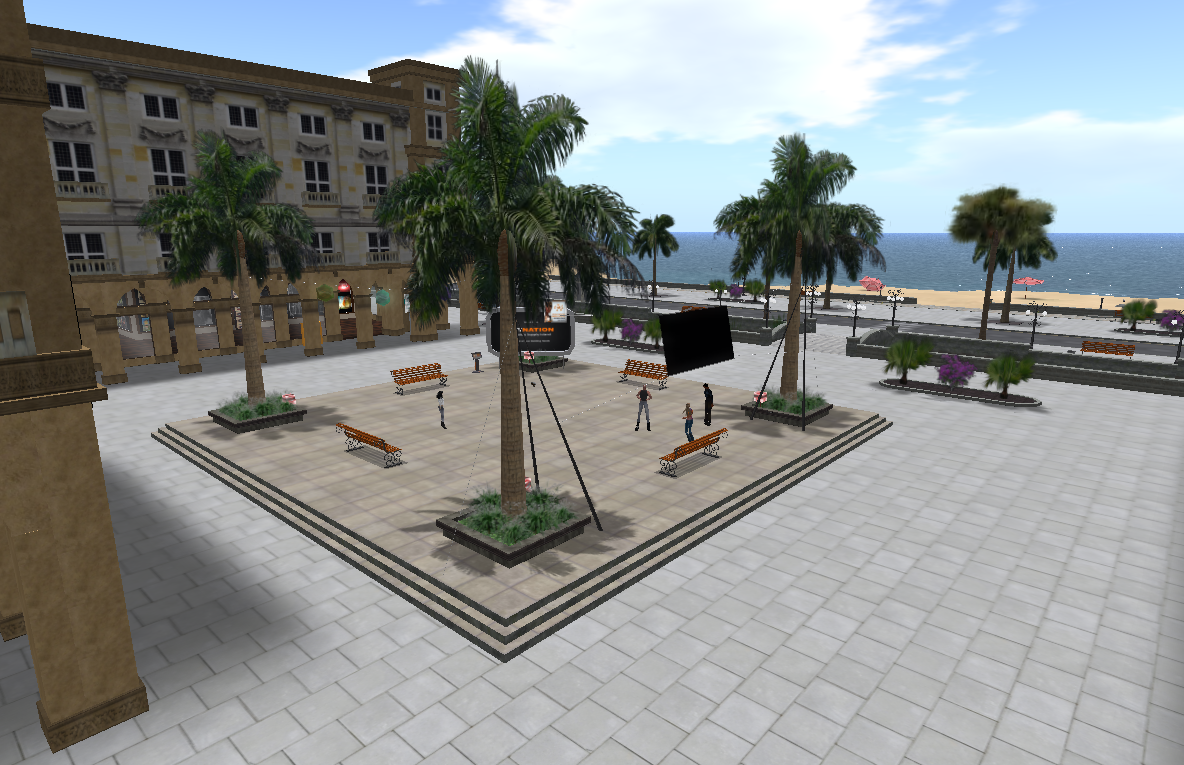





 Inara Pey: Living in a Modemworld