Viewer 2 Basic mode – where next?

Opinions relating to the Basic mode available in Viewer 2 are mixed. While finding it usable in my original review, several aspects left me concerned as to how well it might fill the role for which it appears to have been designed. I specifically questioned the fact that beyond things like basic movement, the view controls and communicating, it has very little in common with the Advanced mode – and there is no obvious continuity in the assistance available for those who opt to start with Basic and come to the point where they want to transition.

One Small Step for a Viewer; One Giant Leap for the User

In fairness, getting to grips with the Viewer at the best of times isn’t easy; while Torley has produced some outstanding videos, these aren’t always easy to locate. Worse, the So-called Quick Start Guide suffers from a combination of having the wrong emphasis in part and missing important and basic information (like actually modifying your avatar’s appearance, rather than simply changing clothes). Also, it’s fair to say the Quick Start Guide hasn’t been updated to reflect the arrival of additional and attractive functionality, thus putting it further out-of-synch with the Viewer.

Put all of this together – the more intense UI of the Advanced mode, a less-than-helpful Quick Start Guide, only the broadest elements of commonality between the Basic and Advanced modes of the Viewer, etc. – and it becomes clear that moving up from the Basic mode to the Advanced mode is not so much a matter of taking the next logical step as it is about taking a leap of faith that the effort is going to be worth it. This considerably undermines the usefulness of the Basic mode.

If the Basic mode is to prove worthwhile, work needs to be put into providing some level of continuity between the two modes of the Viewer to help those making the transition. Indeed, with a little forethought, re-working where and how people get help in the Advanced mode may well assist those leaping straight into it, opting to avoid the Basic mode altogether.

Such continuity / general assistance could be achieved first and foremost by incorporating the HOW TO button with an expanded number of pop-ups (providing overviews of, say, the Sidebar, the revised Toolbar, the menus and the Favourites bar). Doing this would immediately achieve two things:

  1. It would provide needed continuity of approach to seeking help for those moving up to Advanced from Basic.
  2. It offers an obvious place to find basic help and information for those leaping into the Advanced mode of the Viewer and bypassing the Basic mode altogether.

All the pop-ups associated with HOW TO (both Basic and Advanced) should additionally contain links to the Viewer Quick Start Guide, where more in-depth information would still reside. These links should display a pop-up informing the user the QSG will be opened in their external browser (although the Advanced mode should still retain QSG access from the Sidebar as an option).

To further increase the relevancy of the QSG, it should be re-formatted into two sections: BASIC and ADVANCED:

  • BASIC should provide additional information relevant to the Basic mode and which is not included in the HOW TO pop-ups (such as the more familiar WASD keys being available for movement, information on the various icons that appear on the right of the toolbar, etc.)
  • ADVANCED should provide more in-depth information available to Advanced mode users
  • Where any overlap occurs between the two modes, simple visual indicators should be used to indicate options those options only available to the Advanced mode.

Help, Don’t Hinder

It is fair to say that the current QSG is encumbered by several problems:

  • It is out-of-date
  • It lacks key information users will want to know – such as instructions on physically altering an avatar, as mentioned earlier
  • It contains a lot of what might be regarded as extraneous information. For example, while one understands LL’s desire to promote Premium Accounts, is it really necessary to have the latter third of the QSG read like a brochure for Linden Homes – especially as there is already an entire section of the Sidebar given over to this very topic?

It would therefore seem preferable that any re-vamp of the QSG should also focus on ensuring it is updated to reflect more recent version of the Viewer and on assisting the user more effectively, rather than engaging them in a sales pitch for Premium Accounts.

Obviously, a better alignment of the two modes of the Viewer and overhauling the QSG will not solve all the problems inherent in joining Second Life – there are many other aspects of getting into SL that also need to be addressed over an above the Viewer itself.

However, changes like these should help to ease people into using the viewer and encourage a greater tolerance towards it by presenting a more easy-to-follow route into getting help and understanding the UI. In short, it will do more to help users in gaining familiarity with either mode of the Viewer, rather than possibly hindering them.

As stands, as long as the  disconnect between both modes of the Viewer remains, it is hard to see how the Basic mode can achieve any lasting positive impact on new users.
SL concurrency dropping

Tateru Nino reports that SL user concurrency is at its lowest point for two years.

Why this is the case is subject to some debate in the official forum. While it would be dangerous to blame any single factor for the decline anyway,the parallel between the implementation of LL’s more unpopular policies couldn’t be clearer. At the start of 2009, concurrency was on a high, as the Alphaville Herald shows. However, the start of that year saw what many took to be the final bait-and-switch tacttic in the OpenSpace fiasco, to be followed later in the year by the Adult Change debacle, which was at best handled with a certain degree of outright incompetence by Linden Lab,  and so on.

While things did rally a little at the end of the year, the downward trend continued throughout 2010, rallying briefly at the start of 2011 – mostly likely because of a combination of it being the holiday season (and people collectively the world over having more time to log-in) and hopes for the platform rising as a result of the announcement that Rod Humble had been appointed the new CEO.

However, Linden Lab aren’t solely to blame for the decline. much has happened to change the landscape of virtual worlds over the last 2-3 years. Blue Mars pitched up (albeit briefly) and carried a lot of attention away from Second Life – some of which is now drifting back). More importantly, OpenSim Grids started to show signs of maturity and stability. Some of these have become very attractive to SL content creators as being new and exciting markets in which to plunge; as a result of new content becoming available elsewhere, there has been a trend for people to start splitting their time between Second Life and other similar grids such as InWorldz that are now readily available. These other grids are also themselves more attractive to users because their pricing models significantly undercut Linden Lab’s own; whether such prices are sustainable as such platforms grow is debatable – but it cannot be denied that the absurdly high prices charged by LL for server space is limiting SL’s ability to grow, and is indicative that there does need to be a re-emphasis / re-alignments of LL’s revenue streams.

As well as spending more time elsewhere, or whatever reasons (and yes, it’s easy to point the finger and say, “I’m only in X because LL [fill in the blank]”, even when such a statement is not entirely accurate), the users of SL also share in some of the blame: this is a world that exists because we imagine it and create it – yet we seem to be failing ourselves in creating the kind of compelling content that once existed in SL.

What this decline does again demonstrate is that there needs to be a re-evaluation of the LL/ user relationship. If the downward spiral is to be halted, the Lab and the user community need to work more closely together, both in creating a stable, vibrant economy and in the promotion of Second Life to a wider audience. I don’t wish to appear to be blowing my own trumpet here – but the fact is that observations made in post such as Tell Me A Story… and Business, Growth and Collaboration aren’t exactly rocket science – and many SL commentators are saying more-or-less the same things in their own ways.

Stopping the decline is going to take a concerted effort – and no single thing is going to reverse it: not bouncing bewbs, not a revamped new user experience and certainly not mesh; nor is simply taking potshots at LL and blaming them for everything. Second Life is a boat we’re all sitting in together – Lab and users.

It would be nice if we could all start rowing together under the guidance of Coxswain Humble.

The Privacy Zone

It is now some 20 days since the RedZone farrago came to an “end”. While that tool has now gone from Second Life, the wider issue of people’s right to a reasonable expectation of privacy while using the platform remains wide open – and Linden Lab remains resolutely silent on the matter.

Some might argue that the reason RedZone was removed isn’t important; it’s simply enough that it was eventually taken down. But the fact is, we do need to know why it went; was it finally considered to be in violation of the Terms of Service (ToS), or was it simply that the signal noise from the community reached a pitch where removing the device was viewed as the most expedient means of getting everyone to quieten down?

Beyond this is the fact that RedZone was not the only system grabbing information; some have been removed, others haven’t. Gemini CDS is still in use, for example; whether it is capable of account matching or not is irrelevant – it is sending information to a database under the control of a private individual outside of SL. Together with LL’s relatively low-key toughening of the Community Standards, it sends the message that the non-consensual havesting of user data – including that which might be regarded as “private” – for whatever purpose, is perfectly OK.

“Privacy is not something that I’m merely entitled to, it’s an absolute prerequisite” – Marlon Brando

While it is true that some link real life to Second Life as a natural part of their work, hobby or whatever, the vast majority are involved in SL as a means of stepping back from the realities of life and indulging themselves – and anonymity is important to this ability to do so. This point seems to be lost on the likes of Hamlet Au, with their constant (and completely inaccurate) cry that it is avatar anonymity that is “holding back” Second Life.

Even where people do link real life information with a Second Life account for business or other professional reasons, they may also wish to use alternative accounts to explore opportunities, activities and lifestyles that might cause them untold embarrassment if known to peers, family or friends. As such, there needs to be firm Chinese Walls between the accounts they create, and an assurance from Linden Lab that it is doing all it can to maintain those walls.

In short, any linking of real life to Second Life should always remain a matter of choice for the user, and never something thrust upon them by Linden Lab – and it should never be a matter of covert linking carried out without any form of explicit formal consent.

“The first duty of government is to protect the citizen from assault. Unless it does this, all the civil rights and civil liberties in the world aren’t worth a dime.” – Richard A. Viguerie

Linden Lab’s response to RedZone has been weak. There has been no public clarification of what will and will not be tolerated in terms of data harvesting within Second Life. While section 4 of the Community Standards now includes a reference to the sharing of avatar account information, it misses the point entirely – possibly deliberately so.

Attempting to regulate the sharing of data is about as effective as shutting the stable door when the horse has not only bolted, but is sitting on an exotic beach somewhere enjoying a quiet cocktail in the sun. Once data has been successfully culled from Second Life, then there is no way Linden Lab can prevent it from being howsoever those gathering it desire; and as RedZone ably demonstrated, when it comes to private individuals gather said data, it can never be assumed they are doing so with any honourable intent. Ergo, the issue is the gathering of such information in the first place that must be addressed.

Of course there are times when some information needs to be made available elsewhere – as the Linden Lab privacy Policy explains, certain services require data to be passed elsewhere in order for users to benefit from those services. There are even arguments to be made for LL pushing things like Profiles out to the web not only to ease server loads elsewhere, but to enable them to draw on possible advertising revenues through the use of the space on Profile pages. This is all understood and accepted.

What is not acceptable, however, is allowing people to attempt to drill through the existing Chinese Walls simply because it can be done (due to weaknesses in the Viewer software), or as a result of some unsustainable excuse (“the existing security tools aren’t good enough” – a weak excuse used when in fact someone is unwilling to take the time to use said tools properly, as this would inconvenience them far too much).

“I believe in a zone of privacy” – Hillary Clinton

A zone of privacy must exist for users of Second Life in order for us all feel confident that activating one aspect or another of the Viewer’s features is not going to end up in something unpleasant happening – or that we are being spied upon or possibly stalked.

While it is fair to say that no-one expects anything to happen overnight, the fact remains that time is passing – time in which Linden Lab have had the opportunity to do more to reassure the user community that they are in fact working to give each and every one of us a reasonable expectation of privacy. And yet, as it stands:

  • The Media Filter is still not available in Viewer 2, despite the code being available to Snowstorm for nigh-on a month. Instead we have bouncy bits; and while these may have a short-term “wow” factor, as soon as the code is available in the likes of Firestorm and Dolphin 2, which do have the Filter code, people will quickly switch away from Viewer 2
  • JIRAs such as SVC-6751, SVC-6793, and VWR-24807 – all common-sense measures to help provide areasonable expectation of privacy remain unassigned
  • Sections 4.3 and 8.3 of the ToS remain somewhat in opposition to one another
  • The Community Standards remain vague and the Privacy Policy barely offers any firm comfort to users in terms of safeguarding privacy.

It is understandable that the last two of these bullet points will take time to resolve – assuming they are being worked on at all. But given all that has happened around RedZone, keeping silent or avoiding the JIRAs and pushing back on the Media Filter – even as an interim solution – does not give any kind of indication that LL take people’s privacy seriously.

Frankly, people need the assurance that Linden Lab will not tolerate:

  • The creation, distribution and use of any device that seeks to link and / or make available information on alternative accounts by any means, either directly as an in-world device, or via any method using the Second Life Servers or via transmission to any third party database or server
  • The creation, distribution and use of any device that seeks to link avatar accounts with other ancillary information related to user accounts, such as IP addresses, for the purposes of alternative account detection or which may be considered by Linden Lab to infringe on the privacy and security of other users.
  • That such infringements of privacy include the subsequent distribution of any gathered information, either directly (by providing online access to the data) or indirectly (through the transmission of the data to any devices held in-world).

People need to see this enshrined in the Privacy Policy and linked to from the ToS. Beyond this, they need to have the assurance that both the gathering and the sharing of any information relating to their accounts over and above that which is available within the bounds of SL cannot take place without their explicit consent.

Privacy is extremely important for anyone putting themselves out there, expressing themselves, or expressing a side of themselves through an avatar. People don’t want other people to connect the dots from their avatar to their real life person – or even, for that matter, to an alt. One of the ethical obligations we have is to protect people’s privacy.”

– Rod Humble to Dusan Writer, 12th Feb, 2011.

In an age where people’s right to privacy is increasingly being looked upon disparagingly – often by those who will go to great lengths to protect their own privacy – Rod Humble’s comments to Dusan Writer have considerable resonance among the Second Life community. It’s really about time that Linden Lab gave some indication they are taking this position to heart – not just with regards to integration with Facebook or whatever – but in giving us the fundamental assurance that our privacy when in-world is being duly safeguarded.

Further Reading

More on bouncing bits

So, SL is all lit up about the forthcoming bouncing bewbs et al in Viewer 2; so much so that people are stampeding over to the website and downloading the Snowstorm latest development version (2,6,3) of the Viewer in which Avatar Physics are to be found.

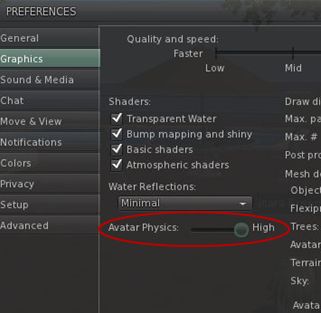
Setting the Avatar Physics rendering slider

To determine how well your Viewer renders Avatar Physics, go to ME -> PREFERENCES -> GRAPHICS, click on ADVANCED at the bottom of the tab, and then adjust the Avatar Physics detail slider.

In what might cause a little confusion for those used to using breast physics in TPVs, Avatar Physics are treated as a new clothing layer in Viewer 2. To enable them, therefore, you need to:

  • Open your Inventory and click “+” at the bottom of the Inventory tab
  • Select NEW CLOTHES -> NEW PHYSICS from the drop-down menu that appears
  • A new clothing layer is created called, by default, “New Physics”.

Once created, wear the new clothing layer, and:

  • Swap to the My Appearance tab in the Sidebar
  • Click on WEARING
  • Right click on the New Physics clothing layer (or whatever you’ve renamed it to) and select EDIT OUTFIT
  • Click on the tools icon to the right of the selected layer to display the Avatar Physics options tab.
Avatar Physics - main options

This tab contains a number of controllers:

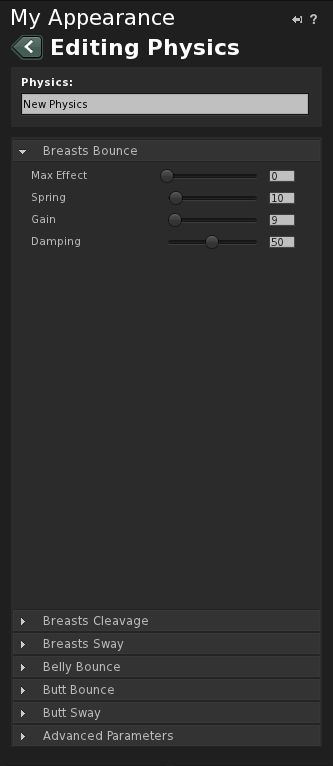
  • Breast Bounce (open by default on first use)
  • Breast Cleavage
  • Breast Sway
  • Belly Bounce
  • Butt Bounce
  • Butt Sway
  • Advanced Parameters

Each of the first six options comprises a series of sliders rated from 0-100 which adjust four parameters: mass effect, spring, gain, and damping.

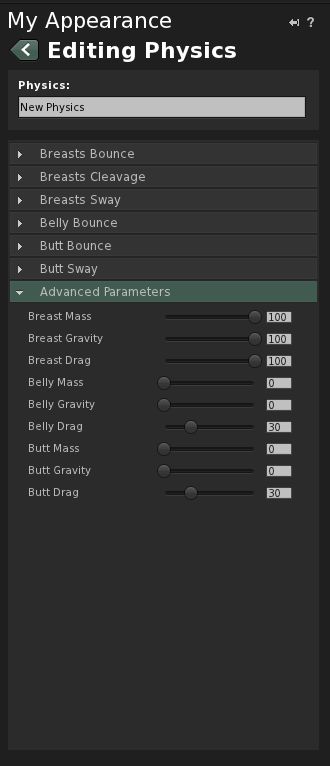
Advanced Parameters contains an additional set of parameters (mass, gravity, drag) for breasts, belly and butt respectively. Again, each of these is controller by a slider rated from 0-100.

In all cases, 0 = effect not seen; 100 = effect on maximum exaggeration. The best way to sort out how to set the sliders is through experimentation and finding something you’re happy with. Once you’re happy with things, click the SAVE button at the top of the tab, or SAVE AS at the bottom, if you wish to rename the layer.

Some things to note:

  • Like the Breast Physics in TPVs, activating Avatar Physics in Viewer 2 broadcasts the effects to other compatible Viewers
  • The Avatar Physics system is not    compatible with the Breast Physics in TPVs – you won’t see bouncing bewbs for others using a TPV with Breast Physics enabled; similarly, they will not see your Avatar Physics.

Happy bouncing!

Bewbs bounce, bellies bobble and butts…umm…

Breast physics are not new to the world of Third-Party Viewers (or Third-Pervy Viewers as I once saw them called in a forum post). First introduced with Emerald, they are now available in most TPVs.

Until now, however, they’ve not been available in the “official” Viewer; but all that is about to change. Yes, bouncing bewbs are coming to Viewer 2. And not only bouncing bewbs, but also physics to make bellies and butt do their own thing.

Whether this leads to a wider uptake of Viewer 2 remains to be seen; I’ve personally found the bouncing bewbs thing to be a nevermind situation – I’m not particularly fussed if someone out there has parts of me madly boinging up and down to aid their visual jollies in a TP, but at least here, as a clothing layer, I retain full control of what is seen. This alone means there should be less screaming from people in terms of sexist attitudes or degrading the female form, as we’ve had in the past.

At the end of the day, if bouncy bits are fun to have and further mimic what we get in real life (well, if not taken to extremes), then well done to LL for finally jumping on the band wagon!

In the meantime – and with grateful thanks to Opensource Obscure, here’s a fun little video marking the soon-to-arrive features, currently available in Snowstorm.

Fantasy Faire booms!

This week is Fantasy Faire week – and quite possibly one of the best-organised events in SL for 2011. A multi-sim celebration, the fantasy covers all aspects of fantasy RP in SL, with sims themed in terms of look and vendors, to present a stunning visual experience that could be heavy on the unwary Linden dollar account!

The tower at Dark Mirage

The aim of the event is to explore the RP themes available in Second Life while at the same time raising money for Relay For Life (and nigh-on $7000 USD has already been raised, with some $1600 of that coming from just the first day).

Events are planned through the week at the faire, with tonnes of live music each and every day, plus some “special” events: such as top creators and sponsors of the event being thrown in jail, where they cannot be released until their bail is paid (all donations to freeing them go to RFL)!

While it may get a little laggy given the amount of attention the event is getting, spending time wandering the sims is more that worth the effort. Not only are thy amazing builds in and of themselves, there are some remarkable creations on sale as well.

Navigating around the sims is a joy: There is a central “hub” sim called Fantasy Faire Central, which acts as the focal-point for arrival. This has a central teleport gazebo, with charity information clearly displayed, together with adverts for the various sims and a teleport board that takes you directly to any of the other sims – where you arrive at a similar gazebo, centrally located and themed to sim, which offers the same facilities. This makes sim-to-sim teleports quick and simple from those not wishing to trust region crossings.

The themes in the sims are nicely carried through: Sea of Mer, for example, features stores with an aquatic fantasy bent – mermaids, and so on; in the Forest of Shadows, stores are all built from the wood of the surrounding forest, while in the Forest of Light, they have almost a fairy-tale look. Dark Mirage features a town build with a stunning tower as its visual focal-point which looks dramatic framed against a burnished sky at sunset.

Another view of the tower at Dark Mirage

Alongside the shops in each sim is a low-key RFL kiosk, allowing donations to be made quickly and easily wherever you are in your travels. Sims are also set to specific times of the day to enhance their appearance, and I’d strongly suggest that you leave your day times settings on Regional Default to fully enjoy this.

Getting around all of the sims is a work of perseverance; even in quiet times, the lag can hit hard – and stands as testament to the fact that Linden Lab really need to put effort into getting this sorted as a matter of course, rather than it repeatedly coming up as a “special focus” for action. However, it really is worthwhile making the extra effort as a lot of time as effort has gone into developing a look for the Faire that puts it head-and-shoulders above others. Certainly it is worth a visit – if only to drop a donation into to a very worthy cause.

Don’t forget to take a look at the Fantasy Faire website – which is packed with information, and take a look at the wide range of photos coming out of the event!

The fabulous tree house in Fantastical and Magical