Of rocks and water, swans and falcons

CuriosityCuriosity has resumed its long drive towards the point where it can begin its examination of the huge mound sitting at the centre of Gale Crater which NASA has dubbed “Mount Sharp” (its official name is Aeolis Mons).

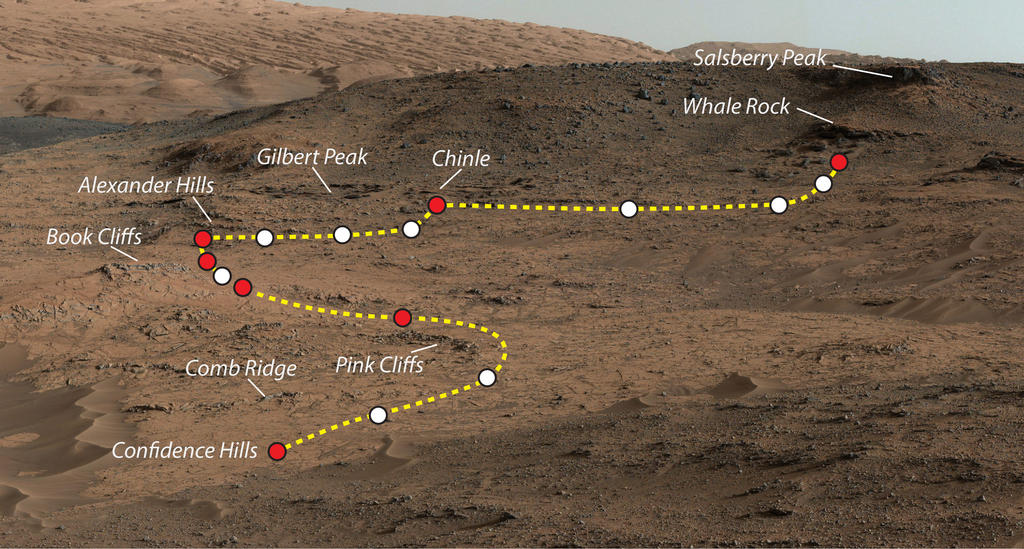
The rover recently stopped-off at an area dubbed “Waypoint 1”, the first of several potential stop-over points on the rover’s route, where it will carried out various studies of the surroundings.

Curiosity departed the area on September 22nd after spending some 10 days examining rocks at “Waypoint 1”, and is once more travelling slowly but steadily towards the point mission managers have identified for it to bypass a dune field lying between it and “Mount Sharp”. Along the way, it is liable to make around four more stops.

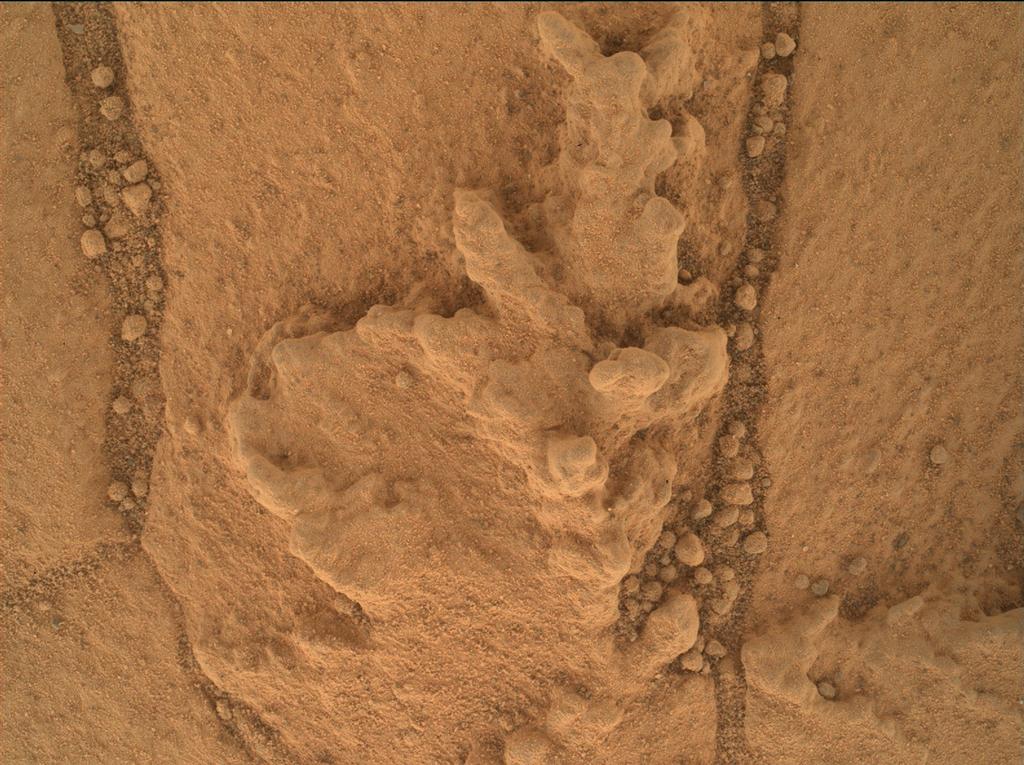
While at “Waypoint 1”, the rover spent time examining a rocky outcrop dubbed “Darwin”, using a range of instruments to gather images and data which again showed that Gale Crater was once the scene of considerable water activity.

A mosaic of four images taken by the Mars Hand Lens Imager (MAHLI) camera shows detailed texture in a ridge on the rock outcrop dubbed “Darwin” the rover studied at “Waypoint 1”. The images were obtained shortly before sunset Sol 400 (Sept. 21, 2013) with the camera 25 cm (10 inches) from the rock. Scale is indicated by the Lincoln penny from the MAHLI calibration target, shown beside the mosaic.

“We examined pebbly sandstone deposited by water flowing over the surface, and veins or fractures in the rock,” said Dawn Sumner of University of California, Davis, a Curiosity science team member with a leadership role in planning the stop. “We know the veins are younger than the sandstone because they cut through it, but they appear to be filled with grains like the sandstone.”

While much of the outcrop was covered in the all-too-familiar oxidised Martian dust, there were a patches of bare rock scattered across its surface in which sand deposits and pebbles could be seen, and it was these that drew the attention of the science team.

A mosaic of nine images, taken by the MAHLI camera, shows detailed texture in a conglomerate rock bearing small pebbles and sand-size particles. Again, these images were captured on Sol 400 (Sept. 21, 2013) with the camera positioned about 10 cm (4 inches) from the rock. Scale is indicated by the Lincoln penny from the MAHLI calibration target, shown beside the mosaic.

Following extensive studies of the outcrop, the science team interpret the sand and pebbles in the rock as material that was deposited by flowing water, then later buried and cemented into rock, forming conglomerates. Research will now focus on the textures and composition of the conglomerates as Curiosity continues onward, to understand its relationship to stream bed conglomerate rock found closer to Curiosity’s landing site. Doing so, together with studies to be undertaken at the remaining waypoints, should help scientists to piece together the relationship between rock layers at “Yellowknife Bay” where the mission found evidence of an ancient freshwater-lake environment favourable for microbial life, and the rock layers at the main destination on lower slopes of “Mount Sharp”.

Water, Water, Everywhere

On September 27th, the Curiosity team published five reports in the journal Science which discuss the mission’s findings during the first four months of the rover’s time on Mars. A key finding from this work is that water molecules are bound to fine-grained soil particles, accounting for about 2 percent of the particles’ weight at Gale Crater. This result has global implications, because these materials are likely distributed around the Red Planet.

The presence of water was discovered as a result of samples of surface material being heated to the point of vapourisation within a small oven inside Curiosity – and the most abundant vapour detected was  H2O. The quantity of water molecules bound-up in the Martian soil suggest that as much as two pints of water could be obtained through the heating of one cubic foot of Martian dirt.

This discovery potentially has major implications for any long-term human presence on Mars in the future. The water – once subjected to appropriate treatment to remove unwanted minerals, such as a perchlorate, which has also been found in small amounts within Martian soil samples and can interfere with the thyroid function – could be used for cleaning and drinking purposes. It could also be electrolysed and used in the creation of oxygen and hydrogen. The hydrogen could then be used for a variety of purposes, including as a raw fuel, or in the production of fuel in the form of methane (created by combining the hydrogen with carbon dioxide from the Martian atmosphere), which could be used with oxygen to power surface vehicles.

An interesting part of the study is that the analysis of the chemicals and isotopes in the gases released during the analysis of soil samples indicates that the water molecules are the result of an interaction between the soil on Mars and the current atmosphere of the planet; so the process of depositing the water molecules is ongoing, rather than the result of some past mechanism. Even the discovery of perchlorate in the samples is of significance; previously, this had only been found in  soil samples examined at the high latitude Phoenix Lander site. That they’ve now also been found in a near-equatorial latitude suggests they have a global distribution as well.

The other papers released by the science team further confirm earlier studies into the mineral composition of samples gathered and studied during the rover’s initial four months on Mars using its full suite of sample analysis tools: MAHLI, APXS, ChemCam, SAM, and CheMin, all of which can perform a range of complementary as well as disparate analyses.

One of the papers additionally focuses on a rock I covered back in the early days of the mission – Jake_M. Named in memory of NASA / JPL engineer Jacob Matijevic, who worked on all three generations of NASA’s Mars rovers and who passed away shortly after Curiosity arrived in Gale Crater, Jake_M was thought to be quite unlike any other rock on Mars – not because of its pyramid-like shape, but because of its composition.

“Jake_M”, the remarkable rock examined by Curiosity on September 22nd 2012, and believed to be a mugearite type of rock. The markings show where ChemCam and APXS were used to examine it

The paper published in Science confirms that Jake_M is most like a mugearite, a type of rock found on islands and rift zones on Earth.

Continue reading “Of rocks and water, swans and falcons”

Boldly going …

On August 25th 2012, while the eyes of the global space community were focused almost entirely on the happenings in a crater on Mars, a significant event took place approximately 18 billion kilometres (11 billion miles) from Earth. Voyager 1 passed through the heliopause, the boundary between what is regarded as the “bubble” of space surrounding the solar system (heliosphere) which is directly influenced by the Sun, and “true” interstellar space.

The heliosphere and its component elements

That the spacecraft might be nearing the so-called “bow shock” area where the solar wind meets interstellar space was indicated by engineers and scientists working on the Voyager project in June 2012; however, it was not until September 2013 that NASA JPL felt confident enough in the data they’d received to confirm that Voyager 1 had in fact passed into interstellar space in August 2012, the first man-made object to have done so, some 35 years after having been launched from Earth in what was a highly ambitious programme of deep-space exploration.

The Voyager programme actually had its roots in a much more ambitious programme, the so-called Grand Tour. First put forward by NASA engineer Gary Flandro,  The Grand Tour proposed the use of a planetary alignment which occurs once every 175 years, together with the potential to use the gravities of the planets as a means by which space probes could explore the outer planets of the solar system.

The idea of using gravity of the planets to help propel a space craft had first been realised by a young mathematician, Michael Minovitch, in 1961. With the aid of the (then) fastest computer in the world, the IBM 7090, Minovitch had been trying to model solutions to the “three body problem” – how the gravities of two bodies (generally the Earth and the Sun) influence the trajectory and velocity of a third (generally a comet or asteroid) moving through space; something astronomers and mathematicians had long wrestled with.

The men behind Voyager: Michael Minovitch (l), circa 1960; Gary Flandro (c), circa 1964; and Ed Stone (r), the project scientist and long-time advocate of the mission, circa 1972 (Stone later when on to serve as NASA's Director at JPL)
The men behind Voyager: Michael Minovitch (l), circa 1960; Gary Flandro (c), circa 1964; and Ed Stone (r), the project scientist and long-time advocate of the mission, circa 1972 (Stone later went on to serve as NASA’s Director at JPL)

Through his work, Minovitch showed how an object (or space vehicle) passing along a defined trajectory close to a planetary body could, with the assistance of the planet’s gravity, effectively “steal” some of the planetary body’s velocity as it orbited the Sun, and add it to its own.

At the time, his findings were received with scepticism by his peers, and Minovitch spent considerable time and effort drawing-up hundreds of mission trajectories demonstrating the capability in order to try to get people to accept his findings. But it was not until 1965, when Flandro started looking into the upcoming “alignment” of the outer planets (actually a case of the outer planets all being on the side of the Sun, rather than being somehow neatly lined up in a row) due in the late 1970s, that Minovitch’s work gained recognition.

Recognising the opportunity presented by the alignment, Flandro started looking at how it might be used to undertake an exploratory mission. In doing so, he came across Minovitch’s work and realised it presented him with exactly the information needed to make his mission possible, and so the Grand Tour was born.

Voyager: the most prominent element of the vehicle is the communitactions dish; below and to the left of this is the nuclear RTG power source; extending out to the top left is the insstrument boom, and to the right the imaging boom and camera system
Voyager: the most prominent element of the vehicle is the communications dish; below and to the left of this is the nuclear RTG power source; extending out to the top left is the instrument boom, and to the right the imaging boom and camera system

This mission would have originally seen two pairs of spacecraft launched from Earth. The first pair, departing in 1976/77 would form the MJS mission, for “Mariner (then the USA’s most capable deep-space vehicle)-Jupiter-Saturn”. These would fly by Jupiter and Saturn and then on to tiny Pluto; while a second pair of vehicles launched in 1979 which would fly by Jupiter, Uranus and Neptune.

Budget cuts at NASA following Apollo eventually saw the Grand Tour scaled-back to just two vehicles, Voyager 2 and Voyager 1, but the overall intent of the mission remained intact under the Voyager Programme banner, now led by Ed Stone. In the revised mission, both spacecraft would perform flybys of Jupiter and Saturn, with Voyager 2 using Saturn to boost / bend it on towards Uranus and from there on to Neptune, while Voyager 1 would approach Saturn on a trajectory which would allow it to make a flyby of Saturn’s huge Moon Titan, of significant interest to astronomers because of its thick atmosphere.  This route would preclude Voyager 1 from reaching Pluto, as it would “tip” the vehicle “up” out of the plane of the ecliptic and beyond even Pluto’s exaggerated orbit around the Sun, and push it onto an intercept with the heliopause.

Continue reading “Boldly going …”

A Dragon of a different kind

As I’ve previously posted here on occasion, and as friends on Twitter will know, I has a soft spot for space exploration. Last year I wrote some pieces about the space shuttle Endeavour, and included some favourite images of her prior to her final return to Earth.

Endeavour and the shuttle fleet have now gone; retired to museums and their missions confined to history. However, the last week or so saw the opening of a new chapter in low-Earth orbit space operations as the Dragon space vehicle, developed by Internet entrepreneur Elon Musk’s SpaceX Corporation, became the first privately funded vehicle to dock with the ISS under NASA’s Commercial Orbital Transportation Services programme.

May 22nd 2012: Dragon lifts-off atop SpaceX’s own Falcon 9 launch vehicle (image: SpaceX)

First flown in 2010, the Dragon space vehicle was put through its paces during May 2012 in an aggressive mission to demonstrate its core capabilities of launching a payload to orbit, rendezvousing with the ISS, where it would be captured by a robotic arm on the station and manoeuvred into a hard dock for cargo transfer, before returning to Earth with a payload from the station (in this case, 590 kilos of items, including “quick return” packages intended to demonstrate that SpaceX could return time-critical experiments from the ISS and deliver them to NASA within 48 hours of the Dragon vehicle detaching from the station).

Dragon is designed to be a highly versatile workhorse vehicle, capable of delivering some 3,310kg of cargo to the ISS and returning up to 2,500kg safely to Earth. What’s more the vehicle’s heat shield is designed to withstand re-entry velocities from possible lunar and Mars missions.

Russia’s Progress (l), Europe’s ATV (c) and Japan’s HTV (r)

The ability to make a return to Earth places Dragon is a league of its own compared to the other cargo vehicles currently operating to resupply the ISS. The Russian Progress vehicle, European ATV and Japan’s HTV all burn-up in the upper reaches of the Earth’s atmosphere after departing the space station.

Nor will Dragon be limited to cargo flights: development is under way of the DragonRider variant – a vehicle capable of lifting up to seven people to  / from the ISS. Two further variants of the vehicle are under development: DragonLab, which will see the vehicle operate commercially on its own as an unmanned orbital research platform, with full return-to-Earth capabilities; and RedDragon, which has been proposed as a NASA Discovery mission slated for 2018, which would see a modified version of the unmanned Dragon fly to Mars and deliver a 1-tonne payload to the surface in order to try to sample subsurface water reservoirs.

Dragon approaching the ISS, May 25th 2012 (NASA)

Dragon was launched on its initial COTS mission on May 22nd, 2012. Once successfully in orbit, it commenced a 2-day “chase and rendezvous” flight with the ISS, gradually easing its way up to the space station, where it performed a series of check-out manoeuvres, prior to making its final approach to the station ready for capture and docking on May 25th.

The ISS captured by Dragon’s thermal camera prior to final rendezvous and capture (SpaceX)

Rather than docking directly with the station, as with the likes of the Shuttle, Progress and Europe’s ATV, Dragon gently manoeuvres up close to the station prior to a robotic arm on the ISS itself being used to “grab” the vehicle and then gently ease it into a berthed positioned against the station’s Harmony module.

May 25th capture: “Houston, we have a Dragon by its tail!” Astronaut Don Petit reported upon successfully grappling the vehicle with a robot arm (NASA)

Once successfully docked, Dragon spent several days mated to the ISS while the station crew off-loaded some 460kg of food, water and other items, then packed the vehicle with 560kg of equipment and items for the return to Earth.

Docked! (NASA)

Return operations commenced on May 31st, when the robot arm was used to detach Dragon from the ISS and move it to a distance of some 10 metres before releasing it. Manoeuvring thrusters then gently backed the vehicle away from the ISS prior to it commencing a series of manoeuvres that moved it ahead of the station by a few hundred kilometres, and started the de-orbit process.

Departure (NASA)

After successfully re-entering the Earth’s atmosphere, the main capsule having been detached from the orbital “trunk” of the craft, Dragon safely deployed its parachutes and splashed-down on-target a little under 900 kilometres off the coast of California, where it was recovered by waiting support ships, bringing the flight test phase of the mission to a successful conclusion.

A Dragon in the water (SpaceX)

Dragon is due to fly to the ISS once more in September 2012 in the first official Cargo Resupply Mission, which will see it carry a full load into space. This will be followed in October by Orbital Science’s Cygnus vehicle (which, like Progress et al, is designed to burn-up on re-entry), to mark the further expansion of the COTS programme.

Orbital Sciences’ Cygnus vehicle

For now, however, all eyes remain on SpaceX and their remarkable – and potentially highly versatile – Dragon vehicle; here’s to a successful mission in September! In the meantime, I’ve put together a little slideshow of images from NASA and SpaceX images highlighting the mission.

(Click here to see the slideshow full screen)

Endeavour: home for the last time

Endeavour on the launch pad prior to STS-134 (image NASA / Space.com)

The space shuttle Endeavour returned home safe and sound today, after her last 16-day flight into space – congratulations to Commander Mark Kelly and his crew on a remarkable mission which saw the last ever space walks to be conducted from a space shuttle, and the effective completion of the International Space Station – a task Endeavour herself started. Best wishes as well to Commander Kelly’s wife, Gabrielle Giffords, on her continued recovery following the terrible events in Arizona.

I’ve already written as to why the Endeavour is special to me, and I included a few facts about her, as well as posting some of my favourite images of her. To round-out her career, I thought I’d look at her “by the numbers”.

1: The number of times Endeavour has visited the Hubble Telescope in orbit. She undertook the first servicing mission (STS-61) in December 1993. The mission famously corrected the telescope’s faulty optics, effectively giving it a contact lens to wear.

3.5: The number of years it took construct Endeavour. Work commenced in September 1987, and was completed in April 1991.


The First: The crew of STS-49, Endeavour’s first mission into space

7: The number of times Endeavour landed at Edwards Air Force base, California.

10: The original anticipated lifespan (in years) for each shuttle vehicle in the fleet.

12: The number of times Endeavour visited the International Space Station. She started with the very first US mission to the station (STS-88, December 1998, carrying the Unity module), and finished with the final construction flight for the station, STS-134 in May 2011.

15 days, 17 hours, 38 minutes, 51 seconds: duration of Endeavour’s final mission.

19: The number of years Endeavour saw service. She first flew on May 7th, 1992, on mission STS-49, and was last launched on May 16th, 2011, returning home on June 1st on STS-134.

25: The number of missions Endeavour flew in her career.

100: total number of missions each shuttle was originally expected to undertake.

173: The number of crew Endeavour has flown into orbit. to orbit.

280: The total number of days Endeavour has spent in space.

4,429: The number of orbits Endeavour has made of the Earth.

The Last: the crew of STS-134, Endeavours final mission

6,154: The number of entries students gave to call the new space shuttle Endeavour after HMB Endeavour, the vessel captained by James Cook on his voyage to the South Pacific.

17,400: The speed (mph) at which Endeavour travels to remain in orbit (roughly Mach 25, five times the speed of a bullet).

122 million: total distance (rounded in miles) Endeavour has travelled during 25 missions.

$450 million: Average cost to launch a space shuttle.

$1,500 billion: Average cost of a complete shuttle mission.

$1,800 billion: How much it cost to build the Endeavour (in 1987 terms), or around 1/2 the cost of the original shuttle vehicles in the fleet, thanks to the use of “spare parts” that were available.

The last touchdown: Endeavour returns to Kennedy Space Centre, June 1st, 2011

Endeavour: Favourite images

I’ve already blogged about the affinity I have for the space shuttle Endeavour and how it came about, and while there are many, many photographs from NASA and others that define the space shuttle era, these are the ones that symbolise, for me, the career of the Endeavour.

Ready to fly: STS-49, Endeavour’s maiden flight (Crew (L-to-r): Mission Specialist (MS) Richard J. Hieb, Pilot Kevin P. Chilton, Commander Daniel C. Brandenstein, MS Thomas D. Akers, MS Pierre J. Thuot, MS Kathryn C. Thornton, and MS Bruce E. Melnick)


STS-61: the First Hubble Servicing Mission, December 1993
The Borealis Australis, STS-59, April 1994
STS-126 night launch, November 2008
On the limb of the world, STS-130, February 2010
Final ascent: STS-134, May 2011