Space Sunday: tourism, hotels and space stations

VSS Unity’s engine propels it to sub-orbital velocity in the vehicle’s first powered test flight, April 5th, 2018. Credit: MarsScientifc.com / Trumbull Studios / Virgin Galactic

VSS Unity, the second of Virgin Galactic’s sub-orbital spaceplanes, Has completed its first powered test flight, bringing the company one step closer to it goal of flying tourist into space.

The flight took place on Thursday, April 5th, with the vehicle, crewed by David Mackay  and Mark Stucky, carried from its operational base at Mojave Air and Space Port in California, to an altitude of about 14,200 metres (46,150 ft) before being released. Dropping clear of the WhiteKnightTwo carrier, the single rocket motor, burning a solid propellant mix, was ignited in what the company calls a “partial duration burn” of 30 seconds. Shorter than an engine burn expected during passenger-carrying flights, it was nevertheless sufficient to push VSS Unity to a maximum altitude of 25,686 metres (83,479 ft) and a maximum velocity of mach 1,87.

Partial though it may have been, the engine burn on the flight nevertheless represented the longest time a SpaceShipTwo rocket motor has been fired in the entire development of the vehicle. It pushed VSS Unity to achieve the highest and fastest speed thus far in a powered test flight – the fifth such flight for a SpaceShipTwo vehicle.

VSS Unity touches down at Mojave Air and Space Port, some 10 minutes after being release from its WhiteKnightTwo carrier aircraft at the start of its first powered test flight. Credit: Virgin Galactic

Three prior flights had been completed by VSS Unity’s predecessor, the VSS Enterprise.  Unfortunately, during its fourth flight, the Enterprise broke apart seconds into its powered ascent on October 31st, 2014, after co-pilot Michael Alsbury accidentally deployed the vehicle’s “feathering” system. Designed to assist the vehicle during its re-entry into the denser part of Earth’s atmosphere, the feathering system tips up the vehicle’s wing booms, but deployed when under power, the feathering place unsustainable stresses on the vehicle, causing it to break-up, killed Alsbury and seriously injuring pilot Peter Siebold.

As a result of that crash, the Unity incorporates additional safety features designed to prevent any repeat on the Enterprise accident.

The April 5th  test flight is the first in a series of powered flights intended to expand the vehicle’s performance envelope and to prepare for commercial flights carrying tourists and research payloads. Exactly how many of these flights will take place  has not been made clear, simply because the company wants to keep things open-ended and be sure they have the highest confidence in the vehicle before commencing commercial flights.

In addition to the test flight, Virgin used April 5th to announce a non-binding agreement in October with the Public Investment Fund (PIF) of Saudi Arabia whereby the PIF would invest $1 billion into Virgin’s space companies, which also includes Virgin Orbit, the small launch vehicle developer.

During to enter the air-launch business later in 2018, Virgin Orbit will use a converted 747 airliner to carry its LauncherOne rocket to altitude before releasing it so it can carry payloads of up to 500 kg to orbit.  These payloads can either be individual satellites or multiple micro-satellites.

The LauncherOne vehicle and its carrier aircraft. Credit: Virgin Orbit

On April 4th, Virgin Orbit announced plans to offer customers a variety of services including responsive launch / maintenance of large satellite constellations and debris removal activities.

“Satellite constellations” refers to large numbers of satellites being placed in low-Earth orbit to perform a specific task, and which tend to be launched en masse using a single large launch vehicle. The Iridium constellation, for example, comprising over 40 satellites, was placed in orbit by SpaceX launching 10 satellites at a time. However, as the individual satellites reach there end of life – or suffer unexpected failures – they will need replacement units, which in turn require more economical launch systems than big boosters. This is the service Virgin Orbit plans to offer under the “responsive launch / maintenance contract: a means for customers to prepare replacement units and then launch them rapidly and at lower cost than possible through other means.

“Commercial customers say the idea of getting into orbit within days is very appealing for them,” Dan Hart, Virgin Orbit president and chief executive, said. “For the national security world, that has always been a goal. For once, the commercial and government worlds are perfectly well aligned.”

The debris removal aspect of the work is longer term, and would likely see Virgin Orbit collaborating with companies specialising in orbital debris removal. “With thousands of [low-Earth orbit] satellites planned, that is going to happen,” Hart stated. “I’ve recently become a believer that space debris is a problem that needs to be solved and I’m happy to see there are companies rising up to take that on.”

The first LauncherOne carrier aircraft, Cosmic Girl, undergoing tests at Long Beach Airport, California. Credit: Michael Carter

Initially, Virgin Orbit will fly from the Mojave Air and Space Port in California, but the company is planning to also operate out of NASA’s Kennedy Space Centre, utilising the massive space shuttle runway available there. Longer-term, as air-launched systems become more accepted globally, the company also hopes to offer launch services from any airport capable of handling a 747, and prepared to allow rocket handling and fuelling.

Continue reading “Space Sunday: tourism, hotels and space stations”

Space Sunday: Tiangong-1’s return and going to the Moon

Tiangong-1, imaged from a docked Shenzhou spacecraft. Credit: CMSE

China’s first orbital laboratory, Tiangong-1 (“Celestial Palace 1”) is due to re-enter the Earth’s atmosphere within the next 24 hours.

Launched in 2011, the 10.4-metre-long (34-foot) unit weighing 8.5 tonnes, was the first phase in China’s project to gain experience in Earth-orbit operations in order to establish a space station in the 2020s. It  operated for four-and-a-half-years, and was visited by two crewed missions before operations were officially brought to a close in 2016, following the launch of the Tiangong-2 orbital module.

Originally, it had been anticipated that Tiangong-1 would be de-orbited and allowed to burn-up in the upper atmosphere in late 2017. However, it was also claimed that the Chinese had lost attitude control over the unit, and that it would de-orbit some time in March 2018. These claims that control had been lost – strongly denied by the Chinese, led to over-the-top reports that the Earth was in imminent danger of the station forming a fireball and crashing to the ground within a city.

Tiangong 1. Credit: CMSE

While it is true that the unit could re-enter the atmosphere anywhere between 43-degrees north and 43-degrees south, the fact is that much of the laboratory’s orbit takes it over open sea, so the risk than any part of it which might survive re-entry and disintegration in the upper atmosphere could strike a populated centre is considered low.

At the time of writing, orbital tracking suggested that Tiangong-1 will re-enter the denser part of Earth’s atmosphere and start to break-up no earlier than 00:18 UTC on Monday, April, 2nd, 2018 (roughly 17:18 EST) +/- 1.7 hours.  As Tiangong-1 descends into the atmosphere it will be subject to frictional heat and vibration which will combine to start breaking it apart. As this happens, it is liable it will start tumbling, speeding the process of disintegration and encouraging more of it to burn-up due to frictional heat. The hope is that almost nothing of the station will survive this burn-up process to actually reach the surface of the planet.

Tiangong’s rate of orbital decay and predictability

But even if some do, again, the chances of them hitting a populated area and causing a loss of life appear somewhat remote. In this, Tiangong-1 reflects the US Skylab mission in 1979 and the Russian Salyut 7 / Cosmos 1686 combination of 1991. Both of these where much larger than Tiangong 1 (77 tonnes and 40 tonnes respectively), and made uncontrolled re-entries into Earth’s atmosphere. In both cases, wreckage did not cause loss of life. It’s also worth pointing out that something equal to, or approaching, the size and mass of Tiangong-1 re-enters Earth’s atmosphere approximately every 3 or 4 years – all without harm to those below.

Those interested in tracking the laboratory’s orbit in real-time can do so via Aerospace Corporation’s Tiangong-1 re-entry dashboard .

The Moon: Gateway or Direct?

As NASA considers whether or not to acquire more than one propulsion module for the proposed Lunar Orbital Platform-Gateway (LOP-G, previously known as the Deep Space Gateway), more are adding their voices to concern that NASA’s idea of establishing a human presence on the Moon’s surface by way of an orbital facility is not the most ideal way to go.

The proposed Lunar Orbit platform-Gateway (LOP-G, formerly the Deep Space Gateway): NASA hopes to have it operating by 2024 with international support. In his Space News Op-Ed, Robert Zubrin believes that humans could be on the surface of the Moon within that time frame. Credit: NASA

The LOP-G has taken various forms over the course of the last several years. envisaged as a small space station occupying a near-rectilinear halo orbit (NRHO) around the Moon, it was previously known as the Deep Space Gateway, intended to support the (now-cancelled) Asteroid Redirect Mission. It was then seen as a means of supporting lunar missions and – eventually – missions to Mars. The reasons for the station have always been pretty thin, and in an Op-Ed written for Spacenews.com, Robert Zubrin offers an alternative approach to a return to the Moon which forgoes the need for LOP-G.

Zubrin, along with David Baker, is the author of  Mars Direct, a proposal for establishing a human presence on Mars. It was conceived in the 1990s in response to NASA’s Space Exploration Initiative of 1989. Also called the 90-Day Report, this sought to set-out a roadmap for reaching Mars. This involved developing orbital facilities around Earth which would in turn allow for a return to the Moon, where large-scale facilities could be built from which humans could embark on missions to Mars. With a 30-year time frame and an estimated cost of US $450 billion, it was a plan built on the specious idea that the Moon offered the “easiest” route to reaching Mars, and which ultimately went nowhere.

Robert Zubrin addresses staff at NASA’s Ames Research Centre, California, in 2014. Credit: NASA

Mars Direct, on the other hand, presented the means to reach Mars with an initial human mission in just 10 years from inception, and at a cost of some US $30 billion overall. This included all the development costs of the launch vehicle and the required crew infrastructure which, once developed, could be used to undertake subsequent missions (launched every 2 years, to take advantage of Earth’s and Mars’ orbits) at a cost of US $1 billion a year. The mission profile also provided the means to use local resources on Mars to reduce overheads (such as using the Martian atmosphere to produce fuel stocks) and establish a permanent presence on the planet, as well as offering crews an assurance of getting back to Earth if anything went wrong with a particular mission.

Continue reading “Space Sunday: Tiangong-1’s return and going to the Moon”

Space Sunday: drills, flares and monster ‘planes

NASA’s Mars Science Laboratory (MSL) rover Curiosity has taken a further step along the way to retrieving and analysing samples gathered by its drill mechanism, which hasn’t been actively used since December 2016, after problems were encountered with the drill feed mechanism.

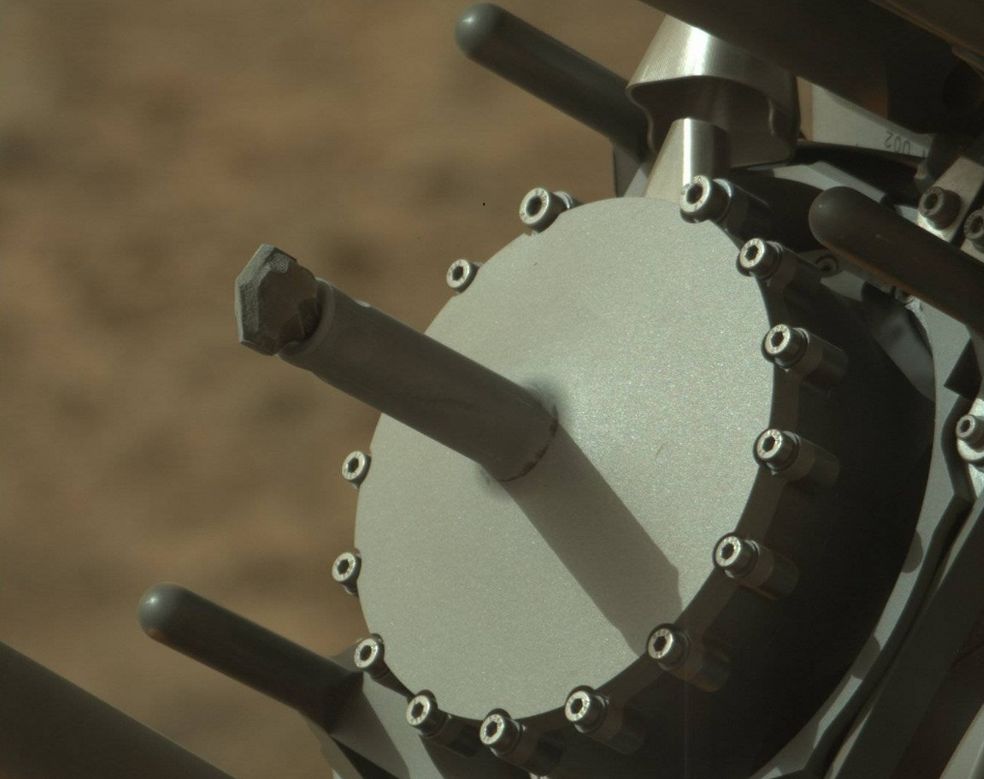
Essentially, the drill system is mounted on Curiosity’s robot arm and uses two “contact posts”, one either side of the drill bit, to steady it against the target rock. A motor – the drill feed mechanism – is then used to advance the drill head between the contact posts, bringing the drill bit into contact with the rock to be drilled, and then provide the force required to drive the drill bit into the rock. However, issues were noted with this feed mechanism, during drilling operations in late 2016, leading to fears that it could fail at some point, leaving Curiosity without the means to extend the drill head, and thus unable to gather samples.

To overcome this, MSL engineers have been looking at ways in which the feed mechanism need not be used – such as by keeping the drill head in an extended position. This is actually harder than it sounds, because the drill mechanism – and the rover as a whole – isn’t designed to work that way. Without the contact posts, there was no guarantee the drill bit would remain in steady, straight contact with a target rock, raising fears it could become stuck or even break. Further, without the forward force of the drill feed mechanism, there was no way to provide any measured force to gently push the drill bit into a rock – the rover’s arm simply isn’t designed for such delicate work.

Curiosity’s drill mechanism, showing the two contact posts (arrowed) used the steady the rover’s robot arm against a target rock, and the circular drill head and bit between them – which until December 2016, had been driven forward between the two contact posts by the drill feed mechanism, which also provided the force necessary to drive the drill bit into a rock target. Credit: NASA/JPL / MSSS

So, for the larger part of 2017, engineers worked on Curiosity’s Earth-based twin, re-writing the drill software, carrying out tests and working their way to a point where the drill could be operated by the test rover on a “freehand” basis. At the same time, code was written and tested to allow force sensors within the rover’s robot arm – designed to detect heavy jolts, rather than provide delicate feedback data – to ensure gentle and uniform pressure could be applied during a drilling operation and also monitor vibration and other feedback which might indicate the drill bit might be in difficulty, and thus stop drilling operations before damage occurs.

At the end of February 2018, the new technique was put to the test on Mars. Curiosity is currently exploring a part of “Mount Sharp” dubbed “Vera Rubin Ridge”, and within the area being studied, the science team identified a relatively flat area of rock they dubbed “Lake Orcadie”, and which was deemed a suitable location for an initial “freehand” drilling test. The rover’s arm was extended over the rock and rotated to gently bring the extended drill head in contact with the target, before a hole roughly one centimetre deep was cut into the rock. This was not enough to gather any samples, but it was sufficient to gauge how well robot arm and drill functioned.

“We’re now drilling on Mars more like the way you do at home,” said Steven Lee, a Curiosity deputy project manager on seeing the results of the test. “Humans are pretty good at re-centring the drill, almost without thinking about it. Programming Curiosity to do this by itself was challenging — especially when it wasn’t designed to do that.”

The test drill site of “Lake Orcadie”, “Vera Rubin Ridge”, imaged by Curiosity’s Mastcam on February 28th, 2018, following the initial “freehand” drilling test. Credit: MASA/JPL / MSSS

The test is only the first step to restoring Curiosity’s ability to gather pristine samples of Martian rocks, however. The next test will be to drive the drill bit much deeper – possibly deep enough (around 5 cm / 2 inches) to gather a sample. If this is successful, then the step after that will be to test a new technique for delivering a gathered sample to its on-board science suite.

Prior to the drill feed mechanism issue, samples were initially graded and sorted within the drill mechanism using a series of sieves called CHIMRA – Collection and Handling for In-Situ Martian Rock Analysis, prior to the graded material between deposited in the rover’s science suite using its sample scoop. This “sieving” of a sample was done by upending the drill and then rapidly “shaking” it using the feed mechanism, forcing the sample into CHIMRA. However, as engineers can no longer rely on the drill feed mechanism, another method to transfer samples to the rover’s science suite has had to be developed.

This involves placing the drill bit directly over the science suite sample ports, then gently tapping it against the sides of the ports to encourage the gathered sample to slide back down the drill bit and into the ports. This tapping has been successfully tested on Earth – but as the Curiosity team note, Earth’s atmosphere and gravity are very different from that of Mars. So whether rock powder will behave there as it has here on Earth remains a further critical test for Curiosity’s sample-gathering abilities.

More Evidence Proxima b Unlikely To Be Habitable

Since the confirmation of its discovery in August 2016, there has been much speculation on the nature of conditions which may exist on Proxima b, the Earth-sized world orbiting our nearest stellar neighbour, Proxima Centauri, 4.25 light years away from the Sun.

Although the planet – roughly 1.3 times the mass of Earth – orbits its parent star at a distance of roughly 7.5 million km (4.7 million miles), placing it within the so-called “goldilocks zone” in which conditions might be “just right” for life to gain a foothold on a world, evidence has been mounting that Proxima b is unlikely to support life.

Comparing Proxima b with Earth. Credit: Space.com

The major cause for this conclusion is that Proxima Centauri is a M-type red dwarf star, roughly one-seventh the diameter of our Sun, or just 1.5 times bigger than Jupiter. Such stars are volatile in nature and prone stellar flares. Given the proximity of Proxima-B its parent, it is entirely possible such flares could at least heavily irradiate the planet’s surface, if not rip away its atmosphere completely.

This was the conclusion drawn in 2017 study by a team from NASA’s Goodard Space Centre (see here for more). Now another study adds further weight to the idea that Proxima b is most likely a barren world.

In Detection of a Millimeter Flare from Proxima Centauri, a team of astronomers using the ALMA Observatory report that a review of data gathered by ALMA whilst observing Proxima Centauri between January 21st to April 25th, 2017, reveals the star experienced a massive flare event. At its peak, the event of March 24th, 2017, was 1000 times brighter than the “normal” levels of emissions for the star, for a period of ten seconds. To put that in perspective, that’s a flare ten times larger than our Sun’s brightest flares at similar wavelengths.

An artist’s impression of Proxima b with Proxima Centauri low on the horizon. The double star above and to the right of it is Alpha Centauri A and B. The ALMA study suggests that it is very unlikely that Proxima b retains any kind of atmosphere, as suggested by this image. Credit: ESO

While the ALMA team acknowledge such ferocious outbursts from Proxima Centauri might be rare, they also point out that such outbursts could still occur with a frequency that, when combined with smaller flare events by the star, could be sufficient enough to have stripped the planet’s atmosphere away over the aeons.

“It’s likely that Proxima b was blasted by high energy radiation during this flare,” Meredith A. MacGregor, a co-author of the study stated as the report was published. “Over the billions of years since Proxima b formed, flares like this one could have evaporated any atmosphere or ocean and sterilised the surface, suggesting that habitability may involve more than just being the right distance from the host star to have liquid water.”

Which is a bit of a downer for those hoping some form of extra-solar life, however basic, might be sitting in what is effectively our stellar back yard – but exoplanets are still continuing to surprise us, both with their frequency and the many ways in which they suggest evolutionary paths very different to that taken by the solar system.

Continue reading “Space Sunday: drills, flares and monster ‘planes”

Space Sunday: budgets and splashdowns

NASA Acting Administrator Robert Lightfoot believes the Lunar Orbit platform-Gateway (LOP-G, formerly the Deep Space Gateway) could be build and operating by 2024 at a cost of around US $3 billion. Really? Credit; NASA

NASA’s fiscal year 2019 budget has had its first public airing, and while not anywhere near finalised, it does first set-out the agency’s table under the Trump administration, and further cement some of the foundations on which that table will be built.

The top line is that for FY 2019 (starting October 2018), NASA should be allocated US $19.9 billion; roughly $370 million above the Obama 2017 budget (which is actually still being used under emergency measures, the FY 2018 budget still yet to be approved), and could be as high as $800 million more than the allocated FY 2018 budget. Some have taken this as a sign that the Trump Administration intends to back-up its noise making around US space activities with some hard spending. However, it’s important to note the FY 2019 request is seen as being the last real-term increase in NASA budget until at least 2024; from 2020 through 2023, it is expected that the agency’s budget will be locked at US $19.6 billion per year.

NASA FY 2019 budget request and forecast 2020-2023. Credit: NASA

Bullet-points from the budget include:

  • Low-Earth Orbit and ISS: confirmation that the Administration wants to phase-out the International Space Station by 2025, in favour of developing a sustained commercial presence in low-Earth orbit. NASA is expected to provide some $900 million through to 2023 to help companies develop their own orbital facilities – or possibly transition the ISS to commercial use (how this would be done, given the international nature of a number of the ISS modules, is unclear).
  • Lunar Aspirations: confirmation of the re-direct for NASA to aim for a return to the Moon and drop human Mars missions from its plans, with a specific emphasis on the agency establishing the Lunar Orbital Platform-Gateway (as the Deep Space Gateway is now being called). Although a NASA project, this is now likely to be driven forward on something of a public / private partnership basis.
  • Earth Sciences: a renewed attempt to end the Deep Space Climate Observatory (DSCOVR) mission, the Climate Absolute Radiance and Refractivity Observatory (CLARREO), the Orbiting Carbon Observatory (OCO) and the Plankton, Aerosol, Cloud, ocean Ecosystem (PACE) satellite. All four were cut from NASA’s 2018 budget by the Trump Administration, but currently continue to receive funding as a result of the failure thus far to get that budget approved.
  • Planetary Sciences: this gets a boost of some US $400 million over 2017, but its unclear where the money is to be allocated; little mention is made of new missions, and the budget language suggests most of the additional $400 million will be allocated to  lunar precursor missions, and thus limited in effective scope.
    • Mars science is effectively frozen at the current level of missions, up to and including the InSight Lander due for launch in May, and the Mars 2020 rover. Only the potential sample return mission to follow Mars 2020 gets seed money.
    • Missions like Europa Clipper gain a lot of words, but no clearer idea on how they are to be achieved.
  • Astrophysics: contains the biggest shock item – cancellation of WFIRST, the Wide Field Infra-Red Survey Telescope (which I previewed here). This has already caused consternation in the science community, is liable to be one of the more strongly fought against recommendations. The White House rationale for the cancellation is that WFIRST “overlaps” the James Webb Space Telescope (JWST), and that “good” science can be conducted with “cheaper” missions. This latter point is particularly ironic given WFIRST, despite a small increase in projected cost, is still one of the most cost-effective NASA deep space missions thanks to its use of available elements.
  • Education: the axing of NASA’s Office of Education, again a repeat of a cut from the FY2018 budget – and one rejected by Congress. OOE accounts for less than 0.5% of NASA’s budget, but plays a significant role in generating interest among US school and college students in pursuing careers in science, technology and engineering.

Initial response to the budget has been mixed. Many are applauding the idea of shifting human activities in low-Earth orbit to a commercial footing – something the Trump administration would like to accelerated through a “streamlining” of policy and regulatory requirements. Advocates of the ISS are less pleased however.

While not approved, it had been expected that ISS operations would be extended through to 2028; a new Russian-built power module, NEM-1, due for launch in 2019/2020 would certainly help with this – and a unilateral decision by the United Station on the ISS might cause some international upset, as well as the domestic kick-back already being heard. Even before the ISS cut was confirmed, Republican law makers were lining up in support of the station. They’ve been joined by Democrats as well.

“The proposal would end support for the International Space Station in 2025 and make deep cuts to popular education and science programmes,” U.S. Senator. Bill Nelson (D-Fla) said. “Turning off the lights and walking away from our sole outpost in space at a time when we’re pushing the frontiers of exploration makes no sense.”

With opinions sharply split of the matter of the future of the ISS, LOP-G offering potentially limited benefit in terms of human operations on the Moon, upset over NASA’s science efforts having to effectively foot the bill for LOP-G, NASA’s FY 2019 budget could be in for as bumpy a ride through Congress as the FY 2018 budget…

SpaceX +1 For Certification; almost +1 for Recovery Attempt

The NASA budget proposal published on February 14th also revealed that the current variant of the SpaceX Falcon 9 rocket has gained “Category 2” launch certification from NASA, clearing the way for the vehicle to start launching science missions on behalf of the agency. The first of these is scheduled to be the Transiting Exoplanet Survey Satellite (TESS), currently slated for launch in April 2018.

On February 22nd, the latest Falcon 9 mission lifted-off from California’s Vandenberg Air Force Base at 14:17 UT, carrying the Spanish Earth-observing Paz satellite and two prototype SpaceX microsats, referred to as Tintin A and Tintin B. Paz will observe Earth in radar wavelengths from a 514 km (319 mi) perch in quasi-polar orbit, gathering data for the Spanish government and other customers over the course of a 5.5 year mission. It will be able to generate images with up to 25 cm (10 in) resolution, day and night and regardless of the meteorological conditions.

The two SpaceX satellite-internet prototypes, originally dubbed Microsat-2a and Microsat-2b, are meant to gather data in advance of deploying and operating a satellite constellation designed to provide a global, low-cost internet service. Called Starlink, the system was first announced by SpaceX chief Elon Musk in 2015, and will eventually comprise thousands of the little satellites when it opens for business in 2020.

The first stage of the launch vehicle had first flown in August 2017, when it helped deliver Taiwan’s Formosat-5 satellite to low-Earth orbit. However, no attempt was made to recover the stage this time around – the ninth such stage to make a second journey into space. Instead, SpaceX’s efforts were focused on trying to recover one of the vehicle’s two payload fairings.

A Falcon 9 / Falcon Heavy payload fairing rolls of the SpaceX production line at a cost of US $3 million. Two such fairings are used per launch. Credit: SpaceX

As I’ve previously noted, the payload fairings enclose the rocket’s cargo during its ascent through the atmosphere. Normally, they are simply jettisoned on reaching low-Earth orbit, and allowed to burn-up in the upper atmosphere.   However, they are actually extremely expensive and complex vehicle elements. The SpaceX units, used by both the Falcon 9 and Falcon Heavy, measure 13.1 m in length and 5.2 m in diameter (43 ft by 17ft), weigh just under a tonne each, and are made of carbon composite material at a cost of US $3 million each – so that’s effectively $6 million per launch being thrown away. If they could be recovered and refurbished, it could allow SpaceX to knock an estimated $5 million off the cost of a launch.

After separating from the Falcon’s upper stage, one of the two payload fairings – which had been equipped with small gas thrusters – re-oriented itself for a slow re-entry into the upper atmosphere, which also gradually slowed it to around eight times the speed of sound (roughly 10,000 km/h). At this point, a parafoil was deployed, effectively turning the fairing into a monster hang glider and further slowing its descent over the Pacific Ocean.

Sea trials: the 62 m (205 ft) long Mr. Steven, leased by SpaceX and converted to “catch” payload fairings in the huge net suspended over the stern deck. Credit: Teslarati / SpaceX / Sea Tran

Waiting for it on that Ocean was Mr. Steven, a “high-speed passenger boat” launched in 2015, and capable of a sustained top speed of 32 knots (37 mph / 59 km/h). The theory is that at this speed, the vessel should be able to sprint along beneath the fairing’s descent trajectory, matching its course and velocity during the final part of the decent, and then “catch” it is a huge net strung between four ungainly arms added to the vessel’s large, flat stern deck.

As it turned out, things didn’t quite come together as hoped. Mr. Steven was unable to maintain position relative to the returning fairing, which actually splashed down in the ocean a couple of hundred metres from the ship. However, it did so so gently, it exhibited little initial visual signs of damage, and Mr. Steven was able to come alongside and recover it.

The payload fairing as seen from Mr. Steven, February 22nd, 2018, a few minutes after the unexpected splashdown. Credit: Teslarati / SpaceX.

“Missed by a few hundred meters, but fairing landed intact in water. Should be able catch it with slightly bigger chutes to slow down descent,” Musk tweeted shortly afterwards.

The next attempt at a fairing recovery could come at the end of March, 2018, with the launch of the next batch of 10 Iridium communications satellites from Vandenberg.

Mr Steven brings the recovered Falcon 9 payload fairing back to port, February 22nd, 2018. Credit: Teslarati / SpaceX

Space Sunday: Mars rover round-up

Curiosity, NASA’s Mars Science Laboratory (MSL) continues its exploration and examination of “Vera Rubin Ridge” on the slopes of “Mount Sharp”.

Most recently, star- and swallowtail-shaped tiny, dark bumps in fine-layered bright bedrock have been drawing the attention of the rover’s science team due to their similarity to gypsum crystals formed in drying lakes on Earth – although multiple possibilities for the features are being considered alongside their potential for being formed as a result of water action.

The features pose a number of puzzles: where they formed at the same time as the layers of sediment in which they sit, or were formed later as a result of some action? Might they have been formed inside the rock sediments of “Mount Sharp” and exposed over time as a result of wind erosion? Do they contain the mineral that originally crystallised in them, or was it dissolved away to be replaced by another? Answering these questions may point to evidence of a drying lake within Gale Crater, or to groundwater that flowed through the sediment after it became cemented into rock.

“Vera Rubin Ridge” stands out as an erosion-resistant band on the north slope of lower Mount Sharp inside Gale Crater. It was a planned destination for Curiosity even before the rover’s 2012 landing on the crater floor near the mountain. The rover began climbing the ridge about five months ago, and has now reached the uphill, southern edge. Some features here might be related to a transition to the next destination area uphill, which is called the “Clay Unit” because of clay minerals detected from orbit.

In addition to the deposits, the rover team also is investigating other clues on the same area to learn more about the Red Planet’s history. These include stick-shaped features the size of rice grains, mineral veins with both bright and dark zones, colour variations in the bedrock, smoothly horizontal laminations that vary more than tenfold in thickness of individual layers, and more than fourfold variation in the iron content of local rock targets examined by the rover.

A mineral vein with bright and dark portions distinguishes this Martian rock target, called “Rona,” near the upper edge of “Vera Rubin Ridge” on Mount Sharp. The MAHLI camera on NASA’s Curiosity Mars rover took the image after the rover brushed dust off the grey area, roughly 5cm by 7.5 inches. Click for full size. Credit: NASA/JPL / MSSS

The deposits are about the size of a sesame seed. Some are single elongated crystals. Commonly, two or more coalesce into V-shaped “swallowtails” or more complex “lark’s foot” or star configurations. They are characteristic of gypsum crystals, a form of calcium sulphate which can form when salts become concentrated in water, such as in an evaporating lake.

“These tiny ‘V’ shapes really caught our attention, but they were not at all the reason we went to that rock,” said Curiosity science team member Abigail Fraeman of NASA’s Jet Propulsion Laboratory. “We were looking at the colour change from one area to another. We were lucky to see the crystals. They’re so tiny, you don’t see them until you’re right on them.”

“There’s just a treasure trove of interesting targets concentrated in this one area,” Curiosity Project Scientist Ashwin Vasavada of NASA’s Jet Propulsion Laboratory, adds. “Each is a clue, and the more clues, the better. It’s going to be fun figuring out what it all means.”

In January, Curiosity examined a finely laminated bedrock area dubbed “Jura”, thought to result from lake bed sedimentation, as has been true in several lower, older geological layers Curiosity has examined. This tends to suggest the crystals formed as a lake in the crater evaporated. However, an alternate theory is that they formed much later, as a result of salty fluids moving through the rock during periodic “wet” bouts in the planet’s early history. This would again be consistent with features previous witnessed by Curiosity in its past examination of geological layers, where subsurface fluids deposited features such as mineral veins.

The surface of the Martian rock target in this stereo, close-up image from the Curiosity rover’s MAHLI camera includes small hollows with a “swallowtail” shape characteristic of gypsum crystals. The view appears three-dimensional when seen through blue-red glasses with the red lens on the left. Click for full size. Credit: NASA/JPL / MSSS

That the deposits may have formed as a result of fluids moving down the slopes of “Mount Sharp” is pointed to by some of them being two-toned – the darker portions containing more iron, and the brighter portions more calcium sulphate. These suggest the minerals which originally formed the features have been replaced or removed by water. The presence of calcium sulphate suggests salts were suspended in any water which may have once been present in the crater. If this is the case, it could reveal more about the past history of Mars.

“So far on this mission, most of the evidence we’ve seen about ancient lakes in Gale Crater has been for relatively fresh, non-salty water,” Vasavada said. “If we start seeing lakes becoming saltier with time, that would help us understand how the environment changed in Gale Crater, and it’s consistent with an overall pattern that water on Mars became more scarce over time.”

Even if the deposits formed inside the sediments of “Mount Sharp” and were exposed over time as a result of wind erosion, it would reveal a lot about the region, providing evidence that as water became more and more scarce, so it moved underground, taking any minerals which may have been suspended within it along as well.

“In either scenario – surface or underground formation –  these crystals are a new type of evidence that builds the story of persistent water and a long-lived habitable environment on Mars,” Vasavada notes.

As well as offering further evidence of Gale Crater having once being the home of multiple wet environments, the presence of iron content in the veins and features might provide clues about whether the wet conditions in the area were favourable for microbial life. Iron oxides vary in their solubility in water, with more-oxidized types generally less likely to be dissolved and transported. An environment with a range of oxidation states can provide a battery-like energy gradient exploitable by some types of microbes.

Opportunity’s Mystery

As Curiosity explores “Vera Rubin Ridge”, half a world away, NASA’s Mars Exploration Rover (MER) Opportunity has reached 5,000 Sols (Martian days) of operations on Mars in what was originally seen as a 90-day surface mission.

A view from the front Hazard Avoidance Camera on NASA’s Mars Exploration Rover Opportunity shows a pattern of rock stripes on the ground, a surprise to scientists on the rover team. It was taken in January 2018, as the rover neared Sol 5000 of what was planned as a 90-Sol mission. Credit: NASA/JPL

Currently, Opportunity is investigating a mystery of its own: a strange  ground texture resembling stone striping seen on some mountain slopes on Earth that result from repeated cycles of freezing and thawing of wet soil. The texture has been found within a channel dubbed “Perseverance Valley” the rover is exploring in an attempt to reach the floor of Endeavour crater. This 22 km (14 mi) diameter impact crater has been the focus of Opportunity’s studies since it reached the edge of the crater in October 2011.

The striping takes the form of soil and gravel particles appearing to be organised into narrow rows or corrugations, parallel to the slope, alternating between rows with more gravel and rows with less. One possible explanation for their formation is that on a scale of hundreds of thousands of years, Mars goes through cycles when the tilt, or obliquity, of its axis increases so much that some of the water now frozen at the poles vaporises into the atmosphere and then becomes snow or frost accumulating nearer the equator and around the rims of craters like Endeavour.

Continue reading “Space Sunday: Mars rover round-up”

Space Sunday: rocket power and space stations

Dude, why’s my car in orbit? Musk’s cherry-red Tesla photographed from its payload mounting on the Falcon Heavy upper stage. Credit: SpaceX

On Tuesday, February 6th, SpaceX launched one of the world’s most powerful launch vehicles – in fact, currently, the most powerful launcher in operation since NASA’s massive Saturn V rocket by a factor of 2 in terms of lift capability.

I’m of course talking about the Falcon Heavy, which after years of development and launch delays, finally took the to skies at 15:45 EST (20:45 UTC) on the 6th, after upper altitude wind shear delayed the launch from its planned 13:30 EST lift-off time – which would have been at the start of the four-hour launch window required to send its payload on a trans-Mars injection heliocentric orbit.

Three cores, 27 Merlin engines, 5 million pounds of thrust. A remarkable shot of the lower part of the Falcon Heavy at lift-off, captured by Ryan Chylinski. Credit: R. Chylinski / SpaceFlight Insider

The run-up to the launch was handled fairly conservatively by SpaceX: Falcon Heavy is a complex system – effectively three individual Falcon 9 rockets which have to operate in unison. So much might go wrong that even Elon Musk was stating he’d be happy if the vehicle was lost after it had cleared the launch pad. This was not a joke: in September 2016, a pre-flight test of a Falcon 9 lead to the loss of the vehicle, its payload and massive damage to its Cape Canaveral launch pad, putting a dent in SpaceX’s launch capabilities at the time. A similar event at Kennedy Space Centre’s pad 39-A, the only launch facility capable of handling the Falcon Heavy, would be a massive setback for the company’s 2018 aspirations.

However, and as we all know, the launch proved to be flawless. All 27 engines fired as required, generating the same thrust as 18 747 running all their engines at full throttle, and the vehicle took to the air. Two minutes later, the “stack” reached the point of “max-Q”, the point at which aerodynamic stress on a vehicle in atmospheric flight is maximised (symbolised in a formula as “q” – hence “max Q”). At this point, were the rocket’s engines to continue to run at full thrust, the combined stresses could literally shake the vehicle apart; so instead the motors are throttled back, easing the strain on the vehicle, prior to them returning to full thrust as “max-Q” has passed.

The Falcon Heavy flight path. Credit: SpaceX

After passing through “max-Q”, the vehicle completed perhaps the most spectacular part of its flight. Their job done, the two outer Falcon 9 stages shut down their engines and separated from the core rocket. Then then re-lit their engines to boost them vertically to where both could perform a back-flip and then return for a landing at Cape Canaveral Air Force Station, just south of Kennedy Space Centre. So perfect was this aerial ballet that the two boosters landed almost simultaneously.

The central first stage should have also made a return to Earth after separating from the upper stage, landing aboard one of the company’s two autonomous spaceport drone ship (ASDS) – necessary because the stage had flown too far and too high to make a return to dry land. This was the only point of failure for the flight. Unfortunately, it over-burnt its propellants, leaving it without enough fuel to land on the floating platform. Instead, it slammed into the sea at an estimated 480 km/h (300 mph), some 100 metres (300ft) from the ASDS – the only notable failure in the launch.

Two from one: the moment at which two Falcon 9 cores are about to touch-down at Cape Canaveral Air Force Station following the February 6th, 2018 launch of Falcon Heavy. Credit: SpaceX

The second stage, however, performed perfectly, the payload fairings jettisoned, and the world got its first look at a car in space: Musk’s own Tesla Roadster, complete with a spacesuited mannequin (“Starman”) at the wheel, Don’t Panic – a reference to The Hitch Hiker’s Guide to the Galaxy – displayed on the dashboard. During the ascent, he was apparently listening to David Bowie’s Space Oddity played on the car’s stereo.

Right now, “Starman” and the car are en-route to a point out just beyond the orbit of Mars. It is is on a heliocentric (Sun-centred)  orbit, travelling between 147 million and 260 million km (91.3 million and 161.5 million mi) from the Sun, and passing across both the orbits of Mars and Earth in the process – but without actually coming close to either. It will continue in this orbit for millions of years. Continue reading “Space Sunday: rocket power and space stations”