Space Sunday: inside Apollo, rover delays & LOP-G changes

Apollo in Real Time. Credit: NASA
2019 through 2022 mark the fiftieth anniversaries of the Apollo Moon landings, and I’ve previously covered the flights of Apollo 11 (in three parts: part 1, part 2 and part 3) and the flight of Apollo 12. This year marks the 50th anniversary of the only Apollo mission to take place in 1970, and perhaps the second most famous of them all: the flight of Apollo 13.

On Friday, March 13th, in the run-up to marking the 50th anniversary of that dramatic mission (which I’ll be covering nearer the time), NASA has released Apollo 13: The Third Lunar Landing Attempt, the third in its web-based Apollo in Real Time.

Developed and produced by NASA software engineer and historian Ben Feist, Apollo in Real Time is a series of in-depth on-line resources that allow people to relive Apollo missions 11, 17 and now 13 by presenting all of the space-to-ground and on board audio from the missions; all of the mission control film footage, news pool television transmissions and press conferences audio; and all of the flight photography synced to a timeline for each mission covering when every word was spoken, scene was filmed and image was taken. Together they represent the most complete records of the three missions.

Putting these sites together has been a labour of love and a technical challenge for Feist. While almost all of the original audio recordings for the missions had been archived, they had been made using a tape format for which only one playback machine remained, requiring they be re-recorded digitally.

Apollo 13 In Real Time showing (top l) the moment of engine ignition; (bottom l) mission milestone / transcript / commentary options; (r top) adjustable audio tracks for entire mission and current period; (bottom r) options for displaying additional information / images. Credit: NASA

For Apollo 13, however, there was a particular problem: the five most important tapes from the mission – those recording the events leading up to, during and immediately following the explosion that crippled both the Service and Command modules – were missing, having been removed to be used in the post-accident investigations. These took time to locate, and proved to be in as poor condition as the rest.

Fortunately, Feist was able to enlist the help of Jeremy Cooper, a software audio specialist, who wrote an algorithm that allowed the distortions in all of the tapes to be eliminated during the re-recording process, providing a complete, high-quality audio record of all three missions.

Most poignantly, perhaps with the Apollo 13 mission, are not the exchanges between mission team members or with mission control and the spacecraft (many of which run concurrently with one another, hence the sheer volume of audio available), but the recordings of telephone conversations between the wives of the astronauts aboard the stricken space craft, and astronaut Ken Mattingly (who had been due to fly the mission, before he was exposed to a risk of contracting German measles and was replaced by Jack Swigert) at mission control.

My kids aren’t up yet and they don’t even know what is going on. They went to sleep before all this came up last night. And I was wondering what I could tell them as far as… um, um, in other words, are we really pretty safe right now?   

– Marilyn Lovell, wife of Apollo 13 commander James Lovell, on the phone to mission CapCom
Ken Mattingly
in the early hours of April 14th, 1970, following the explosion aboard the
spacecraft.

These exchanges, filled with angst and concern, yet delivered in an eerie calmness, really bring home the situation faced by all involved in the unfolding situation.

Apollo 13 in Real Time includes photography by the crew. In these images, captured by Fred Haise, (l) the Lunar Module can be seen stowed in the upper section of the Saturn V S-IVB stage as Lovell guides the command and Service Module towards a docking with the round port in the top of the LM, ready to withdraw it from the spent stage. (r) The S-IVB stage as it drifts and diverges away from the mated CSM and LM post-extraction. The nozzles in the lower left corner are a group of attitude control thrusters on the LM. Credits: F. Haise / NASA

As well as recovering the audio from the missions, Feist and his team had to also painstakingly match it to footage recorded within Mission control throughout each mission – much of it without sound. All of this took considerable time and effort by Feist and his small team; in the case of Apollo 13, a total of eight months of continuous work went into putting together a complete history of the mission’s exact timeline of event from launch to splashdown.

Currently, you can join Apollo 13 in the moments leading up to launch or while it is “in progress.” However, from April 10th, and for the period of the mission from pre-flight through to recovery, you’ll be able to join in “right now” exactly to the hour in the mission, 50 years later and witness it unfolding.

Apollo 13 in Real Time: the Lunar module Aquarius, which served as the crew’s lifeboat (l) and the Command and Service Module (CSM), showing the area of the explosion and damage. Credit: NASA

Apollo 13 In Real Time, together with Apollo 11 and Apollo 17, provides a remarkable insight into these historic flights of exploration and discovery.

ESA Delays Rosalind Franklin’s Flight to Mars

Rosalind Franklin, the European Space Agency’s ExoMars rover, together with its Russian-built lander, has had its July launch date pushed back by two years. The British-built rover, which has had far more than its fair share of woes over the 10+ years of its development (including having to be entirely re-designed after NASA welched on an agreement to launch the rover), will now not launch until the August / September 2022 opposition launch opportunity.

The primary reason for the launch delay is related to the mission’s complex parachute system intended to slow the combined lander / rover as they pass through the Martian atmosphere and to a soft landing on the planet’s surface.

In all, the mission utilises three parachute systems: a high-altitude pilot parachute, designed to steady the vehicles after entry into the Martian atmosphere; an initial “first stage” supersonic parachute, designed to act as a speed brake and slow the lander and rover to subsonic speeds; and finally a much larger “second stage” parachute designed to manage the descent through the atmosphere. As late as August 2019, both of these latter parachutes were failing test deployments in simulated Martian conditions.

The ExoMars parachute systems. Credit: ESA

With the assistance of expertise from NASA – who have the greatest experience in the use of parachute landing systems on Mars – the cause of the failures was eventually traced to the containment bags for the parachutes, which were damaging both on their deployment. This forced a complete redesign of the bags, which was due to be tested at a high-altitude test range in Oregon, USA this month to confirm their readiness for use. However, the spread of the COVID-19 coronavirus strain means that the testing is not now possible. Nor is the testing the only aspect of the mission impacted by the virus: the primary control and management centre for the rover mission is located in Turn, Italy, and is under lock-down, severely hampering mission management and coordination work.

However, it was the inability to carry out the parachute deployment tests that prompted the decision to postpone the mission’s launch date.

We agreed together it’s better to go for success than just to go for launch at this time. Although we are close to launch readiness we cannot cut corners. Launching this year would mean sacrificing essential remaining tests. We want to make ourselves 100% sure of a successful mission. We cannot allow ourselves any margin of error. More verification activities will ensure a safe trip and the best scientific results on Mars.

– ESA Director General Jan Wörner, announcing the ExoMars mission delay

Space Sunday: Mars rovers, molecules & 1.8 billion pixels

NASA’s Mars 2020 rover. Credit: NASA/JPL

It might look like the Mars Science Laboratory (MSL) rover Curiosity, but the vehicle seen above (in an artist’s impression) is in fact the Mars 2020 rover that is due to be launched on its way to the red planet in July of this year to arrive in early 2021.

Based on the chassis, body and power plant used by Curiosity, the 2020 rover is a very different vehicle that is tasked with very different roles. And now the 2020 rover has a name as well: Perseverance.

The name was selected following a US national competition in which K-12 students (kindergarten through to 17-19 years of age) were invited to suggest a name for the rover in essay form ( a practice NASA has taken with a number of missions to Mars, including the MER rovers Spirit and Opportunity and with Curiosity). From the initial entries received, NASA narrowed the choice down to nine possible names, with the public asked to cast their vote for their favourite – although the final decision on any name remained with NASA management. Those nine names were: Clarity, Courage, Endurance, Fortitude, Ingenuity, Perseverance, Promise, Tenacity and Vision, with each name identified by a single essay selected by NASA as best representing the goals of the pace agency.

The final choice of name, based on a combination of votes for the nine and an internal decision at NASA, was made by the agency’s associate administrator for science missions, Thomas Zurbuchen, who selected the name Perseverance based on an essay by 13-year-old Alexander Mather of Virginia. The formal announcement of the name was made by Zurbuchen at a special event at Alexander’s school on Friday, March 5th.

In making the announcement, Zurbuchen made note of the fact that Curiosity actually started its journey to Mars when Alexander and many of the other competition entrants were babies – or had yet to be born – citing their involvement in the competition as an example of the innate curiosity that draws us to want to explore the planets and stars around us. He also noted why he felt Perseverance was a particularly apt name for the new rover.

Yes, it’s curiosity that pulls us out there, but it’s perseverance that does not let us give up. There’s no exploration without perseverance.

Alex’s entry captured the spirit of exploration. Like every exploration mission before, our rover is going to face challenges, and it’s going to make amazing discoveries. It’s already surmounted many obstacles to get us to the point where we are today – processing for launch. Alex and his classmates are the Artemis generation, and they’re going to be taking the next steps into space that lead to Mars. That inspiring work will always require perseverance. We can’t wait to see that nameplate on Mars.

– Thomas Zurbuchen, NASA’s associate administrator for science missions

As noted above, Perseverance may look like Curiosity, but it is a very different vehicle in terms of mission and capabilities.

An artist’s illustration of the Mars 2020 rover Perseverance, showing the “turret” of science instruments at the end of the rover’s robot arm. Credit: NASA/JPL

In terms of overall science mission, Curiosity was tasked with identifying conditions and finding evidence that show that Mars may have once been capable of supporting life on its surface – a primary mission it actually achieved within three months of arriving on Mars. However, it was not actually capable of identifying whether any of that life – and we’re talking microbial life here – may still be present, or of what it might have been. Perseverance will take the next logical step in the process:  it will look for actual signs of past life, or biosignatures, capturing samples of rocks and soil that could be retrieved by future missions and returned to Earth for in-depth study.

To achieve this, Perseverance will carry a host of new science instruments and more advanced versions of some of the systems found on Curiosity, together with additional enhancements born of lessons learned in operating the MSL rover on Mars for the past 8 years.

This means that the rover is slightly larger than Curiosity somewhat heavier, massing just over a metric tonne compared to Curiosity’s 899 kg. Part of this extra weight is accounted for by the systems that allow it to obtain samples of sub-surface material and seal them in containers for possible later retrieval by sample return missions. These include a larger, more robust drilling system mounted on the “turret” at the end of the rover’s robot arm, which also in part accounts for the increase in weight of that unit from 30 kg to 45 kg.

Perseverance rover: instruments and systems

Also, while Curiosity is equipped with 17 camera systems, with only four of them colour imagers. Perseverance has 23 cameras, the majority of which are colour imaging systems. These include a suite of 7 cameras that will provide unique views of the rover’s descent and landing, including views of the parachute deployment and views of it being winched to the ground by its hovering “skyhook” platform It also has a pair of “ears” – microphones that, if they work (NASA’s past attempts to operate microphones on Mars haven’t been successful), will allow us to hear the Red Planet for the first time.

Two further key differences between the two rovers are that Perseverance has a different set of wheels that are larger and designed to better handle Martian terrain, which has taken its toll on Curiosity’s six wheels. Perseverance’s steering  has been updated to give it better manoeuvring capabilities, while the second major difference is that Perseverance has a massively updated self-driving capability. These updates mean that Perseverance will be able to map its route far better than Curiosity, calculating route options five times faster than the older rover. This will eventually seen the time required to map and plan each stage in the rover’s drive route reduced from around a day to about 5 hours. In turn, this means that while Perseverance will travel at the same speed as Curiosity, it will be able to cover more ground in the same time periods, and gather more samples over the course of its prime mission.

Continue reading “Space Sunday: Mars rovers, molecules & 1.8 billion pixels”

Space Sunday: the mathematician of NASA

Tribute to Katherine Johnson. Credit: Breen, San Diego Union-Tribune

So often, when we think of the early years of US space flight, we think of steely-eyed, square-jawed test pilots supported in their missions by male, bespectacled and white-shirted scientists and flight controllers, their breast pockets lined with pens of various colours, all with similar haircuts and staring earnestly at computer screens, headsets allowing them to talk in clipped, precise terms with one another in acronym-laden sentences.

While both were very much the public persona for NASA, even becoming something of a cliché in television and film, they were only in fact the tip of the iceberg of the multitude of talents that formed NASA and made its missions possible. In particular, the image of the “nerds” of mission control has tended to very much overshadow the role played by many women in getting America both into orbit and to the Moon.

One of the foremost of these women was Creola Katherine Coleman, better known as Katherine Johnson, who sadly passed away on February 24th, 2020 at the age of 101. As a mathematician who spent 35 years working for NASA and its precursor, her calculations of orbital mechanics were critical to the success of the first US flights into space during the Mercury programme, and her work also encompassed the Apollo programme and the space shuttle.

Katherine Johnson, circa 1960. Credit NASA

Katherine Johnson was born on August 26, 1918, in White Sulphur Springs, West Virginia, the youngest of four children born to Joylette Coleman, a teacher, and her husband Joshua Coleman, a lumberman, farmer, and handyman. She showed a natural ability with mathematics from an early age. However, as her home county of Greenbrier did not offer public schooling for African-American students past the eighth grade (13-14 years of age), her parents enrolled her, at the age of 10, at the high school on the campus of West Virginia State College.

Following her graduation at 14, she attended West Virginia State, where she took every course in mathematics offered by the college and studied under chemist and mathematician Angie Turner King, and William Schieffelin Claytor, the third African-American to receive a Ph.D. in mathematics In fact, Claytor was so impressed with Johnson, he added new courses just for Katherine. Graduating summa cum laude in 1937 at the age of 18 and with degrees in mathematics and French, Johnson took on a teaching job at a black public school in Marion, Virginia.

She returned to studying mathematics after marrying her first husband, James Goble in 1939, becoming the first African-American woman to attend graduate school at West Virginia University.

Johnson’s association with aerospace commenced in 1953 when she joined the National Advisory Committee for Aeronautics (NACA), joining the Guidance and Navigation Department at the Langley Memorial Aeronautical Laboratory, Virginia. Here, she initially worked in a team of women supervised by mathematician Dorothy Vaughan, carrying out a range of mathematical analyses of aircraft flight dynamics, wind handling and more. She was then reassigned to the Guidance and Control Division of Langley’s Flight Research Division.

At first she [Johnson] worked in a pool of women performing maths calculations. Katherine has referred to the women in the pool as virtual “computers who wore skirts”. Their main job was to read the data from the black boxes of planes and carry out other precise mathematical tasks. Then one day, Katherine (and a colleague) were temporarily assigned to help the all-male flight research team. Katherine’s knowledge of analytic geometry helped make quick allies of male bosses and colleagues to the extent that, “they forgot to return me to the pool”. While the racial and gender barriers were always there, Katherine says she ignored them. Katherine was assertive, asking to be included in editorial meetings (where no women had gone before). She simply told people she had done the work and that she belonged.

– Oral history archive at by the US National Visionary Leadership Project

Katherine G. Johnson Computational Research Facility, Langley Research Centre, Virginia, inaugurated in 2019 and named in honour of Katherine Johnson. Credit: NASA

With the formation of NASA, Johnson worked as an aerospace technologist, moving to the agency’s Spacecraft Controls Branch, a department in which she continued to work through until her retirement from the agency in 1986. Her first major project was calculating the launch window and flight trajectory for Freedom 7, the sub-orbital flight that made Alan Shepard the first American in space on May 5th, 1961. In particular, her trajectory calculations – manually produced – ensured the recovery teams were on hand when Shepherd splashed down. In addition, to her calculation for flights, Johnson plotted backup navigation charts for the astronauts in case of electronic failures aboard their craft.

Such was her reputation and prowess, Johnson was key to ensuring NASA could transition from human computers to electronic computers. In this role, when John Glenn was preparing to make NASA’s first orbital flight around the Earth, he refused to fly unless and until Johnson had personally verified all of the electronic flight calculations for the mission. Despite the greater complexity in orbital flight calculations, Johnson did so by comparing the electronically-produced calculations  with her own manual calculations that she produced over the course of a day and a half – a feat that passed almost unnoticed in the pages of history.

In this respect, Johnson – although living in a state where segregation on the basis of colour was still very real (despite NASA’s somewhat more relaxed view of things) – would later state that she found sexism in the workplace the bigger problem (Glenn, for example, called for her to review the data relating to his flight simply as “the girl”).

We needed to be assertive as women in those days – assertive and aggressive – and the degree to which we had to be that way depended on where you were. I had to be. In the early days of NASA women were not allowed to put their names on the reports – no woman in my division had had her name on a report. I was working with Ted Skopinski and he wanted to leave and go to Houston … but Henry Pearson, our supervisor – he was not a fan of women – kept pushing him to finish the report we were working on. Finally, Ted told him, “Katherine should finish the report, she’s done most of the work anyway.” So Ted left Pearson with no choice; I finished the report and my name went on it, and that was the first time a woman in our division had her name on something.

– Katherine Johnson quoted in Black Women Scientists in the United States, 1999.

President Barack Obama awards the Presidential Medal of Freedom to Katherine Johnson in 2015. Credit: UPI

As NASA shifted gears to achieve President Kennedy’s goal of “landing a man on the Moon and returning him safely to the Earth”, Johnson threw herself into the task of making sure it could happen. She would arrive at the office early in the morning, work through until late in the afternoon, then go home to look after her three daughters – born to her late first husband, and living with her and her second husband, James Johnson – then returning to NASA after the children were in bed, maintaining a schedule of 14- to 16-hour days.

These hours enabled her to carry out a critical role in calculating Apollo 11’s flight to the Moon and back and – most crucially of all – she calculated the exact time that the lunar module ascent stage needed to lift-off from the lunar surface in order to successfully rendezvous with the Command and Service Module, a feat she would come to regard as her proudest accomplishment.

During this time, she also embarked on co-authoring a series of papers specifically for the Apollo programme (as part of some 26 science and mathematics papers she wrote while at the agency). These were intended to guide mission teams and astronauts alike through scenarios in which various computer systems on the spacecraft might fail. One of these papers, produced in 1967 with Al Hamer, detailed alternative methods of celestial navigation in the event of a failure with Apollo’s on-board navigation systems, and was pulled into use in the Apollo13 rescue in April 1970.

Everybody [in the Apollo programme] was concerned about them getting there. We were concerned about them getting back.

– Katherine Johnson, 2010, discussing her co-authored approach to one-star navigation,
tested by Jim Lovell during Apollo 8 (1968), and which formed a part of the Apollo 13 recovery efforts (1970)

Following Apollo, Johnson moved to the space shuttle programme, again playing a key role in preparations for the 1981 first flight of the original space-capable orbiter vehicle, Columbia, and worked on orbital requirements for the Earth Resources Technology Satellite (ERTS) project, which would later be renamed Landsat. Additionally, in leading up to her retirement in 1986, she turned her mind to plans for missions to Mars.

Following her official retirement, Johnson spent her later years encouraging students to enter the fields of science, technology, engineering, and mathematics (STEM), talking about her work at NASA and remaining a strong advocate of human space flight. In 2015, she was awarded the Presidential Medal of Freedom by President Barack Obama, while in 2016 her work, and that of her fellow African-American women at NASA was charted in the 2016 biographical movie Hidden Figures. In that same year NASA dedicated a purpose-built unit, the Katherine G. Johnson Computational Research Facility at the Langley Research Centre, in her honour. A second facility, also in Virginia, was renamed in her honour in 2019. The is responsible for developing and verifying software crucial to NASA missions. Both are fitting tributes to one of NASA’s pathfinders.

Katherine Johnson at 97. Credit: unknown

I found what I was looking for at Langley. This was what a research mathematician did. I went to work every day for 33 years happy. Never did I get up and say, “I don’t want to go to work.”

– Katherine Johnson, commenting on her time at NASA

Katherine Johnson died at a retirement home in Newport News on February 24, 2020, at age 101, she is survived by her three daughters, six grandchildren and 11 great-grandchildren. Her legacy is one that has carried humans into space and to the Moon, and paved the way for modern human space flight.

Space Sunday: moles, asteroids and a high speed planet

InSight’s scoop hovers over the HP3 mole. Credit: NASA / JPL

It’s now close to 15 months since NASA’s InSight lander arrived on Mars (see Space Sunday: insight on InSight for an overview of the mission and Space Sunday: InSight, MarCO and privately to the Moon for more on the mission and InSight’s Mars arrival). In that time the lander has completed a lot of science, but one thing has remained an issue: the HP³ experiment.

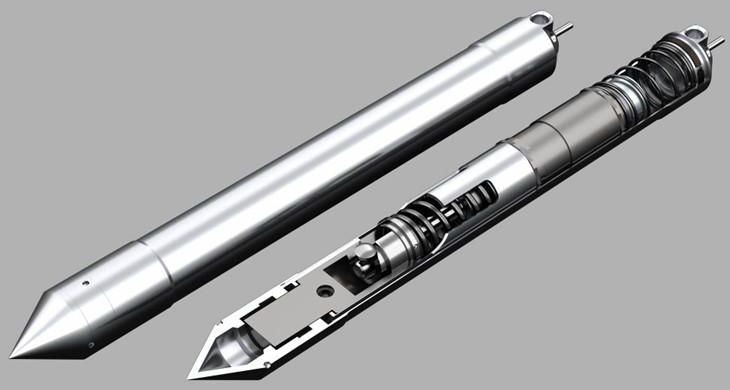
This is one of two surface experiments InSight placed on Mars, and comprises a base module and a long, slender self-propelled probe called the “mole”, designed to “burrow” its way down into the the sub-surface to a depth of up to 5 metres, towing a sensor-laden tether behind it designed to measure the heat flow from the planet’s interior. The mole has an internal hammering mechanism that is designed to drive it deeper into the ground, but this relies on friction against the material forming the walls of the hole it is creating – and this hasn’t been happening.

After a good initial start, the probe came to a halt with around 50% of its length embedded in the soil. At first it was thought it had hit solid bedrock preventing further motion; then it was thought that the mole was gaining insufficient traction from the hole walls, on account of the fine grain nature of the material it was trying to move through.

The HP3 “mole” showing the spring mechanism and “hammer” it drives into the ground. Credit: DLR

By mid-2019, engineers thought they had a solution: use the scoop at the end of the lander’s robot arm to compact the soil around the lip of hole in the hope of forcing sufficient material into the hole it would provide the traction the probe needed to drive itself forward. When this failed, the decision was made push the scoop directly against the side of the probe, pinning it between scoop and hole wall to again give the probe the traction it needed.

Initially, this approach worked, as I noted in Space Sunday: a mini-shuttle, Pluto’s far side & mole woes, but then the mole “bounced back”. Since then, the probe’s progress has been a case of “three steps forward, two steps back”, making some progress into the ground and then bouncing back – a source of much frustration among the science team.

After a year with the mole more-or-less “stalled”, mission engineers have decided to take more direct action. The decision has been made to try to “push” the probe using the robot arm’s scoop. This means placing the scoop on the top end of the mole – an approach that has so far been avoided out of concerns to might damage the sensor tether as it emerges from the same end of the probe. However, in manipulating the lander’s robot arm and its scoop over the course of a year, engineers are confident they can avoid harming the tether.

This latest effort to get the mole into the surface will take place in late February / early March. If it is successful, the team may revert to using the scoop to once again compress the sides of the probe’s hole to try to provide it with further traction as it continues to dig down into the subsurface material. Should the attempts fail, it’s unclear what might be tried to get the mole moving again; the mission team admitting they have “few alternatives” left to try.

How to Deflect an Asteroid

On April 13, 2029, an asteroid in the region of 370 metres in length and 45 metres across will pass by Earth at 30 km/s no further away from the planet’s surface than some of our geostationary satellites.

Called 99942 Apophis, an object I’ve written about in past Space Sunday articles, it is one of a large number of potentially hazardous objects – asteroids larger than 140 m in length that in crossing the Earth’s orbit as both they and the planet go around the Sun, pose a potential risk of one day colliding with us, with potentially devastating consequences. When it was   discovered in 2004, initial tracking of Apophis suggested it could collide with Earth in 2029. Further observations of the object showed this would not happen, not would it do so the next times it passes close to Earth in 2036, 2068 and 2082.

Extinction level event: a very large asteroid impact. Credit: Anselmo La Manna/YouTube screenshot

Which is not to say Apophis or 101955 Bennu, or one of the many other PHOs – Potentially Hazardous Objects – that are being tracked might one day strike Earth. The tipping point for such a collision comes down to such an object passing through, or close to, it’s gravitational keyhole. This is a tiny region of space – perhaps only 800 metres across – where gravitational influences – notably that of Earth – are sufficient to actual “pull” an objects course onto a collision with Earth.

Currently, plans to try to prevent such an impact revolve around identifying when an object has passed its particular keyhole, making an collision inevitable. There’s a reason for this: identifying where an objects keyhole might lie isn’t a precise science, and relies on scientists known an awful lot, including things like the size, mass, velocity and composition of these objects, what forces might be at work to influence their orbit, and so on. However, by leaving things until after an object has passed its keyhole means the time available to try to divert it is relatively short, perhaps months or just a couple of years or so, leaving very little time to plan and execute a mission to prevent any such collision.

Better then, to identify when an object is liable to pass close enough to its keyhole that it it will be drawn into a collision path. This would provide a far greater lead time for planning how to deal with it. This is exactly what a team of MIT researchers are suggesting in a part that also defines a framework for deciding which type of mission would be most successful in deflecting an incoming asteroid.

Continue reading “Space Sunday: moles, asteroids and a high speed planet”

Space Sunday: A pale blue dot, and more on Betelgeuse

A pale blue dot: Earth – the bright dot just right-of-centre – as seen from a distance of 6 billion km (40.5 AU). Credit: NASA / Kevin Gill et al

Thirty years ago, in February 1990, the Voyager 1 space craft had completed its primary mission and was about to shut down its imaging system. However, before it did so, and in response to lobbying from the late Carl Sagan, celebrated astronomer, teacher, broadcaster, writer, futurist and member of the Voyager programme’s imaging team, mission managers order the spacecraft to turn its imaging system back towards Earth to take a final photograph of its former home.

Captured on February 14th, 1990, the image revealed Earth as little more than a tiny blue pixel caught in a  streak of sunlight falling across the camera’s lens. Sagan immediately dubbed the image Pale Blue Dot, and it became his – and Voyager 1’s – Valentine’s Day gift to all of humanity; a last goodbye from the probe taken at a distance of 6 billion km (40.5 AU); 34 minutes later, its camera system was permanently powered down to conserve the vehicle’s power generation system.

From the moment it was published, the image became iconic: a representation of the sum total of humanity, something Sagan recognised at a time when the Cold War still dominated world politics.

Look again at that dot. That’s here. That’s home. That’s us. On it everyone you love, everyone you know, everyone you ever heard of, every human being who ever was, lived out their lives. The aggregate of our joy and suffering, thousands of confident religions, ideologies, and economic doctrines, every hunter and forager, every hero and coward, every creator and destroyer of civilisation, every king and peasant, every young couple in love, every mother and father, hopeful child, inventor and explorer, every teacher of morals, every corrupt politician, every ‘superstar,’ every ‘supreme leader,’ every saint and sinner in the history of our species lived there–on a mote of dust suspended in a sunbeam.

…It has been said that astronomy is a humbling and character-building experience. There is perhaps no better demonstration of the folly of human conceits than this distant image of our tiny world. To me, it underscores our responsibility to deal more kindly with one another, and to preserve and cherish the pale blue dot, the only home we’ve ever known.

– Carl Sagan, Pale Blue Dot, 1994

To mark the 30th anniversary of the original image, NASA issued a newly enhanced version of the image, carefully processed by a team led by software engineer and imagining specialist, Kevin M. Gill, seen at the top of this article. It once again reveals just how small and lonely our world really is. And while the Cold War has long since past, in this age of global warming and climate change, this new image of that tiny, pale blue dot and Sagan’s words remain as powerful a reminder of our fragile place in the Cosmos as they did more than two decades ago.

Betelgeuse: Extent of Dimming Revealed

I’ve previously written about the dimming of Betelgeuseas seen from Earth on a couple of occasions over the past few months (see: Space Sunday: a look at Betelgeuse (December 2019) and A farewell to Spitzer, capsules, stars and space planes (January 2020)). Now two images and a video have been released to show just how startling the apparent changes in the star have been over the course of a year.

As an irregular – and massive – variable star, Betelgeuse goes through cycles of dimming and brightening over time. However, what has occurred over the course of the past year is without precedent in the 125-year history of observations marking the star’s behaviour.

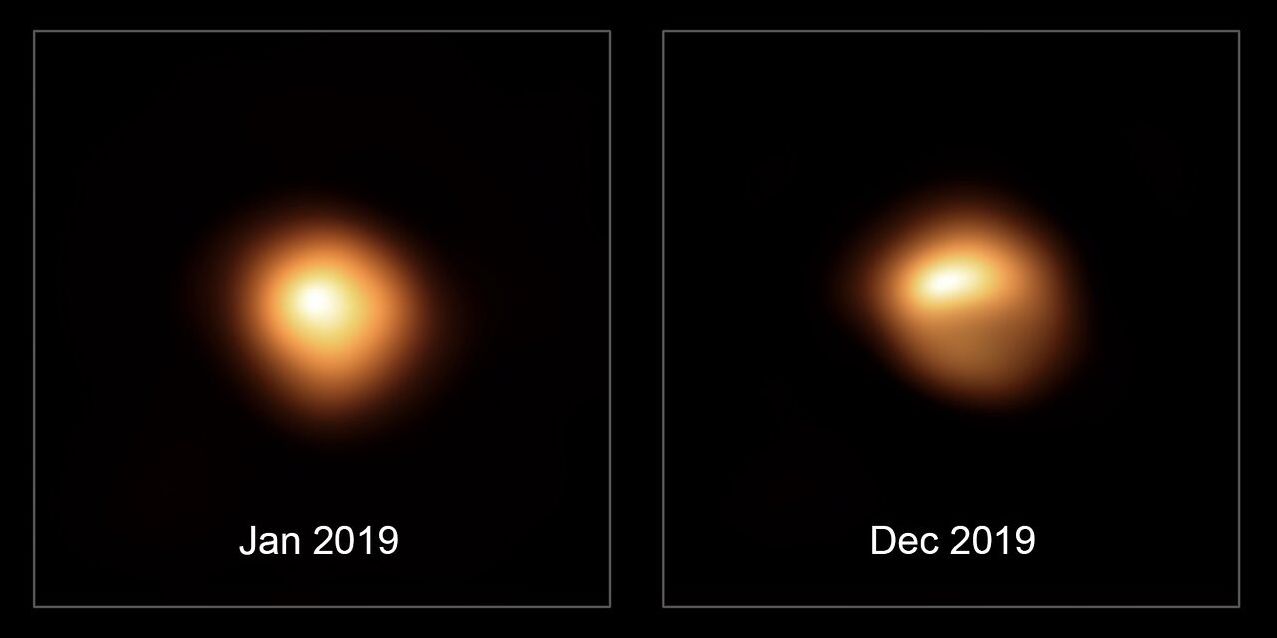
Overall, Betelgeuse’s apparently magnitude (brightness as seen from Earth) has fallen by a factor of 2.5 (or roughly 25-30%). This has prompted speculation that the star may have exploded into a supernova – its eventual fate – and we are currently seeing the light, which takes approximately 643 years to reach us, from the run-up to that cataclysmic event. While most astronomers do not believe this to be the case, the two images do present a stunning spectacle of a star in flux.

Side-by-side comparison of Betelgeuse’s dimming, as seen by the SPHERE instrument on ESO’s Very Large Telescope. Credit: ESO/M. Montargès et al.

The images were captured by the Spectro-Polarimetric High-contrast Exoplanet REsearch (SPHERE) instrument attached to the Very Large Telescope (VLT, currently the most advanced visible light telescope in the world) operated by the European Southern Observatory Captured in January and December 2019, they not only show just how much  Betelgeuse has dimmed in that time, but also how it seems to have changed its shape.

Again, such changes of shape aren’t unusual for a pulsating variable star like Betelgeuse. The surface of such a star tends to be made up of giant convective cells that move, shrink and swell. However, while these pulses – referred to as stellar activity – have likely been responsible for past changes in Betelgeuse’s shape observed from Earth, they have never been anywhere as extreme as those indicated by SPHERE – although it has been acknowledged that they could also be exaggerated by a cloud of dust ejected by the star long enough ago to have cooled, and is now partially obscuring our view of Betelgeuse.

Continue reading “Space Sunday: A pale blue dot, and more on Betelgeuse”

Space Sunday: solar studies and rocket tests

An artist’s impression of ESA Solar Orbiter over the Sun. Credit: ESA

At 04:03 UTC  on Monday, February 10th (23:03 EDT, USA), the European Space Agency’s Solar Orbiter is due to be launched atop a United Launch Alliance Atlas V from Cape Canaveral Air Force Station, Florida. Referred to as SolO, the mission is intended to perform detailed measurements of the inner heliosphere and nascent solar wind, and perform close observations of the polar regions of the Sun, which is difficult to do from Earth, in order to gain a much deeper understanding of the processes at work within and around the Sun that create the heliosphere and which give rise to space weather.

The launch will mark the start of a three 3-year journey that will use a fly-by of Earth and three of Venus to use their gravities to help shift the satellite into a polar orbit around the Sun. Once there, and at an average distance of some 41.6 million km, SolO will move at the same speed at which the Sun’s atmosphere rotates, allowing it to study specific regions of the solar atmosphere beyond the reach of NASA’s Parker Solar Probe and Earth observatories for long periods of time.

ESA’s Solar Orbiter, built by Airbus UK within its clean room assembly area. The large flat panel to the left is the craft’s Sun shield. Credit: ESA

Our understanding of space weather, its origin on the Sun, and its progression and threat to Earth, comes with critical gaps; the hope is by studying the the polar regions of the Sun’s heliosphere, scientists hope they can fill in some of these gaps. The outflow of this plasma interacts with the Earth’s magnetic field and can have a range of potential effects, including overloading transformers and causing power cuts, disrupting communications and can potentially damage satellites. Further, the disruption of the Earth’s magnetic fields can affect the ability of whales and some species of bird to navigate.

We don’t fully understand how space weather originates on the sun. In fact, events on the sun are very hard to predict right now, though they are observable after the fact. We can’t predict them with the accuracy that we really need. We hope that the connections that we’ll be making with Solar Orbiter will lay more of the groundwork needed to build a system that is able to predict space weather accurately.

– Jim Raines, an associate research scientist in climate and
space sciences engineering

Specific questions scientists hope SolO will help answer include:

  • How and where do the solar wind plasma and magnetic field originate in the corona?
  • How do solar transients drive heliospheric variability?
  • How do solar eruptions produce energetic particle radiation that fills the heliosphere?
  • How does the solar dynamo work and drive connections between the Sun and the heliosphere?

To do this, the satellite is equipped with a suite of 10 instruments, some of which will be used to track active solar regions that might explode into a coronal mass ejections (CMEs), a major driver of space weather. When a CME occurs, SolO will be able to track it and use other instruments to be able to break down the composition of the energetic outflow (and that of the outflowing solar wind in general).

Knowing the composition of this outflow should help determine where energy is being deposited and fed into the solar wind from eruptions on the Sun, and how particles are accelerated in the heliosphere – the bubble of space where the Sun is the dominant influence, protecting us from galactic cosmic radiation.

The Solar Orbiter mission. Credit: ESA

Combined with the work of the Parker Solar Probe, launched in August 2018 (see: Space Sunday: to touch the face of the Sun) and which gathers data from within the Sun’s corona, and observations from Earth-based observatories such as the Daniel K. Inouye Solar Telescope (DKIST), Solar Orbiter’s data should dramatically increase our understanding of the processes at work within and around the Sun.

Like the Parker Solar Probe, SolO will operate so close to the Sun it requires special protection – in this case a solar shield that will face temperatures averaging 5,000º C on one side, while keeping the vehicle and its equipment a cool 50º C less than a metre away on the other side. This shield is a complex “sandwich” starting with a Sun-facing series of titanium foil layers designed to reflect as much heat away from the craft as possible. Closest to the vehicle is a aluminium “radiator” that is designed to regulate the heat generated by the craft and its instruments. Between the two is a 25-cm gap containing a series of titanium “stars” connecting them into a single whole. This gap creates a heat convection flow, with the heat absorbed by the titanium layers venting through it, drawing the heat from the radiator with it, allowing Solar Orbiter to both expect excess solar heating and present itself from overheating.

SolO’s primary mission is due to last 7 years, and those wishing to see the launch can watch it livestreamed across a number of platforms, including You Tube.

Continue reading “Space Sunday: solar studies and rocket tests”