Space Sunday: Tenacity, Betelgeuse and a short round-up

The first Dream Chaser Cargo, set to fly in 2021, now has a name – Tenacity. Credit: SNC Inc

Dream Chaser Cargo is an uncrewed version of Sierra Nevada Corporation’s (SNC) Dream Chaser space plane, and it is drawing closer to commencing operations ferrying supplies and experiments to and from the International Space Station (ISS), with operations due to start in mid-to-late 2021.

The world’s only non-capsule private orbital spacecraft, Dream Chaser Cargo is designed to be launched atop a United Launch Alliance Atlas V booster, and land like a conventional aircraft. Once operational, it will be capable of lifting some 900 kg of material within its cargo space, and a further 4,500 kg in a detachable and disposable module called Shooting Star that attaches to the rear of the space plane and includes a docking system for linking to the ISS, as well as supplying electrical power to the Dream Chaser.

SNC’s uncrewed Dream Chaser Cargo, the Shooting Star module bearing the external cargo “box” for unpressurised loads. Credit: SNC Inc

Shooting Star can carry cargo both inside it, and in an external unpressurised unit. In addition, it can be used to hold some 3,500 kg of waste from the ISS, the module being jettisoned to burn-up in Earth’s atmosphere prior to Dream Chaser Cargo (which can also carry experiments back to Earth) making an atmospheric re-entry towards the end of a mission.

Now the first Dream Chaser vehicle has its wings and a name: Tenacity. The wings were delivered to SNC’s fabrication facility in spring 2020, and with work now cautiously resuming, the wings  – sans­ their outer skins – will be mounted on the vehicle’s air frame. During flight, the wings are folded against the fuselage so they can be contained within the payload fairings that protect the vehicle and its module during launch. After the fairings are jettisoned, the wings swing into their “flight” position so they can give Dream Chaser Cargo aerodynamic lift once back in Earth’s atmosphere.

Capable of fully automated flight, Dream Chaser Cargo has a significant advantage over the other ISS resupply vehicles capable of returning material to Earth – Dragon and Progress – in that it uses relatively “safe” fuels. This means ground crews can access the vehicle without having to wait for extensive safety checks to be completed, allowing delicate or time-sensitive cargo to be removed from the vehicle more quickly.

Betelgeuse’s Dimming: Explained But Still Mysterious

The orange giant Betelgeuse caused excitement in late 2019 / early 2020 when it went through a period of unprecedented dimming, even for a star as variable as it can at times be, its apparent magnitude (brightness as seen from Earth) reducing by a factor of 2.5 (or roughly 25-30%).

Side-by-side comparison of Betelgeuse’s dimming, as seen by the SPHERE instrument on ESO’s Very Large Telescope. Credit: ESO/M. Montargès et al.

At the time, the dimming sparked speculation the star may have gone supernova, and we might be about to see the light of that event – it having taken some 700 years to reach us. Most astronomers doubted this was the case, and were confident the star would return to its more natural brightness, as indeed it did 2020 (see: Space Sunday: an exoplanet, a star and an asteroid).

Now, examinations of observations made by the Hubble Space Telescope (HST) in late 2019 suggest the star’s dimming was most likely caused by the ejection and cooling of dense hot gases. What’s more, additional observations suggest Betelgeuse may be going through another dimming period out-of sync with its usual cycles.

Between October and November 2019, HST observed dense, heated material moving outward through Betelgeuse’s extended atmosphere at 320,000 km/h, and it was following these observations that the more dramatic dimming of the star was seen from Earth, notably around the star’s southern hemisphere. It’s now believed that jet stream of hot gas reached a point millions of kilometres from the star and rapidly cooled to form a cloud of dust between the star and Earth-based observers, giving rise to the star’s apparent dimming.

An artistic rendering of the outflow of plasma from Betelgeuse cooling into a cloud of dust that contributed to the star’s dimming. Credit: NASA, ESA, and E. Wheatley (STScI)

However, study of the HST data revealed something surprising: the stream of ejected gas did not originate at the star’s rotational poles, as current stellar models would suggest. Rather, the Hubble data indicates that Betelgeuse can drive off material from any part of its surface. The data also revealed that during the event, the star lost a considerable amount of mass – around twice the “normal” amount it loses in a given period, just from its southern hemisphere. This in itself makes what happened to Betelgeuse unique: nothing like it has been previously seen in 150 years of observations.

Whether or not this means we’re seeing a new stage in Betelgeuse’s life cycle is unclear, but the mystery doesn’t end there. This is because data gathered by NASA’s Sun-orbiting Solar TErrestrial RElations (STEREO) satellite appear to suggest the star is again dimming, and outside of its more cycles. Until now, Betelgeuse has had two cycles of dimming and brightening. The first runs for around 25 years, the other runs through 425 days. Both coincided during the 2019/2020 dimming, contributing it. Thus for the star to be dimming now puts it well inside the 425 day cycle. Exactly what all this means isn’t exactly clear, but it has sparked considerable interest and observers will continue to monitor it through the rest of the year.

Quick Round-up

The last week saw the 2020 Perseids meteor shower reached its peak as the Earth passes through debris left by the comet Swift-Tuttle. As is usual, the event resulted in many outstanding photos, including the one below.

August 11th/12th: a Perseid meteor streaks toward the bright planet Jupiter (to the right of the windmill) and its dimmer companion Saturn (to the left) in the countryside near Las Vegas. Credit: Tyler Leavitt

SpaceX

The next flight of the SpaceX Crew Dragon vehicle has been announced. Crew-1, the first “operational” flight will now targeted for October 23rd, 2020, when it well carry NASA astronauts Shannon Walker, Victor Oliver and Mike Hopkins, together with JAXA astronaut Soichi Noguchi as the nucleus of the Expedition 64 crew.

Originally scheduled for a late September / early October launch, the mission has been pushed back to allow additional time for the Russian Soyuz MS-17 mission to launch and rendezvous with the ISS.

The astronauts who will fly the NASA / SpaceX Crew-1 mission on or after October 23rd: NASA astronauts Shannon Walker, mission specialist; Victor Oliver, pilot; and Mike Hopkins, Crew Dragon commander; and JAXA astronaut Soichi Noguchi
After its 150m “hop”, Starship prototype SN5 has been rolled back for inspection and re-fit – possibly with the lengthened landing legs I mentioned in me previous space Sunday update. In the meantime, it appears that the next vehicle to make a test flight will be Starship prototype SN6. A further prototype, dubbed SN7.1, and comprising just a single fuel tank that uses new alloy end caps, is being prepared for a deliberate over-pressurisation test. This test vehicle has been dubbed SN7.1 in recognition of the SN7 tank section that was also tested to destruction earlier in the year.

However, most attention has turned towards prototype SN8, as it has been confirmed this will be the first of the prototype to be fitted with the upper section, nose cone and aerodynamic “wing” surfaces, and so will likely be used for the 20-km flight tests.

The Starship SN8 prototype elements: within the mid-bay building, the upper section and nose cone; arrowed the forward aerodynamic canards. Credit: RGV Aerial

NASA

Whilst still 7 months from Mars, NASA’s Ingenuity helicopter drone, a part of the Mars 2020 mission and stowed under the Perseverance rover, had its batteries charged up to 35% capacity on August 7th, one week after launch. The 8 hour trickle-charge operation marked the first time the helicopter’s batteries have been charged in the space environment, allowing the vehicle to be powered-up.

The action was taken so that mission managers could check-out the drone’s electrical systems following launch and allow it to report on its overall status. The battery level will be maintained at the 35% charge level throughout the cruise phase, with routine re-charges, in order to allow the helicopter’s electronics to be warmed by a regular flow of electrical power.

Transiting Exoplanet Survey Satellite (TESS) – due to hunt for exoplanets potentially orbiting hundreds of thousands of stars around us. Credit: NASA’s Goddard Space Flight Center/CI Lab

On July 4, NASA’s Transiting Exoplanet Survey Satellite (TESS) finished its primary mission, imaging about 75% of the starry sky as part of a two-year-long survey. In capturing this giant mosaic, TESS has found 66 new exoplanets, or worlds beyond our solar system, as well as nearly 2,100 candidates astronomers are working to confirm.

During the first year of operations, TESS observed the southern sky, while in the second year, it turned its attention to the northern skies.  Allowing the way, the mission team has been able to introduce numerous improvements. Among other things, these now allow the satellite to capture a high-resolution image of the stars around us once every 10 minutes, three times faster than at the start of the mission, while it can now measure the comparative brightness of thousands of stares every 20 seconds, rather than every two minutes. These latter captures will more readily reveal changes in brightness that might be the result of a star “wobbling” in its spin due to the presence of planetary bodies (although TESS’s primary means of locating possible exoplanets is via the transit method) or the results of outbursts like coronal mass ejections (CMEs).

With the completion of its primary mission, TESS is into an extended mission, the first phase of which will run through until September 2020.

Virgin Galactic’s Supersonic Ambitions

As if flying tourists into space wasn’t enough, Virgin Galactic has announced it has entered into an agreement with Rolls Royce to build a new supersonic airliner aimed at the “premium” flight market.

The new aircraft – as yet unnamed – will, the company claim, fly some 50% faster than the Anglo-French Concorde, with a cruising speed of Mach 3 – allowing a crossing of the Atlantic in around 2 hours. If realised, the aircraft will cruise at an altitude of 18 km (60,000 ft) and will be capable of carrying up to 19 passengers.

An artist’s impression of the Virgin Galactic Mach 3 airliner. Credit: Virgin Galactic / Rolls Royce

Yes, that’s right. 19. The aircraft is intended to capture a modest percentage of the premium (business and first class) air travel market, with Virgin Galactic CEO Sir Richard Branson stating the company only need to capture 5% of that market to turn a profit. Currently, the aircraft has completed a “mission concept” review study involving Virgin Galactic, Rolls Royce (building of the engines that powered Concorde), aviation experts and NASA.

No details on when the aircraft might fly have been given, with the craft’s overall shape, size, dimensions, etc., yet to move out of conceptual drawings.

Space Sunday: Hops, glows, plans and Perseids

SpaceX SN5 rises from its launch stand at the SpaceX Boca Chica, Texas, centre. Credit: SpaceX

SpaceX once again heads this week’s column after the Starship SN5 prototype became the first of the units to successfully make a “hop” into the air and back again, travelling some 150 metres up and several tens of metres sideways to navigate its way from launch platform to landing pad.

The flight of the “flying spray can” – the nickname derived from the vehicle’s cylindrical form topped by the nozzle-like 23 tonne ballast mass – only lasted around a minute once the Raptor engine fired, but the hop represented a huge leap forward for SpaceX in their development of the Starship vehicle.

As I noted in July, SN5’s unusual shape is due to it only comprising the section of the vehicle containing its fuel tanks, single raptor engine and landing legs. It lacks any upper sections (replacing by the ballast block) and the aerodynamic surfaces that will give Starship a lifting body capability during atmospheric operations. These will all be present in future prototypes, But for SN5, they are not currently required, as its initial flight(s) are purely about testing Starship’s ability to make a vertical descent and landing.

A starship cutaway showing the fuel tanks and engine bay (outlined in red) that form the prototype vehicle SN5, and the upper cargo / habitation space and aerodynamic surfaces that are not included on the current prototype. Credit: WAI (with additional annotation)

The successful test flight took place on Tuesday, August 4th – an attempt on Sunday, August 2nd was cancelled  due to unfavourable weather in the Boca Chica, Texas, area. Engine ignition came at 23:57 UTC (18:57 local time), the prototype rising vertically, but canted at a slight angle. This  was due to the initial prototypes being designed to operate with three Raptor motors, by SN5 is currently only fitting with one, offset from the vehicle’s vertical centreline, so the vehicle is canted (with the ad of the top ballast block) to compensate for the offset thrust from the motor, with small reaction control system (RCS) jets near the base and top of the vehicle occasionally firing to help maintain a stable flight angle.

As the craft rose, the Raptor motor was also gimballed (moved around like you move a joystick on a game controller, a common practice for rocket motors to allow them to use directed thrust to adjust a flight trajectory), vectoring its thrust so it could translate across to the landing pad for a successful landing.

Prototype nose cones being fabricated at Boca Chica. Credit: NASASpaceflight.com / BocaChicaGal

SpaceX released a video afterwards the flight showing the highlights. In it, SN5 can be seen lifting off, trailing a plume of vented cooling gas, the RCS jets visible as they fire to help maintain stability. The footage also clearly shows the Raptor’s offset exhaust plume moving as the motor in vectored, as well as the craft maintaining a brief hover at the apex of its flight before descending sideways and down towards the landing pad.

Cameras at the base of the vehicle show the landing legs being deployed, as well as a small, non-hazardous fire on the Raptor motor, likely the result of dust blown into the engine space at lift-off that subsequently ignited. This “inside” camera and one on the SN5 hull then captured the moment of landing and engine shut down.

Prototypes SN6, 7, and 8 are in development, and some of these will fly with the aforementioned forward / upper sections and flight surfaces in loftier (literally) and more complex flight tests. Currently, it not clear how many more flights SN5 will make. However, Musk has already indicated he would like to have Starship use a more “Falcon Like” set of landing legs to provide broader support when landing on uneven planetary surfaces, so SN5 might by used to test new landing leg configurations alongside testing of other prototypes.

Continue reading “Space Sunday: Hops, glows, plans and Perseids”

Space Sunday: Perseverance departs, Endeavour returns

The moment of ignition as the Atlas V booster lifts-off from SLC-41 at Canaveral Air Force Station, Florida, Thursday, July 30th, 20020. Credit: NASA TV

At precisely 11:50 UTC (7:50am EDT) an Atlas 5 rocket thundered into near-perfect skies over Cape Canaveral Air Force Station in Florida, carrying aloft NASA’s Mars 2020 on the first stage of its 7-month trip to the red planet.

The launch marked the last of the “big three” missions to launch during the 2020 opportunity, following on the heels of China’s Tianwen-1 orbiter / lander / rover mission and the UAE’s Hope orbiter mission. Carrying the Perseverance rover and Ingenuity helicopter drone, Mars 2020 is the most scientifically complex of the three missions, and potentially set to be the longest running of all three: providing it doesn’t fall foul of any major issues, Perseverance (Or “Percy” as some have dubbed it) could be operational on Mars for 12-14 years, thanks to its nuclear power supply.

A pictorial history of NASA’s successful Mars missions from Mariner to MSL / Curiosity, together with Mars 2020 and the proposed sample return and orbital ice mapper missions. Credit: NASA

In the days leading up to departure, there had been concerns the attempt might have to be postponed thanks to the approaching Tropical Storm Isaias, but on the morning of the launch, conditions couldn’t have been better. There was, however, some pre-launch excitement on the other side of the United States, where the Jet Propulsion Laboratory in (JPL) – mission control for the mission once en route to Mars, was lightly shaken by a local 2.9 magnitude earthquake just 30 minutes prior to lift-off.

Just under 2 minutes after launch, the Atlas V dispatched its four strap-on boosters, allowing the core stage to continue towrds low earth orbit. Less then 2 minutes later, with the vehicle at an altitude of 392 km, the payload fairings were jettisoned, exposing the payload to space. The Centaur upper stage then commenced its “chill down” phase, readying its motor for operation once the Atlas core stage had detached.

BECO and separation: a camera mounted on the Centaur upper stage captures the Atlas V core stage as it falls away following separation and ignition of the EL-10 engine. Credit: NASA TV

BECO – Booster Engine Cut-Off – came 4 minutes and 20 seconds after launch, the core stage separating to allow the Centaur commence its work with and initial engine burn to further raise the vehicle’s orbit around Earth before the RL-10 motor was shut down and the reaction control system (RCS) was fired a number of times to set the stage and the payload rotating along their longitudinal axis, a move designed to ensure the payload would be spin-stabilised during its cruise to Mars.

This part of the journey started some 90 minutes after launch, on the “night” side of Earth relative to JPL. As this point, the RL-10 re-ignited, pushing the Centaur and its payload into a Trans-Mars Injection (TMI) orbit around the Sun before the two separated. As there was no “live” video of the separation, mission managers had to wait for NASA’s Tracking and Data Relay Satellites (TDRS) and Deep Space Network (DSN) on the ground to acquire a direct signal from the payload and its cruise “bus” to confirm they were safely on their way.

The Mars 2020 rover Perseverance. Credit: NASA

This TMI engine burn ensured Mars 2020 would cross the orbit of Mars, but it would do so before the planet reached the same point in space. This was because had both been on a course to intercept Mars, the Centaur booster would crash into the planet, potentially contaminating it. Instead, Mars 2020 will make two mid-course engine burns from the motors on its cruise “bus”, shifting its trajectory onto that will intercept the planet, leaving the Centaur to fly harmless by.

As well as searching for signs of ancient microbial life and advancing NASA’s quest to explore the past habitability, Mars 2020 will also form the first half of a sample return mission – as I’ve previously noted, it is equipped to leave up to 23 sealed sample containers on the surface of the planet, at least one of which may be retrieved by a future NASA/ ESA sample return mission, although such a mission has yet to be formally approved by either agency. In addition, Perseverance carries with it experiments geared towards learning more in preparation for the future human exploration of Mars.

Mars 2020 is heading for the 49km diameter Jezero Crater on the edge of Isidis Basin in the Martian Hemisphere. The crater has evidence for it once being a wet environment, including a broad inflow delta where water once flowed into the crater from the Syrtis Major uplands that is the landing site for Mars 2020. Credit: NASA

The first of these forms a part of the SHERLOC (Scanning Habitable Environments with Raman & Luminescence for Organics & Chemicals) instrumentation. Primarily designed to seek organic compounds on Mars, SHERLOC also contains five small pieces of material that might be potentially used in the outer layers of a future Marts spacesuit. These will be monitored to see how well they deal with possible corrosion by Martian dust and atmosphere under the effects of solar radiation. As a part of its duties, the Mars Environmental Dynamics Analyser (MEDA) will also study the nature of Martian dust so engineers can make better decisions about materials to be used in spacesuits and surface equipment.

Then there is MOXIE – the Mars Oxygen ISRU Experiment – designed to produce oxygen out of the carbon dioxide that makes up 96% of the Martian atmosphere.

Mars Direct (1996): proposed using 6 tonnes of hydrogen carried to Mars by an uncrewed Earth Return Vehicle (ERV) to generate 112 tonnes of oxygen and methane using the 19th century Sabatier reaction. These could then be used propel the ERV (and crew) back to Earth at the end of a mission, while the generate could continue to produce oxygen and methane during the crew’s 700-day stay on Mars after they have arrived 2 years after the ERV. Credit: Orange Dot Productions / Mars Society UK

The idea has its roots in the 1996 Mars Direct mission profile developed by Robert Zubrin and David Baker. They recognised that the biggest encumbrance to a mission to Mars was the amount of fuel required to both get a crew to Mars and then bring them back to Earth. To reduce this, they proposed using the Martian atmosphere to produce both oxygen and methane that could be used to fuel the vehicle a crew would use to return to Earth – massively reducing the mass of a mission. The same technique could also be used to provide a human crew with additional oxygen supplies and fuel for surface vehicles once they get to Mars.

MOXIE is a more modest idea, designed to produce just oxygen from the Martian atmosphere. It’s a proof-of-concept designed to produce 22g of oxygen (O2) per hour with >99.6% purity continuously for around 1230 hours. If successful, it could pave the way for a much large nuclear-powered unit to be delivered to Mars that could be used to produce a large volume of stored oxygen that could be used to produce the atmosphere for a human outpost on Mars and as the oxidiser for powering Earth return vehicles. As with the Mars Direct proposal, the system could be extended to also produce Methane fuel.

The MOXIE experiment aboard Perseverance aims to produce oxygen from the Martian atmosphere. Credit: NASA

Mars 2020 is now en route to Mars in the “cruise” phase of the mission, during which it will study interplanetary space. The next tense moment for the mission comes on February 18th, 2021, when the craft arrive at Mars, and Perseverance and Ingenuity enter the “seven minutes of terror” of the Entry, Descent and Landing (EDL) phase, which should culminate in both being safely delivered to Jezero Crater on the surface of Mars.

A Dragon Comes Home

Sunday, August 2nd, 2020 saw the Crew Dragon Demo-2 mission make its return to Earth. Launched to the International Space Station (ISS) on May 30th, 2020 (see: Space Sunday: how to fly your Dragon) carrying NASA astronauts Bob Behnken and Doug Hurley, the mission was intended to confirm the SpaceX crew dragon vehicle is ready to commence regular crew-carrying flights too and from the space station.

Since then, the vehicle has been docked at the ISS, allowing Hurley and Behnken work as a part of the Expedition 63 crew rotation. In particular, Behnken carried out four EVA space walks alongside of Expedition 63 commander Chris Cassidy, marking them as the third and forth US astronauts after Michael Lopez-Alegria and Peggy Whitson to have completed 10 EVAs during their careers.

Saturday, august 1st, 2020: Crew Dragon Demo-2 backs away from the ISS at the start of a 19-hour journey home. With the nose cap open, the forward docking hatch is visible, with the four black dots of the Draco motors that would later perform the critical de-orbit burn visible around it. Credit: NASA TV

Undocking came at 23:35 UTC (19:35 EDT) on  August 1st, 2020, 19 hours ahead of the planned splashdown, although concerns about Tropical Storm Isaias initially meant that the undocking might have been delayed to avoid rough weather and seas in the Gulf of Mexico south of Pensacola, Florida.

Following departure from the ISS the Dragon vehicle, comprising the capsule Endeavour and its service module (called the “trunk” by SpaceX) that provides long-duration power, life support and primary propulsion, raised itself up and over the ISS to allow it to “drop behind” the space station in their relative orbits prior to dropping down into a lower orbit. This formed the first of several flight manoeuvres that placed the vehicle in the correct orbit before the crew took a meal and had a sleep period.

Endeavour’s main parachutes open as it makes its return to Earth on August, 2nd, 2020. Credit: SpaceX

Final preparations for the re-entry and splashdown commenced just shy of an hour before the vehicle started its descent into Earth’s atmosphere on August 2nd, with the unclamping of the “claw” mating capsule to trunk and relaying power, fluids and atmosphere from one to the other, allowing the capsule to separate from the trunk, which was left to burn-up in the upper atmosphere. Flying free, the capsule then flipped itself over to point its nose in the direction of flight once more. This facilitated the opening of the nose cap to expose the four forward-facing Draco engines.

The latter were then used in a 11-minute de-orbit burn that placed the vehicle on a path of descent into the denser layers of the Earth’s atmosphere. Immediately following this, and still under automated control, Endeavour re-oriented itself to put its heat shield pointing into the direction of travel as the nose cone cover closed and latched. This started a 20-minute descent phase through the upper atmosphere unless Endeavour reached a point where plasma generated by the increasing friction against the atmosphere reached a maximum, blacking out all communications for a 6-minute period.

The moment of Splashdown. “Thank you for flying SpaceX!”. Credit: SpaceX

By the time the blackout ended, Endeavour had reduced its velocity from some 28,000 km/h to just 640 km/h, slowing the capsule to a point where its two drogue chutes could be deployed, stabilising the vehicle in its descent and allowing the four main ‘chutes to be deployed. These slowed the capsule during its final couple of kilometres of descent to just 25.6 km/h, allowing it to splash down precisely on target off the coast of Pensacola.

SpaceX recovery teams using fast motor boats were quickly on the scene and proceeded to carry out checks on the vehicle and the air around it to ensure it was not venting toxic gases while others chased down a recovered the main and drogue parachutes. Check-out operations on the capsule, which is designed to float upright on the water, was somewhat impeded by idiots trying to get close to it in their own power boats, but the support crew were able to rig Endeavour with a recovery harness as the main recovery ship, the Go Navigator, approached in readiness to lift the capsule aboard.

Hoisting the Endeavour aboard Go Navigator as the fast support boats keep onlookers in their own boats at bay. Credit: SpaceX

This was achieved using the a-frame hoist at the stern of the ship, which lifted Endeavour out of the water and onto a special “nest”, a platform that could move the capsule to the crew egress area, an operation completed less than 30 minutes after splashdown.  – in less than 30 minutes after splashdown. Opening the vehicle’s hatch, however was delayed as a result of small traces of potentially toxic Nitrogen Tetroxide fuel vapours from the engine burns remaining in the service space of the capsule where things like the propellant tanks, etc., reside. To avoid risk, this area needed to be purged before the astronauts could exit the vehicle.

This meant it was a further 30 minutes after splashdown that Bob Behnken, the mission pilot,  and mission commander Doug Hurley could be lifted from the the capsule and transferred to the ship’s medical area, where NASA flight surgeons carried out a post-flight medical. After this, both men were given time to adjust back to Earth’s gravity, take a show, get into more relaxed clothing than their pressure suits. They then transferred to a helicopter that rendezvoused with Go Navigator to fly them to Pensacola Naval Air Station and onward transfer to Ellington Field Joint Reserve base and the Johnson Space Flight Centre to be reunited with their families.

NASA astronaut Bob Behnken gives a thumbs-up to the video camera after being helped out of Endeavour. Credit: SpaceX

Endeavour, meanwhile, will be taken back to SpaceX facilities where it will be refurbished and  prepared for the second operational Crew Dragon flight, following NASA’s change of mind and allow SpaceX to re-use their capsules for multiple crewed flights to the ISS. In the meantime, the first operational flight of Crew Dragon is set to fly NASA astronauts Shannon Walker, Michael Hopkins and Victor Glover, together with Japanese astronaut Soichi Noguchi to the ISS in September 2020.

Space Sunday: supergiants on camera and more to Mars

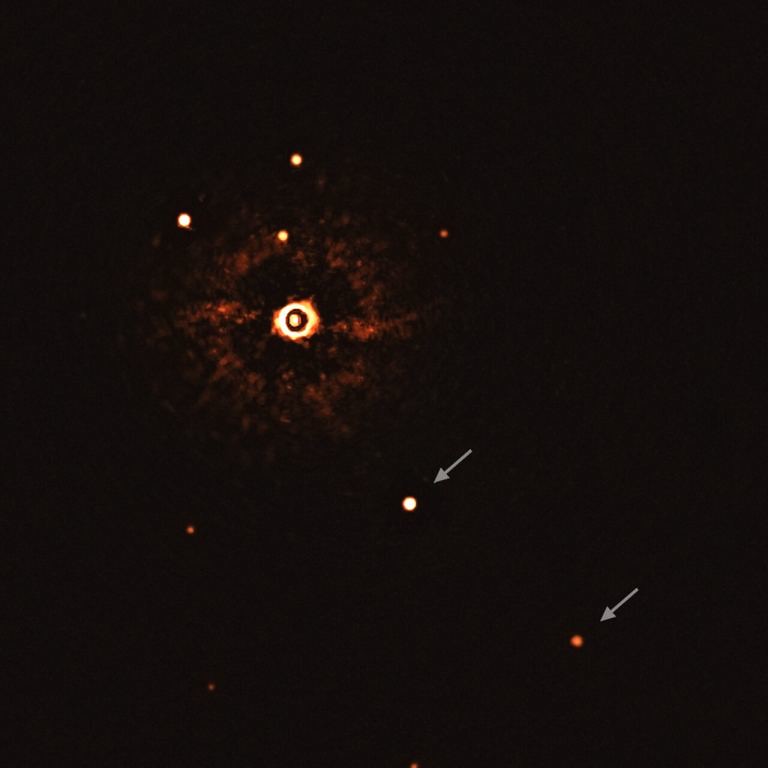
Are they stars? No, they’re a pair of exoplanets 310 light years away. Credit: ESO/Bohn et al, 2020

The above picture may not look that spectacular, just a couple of stars against the backdrop of space – exception the two disks it shows are not stars, they are planets – exoplanets, in fact, orbiting a star 310 light years away. As such, it is the first visible light photograph of multiple planets orbiting a Sun-like star taken from Earth.

Called TYC 8998-760-1, the star in question is of the G2V spectral class, and the closest Sun-like star to the solar system. However, whereas the Sun is some 4.6 billion years old, TYC 8998-760-1 is a mere stripling – just 17 million years old. It lies within the southern hemisphere constellation of Musca – a constellation which though small, contains a number of notable stars including Alpha, Beta, Gamma and Zeta Muscae, part of a group of hot blue-white stars that seem to share a common point of origin and motion within the galaxy, HD 100546, a blue-white Herbig Ae/Be star that is surrounded by a complex debris disk containing a large planet or brown dwarf and possible protoplanet, and  Theta Muscae, a triple star system, the brightest member of which is a Wolf–Rayet star.

The image was taken by the European Southern Observatory’s (ESO) Very Large Telescope (VLT) using the Spectro-Polarimetric High-contrast Exoplanet REsearch instrument (SPHERE). This instrument utilises a coronagraph to block out much of the light from a star, allowing the light reflected by any planetary bodies to be visible.

TYC 8998-760-1 is an interesting planetary system for a number of reasons. Given the relative youth of the parent star, it might be said that the system represents a glimpse of the early formation of the solar system. However, it is on a scale far vaster than our own. Both of the planets are gas supergiants, the innermost, called TYC 8998-760-1 b, being some 14 times the mass of Jupiter, whilst the outermost, TYC 8998-760-1 c, is around 6 times Jupiter’s mass. Both also orbit their parent at incredible distances in comparison to the planets of our own system:  TYC 8998-760-1 b averages 162 AU (1 AU being the average distance the Earth is from the Sun), and TYC 8998-760-1 c averages some 320 AU. By comparison, Neptune, the most distant of our major planets, averages a “mere” 30 AU from the Sun.

The complete image captured by the SPHERE instrument on ESO’s Very Large Telescope, showing the star TYC 8998-760-1 above centre, left, with three additional stars above it and its two supergiant planets below (arrowed). This image marks the first time astronomers have directly observed more than one planet orbiting a star similar to the Sun. Image Credit: ESO/Bohn et al, 2020.

These vast distances make both planets curiosities: exoplanets that are large and orbiting far from their host stars are very difficult to fit into the protoplanetary and accretion disk model(s ) that are generally used to explain planetary formation. Further, both planets appear to occupy relatively stable, circular orbits. Astronomers believe this could indicate that the two planets formed more-or-less where they are now and their near-circular orbits may indicate the presence of a still-to-be discovered third large body orbiting even further from the star (and TYC 8998-760-1 c was unknown prior to SPHERE capturing it) – or that their orbits might indicate their are the result of very specific ejections from an unseen stellar companion to  TYC 8998-760-1.

Further study is required to determine exactly how the planets may have formed, but their presence does raise the questions on whether smaller, rocky planets might orbit closer to the star – possibly within its habitable zone. As it is, SPHERE’s ability to gather data on planets has yielded a lot of information on the two gas giants that will keep astronomers busy. And while this is only the third image of exoplanets currently on record, with the upcoming generation of high-powered Earth and space-based telescopes, that number will increase over the coming decades.

Heavenly Questions En-route to Mars

The Long March 5 carrying China’s Tianwen-1 mission to Mars lifts-off on July 23rd. Credit: CCTV / China National Space Agency

In my previous Space Sunday update I covered the launch of the UAE’s Hope mission to Mars, launched as that article was being written, and the (then) forthcoming launch of China’s ambitious Tianwen-1 (“Quest for Heavenly Truth” or “Questions for Heaven”) orbiter / lander / rover mission.

At that time, it wasn’t clear just when China’s mission would lift-off, but going on past launches of the Long March 5 booster that would be hefting the mission away from Earth have generally been within 6 days of the rocket being delivered to the launch pad, speculation was that the Tianwen-1 launch would come in he week of July 20th through 24th, given its launcher arrived on the pad on July 17th.

A view of the Long March 5 booster ascending to orbit, showing the dual exhaust configuration of its first stage boosters. Credit: CCTV / China National Space Agency

Those speculations proved to be correct, because Long March 5 launch Y4 took to the skies from the Wenchang Satellite Launch Centre on Hainan Island in the South China Sea, at 04:41 UTC on the Morning of July 23rd (11:41 local time).

Continue reading “Space Sunday: supergiants on camera and more to Mars”

Space Sunday: a Martian Hope and Heavenly Questions

An artist’s impression of the UAESA Hope satellite in orbit around Mars. Credit: Mohammed bin Rashid Space Centre

late July and early August mark the period of the 2020 Mars opposition launch window, once again offering opportunities to send missions to the Red Planet. This period occurs once every 26 months, when the orbits of Earth and Mars are both on the same side of the Sun (so Mars and the Sun are on “opposite sides” of Earth, hence the name “opposition”) and positioned relative to one another (with Earth “catching up” with Mars as they both move around the Sun) such that the flight time from Earth to Mars is at its shortest – around 6-7 months.

Because of this, these periods tend to be fairly busy, and 2020 is particularly so, with three missions heading for Mars. The most prominent of this missions in terms of publicity is NASA’s Mars 2020 Perseverance rover, scheduled for a July 30th 2020 launch. The second is China’s ground-breaking orbiter / lander / rover mission (of which more below), whilst the third  – and first to launch – is possibly the most overlooked of the three: the Hope, or Al-Amal, orbiter mission developed by the United Arab Emirates.

Hope under assembly at the Mohammed bin Rashid Space Centre (MBRSC). Credit: MBRSC

Hope is a remarkable mission for the UAE; the mission was announced in 2014, literally as the country formed its fledgling space agency, employing just 75 people – a number that has since grown to 150. At that time the UAE had developed and flown – in partnership with other nations – a total of 5 communications satellites and two Earth observation platforms, so the idea for the country’s new space agency setting its sights on Mars was seen as incredibly ambitious.

However, over the course of the last six years the United Arab Emirates Space Agency (UAESA) has worked steadily on the the project, and has drawn on space development expertise in France, Japan, the UK and USA both for its own development and for the Hope spacecraft, moving the project forward and at minimum cost – just US $200 million.

The Mohammed bin Rashid Space Centre, Dubai, UAE, headquarters for the Hope mission and the UAE’s space efforts, on the night of the Hope mission launch. Credit: UAE television

Roughly cubic in shape, Hope measures 2.37m wide and 2.90m in length and has a mass of just under 1.4 tonnes (including its propellant fuel load). Solar-powered, it is billed as the “first true weather satellite for Mars” and is intended to develop a complete picture of the Martian atmosphere.

To do this, the satellite has a primary mission period of a full Martian year (approx. two terrestrial years), with the option for mission extensions through to 2025. During this time, the spacecraft will study the Martian climate and weather on a daily basis from a 55-hour equatorial orbit around the planet that will vary between 20,000 and 43,000 km from the planet’s surface. This high orbit will afford it the best view of weather patterns in both the northern and southern hemispheres, and observe how weather patterns interact along the equatorial regions of the planet. In particular, Hope will be able to study seasonal weather  / climate cycles and record weather events in the lower atmosphere such as dust storms, and the weather at different geographic areas of Mars.

To achieve this, the mission carries a relatively modest number of science packages compared to other missions, comprising:

  • The Emirates eXploration Imager (EXI): developed with assistance from two US research facilities, this is a multi-band camera capable of taking high resolution images with a spatial resolution of better than 8 km. Equipped with a set of 6 filters, it can image in both RGB colour wavelengths and in the ultraviolet bands, and measure properties such as water, ice, dust, aerosols and abundance of ozone in the Martian atmosphere.
  • Emirates Mars Infra-red Spectrometer: developed with the assistance of the Arizona State University, this is an interferometric thermal infra-red spectrometer. It is designed to examine temperature profiles in the Martian atmosphere and record ice, water vapour and dust in the lower to mid-level of the atmosphere.
  • Emirates Mars Ultraviolet Spectrometer (EMUS): is a far-ultraviolet imaging spectrograph for measuring global characteristics and variability of the Martian thermosphere.

As well as carrying out a genuine science mission that will produce data that will be of significant use for future missions up to and including eventually sending human to Mars, Hope is also seen as an inspirational programme intended to “send a message of optimism to millions of young Arabs” and encourage them to consider careers in science, technology, engineering and maths (STEM).

Nor, given the traditional conservative nature of Arab nations, is this inspirational element of the mission directed solely at young men: the deputy project manager and lead science investigator for the mission is Sarah Amiri, who is also is the Chair of the United Arab Emirates Council of Scientists. She has managed the mission’s objectives and overseen the development and integration of the mission’s science packages, and and will continue in that role throughout the mission. Her role is seen as pivotal to encouraging other Arab nations in allowing women greater access to leadership roles and in encouraging young Arab women to consider STEM-based studies and careers.

Left: the H-IIA launch vehicle on the pad at T -25 minutes before launch on Sunday, July 19th. Right Top: Hope mission managers watch the launch preparations from the main control centre at the Mohammed bin Rashid Space Centre while (right lower), engineers monitor data being received from the satellite.

Continue reading “Space Sunday: a Martian Hope and Heavenly Questions”

Space Sunday: Comet NEOWISE, Starship and Starliner

Comet C/2020 F3 seen in the eastern horizon above Earth shortly before sunrise, as seen from the ISS, July 5th, 2020. Credit; NASA / Bob Behnken

Those in the northern hemisphere wishing to see a comet in the night sky currently have an excellent opportunity to do so. Comet NEOWISE (officially C/2020 F3 (NEOWISE)) is currently approaching Earth and will reach its closest point of approach on July 23rd, 2020, before starting its trip back out to the depths of the solar system.

Having passed around the Sun (reaching perihelion on July 3rd, 2020), NEOWISE has been an early morning, pre-dawn object in clear northern hemisphere skies. however, in the coming week it switches to being twilight object, potentially making opportunities to view it much better for many people.

Comet C/2020 F3 seen early in the morning of July 9th, from the grand view lookout at the Colorado National Monument, Grand Junction, Colorado. Credit: Conrad Earnest

The comet is a relatively “new” object in terms of its first observation – it was initially spotted on March 27th, 2020 by NASA’s Wide-field Infra-red Survey Explorer (WISE), a polar-orbiting space telescope. Launched in December 2009, WISE has been responsible for the discovery of thousands of minor planets within the solar system, and star clusters beyond. It is also a telescope with an interesting history.

Originally given a primary mission of just 10 months – the amount of time required to deplete the hydrogen coolant reserves the telescope needed to successfully operate two of its primary instruments – WISE was afterwards given a 4-month mission extension dubbed NEOWISE. For this mission it was tasked with looking for asteroids and comets that can come close to Earth (and are therefore known as Near Earth Objects, the “NEO” in the mission’s name). That mission drew to a close in February 2011, the telescope having completed an “all sky” survey, and it was ordered to place itself into hibernation, powering-off everything bar its communications link with Earth.

An artist’s impression of the WISE telescope in Earth orbit. Credit: NASA

Then in August 2013, NASA decided to give the telescope a formal wake-up call, tasking it to resume its NEOWISE mission, this time with the emphasis on locating asteroids that may pose a risk of impacting Earth in the wake of the 2013 Chelyabinsk meteor incident. After a period of naturally cooling the vehicle and re-calibrating its instruments, WISE officially resumed NEOWISE operations at the end of 2013, and has gone on to observe more than 26,000 previously known objects, and has additionally identified more than 400 that had not been previously recorded, 25% of which have been classified NEOs.

C/2020 F3 (NEOWISE) is one of those 400+ “new” objects. After it’s initial identification, it was confirmed as a retrograde comet (i.e. it is travelling around the Sun in opposition to the Sun’s rotation), with a near-parabolic orbit. Its nucleus is believed to be about 5 km across, and covered with sooty material dating back to the origin of our solar system, 4.6 billion years ago. At the time of its closest approach to the Sun, the comet was just 43 million km from our star – causing speculation that it might not survive the encounter in one piece.

However, as it once again came into view from Earth, the comet had brightened considerably  – to magnitude +1, while the out-gassing of material saw it develop two tails (although only one or the other tends to be visible in many photographs taken of it so far). The first is blueish in colour, and largely comprises gas and ion; the second is a more yellow-gold in colour, and thought to be largely made of dust.

At its closest approach to Earth, on July 23rd, the comet will be just 103 million km away, potentially offering the best time to see it – although binoculars will be required for the best view. However, it is not clear just how active the comet will remain as it moves away from the Sun, so there is a chance that the currently spectacular tail(s) extending from it may fade before then. As such, astronomers are recommending that the upcoming week should offers the “guaranteed best” opportunities to see the comet (local sky conditions allowing!).

How to see Comet NEOWISE, July 14th-23rd, 2020 from moderate northern latitudes. For those further north, it will appear higher above the horizon. As the month progresses, the comet will move more westward. Credit: Earthsky.org

Having been an early-morning object up until now, C/2020 F3 should switch to being an evening object from July 14th onwards, roughly 80 minutes after local sunset (during the nautical twilight period), and appear up to 20º above the local horizon, depending on your line of latitude in the north-eastern sky.

Beyond July 19th, the comet will remain visible increasing in altitude up to around 30º above the horizon for northern latitudes, and in the same part of the sky – but may see some reduction in brightness if the tail(s) do show a rapid fall-off due to cooling.  After July 23rd, the comet will remain visible, but will fade more rapidly as it moves away from both the Sun and Earth. By August, it will likely only be visible via telescope.

Such was the comet’s close approach to the Sun, its its orbit was altered as a result of acceleration, increasing its orbital period from around 4,500 years to 6,800. So if you want to see it, this is the time to do so.

Continue reading “Space Sunday: Comet NEOWISE, Starship and Starliner”