The United Arab Emirates celebrate the successful orbital insertion about Mars of their Hope mission
As I noted in my previous Space Sunday update, Mars is having one of its busiest period in the 50 years we have been sending probes to either orbit or land on that world, with no fewer than three new robotic missions either now in orbit or about to arrive.
The reason for this rapid-fire arrival is simple: Mars and Earth both orbit the Sun, but Earth, as the nearer of the two, completes a single orbit once every 365.25 days whilst Mars does the same once every 687 days. This means that Every so often, Earth “overtakes” Mars as they circle the Sun.
These periods of “overtaking” occur once every 26 terrestrial months, and are – slightly confusingly – called periods of “opposition”, so-called because Mars and the Sun appear to be on “opposite” sides of the Earth relative to one another in their orbits. However, where space missions are concerned, it’s not the point at which Earth “overtakes” Mars that is important, but the period of a couple of weeks beforehand, when Earth is in the final stages of “catching up”.
It is at this point that a mission to Mars can be most effectively launched. This is for a number of reasons: firstly, it marks the time when Earth and Mars are relatively close to one another in their respective orbits – perhaps as close as 50-60 million km when measured in a straight line. While spacecraft do not travel in a straight line between planets, it does mean the distance they do have to traverse is reduced to a few hundred million kilometres. Secondly, launching while Earth is still “catching up” with Mars means a spacecraft receives an added “boost”. Thirdly, it ensures the vehicle can enter a Hohmann Transfer orbit between the two planets.
A Hohmann Transfer Orbit linking Earth and Mars. Credit: unknown
Named for German engineer Walter Hohmann, who first calculated it in 1925, the Hohmann Transfer Orbit is the most fuel-efficient means for a spacecraft to move between the orbits of two different planets, further reducing the complexity of the journey by reducing the number of mid-course corrections that might otherwise be required. When taken as a whole, these three points mean that a mission to Mars can be launched with the minimum amount of time it needs to reach its destination and in a manner that maximises fuel efficiency.
Because the orbit of Mars is more elliptical than Earth’s, the actual time it takes to travel between the two during these periods can vary between six and seven months., with the distance this time meaning that the three missions launched in July 2020 have taken almost seven moths to reach Mars. They form an international flotilla, as I noted in my previous Space Sunday update, being from the United Arab Emirates by way of Japan, China and the United States.
All three are highly ambitious in nature, again as I noted last time around. The UAE’s Hope mission, the first to arrive, marks both the country’s first attempt to reach Mars and its very first interplanetary mission as a whole – no mean achievement for a country that has only recently committed itself to the goal of long-term space exploration and science.
Released on Sunday, February 14th, it is the first image of Mars take by Hope after it achieved its initial orbit around the planet. Credit: UAE / Mohammed bin Rashid Space Centre
The mission itself has been put together and is being run by a team of around 150 and at a cost of just US $200 million – which, as the saying goes, is just peanuts for space [missions]. It utilised a Japanese H-IIA launch vehicle to reach Mars, and in the face of understandable nervousness within the Hope mission team, the roughly cubic vehicle with a mass of around 1.4 tonnes, lipped into its initially orbit around Mars on Tuesday, February 9th following a 27-minute continuous burn of the vehicles main thrusters, a manoeuvre that used around half the craft’s available fuel load.
As it did so, the UAE staged a national celebration, with images of the Martian moons of Phobos and Deimos being projected into the night sky over the desert, while the skyline of Dubai saw buildings lit up with the mission name and images of the planet.
To celebrate the arrival of Hope in Martian orbit, the UAE government projected images of Phobos and Deimos into the desert skies. Credit: UAE government
The aim of the mission is to further understand the Martian weather, atmosphere and climate, and to specifically close existing gaps in our knowledge of all three. It occupies what is called a high supersynchronous orbit, circling the planet once every 55 hours at a distance of between 20,000 km (periapse) and an apopapse of 43,000 km, altitudes that allow it to observe daily cycles across the entire visible hemisphere of the planet and witness season changes as they affect both the northern and southern hemispheres.
Two seconds from disaster: an inverted starship prototype SN9 about to impact the landing pad at Boca Chica, February 2nd,2021. Directly below the vehicle and on the horizon is the angled base of the Super Heavy launch platform (under construction). Centred on the ground is the Starhopper test vehicle with the SN7.2 test tank to the right. Image credit: Cosmic Perspective
On Tuesday, February 2nd, and after Federal Aviation Authority (FAA) related delays, SpaceX starship prototype SN9 took to the skies over southern Texas in the second high altitude flight test for the starship programme.
The flight itself, to some 10 km altitude, followed by a skydive descent to around the 2 km altitude mark, was remarkably successfully – as was the case with the first high-altitude flight (to 12 km on that occasion) seen with starship prototype SN8 in December 2020 (see: Space Sunday: the flight of SN8 and a round-up). However, and also like the SN8 flight, things went off-kilter during the final element of the flight, resulting in a complete loss of the vehicle.
Lift-off: SN9 rises from its launch platform with SN10 beyond it. he angle of this shot makes the two vehicles appear closer than they were in reality; SN10 was in fact well clear of its sister. Image credit: LabPadre
As I’ve previously noted, the route of staship prototype SN9 from fabrication high bay to launch stand had been remarkably fast compared to that of SN8, leading to speculation that the anticipated second flight test could occur in January. However, while the vehicle remained on the launch stand going through numerous pre-flight tests, including numerous Raptor engine re-start tests (which actually saw two of the motors swapped-out), things appeared stalled before that final step of an actual flight.
This now appears to be down to the fact that the FAA weren’t entirely happy with SpaceX over the flight of SN8, which effectively went ahead without proper approval. In short, SpaceX applied for a waiver against the licence the FAA had granted for starship flight testing which would have allowed the company to exceed “maximum public risk as allowed by federal safety regulations”.
At the time, the waiver was denied – but the SN8 launch went ahead, violating the required safety limits, and whilst no-one was injured in the crash of SN8, the FAA correctly ordered a full investigation into the flight and also the safety culture and management oversight of SpaceX operations. Those investigations not only took time to complete, but also afterwards required FAA review and make modifications to the licence granted to SpaceX to carry out starship prototype flights.
Boca Chica from space: captured by a SkySat satellite approximately 568 km above the Earth, this image shows the SpaceX Boca Chica launch facility with the two Starship prototypes on their launch stands, the SN7.2 tank test unit, the Super Heavy booster launch stand under construction, and other elements such as the fuel farm, and Highway 4 running from the coast (r) back to the SpaceX construction and fabrication facilities (off to the left of the image). Image credit: Planet Labs
If a licensee violates the terms of their launch license, they did so knowing that an uninvolved member of the public could have been hurt or killed. That is not exaggeration. They took a calculated risk with your life and property … If the FAA does not enforce their launch licenses, it will damage the long-term viability of the launch industry and damage their credibility with Congress. It is possible that the industry could suffer significant regulatory burdens enforced by Congress to ensure safety.
– Former deputy chief of staff and senior FAA adviser Jared Zambrano-Stout,
commenting on SpaceX launching SN8 without the request licence waiver
The required licence modifications were not completed until February 1st, the day on which SpaceX initially attempted to launch SN9, and their lack of their availability may have been the reason that attempt was scrubbed, resulting in the February 2nd attempt.
Coverage of the test flight started very early on the morning (local time) on February 2nd, with SpaceX providing multiple camera points around the launch stand and on the vehicle, as well as via drones flying overhead In addition, spaceflight enthusiast such as NASASpaceflight.com also provided coverage from multiple points around the Boca Chica, Texas, site, including video recorded by Mary “BocaChicaGirl”, who provides a daily 24/7 feed of activity at the site.
The vehicle, with prototype SN10 occupying a second launch stand nearby, lifted-off at 20:25:15 UTC, following a 25 minutes delay due a range safety violation – one of the circumstances of concern to the FAA. However, the ascent itself was flawless, with the vehicle rapidly climbing to altitude over the next four minutes, two of the Raptors shutting down as it did so to reduce the dynamic stresses on the vehicle in light of it being only partially fuelled and to ensure it didn’t overshoot the planned apogee for the flight.
Flip over: at 10 km altitude, the one operational Raptor motor gimbals its thrust as the leeward midships RCS thruster fires, tipping SN9 over to start its 2-minute skydive back to the ground. Image credit: SpaceX
This came at 20:29:15 UTC, with the vehicle entering a brief hover using its one firing motor, as fuel supplies were switched from the main tanks to the smaller “header” tanks that would be used to power the engines during landing manoeuvres. At this point, the remaining motor shut down as the reaction control system (RCS) thrusters fired, gently pushing the vehicle over from vertical and into its skydive position, where the fore and aft aerodynamic surfaces could be used to stabilise the vehicle during descent.
This phase of the descent lasted just over 2 minutes, with the order given to re-start two of the Raptor engines given at 20:31:35 UTC. These engines should have then gimballed and used their thrust, together with the forward RCS thrusters to return the vehicle to a vertical pose before one of the motors again shut down and the second slowed the vehicle into a propulsive, tail-first landing.
From below: a camera on the ground dramatically captures the moment one of the Raptor engines on SN9 re-starts as RCS systems fire to help maintain stability. Image credit: SpaceX
Both of these motors fire a split second apart, and footage of the rear of the vehicle suggests that the first may have suffered a mis-fire before starting correctly. However, the second motor appears to have suffered a catastrophic failure on re-start, possibly involving a turbopump failure: as it ignited, debris could clearly be seen being blown clear of the vehicle.
With only one operational main engine, SN9 was unable to stop its change in flight profile and remain upright. Instead, it continued to rotate and become inverted just before it struck the landing pad in what SpaceX refer to as “an energetic, rapid unscheduled disassembly” (that’s “exploded on impact” for the rest of us).
No official word on the failure has been given – obviously, SpaceX will need time for a thorough investigation, and will likely have the FAA watching closely. It is also not clear if the material coming away from the vehicle is actually parts of the engine, or sections of the engine skirt blown clear of the vehicle. As some are still to be drifting down to the ground fairly close to SN10 on its launch stand, it is possible they are from the vehicle’s skin.
A wider image of the inverted SN9 prototype just before impact, with the Super Heavy launch stand, SN7.2 tank and Starhopper prototype overlapping one another, and the SN10 prototype to the right. Note the debris (arrowed) drifting down behind the vehicle. Image credit: NasaSpaceflight.com
Panorama of the Apollo 14 landing site taken in 1971. Credit; NASA
Fifty years ago today, January 31st, 2021, America’s Apollo lunar missions resumed – and came perilously close to a second aborted mission.
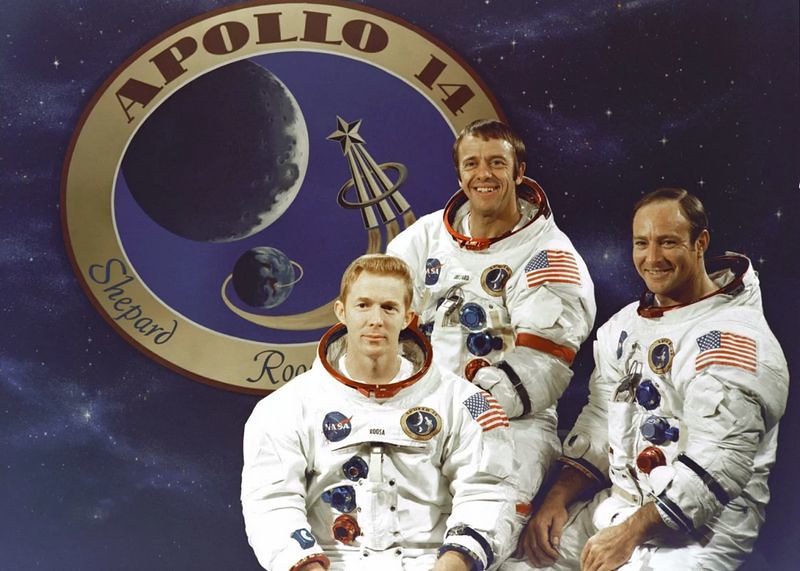
Originally scheduled to take place in July 1970, Apollo 14 was delayed following the Apollo 13 crisis (see: Space Sunday: Apollo 13, 50 years on), to both allow time for recommendations resulting from the investigations into the Apollo 13 mishap to be implemented. This not only led to a hiatus in lunar landings, it also meant that the Apollo 14 crew of Mercury 7 veteran Alan B. Shepard Jr. (Commander), Stuart A. Roosa (Command Module Pilot) and Edgar D. Mitchell (Lunar Module Pilot) eventually spent more time training together than any other Apollo crew to that point: a total of 19 months.
In the immediate aftermath of Apollo 13, NASA Administrator Thomas O. Paine indicated the agency would ideally like to launch the mission before the end of 1970; however, the recommendations for changes to be made to the Command and Service Module (CSM) combination meant that the earliest the agency could realistically schedule a launch for the mission was at the end of January 1971 – with much of the work in supervising the necessary changes being loaded directly onto the shoulders of Shepherd and Roosa.
We realised that if our mission failed—if we had to turn back—that was probably the end of the Apollo program. There was no way NASA could stand two failures in a row. We figured there was a heavy mantle on our shoulders to make sure we got it right
– Edgar D. Mitchell, discussing Apollo 14 preparations, speaking in 2011
A further complication for the mission was that following Apollo 13, the original landing site for the Apollo 14 crew at Littrow crater, in Mare Serenitatis was abandoned in favour of sending the mission to Fra Mauro, the intended landing site for Apollo 13, and which was seen as having greater scientific relevance, requiring Shepherd and Mitchell to revisit their lunar surface and geology training – Littrow had required a high degree of training in volcanic geology; Fra Mauro was an impact crater site.
Official Apollo 14 crew photo: Stuart Roosa, Alan Shepard (centre) and Edgar Mitchell. Credit: NASA
The key changes to the CSM combination were around the oxygen tanks that had exploded on Apollo 13. These includes a complete redesign of the tanks and the circuitry within them, while a third tank was add on the opposite side of the SM that could act as a back-up in case of issues with the first two. Other changes included incorporating a 5 US gallon tank of “emergency” drinking water and an additional battery to help maintain electrical power to the Command Module in event of the main power buses failing. Alterations were also made to the connections between the Command and Lunar modules for easier and faster transfer of power and control between the two.
Outside of the need to overhaul the CSM combination in the wake of Apollo 13, the Lunar Module for the mission – the last of the “short term” H-class missions – underwent changes that included anti-slosh baffles in the descent engine fuel tanks intended to prevent incorrect low fuel warnings to be triggered – an issue that plagued both Apollo 11 and Apollo 12 – and the installation of additional equipment hard-points for the surface science mission, which would be the most intensive yet for an Apollo lunar mission.
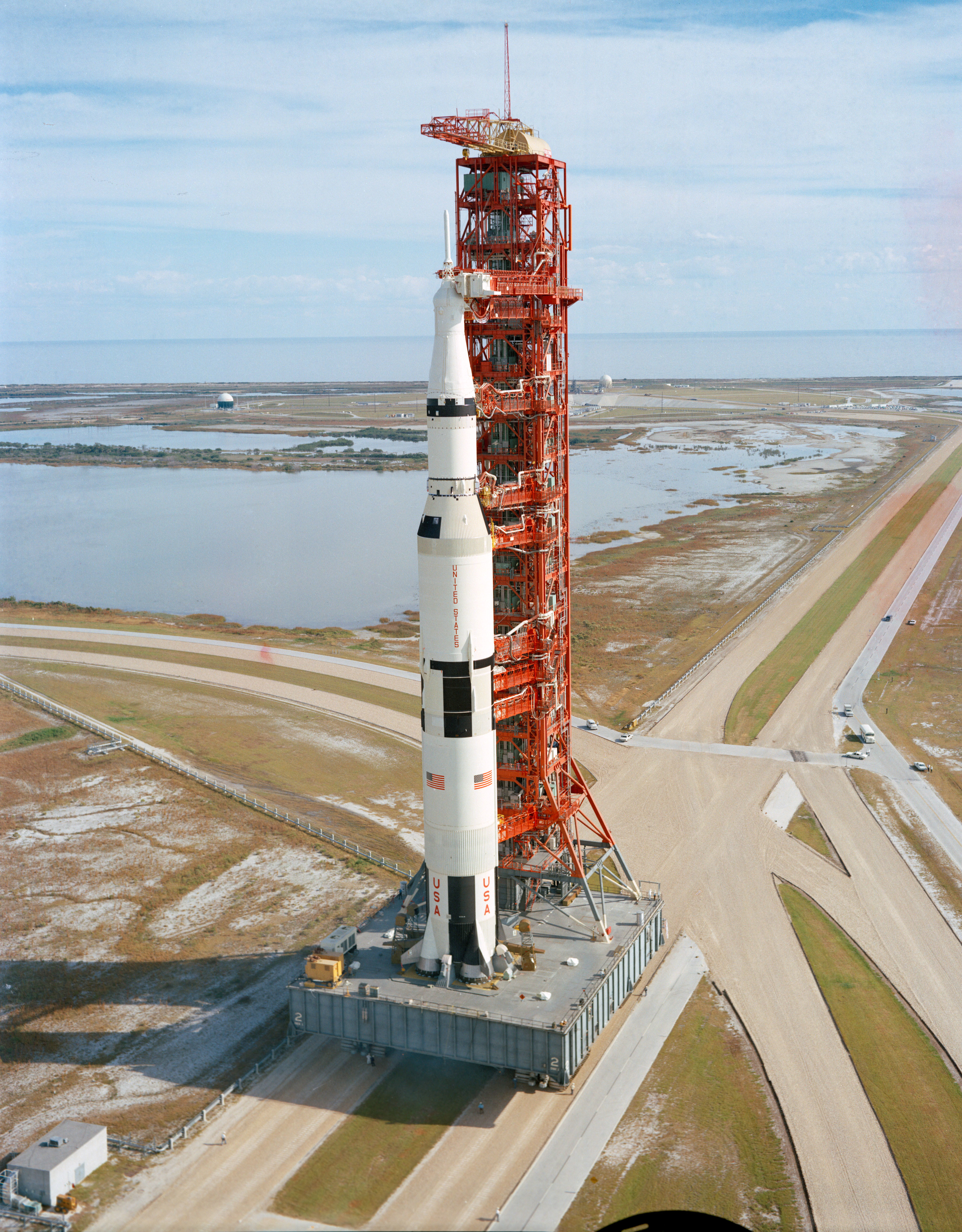
Aside from these changes, the mission was to be the first to fly an altered Saturn V rocket. Whilst ostensibly the same externally as all the previous Saturn Vs that had flown, SA-509 had a series of internal changes made to its fuel system to prevent pogo oscillations – a self-excited vibration in liquid-propellant rocket engines caused by combustion instability that can, if unchecked, result in an engine exploding. On Apollo 13, such oscillations had meant the centre J2 engine of the rocket’s upper stage had to be prematurely shut down.
Saturn V SA-509, topped by the Apollo 14 spacecraft, rolls out from the Vertical Assembly Building (now the Vehicle Assembly Building) on its way to launch pad 39-A. Credit: NASA
Of the crew, Shepard was the only one to have previously flown in space as the first American to complete a sub-orbital hop aboard Mercury Freedom 7 in May 1961.
Born in 1923, Shepard attended the US Navy Academy at Annapolis from 1941 to 1944 (the normal 4-year training course having been cut by 12 months due to World War 2). He initially served aboard the destroyer USS Cogswell – it then being a requirement that Navy aviators serve shipboard time prior to starting flying training -, rising to the rank of Air Gunnery Officer, responsible for the ship’s anti-aircraft guns and crews, a position he held while the Cogswell served critical roles in the Battle of Okinawa and off the coast of Japan.
In November 1945 he transferred to flight training school, and after almost washing out as a pupil, went on to gain 3,600 flying hours with more than 1,700 in jets, eventually rising to the position of Aircraft Readiness Officer on the staff of the Commander-in-Chief, Atlantic Fleet.
After his Mercury flight, In 1963 Shepard was grounded due to Ménière’s disease, an inner-ear ailment that caused episodes of extreme dizziness and nausea.This precluded him from flight involvement in the Gemini programme, although from 1963 through 1969 he was NASA’s Chief of the Astronaut Office with overall responsibility for astronaut training and mission selection.
In 1969, Shepard underwent successful surgery to correct his ear issue, and was returned to active flight status. He immediately lobbied his successor as Chief of the Astronaut Office, Donald “Deke” Slayton for a position on Apollo, and was initially earmarked to command Apollo 13. However, his “inexperience” in having missed the entire Gemini programme, and that of his crew as a whole, saw them “bumped” to Apollo 14 to allow them a greater amount of training.
Both Stuart Roosa and Edgar Mitchell were rookies, with Apollo 14 their first and only flight into space. Roosa had previously been a “smokejumper” with the US Forest Service, parachuting into remote area to combat forest fires, prior to transferring to the United States Air Force and training to be both a fighter pilot and an experimental test pilot. On joining NASA in 1966, he was the capsule communicator (CAPCOM) for the tragic Apollo 1 fire, and also served on the support team for Apollo 9, working closely with Edgar Mitchell.
Mitchell was another Naval aviator, having entered the service in 1952 with a degree in industrial management. During during his military flying career he gained a second bachelor’s degree in aeronautics and a doctorate in in aeronautics and astronautics. He also clocked an impressive 5,000 flying hours as both a front-line fighter pilot and a test pilot, 2,000 of those hours gained in jets.
Mitchell’s involvement with space activities actually started before he joined NASA, when in 1964 he was assigned to the US Air Force Manned Orbiting Laboratory (MOL), serving as Chief, Project Management Division of the Navy Field Office that was liaising with the Air Force, and also as an instructor in advanced mathematics and navigation theory for MOL astronaut candidates. When MOL was cancelled, he applied to NASA, and was accepted as a part of the fifth astronaut intake alongside Stuart Roosa.
Given it was the first mission to follow Apollo 13, there was a lot of media and political attention on Apollo 14, including pressure for it to launch on schedule. As it was, weather intervened on the launch day, causing the countdown to be paused for some 40 minutes – the first time such a delay had occurred with and Apollo mission. Launch eventually took place at 21:03:02 UTC on January 31st, 1971.
The pre-launch delay wasn’t considered to be a significant issue, as the mission was to take a faster trajectory to the Moon than previous launches, so the delay effectively left it running precisely “on time” compared to earlier missions. Following a require time in Earth orbit, the S-IVB third stage engines were-lit, pushing the mission on its way to the Moon.
Once en-route, the CSM – christened Kitty Hawk by the crew in honour of the Wright Brothers – had to separate from the S-IVB, then turn through 180º to dock with the now-exposed Lunar Module (called Antares after the star Shepard and Mitchell were due to use as reference point when orienting their craft for its lunar landing) and then gently pull it clear of the rocket stage, which would then gently divert away from the Apollo vehicles flight path.
Roosa, as Command Module Pilot, hoped to set the record for competing this manoeuvre using the least amount of fuel. However, the extended docking mechanism in the nose of the Command Module had other ideas – it refused to latch onto the lunar module firmly enough to trigger the release of the pin holding the LM in place on the S-IVB. Over two hours Roosa repeatedly attempted to make an initial “soft dock” with the LM, but was repeatedly thwarted, leaving the crew and mission control agitated: if the LM could not be extracted by the CM, then the mission was over – and two mission failures in succession, even without any loss of life, would likely spell the end of Apollo.
Starship SN9: three platform engine test firings in three hours. Credit: Mary “BocaChicaGal”
After a build-up of excitement around a potential start-of-year flight for SpaceX Starship prototype SN9, things has slowed down somewhat – but the vehicle may now be on the brink of making its 12.5 km ascent to altitude and an attempt to land successfully after an unpowered “skydive” back towards Earth.
As I noted in my January 10th Space Sunday report, SpaceX had managed to accelerate the processing of SN9 in comparison to SN8 to a point where the majority of pre-flight checks for the vehicle – including a static fire test of the engines on January 6th – had been completed in just a 2-week period following its delivery to the launch stand on December 22nd, compared to 2 months taken for prototype SN8 to reach the same point.
However, as I noted at the time, that static fire test was far shorter than had been expected – just 2 second in length, signifying a possible issue. This appeared to be confirmed when SpaceX attempted further engine tests between January 8th and January 12th, of of which had to be scrubbed for various reasons (including weather), before a further test was made on Wednesday, January 13th – and things took an unexpected turn: after the first brief test, two further tests took place within a 2-hour period for all three tests.
The three firings were apparently “test starts” of the three Raptor motors, rather than a full pre-flight static fire test of all three simultaneously. Following them, and a successful de-tanking of excess fuel, inspections of the motors revealed that two needed slight repairs, causing the company to swap them out for other units.
As part of streamlining starship operations, SpaceX have refined the processes related to engine swap-outs to a point where they can effectively be achieved within days rather than weeks, depending on the availability of replacement motor units – the actual physical removal of an engine can be completed in hours, as can the installation of a replacement. In this case, the work was done over a couple of days, the engines requiring replacement being removed from the vehicle and shipped out of Boca Chica before the replacements were delivered and installed, clearing the way for a final engine test.
This took place on Friday, January 22nd, when all three engines were ignited for several seconds before shutting down.
Outside of SN9, it appears work at Boca Chica has commenced on starship prototypes SN17 and SN18, and on the second Super Heavy booster prototype. Also, in my January 10th Space Sunday update, I noted that work had been discontinued on starship prototypes SN12 through SN14. Work has now commenced in dismantling those parts of SN12 that had been fabricated. This is likely due to the fact that SpaceX are iterating the design and construction of the prototypes so fast, SN12 had become effectively obsolete due to the materials used.
The rapid rate of iteration is also reflected in the move of a new fuel tank section – SN7.2 -, which has been moved to a test stand where it will be pressurised to destruction in a similar manner to the SN7 and SN7.1, each of which also saw iterations in the basic tank design. SN7.2 in particular is built using 3 mm aluminium rather that the current 4 mm material in an attempt to reduce the overall “dry” mass of the vehicle.
In 2020, Musk raised the idea of launching starship / Super Heavy vehicle from sea platforms, suggesting this could be used for vehicles intended to reach orbit or in passenger-carrying sub-orbital transcontinental flights.. While passenger carrying point-to-point will not happen (for reasons I will explain at some point), evidence has emerged that SpaceX are planning to make sea launches a thing, and is in the process of converting two former offshore drilling platforms for use as floating launch platforms.
Aerospace Photographer Jack Beyer was the first to bring the news to the public eye after exploring the port of Brownsville, Texas, not far from the SpaceX facilities at Boca Chica whilst waiting for the SN9 static fire tests to resume. In particular, he spotted an oil platform apparently called Deimos (“dread”) undergoing extensive refit work. Not long after, a image captured over the port of Galveston, Texas, and dated January 13th revealed another rig with the name Phobos (“fear”), and which was later moved to Pascagoula, Mississippi, between January 17th and 22nd.
Phobos and Deimos are, of course, the names given to the captured moons of Mars, and the discovery of the two rigs sparked speculation that the platforms had been purchased by SpaceX.
The soon-to-be SpaceX sea launch platform for Super Heavy / Starship. Credit: Jack Beyer via NASAspaceflight.com
Michael Baylor from NASAspaceflight.com started digging into things using further images captured by Jack Beyer, and discovered that the two rigs in question were originally owned by the world’s largest offshore drilling / well drilling company: UK-registered and Texas-based Valaris plc (formerly ENSCO-Rowan).
Originally constructed in Singapore in 2008, the two rigs were originally called ENSCO 8500 (later Valaris 8500 and now Deimos), and ENSCO 8501 (later Valaris 8501 and now Phobos). However, following the company declaring bankruptcy, the company offered the platforms for sale and US 3.5 million apiece. The purchaser was company called Lone Star Mineral Development LLC, which had only formed in June 2020. Further digging revealed that one of the principals for Lone Star Mineral Development is none other than SpaceX Chief Financial Officer (CFO), who is also the head of the company’s Strategic Acquisitions Group, Bret Johnsen.
Wreathed in cloud, the Deimos arrives at Pascagoula, Mississippi, January 22nd. Credit: Brady Kenniston via NASAspaceflight.com
Both platforms are classified as “semi-submersible”, meaning they float on large pontoons that can be filled with water ballast that both settles them in the water to stabilise them while dynamic positioning water thrusters hold them in a precise location, making them an ideal launch platform, as does their deck loading of around 8,000 tonnes, means that are more than capable of supporting a Super Heavy / starship combination and their fuel loads.
The work to convert the two platforms to support fuelling, payload integration, launch, and landing operations is extensive. As such neither is likely to be ready for use in 2021. However, once operational, they will effectively double the number of Super Heavy / starship launch facilities – SpaceX is currently building the first Super Heavy platform at Boca Chica, and have plans for a second. Multiple launch facilities will be essential in the future if SpaceX is to start to build towards the planned number of launches for the system..
The Green Run hot fire test: the four RS-25D engines on the SLS-1 core stage running close to full power in the Stennis test stand, January 16th, 2021. Credit: NASASaturday, January 16th saw NASA attempt the Green Run Hot Fire Test of the first Space Launch System (SLS) core stage.
For those who might be unaware of it, the SLS is NASA’s next-generation heavy-lift rocket designed to undertake a range of missions, with the primary focus being the US Artemis programme to return humans to the Moon. Once operational it will be the most powerful launch vehicle commissioned by NASA.
The Hot Fire test formed the final phase of the Green Run test programme, a series of tests vital to clearing the core stage of the rocket ready for it maiden – and only – flight, planned for the end of 2021. The “Green Run” title refers to the fact the test would be the first time all of the components and systems of a core stage would be operated in unison, just as they would in the lead-up to and launch of an SLS rocket.
As such, the Green Run actually comprises a sequence of tests numbered 1 through 8 – each designed to test different aspects of the core stage, gradually bringing everything together as a unified whole and culminating in the hot fire test.
The Green Run test sequence for the first SLS core stage. Credit: NASA
All of the test sequences have been carried out at the historic B-2 Test Stand at NASA’s Stennis Space Centre, Mississippi, and while some issues were encountered along the way, both technical and due to the weather, so eating into the “reserve time” available for getting the first SLS vehicle assembled and onto the launch pad, by Saturday January 16th, all of them – including critical fuel loading and unloading (700,000 gallons of liquid hydrogen and liquid oxygen) test – have been completed and signed-off, allowing the hot fire test to go ahead.
Planned for a 8-minute duration – this being the total time the core stage would be expected to operate its engines during a launch – the test commenced at 22:27 GMT, after some last minute minor technical delays put the count-down on a lengthy hold. Ignition saw the four RS-25D engines ignite milliseconds apart from one another in the sequence 1,3,4 and 2, quickly building up to a combined thrust of just under 726,000 kg – somewhat less than the maximum thrust of 900,000 kg they will reach in an actual launch, but sufficient for the purposes of the test.
Ahead of the test, thousands of gallons of water pour through the flame pit beneath the test stand – water is used as suppression system to absorb the sound from the engines, preventing it from being reflected back onto the vehicle, where sound concussions might damage it. Credit: NASA
The long duration of the test had been intended to allow a comprehensive test of things like engine throttling down / up and gimballing (swinging) the motors in a manner that would provide steering in a flight. However, 67.7 seconds into the test something – at the time of writing, NASA has yet to specify what – triggered the core stage’s automated safety systems, initiating a rapid and safe shut-down of the engines.
The RS-25 is one of the most powerful and advanced rocket engines in the world. Originally built for the shuttle, it is finding new life with SLS – a total of 16 former shuttle variants of the motor will be used to power the first four SLS launches. The four motors for this first core stage already have a distinguished flight career between them, having previously be used on a Hubble Space Telescope servicing missions, the mission that saw John Glenn return to space (STS-95 in 1998), and on the final space shuttle flight, STS-135 featuring the shuttle orbiter vehicle Atlantis (thus offering a direct link between the last flight of the Space Transportation System and the first launch of the Space Launch System). In addition, between them the four engines made six flights to the International Space Station prior to the end of the shuttle programme in 2011.
Four clean burns: the four RS-25D engines under thrust. Credit: NASA
Once those first 16 motors have been used, SLS will be powered by a new generation of RS-25 motor, built using the very latest technologies including components created using 3D printing which we decrease the complexity of the engines.
Despite the hot fire test lasting less than 68 seconds, managers and engineers monitoring the test were confident that they had gathered sufficient data to classify the run as a success, although it is not yet clear if a further test will be required, or whether the core stage can be dismounted from the test stand – originally built to test the core stage of NASA’s Saturn V rocket – and shipped to Kennedy Space Centre for integration with the rest of the vehicle.
All four RS-25 engines ignited successfully, but the test was stopped early after about a minute. At this point, the test was fully automated. During the firing, the onboard software acted appropriately and initiated a safe shut-down of the engines. During the test, the propellant tanks were pressurised, and this data will be valuable as the team plans the path forward.
In [the] coming days, engineers will continue to analyse data and will inspect the core stage and its four RS-25 engines to determine the next steps.
– NASA statement following the test
Future core stages won’t go through a similar Green Run; these tests were only required for the first core stage to confirm its design and gather vital data on its behaviour during its required operations. Instead, they will generally be fabricated at NASA’s Michoud Assembly Facility, New Orleans and then shipped directly to Kennedy Space Centre for vehicle integration with the rest of their launch elements in the famous cube-like Vehicle Assembly Building, used for the “stacking” of every Saturn rocket (both the 1B and V) and every shuttle system.
Once integrated with its upper stage, solid rocket boosters and payload, the stage will participate in the Artemis 1 mission to send an uncrewed Orion vehicle to, around, and back from, the Moon at the end of 2021.
A stunning image of Starship SN9 standing on the Boca Chica launch platform framed by a low Sun. Credit: Mary “BocaChicaGal”
In December 2020, and following the not-quite-successful flight of Starship prototype SN8, SpaceX suffered what might have been a further setback in their flight test plans for the Starship vehicle, when prototype SN9 toppled sideways whilst in the stacking facility at the company’s Boca Chica, Texas, construction and flight test centre (see: Space Sunday: the flight of SN8 and a round-up).
However, the vehicle was quickly righted and following examination, work commenced on repairing / replacing the damaged elements (notably one of the forward aerodynamic surfaces). This work proceeded at a surprising pace; so much so that on December 22nd, 2020, it was delivered to he Starship launch platform.
Since then work has continued at the same rapid pace, such that within the two weeks since its arrival on the stand, SN9 has completed the majority of its pre-flight checks that took around 2 months to complete for SN8. These included initial fuel tank pressurisation tests using inert liquid nitrogen (to test the tanks and structure for leaks), partial and fuel test fuelling operations, vent system tests, testing of the reaction Control system (RCS) thrusters that help maintain the vehicle’s orientation in the atmosphere and will provide manoeuvring capabilities in space, and even a full static fire test of the vehicle’s three Raptor engines, which took place on January 6th.
SN9 static fire engine test. Credit: Mary “BocaChicaGal”
Two tests were skipped in the process – but this is seen as not so much because the company is trying to make up for any “lost time”, but rather the result of growing confidence in the process of taking a prototype vehicle from fabrication to test flight. However, while the engine firing was successful, it was somewhat shorter than those for SN8 – the Raptors fired for less than 2 seconds – so it is not clear whether or not an issue was encountered, forcing a premature shut-down. If this is the case, then it might be that further static fire tests may be announced ahead of any flight; if the brief firing was intentional, then it is possible a flight test could come within the next week or so.
As it is, the exact date of any actual flight test for SN9 – which will seek to repeat the 12.5 km altitude reached by SN8, but hopefully follow it with a successful landing – hasn’t been confirmed. However, to avoid a repeat of the SN8 crash, SpaceX CEO Elon Musk confirmed that the Methane header tank – a smaller tank designed to feed fuel to the Raptor motors during the landing sequence – for SN9 and at least some of the prototypes that follow it will be “pressed” with helium (this is, helium will be forced into the tank in order to force the methane out and to the engines) in order to avoid any pressurisation issues. However, it is not clear if this will be the permanent solution to the problem, or an interim update to allow test flights to continue whilst SpaceX develop a more permanent solution to the problem.
A diagram showing Starship and Super Heavy prototype development. On the left, SN9 is complete, and awaiting its flight. SN10 is awaiting Raptor motor installation and the attachment of its aft flaps, and SN11 has yet to have its upper sections installed and is awaiting its tail flaps and motors. All of the major hull elements of SN12 have been fabricated but have yet to be assembled. The diagram also show the assembly of SN15, which is will in advance of SN13 and SN14, while to the right is the status (as of January 9th) of the first Super Heavy prototype. Credit Brendan Lewis
At the same time as pre-flight tests have been continuing with Starship SN9, work has been continuing with a number of further prototypes. SN10 very close to completion, with just engines and aft aerodynamic flaps to be mounted, and SN11 will be receiving its upper sections in the coming week. Further down the chain, SN15 is also progressing, as is SN16. These will likely be the first two prototypes fully fitted with the thermal protection system used to safeguard the vehicle’s hull during atmospheric entry. This doesn’t necessarily mean either will make an orbital flight – SpaceX will doubtless want to text how the entire thermal system holds up under atmospheric flight prior to committing to an orbital attempt.
However, work currently appears to be on hold for vehicles SN13 and SN14, and SN12 has yet to be stacked. Whether these vehicles will be completed remains to be seen: Musk has previously indicated that the SN15 vehicle and beyond will include “significant upgrades” compared to earlier vehicles, so it is possible SpaceX may opt to skip from SN11 to SN15 in the flight test programme.
An image demonstrating the relative size of SpaceX vehicles and the shuttle. Left: the Crew Dragon – capable of flying up to 7 into LEO; right: a starship vehicle with a shuttle orbiter alongside. The orbiter could carry up to 7 into LEO with up to 28 tonnes of cargo. Starship can carry up to 100 people + cargo or up to 100 tonnes (cargo variant) to LEO. A Tesla 4×4 and human are included for scale. Credit: Dale Rutherford
Puerto Rico Governor Supports Rebuilding Arecibo
The outgoing governor of Puerto Rico, Wanda Vázquez Garced, signed an executive order on December 28th, 2020 backing the rebuilding of the 305-m diameter Arecibo radio telescope that collapsed in November 2020 (see: Space Sunday: returns and a collapse).
The order states that US $8 million is to be “assigned and allocated” for removing the debris of the collapsed telescope and “remedial environmental” work be completed at the site. It further states that the Puerto Rico government wishes to see the development of a telescope with a larger effective aperture, wider field of view and a more powerful radar transmitter to replace the original, thus providing the nucleus of “a world class science and education facility”.
Arecibo as it was: visible is the main dish with the central receiving platform suspended over it via the three towers. Credit: NASA
However, things are not as clear cut as this. For one thing, the construction of a new telescope is liable to cost more than ten times the funding stated in the order. It’s also not clear where the $8 million will come from; the order only suggests it could be provided through “state, federal and private sources (including public-private partnerships and state-federal partnerships)”.
More particularly, Arecibo is not under the funding auspices of the Puerto Rican government, but rather that of the National Science Foundation (NSF), which it turn is funded directly by the US government. Thus far, the NSF has not committed to any rebuilding / replacement at the site, nor have any funds been allocated by Congress in the 2021 federal budget – although the NSF has been directed to prepare a study / report on the telescope’s collapse, the clean-up operation and to determine whether a replacement / comparable facility should be established at the sit, together with the associated costs for doing so.
After the fall: the telescope after the collapse of the receiving platform (the wreckage of which can be see to the right of the disk. Also clearly visible is the scar where the collapsing platform and cables tore through the disk. Credit: NASA
NSF has a very well-defined process for funding and constructing large-scale infrastructure, including telescopes. It’s a multi-year process that involves congressional appropriations and the assessment and needs of the scientific community. So, it’s very early for us to comment on the replacement.
– Ralph Gaume, director of NSF’s Division of Astronomical Sciences





 Inara Pey: Living in a Modemworld