
Our first glimpse through the eyes of the James Webb Space Telescope (JWST) will be unveiled through a live broadcast on Tuesday, July 12th at 14:30 UTC. However, on Friday, July 8th, NASA announced details on what will be featured in the broadcast and the images that will be published during the presentation, promising that the latter will reveal an unprecedented look into some of the deepest views yet of the cosmos.
The targets were selected by an international committee of scientists from NASA, the European Space Agency (ESA), the Canadian Space Agency (CSA) and the Space Telescope Science Institute in Maryland, which manages the observatory. They include:
- The Carina Nebula (NGC 3372): lying some 7,600 light-years away, and visible in southern hemisphere skies, where it appears to lie within the constellation Carina, this nebula is the home of the famous “Pillars of Destruction”, long finger-like structures of cosmic gas and dust.
- Southern Ring Nebula (NGC 3132): appearing to lay within the constellation of Vela (also visible in the southern hemisphere sky) this distinctive nebula of gas and material surrounds dying star is some 2,000 light-years from Earth.
- Stephan’s Quintet: a visual grouping of five galaxies, four of which (called the Hickson Compact Group92) are a genuine grouping of galaxies that are gradually being drawn together by gravity, and will all eventually merge. The fifth member of the quintet is the result of line-of-sight alignment, rather than an actual part of the group.
- WASP-96 b: a “hot Saturn” exoplanet orbiting the star WASP-96, some 1,120 light-years away, within the southern constellation of Phoenix. With a mass roughly half that of Jupiter, the planet orbits its parent every 3.4 terrestrial days and is the first known planet with an entirely cloudless atmosphere, which has a profoundly strong sodium signature.
- SMACS J0723.3-7327: an experiment in using gravitational lensing, using the gravity of relatively “nearby” galaxies to “bend” the light from much more distance galaxies to obtain a deep-field view of their stars.

The presentation and images will mark the first time “operational” data and images relating to scientific targets for the observatory have been made public since the completion of all tests relating to the calibration and commissioning of its four science instruments, all of which allow JWST to operate in a total of 17 different science modes.
It is believed that even though only initial studies of their targets, the images captured by the telescope have stunned science teams and already led to increased understanding of exoplanets, galaxies and the universe itself.
Could Stars be used as Communications Relays?
In June I covered a proposal suggesting the Sun’s gravity could be used to help image exoplanets orbiting other stars using gravitational lensing (see: Space Sunday: exoplanets, starship and the Sun as a lens). Now a paper accepted for publication in The Astronomical Journal lays out the idea that the lensing effect of the Sun’s gravity, and that of other stars, could be used as some kind of interstellar communications network.
The study discusses the idea that gravitational lensing, involving the bending of light as it passes by massive objects like stars and black holes, could be used to focus communications between one point and another, amplifying the signal like an interstellar cell phone tower.
For the purposes of the paper, a team of students at Penn State University working under Jason Wright, professor of astronomy and astrophysics and the director of the Penn State Extra-terrestrial Intelligence Centre, used the Sun as a model, calculating that the gravitational focus on the solar lensing effect lies some 550 AU out from the Sun – or a distance equitable to roughly half-way between the orbits of Jupiter and Saturn.

This is the point where a communications satellite could be placed such that it could use the Einstein Ring effect of gravitational lensing by the Sun to focus its signals on a distant target – and also receive incoming communications from that target as the Sun’s gravity focuses them down onto the satellite.
The most obvious use of such a system would be to enable communications with deep-space probes we might eventually send to nearby stars (assuming they could be accelerated to reach said stars in a reasonably time-frame). However, the students also noted that if the Sun were to be a part of so alien communications network, then we now have a sphere around it where we might detect any relay, which we might try to eavesdrop on.
Whilst a pretty far-fetched idea in terms of an “alien relay station” sitting in our own back yard, the study does offer some food for thought in how signals from ET (if they exist) might leverage stellar objects, and thus offers a potential new avenue to be explored within SETI and CETI (as in Communications) research.
Exploring Mars by Air: the Case for the Sailplane
The success of the Mars Ingenuity helicopter has been encouraging engineers to consider and reconsider all options for remote aerial observations of the Red Planet over the course of the past year. Additional methods for birds-eye views of Mars would not only provide higher resolution data on the landscapes where rovers can’t go — such as canyons and volcanoes — but also could include studying atmospheric and climate processes that current orbiters and rovers aren’t outfitted to observe.
Once such option that had been considered years ago and is now coming back into focus is that of a sailplane. In particular, students at the University of Arizona have been investigating the possible use of small, relatively lightweight (just 5 kg) unpowered sailplanes that could be carried to Mars as secondary payloads alongside larger missions.

Protected through their entry into the Martian atmosphere, these sailplanes would fall free from their aeroshells to unfold their 3-metre wingspan to use the so-call boundary layer of atmosphere known to exist around Mars and which is of considerable interest to scientists.
You have this really important, critical piece in this planetary boundary layer, like in the first few kilometres above the ground. This is where all the exchanges between the surface and atmosphere happen. This is where the dust is picked up and sent into the atmosphere, where trace gases are mixed, where the modulation of large-scale winds by mountain-valley flows happen. And we just don’t have very much data about it.
– Alexandre Kling, NASA’s Mars Climate Modelling Centre
Potentially also using fully or partially inflatable fuselage, such sailplanes could ride the wind and air pressure, gathering data whilst exploiting atmospheric wind gradients for dynamic soaring to extend their gradual descent to the ground.
Despite their relatively light weight, the students believe the sailplanes would be capable of carrying an array of navigation sensors, a camera system to images the terrain below it, and temperature and gas sensors to gather information about the Martian atmosphere. As a part of their studies, the students have experimented with radio-controlled sailplanes adjusted to fly themselves and which have been lifted to altitude under weather balloons before being released to see how they manage the dynamics of a descent through Earth’s atmosphere.

In addition, the students have used computer modelling to research general vehicle handling within the far more tenuous Martian atmosphere. A particular technique used in sailplaning is to use updrafts and thermals in which a pilot can circle and gain lift to increase altitude. Mars is known to have similar phenomena, and the modelling shows that they could be used in a manner akin to sailplaning on Earth – with the added advantage that the higher effective wind speeds often recorded with such updrafts on Mars have the potential to help carry the sailplanes over much greater distances.
If such vehicles were released over terrain features such as Gale Crater (home of the Mars Science Laboratory rover Curiosity or Jezero Crater, home to the Perseverance Mars 2020 rover, they could be used for detailed high-altitude surveys of the craters, using updrafts as the crater walls to regain momentum whilst mapping the crater floors for surface exploration. However, they could also be used in the first highly-details studies of the nature of Vallis Marineris, the 5,000-km long “Grand Canyon” of Mars.
According to the modelling completed by the students, a sailplane could use the rugged, deep base of the canyon, rich in mesas and plateaus to regularly recover 6-11% lift energy on a cyclic basis, which together with the higher atmospheric pressure within the canyon system could allow each sailplane to fly for “days”, offering unparalleled opportunities to study this unique environment.
A further attraction with sailplanes is that of cost: development of a suitable glider vehicle could be measured in years rather than decades, utilising common off-the-shelf parts, particularly where instruments are concerned, with most of the effort going into the delivery / deployment system, gaining a better understanding of the Martian atmosphere and its thermal qualities in order to better determine vehicle flight characteristics, and in how to develop the means to recharge the sailplane’s batteries to power its instruments and controls without relying on a potentially cumbersome solar array system.
Currently, the work by the students has been a project largely internal to the university; however, Kling has worked with the team, and he and professor Sergey Shkarayev from the university who has overseen the work, hope that a formal proposal to extend the research might yield NASA funding.
 Scientists using data from NASA’s Curiosity rover measured the total organic carbon – a key component in the molecules of life – in Martian rocks for the first time, and have discovered that there is potentially more to be found on Mars than in the driest environments to be found here on Earth.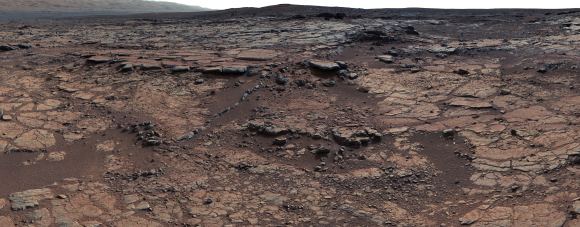









 Inara Pey: Living in a Modemworld