my.secondlife.com direct messaging discontinued?

Update, January 2nd: As promised, I contacted Peter Gray (Pete Linden) at the Lab, and he confirmed profile feed direct messaging has been turned off.

Ciaran Laval brought this to my attention: it appears that direct messaging (DM) on my.secondlife.com may have been discontinued.

The capability was slipped out by the Lab back in October 2011. Like many things about the profile feeds (and elsewhere in Second Life) there was no announcement about its introduction, and people were left to trip over it for themselves. At the time I noticed it, I offered a short tutorial on using it. The removal of the feature – if that is indeed what has happened – has similarly occurred sans any announcement.

I’m using caution here, as things on the profile feeds have been a little higgledy-piggledy* of late, what with snapshot uploads having been badly broken for many for the past week or more (and still broken for some – I confess, I’ve not tried in the last few days). Therefore, the capability might have been suspended due to problems with the hamsters servers.

However, a comment on a forum thread started on the matter would appear to suggest the option has indeed been removed. Responding to the question “…No more private messages?“, Bondboy Dagger states:

I too noticed this feature being gone. I created a ticket to inquire and have been told this feature has been discontinued. :smileysad:

Certainly, the options to send private messages have now gone. There is no longer a New Message button in the Messages tab of the Inbox, and the option to privately message a friend by clicking the message button on their profile feed has also gone – the only option left is to IM them via the viewer (i.e. in-world).
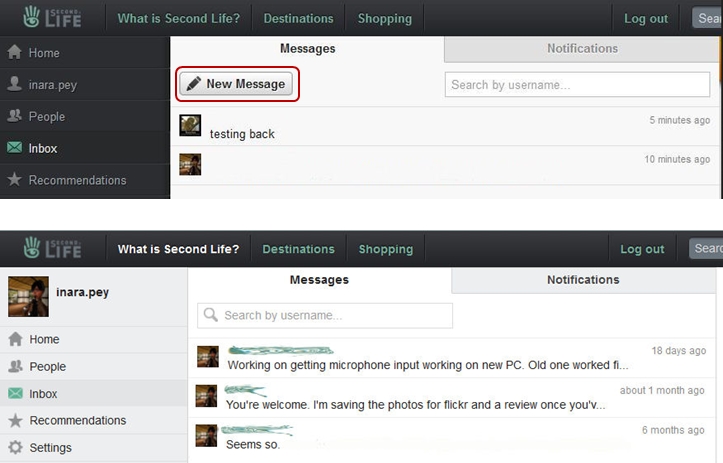
The New Message button has gone from the Messages tab in profile feeds
Now you see me (top), now you don’t (bottom) the vanishing New Message button for profile feed direct messages

Similarly, sending a message in an existing DM conversation no longer works. While the text input box is still there, together with the Send button, and while you can still enter a message, clicking on the Send button does nothing; your text remains displayed in the test input box.

You can still enter text in an existing private message exchange - but it won't be sent
You can still enter text in an existing private message exchange – but it won’t be sent

I’ve dropped a line to Pete Linden to enquire on the matter – but it is Christmas Eve (actually very early Christmas morning where I am!), and I know Pete is out of the office until January 2nd – so please don’t hold your breath over the holidays waiting to find out!

If the option has been removed, it’s liable to meet with mixed reactions. Many have probably never used it, even if they use the feeds, or may have used it occasionally. On the other hand, those of us who have used it, have found it to be extremely useful. For my part, I can say it has been of major assistance in communicating rapid-fire messages as a part of various collaborative projects. Obviously, whether it will be replaced by something else (assuming it has gone the way of the Dodo), is also up in the air at this point.

More news if / when I hear anything back in the New Year!

*for an explanation of “higgledy-piggledy, a technical term, please refer to the bottom of this page (in the hope it raises a smile or two)

SL Marketplace search: Lab asks for feedback

secondlifeIn a blog post dated Tuesday 17th December, the Lab has asked for feedback on the SL Marketplace search functionality, and have set-up a survey for people to take as a means of offering their views.

The blog post reads in full:

Next year, we’ll be making some improvements to the Second Life Marketplace search functionality. To help focus those efforts, we’d like to get some feedback from Marketplace users (both buyers and merchants) about how Marketplace search is working for you today and, more importantly, what you’d like to see in the future.

Please take a few minutes to help us improve this feature for all Residents by completing this brief survey here.

The survey will be available for feedback through January 6, 2014, and your input is greatly appreciated!

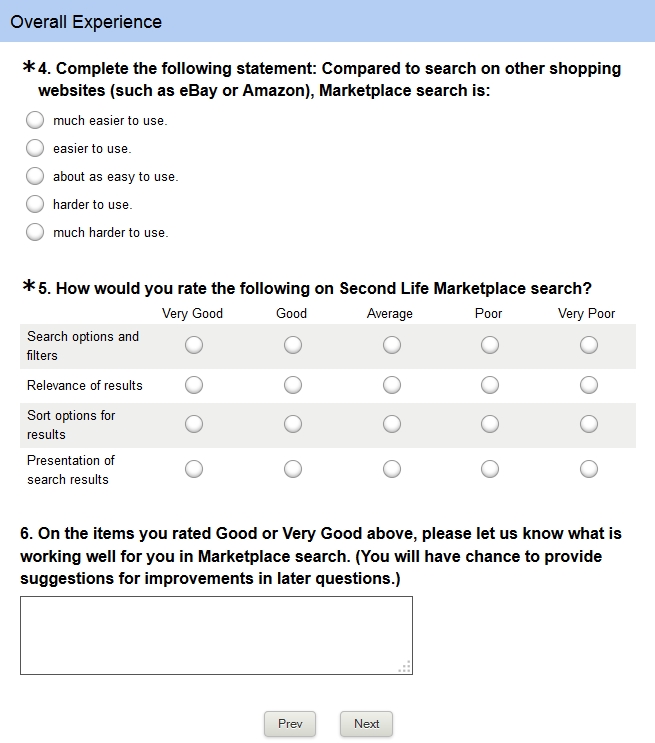
Marketplace search survey: open for input until January 6th, 2014

The survey presents a dozen sections, some of which are multi-part, asking for elements of the search functionality to be rated, and some of which offer users the opportunity to provide direct input / suggestions on things like the current search filters, relevance and sorting of results, presentation of search results, etc., and any specific changes people would like to see. It takes about 5 minutes to complete.

For those frustrated by Marketplace search, this would appear to be a good opportunity to provide feedback as to how things might be improved, which will hopefully be taken on-board. A discussion thread on the survey and feedback given has been started within the Merchant’s forum.

Andrew Linden departing the Lab

Andrew Linden: Departing the Lab

He’s been one of the longest-serving members of the Lab’s team, and actually out-lasted Philip Rosedale for time put in with the company, but after more than eleven years with Linden Lab, Andrew Linden is saying “farewell”.

He broke the news during his regular appearance at the Tuesday Simulator User Group meeting on December 17th, saying, “This is going to be my last User Group meeting as a Linden: I’ve decided to leave LL and pursue other things. I’ve really enjoyed these User Group meetings, which is why I’ve been showing up all these years.”

He confirmed that he will be joining Rosedale at the latter’s latest venture, High Fidelity, saying, “”I’m going to join Philip and his new project. Not because I don’t love SL or am not excited about what LL is working on, but because I’m ready for a change, and I really like working with Philip.”

Andrew’s final day with the Lab will be on Thursday December 19th, after which he’ll be off to join the High Fidelity team.

As a long-serving member of the Lab’s staff, he will be sorely missed. Over the years he’s been exceptionally popular among residents, and he has worked on many of the Lab’s server-side and other projects. Most recently, he has been instrumental in overhauling the platform’s interest list, massively improving the way in which in-world scenes and managed and loaded between the servers and the viewer, and which has also seen an overhaul of the viewer’s object caching capabilities (which are currently available through a release candidate viewer), all of which has significantly improved scene loading and rendering. This work was recently featured in a video narrated by Torley Linden.


The video demonstrating the interest list work: the last large-scale undertaking Andrew worked on

Also of late, Andrew has worked on a number of anti-griefing measures within the platform, and has currently project has involved LSL updates to enable the uniform scaling of objects and linksets (such as uniformly increasing or decreasing a linksets size by a factor of 2). This work should be appearing in an RC release in the New Year.

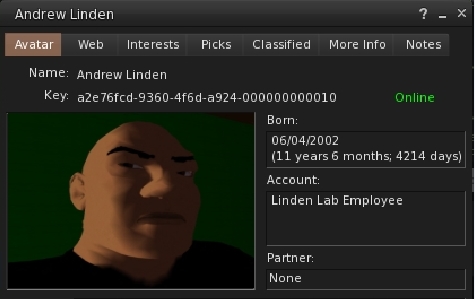
Andrew's profile: testimony to his time at the Lab
Andrew’s profile: testimony to his time at the Lab

In the time I’ve been attending the Simulator User Group meeting (formerly the Server/Sim/Scripting group), Andrew has always been polite, inquisitive and helpful to all, and demonstrated a willingness to readily delve into issues and see what he can find and / or put right. In response to the direct enquiries I’ve put to him in the past, he’s always been more than helpful in his replies, willing to provide concise explanations and offer additional information and guidance.

The news of his departure was met with a mix of sadness and best wishes from those at the meeting. For my part, I’d like to again extend my thanks to Andrew for his input to, and work on Second Life over the years, for his support of the Simulator User Group and to wish him all the best for the future.

2014: Step into the garden of good and evil with the Basilique Performing Arts Company

Paradise LostI recently wrote about of Romeo + Juliet, a unique re-imagining of Shakespeare’s tale of love, loss and tragedy, performed by the Basilique Performing Arts Company, and which features an inspired mix of  renaissance-inspired sets, 1940s costumes, and contemporary music.

While that production is set to continue until around mid-February, and is a must-see for anyone who hasn’t yet taken the opportunity to do so, the Company has now announced its next major – and equally ambitious –  undertaking.

In Spring 2014, the Basilique Performing Arts Company will be premiering Paradise Lost: The story of Adam and Eve’s original sin, choreographed and set to the fourteen movements of Mozart’s Requiem Mass in D minor.

Based on Milton’s epic blank verse poem, the production has been conceived and developed by the creative team of Canary Beck and Harvey Crabsticks. Each performance will run for some 60 minutes and comprise three Acts: The Creation, The Fall and The Expulsion. Through each, we will follow Satan, as he builds Hell, God as he creates the Garden of Eden, the Tree of Knowledge, Adam … and Eve; witness Satan’s beguiling of Eve, watch as she and Adam wilfully lust for one another in the face of God’s anger, only to be banished from the Garden of Eden; then finally, watch all that came after: the battle between  the forces of Good and Evil, and Adam and Eve’s lives after Eden. All have been specially choreographed, and each act will comprise a number movements from Mozart’s Requiem.

This promises to be a most amazing production, as demonstrated in the preview trailer – best watched full screen and in HD, if possible.

Paradise lost: The Story of Adam and Eve’s Original Sin will be staged at the Basilique Playhouse. All performances will be free, and the schedule will be announced in due course, and reported in these pages.

So get set for what is likely to be one of the highlights of the Second Life cultural calendar in 2014!

Fitted Mesh: “last call” for issues; release candidate “after the holiday”

secondlifeThe Lab’s Fitted Mesh project viewer has been out for a month, and has seen some good feedback from those who have been trying it out.

Already one update to the viewer has been released, correcting a number of problems, and the Lab has been working with content creators and users who have been providing feedback through the FITMESH project reporting on the JIRA.

However, Lab is keen to start progressing the project in the New Year, and so a “last call” for issues has gone out.

“If you’ve been seeing any issues with the current fitted mesh project implementation, or anything that needs to be added/changed, please make sure that the issues are filed by now, or as soon as possible,” Nyx Linden said at the Content Creation User Group meeting on Monday 16th December.

For those who missed the original announcement, Fitted Mesh is a means by which mesh garments are rigged to the collision bones of the avatar skeleton, allowing them the be resized as the avatar’s shape is changed using the Edit Shape sliders. In essence, it is the same approach as has been seen within Second Life and variously referred to as the “RedPoly method” or “Liquid Mesh”.

The technique uses both the existing bones in the SL avatar and an additional set of bones in order to work, and you can read more on it in my original preview article, if you’re not already familiar with the approach.

Oz Linden, also at the meeting, underscored the “last call”, saying, “To emphasise what Nyx said earlier … get your comments and issues in on Fitted Mesh ASAP so that we can do a release candidate after the holiday break.”

Quite when that release candidate will appear is unclear; there is a lot going on at the Lab, and several projects are likely to be vying for room in the release channel (although some will hopefully go to project viewer status first and give the rest some elbow room).

However, if you have been looking at the current Fitted Mesh viewer and wish to have input to the project, now is very much the time to do so. Similarly, if it is something which has been on your “to do” list, now is the time to move it to the top, or risking seeing your chance ot have input to the project, and influence on the Lab, vanish.

Related Links

The spies who came into the virtual

News has been breaking that the United States National Security Agency (NSA) and the UK’s Government Communications Headquarters (GCHQ), the British equivalent of the NSA, “infiltrated” various on-line gaming platforms and virtual worlds as part of the anti-terrorist activities.

Revelations a part of The Guardian's "The NSA Files" series
Revelations form a part of The Guardian’s “The NSA Files” series

Information on the operations, obtained via Edward Snowden, the former CIA employee / NSA contractor, who released some 200,000 documents to the press, is at the centre of a series of reports the Guardian newspaper in the UK in partnership with The New York Times and ProPublica, and which have been widely picked-up by the on-line media on both sides of the Atlantic. The reports show that both the NSA and GCHQ were so concerned about the various methods nefarious individuals might use to communicate with one another, that they started targeting various on-line platforms – often on the thinnest of reasoning.

The actual activities were varied in scope, ranging from specific data gathering through the use of “mass-collection capabilities”, through to operatives posing as players on various platforms seeking information and also charged with recruiting potential informants from the more technically aware members of the various communities – with Second Life being one of the targeted platforms.

In some respects, the interest in virtual world and games platforms is unsurprising; I’d frankly be more concerned if the security agencies hadn’t considered the potential for such platforms to be used by militant or terrorist groups (which, I would also add, should not be taken to mean I necessarily condone their actions). However, what I do find to be eyebrow-raising, and doubtless what other people will as well, is the degree to which GVEs – games and virtual environments – were subjected to surveillance and what went on.

For example, ProPublica reports that in 2009, a 3-day “test” of capabilities to gather data from within Second Life, Britain’s GCHQ gathered real-time data on chats, IMs and L$ transactions which amounted to some 176,677 lines of data. How widespread this data-gathering was, who was affected by it and what happened to the data, is unclear.

GCHQ’s interest in Second Life appears to have started out as a legitimate activity. Towards the end of 2008, they were involved in tracking down a credit card fraud ring in what was known as “Operation Galician”. When the fraud ring attempted to move some of their activities to Second Life, GCHQ and the police followed. Even so, the success (or otherwise) of that operation doesn’t seem to stand up as justification for the wholesale gathering of data as occurred in 2009.

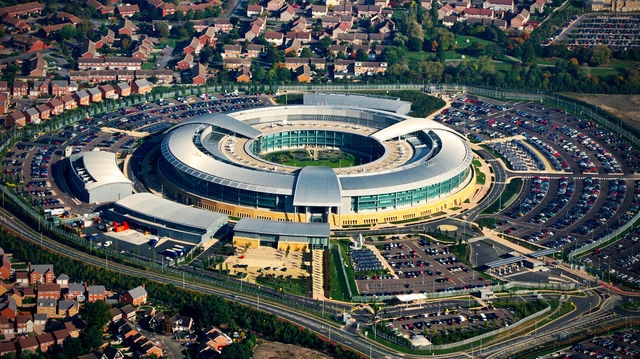
The UK's GCHQ - gathered over 176,000 lines of data pertaining to SL users chat, IM and L$ transactions in a single real-time "test" of their ability to gather SL data
The UK’s GCHQ – gathered over 176,000 lines of data pertaining to SL users chat, IM and L$ transactions in a single real-time “test” of their ability to gather SL data (images via Gizmodo)

The British security agency was no slouch when it came to other virtual and gaming environments, either, as the Guardian’s report reveals:

At the request of GCHQ, the NSA had begun a deliberate effort to extract World of Warcraft metadata from their troves of intelligence, and trying to link “accounts, characters and guilds” to Islamic extremism and arms dealing efforts. A later memo noted that among the game’s active subscribers were “telecom engineers, embassy drivers, scientists, the military and other intelligence agencies.”

GCHQ was also the motivating force behind data gathering activities directed at the Xbox Live console network, and developed “exploitation modules” for various platforms. Much of this activity appears to have been carried out at Menwith Hill, a Royal Air Force base which provides communications and intelligence support services to the United Kingdom and the United States of America, and where GCHQ and NSA operatives worked side-by-side to infiltrate World of Warcraft.

Continue reading “The spies who came into the virtual”