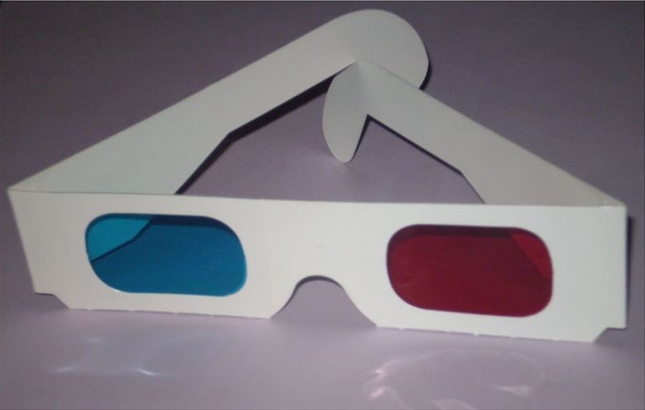
Linden Lab announces anaglyph 3D compatibility!

So… can’t wait for Oculus Rift? Fed-up with no 3D capability on the Linden Viewer with nVidia 3D glasses?

Well, fear not! On April 1st, the Lab announced FULL SUPPORT for anaglyph glasses! This great news was announced in a blog post which reads in part:

As we’ve previously blogged, we recently integrated the Oculus Rift with the Second Life Viewer; users with the development headset can try out the beta now and experience Second Life in a uniquely immersive way. Today, we’re happy to announce another exciting new way to experience Second Life: anaglyph 3D mode.

We think this will appeal to literally dozens of Second Life users nostalgic for the kind of 3D experiences provided by comic books, cereal boxes, and B-movies.

Hungry for nostalgia? Linden Lab's new project viewer brings you just that!
Hungry for nostalgia? Linden Lab’s new project viewer brings you just that!

The post goes on:

A key immersion feature of the Oculus Rift is the ability to look around the world by moving your head. This works with the anaglyph 3D mode as well. Simply attach the monitor to your head and coordinate your camera controls with your head movements.

Those wishing to take advantage of this latest innovation from the Lab, a company which demonstrates it can look backwards as well as forwards, can grab the project viewer today – but be quick, this is a one-day opportunity only!

SL Share: photo upload to Facebook disabled

secondlifeUpdate April 3rd: As per this LL blog post, the Facebook photo upload has been re-enabled by Facebook.

SL Share is the viewer-side capability which allows Second Life users to share pictures, thoughts, etc., with their Facebook account.

Since its launch, it has proven extremely popular among SL users who have no issue in linking their SL and RL identities, and who see it as a means of telling friends about their SL activities. However, a recent spike in usage of the capability highlighted the fact it is in violation of Facebook’s policy by posting SLurls with images sent to Facebook.

As a result, the Lab has announced that the photo upload capability within SL Share has been disabled by Facebook, and the Lab are now working with Facebook to resolve the issue.

The Lab’s blog post announcing the situation reads in full:

Facebook recently contacted us to let us know that the Photo Upload feature of SL Share is not permitted to automatically include location SLURLs in posts made from the application. We’re working with them to get a hotfix out ASAP, but in the meantime the Photo Upload feature in SL Share will not work, as Facebook has temporarily disabled that part of the application. SL Share’s Status Update and Check-In features will continue to work.

When SL Share’s full functionality is restored, SLURLs will no longer be included when you share a picture using Photo Upload, but you will still be able to let your Facebook friends know where to join you in Second Life by using the Check-In feature.

We apologize for the inconvenience this may cause you and are working to get a fix out ASAP.  We’ll use this blog to keep everyone posted with any updates and will of course let you know once the issue is resolved as well. Thank you for your patience.

SL Sare: the inclusion of SLurls with uploaded images is against Facebook policy
SL Share: the inclusion of SLurls with uploaded images (2nd image from left) is against Facebook policy

The situation likely means that any TPVs what have also included the SL Share capability into their offering will need to adopt any hotfix forthcoming from the Lab once it has been made available.

Lab issues call for Oculus Rift beta testers

secondlifeOn Wednesday March 12th, Linden Lab issued a call for people willing to help beta test the upcoming Oculus Rift enabled SL viewer.

The call, made via a blog post, reads in full:

The Oculus Rift offers exciting possibilities for Second Life – the stereoscopic virtual reality headset brings a new level of immersion to our 3D world, making Second Life a more compelling experience than ever before.

Though a consumer version of the headset isn’t available yet, we’ve been working with the development kit to integrate the Oculus Rift with the Second Life Viewer. We now have a Viewer ready for beta testers, and if you have an Oculus Rift headset, we’d love to get your feedback.

If you have the Oculus Rift development hardware and would like to help us with feedback on the Viewer integration, please write to sl_oculus_beta@lindenlab.com to apply for the limited beta.

Oculus Rift: the headset-enabled viewer is now ready for beta testing

As noted in the post, the headset isn’t commercially available as yet, but the pre-release version with the Oculus Software Development Kit is currently available for $300.00 directly from Oculus VR themselves. If you have a kit already, now is the time to sign-up!

As I reported in December, VoidPointer Linden had indicated that the work on making the viewer operate with the Oculus Rift headset was “feature complete”. This fuelled an expectation that a project viewer might make an appearance either before, or soon after Christmas, 2013.

However, Oz Linden shortly afterwards indicated the “soon” might be something of a relative term. Since both of those announcements, the Rift viewer has been working its way through the Lab’s QA process, and while it didn’t appear as quickly as perhaps VoidPointer had hoped. Even so, when commenting on the status of the viewer back in December, he was able to confirm a few things about it:

  • The same viewer can be used in both a “normal mode” and a “Rift mode”
  • There will be no apparent changes to the viewer / UI when in “normal mode”
  • Frame rates when in “Rift look” will be very much down to the user’s own hardware  (unsurprisingly).

Elsewhere, it had been indicated that when in “Rift Look”, UI menus may float over the user’s head, keeping them out of the field of view until such time as needed. This was certainly the case when Simon Linden tried the viewer earlier in “013, but it is unclear if this approach has been carried forward – so that’s one for the beta testers to discover.

There is no timescale for how long the beta testing will last, but this announcement brings official support for Occulus Rift (users can also use David Rowe’s CtrlAltStudio viewer, which provides preliminary support for the headset) a step closer to reality.

@SLOfficialtweet branded “not official” by Linden Lab

A new Twitter account appeared on Friday March 7th. “SecondLife Official” (@SLOfficialtweet) billed itself as the “new Second Life official twitter page”. This took a number of people by surprise, given there is a legitimate Second Life Official Twitter account (@SecondLife).

The appearance of the account prompted a question on its legitimacy from Strawberry Singh (among others), which in turn prompted an immediate and unequivocal response from Linden Lab:

false accountPeter Grey, the Lab’s Director of Global Communications further underlined the unofficial nature of the account in an e-mail to me, stating:

That account is NOT official, nor from Linden Lab. It was first brought to our attention this morning, and we’ve been replying to queries on Twitter about it to confirm it’s not legit.

The account doesn’t appear to be a phishing attempt – the link included in the account header seems to refer to the official secondlife.com website. However, as it stands, it is likely that this account could be blocked / removed by Twitter as it would appear to be a pretty clear attempt at brand impersonation and trademark misuse.

Parody accounts, unaffiliated accounts, etc., are not new on Twitter. However, many of these do carry an indication that they are not in any way official. Twitter also have an account verification process for those accounts that might be subject to impersonation in order to further help prevent issues of misrepresentation. Given the extent to which the Lab uses Twitter, having their own official account verified might help discourage this particular prank from being repeated in future.

SL JIRA officially open – with limits

In keeping with an earlier promise, On Thursday, March 6th, Linden Lab re-opened the JIRA to public scrutiny.

Broadly speaking, this means that:

  • All users will be able to see all BUG issues, all the time
  • All users will be able to comment prior to a report being triaged; post tiraging, reports will open to comment only by the original reporter, LL staff and those from the community (TPV developers and others selected by Linden Lab for having demonstrated skills in this area)
  • The “New Feature Request” is back.

There is a blog post announcing the change, and which indicates there is a limitation:

While we want to make issues visible for the reasons described in our last post, we’re not going to extend this to old issues, because at the time they were created, users knew that those reports would have limited visibility and they may have included sensitive and/or private information. We don’t want to take information that someone thought would be private and suddenly make that visible to everyone, so the new visibility settings will apply only to new issues.

As of Thursday March 6th, the SL JIRA is again open to public viewing - however, only BUG reports filed on or after than date will be viewable to all ...
As of Thursday March 6th, the SL JIRA is again open to public viewing – however, only BUG reports filed on or after than date will be viewable to all …

Even with this limitation, this is a positive step forward in allowing users to again be more pro-active in providing assistance in identifying issues, duplicates, etc., and enabling a better degree of investigation to be carried out when a problem is encountered.

... older BUG reports will only be viewable to those with the requisite permissions
… but older BUG reports will only be viewable to those with the requisite permissions

Note that in order to browse / view BUG issues, you must be logged-in to the JIRA system (STORM, VWR and SVC issues remain browsable without being logged-in). Also, bear in mind MAINT issues will remain unviewable, as was the case before the JIRA was closed.

Lab to re-open the JIRA

secondlifeOn Friday February 28th, Linden Lab announced that the JIRA is to be re-opened to public scrutiny.

The changes will be occurring in week 10 (week commencing Monday March 3rd), and follow hard of the heels of a series of comments by Ebbe Altberg on the subject, made in a forum thread. welcoming him to Linden Lab.

The announcement, in a technology and tools blog post, indicates that:

  • All users will be able to see all BUG issues, all the time
  • All users will be able to comment prior to a report being triaged; post tiraging, reports will open to comment only by the original reporter, LL staff and those from the community (TPV developers and others selected by Linden Lab for having demonstrated skills in this area)
  • The “New Feature Request” is back.

The blog post points to a set of guidelines for participation that need to be followed when commenting on JIRA reports.

The announcement hails the re-opening by stating:

Today, we’re happy to announce some changes to our JIRA implementation – the system we use to collect, track, and take action on bugs reported by users. You’ll see these changes take effect next week.

Recently, this system was working in a way that wasn’t very transparent, and it frankly wasn’t a good experience for the users who care enough about Second Life to try to help improve it, nor was it the best set-up for the Lindens tasked with addressing these issues. So you can see why we’re happy to be changing it!

That the JIRA has been re-opened is welcome news, and that there has been an attempt to meet the needs of those wishing to comment on reports half-way is also to be welcomed. However, of equally good news is the fact that the new feature request capability has been returned to the system, again as the blog post states:

If you’ve got a great idea for a feature, you don’t need to slip it through the system disguised as a bug report – just select the “New Feature Request” category when you submit. Commenting for this category will work just like for bug reports, and submitting improvements through this category will make things much easier for the Linden team reviewing these.

There is also a reminder as to the purpose of the JIRA:

Please remember that JIRA is an engineering tool – it’s not meant for policy discussions and the like nor is it a replacement for the Forums, where you can have all kinds of stimulating discussions.

Those wishing to give feedback on the move can do so via a forum thread created specifically for this purpose.