The next in the Lab’s in-world Town Hall series, again featuring CEO Ebbe Altberg, will take place on Thursday, September 13th, at 09:30 SLT (17:30 BST / 18:30 CET). The event will take place at the Town Hall meeting regions, with the landing point URLs as follows:
Selected questions from the Town Hall meeting forum thread (now closed) will be put to Ebbe during the session, and there may be an opportunity to ask questions from the audience, if time permits.
All things being equal, I hope to have a summary of the session up after the event, which will be similar in nature to my summary of the April 2018 Town Hall – see here for more on that.
In my week #35/1 SL projects update, I referenced the upcoming re-launch of the Governance user group. Since then, the Lab has added a further group to the list that people might want to take note of.
The Concierge & Land has a fortnightly schedule (meeting every other Thursday), commencing on Thursday, September 13th, 2018, between 12:00 noon and 13:00 SLT; this puts it immediately before the Content Creation User Group. It will be led by Theresa Linden, and it will be held at the Linden Estate Services meeting area.
The focus for the meeting is described as being:
Discussion & education of SL topics such as current known issues and bugs, project viewers and new features, and general Mainland issues.
I assume the “known issues and bugs, project viewers and new features” relate directly to the land management tools within the viewer, rather than being for a more general discussion on all things viewer. However, the emphasis on “general Mainland issues” is a little curious, as it almost appears to rule out private estates from discussion. So, it will be interesting to see how this is perceived / carried forward.
A typical TPV Developer meeting
User Groups – General Information
There are now user groups held on a weekly / fortnightly / monthly basis, together with the Third-Party Viewer Developer meeting. All of them are open to general attendance by users – but those joining a meeting are asked to keep questions they have rooted to the topics covered by each of the meetings.
So, for example, the Simulator User Group is primarily for questions on the simulator / back-end services; questions relating to governance issues, cannot be answered at these meetings. Similarly, specific content creation questions cannot be addressed at the TPV or Web meetings, etc.
Full details of the user group meetings can be found in the SL wiki user groups page. The following is a brief summary of all eight (including the TPV Developer meeting). Click the group links for the individual information pages:
Date of next meeting (at the time of writing): Wednesday, September 26th, 2018.
Commencing: Thursday, September 13th, 2018.
Excludes the first Thursday of each month.
Date of next meeting (at the time of writing): Friday, September 7th, 2018.
Further:
All meetings are subject to US holidays.
Changes to the schedules are generally noted on the wiki pages.
You will need to have Voice enabled for the Content Creation and TPV Developer meeting (text can still be used at both for comments / questions, as can Voice).
With thanks to Whirly Fizzle for the pointer to the Land Group meeting.
On Wednesday, August 29th, the Second Life bug tracking and feature request system will be undergoing an upgrade, starting at 20:30 SLT (so the early hours of the morning for those in Europe).
The scheduled window for the upgrade is some six hours in length, although as the official blog post states, it is hoped that the overall downtime will be far less than this.
The primary aim of the upgrade is to bring the Second Life bug tracking system up to a more recent release of the Jira software used the manage the bug tracker by Atlassian Corporation plc.
From a user’s perspective, most of the changes are of a cosmetic nature, again as the official blog post notes; the most obvious being the new log-in page that will be displayed for users following the upgrade, and whenever they are required to log-in to the system to use it.
One of the more visible changes with the Jira update will be the format of the log-in page (left), compared with the more familiar log-in page for most Second Life web properties (right)
An important aspect of this change is that every time you log-in to the new system, it updates the email address that Jira uses for you from the one given with your Second Life account, instead of only updating it the very first time you use Jira, as is the case with the “old” system.
As well as this, there are various layout improvements and updates to the information displayed in things like a user’s dashboard, and some revised positioning of options and buttons.
Key among the latter is likely to be the positioning of the option to create a new bug report / feature request, etc. On the current Jira, this is located in the top right corner of a user’s dashboard. After the upgrade, it should be a lot more front-and-centre on a dashboard, appearing as a blue button.
Following the upgrade, I understand the option to file new bug reports, etc., will be moved from the top right of the Bug Tracker dashboard (shown top for the current version used by the Lab) to a more prominent, button-like position with the new Bug Tracker version, as I believe it will appear after the upgrade (shown bottom)
I understand from the Lab there the upgrade also means some changes to how they handle bug reports, etc., internally, but these should not see any significant changes to actually filing bug reports and feature requests. However, there may be some additional cosmetic changes to some of the forms used with the system, and if so, these will take place once the new system has had time to settle.
I have been working on a guide to filing bug reports and feature requests (with the assistance of a number of people from Linden Lab) for those unfamiliar with using Jira, and hope to be able to publish this, as it reflects the new system, in the near future.
Linden Lab has announced the next in their series of Town Hall meetings, this one again featuring Lab CEO Ebbe Altberg. The event will take place.
Unlike the April 20th event, this will be a single event rather than offering two time options for users to chose from when attending. The date and time being:
Thursday, September 13th 2018 from 09:30 SLT onwards.
Once again, users are invited to offer questions for consideration via a forum thread.
With SL15B behind us (and SL16B to look forward to!) we thought it was time to have another Town Hall, and give Residents a chance to ask about Second Life and hear the latest news on what is being worked on and planned in Second Life. We’ll also share specific updates on our product development roadmap, as discussed earlier this year.
Linden Lab CEO Ebbe Altberg will be appearing at a “Town Hall” chat session on Thursday, September 13th 2018 at 9:30 a.m. (SLT/Pacific). This is your chance to interact directly with Ebbe as he discusses 2018 and beyond. Got a question you want to ask? Post it in the Community Forum thread “September 2018 – A Conversation with Linden Lab CEO Ebbe Altberg” in advance of the Town Hall. Questions will be selected from all submissions made prior to Sept. 10, so make sure to weigh in now!
Don’t forget to mark your calendars for Sept. 13 to see if your question is selected. On that day, you can join us live for the Town Hall meeting. Location will be publicized closer to the event – stay tuned!
I have a full transcript (with audio and video) of the April 20th event for those wishing to catch up with what was said then, and I full plan to attend the September 13th event and offer both a transcript / summary of the session, again with audio recordings of the answers given to questions.
Over the past few months, several mentions on the idea of themed Learning Islands have cropped up in various public discussions featuring staff from Linden Lab – notably CEO Ebbe Altberg.
The idea is that rather than a user signing-up for Second Life via an advert and / or landing page that delivers them to a “generic” learning island and then leaving them to discover things for themselves, incoming users will have a “path of interest” as it were, that leads them from an advert through the sign-up process and then delivers them in-world to a location in keeping with the theme of the ad that originally appealed to them.
The Lab runs a web advertising campaign featuring a specific theme – such as “science fiction”.
Those clicking on an ad are taken to a Second Life landing page that matches the ad’s theme (example shown below).
A Play Now button allows people to sign-up to SL and which, when they log-in for the first time with the viewer, will deliver them to a Learning Island in keeping with the theme of the advert and landing page, where they can get started with using the viewer, etc.
As well as lessons / opportunities to learn, this themed Learning Island includes one (or more) portals which allow incoming users to reach the destinations appearing on the landing pages (and others like them).
Part of the Sci-Fi landing page, an example of the themed landing pages used in conjunction with the themed Learning Islands
The first of these campaigns / themed Learning Islands has been in testing for the last couple of months, and the next is about to be rotated into testing, as Brett Linden, head of Marketing for Second Life, informed me.
Linden Lab is still in the early weeks of testing the concept of Themed Learning Islands. The initiative began quietly a month or so ago with a Romance-themed island test that is not currently active. Next up is a Sci-Fi-themed learning island that we’ll begin testing very soon. We’re also looking at several other themes for future tests, [and] it is also possible that we’ll revise the Romance and Sci-Fi themes as we gather more data on them.
– Brett Linden, head of Second Life Marketing, Linden Lab,
discussing the new themed Learning Islands
The Romance Learning Island presents a wooded island with trails and climbs, with a central “quick learn” starting point covering the essentials of movement
Of course, putting an ad campaign backed by a sign-up process, etc., is only part of the story. There needs to be some means of assessing just how well (or otherwise) it is performing. Such assessment is very much core to all of the Lab’s user acquisition and retention efforts, with A/B testing being one of the primary methodologies they employ. This is the case with these themed campaigns / islands as well, which will be tested from a number of perspectives.
Firstly, the themed campaigns and themed islands are operating alongside the Lab’s various other user acquisition campaigns and in-world learning islands. This allows the Lab to assess the overall effectiveness of each themed campaign compared to existing methods of acquisition / retention that take a more “non-themed” approach. Secondly, the themed Landing Islands within each campaign are being directly compared with their non-themed counterparts to assess their effectiveness in retaining a specific target audience, again as Brett informed me.
There is indeed an A/B test happening — where there are two equal themed landing pages with everything being identical in design/content — except for the Join URL. On the “A” version of the landing page, a click on Play Now will takeyou [via the sign-up process] to the non-themed learning island (currently used for most new users outside this test). The “B” version of this page contains the Join link that will direct [again via the sign-up process] the new user to the Themed Learning Island as their first login destination. In our paid ads that accompany this campaign, we’re distributing both the A and B versions of the landing page equally so that volume to each location will be equal.
– Brett Linden, head of Second Life Marketing, Linden Lab
on some of the Learning Island A/B testing
The Romance Learning Island presents core information on using the viewer to move, communicate and interact, and provides more general information on using Second Life
As a third level of testing, the Lab is using different approaches to the information provided within each type of Learning Island, again to assess what might be more or less effective in encouraging engagement and retention.
For example, the “Romance” themed Learning Island included what might be termed minimal user guidance beyond the basics of using the viewer to walk, jump, fly, communicate and interact. By contrast, the Sci-Fi island is far more hands-on with the user, with “main” and “advanced” tutorial areas, far more ways to impart information: info boards, local chat, links to external SL resources, etc. In the future, other means of providing incoming users with information and to help them understand to basics of the viewer, etc., will be tested in specific theme types.
Thus it is possible for the Lab to investigate what works and what doesn’t in terms of information presented to an incoming user: is it too little or too much? Where might the balance between the two lie? Does a relaxed approach that lets the user learn on their own as the explore work, or is something more “formal” in layout better? Is it better to employ one approach to passing on information, or multiple means – text, boards, videos, web links?
The Sci-Fi themed Island provides a much broader learning experience, covering many more aspects of viewer use, with subject matter split between “Main” and “Advanced” tutorial areas
When not being tested, some of the themed Learning Islands may be opened to broader access from within Second Life. However, during testing, the islands are not publicly offered up for general access. The reasons for this are fairly clear if you stop to think about them, and Patch Linden summed them up succinctly.
We actually want to discourage public access to the islands while in testing so that our statistics, measuring and data-gathering don’t get influenced by having the islands inundated with established users coming into them and possibly preventing new users from naturally proceeding through the anticipated test flow. That way, we can gather as accurate information as possible on what’s happening in terms of acquisition and retention against everything else.
Patch Linden, Senior Director of Product Operations, on why information
on the themed islands isn’t being generally announced
Also, once initial core testing with a specific themed island has finished, the Lab plan to add it to the broader Learning Island rotation. This allows a further level of comparison: does a themed Learning Island perform better with retention of users delivered to it outside of any related advertising campaign than is the case with non-themed islands, or does it not perform as well? Is there a difference? And so on.
Elements common to the “non-themed” learning islands can also be found in some of the themed islands, such as this guide to the SL viewer’s default toolbar buttons, again allowing for wider testing of approaches
One thing that struck me in talking to Keira, Brett and Patch about this programme is just what is going into user acquisition and attempts to improve user retention, when it is perhaps a little to easy to assume the Lab is just “tinkering without understanding”. Considerable thought is being put into trying to increase new user engagement and retention, and it does involve a lot of number crunching, analysis, and trying to build on what is shown to work, as well as trying entirely new approaches.
Overall, this themed approach to advertising / new user experience comes across as a good idea to try. Whether it actually works or not, and how well it works and with which themes, will only become clear over time; I do admit to being a little edgy around the Sci-Fi Island, which is very different in looks to the “hard sci-fi” images presented in the landing page – leading me to wonder if the contrast might have an impact on the new users who come through it.
But, concerns like that aside, it’s clear from talking to Brett, Keira and Patch that the Lab is pouring a lot of effort into this approach, as well as looking at other avenues of user acquisition and retention. Certainly, as this particular programme evolves I hope to be able to return to it in the future and offer updates and perhaps insights. In the meantime, I’d like to extend my thanks to Keira Linden, Patch Linden and Brett Linden for extending their time and input to this article.
As promised in the Second Life roadmap blog post of March 2018, the land auction system has been revamped, and is now live – although only for Linden Lab held Mainland at this point in time.
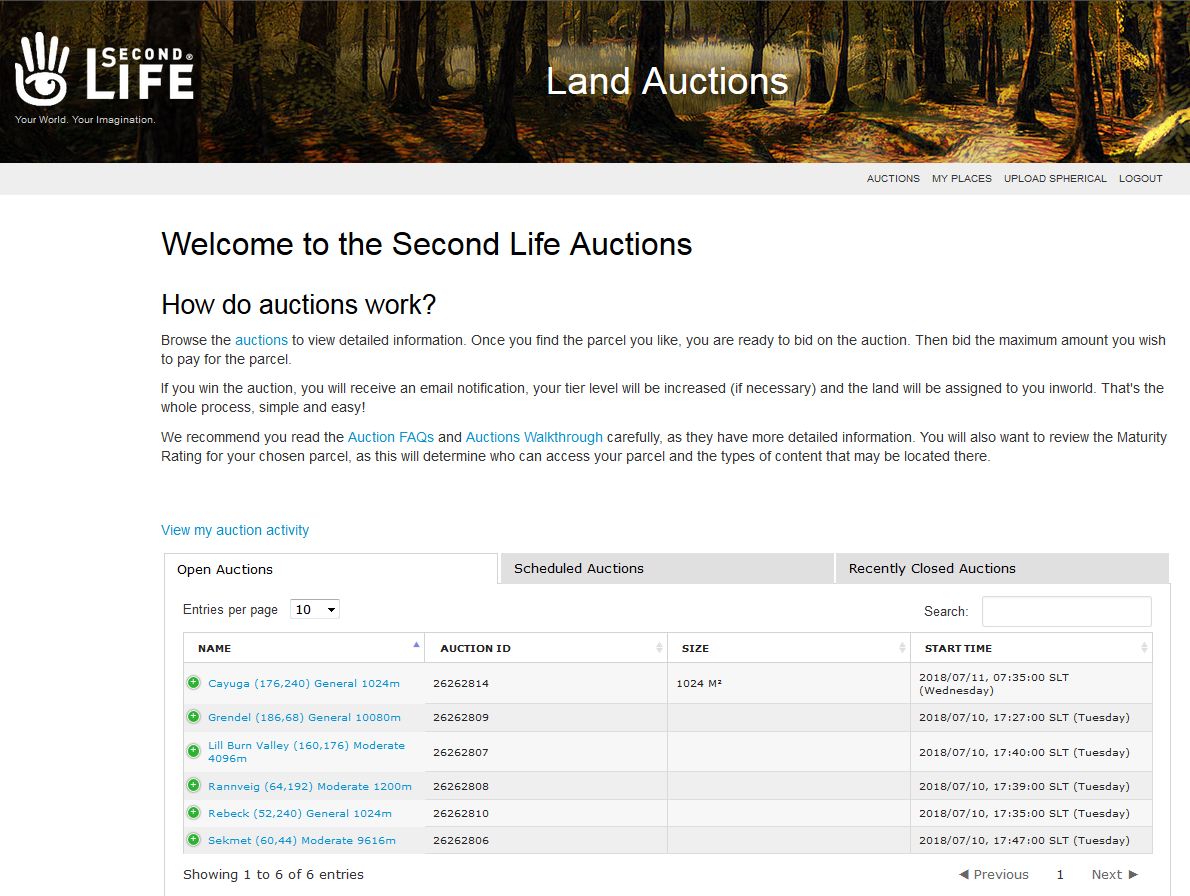
The announcement came via a blog post, A Face lift for Auctions, on Wednesday, July 11th. As per that announcement, the new auction system leverages Second Life Place Pages as the medium for presenting land up for auction and for placing bids, together with a new “cover page” listing available parcels up for auction. which can be found at https://places.secondlife.com/auctions.
As per the official blog post, there are a few things to note with the new system:
Currently, it is for Linden-held land only – Mainland parcel owners will be able to add their own parcels for auction soon.
Auctions of group-owned land are not supported at present.
When bidding, you must have the funds available in your account – under the new system, your maximum bid amount is immediately taken out of your account and held in escrow until you are outbid, or win the auction.
Winning bidders will generally be notified within one hour of an auction closing.
The new Places/Auctions page. Clicking on the link for a parcel available for auction will initially display a brief summary of the parcel (bid end time and current leading bid amount) before taking you to the auction page for the parcel – click to enlarge, if required
To help people get started with the new system, the Lab have produced an Auctions Walkthrough document, together with an Auctions FAQ – both of which should be read by those interested in place their parcels up for auction (when the system is open for people to do so) or who wish to bid on the parcels currently being auctioned.
Those wishing to offer their own land for auction (when possible) and who are not familiar with using Second Life Place pages, may want to read through my Place Pages tutorial. I will be updating this tutorial to additionally include information on how to create your own parcel auctions in due course.
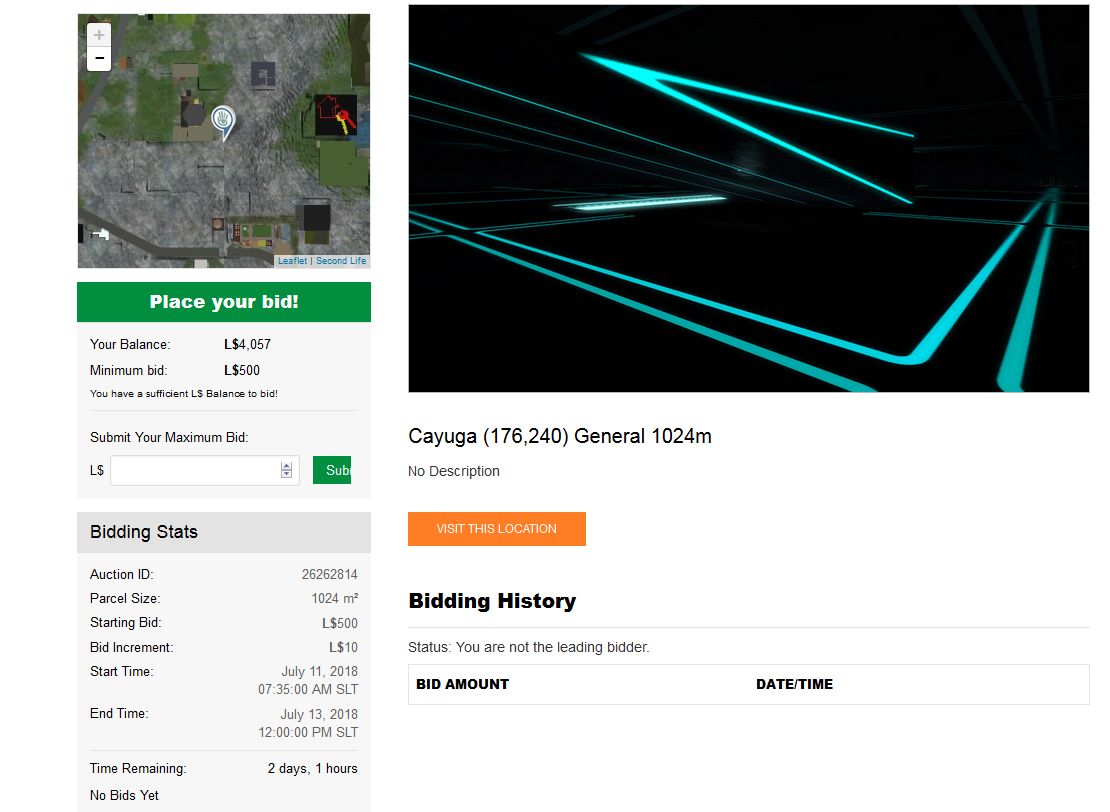
A parcel auction page – note the image on the right is a placeholder; those auctioning their land can include a photograph of it, taken from the parcel’s Place Page


 Inara Pey: Living in a Modemworld