Horizons land auctions: final round-up

The Horizons land auctions having finished
Horizons: rounding-up the land auctions

On Tuesday, November 15th 2016, the Lab launched the Premium members’ Horizons community, a “retro-futuristic” mainland environment featuring 36 residential regions each with 24 parcels available for auction to Premium members, with auctions commencing on Friday, November 18th 2016, with parcels being auctioned in batches of (generally) 10.

Obviously with 864 parcels to auction, it would take some time to get through things, but Whirly Fizzle and I decided to monitor things to see how they progressed, and I gave a brief snapshot at the end of the first week of auctions, and another when the auctions reached a half-way point.  The final lots of parcels was auctioned on the 12th-14th February, and given this, I’d thought I’d round-out the updates with an overall look at things.

All L$  / USD figures are approximate and based on available data. Some approximations have been made using the average parcel price for a region if the actual bid price was missed in collating data (applies to a total of 8 parcels across 864). The US dollar figure is based on a rate of L$260 to the US dollar.

SUMMARY OF AUCTION BATCHES AND TOTALS
Batch
No. Regions
No. Parcels
Total L$
Total USD
Batch 1 10 240 8,744,976.00 33,634.52
Batch 2 8 192 4,304,186.00 16,554.56
Batch 3 8 192 3,334,978.00 12,826.84
Batch 4 10 240 4,489,691.00 17,268.03
TOTALS
36
864
20,873,831.00
80,283.95

Note: a total of 4 regions have been re-auctioned; however, two may have been re-auctioned as a result of original bidder defaulting on payment, as the parcels were apparently re-auctioned without being claimed. If the original payments were made, then a further L$59,131 / approx US $227.42 should be added to the appropriate totals.

Unsurprisingly, this batch of auctions drew the highest bid prices, due in part to the fact that two of the region – Horizons Apollo and Horizons Pandora – have genuine access to sailable open water – the open water to the west, north and east of the Horizons regions currently represent the grid edge, and is not accessible.

Both Batch 1 and Batch 2 were part of my half-way report, and since then, there has been some juggling between those parcels initially put up for sale, those initially offered for rent, and those offered for either rent for purchase.

For those interested in a more granular breakdown of auctions by batch / region, a complete set of tables is available here. The following tables provide a breakdown of parcel usage, based on original bidder’s actions with the parcels they obtained.

GENERAL STATUS OF PARCELS – ALL REGIONS, 864 PARCELS
Parcels Obtained For
Auctioned Sale Rent Either Comm. Private Unkn Re-auct’d
Batch 1 240 100 59 13 4 17 46 1
Batch 2 192 57 55 24 7 13 35 1
Batch 3 192 101 15 37 2 11 26 0
Batch 4 240 69 57 17 5 10 82 0
TOTALS 864 327 186 91 18 51 189 2

Notes

  • Comm = obtained for commercial use
  • Private = obtained for residential or group use
  • Unkn = those most likely obtained for sale / rent but which either have not (as yet) been offered for either / do not appear to have been made available (parcel holders did not respond to enquiries)
  • The re-auctioned parcels are limited to those were a second payment for the re-auction amount can be confirmed. As noted above, two other regions re-auctioned may not have been paid for by the original bidder prior to being put back up for auction. These are currently available for rent, and have been classified in the Batch 2 rental figures.
SNAPSHOT OF PARCELS OFFERED FOR SALE BY ORIGINAL BIDDER
Total for Sale Unsold
Commercial
Private
Offered for re-sale / rent Withdrawn from sale
327 180 23 31 81 12

Notes:

  • “Offered for re-sale / rent” indicates parcels purchased from original bidder and offered for sale / rent by purchaser
  • “Withdrawn from sale” indicates parcels initially offered for sale by bidder, but then set to  “not for sale” & with no indication they are available for rent.
SNAPSHOT OF PARCELS OFFERED FOR RENT BY ORIGINAL BIDDER
Total Offered for Rent Available for Rent
Rented Commercial Rented Private
186 157 12 17


SNAPSHOT OF PARCELS OFFERED FOR SALE OR RENT BY ORIGINAL BIDDER
Total Offer for Sale / Rent Available
Sold Rented
91 64 10 (5 on resale) 17

Notes:

  • Of the 10 sold, the 5 not up for re-sale have been sold for commercial / private use
  • The 17 rented parcels represent a mix of commercial and private use

General Observations

General interest in Horizons appears low – however, this many change now the auctions have finished. Currently, most of the land sales which have occurred post-auction have been between those land resellers / renters originally bidding on the parcels, rather than onward selling to those interested in using Horizons as either a home or a business location.

Sale prices across the  regions appear to be settling into the mid-20K through mid-40K range, although some – notably those with direct open-water access  (as opposed to river / canal access) or perceived water access can carry a premium. Rentals appear to remain at low ebb. As noted previously, this could be down to a lack of direct promotion by those offering them for rent.

Of the 189 listed as “unkn”, almost all are held by those selling and / or renting parcels, so it is not unreasonable to anticipate these being made available for sale / rent if / when current offerings are sold / rented.  One of those holding such parcels did confirm they would be offered for rent, but declined to indicate when.

Those interested in Horizons parcels – whether to purchase (Premium) or rent (anyone), should tour the regions with care. A number of parcels are offered for rent / sale offering boat docking where this is not strictly accurate (e.g. the parcel doesn’t directly join water, or the water it faces is actually off-sim). The regions are also unzoned, so judging how well they may keep to the desired theme is hard to quantify. There are a number of decidedly “non-sci fi retro” buildings across the regions, but many of these are place holders, and should be seen as indicative of the overall region styling.

In the Press: An adept look at Second Life

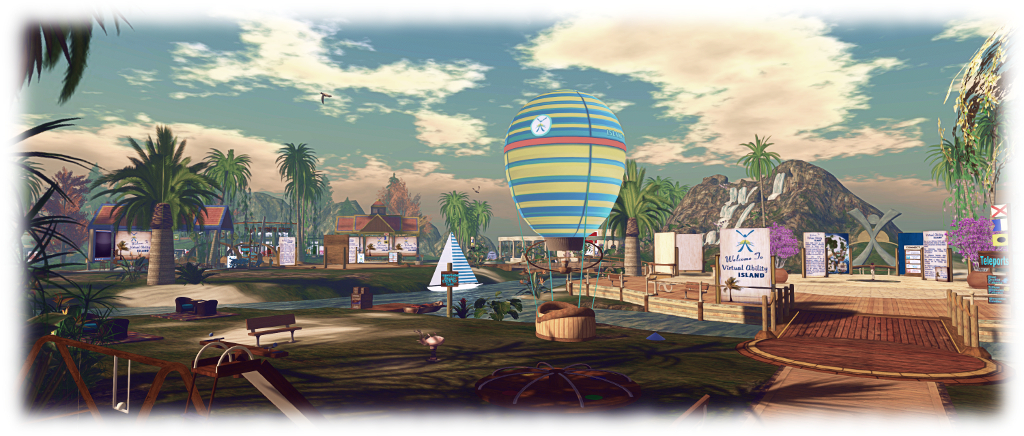
Virtual Ability Island, featuring in the Backchannel article

First They Got Sick, Then They Moved Into a Virtual Utopia appeared in Backchannel on February 13th, 2017. Written by Kristen French, it’s an adept examination of Second Life, with a focus on the help the platform has brought to disabled people around the globe.

The piece starts with Kristen spending time with Fran Seranade, perhaps best known through an early segment of The Drax Files World Makers in 2013 (I covered her story a few months prior to that, as a result of seeing a story about her in the San Diego Union-Tribune). Suffering from Parkinson’s Disease, Fran has found that her involvement in second Life has generated physical world benefits for herself, and she has been – among others – the subject of studies by Tom Boellstorff, a professor of anthropology at the University of California and Donna Z Davis, a professor at the University of Oregon (see my reports here and here).

Kristen French
Kristen French

From Fran’s story, the article broadens its canvas to explore the work of Virtual Ability Inc., touching on the story of Gentle Heron and how VAI came into being and the services it provides. Through this, the piece enfolds the fact that Second Life has been an enormous book to those with many disabilities, including illnesses such as multiple sclerosis, conditions such as autism and PTSD (See here for more on one way in which the platform has been used to help hose suffering from PTSD),  physical disabilities and more.

Much of this may not be especially new to SL users, particularly as a result of our being attuned to the likes of The Drax Files #22, which looked at Sl and health through the work of Virtual Health Adventures. However, for anyone who has not been exposed to Second Life, the piece offers a refreshing, clear-cut insight into one aspect of why the platform remains so popular and well-regarded among its users after 13 years.

It has long been shown that Second Life can have a range of benefits for all of us: it puts us in contact with people, and the ability to visit places and enjoy activities with them where otherwise we might be house bound and confined to little or no physical interaction with anyone of days at a time. It can help us stay healthy, physically and mentally;  it can help healthcare agencies reach their patients (see here and here), and it can be – as seems to very much be the case with Fran – physically and mentally therapeutic.

Fran Swenson (Fran Seranade) and her daughter Barbara Richard (Barbi Alchemi) - images courtesy of San Diego Union-Tribune / Bill Wechter
Fran Swenson (Fran Seranade) and her daughter Barbara Richard (Barbi Alchemi). Credit: San Diego Union-Tribune / Bill Wechter

This examination of Second Life and how it is used makes taking the time needed to read the article worthwhile, but there is more. Through a neatly-encapsulated piece on why Second Life perhaps isn’t as easy to update as extensively as some might believe, the piece moves on to a look at the potential of new worlds like Sansar and High Fidelity.

This is again a considered examination, laying out fairly the benefits more immerse VR environments might be for those with disabilities – and touching on some of the potential barriers. As a part of this exploration of the future, the piece offers a solid reassurance that Second Life isn’t – as yet – facing the end of the road. Instead, it underlines the point the Lab (and I) have often made: SL’s longevity lies as much with its users as it does with LL. So long as there are enough users engaged in the platform to keep it viable, there is little reason for it to be arbitrarily shut down.

There are a couple small misconceptions within the piece. For example, the origins of Radegast: while it is true it was conceived and developed by someone engaged in SL’s Adult / BDSM world, but that doesn’t actually mean it was primarily developed for that market.

However, these really are quite minor quibbles, when noticed. The fact is, First They Got Sick, Then They Moved Into a Virtual Utopia is an engaging, informed and informative piece adeptly written by someone who intrinsically “gets” Second Life. It’s a piece which should definitely be on your reading list if you’ve not come across it already.

In the press: Sansar, Second Life, and avatar empowerment

Via Linden Lab
Via Linden Lab

There have been a number of press reports on Sansar since the start of the year, some of which I’ve covered in these pages – such as in Road to VR (see here), Upload VR and Tom’s Hardware (see here). However, while I’ve read others, I’ve not made the time to write about them. so, in case you missed them, here’s a quick breakdown of notable coverage of the Lab, Sansar and Second Life.

On January 19th, Réalité Virtuelle, the French on-line publication for virtual and augmented reality carried a piece entitled Sansar: la vraie réalité virtuelle débarque en 2017 (“Sansar: the real virtual reality arrives in 2017″).

Penned by Farid Khedri, the piece covers familiar (to those following Sansar’s development) ground, but offers a very well-rounded overview of the Lab’s new platform – and something of a potted history of Second Life, including a look at French politics.

Farid Khedri
Farid Khedri

A nice touch with the piece is that it starts out with a 5-point summary, noting that Sansar gains the advantage of having the Lab’s long-term exposure to VR environments, thanks to Second Life, that Sansar itself is not “Second Life 2.0” (how many time do we have to emphasise that?), but it is geared towards “social VR” experiences.

The potted history of Second Life is dealt with briefly in the first two paragraphs, which offer a rounded view of the platform circa 2003 through 2007. It’s interesting to note that the platform has not only played something of a role in US politics and presidential elections, as Farid notes:

In France, many candidates in the 2007 presidential election, such as Jean-Marie Le Pen, José Bové, Nicolas Sarkozy and Ségolène Royal, opened virtual campaign offices in Linden Lab’s metaverse.

Despite the bubble bursting in 2007/8, again as Farid notes, Second Life has – all things considered – been a success in validating the idea of virtual spaces for social networking, and as a means of learning, business and more. This serves to lead into a well-written piece on Sansar and the Lab’s reasoning behind it (including touching on a return to the company’s VR roots with The Rig – although it is not mentioned by name). As such, and whether you opt to read the original piece, or opt to use something like Google Translate, Sansar: la vraie réalité virtuelle débarque en 2017 is worth taking the time to sit down and run through.

Rachel Metz
Rachel Metz

January 27th saw Rachel Metz delve into similar Sansar territory for the MIT Technology Review.

While somewhat misleadingly entitled Second Life Is Back for a Third Life, This Time in Virtual Reality (Second Life is still very much on its first life, and  – as already noted, Sansar isn’t “SL 2.0”, much less some kind of “Second Life Three”), the article offers a further general overview of Sansar and the Lab’s hopes for it.

Although there is nothing particularly “new” in the piece vis-à-vis Sansar, what I do like about it is that rather than being gung-ho about VR’s future, Rachel offers a measure of caution about how and where the brave new (VR) world might actually go:

Consumer virtual reality is still in its infancy—over two million headsets were shipped worldwide in 2016, according to an estimate from market researcher Canalys. That’s tiny compared to the several hundred million smartphones that ship each quarter, and we’re still figuring out what the heck to do with virtual reality.

And therein lies the rub. As I’ve stated elsewhere, while I believe VR definitely has a future – we just need the technology to mature in ease-of-use (size) and cost – I remain sceptical that it will be as all-pervasive as VR evangelists state – particularly when AR and MR would seem to have much broader practical applications which can impact our daily lives. Thus, Sansar is something of a gamble for the Lab, although Second Life is a long way down the road in demonstrating that if done right, and allowing for the potential for Sansar to fit a lot of suitable use-cases far more easily and affordably than SL has managed, the Lab’s new platform could have a comfortable future.

Going back to earlier in January – but offering a nice pivot away from Sansar and to Second Life, on January 8th, 2017, Alex Burnham examined how Virtual reality opens new doors in education for Florida State University (FSU) News. In particular, he looked at how the university has  successfully leveraged Second Life in undergraduate programmes.

Alex Burnham discussing FSU's use of Second Life for education
Alex Burnham discussing FSU’s use of Second Life for education

The work involving Second Life has been spearheaded by professors William Landing and Stephanie Dillon. Working with Chant Newall Development Group, CNDG,  they have developed  environments within Second Life to help students studying environmental science (under Prof. Landing) and chemistry (under Prof. Dillon).

The article highlights some of the challenges of virtual teaching, as noted by undergraduate student Chris Ortiz, but it also underlines the broad range of opportunities that virtual environments offer for achieving goals and allowing greater understand of, and involvement with, the subjects being taught – something I have little doubt will increase as the likes of Sansar come on stream and which also – equally importantly – demonstrates that far from being a thing of the past, as some pundits would have people believe, education is still a source of involvement and experimentation within Second Life.

Nadika Nadja
Nadika Nadja

In Gender Binary: Second Life, First Loves (January 30th), we are presented within an exploration of gender and identity – two topics which have been much explored in the past through Second Life.

Here, the discussion and exploration – which also in passing touches on archaeological and historical recreation – is presented in a very personal form: the thoughts of Nadika Nadja. It’s a thoughtful, thought-provoking piece, one of a series written for GenderIT.org, poignant for their outright honesty and directness.

Given all that is going on in the world today, with so many fundamental human rights under threat and with so many living in the world who are unable to give expression to their inner selves, Nadika’s article is a powerful reminder of the freedoms inherent in spaces like Second Life we can personally experience – and how they can help us to grow and better understand ourselves and those around us.

This is an article I was tempted to write at length about – but anything I have to say is actually superfluous; Nadika’s own words need no filter; they are beautifully honest and open, and should be read directly.  Instead, I’ll leave you with her closing comment – one which, I think it fair to say, will resonate in all of use who are engaged in Second Life, no matter what our backgrounds, beliefs, feelings or desires.

In turn, Second Life took all my love and gave me something else in return: a community I could depend on, a world I could belong to, an identity I could own.

The final article I’m turning to is Samantha Cole’s piece in Motherboard, Second Life Users Are Protesting With Their Avatars (February 4th, and later picked up by Glixel), a piece looking at Avatars Against Trump moment, established by Strawberry Singh and Cajsa Lilliehook in the wake of the increasingly divisive and negative Trump regime in the United States, and which also reference’s the Lab’s own statement on Trump’s immigration policy (which I reported here).

As noted earlier, politics are not uncommon in Second Life – we are, after all, all flesh and blood behind the screens, so it is only natural the line between physical and virtual worlds is naturally blurred. But as explored within the Motherboard article, Second Life offers a unique ability for people from all backgrounds, religious, geographic, political, social, etc., to come together in a virtual melting pot and – for the most part explore views, understand positions and even form bonds. And which it is required, the platform can also be as much a voice of social conscience as any other medium or activity.

Links to Articles

Horizons land auctions: the half-way point

Horizons: looking at the auctions to date

On Tuesday, November 15th 2016, the Lab launched the Premium members’ Horizons community, a “retro-futuristic” mainland environment featuring 36 residential regions each with 24 parcels available for auction to Premium members, with auctions commencing on Friday, November 18th 2016, with parcels being auctioned in batches of (generally) 10.

Obviously with 864 parcels to auction, it would take some time to get through things. However, the holiday period marked the half-way point in the auctions with 432 parcels auctioned across 18 regions. As Whirly Fizzle and I started monitoring things (largely out of curiosity), and I gave a snapshot at the end of the first weeks of auctions, the half-way point seemed a good opportunity to provide a further snapshot, based on how those 432 regions looked as of Friday, January 6th, 2017.

GENERAL STATUS OF PARCELS FOR BATCH 1 (10 regions) AND BATCH 2 (8 regions)
 Auctioned Parcels Available For (Sold / Rented) Original Auction Others
Sale Rent Either Sold Rented Comm. Resid. Aband Pend Unkn
Batch 1 240 95 55 9 (30) (13) 4 18 1 13 47
Batch 2 192 45 66 24 (3) (3) 7 13 1 0 36
Totals 432 139 121 32 (33) (16) 11 31 2 13 83

Notes

  • Parcels Available For = those parcels bid for and placed immediately on sale / for rent / either
  • Sold / Rented= number of parcels actually sold / rented whether placed for sale  or for rent or either. These set subsets of the Parcels Available For figures, and further breakdowns are provided below
  • Original Auction = those parcels which went directly to private residential use / commercial use during the original auction
    • 4 of the residential parcels may in fact be rented out by bidder
  • Others:
    • Aband = parcels already abandoned by original bidder
    • Pend = regions obtained for sale, but either currently not on sale by bidder (6) or removed from sale by bidder (7 – see sales review, below)
    • Unkn = regions which are not currently in use, nor are they apparently for sale or for rent, and where parcel holders have not responded to enquiries.
RENTAL PARCELS SUMMARY
For Rent Total Rented (16)

Residential Commercial
153 13 3
  • 153 is the total number of parcels available for rent (121), and those offered for rent or purchase (32)
  • Of the 153 parcels currently for rent / rented:
    • 89 are offered through one group of rental operators
    • The remaining 64 are offered through 11 rental groups, with between 1 and 14 parcels on offer per group
  • The average weekly rental for those parcels offered for rent is L$885 (low: L$550; high: L$975)
  • The average weekly rental for parcels offered for sale or rent is L$608 (low: L$495; high: L$800)
PARCEL SALES REVIEW
 Total for Sale Sold (32)
 For Sale Below Bid Price
Residential Commercial Both Re-sale
139 17 10 1 4 20
  • Total for regions on sale does not include those parcels offers for sale or for rent – see rental figures above
  • Of the 139 parcels currently available for sale / sold:
    • 98 are offered by three land sales groups
    • The remaining 41 are offered by 12 land groups / individuals, with between 1 and 12 parcels per individual / group
    • 5 parcels are on sale at prices above L$100,000, ranging from L$112,000 (58.98% mark-up on bid prices) to L$249,000 (255.67% mark-up on bid price) by two land holders
  • Average sale prices:
    • Among all 139 parcels for sale:  L$45,408.
    • Among the three biggest parcel sellers (98 parcels): L$37,360
  • The margins between bid price and sale price vary hugely, between just 2.42% (L$41,000 on a bid price of L$40,033) through to 231.38% (L$199,999 on a bid price of L$62,232)
  • Some 45 parcels have been reduced in price since first being offered for sale
    • The average mark-down on their original price being approximately 25.88%
    • 20 are current for sale at below their original bid price
      • Average drop below bid price: 17.44%
      • Largest drop 50.02% – sale price of L$15,000 on original bid of L$30,010
      • Smallest drop is 0.3% – sale price of L$38,000 on original bid of L$38,010
      • The majority of these drops have been to parcels auctioned in the first batch, and bring prices down to more closely match the prices of parcels the same bidders are selling on other Horizons regions
  • Of the four regions purchased and flipped for re-sale, 3 are by residents without an associated land group / business; one is by another land company active in Horizons.

Commercial Activities

Commercial activities are largely stores (avatar accessories, building materials etc.). Two adult club environments are within Horizons and one sci-fi themed bar.

Approximate Revenue Breakdown

The following table gives a breakdown of approximate revenue across the 18 regions auctioned to date. The US $  value is based on L$260 to the $.

APPROXIMATE AUCTION REVENUES – BATCH 1 AND BATCH 2
Auction Batches Approx L$ Raised Through Auction
Approx US $ (at L$260 / US $)
Batch 1 (10 regions / 240 parcels) 8,714,966.00 33,519.10
 Batch 2 – (8 regions / 192 parcels) 4,309,833.00 16,576.28
TOTALS: 13,024,799.00 50,095.38

Unsurprisingly, the two regions with direct access to open water (that is, parcel which directly access water, with no intervening protected land) – Apollo and Pandora, both located on the south side of Horizons and facing Zindra across water open for sailing / boating, drew the most competitive bidding.

BATCH 1 BY REGION (All 24 Parcels per Region)
Region Total L$
Approx US $
Highest
Lowest
Direct Water Access
Apollo 962,882.00 3,703.39 L$80,000 L$29,787 (x2) 6 parcels
Astrid 749,142.00 2,881.32 L$45,009 L$27,087 (x2) None
Galatea 882,008.00 3,392.34 L$70,010 L$27,010 None
Halley 857,738.00 3,298.99 L$60,010 L$27,111 None
Mercury 903,371.00 3,474.50 L$60,010 L$28,110 None
Nova 857,107.00 3,296.57 L$65,010 L$27,110 None
Pandora 1,029,400.00 3,959.23 L$102,454 L$27,110 (x2) 6 parcels
Polaris 960,663.00 3,694.86 L$60,020 L$27,111 None
Thule 785,673.00 3,021.82 L$45,565 L$27,087 None
Triton 726,982.00 2,792.08 L$40,033 L$26,010 None

The second batch of regions auctioned drew considerably lower value bids, with the third batch of regions more-or-less matching the second thus far.

BATCH 2 BY REGION (All 24 Parcels per Region)
Region Total L$
Approx US $
Highest
Lowest
Direct Water Access
Atlas 542.964.00 2,088.32 L$40,010 L$15,010 None
Celeste 495,317.00 1,905.07 L$30,010 L$12,022 None
Halo 461,464.00 1,774.86 L$32,010 L$13,038 None
Neptune 583,522.00 2,244.32 L$40,121 L$12,121 None
Orion 589,377.00 2,266.83 L$37,799 L$15,009 None
Pluto 521,321.00 2,005.08 L$40,000 L$13,039 None
Sirius 580,799.00 2,233.84 L$42,010 L$12,455 None
Venus 535,069.00 2,057.96 L$40,033 L$26,010 None

General Observations

Outside of those bidding on the parcel lots, there appears to be little direct interest from Premium members in obtaining a property within Horizons. Some may be put off by the Adult rating, others by the lack of any covenant. While the high price of bids places during the first batch of auctions might be considered a reason, the second batch of auctions averages close to half the per parcel bid price of the initial batch, and still generated little direct take-up. This appears to be the case with the third batch.

Rentals  – which should allow non-Premium members to gain a parcel within Horizons if they wished – are currently gaining little traction, although this could be own to lack of promotion on the part of the rental groups. Obviously, the advantage of Mainland holding is they are not a tremendous drain on resources in the way that partially occupied private regions can be.

There may be a follow-up report at the conclusion of the bidding. Or at least a summary of potential revenues. Putting this report together was too much like hard work!

Second Life Horizons land auctions, one week on

Horizons: looking at the auctions to date

On Tuesday, November 15th, the Lab launched the Premium members’ Horizon community, a “retro-futuristic” environment featuring 36 residential regions each with 24 parcels available for auction to Premium members. The auctions opened on Friday, November 18th, with parcels being auction in batches.

One week on, and a total of 87 parcels have been or are up for auction, of which, 67 have closed as of Friday, November 25th, marking the first week of auctions. Whirly Fizzle and I have been tracking things during the week, so we’d thought we’d offer an update on how things are going.

Auction Results Fri Nov 18th Through Friday Nov 25th

GENERAL INFORMATION
Total parcels Auctioned to date For re-sale For rent Commercial Residential Unknown
864 67 26 13 5 11 12

Notes

  • “Unknown” parcels are those which appear likely to be put up for sale or rent. Of these:
    • Four have been obtained by land sellers, with 2 initially put on sale, then withdrawn.
    • Five have been obtained by land renters but are not currently for rent.
    • Three could go either way.
  • Of the commercial parcels, four appear to be rentals; one is parcel holder / store operator.
  • “Residential” refers to those parcels purchased by individuals without any obvious land marketing in their profiles & who have not won auctions for other parcels. These could still be sold / rented out or used commercially.


RESULTS BY LOT
Lot Parcels Top bid
Lowest bid
Average bid
Av sqm bid
Total L$ paid
1 10 57,270 30,133 43,689.80 42.66 436898
2 12 65,010 30,121 39,976.75 39.04 479721
3 15 40,030 29,510 (x3) 31,306.73 28.65 469601
4 10 42,670 31,110 (x4) 35,464.50 34.53 354645
5 10 40,110 26,010 (x2) 37,751.80 30.91 317518
6 10 33,009 27,887 29,790.20 29.09 297902


REVENUE
 Date No of lots
L$ raised in auction Approx US $
 Nov18th-25th 67 2,356,285 9,000

Notes

  • Taking the lowest bid price for all auctions closed to date, and applying it to all remaining parcel yields a potential total revenue of L$24,582,224 / approx US $94,500.
  • Taking a median bid price of L$36,330 based on closed auctions to date, and applying it to all remaining parcels yields a potential total revenue of L$28,955,010 / approx US $111,365.


PARCEL RE-SALE PRICING, FRIDAY NOV 25
Total Av sqm auction price Av sqm sale price
Av sqm mark-up
Highest initial price Highest current price Price spread
26 28.05 57.38 104.56% L$100,000 (x3) L$99,000 (x1) L$33,000 (x4) – L$99,000 (x1)

Notes

  • The figures above are only a snapshot – re-sale prices are fluctuating; prices set for parcels auctioned in lots 5 and 6 are likely to be reduced.
  • Initially, 28 parcels were put up for sale. Two were withdrawn on Friday 25th.
  • Of the remaining 26 parcels currently for sale:
    • Six parcels were initially priced at between 25 and 3 times their auction price; all have had their re-sale price reduced by an average of 50%.
    • Four parcels have seen a reduction in price since first being placed for sale of between 2.5% and 21.52% per parcel.
    • Eight parcels are currently for sale at a median of 2.5 times their auction price (ave L$70,000 per parcel). current tends suggest these will be reduced.


PARCEL RENTALS, FRIDAY NOV 25
Total Rented to Date Upper rental price
Lowest Rental Price
Median Rental
13 4 L$835/w (x1) L$595/w (x4) L$775/w (x4) / L$795/w (x4)


Lab reveals LI / prim allowance changes in Second Life – in full

Note: An earlier version of this article appeared in error whilst still being drafted on-line, as a result of a mistake on my part and to my own embarrassment. Once again, my apologies to Linden Lab and readers of this blog for my carelessness.   

It is something Second Life users have long wanted / wished for / desired / demanded: an increase to the basic land impact (or prim count, if you still prefer) available for regions.

And now the wish is being granted – although word came out a lot sooner than the Lab had anticipated (thanks in part to my aforementioned mistake).

However, on Thursday, November 3rd, the Lab officially announced that they are increasing the Land Impact allowance for Second Life regions. The new allowances are:

  • Full Regions:
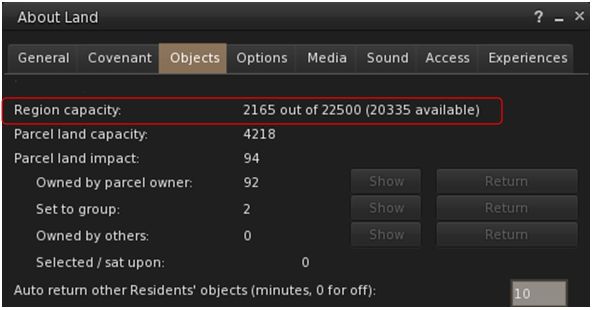
    • Mainland: 22,500
    • Private estates:
      • 20,000 at the same tier price OR
      • 30,000 for an additional US $30 a month (+a one-off US $30 conversion fee to add / remove the extra 10K allowance)
  • Homesteads: 5,000 (Mainland and private)
  • OpenSpace: 1,000 (Mainland and private)

All of the changes filter down to the parcel level, according to parcel size.

Mainland full regions now have a 22,500 Land Capacity / prim allowance as standards
Mainland full regions now have a 22,500 Land Capacity / prim allowance as standard. Those with prim bonuses will be based on the new LI / prim allowance

The changes to Mainland regions were made during the regular weekly deployments on Tuesday November 1st, and Wednesday, November 2nd, with official confirmation being given in part in a blog post from the Lab which indicated the increase to Mainland full regions alongside the most recent Premium subscription offer (note: that blog post from the Lab has now been updated).

So why has this change come about?

“We’ve finally reached the point where we have the equilibrium between technology and software performance on our side,” Patch Linden, Senior Director of Product Operations at Linden Lab informed me, as we sat down to discuss this and other aspects of Second Life. “The hardware we use to run the simulators is in a really good place right now, and will continue to be. Of course, as time goes on, things will continue to get better in that department. And the simulators are running so efficiently now, with all of the back-end work that we’ve done with them over the past several years that we can now do things like this.”

Patch Linden
Patch Linden

“We started with Mainland being it’s obviously ‘ours’ to directly influence,” Patch said. “We could deploy, and watch, and listen to the metrics to see what they tell us. Then providing everything behaves, we’ll go out to the rest of the grid and all private regions shortly thereafter. It is such a fundamental change to the simulator that we want to make sure we do it right, and we don’t cause unnecessary harm in the process. So the more controlled we could do it, the better we felt.”

It was this need to watch and wait following the initial deployment which had caused the Lab to decided to hold back on a public announcement until Thursday, November 3rd. However, users noticed the change almost as soon as mainland regions came back on-line following the Tuesday rolling restart, prompting forum posts and support enquiries as to whether there had  error. As a result, Patch issued a short forum post reassuring people there wasn’t an error, although the decision was made to hold off on any official announcements until November 3rd, due to the arrangements already in place – including a live Designing Worlds session featuring Patch, who would reveal more and take questions.

So given the Mainland changes are now deployed, a key question I had for Patch was: when would Private regions see their update. “We should have them up and running within the next couple of months,” he replied. In essence, the precise roll-out to private islands will depend upon the metrics gathered following the Mainland roll-out.

And the reasons for the differences in the full region allowances between Mainland and private estates?

“There are  2 reasons,” Patch explained. “The first is that Mainland regions have long been a slightly less costly, but also less feature rich product than private islands. But recently we rolled out the private region buy-down offer, which somewhat levelled the pricing between the products. So, we wanted to give a little something back to Mainland, and choose to give full regions there a slightly higher prim limit increase than private estates.

“The second reason  is that private estate full regions have an additional advantage over all the other region types,” Patch continued. “This allows us to offer the additional 10,000 LI allowance to private estate full regions, for a total of 30,000. There is some additional maintenance work that comes with this, hence the US $30 a month fee (per region), together with a one-off  US $30 conversion fee to add or remove that option; but the offer will be available for any price level full region, whether it be an older grandfathered region, a newer bought-down region, or a regular priced full region, immediately the increase in land impact / prim allowance is rolled-out to private estates.

“So you might say, it’s a little give, a little take, and a bit of balance between the advantages of the differing products  :).”

Linden Home holders should now find they have 175 LI as their own to play with
Linden Home holders should now find they have 175 LI as their own to play with – as will users with 512 sq metre parcel on the Mainland, with other parcel sizes adjusting accordingly. The same will be true of private islands, once the update is fully deployed.

In the meantime, the change to the Mainland was warmly received by most, with many land holders and content creators pointing to the home and garden / landscaping markets potentially gaining a significant shot in the arm as a result. This is significant, as a hope at the Lab is that rather than everyone simply adding more objects to their land, the extra capacity will encourage more content creators to make use of optimised levels of details on their mesh creations, rather than using very high LOD values across all viewing distances, thus helping to lighten some of the current load on older systems.

As we closed the conversation, I asked how Patch, as a long-term Lab employee and as a former resident, felt about the change.

“This is something I’ve wanted to do for several years now,” he replied. “And we’re pleased to be able to do something as fundamental as this to change the product in a good way.”

With thanks to Patch Linden, Pete Linden and Linden Lab.