US comedians in line-up for new Sansar series

Image courtesy of Linden Lab

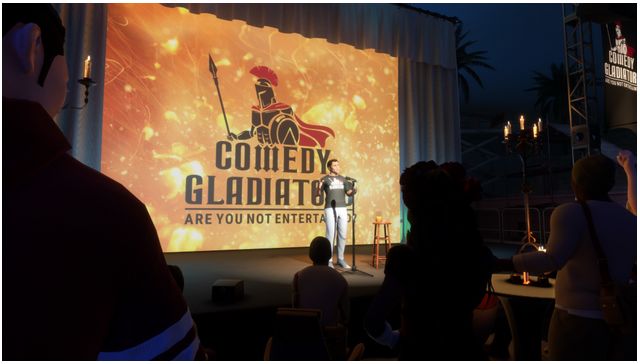
On Wednesday, November 28th, Linden Lab announced a new series for Sansar: Comedy Gladiators, hosted by American comedian and television personality, Steven Hofstetter, which Linden Lab describes as:

A live comedy showcase that lets anyone, anywhere step directly into a comedy club for the night. The series will allow fans to do everything in VR that they would do at a real-life comedy club: purchase tickets in advance, shop for custom merchandise and memorabilia, even order drinks.

– From the Linden Lab announcement

Steven Hofstetter – Hosting and participating in Comedy Gladiators

The first event in the series is scheduled for 19:30 Pacific Time (US) on Monday, December 10th, and will feature the talents of Ben Gleib, Maz Jobrani, Alonzo Bodden, and Mary Lynn Rajskub – perhaps best known on television for her role as Chloe O’Brian in the action thriller series 24.

Comedy Gladiators represents a number of firsts for Sansar.

It is the first ticketed event on the platform. Ticketing is a capability the Lab have been developing for a while for Sansar, with the idea that in time, experience creators will be able to sell tickets to events held within their own experiences.

For Comedy Gladiators, tickets are offered for sale through the Sansar Store at US $4.99 through until December 5th, and then US $9.99 thereafter, up to the event itself. I would anticipate that in the future, experience creators will be able to sell their tickets the same way.

Another interesting factor with Comedy Gladiators is that it mixes the ability to purchase both virtual and physical through the Sansar Store – in this case, copies of Hofstetter’s latest book, Ginger Kidd – with the virtual goods including t-shirts, beer mugs.

Finally, the series is potentially the first large-scale showcasing of Sansar’s “Avatar Broadcasting” feature. This allows performers and presenters working from a single stage / experience in Sansar to reach a potentially unlimited audience through multiple linked instances of the event.

Every day, I get emails and DMs from fans who want to see a live show, but they live in parts of the world I’ll probably never tour in. VR allows those fans to not only see a live show, but feel like they’re part of a bigger community.

– Comedy Gladiators host, Steven Hofstetter

It’s not clear where else the event is being advertised – in checking various websites, including Hofstetter’s own, I didn’t come across any direct adverts. However, the media have picked-up on the event, with reports in the likes of  Variety, with the original press release being reproduced in multiple on-line media covering business, VR, and entertainment.

The Lab is clearly hoping for big things from this move, with Ebbe Altberg noting:

By bringing these commercial opportunities into VR, Sansar is taking virtual events to a whole new level – enhancing and expanding on what’s possible in-person. We look at Comedy Gladiators as the first ripple in a larger wave – the first event of many more that bring entertainers into VR.

– Ebbe Altberg, Linden Lab CEO

The line up for the first Comedy Gladiators: Mary Lynn Rajskub, Ben Gleib, Maz Jobrani and Alonzo Bodden

It’s not clear how often this series will take place, or whether this first event is simply experimental. However, it is a daring move to bring something new and different to VR, and to extend the concept of social VR within the realm of entertainment.

One potential stumbling block is the comparatively low uptake of VR headsets; given Comedy Gladiators is being promoted as a “social VR event”, without very clear underlining that Sansar can also be enjoyed as a desktop activity, there is a risk people might avoid the opportunity to join the audience even if advertising does reach a wide audience due to the misapprehension that a VR headset is a requirement.

On a personal note, I am also curious as to the origins of this series – Comedy Gladiators is a monthly live event held in Bristol,  UK – which I believe is where Sansar’s community manager, Eliot, originally hails from…

With thanks to Wurfi for the heads-up.

Sansar extends to Steam; Lab to end SandeX

Courtesy of Linden Lab

On Tuesday, October, 30th, 2018, Linden Lab announced a significant set of changes to Sansar. In We’ve come a long way together. We can’t wait for what’s next, Landon McDowell, Linden Lab’s Chief Product Officer for Sansar, announced the Lab will, from around the start of 2019, be offering Sansar to users via the Steam gaming platform.

As Landon also goes on to explain, in order to achieve this goal, some significant changes are to be made to how Sansar operates, particularly with regards to SandEX, which is to be discontinued, and how  the process credit system work, with Landon noting:

These changes will also make the credit process for Creators far more consistent and predictable. The first change is that we will be discontinuing the Sandex as of December 4, 2018.

After that date, we will be moving to a fixed conversion rate model. Creators will continue to be able to sell their work for Sansar Dollars on the Store (and soon in experiences!). Eligible creators may convert some or all of their earned Sansar Dollar balance to US dollars at a rate of S$250 to $1, and then request a USD credit to be processed in 30 days. This matches Steam’s payment timeline.

We understand that this may have an impact on the amount of revenue returned to creators compared to the Sandex. However, we believe that in the long run our creators will significantly benefit from having access to the larger Steam user base. In addition, anyone who has created their Sansar account before December 31, 2018 will receive a legacy conversion rate of S$143 to $1 until December 31, 2019, after which the conversion rate for all accounts will be S$250 to $1.

Our automated Sansar Dollar Conversion page will not be available until January 2019. In the interim, we are committed to working with our Creators to manually process credit requests of Sansar Dollars through an email process, the details of which will soon follow.

These are significant changes which bring with them significant questions. While attempts have been made to address some of these through the Sansar Discord channel, Landon has indicated the next product meet-up, scheduled (at the time of writing) for Thursday, November 1st, 2018 at 11:00 PST (not Friday, November 2nd, as quoted in the blog post) will be used as an opportunity to address and discuss questions and concerns directly.

Sansar is expanding to Steam – something LL tried with SL in 2012. Times have changed on since then, so will Sansar do better?

All told, this is an interesting move, one the Lab sees as in keeping with the aim – stated at the start of 2018 – that they wanted to start growing their consumer user base (as opposed to designer / creator users). While some have chosen to question it on the basis of Steam’s VR-capable user base (which would appear to be just 0.72% of Steam’s 90 million monthly active users), it’s important to remember that Sansar has a Desktop mode and – as Landon alludes to in his blog post – Steam users are liable to have the kind of hardware required to comfortably run Sansar.

Of course, whether or not Sansar really is ready for a consumer focused prime-time is highly debatable. It could rightly be argued that there is a lot of functionality that might be seen as essential to generating widespread user appeal that is still missing from the platform. It’s a view I’d actually agree with; but it is worth pointing out that Sansar has come a long way in the last 18 months, and some of the more recent updates, together with those planned for between now and the end of the year, stand to significantly improve Sansar’s usability even further.

Jason Gholston departs Sansar and the Lab

Jason Gholston

Jason Gholston, who through social media and interviews, had become something of a public “face” for Linden Lab’s Sansar Social VR platform, has left the company for pastures new.

Jason joined the Lab in April 2012, working initially on Second Life before transitioning into the Sansar team as a Director of Product.

While working on Second Life, Jason Led the maintenance engineering team with a focus on customer retention and quality of service, and oversaw the attempts to integrate Oculus Rift with the platform.

On transitioning to work on Sansar, he worked on creating the Unity prototypes used to greenlight the development of Sansar. As Product Manager, he was responsible for management of the monthly releases of Sansar from the engine, rendering, audio, level editor, terrain editor, VR level editor, avatar simulation, and content pipeline teams. He also initially hosted the weekly VR meet-ups with the creator community within Sansar to gather feedback, help troubleshoot issues.

Jason was also responsible for establishing Sansar Studios, the content creation team for Sansar. This team has been responsible for developing a range of experiences on the platform designed to help demonstrate capabilities within the platform and for working with content partners to develop unique experiences.

From left to right: Jason Gholston, Drew Struzan, Greg Aronowitz discuss the Drew Struzan Gallery in Sansar during a Deviant Art livestream event with host Matthew Holt. Credit: Deviant Art

As a part of running Sansar Studios, Jason initiated and negotiated unique partnerships and content commissions between Linden Lab and partners, valued at over US $2 million. Some of these partnerships have included the development of experiences tied-in to the Ready Player One movie – Aech’s Garage and Aech’s Basement, the Star Trek ties-ins, Bridge of the USS Enterprise and the Roddenberry Nexus, and most recently No Spectators: The Art of Burning Man, a collaboration between Linden Lab, Intel and The Smithsonian American Art Museum.

Jason also managed the collaboration with Greg Aronowitz and Drew Struzan that resulted in the Hollywood Art Museum, featuring Star Wars memorabilia reproduced in Sansar, together with the art of Drew Struzan and a reproduction of his studio workshop.

The Bridge of the USS Enterprise – a social space where people can watch weekly broadcasts of the Mission Log Live series by Roddenberry Entertainment, hosted by Ken Ray (seen on the viewscreen) and John Champion. One of several collaborative experiences in Sansar Jason Gholston helped bring to fruition

In leaving the Lab, Jason has moved to work for UK-based Speech Graphics, where he takes up the role of Creative Director, working out of the company’s Bay Area offices. Speech Graphics is one of Linden Lab’s technical partners with Sansar, the platform utilising the company’s technology to provide accurate avatar lip-syncing and facial animations, driven in real-time as users simply speak into the microphones on their HMDs or audio headsets.

On a personal note, I had the pleasure of dealing with Jason on several occasions whilst preparing Sansar articles for this blog, and would like to thank him for his willingness to provide his time and assistance, and for supporting this blog through social media. I wish him every success at Speech Graphics.

2018 Sansar Product Meetings week #42: licensing changes

Courtesy of Linden Lab

Note: This should have been a Product Meeting summary for week #42 2018. Unfortunately, my PC blue screened on me, some 45 minutes into the meeting, and I lost all audio to that point. As such, these notes focus only on the licensing  / permissions changes as reported in the official blog, with some additional notes from the meeting.

Licensing and Permissions

Following the R26 Thumbs Up release on Tuesday, October 9th, 2018 and the feedback provided, Linden Lab are making changes to the new Licensing and Permissions system. The full details can be found in the official blog post, and summarised below:

  • All items uploaded prior to the R26 Thumbs Up release are re-designated “Unlicensed” objects.
    • Unlicensed items will once again be editable as they were prior to the R26 release. This includes editing values in scripts, editing materials and all other object properties.
    • Unlicensed items can be combined and saved back to inventory, but they cannot be uploaded to the store and sold.
  • All items uploaded after the R26 deployment are designed as “Licensed” objects.
    • These will have fully editable properties  – including materials (so items no longer have to be set to Full Permissions in order to have their materials editable).
    • Unlicensed items can be combined with Licensed objects (e.g. an unlicensed script can be included in a licensed object) and saved back to inventory. However, the combined object cannot be uploaded to the Store for sale.

These changes will come into effect with a Sansar point release due on or around Thursday, October 18th, 2018.

An important point to note with the changes is that all objects uploaded since the R26 release will, by default have materials editing enabled by default as Licensed objects. Therefore, those items for which the creator does not wish to have materials editing enabled will have to be modified after the update has deployed.

Sample of updates properties editing on Licensed and Unlicensed objects. This was a work-in-progress at the time the images were captured, and the final design may be different on release. Credit: Linden Lab

Additional notes:

  • The official blog post on licensing also includes an FAQ that was a WIP at the time of writing this update, therefore please refer to that post for further updates.
  • There will be a further licensing / permissions update (most likely R28 in November) to surface what is, and what is not, an editable parameter on an object.or combined object.
  • As a reminder: all of the above, and the licensing / permissions system in general, only applied to “in scene” objects, Clothing and worn accessories are currently not a part of the licensing / permissions system, but will be added in the future.
  • To become Licensed products, any objects uploaded prior to R26 must be re-uploaded into order to enabled the ownership / license tracking on it.


Sansar “watch room” contest: S$5,000 + Oculus Rift

Courtesy of Linden Lab

Linden Lab is running another Sansar experience creation competition, this one with a S$5,000 first prize (equal to US $50) and an Oculus Rift headset and touch controllers (approx US $400) up for grabs.

For this competition, entrants are asked to build a “watch room” – a space where people can gather to watch a media stream on one of three topics: anime, sport or pets. The “watch room” can be as complex or as simple as entrants desire, so long as the environment matches the subject matter of the media stream (so if the video is of pets, then pets should feature in the experience design).

The Dotaworld lounge space, by Sansar’s Community Manager, Eliot, is offered as a suggestion for a simple “watch room” layout – although entrants to the content should decorate their environments to match the style of media they have chosen

Videos themselves should be drawn from Twitch, YouTube or Vimeo, and should be played on a purpose-built media surface, or a suitable media surface obtained through the Sansar Store, some examples of which include:

All of which are available for download and use free-of-charge.

Entries are made by publishing completed entries in the Sansar Atlas and then sharing a link to the experience on Twitter, using the hashtag #MySansarLounge and tagging @SansarOfficial with the link.

OpTic Gaming’s official Greenwall VR Sansar experience could be considered an example of a more complex watch room style of experience

The closing date for entries is Sunday, September 30th, 2018. The full rules for entry can be found on the Sansar website, with perhaps the most important being that experiences entered into the competition cannot break copyright law or feature intellectual property – including the media stream – that the user does not own the rights to.

More Star Trek in Sansar: the Roddenberry Nexus

Sansar: Roddenberry Nexus; Inara Pey, August 2018, on FlickrSansar: Roddenberry Nexus – click any image for full size

In May 2018, Linden lab via their design team of Sansar Studios launched a collaboration with Roddenberry Entertainment, run by Eugene “Rod” Roddenberry Jr, the son of Star Trek creator Gene Roddenberry. It saw the opening of a new experience, The Bridge of the USS Enterprise (read here for more) and came with a promise of “more to come”, probably around the time of the Star Trek Las Vegas 2018 convention (Auguest 1st through 5th, 2018). Well, in keeping with that promise, on Wednesday, August 1st, Linden Lab and Roddenberry Entertainment unveiled the next step in their Sansar collaboration.

The Roddenberry Nexus is billed as “the final frontier of fan engagement. Experience the legacy of Roddenberry in a whole new way – never-before-seen props, costumes, and so much more.” And it is a beautiful build; albeit one perhaps a little light (for the time being) on the kind of detail Trek fans like myself might like to see.

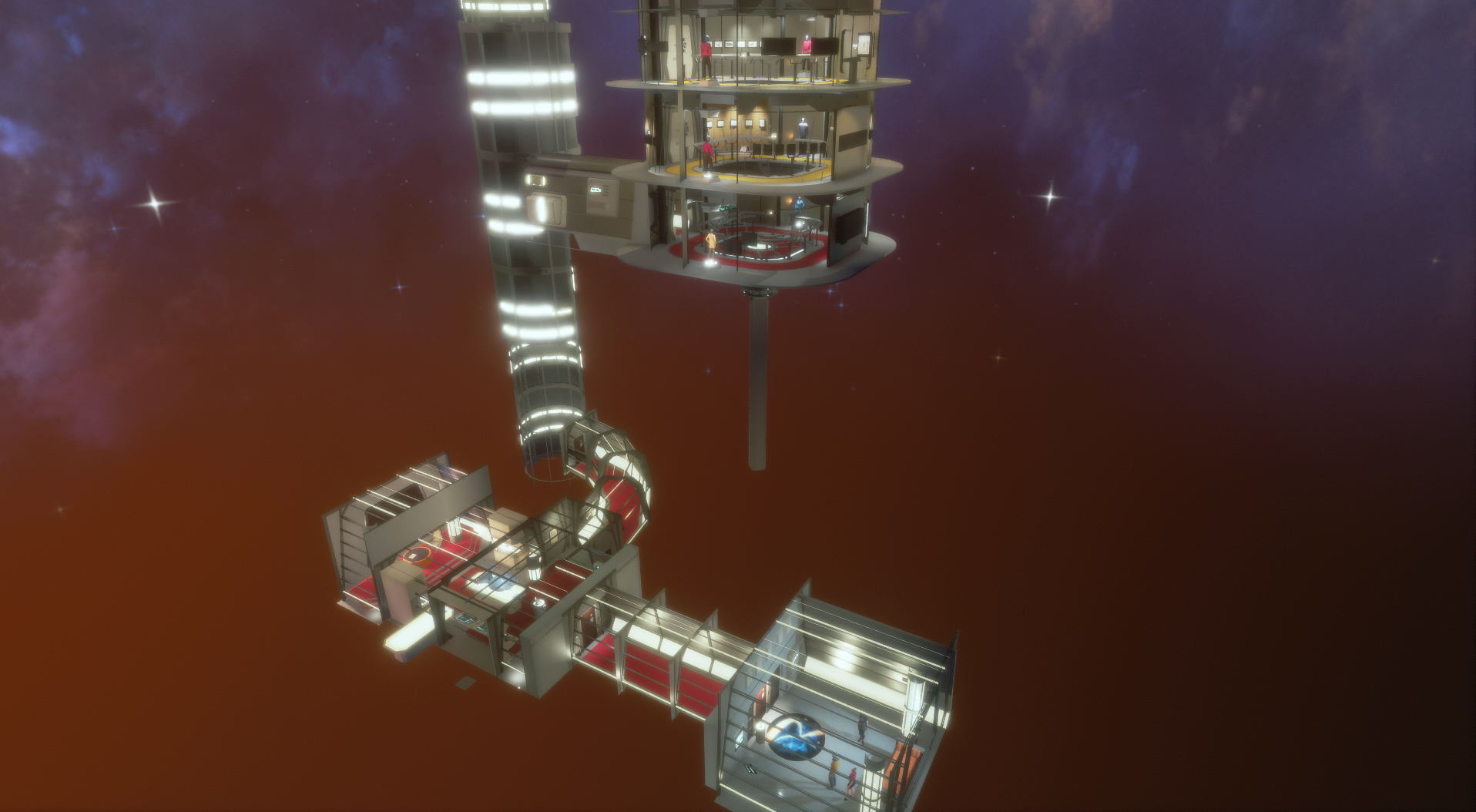
Sansar: Roddenberry Nexus; Inara Pey, August 2018, on FlickrSansar: Roddenberry Nexus: The experience is fairly complex, starting at the spawn point, bottom right, proceeding through the lower exhibition space, thence via corridor to a teleporting “turbo elevator” to the upper three galleries, which are linked by a central lift platform

The spawn point for the experience is very mindful of the cabin designs seen in 1979’s Star Trek: The Motion Picture (ST:TMP), complete with corner lighting column. Here one can listen to an introduction to the Nexus from Rod Roddenberry before passing through the waiting door into a ship’s corridor.

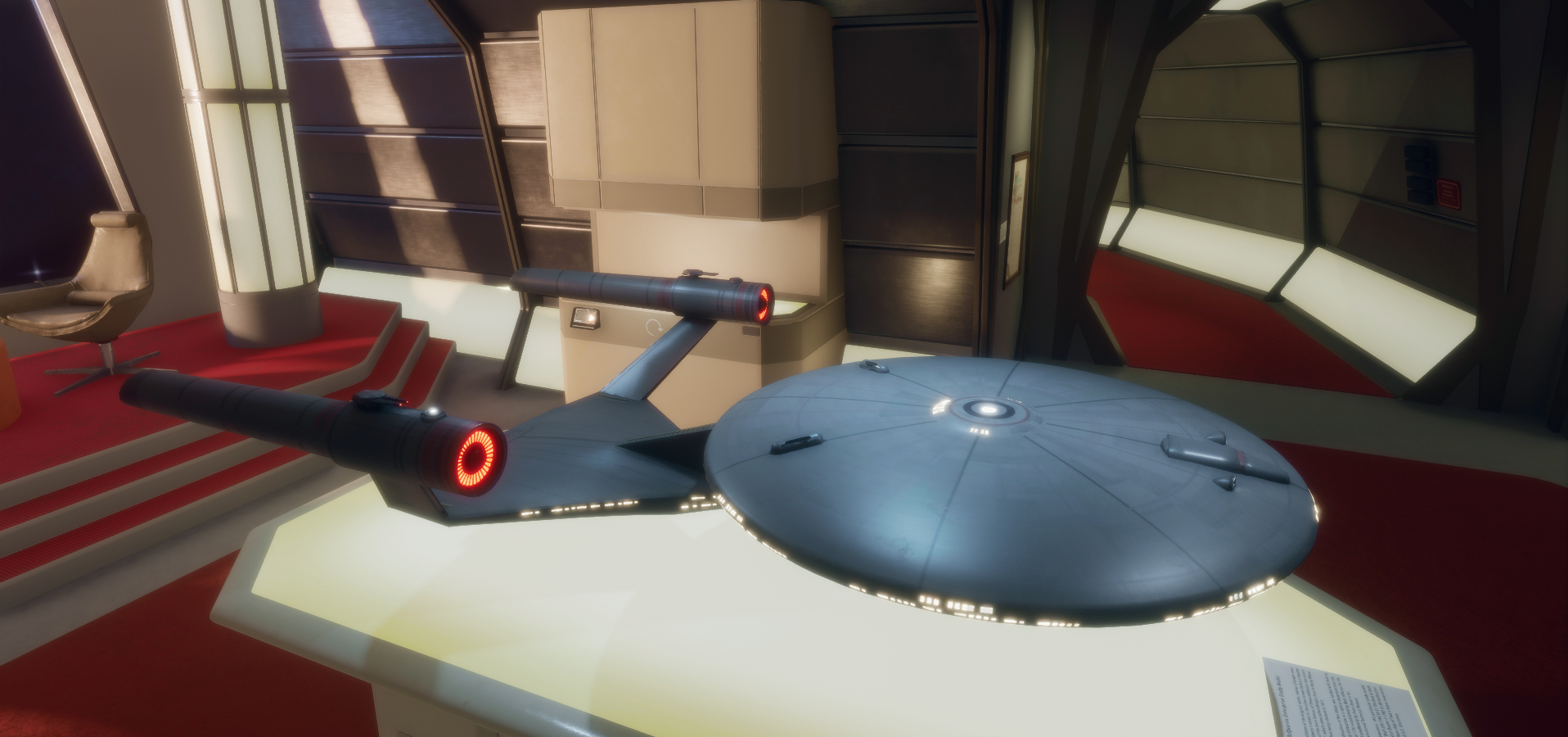
This leads to the first display room, which, other than the couch at the far end is a little suggestive of the engineering space found in the Enterprise-D of Next Generation fame. It i dominated by a model of the McQuarrie concept for a radically altered USS Enterprise design, which is seated on what could otherwise be taken to be representative of Geordi La Forge’s engineering table.

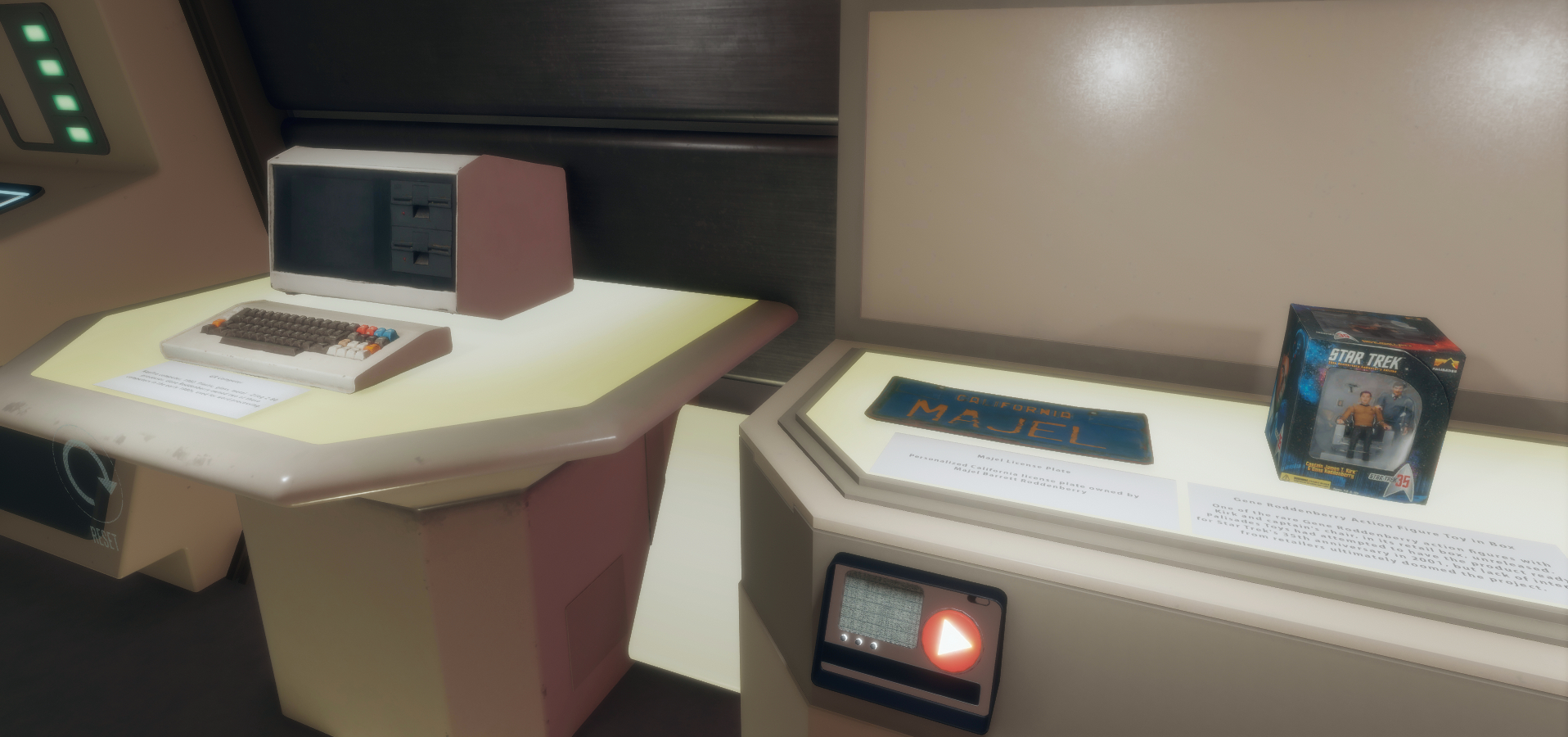
Sansar: Roddenberry Nexus; Inara Pey, August 2018, on FlickrSansar: Roddenberry Nexus: personal memorabilia from the lives of Gene and Majel Roddenberry, reproduced in Sansar

This was the design (seen at the top of this article) being considered for one of the potential returns of Star Trek following the 1969 cancellation of what was to become known as a The Original Series (TOS). This design is perhaps most readily associated with the unproduced TV series, Star Trek: Phase II, however, as the text accompanying the model notes, originally, the design was put forward for a Star Trek film, Planet of the Titans, which was pushed to one side in 1977 in favour of the new TV series concept. While both film and series were ultimately never made, as every Trek fan will know, and as the text again confirms, the design did make two on-screen appearances in Star Trek; The Next Generation, and formed the inspiration for the Crossfield class of vessel seen in the latest incarnation of TV-based Trek, Star Trek Discovery.

Also to be found on this level are some wonderful miniatures representing props from the original series and Trek’s first big screen outing. There are also models more personal to the life of the Roddenberrys: a reproduction of the Kaypro wordprocessor model used by Gene Roddenberry after he gave up on the typewriter (a computer perhaps made most famous by science fiction author Sir Arthur C. Clarke), a copy of Majel Barrett-Roddenberry’s personalised car license plate, and a model of the infamous IDIC Medallion.

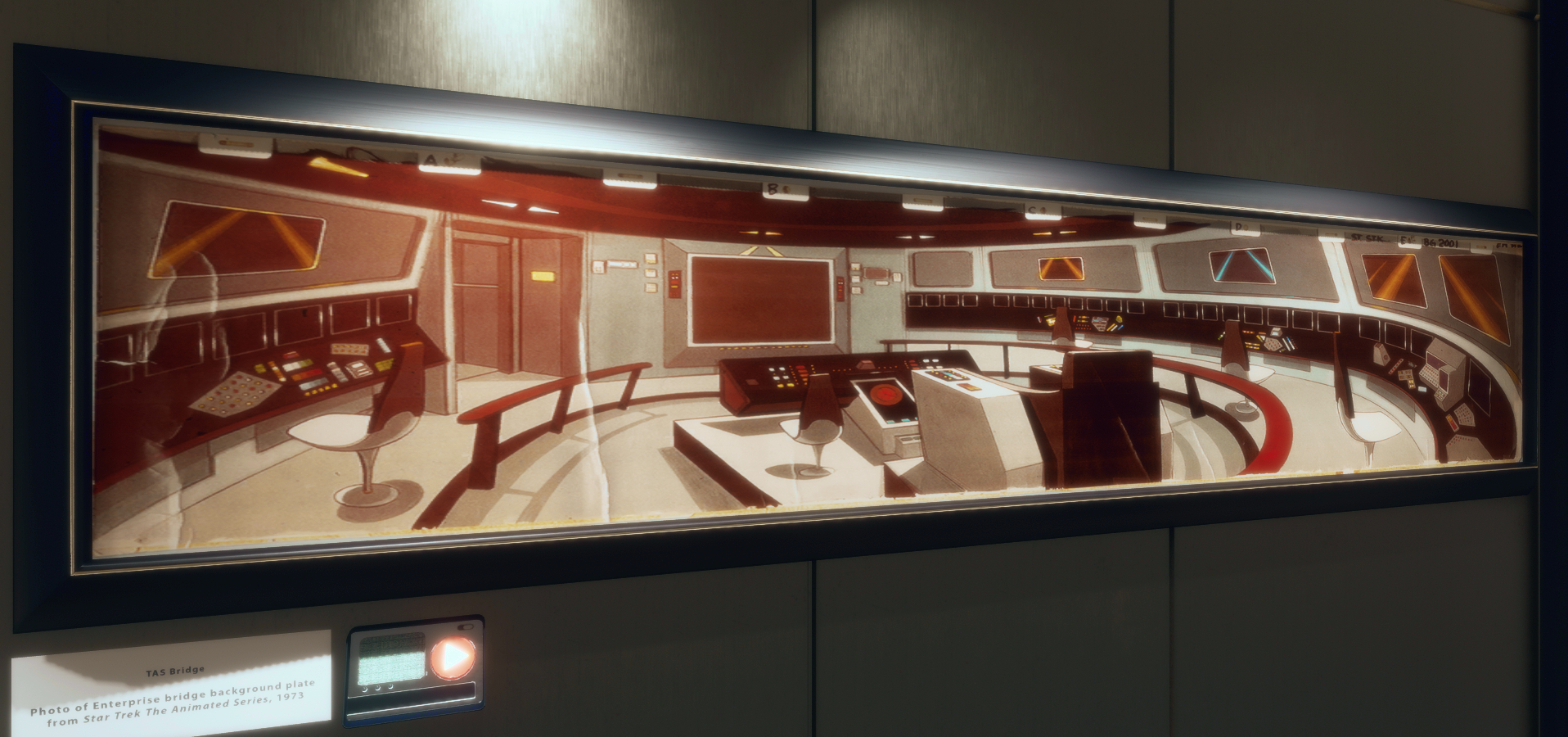
Sansar: Roddenberry Nexus; Inara Pey, August 2018, on FlickrSansar: Roddenberry Nexus: recalling the 1973 Star Trek animated TV series

Beyond this, on the additional levels, reached by teleport and a working elevator, can be found more in the way of reproductions of various Trek uniforms, together with artwork from (again) ST:TMP in the form of storyboard sequences, and also from one of the more overlooked aspects of the franchise – the 1973 animated series. Additional displays along the corridors complete the initial content, while communications panels spaced throughout the experience provide audio information from a range of hosts, all of whom have ties to, or worked on, the various Trek incarnations.

In terms of the individual series and films, the Nexus is perhaps a little light: The Motion Picture gets fair coverage, but the other films – outside of things like uniforms and insignia – are almost entirely absent. However, Trek is a big subject, and much of the latter history is more than likely fairly familiar to most Trek fans, so this can perhaps be forgiven, particularly as the Nexus will be expanded over time. The infamous Kelvin Universe and Star Trek Discovery are present, albeit in a most subtle manner (check the insignia display along one corridor). It’s also probably not unfair to say that trying to cover everything  – even leaving aside 52 years of history being voluminous – is likely made more difficult by the complex web of rights involved in Trek (CBS holding the television rights, Paramount retaining the big screen rights and so on).

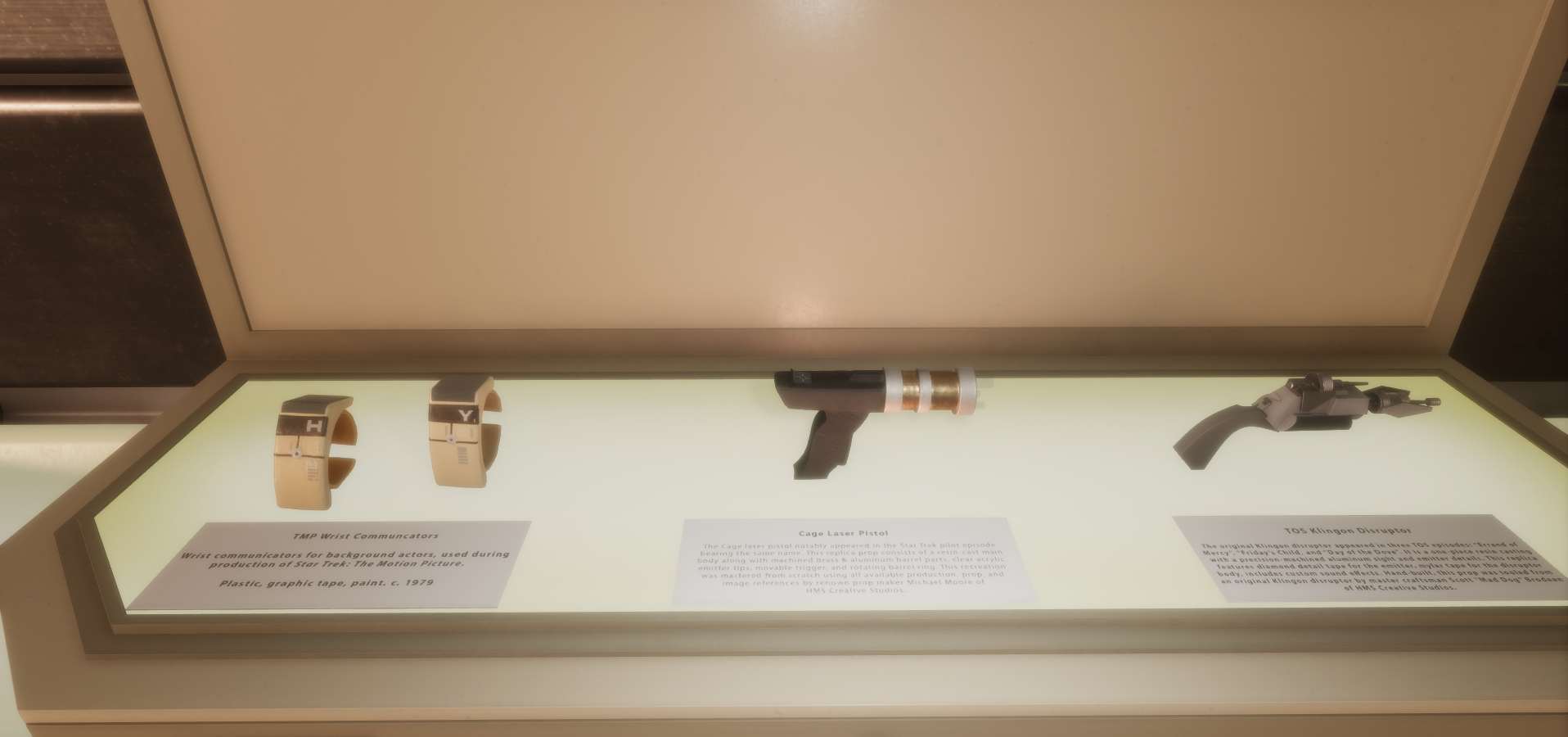
Sansar: Roddenberry Nexus; Inara Pey, August 2018, on FlickrSansar: Roddenberry Nexus: prop from The motion Picture (l), the original TV pilot of The Cage (c) and The Original Series (Klingon disruptor, r)

Those attending  STLV 2018  have the opportunity to visit the Nexus in VR – and possibly wind an Oculus headset and “Roddenberry Goodies” in a raffle. There weren’t too many people availing themselves of the experience during my three visits – but then, I’m across the Atlantic and half a continent away from Las Vegas, so it’s unlikely my visits coincided with times when I was in the experience (05:00 and 07:00 Las Vegas time on my 2nd and 3rd visits).

As a means to attract an audience, approaches like this – offering something unusual and with a guaranteed niche audience – is a subtle way of increasing people’s awareness of Sansar, if not a guarantee of obtaining extended growth in terms of active engagement. Certainly, if it is emphasised the Nexus and The Bridge of the USS Enterprise can both be accessed from PC systems without the need for VR and the Nexus is to be grown in scope, it might encourage some of those visiting by way of STLV to keep an eye on Sansar for the future. That said, I am a little surprised that while the spawn point offers a teleport to the Hollywood Art Museum, there doesn’t appear to be an opportunity for people to hop over to The Bridge of the USS Enterprise.

Sansar: Roddenberry Nexus; Inara Pey, August 2018, on FlickrSansar: Roddenberry Nexus: reproductions of storyboard art from Star Trek: The Motion Picture

Given the niche nature of Trek fandom in the global scheme of things, the fact that Linden Lab have struck up a working relationship with Roddenberry Entertainment led me to wonder how many Trek fans might be at the Lab. It was a question, alongside one concerning future plans for the Nexus, that I was able to put to Jason Gholston, who heads-up the Lab’s Sansar Studios.

Yes… Many Trek fans at Linden. Sansar Studios’ Torley loves Star Trek! This is just the beginning. We should see the Roddenberry Nexus expand in time! So many fantastic stories to tell and artefacts to share.

– Jason Gholston, head of Sansar Studios, on support at the Lab for Star Trek and future Nexus plans

So why not pull out your communicators / tap your combadges and beam over to the Nexus!

Experience URL