Rodvik shares – and so do I

So here we are in October, and we have the news that the simulator software is undergoing some kind of “critical software upgrade” that is affecting all channels and could see a higher than usual number of restarts over the course of the next week. At least updates on this are being pushed out via Twitter and the Grid Status pages (rather than it being one or the other in a lot of instances of late).

As I’ve been away for the last few days sunning myself and enjoying Swiss hospitality, I’ve no idea as to whether LL have finally recommenced in-world announcements where they know that restarts, etc., are going to impact object rezzing, transactions and so on. If they haven’t, it’s really about time they did.

LL CEO Rod Humble

We also have Rodvik sharing a post as a follow-on from comments relating to the platform made earlier this year, and which is intended to “Update you on each area and share with you our plans for the remainder of the year”.

Certainly, there were some tidbits – but I couldn’t help reading some elements of the post with a sense of disappointment at what was left unsaid.

Let’s take the items Rodvik discusses in order:

Viewer Usability

The two modes (Basic and Advanced) to be merged “soon” allowing changes made to the Basic mode to be integrated into the Advanced mode. Precise details are scant, but Rodvik specifically mentions avatar and camera movement. Ergo, expect to see the Basic mode “click to move” and perhaps the “goto” movement options appearing in the Advanced mode.

One would hope, as well, that the HOW TO button finds its way into the Advanced mode – and has potentially been extended to cover other important functionality, a point I’ve touched on in the past.

How To: cue-card style help in Basic mode: soon to be seen in advanced? One hopes so

At SLCC 2011, Rodvik indicated that the Sidebar’s days were numbered – and it would probably be a better than even guess that this is what he is referring to when he states, “After these modes are merged and deployed, you can expect us to release an improved UI into the Viewer”. I’ve little doubt the improved UI will see other nips and tucks made – but  anyone interpreting this as meaning the V2.x/3.x UI is “going away” or going to receive anything approaching a major revamp … is most likely going to be disappointed.

Mesh

This was the real eye-opener statement in the most negative sense. “Thankfully this massive feature got deployed on time”. Hardly the best opening line to describe what is supposedly one of the biggest changes to SL’s capabilities. Rather than championing a new and exciting medium, this reads almost as if Rodvik is saying, “Thank God that’s over!”

It is certainly an odd statement to make given LL went to some lengths to avoid being tied-down to any precise dates. Even the May “mesh roadmap” was so full of caveats and warnings one fully expected mesh to slip beyond the broad deadline of “the end of August” for full deployment.

Yet now it would appear that – as I’ve commented upon in the past where LL is concerned – dates were the driving factor in the deployment, not matters of usability. How else can one explain deploying a mesh upload dialogue which was, by LL’s ownadmission at the time, as much a cause for confusion as anything else when it comes to trying to optimise mesh for SL use?

Beyond this, there is the fact that we know from Charlar that mesh in SL is due at least one more “non trivial” update – possibly before the end of the year. Whither then, is the pointer towards this in Rodvik’s comments?

True, in the context of this post, he’s not directly talked about the future of mesh in the past, but that doesn’t mean he cannot give at least a hint that LL are striving to overcome shortfalls and issues. Even something like, “We are working on a series of updates to improve how mesh objects are uploaded to SL, and how you can better understand their resource impact, and we’ll be blogging about that soon,” would be better received than what amounts to something of a brush-off – especially for those suffering under LL’s refusal to respond to the likes of JIRA SH-2374.

Improved Service

This was more honest: improvements have been made, but more investment is needed and will be given. This is good news all around. Of greatest interest to me was the comment relating to revised policies. At SLCC 2011, Rodvik hinted that things could soon get particularly unpleasant for griefers in-world. At the time, I got the impression he wasn’t just talking about deploying tools estate owners could use to handle griefers directly. Are we about to see a revised ToS that also makes the consequences of anti-social behaviour in-world a lot clearer to all?

Better Customer Value

This came across as a very self-congratulatory pat on the back. Frankly, I’m not sure it is due. It is good to see LL moving to make Premium accounts more relevant and attractive – but much more needs to be done in this area before LL can really start to feel good about things. This is particularly true with regards to re-engaging with people like myself; those who were Premium members but who “downgraded” to free accounts.

Rodvik, stipends here don’t cut it – I don’t particularly care if I get “most” of my subscription back in stipends (assuming I pay annually, that is) – I’d still be spending $24 (incl VAT, thank you) a year to enjoy what I already have. Nor does anything else currently on offer present anything approaching a “must have” factor for me – and I’m not alone in this. You need to give more thought to making Premium attractive to your established user base.

Shiny New Things

This section offered perhaps the most interest. At SLCC 2011 (again), Rodvik made mention of the introduction of NPCs – Non-player characters with whom it would be possible to interact with to a degree, and which can be set to perform specific tasks.

While bots, etc., have been possible within SL, they’ve tended to rely on a mis-match of enabling technologies: external data servers in some cases, or heavy reliance on server-side scripting resources (such as with many breedables) that draw down the anger of those impacted by such entities.
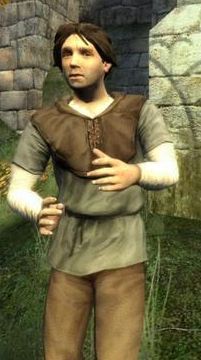
NPCs: New opportunities

Second Life itself actually had the capabilities to manage artificial life at one time – specifically plants and animals. Whether or not this capability is being revamped and re-introduced into the platform or not is really beside the point (although if it is there and is robust enough, making use of it would seem to make sense).

What is important is the fact that a massive capability is going to be added to the platform that could have a huge range of potential applications in-world. NPCs alone – human, alien, animal – have a wide range of applications in the likes of role-play and so on. As Rodvik states in his post: imagine a town filled with NPCs going about their “business”, allowing for a certain degree of interaction and so on, generating enormous depth to any gameplay or role-play environment.

Nor does it end there – assuming it can be done robustly and intelligently – the opportunities for using such “artificial life” capabilities has implications well beyond those of gameplay, many of which fall into the realms of education and practical research. Self-navigating agents? The avenues for schools and educational institutions to engage in things like robotics are simply mind-boggling.

Native AI in SL: potential educational / research / modelling benefits beyond RPG

According to Rodvik, we can expect some of these new capabilities to commence testing in December of this year, although (wisely) no roll-out data has yet to be pinned to the wall. Given the impact and benefit such capabilities could bring to Second Life, I really hope that LL strive for two things:

  1. Make sure the capability is properly developed and implemented – sorry, but at the end of the day, mesh came across as a half-arsed implementation to many, and I’d suggest further that it is a practical demonstration why (again) the push, test, polish, test, polish approach can actually do SL as much harm as it can potentially do good.
  2. They openly engage with a wide range of potential “beta testers” from within and without the SL community to ensure as wide as possible spread of potential use cases are identified and catered for and are the determining factors as to when the functionality is rolled out. Let’s not have the calendar again dictating what can and cannot get done in the “first release”, because many using SL already equate “first release” with, “That’s all LL are prepared to do”.

Rodvik makes The Mark; I get philosophical about virtual identity

LL CEO Rod Humble

Rod Humble once again demonstrates an adept hand and tongue when dealing with the media – this time the e-zine The Mark. It’s a fascinating piece that further demonstrates Rodvik not only grasps Second Life as a platform, he understands the importance of virtual identity. Take this extract:

The Mark: Do you think people existing in virtual worlds get closer to, or further away from, their true selves?

Rod Humble: I don’t have a clear answer on that, but I do have an opinion. There have been a series of high-profile people, from the head of Facebook to the Pope, talking about how social media should be about centering the individual – that it is all about your real life and ensuring that you don’t become a fractured person. I respectfully disagree with that.

I think that one of the healthiest things that technology can do is actually help us develop the different dimensions of ourselves that we portray in different situations. For example, the “me” at church is very different from the “me” who plays an online shooter game. The “me” talking to you now is very different from the one who will be at my parent-teacher-association meeting later tonight. We’ve always had that. I actually like the idea of enabling people to say, “In this community, I’m a completely different person, and I can hold views that aren’t going to seep into this other part of my life.” It’s a slightly heretical position, but that’s the one I take.

It may be a heretical position among his peers, but Rodvik hits the nail squarely on the head. No one in the world is ever “one” individual per se. Yes we may constantly present the same physical face to the world (although for those that wish to make use of cosmetic surgery, even that isn’t a given) – but the individual we present to different social aspects of our lives vary enormously. I am simply not the same person when among my family as I am when in the office environment of a major publishing house.

Of course, the “identity purists” will argue that this is not a matter of identity but rather of behaviour and personality; that while I may behave differently according to circumstances, my identity remains constant, as demonstrated by my having the same name on my office ID (when I have one!) as I do on my driving license. And in terms of ID cards and driving licenses they’d be right.

But they’d also be missing the point entirely. Identity is not distinct from either behaviour or personality. Rather it is intimately bound up with both, and that who were are and how we present ourselves to the world goes far beyond the a photo on a piece of paper or laminated card.

Facebook and, it now seems, Google Plus, would rather narrow the definition of identity to the two-dimensional aspects of name and photo, coupled with a verifiable address, as that better suits their marketing engines and their ability to generate revenues. I say “it seems” where Google Plus is concerned, because that situation is an unholy mess right now as regards “identity”, and it’s unclear how Google’s own tools may or may not be hooked-into Plus to reap data for their own use.

In taking this approach, the likes of Facebook are trying to enforce a form of conformity on their terms while remaining blind to the potential offered by virtual identities simply because the virtual does fit with the corporate modus operandi or world-view.

The fact is, “Inara Pey” is as much me as the person I present to business or to family and friends. In some ways she’s more “me” than the “real me” I am myself. Through her, I can integrate and publicly express facets of my personality that “real world” society would still deeply frown upon. I can, for example, mix my interests with fetish, D/s, etc., with my interests in business, psychology, politics, history, sport, etc., without (for the most part) being judged solely on the one aspect (fetish / D/s) some have determined to be “objectionable”.

She’s also a part of my psyche in other ways: she is an outlet for my writing on a variety of subjects; she represents me through Twitter and the like. In fact, I find it impossible – even discomfiting – to enter other virtual worlds without her, and so she existed in Blue Mars (as was) and exists in InWorldz, OSGrid, New World Grid, and Avination.

She only really differs in looks (although I’ve tried to mod her shape to be reasonably reflective of the “meat me”): I’m Caucasian in real life, whereas she is dark-skinnned. But even this is perhaps a subconscious reflection of elements of my “real” personality.

I say this because one side of my family’s history goes back to New Zealand, which has generated a deep interest in all things Maori in my in adult life. At the same time, I’ve been fortunate to spend a fair amount of time as an adult in Sri Lanka, and have developed a deep love for that country and its people. The fascination with both New Zealand’s Maori and the Sri Lanka people (Sinhalese and Tamil) seems to have influenced how Inara herself looks.

This genuinely wasn’t a conscious act on my part when I decided to give her a virtual make-over last year. However, the look evolved somewhat subconsciously over a period of several months, and has left me feeling that her appearance is a result of these various inner voices and aspects of who I am coming together to give her form. so to me, physical and virtual self, are deeply intertwined emotionally and psychologically; and I doubt I’m alone in feeling this.

And while she may not have a credit card or a driver’s license or a passport, it’s about time that big business caught on to the fact that she can still be a consumer (and again, that’s really what a lot of the kerfuffle about “real identities” is about: the ability to connect producer with consumer). This is because advertising, promotions, and the like that are directed at her still reach me. Certainly, they do screw with FB’s (and the likes) abilities to carry out wider data-gathering and limit their ability to gain “real” influence (in their eyes) over people – but the fact is, *if* I end up purchasing something, getting involved in something (either directly, or through my digital persona, and accept the receipt of on-going communications, etc., from a service, company or group – does it really matter if it came about through contact with my digital self rather than the “real” (in their eyes) me?

Blimey, and I haven’t even started on privacy concerns and handing over my “real” identity over to the suits and shirts of FB et al is akin to handing them power over me…

But to return to the interview with Rodvik: as well as identity, he dives into the many creative facets of Second Life and the myriad ways in which it brings people together and how they interact once brought together. As such, it not only shows (again) that he gets the value of Second Life on just about all levels, it provides interesting thought for consideration, both by those of us involved in this frontier – and, dare I say, by those who would seek to limit our ability to explore it by forcing us to restrict ourselves to their interpretation of what can be classified as a “real identity”. Not that I can see it causing them to re-think their position, sadly.

If I were to take issue with Rodvik, it would in his answer to a question concerning the future of virtual worlds and how people come together, when he replies:

“Good question. I think that something big is going to happen when it comes to online associations, which are going to run headlong into conflict – probably with some totalitarian country somewhere. It’s a broader thing than just Second Life.”

My take on this – while it is slightly out-of-context to the question asked, which set commercial aspects of virtual interaction to one side – is on the one hand he is more than likely right right in his assessment vis “totalitarian countries”. However, on the other, for those of us already living on the edge of the “new digital divide”, the conflict is clearly already here, with the totalitarian drive is coming out of “big business”. How that is resolved may actually render anything else moot for us.

I would, however, end this piece on a lighter note, and wag a teasing finger. My 40th birthday is rushing towards me fast enough as it is, Rodvik, so did you really have to go and push me into my “mid-40s” in the interview?! That’s two dances you owe me! 😉

Rodvik: Virtual Goods and LL’s Profitability

Rod Humble discusses virtual goods and virtual worlds in a brief Bloomberg interview. What are most interesting to note are the comments towards the end of the piece, regarding Linden Lab’s current profitability:

Emily Chang: The Tech IPO bandwagon is filling up. Is that something that you guys would consider or [are] considering?

Rod Humble:  We’re not looking for any further investment right now. We’re profitable, we’ve got [a] very good cash balance… So from our perspective, if we were to be able to deliver a large and measurable long-term return on new investment, then we’d certainly look at it. We’ve got a long runway of features that I want to put in place with our current very healthy cash and profitable business first, though.

Should this story be picked up, it is these words that are probably going to be the focus of attention – particularly among those who seem anxious to sink the Second Life boat, who will probably interpret Humble’s words as, “We’re not really attractive enough for IPO, and we’ve got to blow money to get there, ‘cos we have to make ourselves attractive somehow.”

Personally, I see his statement in a more positive light: LL are reasonably cash stable and are profitable, something I’ve commented on previously. Furthermore, there is a continuing upswing in sign-ups (still running at around 16K per day), which appears to be translating into a rise in user concurrency, which would indicate that new users are actually sticking around for longer and potentially getting more involved. Both of which are healthy signs.

What is key about Humble’s words, however, is the sheer pragmatism they carry, even in such a relatively lightweight interview. He recognises that while Second Life indeed “has legs”, and can, on current form, continue pretty much as is as a private company generating sufficient profits to demonstrate (presumably) a return reasonable enough to keep the original investors happy, it also has the potential to go much further in time. Thus, while IPO is definitely not on the cards right now, this may not be the case in the future, should things develop in that direction.

This is pragmatic on two counts. Firstly, it is allowing the company a degree of freedom in tackling the issues it currently faces – technical and otherwise – and solidifying its position without any ulterior needs or requirements overshadowing things. Given the company has undergone significant pain when ulterior motives have been the driving force behind matters in the past (e.g. the drive to convert SL into some form of “real world” business and applications platform), this is a wise move. Secondly, as Emily Chang states – the technology IPO bandwagon is fast filling up, but if we’re all absolutely honest, we’ve no idea where it is going. As such, not leaping onto it with everyone else is also something of a potentially wise move; especially if the wheels do come off the wagon, as LL get to avoid the resultant crash. However, if the bandwagon proves it can roll and roll, then LL could ideally be well-placed to pick-up on all those investors who might otherwise be kicking themselves from not being “in” on things from the start.

Taking this perspective and being willing to acknowledge both sides of the coin, so to speak, again demonstrates to me that Rod Humble is very much the right man in the right place at Linden Lab – and he’s hopefully carrying the board with him on this.

SL8B: Rocket Man

So, I was a little disappointed that Rodvik wouldn’t be speaking at SL8B. Then I figured that as he’s appearing when FedoraJones is on the main stage, maybe we’d get a duet, or I’d at least get to see the fabled toga for myself.

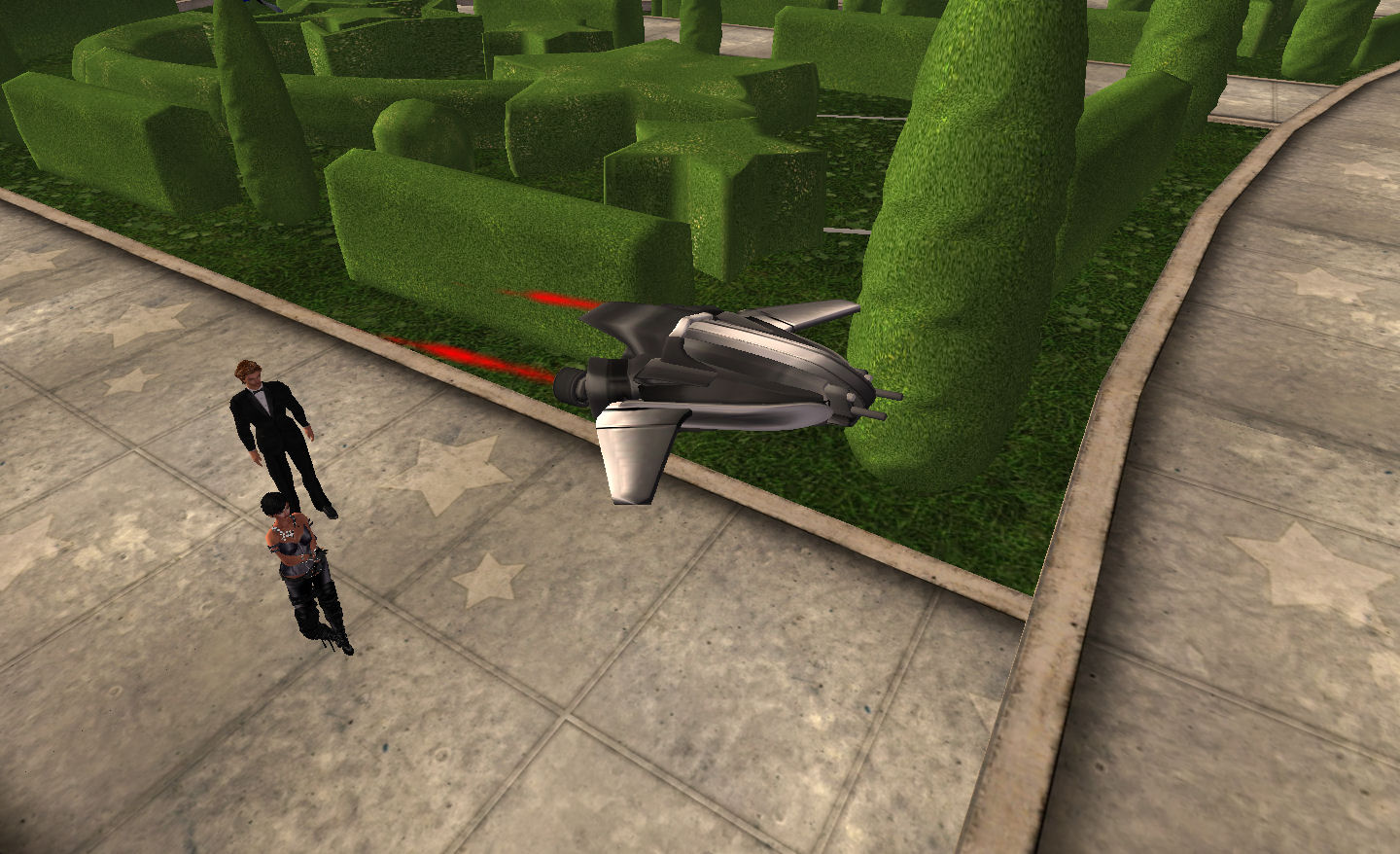
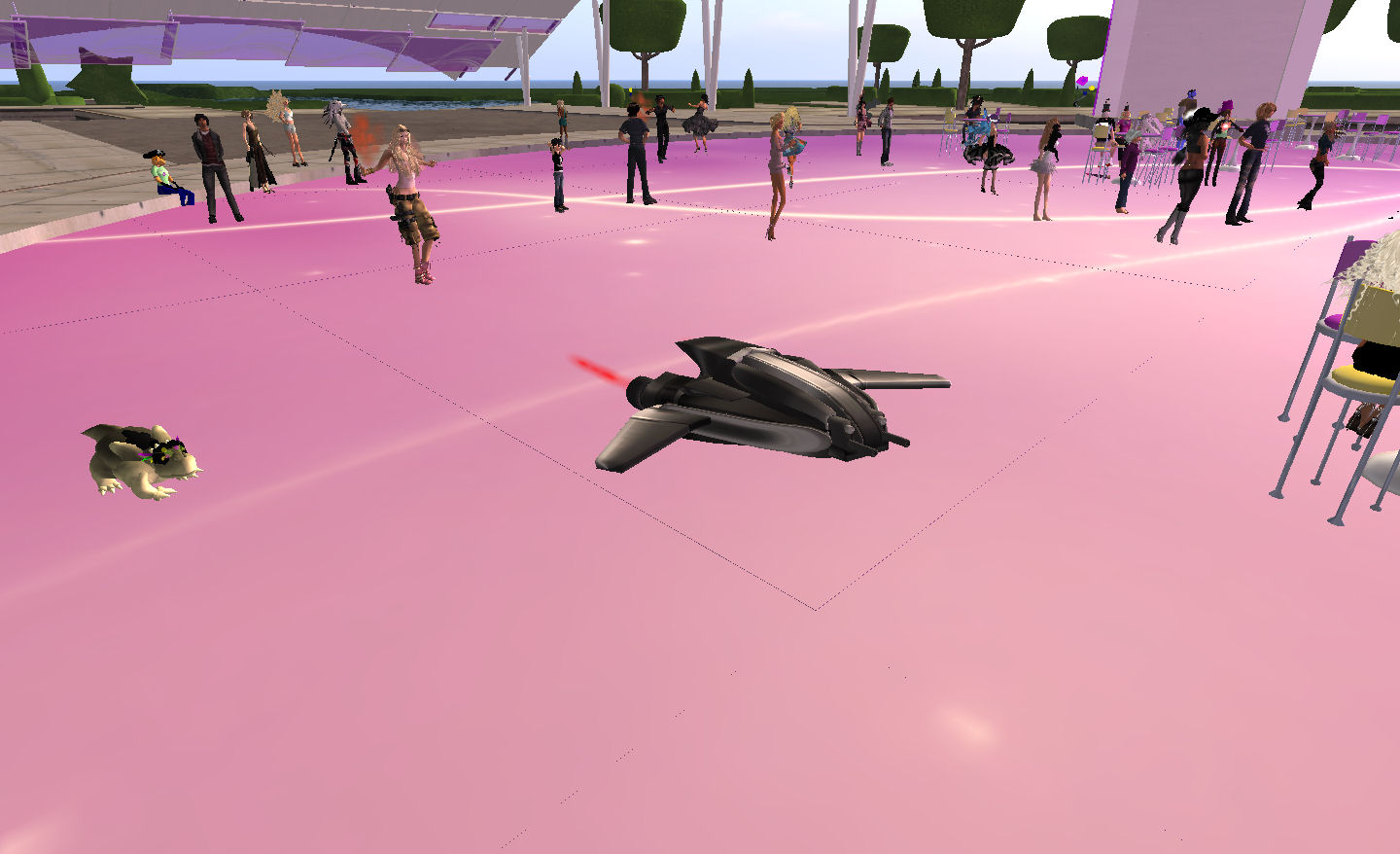
But in the end, we were treated to none of the above – no talk, no toga, no songs. Instead we got and ultra-cool Rodvik “Rocket Man” Linden.

Incoming!

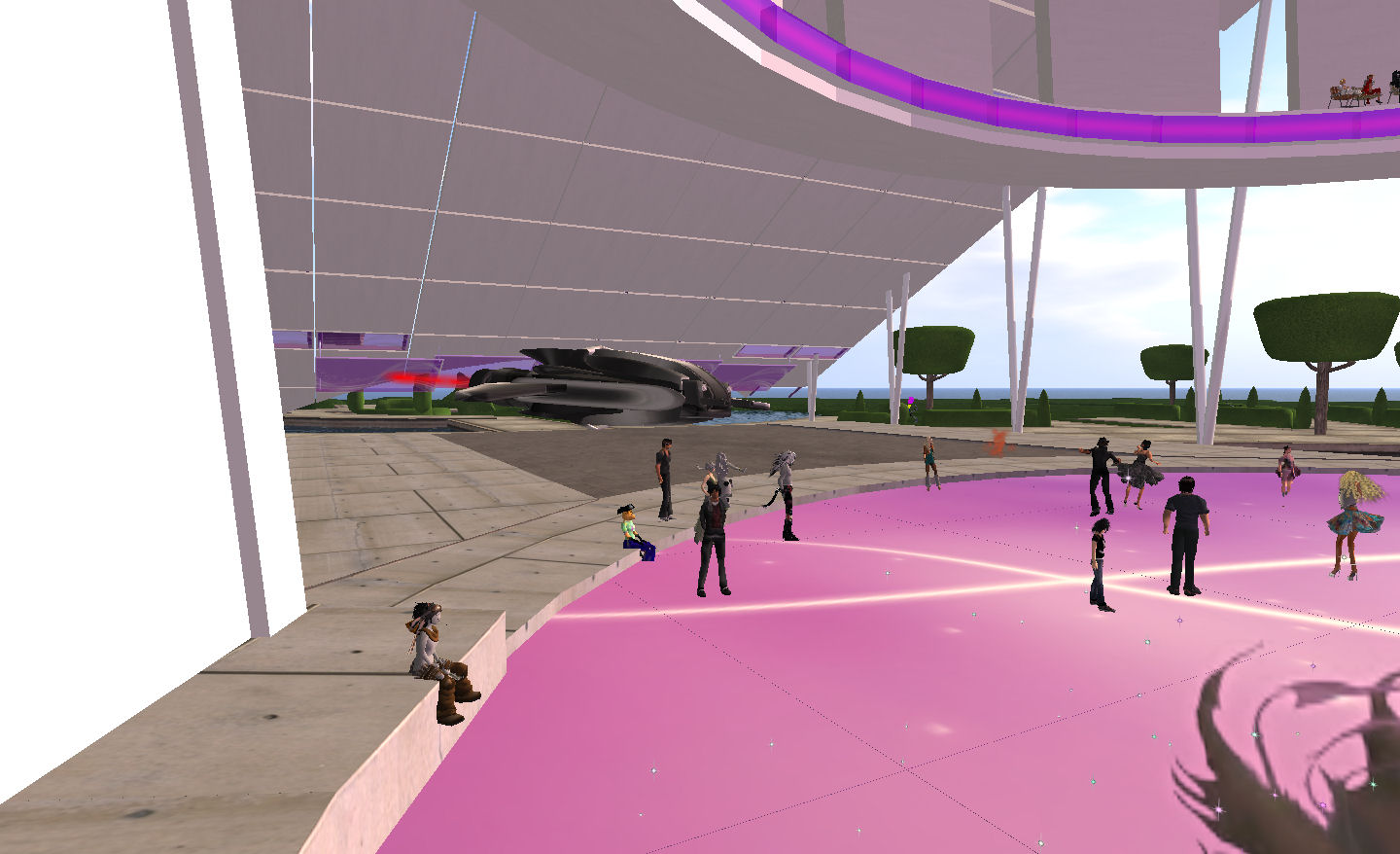
Yes, Rodvik arrived wearing a spiffy spaceship avatar, which I managed to catch as he headed towards the Main Stage as FedoraJones was starting on his set. Arriving stage-side, Rodvik commented wryly, “Heh, I should probably ghave changed av’s,” to me as he proceeded to fly around the stage auditorium, mingling with the crowd.

“Heh, I should probably ghave changed av’s”
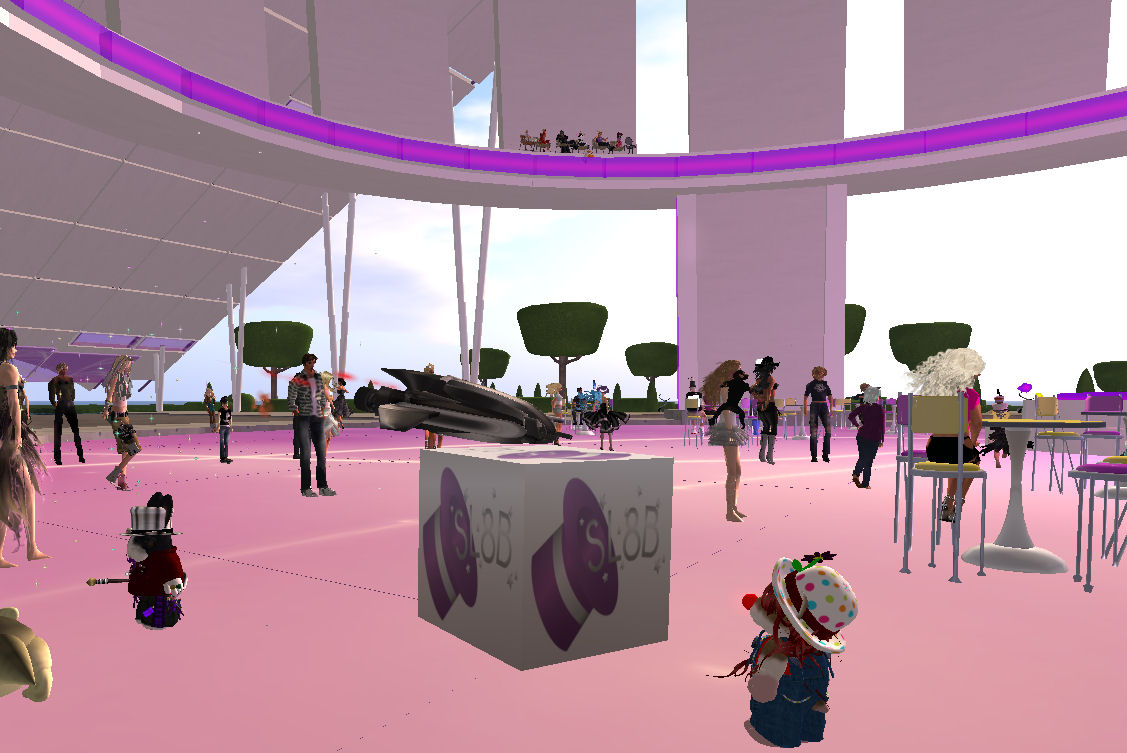
Rodvik proves a hit with the smaller members of the community

For the next half-hour, Rodvik mingled with those celebrating SL’s eighth birthday, chatting here and there, avoiding walls, boogie-ing around  – or as he put it, “Dancing with my afterburner!” and describing his little ship as having, “Power seats and nanorobots ready to run amok and take over the galaxy. usual stuff :0”!

Of course, with the CEO of LL making good on the dance floor, it was hard not to resist doing a Hamlet…

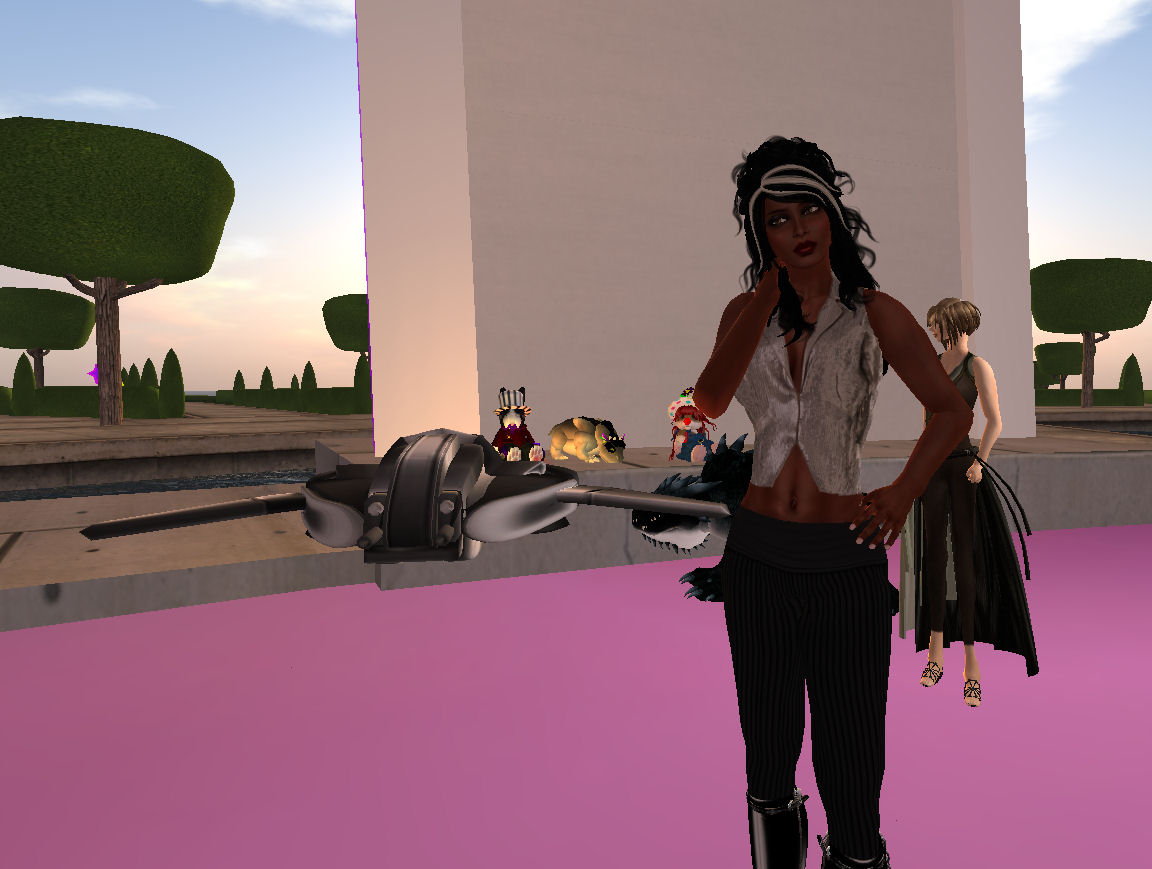
“Here I am at SL8B, with Linden Lab CEO, Rodvik Linden…”

I also couldn’t resist passing a comment on duets,

Inara Pey: There was I, hoping you’d be on stage singing with FedoraJones!

Rodvik Linden: Dream on :O

Well – what is Second Life if not for dreaming? And that is really what the magic is all about – given wings to our imaginations and desires and creativity and giving them flight in incredible ways. Even in cute little spaceship-style avatars.

Kudos, Rodvik, again, for joining in and demonstrating how much you do grok Second Life!

Rodvik rules the airways!

Twittering with Rodvik

Yesterday evening, Rodvik Linden – LL’s CEO Rod Humble – popped up on Twitter and chatted with some of us there in what was another of the warm an open conversations that have been a hallmark of his time at LL so far.

I actually came late-in-the-day to the conversation, logging-in to Twitter to catch this from Rodvik, replying to a comment on things SL:

@SecondLie I think we need to put purchasing into Basic first 🙂

Given the Basic mode of the Viewer is something that has been occupying my thoughts of late, I Tweeted in return:

@rodvik how about offering a better “step up”, help-wise from Basic to Advanced? – pointing to my recent post on the subject, and:

@rodvik If you keep adding functionality to the Basic mode, won’t you end up with…the Advanced mode?

I’ve no idea if Rodvik went and read the post in question; but it sparked something of a short discussion on the Basic mode and the Viewer in general in which he responded very positively to all making comments. In particular, he tweaked my curiosity with a reply to my suggestion that perhaps the Viewer should be made more modular:

@InaraPey Maybe yeah. Bagman keeps telling me that would be a good approach.

Bagman Linden is Jeff Petersen, the Lab’s newly-appointed VP of Engineering, and I have to admit, hearing that he’s thinking along similar lines  – and leaving my precious little ego well out of things – does raise my spirits, and it suggests that we just might be seeing a wholly new iteration of the Viewer at some point that may well achieve something Viewer 2 has so far failed to do. Going the modular route just – to me at least – seems the most common-sense approach to take; what isn’t clear is just how much effort it will take…

I also took the opportunity to both congratulate and tease Rodvik on the new Avatar sign-up pages. As reported yesterday, these are a superb step forward, but the lack of overall QA on their compatibility with all browsers really lets them down. Rodvik took the tease in good spirits:

@rodvik. The new sign-up process is very clean; hope the compatibility issues are sorted ASAP; they tend to defeat the hard work put in.

@InaraPey Thanks, yeah should be fixed quickly. Even with those the results have been amazing.

This comment is interesting, as it’s been stated that new user sign-ups are running as high as about 10K a day; although it’s hard to see this reflected in on-going concurrency, which has been dropping. I’d really like to know more as to what has been the effect of the new sign-up pages, and how badly things like new users ending up bewildered and confused by SL once they are here are affecting user retention.

Again, leaving aside any ego-boo I get from chatting with Rod Humble via Twitter, I found the time he took to address questions and suggestions as best he could to be refreshing and open. Of course, there is a temptation to bemoan the fact that while he is chatting on Twitter, the rest of LL seem to be engaged in an obstinate silence on their own Community Platform – but the fact is (and providing it goes beyond purely touchy-feely “niceness”), Twitter does offer an immediacy the CP lacks.

What would be good- and where Linden Lab are most definitely missing a trick – is in not having a Twitter feed or two on their own web pages. I really would recommend a couple of  live feeds from the likes of Rodvik and Pete “Ballyhoo” Linden direct to people’s Dashboards would prove very useful in demonstrating to users that LL are communicating.

So how about it, Rodvik, Pete?

More from Rod Humble: Privacy

Privacy is extremely important for anyone putting themselves out there, expressing themselves, or expressing a side of themselves through an avatar. People don’t want other people to connect the dots from their avatar to their real life person – or even, for that matter, to an alt. One of the ethical obligations we have is to protect people’s privacy

“People come to Second Life because they want a story, they want to be in a story….and we have an ethical obligation to protect that.

I’m not so sure that the conventional wisdom makes any sense. Yes, it might be technically easy to track people and all that. But in the long-term I’m optimistic that we’ll see the pendulum swing back in the other direction towards more privacy.

Thus speaks Rod Humble in what is quite possibly the best interview held with him since he took office at Linden Lab, and Kudos to Dusan Writer for bringing it to us.

It’s an uplifting piece on many levels. The comments about privacy, for example, are particularly relevant given both the degree to which Linden Lab seems determined to shovel users of Second Life towards Facebook and the manner in which data is being scraped and potentially used by the likes of RedZone.

For me, the interview is encouraging, as I’ve been advocating the need for Linden Lab to take what I term a more holistic view of Second Life, and to stop looking at it in terms of how it can be “compartmentalised”: focusing on individual technical issues, trying to tap into audiences, etc., and start looking at it as a complete, unified entity. In fact, I’ve already had concerns that Rod Humble is sliding into this very trap.

But no, he does seem to get it: he recognises the fact that the magic of Second Life is about the ability to create – physically and metaphorically (he talks about us being able to create “personas” in SL and imbue them with specific identities) – and he really does demonstrate he’s thought about these ideas, and is not simply peddling words.

Similarly, he recognises that Second Life can increase its relevancy in terms of real world interactions by providing n-world and supportive tools that work with the platform to empower people to interact with one another through Second Life (rather than telling them to bugger off elsewhere).

This is marvellously encouraging. Of course, there is a degree of hyperbole that strays dangerously close to Rosedale Country; after making very valid points about the relevancy in having multiple personas in life (which we all do), and these personas / identities being an integral part of our being (a marked difference from Zuckerberg over at FB, who views  multiple identities as demonstrating a “lack of integrity”), Rod does unfortunately slip into Pipspeak:

“I don’t want to get all geeky about it, but I sort of see this day coming when there’s a formalization of identity that happens. We haven’t had the tools before to formalize our broken up bits of identity…We can increasingly go deep on each element of identity and they become more valuable and I can’t help thinking that if we formalize the structures around those identities and have the tools to do that it might actually change us – it might change the person.”

Shades of Transhumanism lurking there – but not enough to shake one’s feeling that here, finally, Linden lab have struck gold. Rod Humble not only gets Second Life technically, he gets it visually, socially, personally, and metaphorically. In short, he appears to understand it holistically.

Lets hope that understanding translates itself into policies and action that allow us all to look back in 12 months or so, and we”ll all be “talking about all the new kinds of content and creations and categories of creation…and say ‘Wow, it’s amazing, look how far we’ve come in having ways to make stuff‘.” And that we’re all secure and confident in the levels of privacy and security Second Life affords us.