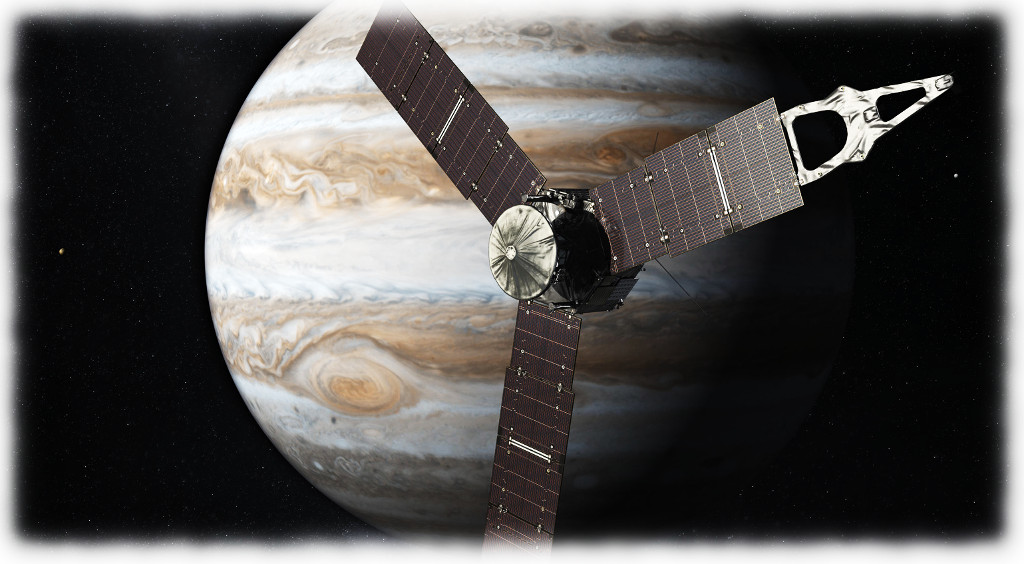
Juno is the name of the NASA deep space vehicle due to rendezvous with Jupiter in July 2016. Launched August 5th, 2011, from Cape Canaveral Air Force Station, the mission is designed to study Jupiter’s composition, gravity field, magnetic field, and polar magnetosphere, as well as seeking evidence and clues on how the planet formed, including whether it has a solid core, the amount of water present within the deep atmosphere, how its mass is distributed, and its deep winds, which can reach speeds of 618 kilometres per hour (384 mph).
Unlike most vehicles designed to operate beyond the orbit of Mars, which tend to utilise radioisotope thermoelectric generators (RTGs) to produce their electrical power, Juno uses three massive solar arrays, the largest ever deployed on a planetary probe, which play an integral role in stabilising the spacecraft.
On arrival at Jupiter on July 4th, 2016, Juno will enter a 14-day polar orbit around the planet, where it will remain through the duration of the mission, which should last until February 2018, when the vehicle, fuel for its manoeuvring systems almost depleted, will be commanded to perform a de-orbit manoeuvre and burn-up in Jupiter’s upper atmosphere.
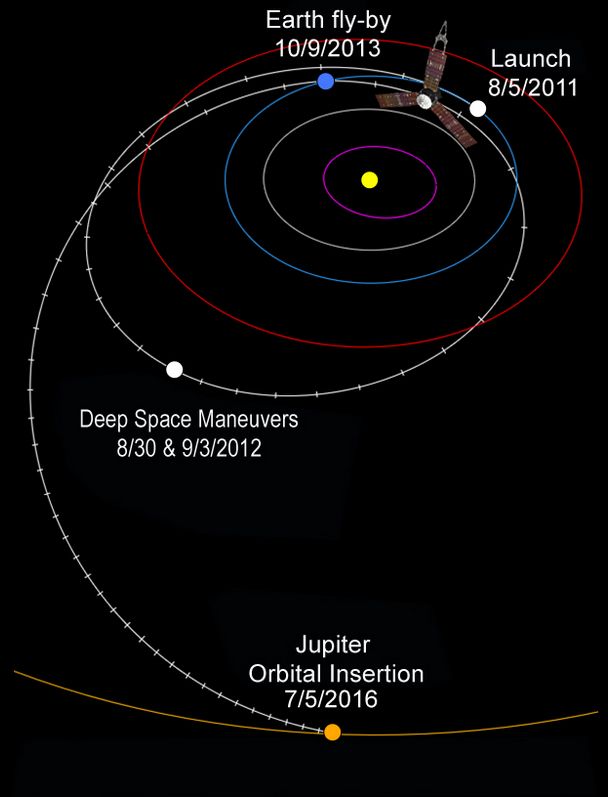
Currently travelling at some 25 kilometres per second relative to the Earth and 7.6 kilometres per second relative to the Sun, Juno has used a 5-year gravity assist mission to reach its destination.
The first part of this saw the craft launched into an extended orbit about Earth which carried it beyond the orbit of Mars (2012), before swinging back to make a close flyby of Earth in 2013 which both used Earth’s gravity well to accelerate the craft and as a “slingshot” to curve it onto a trajectory that would carry it to Jupiter.
By the time Juno enters orbit around Jupiter, it will have travelled some 2.8 billion kilometres (1.74 billion miles, or 18.7 AU).
Juno’s planned polar orbit is highly elliptical and takes it to within 4,300 kilometres (2,672 mi) of either pole at its closest approach to the planet, while at its furthest point from Jupiter, it will be beyond the orbit of Callisto, hence the 14–day orbital period. This extreme orbit allows Juno to avoid any long-term contact with Jupiter’s powerful radiation belts, which might otherwise cause significant damage to the vehicle’s solar power arrays and electronics. Overall, Juno will receive much lower levels of radiation exposure than the Galileo mission. But even allowing for this, there is no guarantee the exposed science instruments on the vehicle will last the full duration of the mission. Scientists and engineers are hoping the JunoCam and Jovian Infra-red Auroral Mapper (JIRAM), will last at least eight of the mission’s 37 orbits of Juptier, and that the microwave radiometer will survive for at least eleven orbits.On Wednesday February 3rd, 2016, the vehicle completed the first of two final manoeuvres designed to correctly align it with its intended point of orbital insertion around Jupiter. The second such manoeuvre will take just before Juno is due to arrive at Jupiter. The spacecraft’s name comes from Greco-Roman mythology. The god Jupiter drew a veil of clouds around himself to hide his mischief, but his wife, the goddess Juno, was able to peer through the clouds and see Jupiter’s true nature – just as it is hoped the mission will probe deep into the planet’s atmosphere and reveal its true nature and origins.
Orion at Kennedy Space Centre
Now set for launch in September 2018 on a circumlunar mission lasting 20 days, the second Orion space vehicle arrived at Kennedy Space Centre, Florida, on Wednesday, February 3rd, 2016. The vehicle, sans its outer skin and massing 1.22 tonnes, arrived from NASA’s assembly facility iin Louisiana by air aboard the agency’s “Super Guppy” transporter, which has been transporting space vehicle components since the Apollo era.
Further construction activities and a variety of tests will be performed at KSC and NASA’s Glenn Research Centre in Ohio to prepare the craft for its mission, officially titled Exploration Mission 1 (EM-1). This will see the uncrewed Orion launched for the first time with and operational, European-built Service Module atop its dedicated Space Launch System (SLS) rocket.
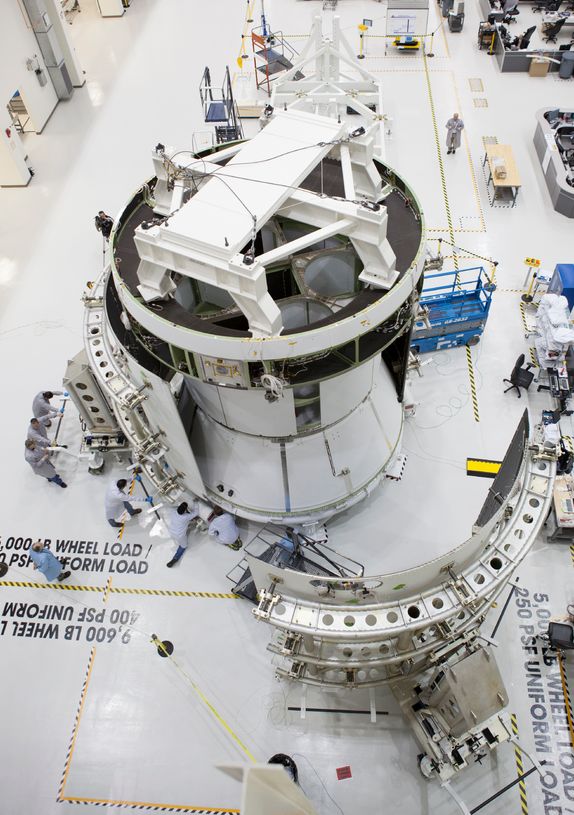
“This mission is pretty exciting to us,” Scott Wilson, NASA’s Orion production manager, said as the capsule arrived at KSC. “It is the first time we will have the operational human-rated version of Orion on top of the SLS rocket. It’s a lot of work, but a very exciting time for us.”
The flight will see the Orion system launched into Earth orbit, where a purpose-built upper stage propulsion unit will power the craft onto a flight towards the Moon.
Orion will use the relatively low lunar gravity to both accelerate it and throw it into an elliptical orbit, carrying it a further 70,000 kilometres beyond the Moon – almost half a million kilometres (312,500 miles) from Earth – further than any space vehicle designed to carry humans has yet flown.
Following this, the vehicle will swing back towards Earth, passing the Moon once more before the Command Module separates from the Service Module to make a controlled entry into Earth’s atmosphere and a splashdown in the Pacific Ocean.
The flight will be a comprehensive test of the European-built Service Module, which is vital for providing power and propulsion to the Orion capsule, and which is being built using the expertise Europe gained in building and operating the Automated Transfer Vehicle, which remains the largest ISS resupply vehicle so far used in space. The Service Module includes four post-launch deployable solar panels for electrical power, and provides power, heat rejection, the in-space propulsion capability for orbital transfer, attitude control and high-altitude ascent aborts. It also houses water, oxygen and nitrogen for deep space missions.
Like the Apollo Command and Service modules vehicles, the Orion capsule sits on top of the Service Module at launch, covered by the launch abort system shroud, the service Module protected by special payload fairings and mated to the SLS upper stage propulsion unit. The launch abort system and the fairings are jettisoned once the Orion has reached low Earth obit and has separated from the rest of the SLS booster. The Service Module solar panels are then deployed, and the upper stage of the booster re-fires, sending Orion on its way.
The 2018 mission will be followed in 2023 by a similar flight, this time carrying a crew of four further into space than any humans have ever previously been. Together, Orion and the SLS are intended to be the backbone of America’s return to the moon and for human missions to Mars.
Continue reading “Space Sunday: Juno, Orion and getting to Mars”





 Inara Pey: Living in a Modemworld