New users: the shared experience

Note: This article has been taken to mean I was unaware of the Community Gateway programme. Not so; rather I wanted to focus on the Destination Islands in this piece. As it is, and subsequent to this being published, a comment was passed elsewhere indicating the new Destination Islands are in fact something of a collaborative effort between the Lab and residents. 

“Shared” is a word that has gained increasing prominence where Second Life is concerned over the last year. We’ve had Rod Humble talking about “shared creativity” and more recently, Oz raising the issue of the “shared experience”.  Now there would appear to be an opportunity available for LL to come together with members of the user community to share creativity in order to develop a shared experience that can be of great potential benefit.

As I reported recently, LL have – at some point – launched a new range of “Destination Islands” to which new users are delivered. Currently, it’s hard to see what these regions actually achieve; they provide no introduction to SL, they don’t build on information given to the new user through the Viewer installation process, etc. As some have commented, they could even result in people thinking they’ve entered little more than a cartoon-based game with no obvious goal or function.

However, they are evidence that LL are still trying to address the issue of the “new user experience” by at least providing a means to direct newcomers to experiences they might be interested in. The problem is, the entire process is very hit-and-miss, and actually leaves much that is attractive about SL completely hidden – such as building and content creation.

New destination islands: low-key

It’s Not Easy

In fairness to the Lab, providing a means of supporting new users is no easy task. As we all tend to point out, SL cannot be taught in a day, and when one goes from talking about the “first hour experience” to the “first five hours experience” – as Mark Kingdon famously did – then something, somewhere is going more than a little pear-shaped when considering new users. At the same time LL have been presented with ample evidence that help centres that rely on direct user / user interaction don’t always work.

However, there is also a risk in going too far in the other direction as well and simply providing too little help and support – and this is the issue one tends to have with the new Destination Islands; they are minimalist in approach, both in terms of appearance and information, to the point of being mere way-stations that direct people elsewhere in SL without doing anything to help them understand where they are or what they might be doing.

How much better might it be if, rather than trying to deal with the “new user experience” without actually addressing it, LL were to seek to collaborate with the user community to provide a means by which new users entering Second Life for the first time are faced with an immersive, engaging experience that helps them understand the basic mechanisms in using the Viewer and the nuances of performing basic tasks SL before passing on elsewhere.

The Competitive Edge

This could be run as a form of a competition or a request for proposals (RFP) process, with Linden Lab providing a set of guidelines as to what is required, together with access to capabilities such as the new advanced creation tools, allowing those in the community to offer potential solutions / responses that meet the requirements /criteria in imaginative and innovative ways, with people free to work either individually or as a collaborative group.

Obviously, not every eventuality for user interaction in SL needs to be covered – just enough to get users reasonably acquainted with getting on with things in SL – and the experience could finish be delivering users to the style of portals currently positioned on the Destination Islands, allowing them to continue their adventures elsewhere. As such, potential criteria for the competition / proposal might be:

  • Provide users with sufficient information on using key aspects of the official Viewer 3.x UI – HOW TO, setting-up buttons, key menu options, etc.
  • How to walk, talk, IM perhaps leveraging HOW TO)
  • Provide an overview of inventory, including the basics of wearing clothing
  • Show how basic interaction with in-world objects work: opening doors, selecting and opening objects with contents
  • Use the advanced tools to demonstrate more advance interactions with in-world objects, such as opening an item and wearing the contents
  • Provide an introduction to building in SL, perhaps with some explanation of what sandboxes are

These criteria could be met through anything from simple read-and-do style notices, to practical demonstrations and / or by the user exploring an immersive build, where they walk a path of their choosing and encounter objects and information boards along the way and are encouraged to apply what they are learning along the way (an example of this might start with a simple door into a building / in a room with the words “click me” written on it to encourage someone to click & open it).

Linden Lab would then be free to select the entry / proposal that most closely fulfils their requirements and proceed to work with those responsible for the entry / proposal to develop and enhance the current Destination Islands.

Portals to more directed experiences might even be provided along the way; for example: those particularly drawn to in-world content creation might be offered a portal taking them to the Ivory Tower of Prims or on reaching the end of the experience, be offered a portal connected to various sandboxes across the grid.

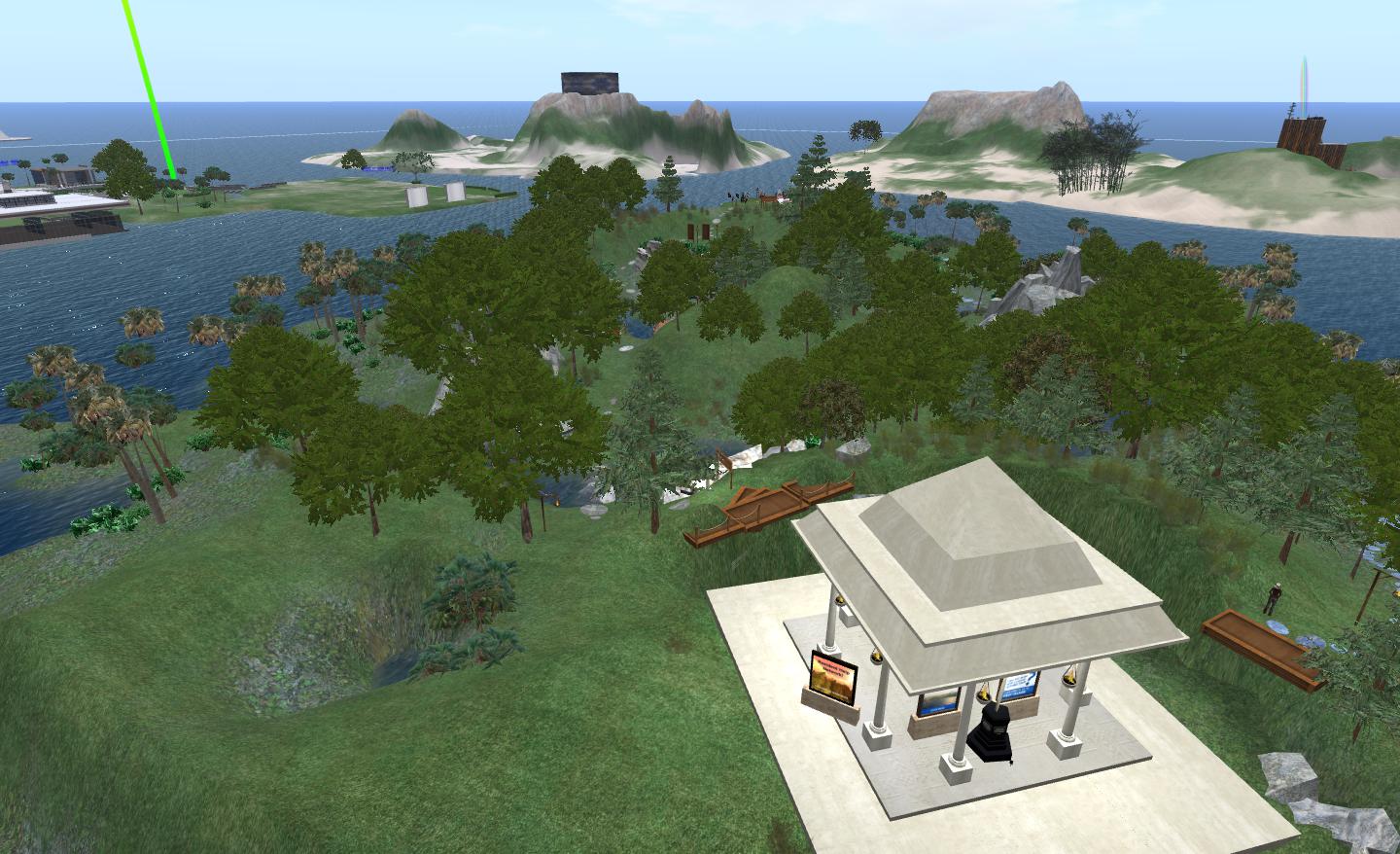
In order to simplify understanding things like the UI, portals could perhaps be included to the gated Orientation Island regions (assuming these are to be continued, given there only appears to be one left & they could be made somewhat more relevant) or to platforms over the Destination Islands, where those who need it can obtain more in-depth guidance. In turn, portals from them could allow new users to find their way back to specific elements of the Destination Islands experience.
Gated Orientation Islands: fold them into the mix?

Such an approach potentially achieves three goals:

  • Relieve LL of the burden of having the physically devote a large amount of time and effort to the development of a “new user experience” while allowing them to retain control over how such an experience should be framed
  • Leverage the core experience and familiarity with SL that the user community has
  • Promote a collaborative, shared experience between the Lab and the user community that can be used to benefit new users, the community and the platform as a whole.

Add to that the capability to “regionalise” the experience by sign-up language (so that those whose primary language is, say, Portuguese, arrive in a Portuguese Destination Island for example), then so much the better. (This may already be the case for the current system, hence the number of Destination Islands already on the grid; I’ve simply no idea.)

Working in this manner isn’t entirely new to Linden Lab  – they’ve recently taken a similar approach elsewhere in terms of issuing an RFP. Admittedly, this approach might require a little more structure from LL to avoid cried of “foul!” from elsewhere – but providing the process is as transparent as possible, there is no reason why it shouldn’t result in a positive outcome. Were the approach to be run as a competition, involvement from users needn’t be limited to those presenting entries: there is no reason why selected users shouldn’t sit on the “judging panel”.

Some would inevitably find fault were LL to take the opportunity to generate a project this way, but overall, given the potential benefit it could bring, it’s hard to find a show-stopping fault with the idea.
New Destination Islands – help or hinder?

In a low-key move, Linden Lab has rolled-out what appears to be a “new” new user experience and which seems to utilise some of the new game controls LL are shortly to be rolling-out to the community as a whole. However, what it is precisely aimed at doing is unclear.

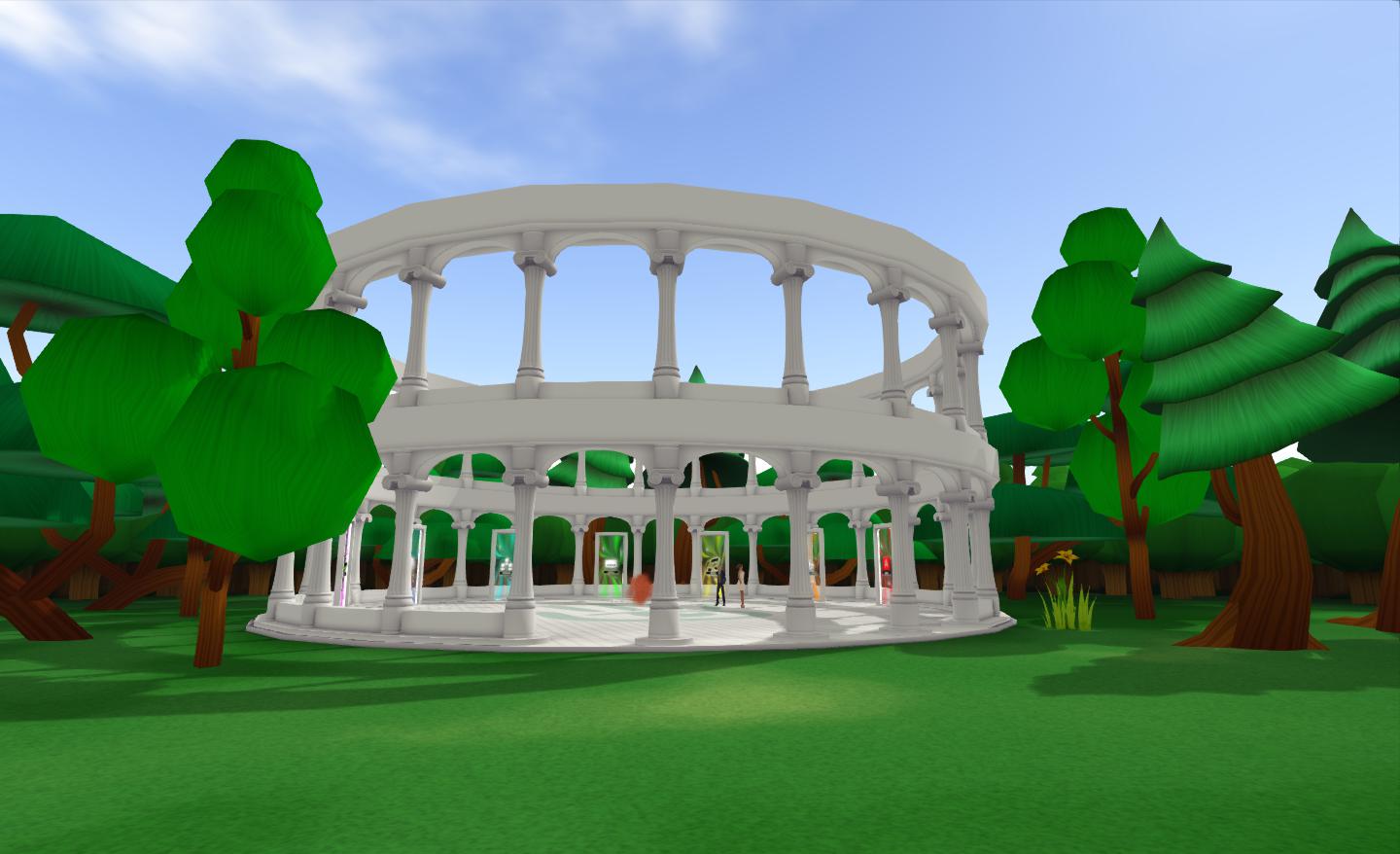
On signing-up to Second Life, new users (or those with a new avatar account) are now delivered to one of 24 Destination Islands.  Like Linden Realms, these are a group of identical regions, each containing mesh trees from the game, with a central coliseum-like structure towards the centre which forms the arrival-point for new users.

Once of the new Destination Islands

No real explanation is provided as to what the place represents or how to use it. Arrivals are instead presented with a series of glass-like doorways with arrows and footprints leading to them, and each with is own label.

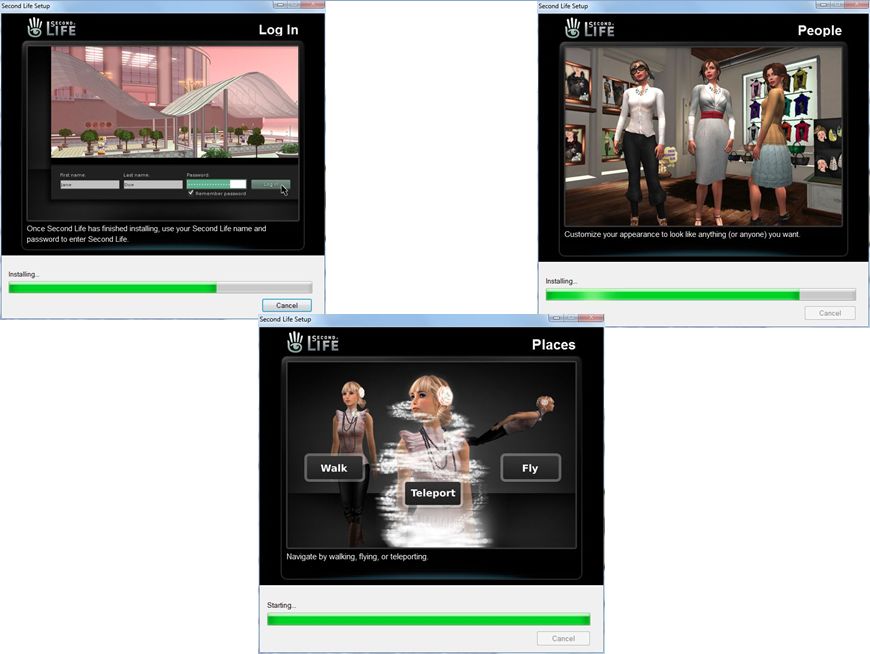
Information slides for those installing the SL Viewer for the very first time following sign-up

True, as a part of installing the Viewer for the first time (the download being a part of the sign-up process), new users are treated to a series of slides that provide a little more detail on using SL (see selected screen captures above), and they’ll have the Destination Guide open once they’ve logged-in to SL – but that’s it. Within the Destination Island areas there are no hints, tips or tutorials available to help the new user – there are just the seven doors (Art, Role-playing, Popular, Social, Music, Editor’s Picks and Adult), arrows and footprints.

Magical mystery tour

Walking through a portal will do two things: open the world-map at a potential destination and auto-teleport your avatar to a destination. Unless you’re using an unverified adult account and try the Adult portal. In this case you’ll simply get a flat nose and no explanation as to why. While an e-mail on this subject of adult verification is sent out to users as a part of the sign-up process, it would be nice if walking-into the door with an unverified account popped-up some kind of explanation rather than leaving people bouncing off the portal for no readily apparent reason.

Passing though other doors drops you into a destination based on the portal’s category. These appear to be selected at random from the Destination Guide. The process doesn’t seem entirely smooth: the world map opens during teleport (or it did for me. Twice), only to close on arrival. This is something that doesn’t happen in Linden Realms, so if the system i use at the Destination Islands is the same as the auto-teleport function used within LR, I assume this is a glitch that will be fixed, rather than a “feature” of the auto-teleport function.

Once you’ve left the Destination Islands there is no way back. Any attempt to teleport directly to them (assuming a new user understand the concept of teleporting) is met “Teleport Failed. You cannot teleport back to Help Island. Go to ‘Help Island Public’ to repeat the tutorial” and an OK button. Hence why you’ll have to create a new account if you want to test the system yourself.

OK, where next? What next?

This isn’t the solution you’re looking for?

Much – perhaps too much – has been made of the new user experience over the past few years. We’ve had talk of the “first hour”, the “first five hours” and, at the opposite end of the spectrum, “the first five minutes”. From comments he’s passed, it’s clear that Rod Humble is swayed towards the latter – that if you don’t capture the heart and mind of a new user in the first five minutes, then you’ve potentially lost them forever.

I’m not about to debate his wisdom on that one – but I will say that it’s hard to see how this approach actually improves matters. While one doesn’t necessarily need to have masses of information on display at the Destination Islands, having at least some guidance provided would, I’d have thought, be beneficial. Of course, this may be coming – in which case LL have rather put cart before horse in hooking-up the new islands to the sign-up process ahead of the information arriving.

This is where I think LL missed a step in merging-up the Basic and Advanced modes of the Viewer. In the former, we had a very good introductory series of tutorials in the form of the HOW TO pages. At the time I felt these could be enhanced, but overall they provided a good starting-point. While HOW TO is still evidenced in the Viewer in the form of a button – it would be useful if the installation process at least drew attention to it. Much better would be for HOW TO to be open by default until the first time it is manually closed (as with the Destination Guide). It wouldn’t solve all the issues in getting new users semi-oriented to SL, but it would at least help them feel comfortable with the Viewer UI – not everyone is happy with randomly pushing on-screen buttons and seeing what happens.

My experience demonstrated that people arriving at the same destination as myself were very confused as to what was happening and what they were supposed to be doing. The flow of people into the region I arrived in was fairly steady, but all of those stating they had just joined SL (and the number was around one or two arriving every few minutes) all pretty much had the same three questions:

  • What just happened?
  • Where am I?
  • What am I supposed to be doing?

Few had actually appreciated there was a HOW TO button (more-or-less the first thing I directed them to), and I found that doing so, and pointing them to functions such as Search,  was greeted with verbal facepalming, e.g.: “Well, it would help to be told that from the start!”

It’s hard to see how this system relates to the Public Help Islands, which are still active. There are no links between the two (other than the message displayed when trying to teleport directly to a Destination Island, as described above). Whether information from PHI will be incorporated into the Destination Islands is an unknown and remains to be seen.

Right now, I’m curious as to where this idea is going. Is it offered-up as delivered, or will there be enhancements based on feedback or observation (and if based on feedback, where do people give it?). As it stands, it’s hard to see how this system helps new users – although LL are doubtless in a far better position to make a call on this than my casual observations. I can’t help feel the approach, as currently presented is potentially as much a hindrance as anything else, and getting to grips with SL is still a matter of dogged determination on the part of those signing-up.

But then, this isn’t the easiest of issues to address, as we’ve seen over the years.

I’d like to keep an eye on if / how the new regions develop. As such I’ve held back with a new account on one of the islands to see if anything changes. If it does, I’ll be following-up here.

Related Links

New users: the shared experience

Some thoughts on Second Life

Last week, I commented on people’s impatience to hear something from Rod Humble, LL’s new CEO. In doing so, I followed a lead set by Tateru Nino in outlining why Mr. Humble is facing such an uphill struggle, even if he does listen to the platform’s own user base.

Since then, I’ve been cogitating a bit (aka sitting up very late at night, logged-in to Second Life and doing next-to-nothing as I’m simultaneously nursing a poorly cat at the same time). Inevitably, my thoughts turned to what is going “wrong” with Second Life / Linden Lab – or more correctly, why things are failing.

As I’ve also said before, there seems to be a perception that Linden Lab are somehow both malicious and – in their communications at least – mendacious. Certainly, when one looks at the damage caused by ill-considered acts such as the changes to Adult Content & Policy when a fair simpler solution was readily available (create a G-rated continent), or when one looks at the way in which economic reports are currently being re-jigged to the point of becoming almost meaningless, one can be somewhat forgiven for thinking along both these lines.

I don’t actually ascribe to either viewpoint. Rather, I take the view that the board of Linden Lab are – for people heading-up an allegedly “visionary” and “forward-thinking” company – frankly remarkably backward in their thinking.

I don’t say this as an insult; I seemly mean that they have fallen into the trap common to many start-ups: they don’t actually understand their own success, and so they spend far, far too much time looking at the data – the peaks in user numbers and the like – and then try to extrapolate future trends which become the basis for their next set of strategies.

Or to put it another way, they try to reverse-engineer the future.

And it doesn’t work. Never has, never will. Why? Because the focus is too narrow and tends to ignore one important factor: the existing user base.

Take just one of the peaks Second Life has enjoyed over the years: the rise in increase in concurrency throughout 2008 that saw daily numbers topping the 80K user mark, with the Grid groaning under the strain.  When looking back at those figures (which have been at best flat after a long period of decline), one suspects that those at the top of LL started wishing along entirely the wrong lines, their thinking going something like this:

We need more users. If we have more users, then they’d invest in land and the land owners would be happy; they’d but more simulators from us and drive up our revenues. More people mean more consumers of content, which means growth in the economy, grater revenues, more success and….more users! So how do we get those users through the door? Obviously we need to simplify the sign-up so they get in-world quicker. If we’re getting them in-world quicker, we need to give them a simplified interface…

And thus is born the overhaul of the “First Hour Experience” under Mark Kingdon which, after it failed, became “Fast, Fun and Easy” under Philip Rosedale (with a similar lack of success), and will, if we’re very unlucky, become some other sound bite in the near future.

Yet, if you look at it, nothing LL identified as a “barrier” to growing the user base actually stopped people signing up throughout the 2007/08 “boom period” in the first place! Some may have found it annoying – sure. But it didn’t stop them.

The fact is, “Fast, Fun and Easy” is not a strategy – it is a strap line, nothing else.

It’s been said a thousand times before in a thousand different ways, but the key to Linden Lab’s success is its existing user base. Rather than looking back at the past peaks of concurrency or the number of Big Businesses that popped their heads into SL (however briefly), and looking at the means to attract and retain them once more, Linden Lab should really be focused on one thing, and one thing only: providing a better experience for its existing user base.

Now, to be fair, Linden Lab has done this to a degree: the platform is a lot more stable overall that it was just two years ago. Yes, we’re seeing hiccups along the way – the “resolved” teleport / sim freeze issue seems to have made something of a return – but on the whole, things are better. The RC server release cycle recently introduced has helped in this regard. We’re also seeing server loads reduced through the transferral of things like Profiles to a web-based system; Linden Lab are also embracing much-needed technology improvements such as Mesh (with caveats I’ll come to) and more standardised scripting languages. Its here that overhauling the Viewer is valid: if it enables users to take advantage of new tools and functions and enhance their experience – go for it! Just don’t dumb it down for the sake of dumbing it down in the *hope* of attracting mythical “new users”.

That said technology improvements are only a part of the equation. Second Life is a social platform (I’ll not say “social network” because of the Facebook connotations people seem to get uptight about) – and yet the social tools it provides for us to engage with one another are chronically weak – not just in-world, as anyone trying to manage their Group will tell you – but in trying to reach a wider audience. Again, while many are anti-Facebook (myself included), there are times when tools that connect Second Life to other social environments are useful.

This is where LL should take a more holistic view to things, rather than repeatedly trying to fit them into discrete boxes. The technical and the social need to be considered together. But, over the last few years they haven’t. Sure, LL has acknowledged the social aspects of SL, but when it comes down to it, they’ve been trying to meet these needs by actively pushing users away from SL and towards the likes of Facebook  – witness the Valentine’s Day Hunt last year and the equally insidious “advertising opportunity” for people to promote SL.

This approach – whether initiated by the Board or solely by Mark Kingdon  – was a mistake. What should have happened was that LL should have worked to provide such tools within the framework of Second Life and give the users with the choice of whether or not to use them.

User choice should always be about that: choice. But that doesn’t mean that LL shouldn’t seek to provide links to other social environments for those that wish to use them, so long as it is done in a manner that the user choice isn’t compromised or in such a way that it comes at the expense of our in-world experience, or is foisted on us as a fait accompli. Again, this is where the move to web-based Profiles has something of a “fail” mark against it: while there is nothing wrong with providing options to have our Profiles shared with the likes of Facebook, Twitter and LinkedIn – it should be done in such a way that we have the choice as to whether or not the buttons to link to such external networks appear on our Profiles.

Other social aspects are being handled in-world: we’re shortly to get an improve Group Chat function. But again, it’s been tackled as a purely technical exercise, not part of a wider understanding of what we might want or need to make SL an effective social tool for us to more easily reach people in-world and, if we wish, elsewhere.

This lack of any holistic view or understanding of the complexities of Second Life can be illustrated further if we examine the forthcoming arrival of Mesh imports.  When talking about it last year, Jack Linden and Philip Rosedale came out with comments that still stun me whenever I read them. When asked about the potential impact on in-world content creation, Jack’s reply was that it would change “very little” in regards to in-world content creation because the number of content creators is “very small”. Philip Rosedale, in a separate interview, stated his belief that the majority of “new users” will (quote), “never rez a prim”.

Leaving aside Rosedale’s statement amply demonstrates LL’s overwhelming obsession with the “new user” demographic, both of these statements were, and are, alarming because they most clearly demonstrate the overall lack of understanding those at the top of Linden have when it comes to what makes Second Life vibrant and engaging.

To paraphrase a former US President or two, it’s about the content, stupid. The reason many people involved in Second Life in the first place was not because the sign up process was simple, or that the Viewer was easy to use or that the “first hour” experience was particularly gratifying. The reason they got involved in Second Life is because they could a) meet people and b) they can create. Whether they did so for commercial reasons or simply for the sheer pleasure of being able to doodle, play and have that warm inner glow of being able to say, “Wow! *I* did that!” is utterly irrelevant.

There was a time when those at Battery Street understood this; sadly, that understanding seems to have died a death. All that is left is that one narrow focus “new users”. One can almost hear the mantra at Battery Street: Mesh is good, as Mesh will bring in users… wash, rinse, repeat…

Well…yes, Mesh will bring in some new users. But it won’t, in and of itself, retain them or lead to sustained growth for the platform because, fundamentally, it doesn’t really significantly add to what people can do in-world.

Again, within a more holistic framework – providing the means by which we can more effectively use these shiny new things and tell our friends in-world and out world about them – LL would do so much to both improve the user (new or established) experience and empower / encourage users themselves to become LL’s best means of promoting Second Life, potentially up to the point of it going viral in a positive sense.

At the end of the day, Second Life has succeeded because of its users – and not in spite of us, as one sometimes feels is how some at Linden Lab seem to think.

It grew because  – for a time at least – the company was focused on ensuring that those who came could participate and have fun. Over the years, Linden Lab has – in the manner of many start-ups – drifted away from the nucleus of what made them a success in the first place. And that nucleus was never the Viewer or the signing-up process or the “first hour experience”. These were, are and remain, means to an end.

While it would be impossible to listen to each and every one of our views on things, this is no reason for LL to go entirely the other way and utterly ignore what we say, even when we are united and what we have to say makes sense.

Nor is it justification for the company to cut itself off from the platform. Being ready and willing to spend more time in-world – to travel, to see, to participate and engage with us – would go a long way to helping the company define a better, more rounded strategy for the future. It might even finally break their approach to “growing” Second Life that has, for the last three least in particular, repeatedly failed to achieve any significant success or growth.

Exchanging views with Amanda Linden

For the last 48 hours, I’ve been engaged in a surprising forum-based exchange with Amanda Linden over in this unfortunately titled thread (don’t feel you have to go wade through it all, the crux of the issue is repeated below  – I’m including the link for context).

I’m not sure what drew me to this particular thread, given the title tends towards the OP is looking to simply start a flame war – but I was somewhat shocked to find none other than Amanda Linden responding to a post in the thread that raised the issue of the (premature) release of Viewer 2.0.

The reply reads thus:

Thanks Void [Singer]. You bring up a great point. As with any new software product, there are plenty of bugs. And, during the beta period over the last month or two, we’ve been hard at work smashing bugs. We’ve fixed thousands of bugs, in fact. Yes, we have more to do–for sure–and the team is heads-down addressing every bug filed in Jira. We take bugs filed by Residents seriously. They are evaluated, prioritized, and then fixed. So, keep bringing us bugs and we’ll resolve to fix them as soon as possible.

This post – in typical (I have to say) light, trippy, LL form – generated a number of responses, including this from me:

Amanda,

There is a truism that states “no software is ever finished” (or if there isn’t there ought to be)…and as such, it is true that Viewer 2.0 will inevitably have bugs that will need fixing.

But let’s be honest here: Viewer 2.0 was in development – by your own (LL’s) admission – for over a year; yet what was released into Beta was riddled with issues, many of which are so basic, not only should they have been identified and dealt with prior to the public Beta, [they] are still waiting to be fixed. So why the drive to push it into prime time?

When the (then) forthcoming public Beta was initially announced, it was also stated that you intended to “go live” with Viewer 2.0 “at the end of Q1” (i.e. 31st March, 2010) – and you’ve done precisely that. Ergo, one gets the impression that roadmap was not only drawn, but printed, laminated and framed on the wall over someone’s desk at Battery Street before the public Beta commenced, and that as such – the target date wasn’t going to be missed, regardless of the number of issues / bugs found within the code.

By your own admission, Viewer 2.0 needs more work….Search needs more work….shared media needs more work (particularly around issues of security)….yet everything is being pushed out with an urgency that could leave observers speculating as to what on Earth is going on at LL.

One can only assume that LL has become purely a target-driven entity, more concerned with short-term new users acquisition over longer-term user retention.

Is it simply because you have some overall “target” of new user subscriptions – one that has been calculated as needing X months to achieve at an acquisition rate of Y new users a month – which is thus fuelling what appears to be the overly premature release of this software? Is user acquisition in fact going to become your overall measure of “success”, regardless of the potential attrition rate of non-returning users? Are we going to see something like New users in the last 24 hours appearing on splash screens?

Now I’ll be honest. When I posted this, I genuinely didn’t expect an answer. As we’re all only too aware, Lindens have a reputation for peppering the flogs with replies now and again in what seems like a scatter gun approach: it is rare that one will stick around and address concerns / critiques that call into question the “official” line.

So I was surprised when Amanda followed up:

West, Inara, Gideon, Great comments and your challenges with the viewer, including bugs–I understand and I hear you.

Here’s my experience with V2. I’ve been using it since December. I admit, when I first started using it–the bugs made the viewer tough to use–and the new design took some getting used to. Those were early days–first alpha. But, I stuck with it and the software became more stable and usable each release. The V2 that you see today is SOOO much better. For basic SL functions, as any new Resident would perform, the software is ready and stable enough to deliver a much better experience than v1.23. We are not only confident of that fact, but we see it borne out in our analytics–that we’re watching very closely.

Remember, our primary goal this year is to grow Second Life from 700,000 to 1,000,000 actives (spend 1 hour in world each month). With more Residents in SL, the larger the economy, more customers to purchase your virtual goods, more interesting events, more vibrant communitites, and more that we can do to invest in improving the SL experience. In other words, better for everyone.

That said, we think that you’ll love Shared Media and Mesh (coming this year) enough to make the switch and then give us the feedback that we need to integrate into our product roadmap to make it a great Viewer for SL power users too.

Again, it’s important to understand that this product is FAR from final. We are committed to making V2 great–stable, easy to use, and as bug-free as possible.

There are two things to note here: a) continuing the spin relating to the value of Viewer 2; b) not actually responding to questions raised. However – a reply is a reply, and opens the door for further potential dialogue; something I was (and am) determined to follow-up on:

Amanda,

Firstly, thanks for replying.

Secondly, mentioning figures like 700,000-,1,000,00 “actives” on a monthly basis doesn’t actually answer my concerns about LL’s position with regards to user retention. Indeed, it doesn’t actually reassure me in any way at all. SL is already hitting concurrent logins in the 60-70K mark daily. Even if we discount 40% of these as bots and alts – that still means SL *is* potentially hitting around 1.2 million “actives” a month….so I’m having major problems seeing any growth here….

So I’ll ask again: Is user acquisition in fact going to become your overall measure of “success”, regardless of the potential attrition rate of non-returning users?

Numbers of “actives” does not equate to numbers of retained users: it is entirely possible to have both a high number of new sign-ups on a weekly / monthly basis and a continuing high attrition rate in terms of repeat log-in falloff. Thus, rather than growing the economy and providing, “more customers to purchase your virtual goods, more interesting events, more vibrant communities” – we could in fact end up with the current status quo being continued into the future.

Once again, I received a reply, this one actually moving towards addressing issues:

Inara–Thanks for such a thoughtful post. And, YES–retaining current Residents is a huge priority here at the Lab. We cherish the SL community and you’ll see more programs rolling out to help make your experience better, too. But, the announcements on Wednesday were centered around the new Viewer and welcome experience–so it feels like we’re only thinking about attracting and retaining new Residents. More to come in the coming months….

Cheers, Amanda

Now…this could of course all be flannel. As the old cliche goes, actions speak louder than words – and as we’ve all too often observed, Linden Lab has a habit of tripping over its own two feet when moved to action. But…action has been promised, and I’m certainly not going to let things go with this, as I hope my follow-up demonstrates:

Amanda,

I’ll take you at your word regarding user retention, and look forward to seeing both future posts and affirmative action on the part of LL that demonstrate this to be the case.

I appreciate the Wednesday’s announcements were close related to new users (welcome experience / Viewer) –  but by the same token, the “new user experience” has been pretty muchthe mantra for well over a year. The “First Hour” experience, the “First Five Hours”, the viewer…search….other changes. Almost all have been accompanied by the mantra of “new users”. When concerns have been raised where some changes are concerned, many of the replies received by Linden Lab could be paraphrased as, “Ah, yes, but for new users….” (you can fill in the “…”) – so much so that it is fair to say that there is a strong perception among established users that “new users” *is* the only measure that counts nowadays.

I also appreciate that it is hard sometimes to pick out concerns above the *noise* at times, given the sometimes heated debates that go on within these forums, and the levels of emotional response that heaped in some postings.So I do appreciate you are taking the time to post here and give support to your initial replies, especially given the emotive title of the thread.

But that said – and leaving aside the “new user” mantra – another major reason why seasoned users are feeling jaded towards Linden Lab is that quite often we’ve been faced with responses from LL that suggest that those who post in these forums are a “vocal minority” (my term), who are not representative of the “majority” of SL users – even when valid points are being made.

This is very much an incorrect perception. The people who ardently post here do so because they are involved in Second Life; the majority genuinely care for the platform and what happens to it – and as such, far from being a “vocal minority”, are actually pretty representative of the feelings of those who are equally as engaged in the platform but who don’t post here for one reason or another (i.e. they themselves are already feeling jaded by what is perceived to be the same rhetoric being repeated time and again – so they read, but simply don’t post).

So again, I very much hope that the time you are taking here is an indication that – as you stated at Metanomics recently – you (as in LL) will be much more active in communicating with residents (as opposed to communicating to residents) as we go forward, and that you’ll do more to demonstrate that you are actively taking on board user concerns and actively responding to them, rather than opting to post replies that read as being both arrogant in tone and suggestive that LL prefer to cherry-pick user views and attitudes that are (possibly) more closely aligned to your desired strategy / direction.

As it stands, the weekend is here, and I obviously do not expect or anticipate any reply before the middle of next week – but I think the points above are worth making, given dialogue has been joined, and I very much hope that Amanda will continue to keep the door open on what is a developing two-way exchange. Yes, her replies are light on specifics and full of the usual Linden spin – but I can live with that.

I very much hope that she’ll also revisit comments made in the same thread by the likes of Amethyst Rosencrans and Ciaran Laval. The concerns and observations they both raise very much point to the need for better, clearer and more balance exchanges between the Lab and users, especially if Amanda’s statement that retaining current Residents is a huge priority here at the Lab. We cherish the SL community is going to be anything other that hollow market speak.

User satisfaction isn’t simply about a “more predictable” in-world experience. It’s not purely about reducing lag or boosting hardware performance or providing new and better LSL functions or integrating in-world and XSL accounts.

User satisfaction is about taking the time to engage with the community; it’s about abandoning pretences and participating in the two-way exchange of dialogue. Linden Lab has persistently failed in this  – and have been absolutely chronic in the sphere of user relationships in the last few years in particular. While they may be “small” and “parochial” in the scheme of things, even the San Francisco Better Business Bureau have noticed LL’s weakness in customer relations – awarding them a “F” rating.

I’m not foolish enough to believe that a couple of forum exchanges with the likes of me are seriously going to change things – we’ve all see Linden staff drop comments here and there across the flogs. What I do find heartening, tho, is that when pushed on issues, Amanda hasn’t simply blanked me and skipped on to more favourable comments for her replies – she’s met me (almost) head-on.

I really do hope we see more of it.

I couldn’t help it; I cringed.

I’m sorry.

Maybe I’m suffering from a sense of humour failure – but who on Earth came up with the Welcome Video on DiscoveryIsland? I mean, trying to riff on a 30-year-old TV series remembered largely for being the bastion of trite, formulaic television, replete with more re-use of stock footage in a single episode than most TV shows managed in an entire series.

Riffing on Fantasy Island, for crying out loud to promote Second Life as a “hip” place?

While I was too young to watch it when first aired, I do remember it being on-air in re-runs on Saturday afternoons, wherein it was generally received with derisory humour  – before the channel was changed…..

I’m not sure exactly what demographic LL are trying to appeal to. Silver surfers with a taste for “fine corinthan leather” and bad 80’s television, perhaps?

All together now, “The pain, boss! The painnnnnnn!”

M’s People: Looking through Kingdon’s Spyglass

Mark Kingdon bounces into the Blogrum with a buoyant post looking to the future. Once one gets through the initial paragraphs, it is interesting to note where he lays emphasis for plaudits during 2009 and what he sees as being important for 2010.

First, his view on 2009 is interesting for the degree of spin evident – some of which borders on a complete re-writing of history, vis: We acquired two virtual goods e-commerce sites and began integrating them into the Second Life experience so that Residents can buy virtual goods both inworld and on the web. While it cannot be denied Onrez and SL Exchange were bought-out, to say they were both “integrated” in any way is far short of the mark. For a start, Onrez was simply killed stone dead, while the “integration” of SL Exchange (now XStreetSL, or XSL) has been nothing less than controversial, has seen LL (again) turn a deaf ear to many legitimate concerns of users, and has contributed further to the lack of trust between residents and the lab.

Similarly, his commentary on the Content Protection Roadmap and the Solution Provider Program fall wide of the mark for the majority of users. The former simply has no teeth, so is hardly something to chalk up as a “success”, while the latter is clearly aimed an LL’s belief in the “corporate market” and has little, if anything, to do with “casual users” (although many of us would like to think it does).

Looking more closely at the Content Protection Roadmap, many seem hung-up on the fact that it is all about “making” people have avatars that reflect their “real lives” (this coming off the back of Amanda Linden’s Work Avatar blog post, which was itself widely misunderstood – I hope).

However, the real threat here is not so much in the risk of people being “outed”, but more the case that the roadmap insidiously suggests that only those who (quote) meet a minimum threshold for content transactions will be able to partake in the new “content seller program”. Who will define this threshold? LL? LL in consultation with a few (and proven elitist) merchants (paging Ami Hoi….)?

What of those merchants who meet all the other criteria but fail to meet this threshold? They have payment info on record, they make quality goods for niche markets, they are in “good standing” with LL – are they suddenly to be outlawed for failing to hit sales of a few thousand linden dollars?

Similarly, the comment that merchants must be in good standing and not have been suspended for any violation of the Second Life Terms of Service is worrying given the way LL have suddenly started wielding the ToS like a big stick over merchants: “if thou knowingly mention a rival web commerce site on XSL, thou wilt not only have thine offending item removed but thous shalt face the wrath of Linden Lab, who will smite thee with a three-day account suspension” (believe me, this has happened, as reported on the Slapt.me forums).

Similarly, the commentary around the Linden Homes is suspect. Again, I’ve hammered out my view on this enough recently to make people possibly sick of it – but I have to say, M’s spin tends to mirror my thoughts: what he calls making it “web easy” for new residents to obtain their first home, I call “funneling” a section (Premium Account holders) joining SL away from the open market for land and homes, and towards a channelled experience that can either be used downstream to boost sales of the labs own “themed sims” – or used to direct users into the gleeful hand preferred land barons as the users find they need bigger land holdings as their experience grows.

And “channeling” (or “siloing” or “corralling”, whichever term you prefer) “casual users” (i.e. the likes of you and me), is very much a consistent theme with Kingdon of late, as I’ve previously mentioned. It is also in step with calls from the likes of Justin Bovington to “stream” the SL experience, and harks right back to another of my chestnut observations, Kapor’s own call for we “pioneers” to step (or get moved) aside for the “pragmatists”.

Little wonder, then, that the “Enterprise solution” (was there ever a problem with business enterprise that warranted a solution?) is flagshipped as the first 2009 “platform improvement”. And while the LLNet may well benefit “casual users” in the increased stability it brings, one cannot help but feel that this is a non-benefit as far as LL is concerned: LLNet is also about being able to furnish the corporate market, by providing high-speed, reliable connectivity between “behind the firewall” installations and a gleaming SL-based “shop front” corporate users can use to promote themselves among their peers and meet the LL-vaunted “Gold Solution Providers”. Again, such an environment has cropped up in several of Amanda Linden’s posts in the past.

And so we turn to M’s view of 2010….and for the casual user, I have to say, it is pretty glum. Once again, from a platform perspective, the emphasis is primarily on the perceived corporate market. Sure, there is much talk of the introduction of C# and of APIs and new protocols – and these will have some benefit to the user base at large – but make no mistake, the primary aim of these new tool sets are “business users”.

Not even the mini-list of “Technical Must Dos” is in anyway a comfort: the majority of them are “must dos” LL promised to deal with – or start dealing with proactively (as opposed to reactively, as is currently the case with things like inventory / asset problems) in 2009…and 2008…and 2007…and 2006….

M’s statements on the “ecosystem” offer little further comfort – indeed words like “seller directory” hold nothing but cold, empty dread while screaming “FIC!”. Similarly, the idea of XSL being further “integrated” holds concerns for me as a content seller, and the idea of it being “segmented” causes concerns for me as a “casual” user. While I can understand segmenting the needs of the corporate user away from those of the “casual” user (the former are, at least in theory, going to be largely looking for API and application-based tools and services not houses, furniture, clothes and the like that interest the rest of us) – the worry here is that things are going to go deeper: will Adult Content, for example, come under new and harder controls to “improve” the “user experience” in accessing and using XSL (or whatever it becomes)?

Of all M’s comments, those relating to Viewer 2.0 are perhaps the most relevant to the casual user.

There can be no denying that the current “official” Viewer is long in the tooth, is technically handicapped and cumbersome to use. While they may be forced to use broadly the same front end as the “official” Viewer, the major reason for 3rd party Viewers being so popular is not because they may be useful for illegal / unsocial behaviour but simply the fact that they avoid many of the issues inherent in the official viewer (memory leaks, etc.) and offer functionality users have been clamouring for over the last three or so years.

As such, a Viewer that addresses this issues, and provides greater flexibility of use (or is – to use LL’s own horrendous term – “localised”) should be welcomed, even if it will doubtless take us all time to get used to using it after years of ingrained use of the current Viewer.

One should also welcome the idea of new discovery tools – with the caveat being so long as said tools do not supplant existing tools (such as Landmarks) while offering less functionality / flexibility of use.

The idea of the new orientation program is one I’m very leery of, because again it smacks of M’s mime of “streaming” users into defined (easily-managed) groups, presenting the opportunity to further channel new users in directions LL would prefer them to take, rather than allowing them the more open thrill of discovery (even if the latter can mean a degree of confusion for some).

Again, while some hand-holding of new users is to be welcomed and encouraged, let’s not go too overboard. According to LL’s own hype, in the six years SL has been active, “millions” of users have made it through the first hour experience and “millions” of us have gone on to enjoy SL in all its forms and pleasures. So while there are issues to overcome with getting to grips with the software – it can’t all be bad.

Thus, the idea that – as Kingdon again suggested in his interview with Tateru Nino – it is now the first five hours of user’s in-world time which needs to be “addressed” – strikes me as a trifle excessive, and suggestive not so much of orientation but rather indoctrination.

Given LL are creeping ever deeper into the realm of service provisioning in-world (i.e. First Homes, “themed” mainland and private sims) and appear to be toying with entering the content creation business, one cannot help but wonder just how directed / channelled / siloed / corralled new users will be on emerging from their “first five hours” – and at what cose to resident-based businesses.

Overall, M’s post says nothing new. It confirms (if this needed emphasising) that LL has nailed its colours to the corporate environment masthead – but is not yet confident in its new shipmate to entirely let go of all pretense of regarding casual users as the core of their business.  Perhaps the saddest element in Kingdon’s post is the fact that it simply doesn’t embrace any of the core values that have so long earmarked what makes SL unique: the sheer diversity and creativity of we “casual users” and our ability to create and grow personal and group visions that are both exciting and enticing to the community as a whole, and which have, for six years, enabled Second Life, warts and all, be summed up in a single word:

Fun.