Space Sunday: InSight, MarCO and privately to the Moon

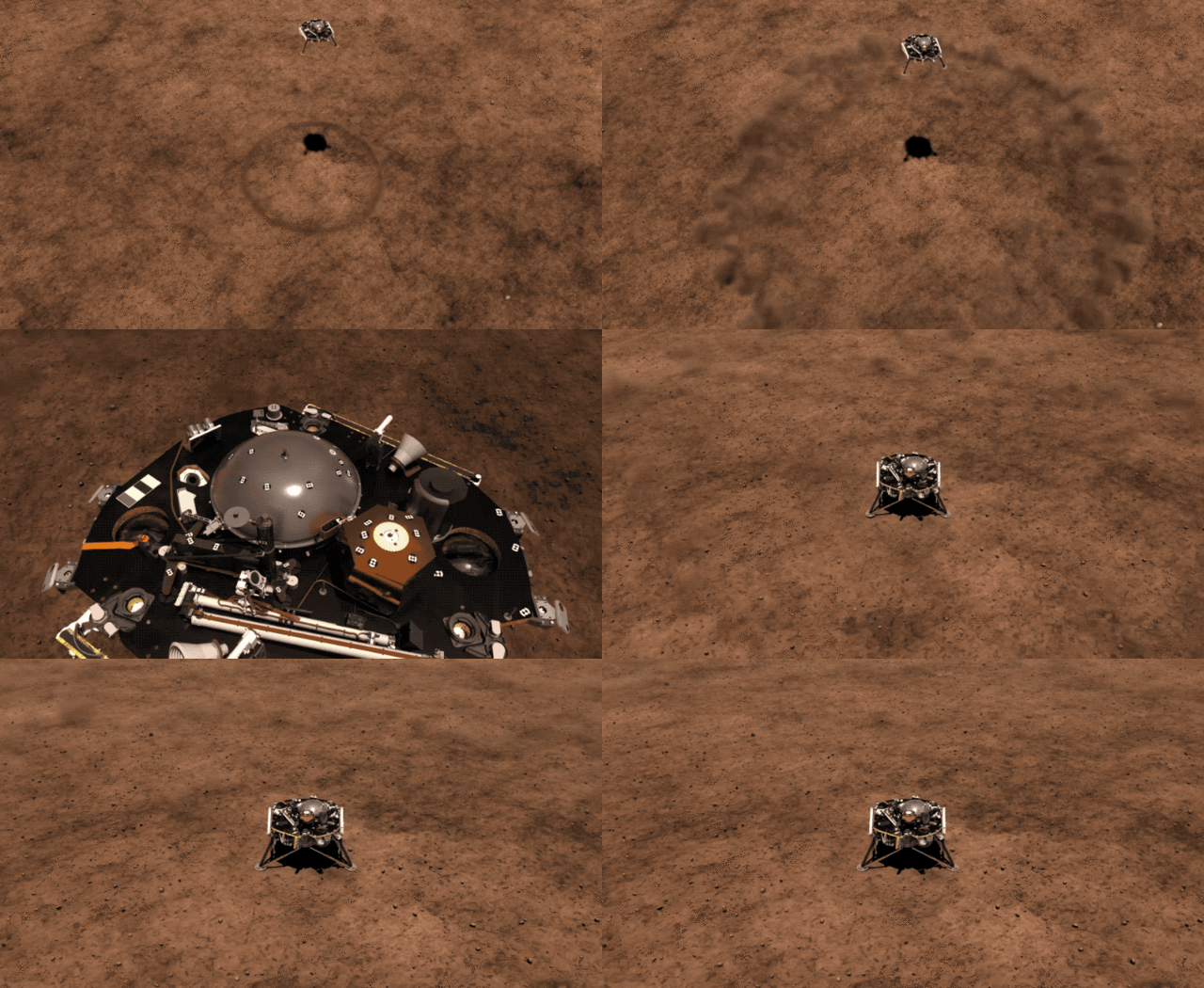
A simulation of InSight touching down on Mars using its 16 rocket motors. Credit: NASA

On Monday, November 26th, 2018, the latest in a series of NASA missions, the InSight lander – built with international cooperation -, arrived on the surface of Mars.

As noted in my previous Space Sunday report, confirmation that InSight (Interior Exploration using Seismic Investigations, Geodesy and Heat Transport) had safely arrived could only be received by mission control at NASA’s Jet Propulsion Laboratory (JPL) after the team there had endured the “seven minutes of terror”, more officially known as the Entry, Descent and Landing (EDL) phase of its journey, the time when the vehicle would enter Mars’ atmosphere and hopefully make a reasonably soft-landing on the planet’s surface.

While undeniably tense, when it came to it – and watched live via social media,  and assorted web broadcast channels put out by NASA – EDL was completed flawlessly. After separating from is cruise element around 7 minutes prior to EDL, InSight, protected by its heat shield and aeroshell, entered the upper reaches of the Martian atmosphere almost precisely on schedule, where over a 4-minute period, the frictional heat created by is passage helped decelerate it from an initial entry velocity of 19,800 km/h (12,300 mph) to 1,400 km/h (860 mph). At this point, telemetry once again being relayed, the supersonic braking parachute was been deployed.

After this things moved quickly: the heat shield was jettisoned from under the lander, which itself dropped free of the parachute and conical aeroshell, using its 16 rocket motors to achieve a “soft” landing on the surface of Mars – travelling at just 8 km/h (5 mph). A video compressing the seven minutes into just over a minute and a half captures the landing – and the joy at mission control (not the celebratory handshake at 1:19!).

It had been anticipated that the first “official” confirmation that InSight had arrived safely would be a “beep” sent directly to Earth from the lander’s X-band radio – and this might be followed a few minutes later by a photograph taken by the lander. As it turned out, and thanks to two tiny CubeSats – of which  more in a moment – it was the photo that arrived first. Grainy and indistinct due to it being taken by a camera still with its protected lens cap in place (itself splattered with dust), it shows a rocky surface and a tightly curved horizon – caused by the camera still being in its stowed configuration.
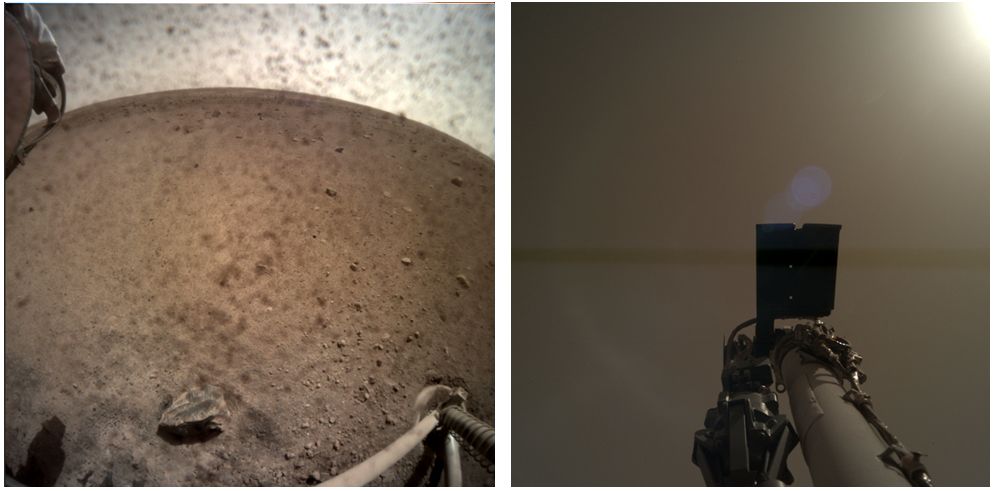
Side-by-side: (l) the first image returned by InSight using the lander-mounted, Instrument Context Camera (ICC), still with its dust cap in place – note the lander’s leg in the lower right corner. (r) a photo captured by the robot-arm mounted Instrument Deployment Camera (IDC), also taken with the lens cap in place, as the arm is exercised on November 30th, 2018. Credit: NASA/JPL

Initially after landing, InSight was operating on battery power whilst awaiting the dust to settle out of the atmosphere so the two circular solar panels could be deployed. This occurred some 30 minutes after touchdown, with the panels proving so efficient that . So efficient are these panels that during their Martian Sol of operation, they set a new record for power generation: 4,588 watt-hours – well over the 2,806 watt-hours generated in a single Sol by the “nuclear powered” Curiosity.

The efficiency of InSight’s solar arrays will deteriorate over time – the result of general wear-and-tear and the influence of dust that will inevitably accumulate on them – but the power levels have been more than enough for the lander to start flexing its muscles – including testing its robot arm, which is essential to it being able to place key experiments on the surface on Mars.
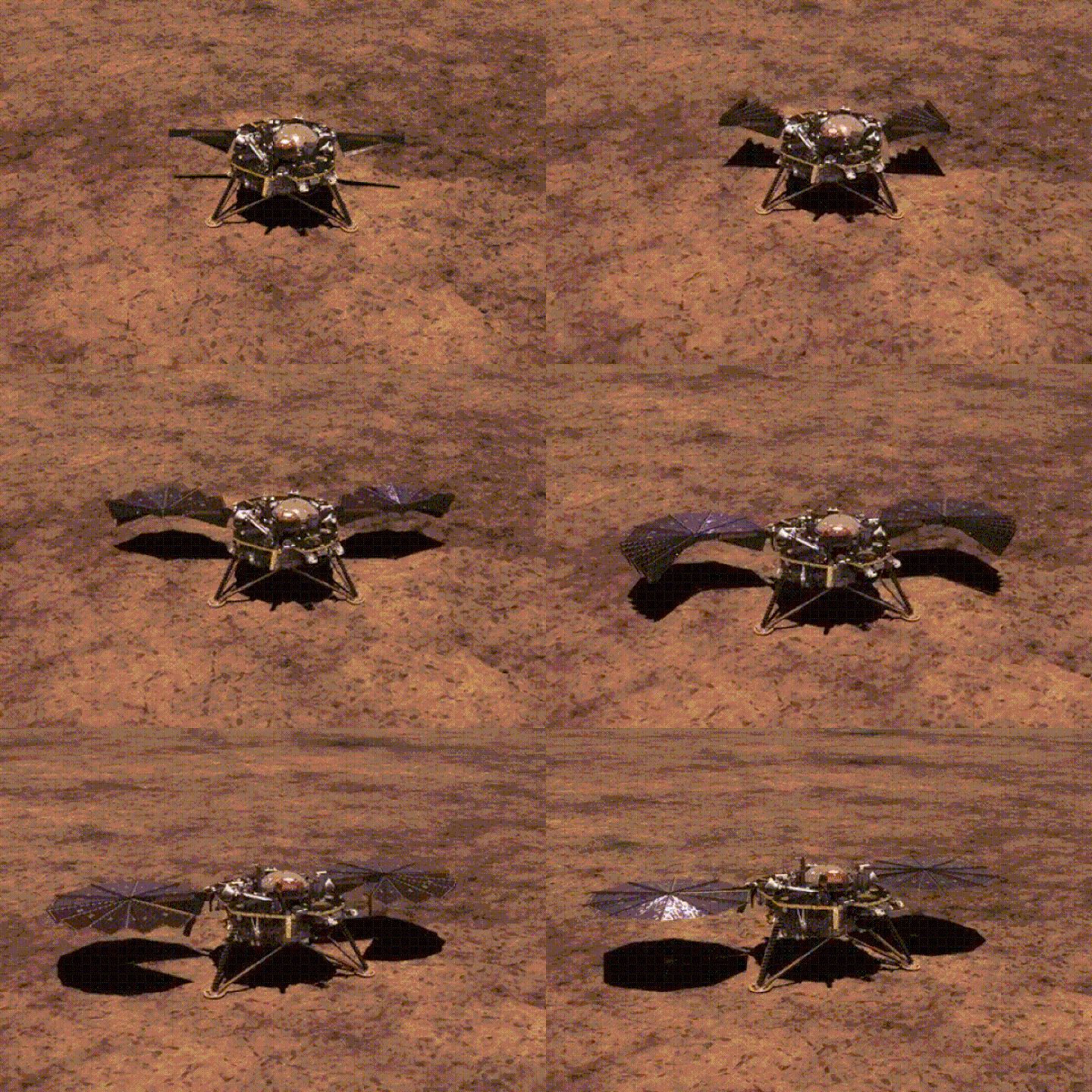
A computer simulation of InSight deploying its solar arrays. Credit: NASA

It is going to be early spring 2019 before InSight is fully involved in its science mission. There are a lot of equipment check-outs and calibration test to be undertaken, as well as the surface deployment of key instruments. However, there have been some external concerns raised over how well InSight will fulfil its science objectives. As data started coming back from the lander, it was noted that it had touched down in a shallow impact crater, almost completely filled by sand and dust (such craters being known as “hollows” on Mars), which has given InSight a 4-degree tilt.

Overall, the lander can in theory operate with up to a 15-dgree cant (the result of one of this three landing legs coming down on a boulder, for example), but here is a worry about how the tilt may impact placing the Seismic Experiment for Interior Structure (SEIS) and HP3, the Heat Flow and Physical Properties Package, on the surface of Mars, and how the material filling the hollow might affect the operation of HP3’s “mole”, which is designed to burrow into subsurface rock and measure the heat flow from the centre of the planet.
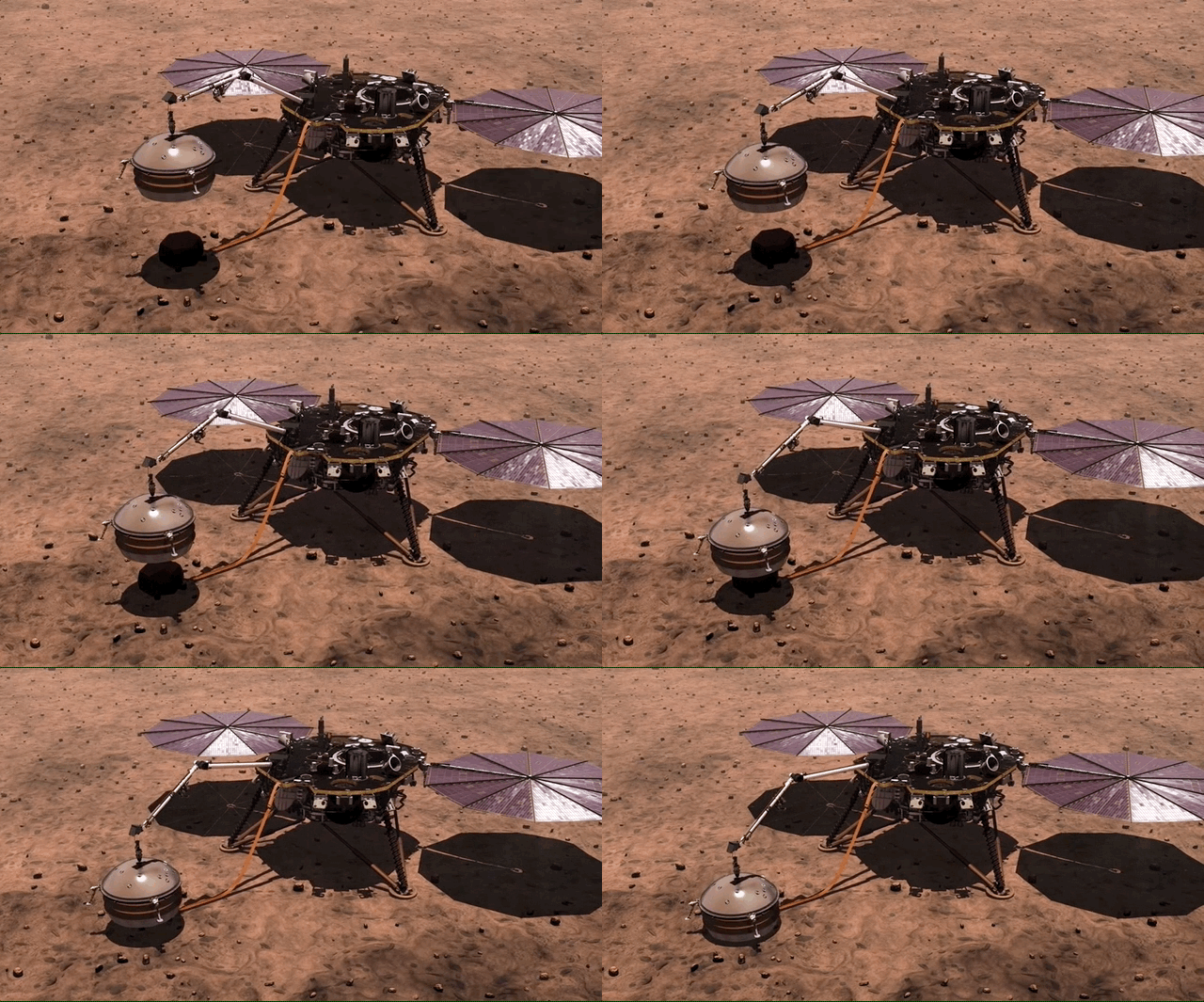
Computer simulation of Insight Placing the Seismic Experiment for Interior Structure (SEIS) experiment and its dust cover on the surface of Mars. Credit: NASA/JPL

Nevertheless the mission team remain in a positive mood and are delighted with both the landing and the first few days of operations.

We couldn’t be happier. There are no landing pads or runways on Mars, so coming down in an area that is basically a large sandbox without any large rocks should make instrument deployment easier and provide a great place for our mole to start burrowing.

– InSight project manager Tom Hoffman

Further examination of the lander’s surroundings will be made once the dust covers have been ejected from the on-board cameras, something that should happen in the next few days. This work will include a careful study of the ground to determine the best placement for SEIS and HP3, as well as a general surveying of the location, which in the initial images, appears a lot less rock-strewn than other locations visited by landers and rovers.

We are looking forward to higher-definition pictures to confirm this preliminary assessment. If these few images—with resolution-reducing dust covers on—are accurate, it bodes well for both instrument deployment.

– Bruce Banerdt, InSight principal investigator

I’ll have more on InSight as the mission develops.

Continue reading “Space Sunday: InSight, MarCO and privately to the Moon”

Space Sunday: Mars roundup

via Associated Press

NASA’s INterior Exploration using Seismic Investigations, Geodesy and Heat Transport (InSight) lander, launched in March 2018, is due to land on Mars on November 26th, 2018. Managed by NASA’s Jet Propulsion Laboratory, the mission is intended to study the internal structure of the planet, and in doing so it could bring new understanding of the Solar System’s terrestrial planets — Mercury, Venus, Earth, Mars and the Moon.

The lander is based on the design used for NASA’s Mars Phoenix lander, which successfully arrived on Mars in 2008, using circular solar arrays to generate power for its systems and instruments. As with the Phoenix Lander, InSight is designed to operate for a Martian year once on the surface of Mars, with an initial primary mission period of 90 days.

As a static lander, InSight will use a range of instruments to study the deep interior of Mars. Two of the principle instruments in this investigation are the Seismic Experiment for Interior Structure (SEIS) and HP3, the Heat Flow and Physical Properties Package, both of which will be placed in direct contact with the surface of Mars after touch-down.

An artist’s impression of InSight on Mars, showing the SEIS package deployed. Credit: NASA / JPL

Developed by the French Space Agency (CNES), with the participation of the Institut de Physique du Globe de Paris (IPGP), the Swiss Federal Institute of Technology (ETH), the Max Planck Institute for Solar System Research (MPS), Imperial College, Institut supérieur de l’aéronautique et de l’espace (ISAE) and JPL, SEIS is a sensitive instrument designed to do the work of an entire network of seismographs here on Earth.

It will measure seismic waves from marsquakes and meteorite strikes as they move through the planet. The speed of those waves changes depending on the material they’re travelling through, helping scientists deduce what the planet’s interior is made of. Seismic waves come in a surprising number of flavours; some vibrate across a planet’s surface, while others ricochet off its centre and they also move at different speeds. Seismologists can use each type as a tool to triangulate where and when a seismic event has happened.

Such is the sensitivity of SEIS, it can sit in one place and listen to the entire planet and detect vibrations smaller than the width of a hydrogen atom. It will be the first seismometer to be directly placed on the surface of Mars, where it will be thousands of times more accurate than seismometers that sat atop the Viking landers.

Artist’s illustration of InSight’s Seismic Experiment for Interior Structure (SEIS) instrument on the Red Planet’s surface. Credit: NASA TV/JPL

Also, because of the instrument’s sensitivity, SEIS will be protected from the local weather by a protective shell and skirt, both of which will stop local wind interfering with the instrument. In addition, it will be supported by a suite of meteorological tools to characterise atmospheric disturbances that might affect its readings.

HP3 has been provided by the German Aerospace Centre (DLR). It is a self-penetrating heat flow probe,  more popularly referred to as a “self-hammering nail” with the nickname of “the mole”. Once deployed on the surface of Mars, it will burrow 5 m (16 ft) below the Martian surface while trailing a tether with embedded heat sensors every 10 cm (3.9 in) to measure how efficiently heat flows through Mars’ core, revealing unique information about the planet’s interior and how it has evolved over time.

The “self-hammering nail” description comes from the spike, or “mole” at the end of the tether. A mechanism within it  will allow it to propel itself into the Martian regolith and down through the rock beneath it.

Diagram of HP3, showing the deployment system, the “mole” and tether. Credit: DLR

Once fully deployed, HP3 will be able to detect heat trapped inside Mars since the planet first formed. That heat shaped the surface with volcanoes, mountain ranges and valleys. It may even have determined where rivers ran early in Mars’ history.

On arrival at Mars, InSight will enter the planet’s atmosphere and land on Elysium Planitia, around 600 km (370 mi) from where the Curiosity rover is operating in Gale Crater. I’ll have more on the mission around the time InSight makes its landing on Mars.

Continue reading “Space Sunday: Mars roundup”

Space Sunday: saving Oppy, ISS leaks, and humans to Mars

NASA’s MER rover, Opportunity (MER-B) arrived on Mars in January 2004. It has been in a “sleep” mode since the start of June 2018, as a result of a globe-spanning dust storm on Mars. Credit: NASA/JPL

NASA has announced it will undertake a 45-day campaign to try to re-establish contact with its long-lived Mars Exploration Rover (MER) Opportunity. in the wake of contact being lost was a globe-spanning dust storm started to grip Mars in June 2018.

After running its course for almost three months, the storm is now abating, and whilst not the biggest storm seen on Mars since “Oppy” arrived there it the start of 2004, it is one of the most intense in terms of the amount of dust thrown up into the Martian atmosphere.

Contact with the rover was lost in early June 2018. With sunlight barely able to penetrate the dust in the air, it is thought the rover went into hibernation to conserve battery power – terminating contact with Earth in the process.

The attempt to re-establish communications will commence once the tau in the region where “Oppy” is located has dropped below 1.5. Tau is the term used to measure the opaqueness of the dust in the Martian atmosphere, and it is usually around 0.5. Opportunity requires a tau of below 2.0 to avoid triggering its sleep mode, and by early June the value had reached 10.8 – making this dust storm the densest the rover has ever encountered during its fourteen years on Mars.

As a solar-powered vehicle, there are a number of risks Opportunity faces during a long duration dust storm. The first is that as the batteries cannot be charged, they could run out of sufficient power required to keep the rover’s sensitive electronics warm – although this is partially mitigated by the fact that during a storm like this, the heat normally radiated away by the planet gets trapped in the dusty atmosphere, raising the ambient temperature and thus offsetting the amount of power the rover needs to use to keep itself warm.

How the dust storm progressed. Taken 15 days apart through the same telescope and viewing the same face of Mars. On the left, taken on June 8th and the storm started to rise, features such as Syrtis Major ( the dark India-shaped marking below centre) are visible. On the right, taken on June 23rd, they are almost totally obscured by dust. Note that south is top the top of both images. Credits: Damian Peach (left) / Christopher Go (right)

To other points of concern with the rover are the potential for a clock failure, or what is called an “uploss” recovery being triggered. Opportunity’s on-board clock allows the rover to track when an orbiting satellite – vital for relaying signals from the rover to Earth – is above the local horizon, allowing Opportunity to make contact with Mission Control. If it has failed or now has an incorrect reading as a result of power fluctuations, “Oppy” might not be easily able to establish contact with Earth by itself. An “uploss” recovery is triggered when the rover has failed to establish contact with Earth for an extended period. There is a concern that if the rover didn’t enter its hibernation state correctly, the lack of any communications might have triggered this mode, forcing the rover to continuously re-try different methods to receive a signal from Earth, using up its power reserves.

The 45-day campaign will be a pro-active attempt to re-establish contact with “Oppy” from Earth by sending commands out to it. However, if there is no response from the rover, a grim warning was given in the announcement:

If we do not hear back after 45 days, the team will be forced to conclude that the Sun-blocking dust and the Martian cold have conspired to cause some type of fault from which the rover will more than likely not recover. At that point, our active phase of reaching out to Opportunity will be at an end.

– John Callas, Opportunity project manager, NASA Jet Propulsion Laboratory

This has drawn some sharp criticism from former members of the MER team, particularly those who worked with Opportunity. They point out that when communications were lost with the other MER vehicle, Spirit, in 2010, NASA spent 10 months trying to re-establish contact. In response to the criticism, NASA state that the 45-day period has been dictated by the decreasing amount of sunlight the rover is receiving as winter approaches, requiring the rover to start conserving power once more, but they will continue to listen for any attempts by the rover to re-establish communications after 45 day campaign has come to an end – they just won’t continue to try to make the connection pro-actively.

Even if communications are re-established, it doesn’t necessarily mean “Oppy” is out of danger; there is a chance that the storm has caused the rover to use its batteries for so long without charge, then may not longer have the capacity to charge correctly or to efficiently retaining their charge – either of which could severely impact further operations for the rover, and require careful assessment.

Soyuz Pressure Leak at the ISS

A Soyuz vehicle suffered a minor loss of cabin pressure whilst docked at the International Space Station (ISS), causing a bit of a fuss in some sectors of the media.

At around 19:00 Eastern Standard Time on August 29th, 2018, ground controllers noted a loss of atmospheric pressure in the orbital module of a Soyuz MS-08 docked to the station. While some media outlets reported the ISS crew “scrambled” to locate and patch the source of the pressure loss, the drop was so slight mission controllers decided to allow the 6-man crew to continue their sleep period aboard the station, and did not inform them of the issue until they were woken up at their scheduled time.

A Soyuz vehicle docked with the ISS (a second Soyuz is just visible, top reight of this image). The pressure leak occurred in the spherical orbital module directly attached to the space station. Behind this is the earth return module (and primary compartment for cosmonauts and astronauts when flying Soyuz) with the white section at the rear, with the solar panels, is the vehicle’s propulsion and power module. Credit: NASA / Roscosmos.

The leak was ultimately traced to a 2mm hole through the skin of the Soyuz module. A temporary fix was made using tape while the crew awaited instructions from Earth on how best to affect a more permanent repair. This actually highlighted a difference in approach between American astronauts and engineers and their Russian counterparts in handling situations.

The Americans – including Expedition 56 Commander Drew Feustel – were keen to explore and test options on Earth before determining on a curse of action out of concern that if options were not tested, then a repair could result in additional damage to the Soyuz. Russian engineers, however, proposed just the one approach to making the repair, and ordered the two Russian cosmonauts on the ISS – Oleg Artemyev and Sergei Prokopyev – to make the repair without any Earth-based testing, handling the situation entirely in Russian and using an interpreter to keep NASA personnel appraised of progress.

After completing the work, Artemyev and Prokopyev reported bubbles forming in the patch, but were instructed to leave it in place to harden over 24 hours. At the time of writing, the path appears to be holding, with no further leaks reported. The damaged Soyuz had been scheduled to make a return to Earth in December 2018 (each vehicle generally spending around 6 months berthed at the ISS alongside another Soyuz so they can be used as “lifeboats” by a station crew should they have to abandon the station for any reason), but as a result of the incident, mission controllers are contemplating using the vehicle in October, when three of the current ISS crew are due to return to Earth.

As the leak occurred in the Soyuz orbital module, it does not pose a threat to a crew: the module is only used during the time a Soyuz is en route to the ISS to give the crew a little more space. On a flight back to Earth the module is jettisoned along with the power and propulsion module, leaving the crew to return in the “mid-ships” Earth return capsule.

The cause of the leak is still being investigated, but suggestions are that it may have been a MMOD – a MicroMeteoroid (tiny piece of orbiting rock weighing less than a gramme but travelling at high-speed) or a piece of Orbital Debris (tiny fragment of debris from a space mission). Such strikes have occurred with the ISS in the past, but if this is the cause of the Soyuz leak, it will be the first time such a strike has directly resulted in a loss of atmospheric pressure either aboard the station or a vehicle docked with it, something that will add to concerns as to the amount of natural and human-made debris circling Earth.

Continue reading “Space Sunday: saving Oppy, ISS leaks, and humans to Mars”

Space update special: the lake on Mars

An artist’s impression of Mars Express probing Mars using its MARSIS instrument superimposed on a radar cross-section of the southern polar layered deposits. The continuous white line at the top of the radar results above marks the beginning of the South Polar Layered Deposit; a layered accumulation of water ice and dust. The blue spots are areas of very high reflectivity and thought to be water. Credit D. Coero Borga/ESA / INAF

Whether or not liquid water exists on Mars has long been a source of study with regards to the Red Planet. There are many signs that the surface of Mars was once affected by free-flowing liquid – most likely water – in the planet’s ancient past. Curiosity, NASA’s Mars Science Laboratory rover, has confirmed the crater it has been exploring was home to several lakes during the early part of Mars’ history. What’s not clear is whether and how much of the remnants of that water still survives in liquid form today under the planet’s surface. Now a group of European scientists believe they have found direct evidence a sub-surface lake of liquid water on Mars.

The news comes via a paper published on Wednesday, July 25th in the Journal Science by a team of researchers involved in analysing the data from the European Space Agency’s Mars Express orbiter – something of a “forgotten mission” around Mars, given the volume of US missions on and orbiting the planet.

Mars Express arrived at Mars on December 25th, 2003. Since then, it has been quietly working away, observing Mars, gathering data about the planet’s atmosphere, surface and sub-surface, using a range of instruments including the Mars Advanced Radar for Subsurface and Ionosphere Sounding (MARSIS) package capable of “seeing” what lies under the surface of the planet. It is data from MARSIS which points to the presence of the subsurface lake.

An artist’s impression of Mars Express over Mars. The long booms (40m in length) extending from the vehicle are the deployed radar emitters for MARSIS. Credit: ESA

The story actually begins in 2007, when data from a MARSIS survey of a region near the Martian south pole revealed very strong differences in the radar returns (“echoes”) of two subsurface layers. On Earth, such a strong differentiation in returns typically tends to be the result of one of the layers being subsurface water. Analysis of the data from MARSIS initially suggested the “bright” return from the region on Mars might be caused by a layer of carbon dioxide ice. However, as further data was gathered on the region, researchers noticed something odd: the measurements of the layer kept changing over relatively short periods of time, rather than remaining relatively constant as might be expected from a body of subsurface ice.

Investigations of the apparent fluctuations in different radar returns of the same area revealed something unexpected: such was the volume of data point being collected by MARSIS, the software aboard Mars Express to initially process the returns was effectively averaging things out – giving the impression whatever the radar was encountering beneath the surface of Mars was somehow fluctuating: present in quantity during one pass, all but gone a few passes later, only to suddenly return in volume.

A composite image showing the south pole of Mars (r) and the region where the MARSIS radar reflections have been found (l). Credit: ESA

With their understanding of what was happening with the MARSIS processing, researchers were able to work out a means of compensating for it, and began a campaign of gathering data from the region, which ran for three years between mid-2012 mid mid-2015. It is the Earth-based analysis of this data over the last couple of years that has led to the conclusion that not only had MARSIS discovered something under the surface of Mars, but that it is very likely liquid water sitting under a covering of relatively cleat ice.

It is unclear if the body, some 20 km (12 mi) across and at least 2 metres deep and lying some 1.6 km (1 mile) beneath the surface, is actually an ice-covered body of water, or if it is an aquifer created by water filling interconnected pores in Martian rock beneath the ice.

However, given the extremely low temperatures on Mars, any water under the surface of the planet would require high concentrations of salt held in suspension within it, because salt helps reduce the temperature at which water freezes (a 20% solution lowers the freezing point of water to -16oC (-2oF), for example).  The data gathered by MARSIS is consistent with the liquid containing high concentrations of salts.

The discovery also has possible repercussions for the idea of Martian life.

For Life to get started, it needs three things: liquid water, an energy source such as minerals leeching into the water, and a biological seed. As noted at the top of this article, the evidence for water once having existed on Mars is strong. What’s more, NASA’s Curiosity rover has already found evidence for the second requirement – an energy source in the form of leeching minerals – was present at the time the planet had liquid water on its surface. So, if the third element – the biological seed – was available, then it is possible that microbial life may have started on Mars. Thus, there is the tantalising question of whether those Martian microbes might have followed the water into places like the south polar lake. However, we’re still a very, very long way from answering this particular question.

From what I think we have learned about this sub-glacial lake, the most likely analogue for this environment is the sub-glacial lake that was recently discovered in Canada… in which the lake itself is in contact with a deposit of salt, and so it is very, very salty. There are micro-organisms that are capable of surviving well below zero even without being in contact with water, and there are micro-organisms that can use the salt, presumably the salt in the water on Mars… for their metabolism.

– Roberto Orosei, MARSIS instrument co-investigator, and co-author of the lake study

Continue reading “Space update special: the lake on Mars”

Space Sunday: asteroids, telescopes and dust

Credit: Mopic/Shutterstock

Saturday, June 30th marked International Asteroid Day, a global event involving researchers, astronomy groups, space agencies and more talking about asteroids  – and the risk some of them present to Earth.

Since 2013, and the Chelyabinsk event which saw a meteor  roughly 20 metres across, caught on film as it broke up high over the Russian town, the tabloid media has seemingly been obsessed with reporting meteors about to collide Earth and wreak havoc.

Fortunately, the vast majority of the estimated 10 million objects which have orbits passing close to Earth – referred to as NEOs, for Near Earth Objects, are unlikely to actually strike our atmosphere or are of a small enough size not to pose a significant threat if they did, despite all the screaming of the tabloids.

A map showing the frequency of small asteroids entering Earth’s atmosphere between 1994 and 2013. The dot sizes are proportional to the optical radiated energy of impacts measured in billions of Joules (GJ) of energy. A total of 556 events are recorded on the map, representing objects ranging in size from 1m to 20m. Credit: NASA’s Near Earth Object (NEO) programme

Which is not to say NEOs don’t pose a potential threat. Not all of the 10 million objects with orbits passing close to, or intersecting, the orbit of Earth have been properly mapped. Take 2018 LA (ZLAF9B2), for example. As I reported at the start of June, this asteroid, some 2 metres across, was only identified a handful of hours before it slammed into Earth’s upper atmosphere over Botswana at approximately 17,000 kilometres per second, to be caught on film as it burnt up. The energetic force of the accompanying explosion has been estimated to have been in the region of 0.3 to 0.5 kilotons (300 to 500 tonnes of TNT).

To offer a couple of quick comparisons with this event:

  • The 2013 Chelyabinsk superbolide (roughly 10 times the size of 2018 LA (ZLAF9B2) disintegrated at an altitude of around at 29.7 km at a velocity between 60,000-69,000 km/h, producing an energy release equivalent to 400-500 kilotons (400,000-500,000 tonnes of TNT). This was enough to blow out windows and send 1,491 people to hospital with injuries, including several dozen temporarily blinded by the flash of the explosion. The first 32 seconds of the video below convey something of the force of that event.

  • In June 1908 a cometary fragment estimated between 60 and 190 metres cross disintegrated some 5 to 10 km above Tunguska, Siberia. This generated an estimated downward explosive force of between 3 to 5 megatons and an overall force of somewhere between 10 to 15 megatons (again for comparison, all the bombs dropped by allied forces in World War 2 amounted to around 3.4 megatons of combined explosive force). This is believed to have generated a shock wave measuring 5.0 on the Richter scale, flattening an estimated 80 million trees covering an area of 2,150 square kilometres. Were it to occur today, such an event would devastate a large city.

There are two sobering points with these two events. The first is that astronomers estimate only about one-third (1600) of objects the size of the Tunguska event meteoroid which might be among that 10 million NEOs have so far been mapped. The second is that many NEOs can remain “hidden” from our view. the Chelyabinsk superbolide, for example passed unseen as the Sun completely obscured its approach to Earth.

There have been several proposals for trying to deal with the potential risk of a PHA – Potentially Hazardous Asteroid – impact over the years. One currently in development is the NASA / Applied Physics Laboratory (APL) Double Asteroid Redirection Test (DART) mission intended to demonstrate the kinetic effects of crashing an impactor spacecraft into an asteroid for planetary defence purposes.

The target for this mission is rather interesting. DART will be launched on an intercept with 65803 Didymos, an asteroid around 750 metres across – but this will not be the vehicle’s target. That honour goes to a much smaller asteroid – around 170 metres across (so in the size range of the Tunguska object) – orbiting 65803 Didymos and informally referred to as “Didymoon”.

Originally, DART was to be a part of a joint NASA/APL and European Space Agency effort, with ESA supplying a vehicle called the Asteroid Intercept Mission (AIM). This would have been launched ahead of DART on a trajectory that would place it in orbit around the 65803 Didymos / “Didymoon” pairing, allowing it to track / guide DART to its target and record the entire impact and its aftermath.

AIM never received funding, leaving the NASA/APL mission, which is currently scheduled for launch in 2021 and will intercept “Didymoon” in 2022. However, in the last few weeks, ESA has announced a revised mission to 65803 Didymos called Hera. Like AIM, it is designed to orbit the asteroid and is moon, and a call has been made to combine it with DART under a new joint mission called Asteroid Impact and Deflection Assessment (AIDA).

This would require DART to be delayed for a number of years to give ESA time to obtain approval for Hera and design, build and launch the craft – so the intercept would not take place until 2026. While this is a delay, it would mean that scientists would be able to better characterise “Didymoon” ahead of DART’s arrival, and witness the impact and its aftermath in real-time.

The original DART / AIM mission – to study the use of kinetic vehicles to divert an asteroid – now potentially superseded by the DART / Hera mission. Credit: NASA / APL / ESA

It’s not clear whether or not DART will be delayed. If it isn’t, then it has been proposed DART carries a camera equipped cubesat similar to those AIM would have used in support of its mission. This could then be separated from DART ahead of the impact so it could image the event as it flies by “Didymoon”. The Hera mission would then arrive a few years after the impact and assess the outcome, including imaging the impact crater on the asteroid and changes to its orbit and its rotation, which can help scientists determine how efficient the impact was in transferring its energy into “Didymoon”.

Continue reading “Space Sunday: asteroids, telescopes and dust”

Space Sunday: the sands of Mars and Planet Nine

The spread of the 2018 dust storm as seen by NASA’s Mars Reconnaissance Orbiter between May 31st and June 10th. The black gaps in the images indicate parts of the planet’s surface not captured in the individual images making up this time-lapse view. Note the position of the Opportunity and Curiosity rovers. Credit: NASA / MSSS

Dust storms on Mars are not unusual event; they occur in both hemispheres with the changing of the seasons, and can even grow to encompass the entire planet.

Just such world-girdling dust storm occurred in 1971, and was caught by the cameras on NASA’s Mariner 9 space vehicle when it arrived in the vicinity of Mars in November of that year. The images Mariner 9 returned from Mar as it entered orbit (becoming in the process the first man-made object to orbit another planet) show the entire surface of Mars totally obscured by a blanket of dust that reached high up into the atmosphere. It took some two months for the storms to abate – although scientists were treated to Mars gradually revealing itself to Mariner 9’s camera as the dust slowly settled, starting with the high peaks of Olympus Mons and the Tharsis Ridge volcanoes, which rise up to 25 kilometres above the mean surface level of Mars.

In 2001, the Hubble Space Telescope (HST) reveal just how all-encompassing these more massive storms on Mars can be, when it took two images of Mars just three months apart. In one, surface features are clearly visible; in the second, Mars appears to be devoid of any detail.

These two images, captured 3 months apart by the Hubble Space Telescope in 2001, shoe how all-encompassing the more extreme dust storms on Mars can be. Note that in both images, south is at the top . Credit: NASA / The Hubble Heritage Team

Now, another dust storm is engulfing a huge swathe of Mars. It grew quickly in the opening week and a half of June, While it has not – as yet – engulfed the entire planet, it is raising massive mounts of dust high into the Martian atmosphere, marking it as the “thickest” dust storm witnessed on Mars.

Of to two rovers currently operating on Mars, the Mars Exploration Rover Opportunity is particularly impacted by storms of this nature as it is solar-powered. Such is the volume of dust lifted into the Martian atmosphere when these more extreme storms occur that they can severely limit Oppy’s ability to gather sunlight to charge its batteries.

This is not the first such dust storm Oppy has encountered; in 2007, a large-scale storm resulted in a severe degradation in the amount of sunlight reaching the Martian surface where the rover was operating. At that time, we were treated to some remarkable images of just how all-pervasive the dust can become when lifted into the tenuous Martian atmosphere.

This series of images show the onset of a severe dust storm, as seen by NASA’s Opportunity rover in 2007. On the left, Sol 1205, is “normal” daylight conditions. The remain shots show the reduction in daylight between Sol 1220 and Sol 12035. Credit: NASA / Cornell University

Even so the current storm is perhaps the most severe Oppy has had to face. So much so that even though the decision was quickly made to suspend all science gathering operations as it explores Endeavour Crater, and so reduce its power output, the rover has since switched itself into a further “safe” mode of power conservation.

This  kind of more massive storm is particularly prone to occurring when summer comes to one of the hemispheres (in this case, the southern hemisphere). At this time, the increased sunlight warming the atmosphere causes an increase in wind activity, which results in more dust being lifted into the atmosphere. For so reason, this dust causes the winds to persist  – and even increase, lifting more dust, and a feedback loop is created, turning the process into a self-driving storm that can take weeks or months to die down.

A couple of interesting points with these dust storms is that firstly, and for those familiar with the Matt Damon vehicle The Martian, the winds are nowhere near as violent as portrayed by that film. While wind speeds during these storms can reach speeds of 96-160 km/h (60-100 mph), the Martian atmosphere is so tenuous, the overall effect of such wind speeds is akin to a stiff breeze here on Earth. The second point is that while they do reduce the amount of sunlight reaching the surface of Mars, the dust is an effective insulator, both reducing the amount of heat being radiated away from Mars whilst simultaneously absorbing solar radiation, both of which serve to raise ambient surface temperatures.

This latter point is in part good news for Oppy, as it helps reduce the rover’s power outlay in keeping itself and its instruments warm. However, given that such intense storms can last for periods of several weeks to months at a time, there is genuine concerns as to how well Opportunity might survive if this storm is particularly drawn out, leaving the MER team on Earth reasonably confident the rover will be able to survive the storm without its systems becoming too cold to be restarted.

By June 10th, the storm had grown to a size where it was starting to make itself felt in Gale Crater, where NASA is operating the Mars Science Laboratory rover Curiosity, although the effects haven’t been as great as around Endeavour Crater, which Opportunity has been exploring. When it comes to dust storms, Curiosity has a significant advantage over Opportunity in that it is nuclear powered and is thus its power systems aren’t affected by any loss of  sunlight.

The dust storm reaches Gale crater: on the left, a true colour image from Curiosity’s Mastcam taken of the east-north-east rim of Gale Crater taken on June 7th, 2018 (Sol 2074). On the right, the same view seen three days later, on June 10th, 2018 (Sol 2077). Credit: NASA / MSSS

By the time the dust storm reach Gale Crater, it was blanketing to 35 million square kilometres (14 million sq miles) of the Martian surface – or roughly one-quarter of the entire planet, and it was still growing. As well as bing observed by the two surface rovers, it is also being watched from space by the combined network of NASA’s Mars Reconnaissance Orbiter (MRO), Mars Odyssey and MAVEN space vehicles, as well as Europe’s Mars Express mission and India’s Mars Observer Mission.

Observing and probing this kind of storm is seen as vital on a number of counts. In the first place, the precise mechanism that causes the feedback loop of wind and dust mentioned above isn’t really understood, so seeing storms like the develop and abate can help scientists to fill-in the blanks. In addition, and as NASA’s Mars Programme Office chief scientist Rich Zurek explains:

Studying their physics is critical to understanding the ancient and modern Martian climate. Each observation of these large storms brings us closer to being able to model these events, and maybe, someday, being able to forecast them. That would be like forecasting El Niño events on Earth, or the severity of upcoming hurricane seasons.

This latter point is particularly important in terms of planning for future missions – including any human mission to Mars. Being able to predict the rises and potential scope of these storms could go a long way to ensuring human safety on Mars. However, for the duration of this storm, all eyes are on little Opportunity, caught in the midst of it, with the hope that the rover will come through the storm able to resume its record-breaking 14+ years of operations on Mars.

Continue reading “Space Sunday: the sands of Mars and Planet Nine”