Space Sunday: total eclipse and exoplanet update

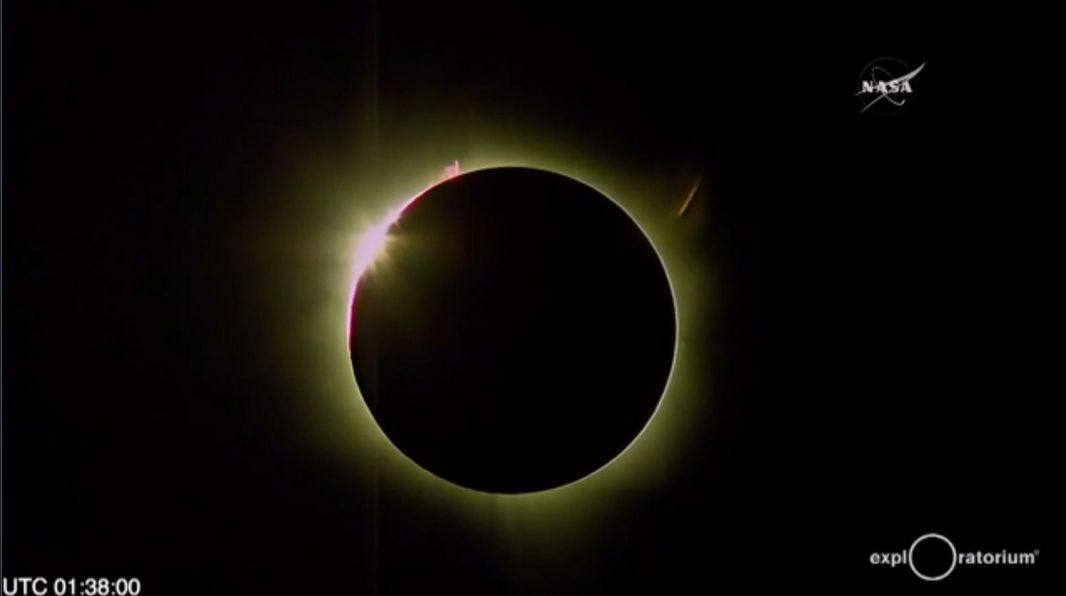
2016 total eclipse Credit: NASA Exploratorium webcast

On Monday, August 21st, the continental United States will experience its first total eclipse of the sun for 38 years (the last total eclipse visible from the USA having occurred in 1979). Providing the weather holds good along the path of the eclipse, an estimated 220 million people will be able to see the event – providing they take the proper precautions.

An eclipse is a periodic event, occurring when the Moon passes between the Sun and Earth and either fully or partially occults (blocks) the Sun’s light. This can happen only at new moon, when the Sun and the Moon are in conjunction as seen from Earth, in an alignment referred to as syzygy. There are actually four types of eclipse:

  • Partial – this occurs when the Sun and Moon are not exactly in line with the Earth, and so the Moon only partially obscures the Sun. Partial eclipses are virtually unnoticeable in terms of the sun’s brightness, as it takes well over 90% coverage to notice any darkening at all.
  • Annular – occurs when the Sun and Moon are exactly in line with the Earth, but because of the variations in the Earth’s distance from the Sun, and the variations in the Moon’s distance from the Earth, the apparent size of the Moon is smaller than that of the Sun. Hence the Sun appears as a very bright ring, or annulus, surrounding the dark disk of the Moon.
  • Total – occurs when the dark silhouette of the Moon completely obscures the intensely bright light of the Sun, allowing the much fainter solar corona to be visible. The complete coverage of the Sun’s disk by that of the moon – referred to as totality – occurs at its best only in a narrow track on the surface of Earth.
  • Hybrid (also called annular/total eclipse) – this shifts between a total and annular eclipse. At certain points on the surface of Earth, it appears as a total eclipse, whereas at other points it appears as annular. Hybrid eclipses are comparatively rare.

The last total eclipse took place in March 2016, and was visible from South/East Asia, North/West Australia, the Pacific and Indian oceans. The 2017 event will be visible in partial forms across every continent except Antarctica and Australia. However, the path of totality will only be visible across the continental United States.
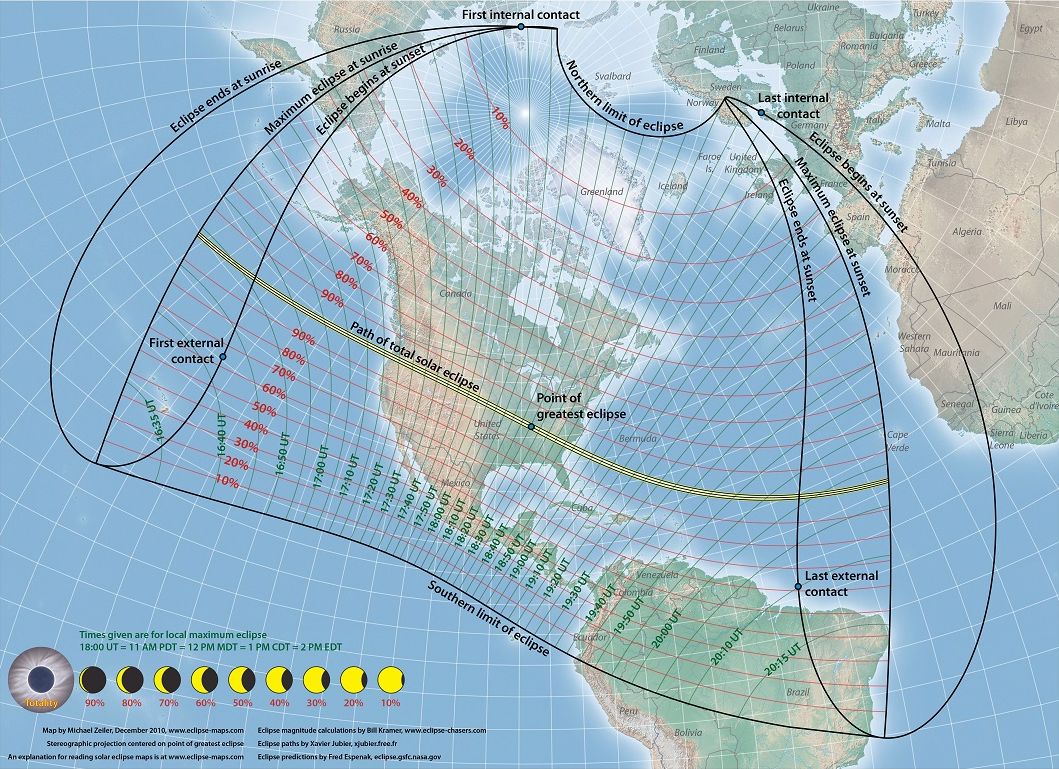
Although totality slices through the U.S., partial phases of the eclipse touch on every continent except Antarctica and Australia. Credit: Michael Zeiler / The Great American Eclipse – click for full size

The path of totality will run from Oregon to South Carolina, as will be around 113 kilometres (70 miles) wide, offering people along it an unrivalled opportunity to view the eclipse  – weather permitting -, providing the right precautions are taken.

The most important aspect of viewing an eclipse “live” is never look directly at the Sun, even during the period of totality; you should at least use a solar filter or viewer. However, if you don’t have one or the other or any specialised kit, the best way to see the eclipse in the flesh is via pinhole projection. For those who are unable to see the eclipse first-hand, there are a wide variety of ways to watch the event on television or the Internet, including:

  • NASA Total Eclipse live stream is providing options to watch through NASA Edge, NASA TV, Ustream, YouTube and more. NASA’s Facebook page. These will show images of the eclipse, from 11 spacecraft, three aircraft and from more than 50 high-altitude balloons, and the astronauts on the International Space Station.
  • Slooh, the on-line community observatory, will run a webcast starting at 12:oo noon EDT (1600 GMT), as a part of a 3-day celebration of the eclipse.
  • The Virtual Telescope Project is hosting a free online observing session with views of the total solar eclipse beginning at 13:00 EDT (17:00 GMT).
  • The Eclipse Ballooning Project will be broadcasting live views of the eclipse from the edge of space via more than 57 cameras sent up on weather balloons.
  • CNN and Volvo will be providing a 360-degree view of the eclipse with 4K resolution from different locations along the eclipse path. The stream will also be viewable in virtual reality, which people can navigate by moving a phone or virtual reality headset. The live stream begins at 12:03 p.m. EDT (16:03 GMT).
  • ABC will air a two-hour special on the eclipse starting at 13:00 EDT (17:00 GMT). The broadcast will also be available on Facebook Live and YouTube

There are a number of terms common to eclipses which are worth mentioning for those who wish to follow the event, but are unfamiliar with the terminology. These include:
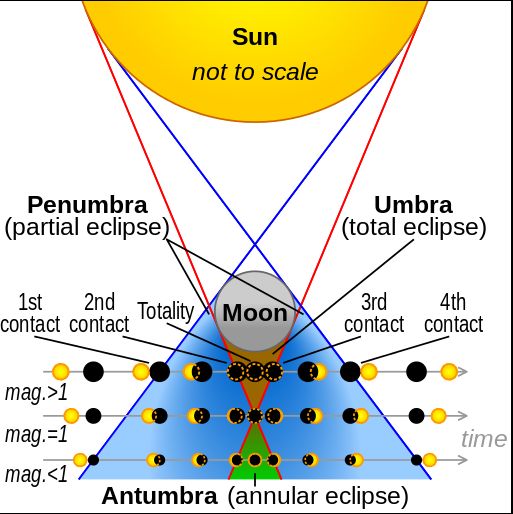
Eclipse Types (Moon and Sun not to scale). Credit: Cmglee
  • The umbra, within which the object in this case, the Moon) completely covers the light source (in this case, the Sun’s photosphere).
  • The antumbra, extending beyond the tip of the umbra, within which the object is completely in front of the light source but too small to completely cover it.
  • The penumbra, within which the object is only partially in front of the light source.
  • Photosphere, the shiny layer of gas you see when you look at the sun.
  • Chromosphere, a reddish gaseous layer immediately above the photosphere of the sun that will peak out during the eclipse.
  • Corona, the light streams that surround the sun.
  • First contact, the time when an eclipse starts.
  • Second contact, the time when the total eclipse starts.
  • Third contact, the time when the total eclipse ends.
  • Fourth contact, the time at which the eclipse ends.
  • Bailey’s beads, the shimmering of bright specks seen immediately before the moon is about to block the sun.
  • Diamond ring, the last bit of sunlight you see right before totality. It looks like one bright spot (the diamond) and the corona (the ring).

A total eclipse occurs when the observer is within the umbra (they are standing in the shadow cast by the Moon); an annular eclipse when the observer is within the antumbra, and a partial eclipse when the observer is within the penumbra.

As well as the passage of the Moon between the Earth and Sun, there are a number of Earthly effects to look for if you are in the path of totality, such as a the 360-degree sunset. This may also be accompanied by an “eclipse wind” as temperatures suddenly drop. And, of course, there is the rousing of nocturnal animals, fooled by the darkness, followed by a false dawn as the Moon moves away from between the Earth and the Sun, and an accompanying dawn chorus.

The period of totality lasts only a few minutes but offers a superb opportunity for observing the Sun and its corona – hence why NASA is using a chain of three aircraft to “chase” the eclipse as the Moon’s shadows travels at an average speed of 3,683 km/h (2,288 mph) west-to-east, enabling them to carry out an extended study of the corona.
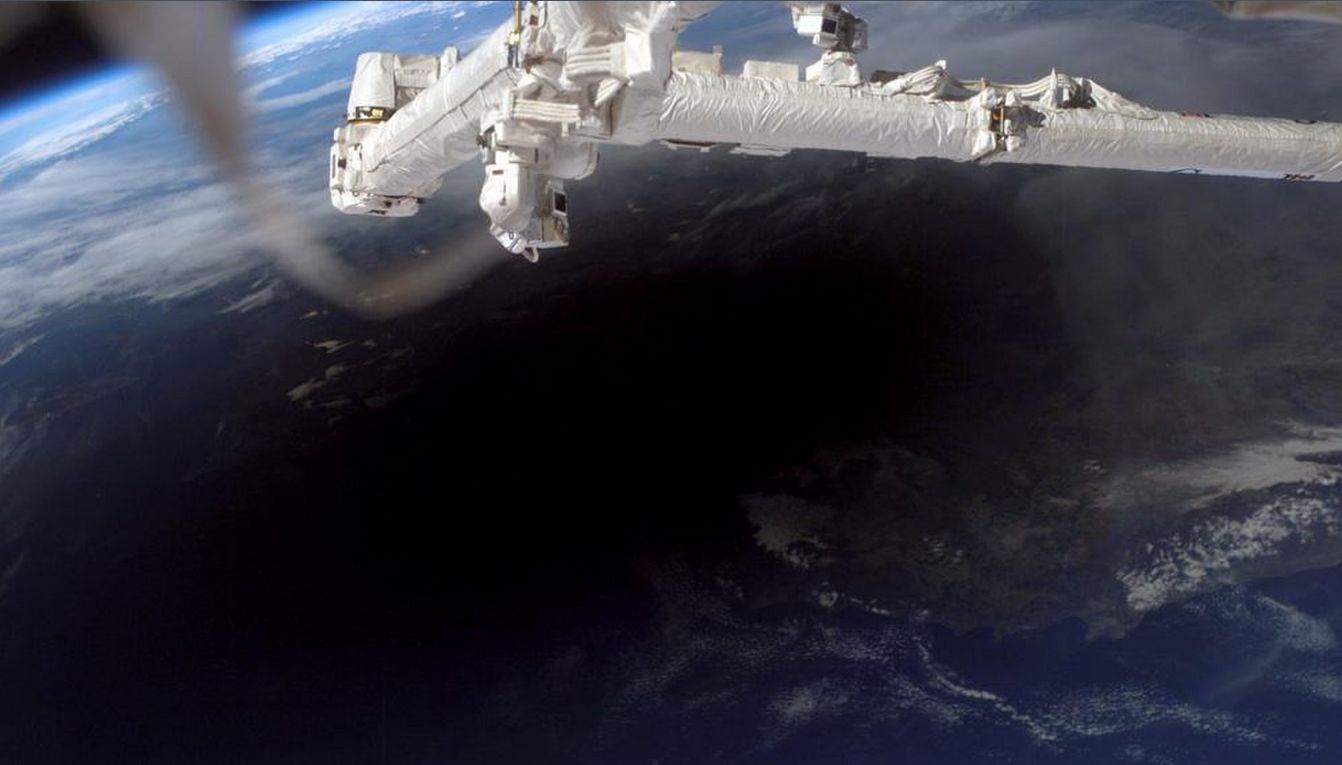
The Moon’s shadow on Earth, as seen from the International Space Station on March 29th, 2006 as it passes over southern Turkey, Northern Cyprus and the Mediterranean Sea. Credit: NASA

As a point of historical interest, August 21st marks the 103rd anniversary of the 1914 total eclipse, which was seen from Scandinavia through to Turkey, the middle east and India. It was the subject of a number of expeditions being sent eastwards to the Baltic and Ukraine by Britain and other European nations with the intention of studying it – only for the conflagration of the First World War to erupt.

The war foiled attempts by a British expedition which intended to use the eclipse as a means to measure relativity; however, it did give rise to another mystery: whether or not a film of the eclipse apparently made in Sweden in 1914 is the real deal or not. If it is, it might be the oldest surviving footage of an eclipse.

If you are on the path of totality, and plan to view the eclipse, do please take the proper precautions and I hope the weather cooperates with you. I’ll be following things on-line.

Continue reading “Space Sunday: total eclipse and exoplanet update”

Space Sunday: Curiosity’s 5th, Proxima b and WASP-121b

On August 6th 2016, NASA delivered the Mars Science Laboratory (MSL) to the surface of Mars in what was called the “seven minutes of terror” – the period when the mission slammed into the tenuous Martian atmosphere to begin deceleration and a descent to the surface of the planet which culminated in the Curiosity rover being winched down gently from a hovering “sky crane” and then lowered until its wheels made firm contact with the ground.

The “seven minutes of terror” actually had a double meaning. Not only did it represent the time MSL would smash into Mars’ atmosphere and attempt its seemingly crazy landing, at the time of the event, the distance between Earth and Mars meant it took seven minutes to be returned to mission control from the red planet. Thus, even as the initial telemetry indicating the craft was entering the upper reaches of Mars’ tenuous atmosphere was being received, mission controls knew that in reality, the landing had either succeeded or failed.

Obviously, the attempt succeeded. Everything worked flawlessly, and Curiosity was delivered to the surface of Mars at 05:17 GMT on August 6th, 2012 (01:17, August 6th EDT, 22:17 PDT, August 5th). In the five years since that time, it is helped revolutionise our understanding of that enigmatic world – as well as adding somewhat to its mystery.

To call the mission a success is not an exaggeration; within weeks of its arrival inside the 154 kilometre (96 mile) wide Gale Crater, Curiosity was examining an ancient riverbed en route to a region of the crater dubbed “Yellowknife Bay”. It was there the rover made its first bombshell discovery: analysis of the area showed that billions of years ago it was home for the ideal conditions to potentially kick-start microbial life. It was, in essence, the achievement of mission’s primary goal: to identify if Mars may have once harboured the kind of conditions which might have given rise to life.

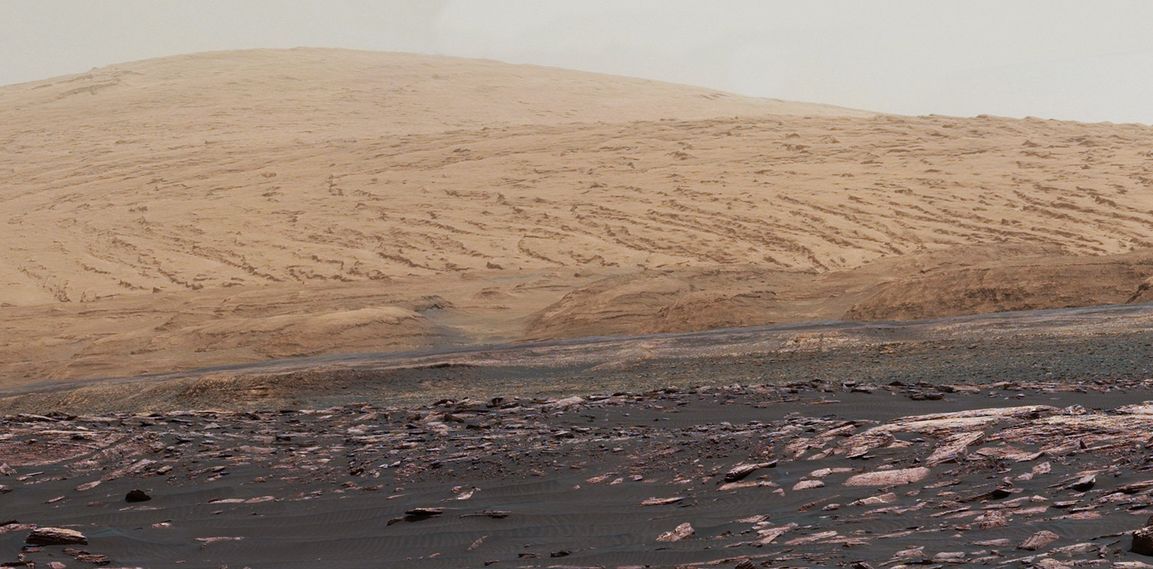
This 360-degree view was acquired on August 6th, 2016, by Curiosity’s Mastcam as the rover neared the “Murray Buttes” on lower “Mount Sharp”. The dark, flat-topped mesa seen to the left of the rover’s arm is about 15 metres (50 ft) high and about 61.5 metres (200 ft) long. Credit: NASA/JPL / MSSS

For the first year following its arrival on Mars, Curiosity continued to survey the regions relatively close to its landing zone, finding more evidence of a benign ancient environment. Then it started out on the next phase of its mission: the long traverse towards the massive bulk of “Mount Sharp” – officially called Aeolis Mons. A huge mound of rock deposited against the crater’s central impact peak, “Mount Sharp” rises from the crater floor to an altitude of some 5.5 km (3 mi), and imagining from orbit strongly suggested its formation was due, at least in part, to the presence of water in the crater at some point in Mars’ past.

The 8 km (5 mi) trip took the rover a year to complete, in part due to its relatively slow speed, in part due to the fact is had to travel a good way along the base of “Mount Sharp” to reach a point where it could commence an ascent up the slope; but mostly because there were a number of points of interest along the way where the mission scientists  wanted to have a look around, investigate and sample.

Mount Sharp as seen from Curiosity, on January 24th, 2017. The light grey banding befpre the sandy coloured slopes is the clay unit the rover will reach in about 2 years. In front of it is the “Vera Rubin Ridge”, the next location for study by the rover. Credit: NASA/JPL / MSSS

For the last three years, the rover has been slowly making its way up “Mount Sharp”, climbing around 180 metres (600ft) vertically above the surrounding crater floor and visiting numerous points of interest – such as “Pahrump Hills”, the mixed terrain where “Mount Sharp” merges with the crater floor. Along the way, Curiosity has both confirmed that “Mount Sharp” was most likely the result of sedimentary deposits laid down during several periods of flooding in the crater before the water finally receded and wind action took over, sculpting the mound into its present shape down through the millennia.

The lakes within Gale crater may have actually been relatively short-lived, perhaps lasting just 1,000 years at a time, but Curiosity has shown that even during the dry inter-lake periods, water was very much a feature of Gale Crater, finding evidence of compressed water channels within the layers of rock which sit naturally exposed on “Mount Sharp’s” flanks.

In December 2014, NASA issued a report on how “Mount Sharp” was likely formed. On the left, the repeated depositing of alluvial and wind-blown matter (light brown) around a series of central lakes which formed in Gale Crater, where material was deposited by water and more heavily compressed due the weight of successive lakes (dark brown). On the right, once the water had fully receded / vanished from the crater, wind action took hold, eroding the original alluvial / windblown deposits around the “dry” perimeter of the crater more rapidly than the densely compacted mudstone layers of the successive lake beds, thus forming “Mount Sharp”

Alongside the sedimentary layering of the mudstone comprising “Mount Sharp” and the compressed and long-dry water channels, a further sign that the region was once water rich comes in the form of the mineral hematite, which Curiosity has found on numerous occasions. Right now, the rover is making its way towards a feature dubbed “Vera Rubin Ridge” which orbital analysis shows to be rich in this iron-bearing mineral which requires liquid water to form. Beyond that is a clay-rich unit separating the hematite rich ridge from an area which show strong evidence for sulphates. These are also indicative of water having once been present, albeit less abundantly than along “Vera Rubin Ridge”, and thus hinting at a change in the local environment. Currently, Curiosity is expected to reach this area in about two years’ time, after studying “Vera Rubin Ridge” and the clay unit along the way.

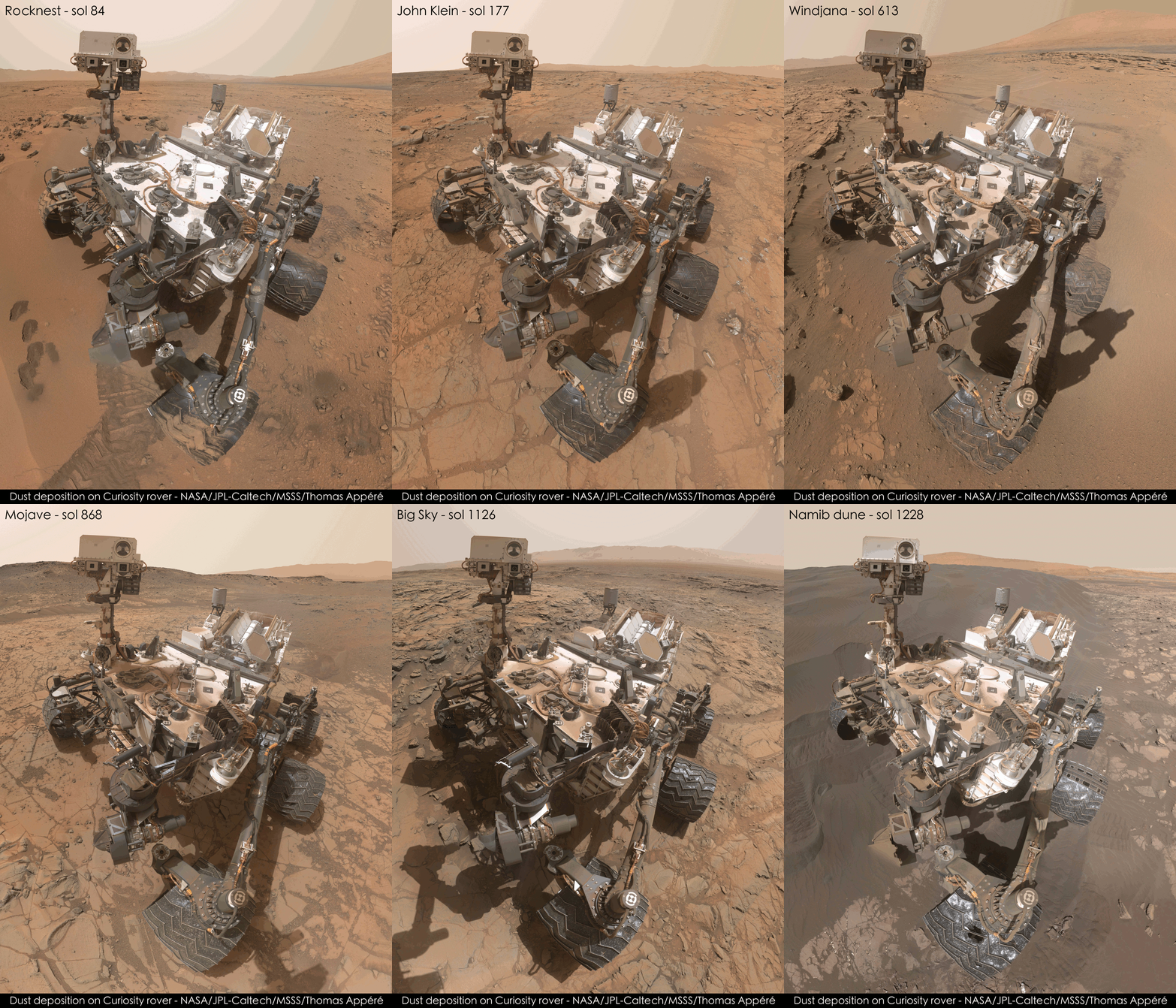
Selfies from Mars: how Curiosity has weathered the dust on Mars over five years – the dates are given as Sols – Martian days, top left and the locations where the pictures were taken. Credit: NASA/JPL

Throughout the last five years, Curiosity has remained relatively healthy. There has been the odd unexpected glitch with the on-board computers, all of which have been successfully overcome. There has been some damage to the rover’s aluminium wheels. This did give rise to concern at the time it was noted, resulting in a traverse across rough terrain being abandoned in favour of a more circuitous and less demanding route up onto “Mount Sharp”. But overall, the wheels remain in reasonably sound condition.

The one major cause for concern at present lies with Curiosity’s drill mechanism. Trouble with this first began when vibrations from the drill percussive mechanism was noted to be having a negative impact on the rover’s robot arm.

More recently – since December 2016, in fact – all use of the drill has ceased, limiting Curiosity’s sample gathering capabilities. This has been due to an issue with the drill feed motor, which extends the drill head away from the robot arm during normal drilling operations, preventing the arm physically coming into contact with targets. Attempt to rectify the problem have so far been unsuccessful, so engineers are loot at ways to manoeuvre the rover’s arm and place the drill bit in contact with sample targets, avoiding the need to use the feed motor.

So with five years on Mars under its belt, and barring no major unforeseen incidents, Curiosity will continue its mission through the next five years, further enhancing our knowledge of Mars.

Continue reading “Space Sunday: Curiosity’s 5th, Proxima b and WASP-121b”

Space Sunday: of life elsewhere and launches

Titan’s structure (via wikipedia)

Saturn’s giant moon, Titan, has been a source of speculation of decades. Shrouded in a dense, methane-nitrogen rich atmosphere, potentially harbouring a liquid water ocean beneath its crust, the moon has long be thought to have the conditions in which basic life might arise.

The joint NASA-ESA Cassini-Huygens mission has, over the span of thirteen years, added immeasurably to our understanding of Titan – and to the mysteries of its potential. In doing so, it has also provided us with evidence of processes taking place which are the precursors to the development of life. For example, we know that within Titan’s ionosphere, nitrogen, carbon and hydrogen are exposed to sunlight and energetic particles from Saturn’s magnetosphere. This exposure drives a process wherein these elements are transformed into more complex prebiotic compounds, which then drift down towards the lower atmosphere and form a thick haze of organic aerosols that are thought to eventually reach the surface.

However, while the drivers of the process are known, the nature of the process itself has been something of a mystery – one which an international team of scientists led by the University College London (UCL) think they now understand.  In Carbon Chain Anions and the Growth of Complex Organic Molecules in Titan’s Ionosphere the team identify Titan’s upper atmosphere contains a negatively charged species of linear molecule in Titan’s atmosphere called “carbon chain anions” – which, it has in the past been theorised, may have acted as the basis for the earliest forms of life on Earth.

The molecules were detected by CAPS, the Cassini Plasma Spectrometer, as the vehicle passed through the upper reaches of Titan’s atmosphere on a final flyby before commencing its “Grand Finale” of flights between Saturn and its rings. The discovery came as a surprise, as carbon chain anions are highly reactive, and should not survive long in Titan’s atmosphere. However, what particularly caught the attention of the science team was that the data show that the carbon chains become depleted closer to the moon, while precursors to larger aerosol molecules undergo rapid growth. This suggests a close relationship between the two, with the carbon chains ‘seeding’ the larger molecules – those prebiotics mentioned above – which then fall to the surface.

How complex molecules are thought to form in Titan’s atmosphere. Credit: UCL

“We have made the first unambiguous identification of carbon chain anions in a planet-like atmosphere, which we believe are a vital stepping-stone in the production line of growing bigger, and more complex organic molecules, such as the moon’s large haze particles,” said Ravi Desai, the lead author for the study in a press release from UCL.

He continued, “This is a known process in the interstellar medium – the large molecular clouds from which stars themselves form – but now we’ve seen it in a completely different environment, meaning it could represent a universal process for producing complex organic molecules. The question is, could it also be happening at other nitrogen-methane atmospheres like at Pluto or Triton, or at exoplanets with similar properties?”

With its rich mix of complex chemistry coupled with its basic composition, Titan is something of a planetary laboratory; one which probably mirrors the very early atmosphere surrounding Earth before the emergence of oxygen-producing micro-organisms which started the transformation of our atmosphere into something far more amenable for the advance of life. As such, the discovery of carbon chain anions in Titan’s atmosphere potentially confirms that long-held theory that they help kick-start the life creating processes here on Earth, and suggest conditions on Titan might allow the same to happen there. It also offers insight into how life might start elsewhere in the galaxy.

“These inspiring results from Cassini show the importance of tracing the journey from small to large chemical species in order to understand how complex organic molecules are produced in an early Earth-like atmosphere,” Dr Nicolas Altobelli, ESA’s Cassini project scientist, said in the same press release. “While we haven’t detected life itself, finding complex organics not just at Titan, but also in comets and throughout the interstellar medium, we are certainly coming close to finding its precursors.”

Dream Chaser ISS Flights target 2020 Commencement

Sierra Nevada Corporation (SNC) has confirmed than United Launch Alliance (ULA) will provide the veritable Atlas V booster as the launch vehicle for the Dream Chaser Cargo mini-shuttle, which will be joining fleet of uncrewed vehicles from America, Russia and Japan keeping the International Space Station (ISS) supplied with consumables, equipment and science experiments. The company also indicate that launches of the vehicle could start in 2020.

The Altas V – Cream Chaser Cargo launch configuration. Credit: United Launch Alliance

Dream Chaser was originally conceived to fly crews to and from the ISS as part of NASA’s commercial crew transportation joint venture with the private sector. Four companies vied for contracts to supply NASA with vehicles capable of shuttling up to six personnel to and from the space station. Despite being one of the most advanced of the designs in terms of feasibility and development, the Dream Chaser was not selected for that work, with NASA opting for the SpaceX Dragon 2 vehicle and Boeing’s CST-100 Starliner capsule.

However, support within the US space agency for the Dream Chaser continued, allowing SNC to propose the development of Dream Chaser Cargo, a revised version of the original concept, capable of supplying up to 5.5 tonnes of cargo to the ISS. In January 2016, in renewing its contract with SpaceX (Dragon) and Orbital ATK (Cygnus) for such resupply missions, NASA extended it to include SNC. This was followed a year ago by formal approval being given for Dream Chaser missions to the ISS, which allowed SNC to push ahead with testing of the revised vehicle.

Dream Chaser will launch atop the commercial Atlas V in its most powerful configuration, dubbed Atlas V 552, with five strap on solid rocket motors and a dual engine Centaur upper stage. The cargo vehicle will be held inside a five metre diameter payload fairing with its wings folded. Cargo will be carried both within the vehicle itself and in a support module mounted on the rear of the spacecraft, which will also house a docking adaptor for connecting with the space station. The latter will be supplied to SNC by the European Space Agency, which is also supplying NASA with the Service Module for the Orion multi-Purpose Crew Vehicle.

The Dream Chaser Cargo, built by SNC, and the International Berth and Docking Mechanism, to be supplied to SNC for Dream Chaser flights by the European Space Agency. Credit: SNC

In addition to flying up to 5.5 tonnes to the ISS, Dream Chaser Cargo will be able to return some 2 tonnes of equipment, experiments and other items from the space station to Earth, where it will make a conventional runway landing using the former space shuttle runway at Kennedy Space Centre – or any other suitable landing facility in the United States.

It is expected that Dream Chaser cargo will fly a total of six missions to the ISS between 2020 and 2024, when it is currently anticipated the space station will be decommissioned.

Continue reading “Space Sunday: of life elsewhere and launches”

Space Sunday: ninja space stations, Falcons, Dragons and ET

The cislunar Deep Space Gateway with an Orion Multi-Purpose Crew Module approaching it. Credit: NASA

Lockheed Martin has announced it will build a full-scale prototype of NASA’s proposed Deep Space Gateway (DSG), a space habitat occupying cislunar space. The facility, which if built, will be both autonomous and crew-tended, and is intended to be used as a staging point for the proposed Deep Space Transport NASA is considering for missions to Mars, as well as for robotic and crewed lunar surface missions.

DSG is part of a public-private partnership involving NASA in developing technologies for carrying humans beyond low Earth orbit called Next Space Technologies for Exploration Partnerships (NextSTEP). A Phase I study for the facility has already been completed, and the full-scale prototype will be constructed as a part of the Phase II NextSTEP habitat programme, which will examine the practical issues of living and working on a facility removed from the relative proximity of low Earth orbit, outside of the relative protection of the Earth’s magnetic field and subject to delays of up to 3 seconds in two-way communications.

“It is easy to take things for granted when you are living at home, but the recently selected astronauts will face unique challenges,” said Bill Pratt, Lockheed Martin NextSTEP program manager.

“Something as simple as calling your family is completely different when you are outside of low Earth orbit. While building this habitat, we have to operate in a different mindset that’s more akin to long trips to Mars to ensure we keep them safe, healthy and productive.”

The proposed Gateway, which if built would likely enter service in 2027/2028, will be designed to make full use of the Orion Multi-Purpose Crew Module as its command and control centre, and will also use avionics and control systems designed for the likes of NASA’s MAVEN mission in order around Mars and the Juno mission at Jupiter, which will allow the facility to operate in an uncrewed automated flight mode around the Moon for up to seven months at a time.

NASA’s MPLM mission logo. Credit: NASA / Marshall Space Flight Centre

The core of the prototype will be the Donatello Multi-Purpose Logistics Module (MPLM), originally designed and built for flights aboard the space shuttle and capable of delivering up to nine metric tonnes of supplies to the International Space Station (ISS). Two of these units, Leonardo and Raffaello flew a total of 12 missions to the ISS between 2001 and 2011, with Leonardo becoming a permanent addition to the space station in early 2011. And if film and comic fans are wondering, yes, the modules were all named after a certain band of mutant ninja turtles – hence the MPLM mission logo (right).

Donatello was a more capable module than its two siblings, as it was designed to carry payloads that required continuous power from construction through to installation on the ISS. However, it was never actually flown in space, and some of its parts were cannibalised to convert Leonardo into a permanent extension to the space station. In its new role, Donatello will form the core habitat space for the DSG prototype, and will be used as a testbed for developing the living and working space in the station, which will also have its own power module and multi-purpose docking adapter / airlock unit.

The Phase II development of the DSG is expected to occur over 18 months. Mixed Reality (augmented reality and virtual reality) will be used throughout the prototyping process to reduced wastage, shorten the development time frame and allow for rapid prototyping of actual interior designs and systems. The results of the work and its associated studies will be provided to NASA to help further the understanding of the systems, standards and common interfaces needed to make living in deep space possible.

The DSG is one of two concepts NASA is considering in it attempts to send humans to Mars. The second is the so-called Deep Space Transport (DSH). This is intended to be a large vehicle using a combination of electric and chemical propulsion to carry a crew of six to Mars. It would be assembled at the Deep Space Gateway.

While having a facility in lunar orbit does make sense for supporting operations on the Moon’s surface, when it comes to human missions to Mars, the use of the DSG as an assembly  / staging post for the DST actually makes very little practical sense. Exactly the same results could be achieved from low Earth orbit and without all the added complications of lunar orbit rendezvous. The latter simply adds an unnecessary layer of complexity to Mars missions whilst providing almost no practical (or cost) benefits, and perhaps again demonstrates NASA’s inability to separate the Moon and Mars as separate destinations – something which has hindered their plans in the past.

Musk Walks Back SpaceX Aspirations

SpaceX CEO and chief designer, Elon Musk has walked back on expectations for the initial lunch of the Falcon Heavy booster and on longer-terms aspirations for the Dragon 2 crew capsule.

Musk: a successful maiden flight of the Falcon Heavy “unlikely”. Credit: Associated Press

Speaking at the International Space Station Research and Development Conference held in Washington DC in mid-July 2017, Musk indicated that a successful maiden flight of the Falcon Heavy rocket is extremely unlikely. He also indicated that the company is abandoning plans to develop propulsive landing techniques for the Dragon 2 when returning crews to Earth from the ISS – and to achieve a soft landing on Mars.

Falcon Heavy is slated to be the world’s most powerful rocket currently in operation when it enters service in 2018, capable of lifting a massive 54 tonnes to low Earth orbit – or boosting around 14 tonnes on its way to Mars. Designed to be reusable, the rocket uses three core stages of the veritable Falcon 9 rocket – one as the centre stage, two as “strap on boosters” either side of it.

But computer modelling has revealed that firing all 27 motors on the stages (nine engines apiece) at launch has dramatically increased vibrations throughout the vehicle stack, making it impossible to gauge by simulation whether or not the rocket will shake itself apart without actually flying it. Hence Musk’s statement that the maiden flight of the Falcon Heavy  – slated for later in 2017 – is unlikely to achieve a successful orbit. However, telemetry gathered during the flight – should the worse happen – will help the company more readily identify stresses and issues created by any excessive vibration, allowing them to be properly countered in future launches.

Once Falcon Heavy is fully operational, all three of the core stages are intended to return to Earth and achieve a soft landing just as they do when used as the first stage of a Falcon 9 launch vehicle, and SpaceX is also working to make the upper stage of the Falcon 9 / Falcon Heavy  recoverable as well.

Also at the conference, Musk announced SpaceX will no longer be using propulsive landings for the crewed version of their Dragon 2 space capsule, due to enter operations in 2019 ferrying crews two and from the ISS, operating alongside Boeing’s CST-100 Starliner capsule. Initial flights of the Dragon 2 were intended to see the vehicle make a “traditional” parachute descent through Earth’s atmosphere followed by an ocean splashdown – the technique currently used by the uncrewed Dragon I ISS resupply vehicle.

However, SpaceX had planned to shift Dragon 2 landings from the sea to land – using parachutes for the majority of the descent back through the atmosphere, before cutting the vehicle free and using the built-in Super Draco engines (otherwise used as the crew escape system to blast the capsule free of a Falcon launch vehicle if the latter suffers any form of pre- or post-launch failure). The engines would fire during the last few metres of decent, placing the capsule into a hover before setting it down on four landing legs.

Extensively tested in tethered “hover” flights, propulsive landings would in theory made the recovery and refurbishment of Dragon capsules for future launches a lot easier, lowering the overall operating costs for the capsule. In announcing the decision to scrap the propulsive landing approach, Musk indicated it would have unnecessarily further drawn out the vehicle’s development as SpaceX sought to satisfy NASA’s requirements for crewed vehicle operations.

The decision also affects Musk’s hope of placing a robotic mission on the surface of Mars in 2020. Under that mission, a special cargo version of Dragon 2 – called Red Dragon- would fly a NASA science payload to Mars and use supersonic propulsive landing to slow itself through the tenuous Martian atmosphere and achieve a successful soft landing. This approach was seen as ideal, because using parachutes on Mars is extremely difficult with heavy payloads – NASAs studies suggest parachute on Mars have an upper limit of payloads around 1.5-2 tonnes. A Red Dragon capsule is liable to mass around 8-10 tonnes.

SpaceX have dropped plans to use propulsive landings on both their crewed Dragon 2 vehicles returning from the ISS and on their Red Dragon automated Mars lander (above). Credit: SpaceX

However, Musk no longer believes the use of a propulsive landing mechanism is “optimal” for Red Dragon, and the company has a better way of realising their goal – although he declined to indicate what this might be. Instead, propulsive landing systems would seem to be something the company will return to in the future – particularly given their hopes of placing vehicles massing as much as 100 tonnes on the surface of Mars.

No, ET Isn’t Calling Us

The Internet was agog recently after it was announced some very “peculiar signals” had been noticed coming from Ross 128, a red dwarf star just 11 light-years away. While not known to have any planets in orbit around it, and despite the best attempts of astronomers – including the team picking up the signals at the Arecibo radio telescope, Puerto Rico – news of the signals led to widespread speculation that “alien signals” had been picked up.

The usual signals – officially dubbed the “Weird!” signal, due to the comment made in highlighting the signals in an image – were first picked up on May 12th/13th, 2017. However, it was not until two weeks later that the signals were identified and analysed, the PHL team concluding that they were not “local” radio frequency interference, but were in fact odd signals coming from the direction of Ross 128 – sparking the claims of alien signals, even though the director at PHL and the survey team leader -Abel Mendez – was one of the first to pour water on the heat of the speculation. “In case you are wondering, he stated in response to the rumours, “the recurrent aliens hypothesis is at the bottom of many other better explanations.”

The Weird! signal. Credit: UPR Aricebo

Without drawing any conclusions on what might be behind the signals, PHL liaised with  astronomers from the Search for Extra-Terrestrial Intelligence (SETI) Institute to conduct a follow-up study of the star. This was performed on Sunday, July 16th, using SETI’s Allen Telescope Array and the National Radio Astronomy Observatory‘s (NRAO) Green Bank Telescope. The fact that SETI was involved probably also helped fan the flames of “alien signal” theories. However, initial analysis of the signal and the portion of the sky where it was observed have suggested a far more mundane explanation:  geostationary satellites.

“The best explanation is that the signals are transmissions from one or more geostationary satellites,”  Mendez stated in an announcement issued on July 21st. “This explains why the signals were within the satellite’s frequencies and only appeared and persisted in Ross 128; the star is close to the celestial equator, where many geostationary satellites are placed.”

While certain this explanation is correct, Mendez does note it doesn’t account for the strong dispersion-like features of the signals (diagonal lines in the figure). His theory for this is that it is possible multiple reflections caused the distortions, but the astronomers will need more time to evaluate this idea and other possibilities.

So sorry, no ETs calling out into the night – yet.

Space Sunday: anniversaries, storms and hidden worlds

July 16th, 1969. A Saturn V rocket lifted the crew of Apollo 11 – Neil A. Armstrong, Edwin Eugene “Buzz” Aldrin Jr and Michael Collins –  on their way to the Moon, and the first manned landing there. Credit: NASA

July is a celebratory month for the US space programme. I’ve already written about July 4th marking the 20th anniversary of America – and the world – having had a continuous robotic presence on or around Mars for 20 years. This week, July 16th and July 20th mark the anniversaries of perhaps the two most momentous days in human space flight – the Lift-off of the Apollo 11 mission to land men on the lunar surface and, on July 20th, the actual landing of the Lunar Excursion Module Eagle on the Sea of Tranquillity. Neil A. Armstrong and Edwin “Buzz” Aldrin  spent 21.5 hours there, while their colleague Michael Collins (the “forgotten third man” of Apollo 11) orbited the Moon aboard the Command and Service Module Columbia, carrying out a range of science work as he awaited his compatriots’ ascent back to orbit.

The Apollo programme, although ultimately dedicated to meeting John F. Kennedy’s 1961 goal of “putting a man on the Moon and returning him safely to the Earth”, actually had its roots in President Dwight D. Eisenhower’s administration, when it was seen as a logical progression from America’s single-seat Mercury programme to a vehicle capable of carrying a crew of three on a range of mission types, including ferrying crews to a space station, performing circumlunar flights, and eventually forming part of manned lunar landings.

Apollo was a bold venture, particularly when you consider Kennedy’s directive that America commit itself to achieving a manned landing on the Moon before the end of the 1960s, given in a stirring address before Congress on May 25, 1961 came just twenty days after NASA had finally managed to pump a man  – Alan Shephard – into space on a sub-orbital flight, while their first orbital success with John Glenn was still nine months in the future. It was a programme which was politically motivated to be sure, but which nevertheless yielded scientific and technological results which helped shape both our understanding of the solar system and helped improve ours lives on many levels. It raised the potential of human space exploration high in the public consciousness, and was illuminated by tremendous successes whilst also and shadowed by moments of tragedy and near-tragedy.

A sketch of the Apollo lunar landing mission profile produced as a part of NASA’s post Apollo 8 mission report of February 1969 annotating how the mission would be undertaken

As well as the missions themselves and the hardware required to carry them out – the Command and Service Module, the Lunar Excursion Module, the Saturn family of rockets (including the mighty Saturn V), Apollo perhaps did more than any over programme to shape NASA. It gave rise to the massive launch infrastructure at Merritt Island, Florida – now known as the Kennedy Space Centre – including the historic launch pads of Launch Complex 39, used by both Apollo and the shuttle, and now used by SpaceX and (soon) by NASA’s massive Space Launch System rockets; the Vehicle Assembly Building (then called the Vertical Assembly Building), where the Saturn rockets were assembled ready for launch, the still-used Launch Control Complex, and more. At the same time, Apollo gave NASA its operational heart for human space missions – the Manned Spaceflight Centre (now called the Johnston Spaceflight Centre) on land just outside Houston, Texas, donated to NASA by Rice University.

The entire history of the programme is a fascinating read – the politics, both in Washington (Kennedy’s own s science advisor, Jerome Wiesner, was quite vociferous in opposing the idea of sending men to the Moon) and in NASA (where a fierce difference of opinion was apparent in how the mission should be carried out. It’s a story I may some day plumb in a Space Sunday “special”, but for now I’ll simply say that all things considered, Apollo was a success, albeit one very self-contained. Six missions to the surface of the Moon, nine missions to and around the Moon, and the opportunity to increase our understanding of Earth’s natural satellite both by a human presence there and afterwards, thanks to the equipment left behind.

Armstrong, Collins and Aldrin pose for an official Apollo 11 crew shot, May 1st, 1969

New Horizons Pluto Flyby

July 14th marked the second anniversary of the New Horizons spacecraft’s flyby of Pluto and Charon – a high-speed dash between the two lasting mere hours, after a nine-and-a-half year flight simply to reach them. Brief though the encounter might have been, the spacecraft returned such a wealth of data and images that our view of Pluto and its companion has been forever changed, with Pluto in particular – as I’ve often referenced in these Space Sunday pieces –  revealing itself to be an enigma wrapped in a puzzle, determined to shatter our understanding of small planetary bodies in the solar system.

Such is the wealth of data gathered by the probe, coupled with the distances involved and the rate at which it could transmit data back to Earth, it took 16 months of all of the information stored aboard New Horizons to be returned to scientists here on Earth.

The July 14th mosaic of Pluto. The heart-shaped region is informally called “Tombaugh Regio” in honour of Pluto’s finder, Clyde Tombaugh. The left lobe of the “heart” is a vast icy plain. Credit: NASA/JHUAPL/SwRI.

To mark the second anniversary of New Horizons’ flyby, NASA released a new video using actual New Horizons data and digital elevation models of Pluto and Charon, to offer a unique flight across Pluto.

The movie starts over the highlands to the south-west of “Sputnik Planum’s” great nitrogen ice sheet (visible to the right as the movie progresses), with the track of the film passing directly over the chaotic cratered and mountain terrain of “Cthulhu Macula”. moving northwards, the flight passes over the fractured highlands of “Voyager Terra” then back southwards over Pioneer Terra, distinguished by pitting, before concluding over the bladed terrain of Tartarus Dorsa in the far east of the encounter hemisphere.

Continue reading “Space Sunday: anniversaries, storms and hidden worlds”

Space Sunday: imaging a star and x-rays from a planet

The M-2 red super giant Betelgeuse, 650 light-years from Earth, as seen by the Atacama Large Millimetre Array (ALMA). Credit: ALMA / ESO / NRAO

Some call it Betelgeuse others call it Beetlejuice. It is the second brightest star in the constellation of Orion and officially designated Alpha Orionis, the ninth brightest star in the night skies over Earth.

A red super giant of spectral type M1-2, Betelgeuse is around 12 times the mass of our own Sun, and is one of the largest and most luminous stars visible to the naked eye. It is also destined to be – in cosmic terms –  very short-lived. At just eight million years of age, it is already approaching the end of its life and will likely go supernova some time in the next few thousand years.

But it is the star’s sheer size which makes it stunning: it’s an estimated 2.6 AU in diameter. To put this in perspective, were it to be dropped into our solar system to replace the Sun, it would extend out towards the orbit of Jupiter.  Such is its size, it is one of the few stars we can observe via telescope large enough to be resolved as anything more than a point of light.

This was brought home at the end of June 2017, when the Atacama Large Millimetre Array (ALMA) captured the star in a series of images taken at the sub-millimetre wavelength range. The images reveal the star’s chromosphere looking somewhat asymmetrical, the result of the star  generating a massive bow-shock as it moves through the interstellar medium. In short, as Betelgeuse travels through the gas clouds at a rate of around 30 kilometres per second, it own equivalent of the solar wind (much denser than anything the Sun generates) which is thrown off of the star at 17 kilometres / second, slams into this gas in the direction of travel at47 km/ sec, generating a massive shock wave about 3 light-years across in front of the star, which curls around it, influencing its chromosphere.

The bow shock preceding Betelgeuse, as seen by the Japanese Akari orbital observatory. Credit: JAXA/Akari

When Betelgeuse goes supernova, it will be in a blink of an eye – although we’ll only know about it 650 years after it has actually happened. When it does so, it will create an unmistakable light in the night sky – and this bow shock of matter will play a role in the supernova process, as it reacts to the sudden influx of matter slamming into it from the exploding star at a large fraction of the speed of light.

As violent as it will be, the Betelgeuse supernova will not threaten life on Earth, as it’s beyond the “harmful” range. And in case you think that’s a bit of a reach, scientists have shown that the Earth has in fact been influenced by supernovae in the past. This evidence comes from the presence of Iron 60 in the deep oceans, an isotope formed within stars, and which has an exceptionally short half-life: 2.6 million years – so the fact we can detect it suggests it originated in other stars that went supernova.

In fact, for the last 5-10 million years, the solar system has been travelling through a region of space called the “local bubble”, an expanding region of gases some 300 light years across, created by a series of supernova explosions which occurred over a relatively short period  of time about 20 million years ago. Within this bubble, the magnetic field is weak and disordered, which could greatly magnify the impact a large supernova occurring within 100 light years from Earth could have on life here.

At the upper end of this distance, research suggests a supernova could lead to climate changes similar to those which caused a rise in glaciation seen in the Pleistocene period, 2.5 million years ago. At the nearer end of this distance – say, 25-30 light years – a supernova could actually be an extinction level event for much of life here due to the radiation levels striking the Earth, altering the climate, impacting the Earth’s biomass, and giving raise to increases in cancers.

The stars of the IK Pegasi system compared to our own Sun (r). IK Pegasi is the large white star on the left, and IK Pegasi B – a potential supernova progenitor – is the white dot below and between the other two stars. Credit: R.J. Hall

Fortunately, the nearest known star to us which is likely to go supernova is IK Pegasi B, a massive white dwarf star which forms part of the binary star system IK Pegasi in the constellation of Pegasus, and 150 light years away. As a massive white dwarf, IK Pegasi is no longer generating energy through nuclear fusion. However, when its companion star, IK Pegasi A, a main sequence star slightly larger than our own Sun and itself a variable star, reaches the latter stages of its life, it will swell up to a red giant, allowing IK Pegasi B to star accrete matter from it, causing it to swell to as much a 1.4 solar masses – at which point it will explode as a supernova.

China’s Launch Failures

China’s space efforts have been in the news for the wrong reasons of late. In mid-June a Long March 3B rocket – the workhorse of the Chinese fleet – designed to carry a communications satellite to geostationary transfer orbit was declared a “partial failure” when the rocket’s upper stage failed, initially leaving the satellite stranded in a much lower orbit. Since then, mission controller have been using satellite’s manoeuvring motors gradually nudge it up to an operational orbit, although this will drastically shorten its active lifespan.

A slight fuzzy TV image of the Long March 5 launch on July 2nd, 2017. The vehicle suffered “an anomaly” shortly after lift-off and eventually crashed into the Pacific Ocean. Credit: CCTV

Then, on July 2nd, 2017, the second launch of China’s powerful Long March 5, capable of launching 8.4 tonnes of payload to the Moon or placing 25 tonnes in low Earth orbit, suffered a major failure shortly after clearing the launch pad at 11:23 GMT. This booster is key to China’s longer-term ambitions in space, as it is crucial to the development of their own space station, as well as vital for a number of deep space missions.

Continue reading “Space Sunday: imaging a star and x-rays from a planet”