Space Sunday: reborn stars, icy worlds and air propulsion

A symbiotic X-ray binary of an ageing red giant (l) and relatively young neutron star (r – not to scale). Interaction between the two may have helped the neutron star to be “come back to life”. 

Astronomers have witnessed an extraordinary stellar event – a star “coming back to life” thanks to its nearby neighbour.

The two stars are from different points in the stellar evolutionary process. The “dead” star is a neutron star, all that remains of a massive star  – possibly with 30 times the mass of the Sun – which ended its life in a violent explosion, leaving whatever matter was left so densely packed, a sphere of the material just 10 km (6.25 mi) in diameter could have a mass 1.5 times that of the Sun.

The “donor” star is a red giant. This is a star similar to the Sun which has reached the latter stages of its life. With the hydrogen in its core exhausted, the star has swollen in size as a result of heat overcoming gravity, and has begun thermonuclear fusion of hydrogen in a shell surrounding the core. When this happens, the star sheds stellar material from its outer layers in a solar wind that travels several hundreds of km/sec.

In this particular case, the two stars – red giant and neutron – form what’s called a symbiotic X-ray binary system – one of one 10 such binaries of this kid so far discovered. There are also some oddities about this particular pairing which makes it somewhat unique. For one thing, while most neutron stars spin at several rotations per second, the neutron star in this pairing takes around 2 hours to complete one rotation. In addition, this star has a much stronger magnetic field than is usual for neutron stars, suggesting it is relatively young.

The ESA INTEGRAL observatory was the first to spot the “re-animation” of the neutron star. Credit; ESA

The “re-animation” of the neutron star occurred in late 2017, and is the subject of a paper published in the Journal of Astronomy and Astrophysics. It was spotted by the European Space Agency’s  INTEGRAL mission on August 13th 2017, which detected high-energy emission from the dead stellar core of the neutron star. These emissions were quickly picked-up by other observatories, such as ESA’s  XMM Newton observatory and NASA’s NuSTAR and Swift space telescopes, and a number of ground-based telescopes, confirming the event.

Its discovery has prompted two main questions: what exactly happened, and how long will this process go on? In answering the first question, astronomers believe that as the neutron star is relatively young, it rate of rotation may have been held in check by the solar wind from the red giant. Over time, the interaction between the red giant’s solar wind and the neutron star’s magnetic field resulted in ongoing high-energy emissions from the dead stellar core.

As to whether this it a short-lived phenomenon or the beginning of a long-term relationship, Erik Kuulkers, ESA’s INTEGRAL project scientist, notes:

We haven’t seen this object before in the past 15 years of our observations with INTEGRAL, so we believe we saw the X-rays turning on for the first time. We’ll continue to watch how it behaves in case it is just a long ‘burp’ of winds, but so far we haven’t seen any significant changes.

So for now, we’ll just have to wait and see.

Air-Breathing Electric Thruster Tested

While it is true the that densest part of the Earth’s atmosphere extends to the edge of the mesopause, just 85 km (53 mi), and the Kármán line –  representing the boundary between Earth’s atmosphere and “outer space” sits at 100 km (62 mi) altitude above the surface of the planet – the fact is that Earth’s atmosphere extends much further from Earth – out as far as 10,000 km (6,200 mi) from the planet’s surface.

This means, for example, that the space station, which operates at an altitude of 400-410 km  (250-256 mi) is operating within the thermosphere, and despite the tenuous nature of the atmosphere at that altitude it is subject to drag which requires it periodically boosts its orbit. This atmospheric drag also extends to low-Earth orbit satellites (which operate up to 2,000 km (1,200 mi), requiring they also periodically need to adjust their orbits. The problem here is that while the ISS can be refuelled – satellites in low-Earth orbit have finite supplies of fuel they can use, which can limit their operating lives.

Now – in a world’s first – the European Space Agency has tested an electric thruster was can ingest scarce air molecules from the thermosphere as fuel, potentially allowing satellites in very low orbits around Earth to have greatly extended operating lives.

Ram-Electric Propulsion is a potential means of providing propulsion for low-orbiting satellites uses extremely rare air molecules in the upper reaches of the Earth’s atmosphere as a means to generate electric thrust. Credit: ESA

A test version of the air-breathing thruster (technically referred as Ram-Electric Propulsion) was recently tested in a vacuum chamber simulating the environment at 200 km altitude. In the test, the thruster was initial fired using xenon gas – a common fuel supply for electric thruster systems – generating a distinctive blue-green plume. A “particle flow generator” was then used to simulate the influx of rarefied air molecules into the thruster system as if it were moving in orbit around Earth, causing the exhaust plume to turn a milky-grey – a clear sign the thruster was burning air as propellant, rather than xenon.

Once the initial thruster burn was completed, the thruster was shut down, purged and than restarted a number of times only using the air molecules provided by the “particle flow generator”, proving the engine can be successful fired – and fuel – by upper atmosphere trace gases.

Placed in a vacuum chamber simulating the mix of atmospheric gases at 200 km altitude, the thruster was initially fired using xenon gas as a fuel, causing a distinctive blue-green exhaust plume (l). It was then fired – with the aid of a “particle flow generator” to simulate its movement through the upper atmosphere – purely using the available air molecules as a fuel supply (r). Credit: ESA

The test firing is the culmination of almost a decade’s worth of research into electric thruster systems. While there is still a way to go before it is ready for practical use, the approach has the potential to benefit more than just low-Earth orbit satellites.

With minimal adjustment the system could in theory be adapted for use on satellites intended to operate in orbit around Mars or even Titan, both reducing the amounts of on-board propellants such a vehicle would require and increasing the mass allowance for science systems.

Continue reading “Space Sunday: reborn stars, icy worlds and air propulsion”

Space Sunday: drills, flares and monster ‘planes

NASA’s Mars Science Laboratory (MSL) rover Curiosity has taken a further step along the way to retrieving and analysing samples gathered by its drill mechanism, which hasn’t been actively used since December 2016, after problems were encountered with the drill feed mechanism.

Essentially, the drill system is mounted on Curiosity’s robot arm and uses two “contact posts”, one either side of the drill bit, to steady it against the target rock. A motor – the drill feed mechanism – is then used to advance the drill head between the contact posts, bringing the drill bit into contact with the rock to be drilled, and then provide the force required to drive the drill bit into the rock. However, issues were noted with this feed mechanism, during drilling operations in late 2016, leading to fears that it could fail at some point, leaving Curiosity without the means to extend the drill head, and thus unable to gather samples.

To overcome this, MSL engineers have been looking at ways in which the feed mechanism need not be used – such as by keeping the drill head in an extended position. This is actually harder than it sounds, because the drill mechanism – and the rover as a whole – isn’t designed to work that way. Without the contact posts, there was no guarantee the drill bit would remain in steady, straight contact with a target rock, raising fears it could become stuck or even break. Further, without the forward force of the drill feed mechanism, there was no way to provide any measured force to gently push the drill bit into a rock – the rover’s arm simply isn’t designed for such delicate work.

Curiosity’s drill mechanism, showing the two contact posts (arrowed) used the steady the rover’s robot arm against a target rock, and the circular drill head and bit between them – which until December 2016, had been driven forward between the two contact posts by the drill feed mechanism, which also provided the force necessary to drive the drill bit into a rock target. Credit: NASA/JPL / MSSS

So, for the larger part of 2017, engineers worked on Curiosity’s Earth-based twin, re-writing the drill software, carrying out tests and working their way to a point where the drill could be operated by the test rover on a “freehand” basis. At the same time, code was written and tested to allow force sensors within the rover’s robot arm – designed to detect heavy jolts, rather than provide delicate feedback data – to ensure gentle and uniform pressure could be applied during a drilling operation and also monitor vibration and other feedback which might indicate the drill bit might be in difficulty, and thus stop drilling operations before damage occurs.

At the end of February 2018, the new technique was put to the test on Mars. Curiosity is currently exploring a part of “Mount Sharp” dubbed “Vera Rubin Ridge”, and within the area being studied, the science team identified a relatively flat area of rock they dubbed “Lake Orcadie”, and which was deemed a suitable location for an initial “freehand” drilling test. The rover’s arm was extended over the rock and rotated to gently bring the extended drill head in contact with the target, before a hole roughly one centimetre deep was cut into the rock. This was not enough to gather any samples, but it was sufficient to gauge how well robot arm and drill functioned.

“We’re now drilling on Mars more like the way you do at home,” said Steven Lee, a Curiosity deputy project manager on seeing the results of the test. “Humans are pretty good at re-centring the drill, almost without thinking about it. Programming Curiosity to do this by itself was challenging — especially when it wasn’t designed to do that.”

The test drill site of “Lake Orcadie”, “Vera Rubin Ridge”, imaged by Curiosity’s Mastcam on February 28th, 2018, following the initial “freehand” drilling test. Credit: MASA/JPL / MSSS

The test is only the first step to restoring Curiosity’s ability to gather pristine samples of Martian rocks, however. The next test will be to drive the drill bit much deeper – possibly deep enough (around 5 cm / 2 inches) to gather a sample. If this is successful, then the step after that will be to test a new technique for delivering a gathered sample to its on-board science suite.

Prior to the drill feed mechanism issue, samples were initially graded and sorted within the drill mechanism using a series of sieves called CHIMRA – Collection and Handling for In-Situ Martian Rock Analysis, prior to the graded material between deposited in the rover’s science suite using its sample scoop. This “sieving” of a sample was done by upending the drill and then rapidly “shaking” it using the feed mechanism, forcing the sample into CHIMRA. However, as engineers can no longer rely on the drill feed mechanism, another method to transfer samples to the rover’s science suite has had to be developed.

This involves placing the drill bit directly over the science suite sample ports, then gently tapping it against the sides of the ports to encourage the gathered sample to slide back down the drill bit and into the ports. This tapping has been successfully tested on Earth – but as the Curiosity team note, Earth’s atmosphere and gravity are very different from that of Mars. So whether rock powder will behave there as it has here on Earth remains a further critical test for Curiosity’s sample-gathering abilities.

More Evidence Proxima b Unlikely To Be Habitable

Since the confirmation of its discovery in August 2016, there has been much speculation on the nature of conditions which may exist on Proxima b, the Earth-sized world orbiting our nearest stellar neighbour, Proxima Centauri, 4.25 light years away from the Sun.

Although the planet – roughly 1.3 times the mass of Earth – orbits its parent star at a distance of roughly 7.5 million km (4.7 million miles), placing it within the so-called “goldilocks zone” in which conditions might be “just right” for life to gain a foothold on a world, evidence has been mounting that Proxima b is unlikely to support life.

Comparing Proxima b with Earth. Credit: Space.com

The major cause for this conclusion is that Proxima Centauri is a M-type red dwarf star, roughly one-seventh the diameter of our Sun, or just 1.5 times bigger than Jupiter. Such stars are volatile in nature and prone stellar flares. Given the proximity of Proxima-B its parent, it is entirely possible such flares could at least heavily irradiate the planet’s surface, if not rip away its atmosphere completely.

This was the conclusion drawn in 2017 study by a team from NASA’s Goodard Space Centre (see here for more). Now another study adds further weight to the idea that Proxima b is most likely a barren world.

In Detection of a Millimeter Flare from Proxima Centauri, a team of astronomers using the ALMA Observatory report that a review of data gathered by ALMA whilst observing Proxima Centauri between January 21st to April 25th, 2017, reveals the star experienced a massive flare event. At its peak, the event of March 24th, 2017, was 1000 times brighter than the “normal” levels of emissions for the star, for a period of ten seconds. To put that in perspective, that’s a flare ten times larger than our Sun’s brightest flares at similar wavelengths.

An artist’s impression of Proxima b with Proxima Centauri low on the horizon. The double star above and to the right of it is Alpha Centauri A and B. The ALMA study suggests that it is very unlikely that Proxima b retains any kind of atmosphere, as suggested by this image. Credit: ESO

While the ALMA team acknowledge such ferocious outbursts from Proxima Centauri might be rare, they also point out that such outbursts could still occur with a frequency that, when combined with smaller flare events by the star, could be sufficient enough to have stripped the planet’s atmosphere away over the aeons.

“It’s likely that Proxima b was blasted by high energy radiation during this flare,” Meredith A. MacGregor, a co-author of the study stated as the report was published. “Over the billions of years since Proxima b formed, flares like this one could have evaporated any atmosphere or ocean and sterilised the surface, suggesting that habitability may involve more than just being the right distance from the host star to have liquid water.”

Which is a bit of a downer for those hoping some form of extra-solar life, however basic, might be sitting in what is effectively our stellar back yard – but exoplanets are still continuing to surprise us, both with their frequency and the many ways in which they suggest evolutionary paths very different to that taken by the solar system.

Continue reading “Space Sunday: drills, flares and monster ‘planes”

Space Sunday: rockets, exoplanets landers and asteroids

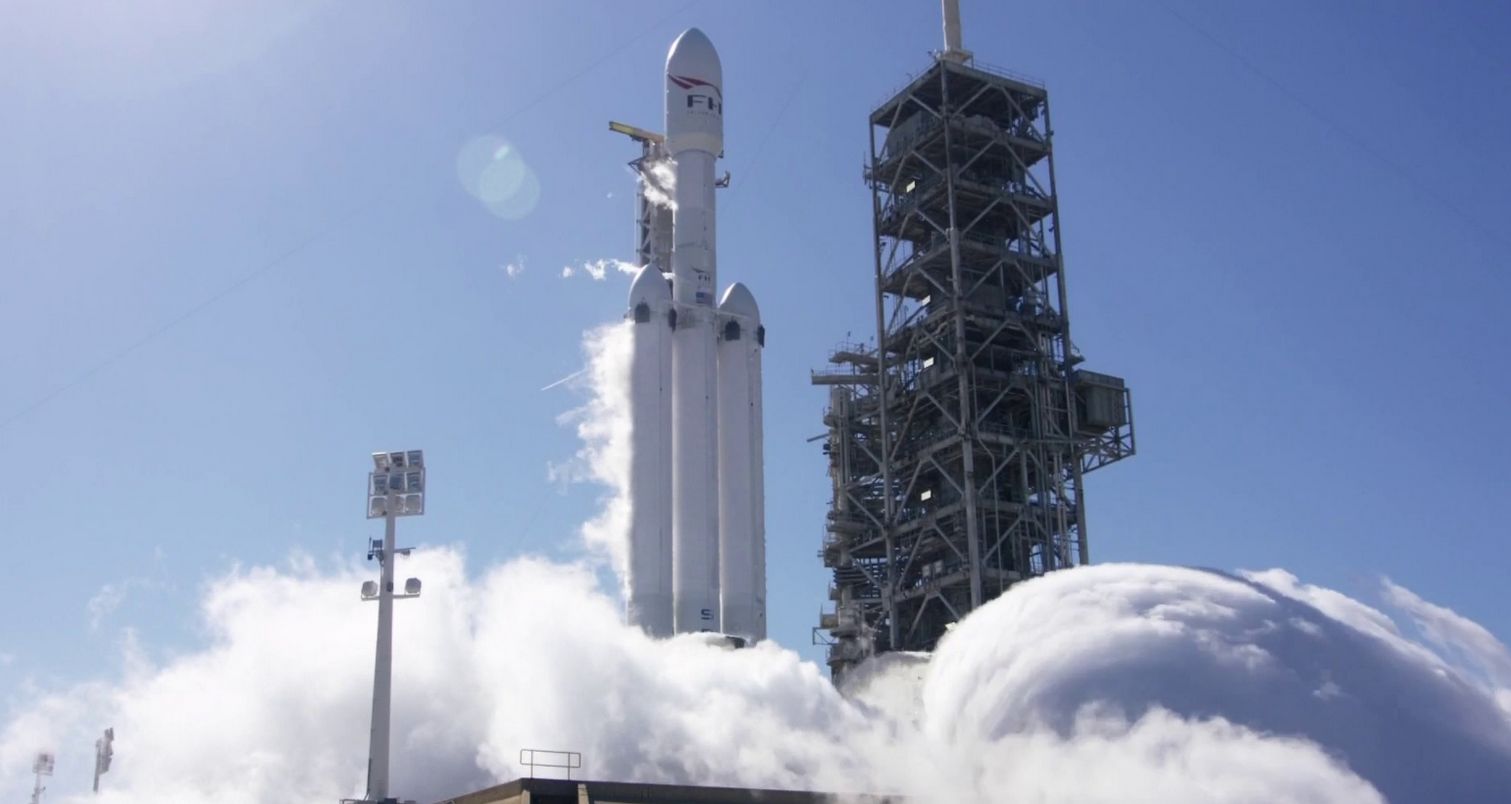
Fire in the hole! the Falcon Heavy’s 27 Merlin engines are test-fired on Pad 39A at NASA’s Kennedy Space Centre, January 24th, 2018. Credit: SpaceX

SpaceX faces a busy couple of weeks for the end of January and the start of February 2018. On Tuesday, January 30th, the company is set to launch Luxembourg’s SES-16/GovSat 1 mission on a Falcon 9 rocket from Launch Complex 40 at Canaveral Air Force Station on Florida’s coast. As is frequently the case with SpaceX missions, an attempt will be made to return the booster’s first stage to a safe landing  – this time at sea, aboard the Autonomous Spaceport Drone Ship Of Course I Still Love You in the Atlantic Ocean.

Then, if all goes according to plan, on Tuesday, February 6th, SpaceX will conduct the first launch of the Falcon Heavy booster which should be a spectacular event. As I’ve previously noted in these updates, Falcon Heavy is set – for a time at least – to be the world’s most powerful launch vehicle by a factor of around 2, and capable of lifting up to 54 tonnes to low Earth orbit, and of sending payloads to the Moon or Mars. The core of the rocket comprises three Falcon 9 first stages strapped side-by-side, two of which have previously flown missions.

For its first flight, the Falcon Heavy is set to send an unusual payload into space: a Tesla Roadster owned by Tesla and SpaceX CEO Elon Musk. It’s part of a tradition with SpaceX: mark a maiden flight with an unusual payload; the first launch of a Dragon capsule, for example, featured a giant wheel of cheese. If all goes according to plan, SpaceX hope to recover all three of the core stages by flying them back for touch downs; two of them on land, and one at sea using an Autonomous Spaceport Drone Ship.

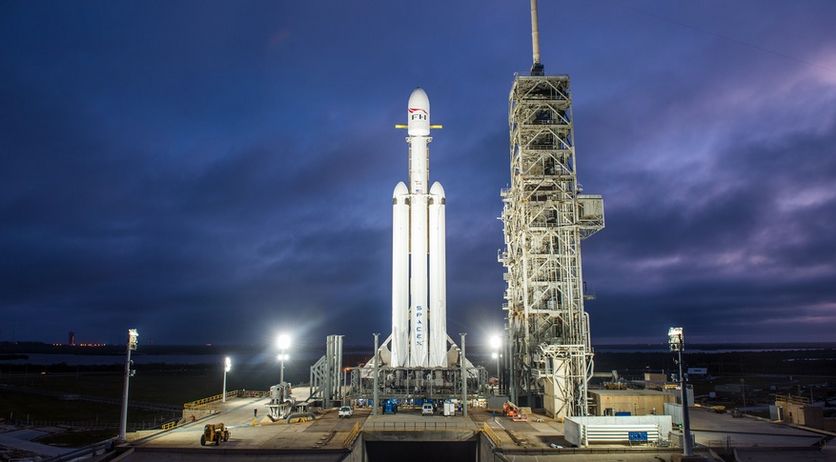
The Falcon Heavy is raised to a vertical position on December 28th, 2017 in a launch pad “fit test”. Credit: SpaceX

As part of the preparations for any Falcon launch, SpaceX conduct a static fire test of the rocket’s main engines.For the Falcon Heavy, this took place on January 27th, 2018. These tests have come in for criticism from some quarters as a high-rick operation. However, to date, SpaceX has not suffered a single loss as part of such a test, although in September 2016, a Falcon 9 and its payload were lost while the vehicle was being fuelled in preparation for such a test. For the Falcon 9, the test involves firing the 9 Merlin main engines for between 3 and 7 seconds; with the Falcon Heavy test, and possibly to obtain additional vibration and stress data ahead of the launch, all 27 engines were fired for a total of 12 seconds – almost twice as long as the longest test of a Falcon 9.

Assuming the launch is successful, it will pave the wave for Falcon Heavy being declared operational. The second launch will most likely carried a Saudi Arabian communications satellite into orbit, and the third flight of the Heavy undertake the launch of multiple satellites. All three launches will be watched closely by the US Air Force, who are considering using the Falcon Heavy as a potential launch vehicle alongside the Falcon 9, which was added to the military launch manifest in 2016.

TRAPPIST-1: Further Look At Habitability

Since the confirmation of its discovery in February 2017 (read more here), the 7-exoplanet system of TRAPPIST-1 one has been the subject of much debate as to whether or not anyone of the planets might be habitable – as in, have suitable conditions in which life might arise.

As I’ve previously reported, while some of the seven planets sit within their parent star’s habitable zone where liquid water might exist, there are some negative aspects to any of the Earth-sized worlds harbouring life or having the right conditions for life. In particular, their parent star is a super cool red dwarf with all internal action entirely convective in nature. Such stars tend to have violent outbursts, so all seven planets are likely subject to sufficient irradiation in the X-ray and extreme ultraviolet wavelengths to significantly alter their atmospheres and rendering them unsuitable for life. Further, all seven are tidally locked, meaning they always keep the same face towards their parent star. This will inevitably give rise to extreme conditions, with one side of each world bathed in perpetual daylight and the other in perpetual, freezing darkness, resulting in atmospheric convection currents moving air and weather systems / storms between the two.

Artist’s concept showing what each of the TRAPPIST-1 planets may look like. A new study suggests TRAPPIST-1d and 1e might be the most potentially habitable. Credit: NASA

However, on the positive side, TRAPPIST-1 is sufficiently small and cool that, despite their proximity to it, the sunward faces of the planets won’t be as super-heated as might otherwise be the case. This also means that the extremes of temperature between the lit and dark sides of the planets aren’t so broad, reducing the severity of any storms some of them might experience. Now a team of researchers have identified the more likely planets within the seven which might have conditions conducive for life.

This involved certain assumptions being made, such as all the planets being composed of water ice, rock, and iron, and – given some of the data concerning the planets, such as their radii and masses, are not well-known – a range of computer models having to be built.

In putting everything together, the team concluded that TRAPPIST -1d and TRAPPIST-1e might prove to be the most habitable, with TRAPPIST 1d potentially being covered by a global ocean of water. The study also suggests that TRAPPIST-1b and 1c have have partially molten rock mantles, and are likely to be heavily volcanic in nature.

In publishing their work, the team are reasonably confident of their findings, but note that improved estimates of the masses of each planet can help determine whether each of the planets has a significant amount of water, allowing better overall estimates of their compositions to be made.

Continue reading “Space Sunday: rockets, exoplanets landers and asteroids”

Space Sunday: a view of Earth, a look at China, and 5 exoplanets

The Earth and Moon as seen from OSIRIS-REx. Credit: NASA/OSIRIS-REx team and the University of Arizona

NASA’s Origins, Spectral Interpretation, Resource Identification, Security – Regolith Explorer (OSIRIS-REx), launched in September 2016 is on a mission to gather samples from the surface of asteroid Bennu and return them to Earth (see my previous reports here and here). It’s a huge undertaking, one which will take the vehicle on a journey of some 7.2 billion kilometres (4.5 billion miles).

Part of this journey involved OSIRIS-REx looping past the Earth in September 2017, in a gravity assist manoeuvre design to increase its velocity by some  13,400 km/h (8,400 mph) to almost 44,000 km/h (27,500 mph), and swing it on to an intercept with the asteroid, which it will reach in October 2018. During this Earth flyby, scientists carried out an extensive science campaign, allowing them to check and calibrate the probe’s suite of science instruments.

A part of this campaign involved testing the probe’s camera system, using it to take pictures of the Earth and Moon during September and early October. Several of these images, captured on October 2nd, 2017, were used by NASA used to create a to-scale composite image of the Earth-Moon system, which was released into the public domain on January 3rd, 2018 (seen above).

At time the images were taken, the spacecraft was approximately  5 million km (3 million mi) from Earth – or about 13 times the distance between the Earth and Moon. It was created by combining pictures captured using blue, green and red filters, allowing it to present a true colour view of the Earth and Moon as they reflect sunlight. Looking at it, one cannot help by be reminded of just how small and fragile our place in the universe really is.

China’s Space Ambitions

In reporting on China’s space programme, I’ve frequently noted the growing ambitious nature of their endeavours.  A mark of this is that in 2017, China mounted more than 20 successful launches – including some for foreign nations such as Venezuela, as a part of China’s desire to expand their commercial launch operations – matching Russia’s launch efforts, and sitting not that far behind the USA.

At the start of January 2018, the China Aerospace Science and Technology Corporation (CASC) upped the ante, indicating that in 2018, they plan to carry out 35 launches through the year. At the same time, CASC’s sister organisation,  China Aerospace Science Industry Corporation (CASIC) indicated it would be carrying out at least 5 launches during the year – four of them in the span of a week – while the Chinese private sector corporation, Landspace Technology, indicated it would commence launch operations during the year. Like America’s SpaceX, Landspace plan to become a major force in commercial sector launch operations, initially with satellite payloads, but ramping to flying people into space in around 2025.

One of the more notable missions China plans to launch in 2018 is the Chang’e 4 mission to the Moon’s far side. This is a two-phase mission, commencing in June 2018 with the launch of a communications relay satellite to the Earth-Moon Lagrange point. It will be followed in December by a lander / rover combination which will land on the lunar far side to commence science studies. It will mark the first attempt to carry out long-term studies on the side of the Moon permanently facing away from Earth – not to mention the first far side lunar landing.

The Chang’e 3 lander (top) and Yutu rover share similar designs with the upcoming Chang’e 4 lunar surface mission. Credit: National Astronomical Observatories of China

The CE-4 Relay satellite is required in order for communications to take place between Earth and the Chang’e 4 lander and rover.

As the Moon is tidally locked with Earth, and always keep the same side pointed towards us, there is no way to have direct communications with any vehicle on the lunar far side. This is overcome by placing a satellite in the Earth-Moon L2 position, where it can maintain a steady position relative to the Earth and the Moon’s far side, enabling communications between the two, and keeping scientists and engineers on Earth in contact with the lander and rover.

The lander / rover combination will explore part of the 180 km (112.5 mi) diameter Von Kármán crater, believed to be the oldest impact crater on the Moon. It lies within the South Pole-Aitken Basin, a vast basin in the southern hemisphere of the far side which extends from the South Pole to Aitken crater.

The crater is of general interest because it contains about 10% by weight iron oxide (FeO) and 4-5 parts per million of thorium, which can be used as a replacement for uranium in nuclear reactors. In addition, the South Pole-Aitken Basin – one of the largest impact basins in the solar system (about 2,500 km / 1,600 mi across and some 13 km / 8.1 mi deep) – also contains vast amounts of water ice. These deposits are believed to be the result of impacts by meteors and asteroids over the aeons, which deposited ice within the basin, which lies in almost permanent shadow.

The water deposits will be part of Chang’e 4’s studies – China has already announced its intent to establish a human mission on the lunar surface, and relatively easy access to water ice could be a critical part of sustaining a human presence there. To carry out their studies, both the rover and the lander will carry a range of science instruments and experiments, including systems supplied by Sweden, Germany, the Netherlands and Saudi Arabia.

In addition, the lander will include a container with potato and rockcress seeds, together with silkworm eggs to see if plants and insects can survive in the lunar environment. It is hoped that if the eggs hatch, the larvae would produce carbon dioxide, while the germinated plants would release oxygen through photosynthesis, allowing both to establish a simple life-sustaining synergy within the container. If successful, it might allow larger biotic systems to be developed and used to augment the life support systems in a lunar base while providing additional foodstuffs.

2018 should also mark the return to flight of the Long March 5, China’s most powerful launch vehicle. This entered service in November 2016, but flights were suspended in 2017 following the failure of the vehicle’s second launch in July of that year. Long March 5 is critical to China’s ambitions, as it will be the launch platform for the Chang’e 5 (2019) and Chang’e 6 (2020) lunar sample return missions, the modules to be used in a planned space station, due to start in 2019 with the launch of Tianhe unit, and boost the Mars Global Remote Sensing Orbiter and Small Rover mission to the red planet in 2020.

A slight fuzzy TV image of the Long March 5 launch on July 2nd, 2017. The vehicle suffered “an anomaly” shortly after lift-off and eventually crashed into the Pacific Ocean. 2018 should see the Long March 5 resume operations. Credit: CCTV

The 2018 return-to-flight of the Long March 5 will likely involve placing a Dongfanghong-5 (“The East is Red”) communications satellite, which will be placed in low Earth orbit.

Continue reading “Space Sunday: a view of Earth, a look at China, and 5 exoplanets”

Space Sunday: helicopters, telescopes and cars in space

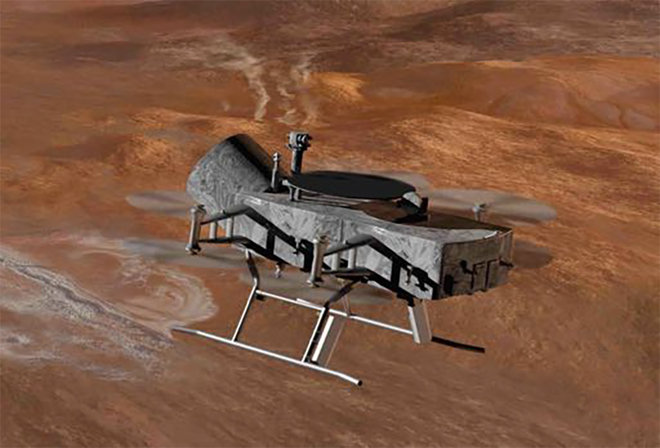
An artist’s impression of the Dragonfly dual-quadcopter, both on the surface of Titan and flying. The vehicle could make multiple flights to explore diverse locations as it characterises the habitability of Titan’s environment. Credit: JHU /APL / Mike Carroll

Back in August I wrote about a proposal from the Johns Hopkins Applied Physics Laboratory (APL) to fly a robotic helicopter to Saturn’s moon Titan.

Called “Dragonfly”, the mission would use a nuclear-powered dual-quadcopter, an evolution of drone technology, carrying a suite of science instruments to study the moon. Capable of vertical take-off and landing (VTOL) operations, the vehicle would be able to carry out a wide range of research encompassing Titan’s atmosphere, surface, sub-surface and methane lakes to see what kind of chemistry is taking place within them.

The proposal was one of several put forward for consideration by NASA as a part of the agency’s New Horizons programme for planetary exploration in the 2020s. In late December 2017, NASA announced it was one of two finalist proposals which will now receive funding through until the 2018 for proof-of-concept work.

Titan has diverse, carbon-rich chemistry on a surface dominated by water ice, as well as an interior ocean. It is one of a number of “ocean worlds” in our solar system that hold the ingredients for life, and the rich organic material that covers the moon is undergoing chemical processes that might be similar to those on early Earth. Dragonfly would take advantage of Titan’s dense, flight-enabling atmosphere to visit multiple sites by landing on safe terrain, and then carefully navigate to more challenging landscapes.

Dragonfly in flight. Credit: JHU /APL / Mike Carroll

At 450 kg, Dragonfly is no lightweight, and a fair amount of the mass would be taken up by its nuclear power unit. However, the vehicle will carry a science package comprising some, or all, of the following:

  • A mass spectrometer for analysing the composition of Titan’s atmosphere and surface material.
  • A gamma ray spectrometer of analysing the shallow sub-surface.
  • A seismometer for measuring deep subsurface activity.
  • A meteorology station for measuring atmospheric conditions such as wind, pressure and temperature.
  • An imaging system for characterising the geologic and physical nature of Titan’s surface and identifying landing sites.

Commenting on the NASA decision to provide further funding for the project, APL Director Ralph Semmel said:

This brings us one step closer to launching a bold and very exciting space exploration mission to Titan. We are grateful for the opportunity to further develop our New Frontiers proposals and excited about the impact these NASA missions will have for the world.

The second proposal to receive funding through until the end of 2018 is the Comet Astrobiology Exploration Sample Return (CAESAR) mission proposed by Cornell University, Ithaca, New York and NASA’s Goddard Space Flight Centre.

This mission seeks to return a sample from 67P/Churyumov-Gerasimenko, a comet that was successfully explored by the European Space Agency’s Rosetta spacecraft, to determine its origin and history. This project is being led by Steve Squyres of Cornell University, who was the principal investigator for NASA’s Mars Exploration Rover missions featuring Opportunity and Spirit.

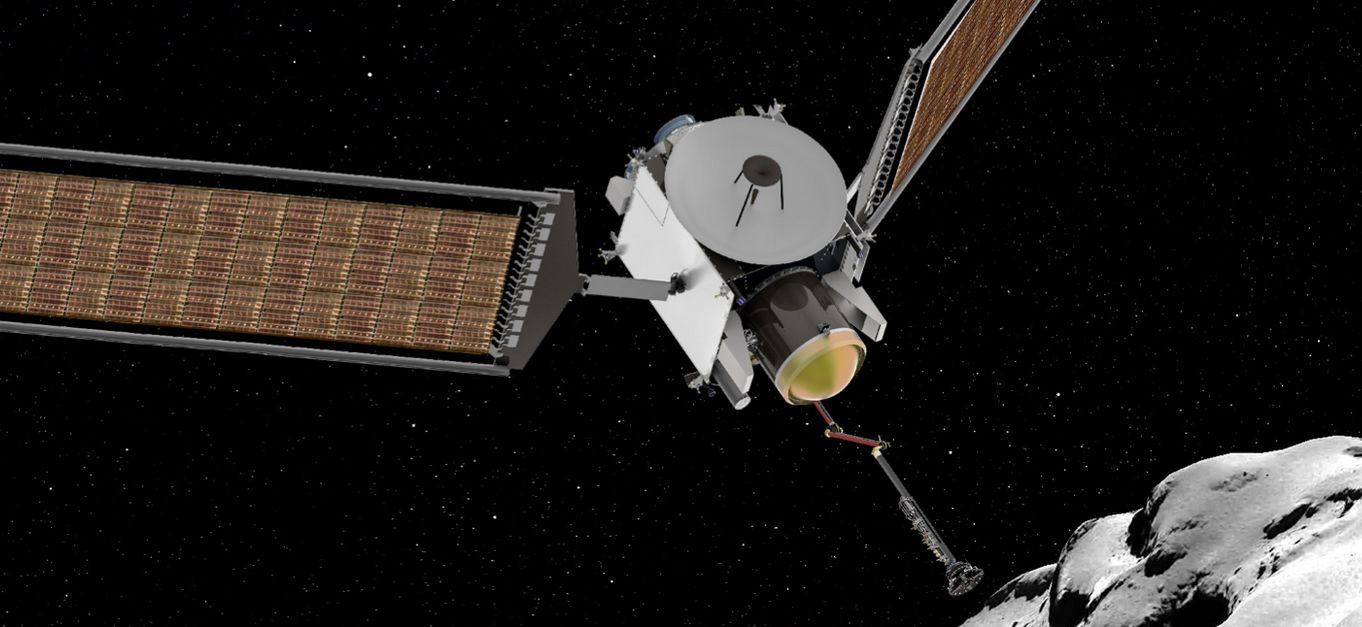
If approved by NASA, CAESAR would launch in 2024/25, collect at least 100 g (3.5 oz) of regolith from the comet, separating the volatiles from the solid substances. The spacecraft would then head back to Earth and drop off the sample in a capsule, which would re-enter Earth’s atmosphere and parachute down to the surface in 2038. 67P/C-G was selected because it has been extensively imaged and mapped by the Rosetta mission, thus enabling engineers to design a vehicle better able to meet the conditions around the comet as it swings around the Sun.

A conceptual rendering of CAESAR orbiting comet 67P/C-G

New Frontiers is a series of planetary science missions with a cap of approximately US $850 million apiece. They include the Juno mission to Jupiter, the Osiris-REx asteroid sample-return missions, and the New Horizons mission to Pluto, also built and operated by APL. Under the terms of NASA funding, both of the 2017 finalists will receive US $4 million each in 2018, and a final decision on which will be funded through to completion will be made in 2019.

WFIRST: Hubble’s New Cousin

While attention is on the next space telescope due for launch – the ambitious James Webb Space Telescope (JWST), which will be departing Earth in 2019 – NASA and the international community is already turning its attention to the telescope that will come after JWST, with a launch due in the mid-2020s.

Billed as a cousin to the Hubble Space Telescope, and something of a descendent of that observatory, the Wide Field Infra-Red Survey Telescope (WFIRST) will use a very similar telescope system as Hubble, with a 2.4m diameter primary mirror, but with a shorter focal length. This, coupled with no fewer than 18 sensors built into the telescope’s camera (Hubble only has a single sensor), means that WFIRST will be able to image the sky with the same sensitivity as Hubble with its 300-mexapixel camera – but over an area 100 times larger than Hubble can image. To put this in perspective: where Hubble can produce a poster for your living room wall, an image from WFIRST can decorate the entire side of your house.

NASA’s Wide Field Infrared Survey Telescope (WFIRST) will fly in the mid-2020s and provide astronomers with the most complete view of the cosmos to date. Credit: NASA Goddard Space Flight Centre / CI Lab

This wide field of view will allow WFIRST to generate never-before-seen big pictures of the universe, allowing astronomers explore some of the greatest mysteries of the cosmos, including why the expansion of the universe seems to be accelerating. One possible explanation for this speed-up is dark energy, an unexplained pressure that currently makes up 68% of the total content of the cosmos and may have been changing over the history of the universe. Another possibility is that this apparent cosmic acceleration points to the breakdown of Einstein’s general theory of relativity across large swaths of the universe. WFIRST will have the power to test both of these ideas.

Continue reading “Space Sunday: helicopters, telescopes and cars in space”

Space update special: the 8-exoplanet system and AI

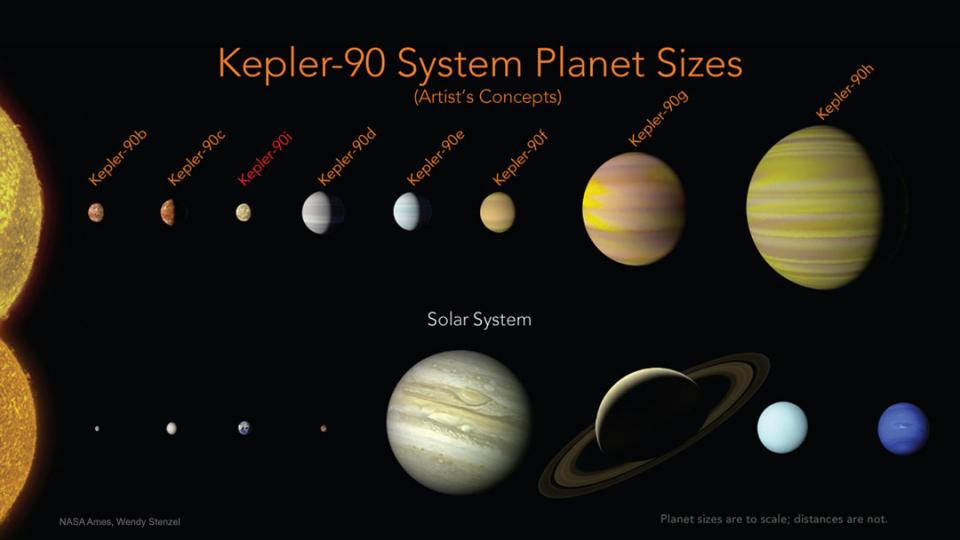
Artist’s impression of the Kepler-90 planetary system. Credit: NASA / Wendy Stenzel

I missed my usual Space Sunday slot due to Christmas activities taking up much of my time, so thought I’d round out the year of astronomy / spaceflight reporting with a last look at a subject that has dominated space news this year: exoplanets.

Back in February, it was confirmed that a red dwarf star had no fewer than seven planets in orbit around it, all of them roughly Earth-sized, and three of them within the star’s habitable zone (see Space update special: the 7-exoplanet system for more). At the time it was the largest number of planets thus far found to be orbiting a star – in this case, TRAPPIST-1, as it is informally called – named for the Transiting Planets and Planetesimals Small Telescope (TRAPPIST) system that discovered it.

At the time, the discovery meant TRAPPIST-1 tied with Kepler-90 for having the most exoplanets discovered to date orbiting it. However, as announced earlier in December, Kepler 90 has now regained the title, thanks to the work of a researcher from Google AI, and an astronomer from the Harvard-Smithsonian Center of Astrophysics (CfA), with the discovery of an eighth planet orbiting the star designated Kepler-90. However, what is particularly interesting about this discovery is both the way in which it was made.

Located about 2,545 light-years (780 parsecs) from Earth in the constellation of Draco, Kepler-90, unlike TRAPPIST-1 and the majority of other planet-bearing stars, in not a M-class red dwarf star. Rather, it is a G-class main sequence star, with approximately 120% the mass and radius of the Sun. It is thought to be around 2 billion years old and it has a surface temperature of 6080 Kelvin – compared to the Sun’s 4.6 billion years of age and 5778 Kelvin surface temperature. Thus, the star and its planetary system has certain key similarities to our own solar system in terms of Kepler-90’s nature, the number of major planets now known to be orbiting it, and their distribution – the smaller rocky planets being closer to their parent than the system’s gas giants.

The Kepler system roughly compared in terms of planet sizes, with our own. Credit: NASA / Wendy Stenzel

The Kepler designation for the star indicates it was a subject of study for the Kepler Space Telescope. Prior to that, the star was designated 2MASS J18574403+4918185 in the Two Micron All-Sky Survey catalogue, compiled following the 1997-2001 whole sky astronomical survey of the heavens visible from Earth. At that time, transit data gathered from earth-based observations suggested it may have a planet orbiting it, so it was made a target for observation by Kepler, and re-designated Kepler Object of Interest 351 (KOI-351). In 2013, thanks to Kepler’s observations, it was confirmed the star had six or possibly seven planets orbiting it (the outermost remained a subject of doubt for a while after it was initially identified).

All seven of the initial discoveries were made using the transit method (Transit Photometry) to discern the presence of planets around brighter stars. This consists of observing stars for periodic dips in brightness, which are an indication that a planet is passing in front of the star (i.e. transiting) relative to the observer. Kepler’s data revealed the seven planets orbiting the star over a period of two months, with the planets being designated as follows (in order of distance from their parent star):

Kepler-90 b Kepler-90 c Kepler-90 d Kepler-90 e Kepler-90 f Kepler-90 g Kepler-90 h
Radius: 1.31 Earth Radius: 1.19 Earth Radius: 2.9 Earth Radius: 2.7 Earth Radius: 2.9 Earth Radius: 8.1 Earth Radius: 11.3 Earth
“Super Earth” “Super Earth” “Mini Neptune” “Mini Neptune” “Mini Neptune” “Saturn size” “Jupiter size”
Orbital period: 7 days* Orbital period: 8.7 days* Orbital period: 59.7 days* Orbital period: 92 days* Orbital period: 125 days* Orbital period: 210 days* Orbital period: 311 days*

*=terrestrial days

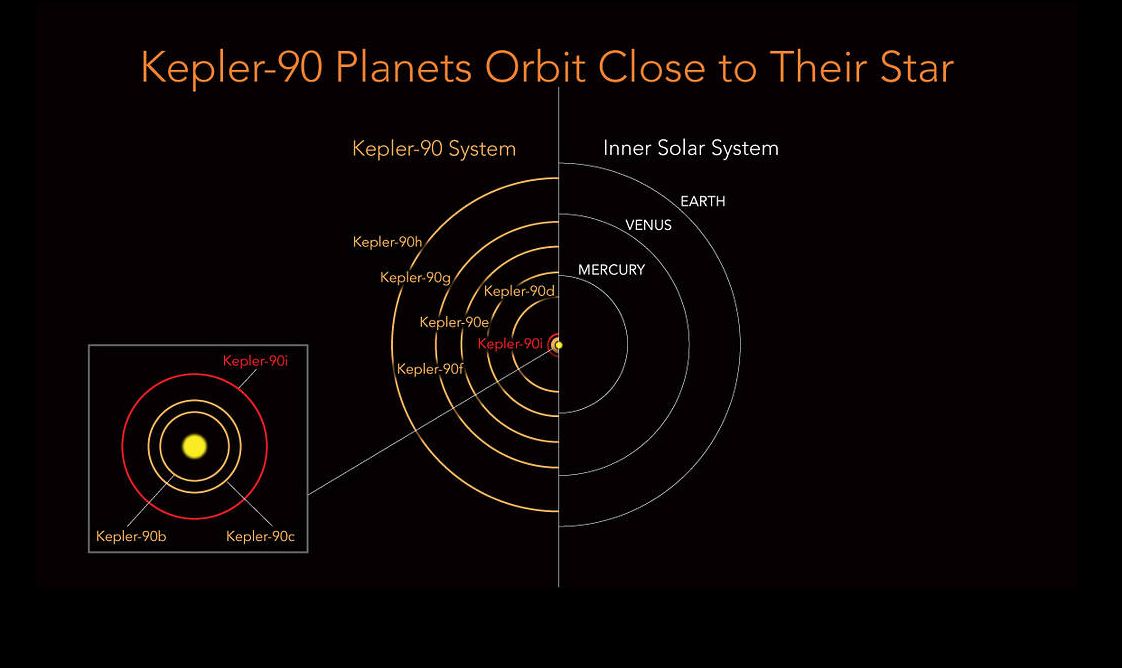
However, while the system does have similarities to our own, all of the planets within it orbit much closer to their parent star than do the planets of the solar system. So much so that the largest and outermost of those discovered, the Jupiter-sized Kepler-90 h, is the only one to orbit within the star’s habitable zone – the point at which liquid water and other essentials for life might exist in the right combinations. And while it may well sit on the inner edge of the star’s habitable zone, given that Kepler-90 h is a gas giant world somewhat equitable with Jupiter in size and mass, it is highly unlikely it is a suitable environment in which life might arise – but there is the intriguing question that should it have a sufficiently large moon orbiting it – say one the size of Titan or Ganymede – which has a good magnetic field protecting it, life might arise there.

The inner planets of the system, while more Earth-like in their size, are unlikely to support life, even if the three “mini Neptunes” were to prove to be solid bodies with atmospheres. Kepler 90 b through Kepler 90 e all orbit within or at about the same distance Mercury orbits the Sun, meaning they all experience similar or hotter surface temperatures the innermost planet of the solar system experiences. Kepler-90 f orbits at approximately the same distance as Venus does from the Sun, which likely means that if it is a mini-Neptune and, it could well be like Venus it terms of the conditions within any atmosphere it might have.

The Kepler-90 planetary orbits compared to those of the solar system’s planets. Credit: NASA / Wendy Stenzel

Continue reading “Space update special: the 8-exoplanet system and AI”