Space Sunday: of launches and Earth’s Moon(s)

A Falcon 9 rocket carrying Crew Dragon Freedom and the two members of the Crew 9 / Expedition 72 mission to the ISS lifts-off from SLC-40, Canaveral Space Force Centre, September 282th, 2024. Credit: SpaceX

The long-awaiting NASA Expedition 72 / SpaceX Crew 9 mission launched for the International Space Station (ISS) on the 28th September, 2024, with some media still quite wrongly calling the launch a “rescue” mission.

The mission continues to be dubbed as such most likely because it is an attention-getting headline, after the recent farrago with the Crew flight Test (CFT) mission involving Boeing’s CST-100 Starliner. While the latter made a safe uncrewed return to Earth – albeit it with some additional thrusters issues and an unexpected software reboot – on September 9th (See: Space Sunday: Starliner home; New Glenn update), the vehicle’s crew of Barry “Butch” Wilmore and Sunita “Suni” Williams remained aboard the space station, allowing the media to continue to play the “astronauts stranded in space!” tune.

The Titan IVB/Centaur (Model 401) carrying the NASA/ESA Cassini/Huygens mission, on the pad at Launch Complex 40 within the (then) Cape Canaveral Air Station, October 13th, 1997, shortly before the mission’s launch Credit: NASA

Leaving aside the sensationalism of reporting, the Expedition 72 / Crew 9 mission is still something of a landmark mission for SpaceX, being the first time a crewed launch has ever taken place from Space launch Complex 40 at Canaveral Space Force Station, adjoining the Kennedy Space Centre. Referred to as SLC-40 (or “slick-40”) in US Air Force parlance when it was used by the military, from 1965 through 2007 been the launch point for payload missions using the Titan launch vehicle family.

In 2007 SpaceX leased the facility, and it has since become the highest-volume launch facility for the company’s Falcon 9 vehicles, hosting over 200 launches (the majority of these being non-direct revenue generating Starlink launches). Since 2023, SpaceX has been upgrading SLC-40 for launches of the Dragon capsule system, with the emphasis on cargo launches to the ISS, but also crewed launches once the necessary access, support and emergency escape systems, etc., had been integrated into the launch facility.

Crew 9 had originally been due to launch from Kennedy Space Centre’s Launch Complex 39A (LC-39A), until now the only facility available to SpaceX for launching crewed missions, and also the Falcon Heavy launch system. However, as the launch date for Crew 9 continued to be pushed back from mid-August through September, it risked conflicting with the launch of NASA’s Europa Clipper mission using Falcon Heavy, and which has to take place in October. So, to avoid scheduling issues, NASA and SpaceX agreed to move the Crew 9 launch over to SLC-40.

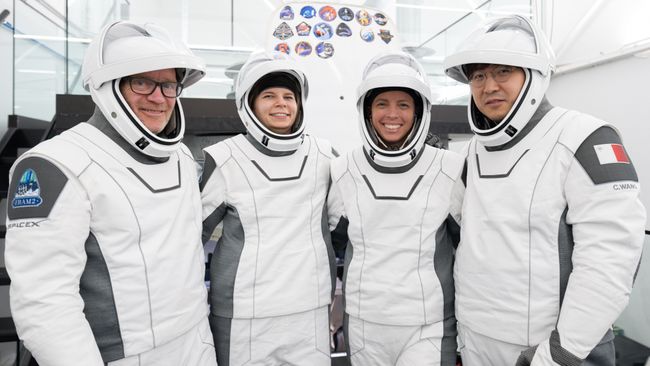
Crew 9, carrying NASA astronaut Nick Hague and cosmonaut Aleksandr Gorbunov lifted-off at 17:17 on September 28th, the launch having been delayed from this target date by Hurricane Helene. The flight proceeded smoothly, with the first stage of the rocket making a safe boost-back and landing some 8 minutes after launch, and the upper stage correctly delivering the Crew Dragon capsule Freedom to its initial orbit and the start of a 28-hour “chase” to rendezvous with the ISS, that latter being due at approximately 21:30 UTC on Sunday, September 29th.

However, whilst all has proceeded smoothly with the Crew Dragon vehicle, an anomaly with the Falcon 9’s  upper stage de-orbit burn meant it splashed down outside of its designated target area in the Pacific Ocean, prompting SpaceX to suspend Falcon 9 launches until the reason for the deviation to be investigating, per Federal Aviation Authority (FAA) requirements.

A shot from a camera on the upper stage of the Falcon 9 used to launch the Crew 9 mission, showing the Crew Dragon Freedom moving away following vehicle separation on reaching orbit. Credit: SpaceX via NASA TV

As to why Crew 9 is not a “rescue mission”, the explanation is simple: the mission is a part of NASA’s schedule of ISS crew rotations and not any specifically result of the issues pertaining to Boeing’s Starliner or the fact that Williams and Wilmore being “stranded in space”.  In fact, the two astronauts have always had the means to return to Earth, either using the Starliner vehicle or the SpaceX Crew 8 Dragon vehicle.

One of the temporary seats the ISS crew rigged within Crew Dragon Endeavour for use by Williams and Wilmore, had it been necessary for any evacuation of the ISS. Credit: NASA / Michael Barratt

The former was demonstrated in June 2024, when Wilmore and Williams and the rest of the ISS crew were ordered into their respective vehicles in readiness for a possible emergency Earth return due to the risk of the ISS being hit by debris from the break-up of a Russian satellite in an orbit which intersected that of the space station (see:  Space Sunday: of samples and sheltering).

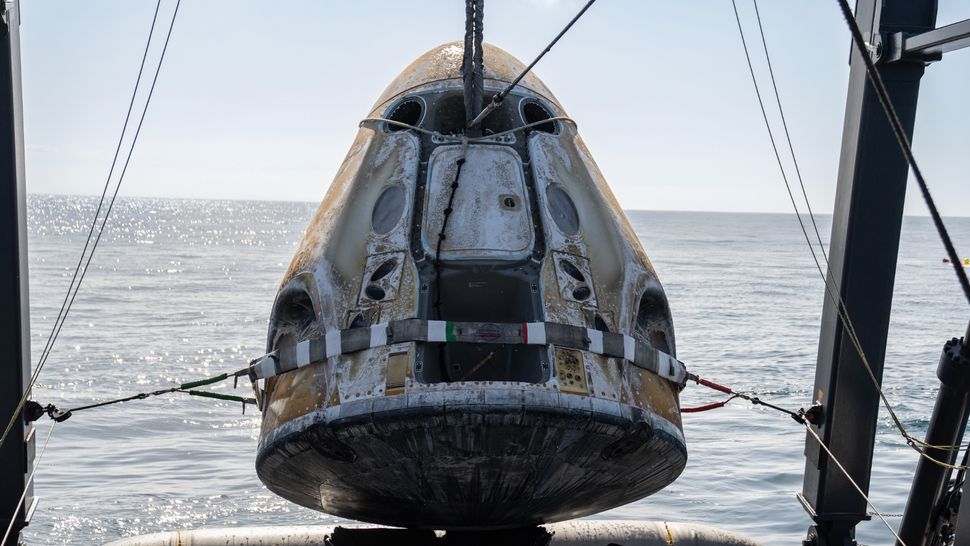
The latter was shown following the return of the Crew 8 mission aboard Crew Dragon Endeavour, when the additional seated rigged within the vehicle’s pressurised cargo area for use by Williams and Wilmore, had a return to Earth been required prior to the arrival of the Crew 9 mission.

Which is not to say either option was either optimal or entirely safe; ergo, the need for an abundance of caution on NASA’s part, coupled with the need to disrupt crew rotations to the ISS as little as possible, the decision to fly Crew 9 with only 2 on board and thus “reserve” the remaining two seats for Wilmore and Williams made the most sense, both ensuring they had an assured flight home, and could complete the planned Expedition 72 crew rotation on ISS in place for astronauts Stephanie Wilson and Zena Cardman.

SpaceX and FAA

In the meantime, SpaceX has entered into an aggressive head-to-head with the Federal Aviation Authority over both launches of Falcon 9 and Falcon Heavy earlier in the year and overall SpaceX’s Starship operations out of Texas.

In short, the FAA is seeking to impose fines on SpaceX to the tune of US $633,009 due to SpaceX having failed to comply with the requirements of licenses issued for the launches of both Falcon 9 and Falcon Heavy, which the FAA states violated the launch licenses it granted for the them on the basis of changes SpaceX made to the launch operations. The changes, relating to a new control centre and propellant farm, were subject to license modifications for the respective launches, but the FAA state SpaceX submitted the requests for modifications too late for them to be properly processed.

In response to this, SpaceX claims it sought to have the licenses modified for the launches in question, but the FAA is at fault for failing to process the modifications in time for the launches to proceed as scheduled, and that as SpaceX judged the changes to not be safety issues, decided to go ahead with them nevertheless.

The Starship issues are equally complicated, with the FAA stating the license for to carry out any further Starship launches is being held-up on two main counts.

The first is that SpaceX is in violation of Texas state and federal requirements relating to the water deluge system used during Starship / Super Heavy launches out of Boca Chica. SpaceX dispute this – although they are also fighting US $148,378 in fines levied by the US Environmental Impact Agency for violations in the use of said system. The second is that SpaceX has failed to carry out required sonic boom analysis relating to its plans to return the Super Heavy booster to the launch facility for “capture” during the next Starship flight. Both of these are viewed by the FAA as “safety” issues SpaceX must address prior to any license being granted.

For its part, SpaceX and its CEO have aggressively hit back at the FAA, claiming the agency’s senior management is “lying”, and that FAA Administrator Mike Whitaker should be fired by Congress. In particular, with the SpaceX CEO stating the FAA is targeting SpaceX over “petty issues” relating to safety whilst “neglecting real safety issues at Boeing”. Whilst uncalled for, these comments came at a time when FAA Administrator Mike Whittaker was testifying to the House Transportation Committee in relation to Boeing’s ongoing aviation issues; as a result, Rep Kevin Kiley (R-Calif.) used the aviation-related hearing to accuse the FAA of “undue scrutiny” where SpaceX is concerned, and questioning whether the FAA treat SpaceX “equally” with Boeing.

Addressing the House Transportation Committee, FAA Administrator Mike Whitaker noted that the best way for SpaceX to “speed up” the launch licensing process would be to properly comply with the regulations. Credit: House Transportation Committee webcast

In reply, Whittaker agreed that companies should be held to the same standards of safety – and pointed out that in this respect, Boeing has both a safety management system (SMS) programme in place and (however unwillingly) operates a whistleblower programme as a part of their SMS. By contrast, and despite 20+ years of operations, SpaceX has consistently failed to implement either.

The comments around Boeing have also prompted some SpaceX fans to question why the FAA is so quick to “ground” SpaceX but has not done the same with Boeing’s Starliner. The answer to this is simple: the FAA has jurisdiction over all commercial launches from US soil, but is not responsible for licensing or overseeing US government launches or the spacecraft craft carried on these missions. As Starliner’s issues were purely spacecraft related, decisions relating to the vehicle’s safety fall under the remit of NASA, not the FAA.

How Many Natural Moons does Earth Have?

The above should be a simple question to answer – “one”. However, between now and November 27th, 2024 one could argue the answer should be “two”, thanks to the arrival of a tiny asteroid called 2024 PT5.

Measuring roughly 10 or 11 metres across, the asteroid is technically referred to as a near-Earth object (NEO) – an asteroid in an elliptical orbit close to the Sun and on a path that frequently cross Earth’s as we move around the Sun. Officially “discovered” (observed for the first time) on August 7th, 2024, it passes around the Sun just over once a terrestrial year, but at a low relative velocity when compared to Earth’s.

Thus, at 19:54 UTC on September 29th, it will pass just outside of Earth’s Hill Sphere at a velocity low enough for it to temporarily pass into a short-order orbit around Earth. However, because the asteroid will be just beyond the Hill Sphere at the time of “capture”, it will resume its passage around the Sun on November 25th, 2024, after 57 days passing around Earth and the Moon, not quite completing a full orbit. Sadly, during the encounter, it will be too small to observe with anything but the largest of optical telescopes.

This is actually not the first time our planet has – at least briefly – has had a “mini-Moon” – and such events might actually be relatively frequent; the last recorded event like this was in 2020, and that as more and more attention is focused on NEOs, it is possible that more and more might be found to make similar temporary orbits around Earth. One of the more interesting questions around 2024 PT5 is whether it started life as an asteroid or whether it might have originated on the Moon and was blasted out into space as part of a significant impact at some point in the Moon’s history. After this little loop, orbital calculations show that the next time it comes close enough to enter a temporary orbit in this manner will be in 2055.

And where did the Moon Come From?

For the last 40 years, the going theory for the origin of the Moon has been that it was formed from material resulting from a very large collision between Earth and another large body some 60 million years after the solar system formed.

The theory was a consensus decision reached by planetary scientists at a 1984 conference called to discuss findings from studies of the rocks returned by the Apollo mission and held in Hawai’i. The basis for the consensus was that chemical and isotopic analysis of the returned material showed that it was similar to the rock and soil on Earth: calcium-rich and basaltic in nature and was of a near-identical age to similar rocks found on Earth.

Professor Darren Williams, Penn State Behrend College, one of the co-authors of a new paper suggesting on the origins Earth’s Moon. Credit: Penn State Behrend / Penn State

However, according to planetary scientists from Penn State Behrend College, this might not be the whole story: there is a possibility the Moon might actually have actually formed elsewhere and was captured during a close encounter between the young Earth and a terrestrial binary.

In this theory, there were two objects in a binary orbit and orbiting the Sun in an orbit very similar to Earth, and most likely formed at around the same time (thus meaning their composition would be similar). Over time as the respective obits of the binary system and Earth came into proximity to one another, Earth’s gravity separated the binary, snagging one of the objects, which became our Moon.

As evidence of this, the researchers point to the Moon being more in line with the Sun than with Earth’s equator, suggesting it originated in solar orbit. They also note that such situations are not uncommon in the solar system – Neptune’s moon Triton, for example, is most likely a captured Kuiper Belt object. In addition, the team’s modelling show that a binary-exchange object of the Moon’s size and mass interacting with the Earth’s gravity would likely start in an elongated elliptical orbit as it is initially captured by the Earth, which overtime would become increasingly circularised to a point where it became tidally locked with Earth: always keeping the same face towards the planet. After this, tidal evolution would be reversed, causing the object to slowly start to move away from Earth once more.

Much of this matches the behaviour of the Moon, which is now roughly 382,400 kilometres from Earth and moving away at the rate of 3 centimetres a year. This might not sound like a lot, but it is far enough for the Moon to be entering what will, in the centuries ahead, become an increasing tug of war between Earth and the Sun for control of the Moon – one which the Sun will eventually win.

Even so, and as the researchers note, their work is not conclusive whilst raising new questions:

No one knows how the moon was formed. For the last four decades, we have had one possibility for how it got there. Now, we have two. This opens a treasure trove of new questions and opportunities for further study.

Professor Darren Williams, Penn State Behrend College

China Unveils Lunar Spacesuits

China has unveiled the new generation of its space suit intended for use in their upcoming lunar exploration programme.

The suit appears to be a further Feitian space suit developed for extravehicular activities aboard the Chinese space station; however it remains unnamed, with the China Manned Space Agency (CMSA) launching a competition to name the new suit.

An artist’s renderings of China’s new lunar spacesuit. Credit: CMSA

Unveiled at the third Spacesuit Technology Forum hosted by the China Astronaut Research and Training Centre, with the press release highlighting the red strips on the suits, stating they are inspired by the famous “flying apsaras” of Dunhuang art (upper arms), and rocket launch flames (legs). It is said to be equipped with a multifunctional integrated control panel that is easy to operate, cameras for recording close-up and long-distance scenes and made from protective materials that can effectively shield astronauts from the lunar thermal environment and lunar dust.

Alongside the presentation of the new suit, CMSA released a video promoting the new suit and featuring taikonauts Zhai Zhigang and Wang Yaping. Zhai made history in the Shenzhou-7 mission as China’s first person to conduct a spacewalk; he also flew Shenzhou-13 with Wang, who became China’s first female taikonaut to complete a tour of duty aboard the Tiangong space station. Their use as models for the new suit has spurred speculation that they might be part of China’s first crewed lunar landing  – although given the first landing will be before 2030, this is purely an assumption.

Space Sunday: exoplanets and atmospheres

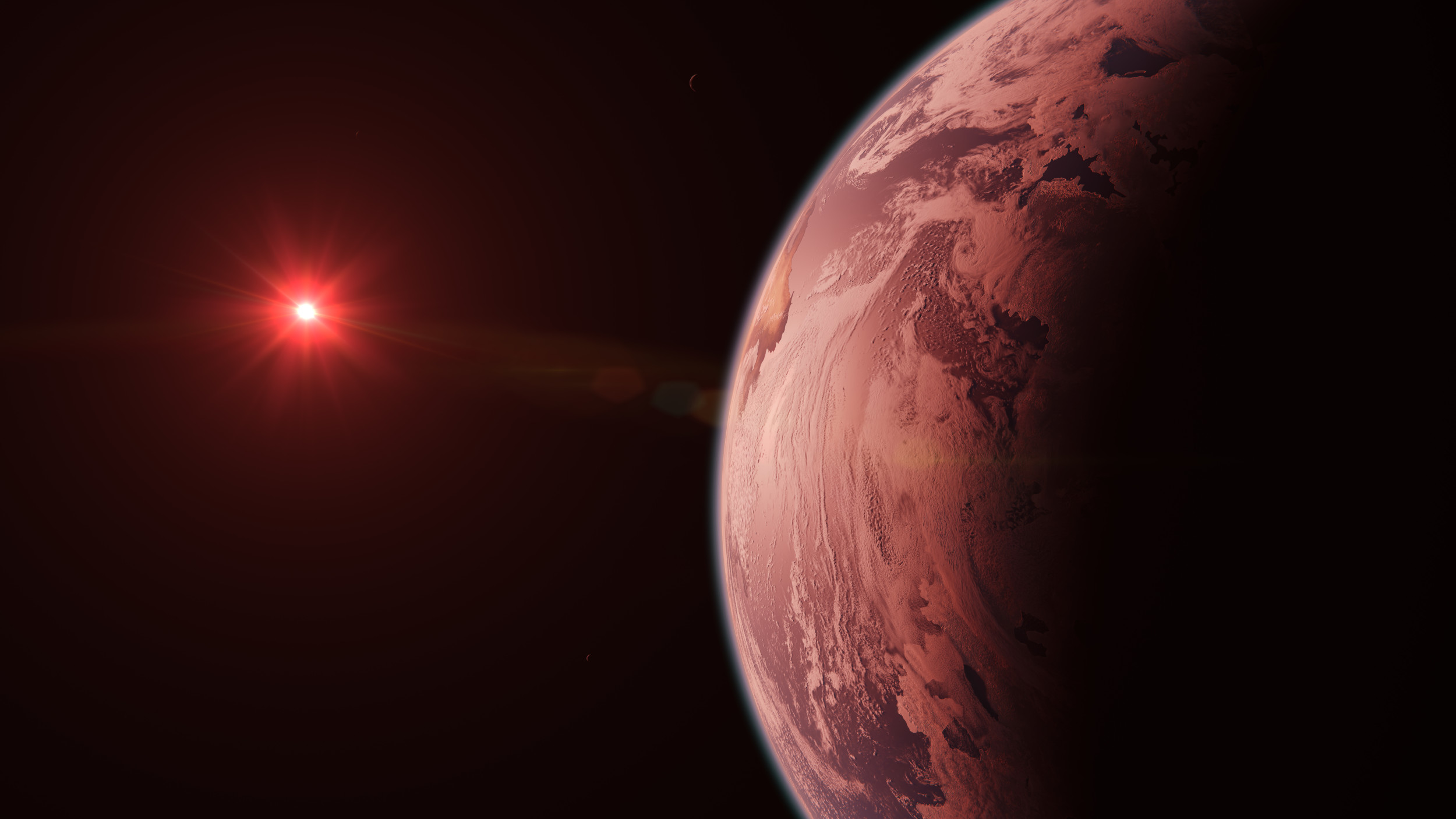
An artist’s impression of one of the TRAPPIST-1 planets in the star’s habitable zone. Credit: unknown

Scientists have once again been turning their attention to the TRAPPIST-1 planetary system – this time to try to find evidence of technosignatures – artificial radio transmissions if you will – emanating from the system.

TRAPPIST-1 is a red dwarf star some 40 light years from Earth which had been previously known by the less exotic designation 2MASS J23062928-0502285. The name change came about in 2017, after extensive observations led by the Transiting Planets and Planetesimals Small Telescope (TRAPPIST) system revealed the star had no fewer than seven roughly Earth-sized planets orbiting it (see: Space update special: the 7-exoplanet system). The discoveries marked the star as a prime contender for the study of exoplanet systems, not only because of its proximity to our own Sun or the number of planets orbiting the star, but also because three of the seven planets lay within the star’s “Goldilocks zone” – the region where everything is kind-of “just right” for liquid water to exist and – perhaps – life to potentially take hold.

However, there have always been caveats around any idea of any of the planets harbouring liquid water, much less life, the most obvious being whether or not they have an atmosphere. One problem is that red dwarf stars tend to be rather violent little fellows in comparison to their size, prone to extreme solar events which could, over time, simply rip away the atmospheres of any planets orbiting. Another, more intrinsic problem is that a new study suggests that it might be harder to confirm whether or not the TRAPPIST-1 planets have any atmospheres because the means by which scientists have generally used to try and identified whether or not tidally locked exoplanets might have atmospheres could well be flawed – of which more in a moment.

True-colour illustration of the Sun (left) next to TRAPPIST-1 (right), both to scale relative to one another. TRAPPIST-1 is darker, redder, and smaller than the Sun, being slightly larger than Jupiter. Via: Wikipedia

The issue of TRAPPIST-1 ripping away an atmospheres its planets may have had is a mixed one: on the one side, all of the planets orbit their parent star very closely, with orbits completed in periods measure from just 2.4 terrestrial days to 18.9 terrestrial days; this puts them well inside the “zone of violence” for any stellar outbursts from the star. On the other, TRAPPIST-1 is old: estimates put it at around 7.6 billion years old, or more that 1.5 times the age of our Sun, and it might be a much as 10 billion years old. This age means that as red stars go, it is actually quite staid, and may have passed through it more violent phase of life sufficiently long ago for the atmosphere of the more distant planets orbiting it, including those in the habitable zone where life may be able to arise, to have survived and stabilised.

One of the most interesting aspects of the TRAPPIST-1 system is that, even though they are tidally locked, two of the planets within the star’s habitable zone TRAPPIST-1e and TRAPPIST-1f – could actually have relatively benign surface temperatures on their surfaces directly under the light of their star, with TRAPPIST-1e having temperatures reasonable close to mean daytime surface temperatures here on Earth and TRAPPIST-1f matching average daytime temperatures on Mars. Thus, if they do have dense enough atmospheres, both could potentially have liquid water oceans constantly warmed by their sun, and the regions in which those oceans exist could experience relatively temperate weather and climate conditions.

An illustration of the TRAPPIST-1 system scaled to match the inner solar system. Three of the TRAPPIST-1 planets – e, f, and g, sit within the tiny star’s habitable zone, where liquid water might exist on them. Credit: NASA

Since the discovery of the seven planets, there have been numerous studies into their potential to harbour atmospheres and much speculation about whether or not they might harbour life. However, the idea that any life on them might have reached a point of technological sophistication such that we might be able to detect it is – if we’re being honest – so remote as to be unlikely simply because of the many “ifs” surrounding it. However, that doesn’t mean we shouldn’t try to find out; for one thing, there is the intriguing fact that if any civilisation has arisen to a level  of technology similar to ours on any of the planets,  the relative proximity of the entire system means that it might have made the jump between them and achieved something of a multi-planet status.

Again, the chances of this being the case are really remote – but if it has happened, then there would likely be communications passing back and further the planets. Assuming that such communications are made via artificially modulated radio frequencies, we might be able to detect them from Earth. At least, this has been the thinking of a team of radio astronomers, and they’ve been putting the idea to the test using a natural phenomenon called planet-planet occultation (PPO). A PPO is when one planet comes between two others – in this case one of the TRAPPIST-1 planets and Earth.

The theory is that if the two alien words are communicating one to the other, then during a PPO, any radio signals from the planet furthest from Earth (planet “b” in the illustration below) direct at the occulting planet (planet “c”), would “spill over” their destination and eventually pass Earth, allowing us to detect them. Note this doe not mean picking up the communications themselves for any form of “translation” (not that that would be possible), but rather detecting evidence of artificially modulated radio frequencies that might indicate intelligent intent behind them.

An example of planet-planet occultation (PPO): as planets “b” and “c” pass around their star, “c” will periodically occult (pas in front of) “b” relative to Earth. When this happens, it might be possible it detect radio signals passing from “b” to “c” (if they exist. Credit: Tusay, et al

To this end, a team of radio astronomers the latter’s Allen Telescope Array (ATA), originally set-up by the SETI Institute and the University of California, Berkeley, to listen to the TRAPPIST-1 system and gathered some 28 hours of data across several potential PPO events involving different planets in the TRAPPIST-1 system. In doing so, they collected some 11,000 candidate signals coming from the general proximity of the TRAPPIST-1 system. These event were then further filtered down using computer modelling to some 2,000 potential signals that could be directly associated with 7 PPO events. These 2,000 signals were then analysed to determine if any were statistically unusual enough to suggest they might be of artificial origin – that is, potential radio transmission.

Sadly, the answer to this was “no”, which might sound like a lot of work for no result; but just imagine if the reverse had been true; further, now the concept of using PPO events in this manner has been tested, it lends itself for potential use with other multi-planet systems orbiting relatively nearby stars.

The Problem of Atmospheres

Now, to circle back to the question of atmospheres on tidally locked planets. As noted above, such planets always have one side permanently facing their parent star and the other always pointing away into space, as the rotation of the planet is precisely in sync with its orbital motion around the parent star. This means that – again as already noted – if there is any atmosphere on such a planet, it might result in some extremes of weather, particularly along the terminator between the two sides of the planet.

However, if the atmosphere is dense enough, then conditions on the planet might not only be capable of supporting liquid water, they might also result in stable atmospheric conditions, with less extreme shifts in climate between the two sides of the planet, and while the weather would still be strange, it would not necessarily be particularly violent; thus, such planets might be far more hospitable to life than might have once been thought. And herein lays a problem.

To explain: exoplanet atmospheres are next to impossible to directly observed from Earth or even from the likes of the James Webb Space Telescope (JWST). Instead, astronomers attempt to observe the spectra of an exoplanet, as this reveals the chemical composition of any atmosphere that might be surrounding it. But tidally-locked planets tend to be orbiting so close to their parent star that trying to obtain any atmospheric spectra is hard due to the interference of the star itself. Instead, a different technique is used.

Computer-generated rendering of how the tidally locked world TRAPPIST-1f might look when viewed from its star, assume it has an atmosphere that might support liquid water on its surface. Credit: NASA

As a tidally locked planet passes between Earth and its parent star it presents its dark side directly to us, allowing astronomers by dint of knowing the nature of the star itself, to calculate the temperature of the planet’s dark side. Then, as it moves around to the far side of the star relative to Earth, we get to measure its “light” side. Again, as the nature of the star and its light / temperature are “known”, it is possible to extrapolate out the likely temperature of the “light” side of the planet. With this done, the two temperatures can be compared, and if they are massively different, then – according to the thinking to date – viola! The planet has no atmosphere; but if the difference between the two is not drastically different, than it’s likely the planet has a nice, dense atmosphere.

Except a new study currently awaiting peer review points out a slight wrinkle in this approach. In it, researchers show that yes, while a dense atmosphere on a tidally-locked exoplanet would moderate the planet’s global temperatures and thus remove extremes, it could also result in the formation of upper atmosphere clouds across much of the dark side of the planet. Such clouds would have two outcomes: on the one hand, they would help retain heat within the atmosphere under them, keeping it much warmer than would otherwise be the case and making the entire planet potentially far more hospitable to life. On the other, they would “reflect” the coldness of the upper atmosphere such that when we attempt to measure the temperature of the planet’s dark side, we are actually measuring the temperature of the cold upper layers of the clouds, not the temperature of the atmosphere below them. This would result in the dark side temperatures appearing to be far lower than is actually the case, leading to the incorrect conclusion that the planet lack any atmosphere when this is not the case.

How clouds could make a planet appear airless. Credit: Powell, et al, Nightside Clouds on Tidally-locked Terrestrial Planets Mimic Atmosphere-Free Scenarios

What’s the impact of this? Well, allowing for the study to pass peer review – and the author’s note that more work in the area is required, it could mean that we have dismissed numerous smaller, solid exoplanets as being unsuitable for life because “they have no atmosphere” when in fact they could in fact do so. Thus, there might be more potentially life-supporting planets than previously considered.

Space Sunday: stellar companions and updates

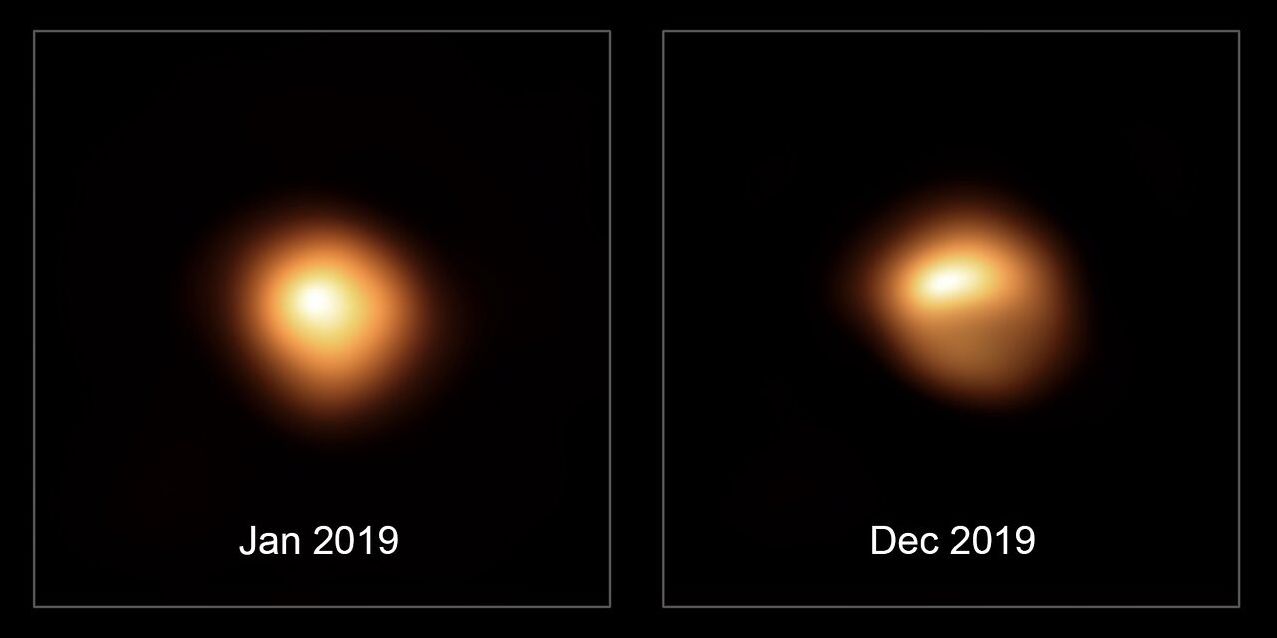
Side-by-side comparison of Betelgeuse’s dimming, as seen by the SPHERE instrument on ESO’s Very Large Telescope prior to (left) and during (right) the “great dimming” of 2019/2020. Credit: ESO/M. Montargès et al.

Back in 2019 / 2020 the red giant star Betelgeuse caused considerable excitement among astronomers on account of it undergoing a period of exceptional dimming – far more than is customary, given it is a pulsating variable star – which fuelled speculation that what was being seen might be the precursor to the star having gone supernova some 643 years ago (that being the time it takes for light from it to reach us), and the dimming was actually the star going through the kind of collapse the comes before such a supernova explosion.

However, despite the rapid and unusual dimming witnessed over December 2019January 2020 and February 2020, by April 2020, the star  had returned to its normal levels of brightness, and by August of that year, astronomers thought that had an explanation for the unwarranted dimming: the star’s pulsating nature gives rise to clouds of energetic particles to be ejected, some of which form a illuminate cloud around the star whilst more cool and form a blotchy cloud too dim an cold to be detected by optical or infrared means, and which can result in the star dimming significantly in addition to any normal variations in its brightness as see from Earth.

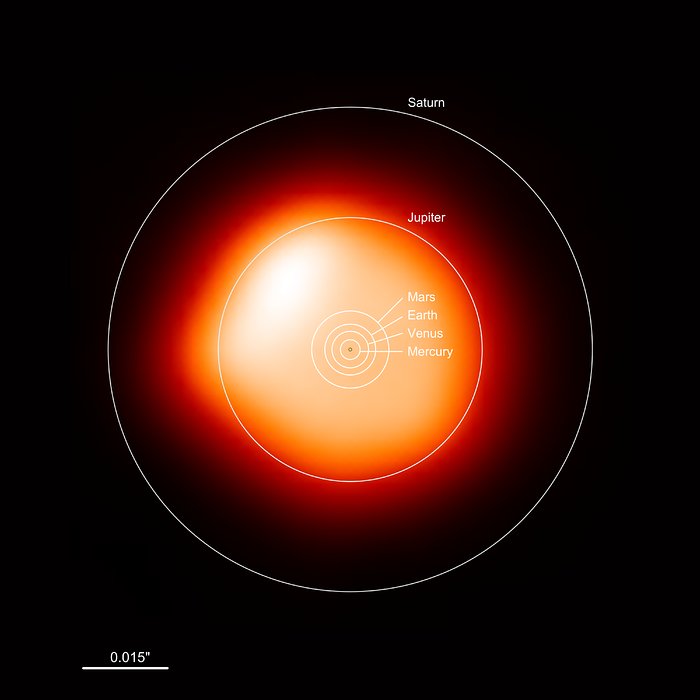
“Betelgeuse is big. Really big. You just won’t believe how vastly hugely mind-bogglingly big it is. You might think it’s a long way to the Moon, but that’s just peanuts to Betelgeuse!” (with apologies to the estate of Douglas Adams). A diagram showing the approximate size of Betelgeuse compared to our solar system. Credit: unknown

Because of the “great dimming”, astronomers have continued to observe Betelgeuse and gather a lot more data about it, particularly with regards to trying to understand the drivers of the star’s Long Secondary Period (LSP) of variability. Stars like Betelgeuse tend to have overlapping periods of variability: the first tends to be a fairly short cycle of dimming and brightening. In the case of Betelgeuse, this cycle of dimming and brightening again lasts some 425 days.

This overlaps a much longer period of variability – the LSP – which in the case of Betelgeuse lasts somewhere in the region of 2,100 terrestrial days, or roughly 6 years. These periods, short and long, can occasionally synchronise so that both reach a period of maximum dimness or brightness. Originally, it had be thought that such a period of synchronicity had caused with the 2019/2020 “great dimming”, until data and observations showed otherwise. However, and more to the point, the actual mechanisms which cause LSPs for variable red giant stars is not well understood, and have been ascribed to several potential causes.

One of these is the potential for the red giant to have a smaller companion star, one very hard to observe due to the behaviour and brightness  of the red giant. Such is the conclusion reached in a new paper: A Buddy for Betelgeuse: Binarity as the Origin of the Long Secondary Period in α Orionis published via arxiv.org (and thus still subject to peer review). In it, researchers  Jared A. Goldberg, Meridith Joyce and László Molnár walk through all of the accepted explanations for LSPs among red giant stars as they might be applied to Betelgeuse, concluding that perhaps the most likely is that the red giant has a very low-mass (comparatively speaking) companion orbiting it at roughly 2.43 times the radius of Betelgeuse.

This puts the companion within the observable and illuminated dust cloud around Betelgeuse, potentially making the companion – referred to as α Ori B – exceptionally hard to observe, as it would be subsumed in the brightness of the surrounding dust and Betelgeuse’s own corona. further, it would be unlikely to form its own accretion disk, something which might otherwise aid its observation.

This December 2019 VLT VISIR image reveals the infrared light being emitted by the dust surrounding Betelgeuse. These clouds are formed when the star sheds its material back into space, while the black disk at the centre of the image obscures the star and its corona and inner dust cloud in order for VISIR to see the infra-red light of the dust clouds. An image of Betelgeuse is overlaid to scale at the centre of the disk. The disk also covers the area within which the proposed companion object might reside. Credit: ESO / P. Kervella / M. Montargès / Eric Pantin

In particular, the paper notes that such a low-mass companion orbiting at the calculated distance from the red giant would actually give rise to an LSP of some 2,000-2,100 days as seen from Earth.

The one wrinkle in the idea – as noted by the authors – is that the calculated mass for α Ori B is well in excess of the calculated potential mass for such theoretical binary companions as provided by established (and peer-reviewed) papers investigating possible causes for LSPs among variable red giants. As such, and given the unlikely ability to optically identify any companion to Betelgeuse, the paper’s authors outline upcoming periods when α Ori B might be particularly susceptible to detection via repeated targeted radio-interferometric observations, in the hope their theory might be proven or disproven.

But why is all this important? Well, notably because Betelgeuse, at around 10-12 million years of age, could have entered the period in which it might go supernova (such massive stars evolve and age much more quickly than main sequence stars like our on Sun). When it does so, even though it is over 640 light years away, it will shine in the night sky with a brightness equivalent to that of the half Moon for a period in excess of three months before it fades away; hence why the “great dimming” caused so much excitement.

An artist’s impression of how Betelgeuse might look in our night sky when it goes supernova. Via wikimedia

However, we could equally be as much as 100,000 years from such an event occurring. By understanding precisely what is going on around Betelgeuse, such as the presence of a cooler, darker dust cloud orbiting it affecting its brightness and as potentially found by the Hubble Space Telescope, or confirmation that the star has a smaller companion which plays a role in its cyclical brightening and dimming, astronomers are better available to judge whether or not any prolonged or unusual dimming of the star might indicate it has started collapsing in on itself and is heading for a supernova explosion – or are simply the result of expected and identified events unrelated to any such collapse.

New Shepard Aces Return to Flight Mission

Blue Origin took six people, including a NASA-funded researcher, on a New Shepard suborbital spaceflight on August 29th, the first such flight after issues have kept the system grounded almost continuously for two years.

The NS-26 flight carried its occupants to an altitude of 105.2 km, thus passing through the Kármán line, which is seen by some as the “boundary” between Earth and space at 100km above mean sea level. Interestingly, whilst named for Theodore von Kármán, the limit was not actually defined by him; instead, he calculated a theoretical altitude for aeroplane flight at 83.8 km (52.1miles) above mean sea level, which has led to 80 km (50 miles) also being regarded as the “boundary” between the denser atmosphere and space – however, some nations and organisations raised this to 100km based on calculations which showed that any satellite dropping to or below that altitude without any attempt to boost its orbit will see its trajectory decay before it can complete one more orbit.

The flight, which took off from Blue Origin’s Launch Site One in West Texas at 13:07 UTC, lasted 10 minutes and 8 seconds, the New Shepard booster safely landing some 7 minutes 18 seconds after launch, having separated from the capsule First Step, which continued upwards under ballistic flight. Aboard the flight were six people, including Robert Ferl, a University of Florida professor who conducted experiments on how gene expression in one type of plant changes when exposed to different phases of the the flight, including microgravity.

Also aboard was Karsen Kitchen, a 21-year-old University of North Carolina student, who became the youngest woman to cross the Kármán Line – but not necessarily the youngest woman to reach the edge of space; in August 2023, Eighteen-year-old Anastatia Mayers flew aboard Virgin Galactic 02 and passed through the 80-km “boundary” (also becoming one half of the first mother-daughter duo to reach the edge of space with her mother, Keisha Schahaff).

21-year-old student Karsen Kitchen exits the New Shephard capsule RSS First Step at the end of NS-26, and becoming the youngest woman thus far to cross the Kármán Line. Credit: Blue Origin

The remaining passengers on NS-26 comprised Nicolina Elrick, a philanthropist and entrepreneur; Ephraim Rabin, an American-Israeli businessman and philanthropist; Eugene Grin, who works in real estate and finance; and Eiman Jahangir, a cardiologist and Vanderbilt University associate professor (making a sponsored flight, rather than for research, his seat paid for via cryptocurrency group MoonDAO).

As noted, the flight came after almost two years New Shepard during which the vehicles barely flew. In September 2022 Blue Origin launched the first of 2 planned uncrewed flights – NS-23 – utilising the capsule RSS H.G. Wells carrying a science payload. During ascent, the booster’s main engine failed, triggering the capsule launch escape system. Whilst the capsule successfully escaped and made a safe landing under parachute, the booster was lost, resulting in the system being ground for investigation.

It was not until December 2023 that flights initially resume, again with a payload-carrying science mission. However, whilst successful, that flight was followed by crew-carrying NS-25 in May 2024. While no-one was injured, this flight suffered a partial deployment failure with one of the capsule’s three main parachutes, prompting a further grounding whilst the matter was investigated and remedial actions taken. NS-26 is thus the first flight since that investigation and subsequent work on the parachute systems had been completed.

New Shepard’s propulsion module makes a powered landing during the NS-26 mission on August 29th. Credit: Blue Origin webcast

For Ferl, the flight was a vindication of the value of sub-orbital flight to carry out research, despite their brevity. A long-time advocate of the use of sub-orbital crewed flights for carrying out packets of research , his work was funded by NASA’s Flight Opportunities programme and supported by the agency’s Biological and Physical Sciences Division, and marked him as the first NASA-funded researcher to go on such a flight.

Brief Updates

Polaris Dawn

The first all-private citizen spaceflight scheduled to include a spacewalk by two of the crew is currently “indefinitely” postponed – although that could now once again change fairly soon.

As I noted in my previous Space Sunday article, the mission, financed by billionaire Jared Issacman and to be carried out using a SpaceX Falcon 9 launcher and the Crew Dragon Resilience, had been scheduled for lift-off from Kennedy Space Centre at 07:38 UTC on the morning of August 27th. However, the launch was  scrubbed as a result of a helium leak being detected  in the quick disconnect umbilical (QDU) that connects the propellant feed lines to the launch vehicle. Helium is used to safely purge such systems of dangerous gases that might otherwise ignite. Ironically, helium leaks are a part of the issues which have plagued the Boeing Starliner at the ISS.

The Polaris Dawn crew are currently awaiting news on when their mission is likely to fly. Credit: Polaris Dawn

The launch was initially re-scheduled for August 28th, but this was then called off as a result of weather forecasts indicating conditions in the splashdown area for the capsule at the end of the mission would likely be unfavourable for a safe recovery and would probably remain so for several days. As the Crew Dragon will be carrying limited consumables for the crew and so cannot remain in orbit for an extended period, it is essential it is able to make a return to Earth and safe splashdown within n a limited time frame.

It was then postponed altogether later on August 28th after the longest-serving core stage of a Falcon 9, B1062 with 22 previous launches and landings to its credit, toppled over and exploded whilst attempting its 23rd landing – this one aboard the autonomous drone ship A Shortfall of Gravitas. The accident prompted the US Federation Aviation Administration to suspend the Falcon 9 launch license pending a mishap investigation. However, following a request from SpaceX, the license was reinstated on August 30th, allowing launches to resume whilst the FAA continues its investigation into B1062’s loss.

SpaceX has yet to indicate when the Polaris Dawn mission might launch, with much depending on other operational requirements both for SpaceX and at Kennedy Space Centre.

Starliner Update: One Down, Two Up

Again in my previous Space Sunday article, I updated on the Boeing Starliner situation and NASA’s decision not to have astronauts Barry “Butch” Wilmore and Sunita “Suni” Williams fly the beleaguered craft back to Earth. At that time, it had been decided to fly the next crewed flight – Crew 9 / Expedition 72 – to the International Space Station (ISS) with just two crew, leaving two seats on the Crew Dragon vehicle available to bring Williams and Witmore back to Earth at the end of that mission in February / March 2025.

Since then, NASA has confirmed that the two members of Expedition 72 who will launch on the Crew 9 flight will be NASA astronaut Tyler Nicklaus “Nick” Hague, and Roscosmos cosmonaut Aleksandr Vladimirovich Gorbunov. I’d previous pointed to Hague making the flight, but had pegged mission commander Zena Cardman as flying with him. However, in order to keep the seating agreement with Roscosmos (who provide seats to NASA on their Soyuz craft flying to the ISS in return for NASA reciprocating with their flights), rookie Gorbunov was first announced as flying the mission, with Hague taking over the Commander’s seat on the basis of experience – he has flown into space previously aboard Soyuz TM-12, whereas Crew 9 would be Cardman’s first flight, and NASA does not fly all-rookie crews.

A composite image of NASA’s Nick Hague (left) and Roscosmos’s Aleksandr Gorbunov in their SpaceX crew suits and helmets. The two will now form the Crew  9 Expedition 72 team flying to the International Space Station on or after September 24th.

In fact, Hague has had something of an exciting time in his NASA career: his very first launch was on Soyuz TM-10 (Expedition 57) in October 2018 – only for that mission to suffer a booster failure mid-ascent to orbit. This triggered the crew escape system, which pushed the capsule containing Hague and mission commander Aleksey Ovchinin clear of the booster prior to the later breaking up, and then make a safe return to Earth under the capsule’s parachutes.

Currently, Crew 9 is slated for launch no earlier that September 24th.

Prior to that, and somewhat sooner than may have been expected, Boeing will attempt to bring their Starliner capsule Calypso back to Earth safely on September 6th. The announcement was made on August 29th, Boeing having indicated earlier in the month that it would take “several weeks” to prepare and upload the required software to the vehicle. Under the plan, the craft to undock from the ISS at 22:04 UTC on Friday, September 6th, and then complete a 6-hour return to Earth, the capsule landing at White Sands Space Harbour in New Mexico at 04:03 UTC. If this schedule holds, the vehicle will have spent exactly 3 months at the ISS on what should have been a week-long flight.

Of particular concern during the return attempt will be the performance of the vehicle’s primary propulsion thrusters, mounted on the Starliner’s service module. These are required for the vehicle to manoeuvre accurately and complete critical de-orbit burns prior to the service module being jettisoned to leave the Calypso capsule free to re-enter the atmosphere and make its descent.

The Boeing CST-100 Starliner, comprising the capsule Calypso and it service module, is now set to depart the ISS on Friday, September 6th, under automated flight. Credit: NASA

Should the return be successful, it will enable engineers to carry out a complete assessment of the capsule and its systems to assess how it stood up to its unexpectedly extended stay at the ISS. However, determining what needs to be done to overcome the propulsion systems issues might take longer to resolve, as Boeing and Aerojet Rocketdyne (who built the thrusters systems on the service module) will only have data to work from – as the service module will be jettisoned to burn-up in the atmosphere, they will not be able to eyeball the faulty elements to determine more directly where root causes lay. Only after this work has been completed is it likely that Starliner will again carry a crew – although whether this is as part of an operational flight or as a second crew flight test (possibly completed at Boeing’s expense), remains to be seen.

Space Sunday: Water in Mars, and a Juice-y flyby

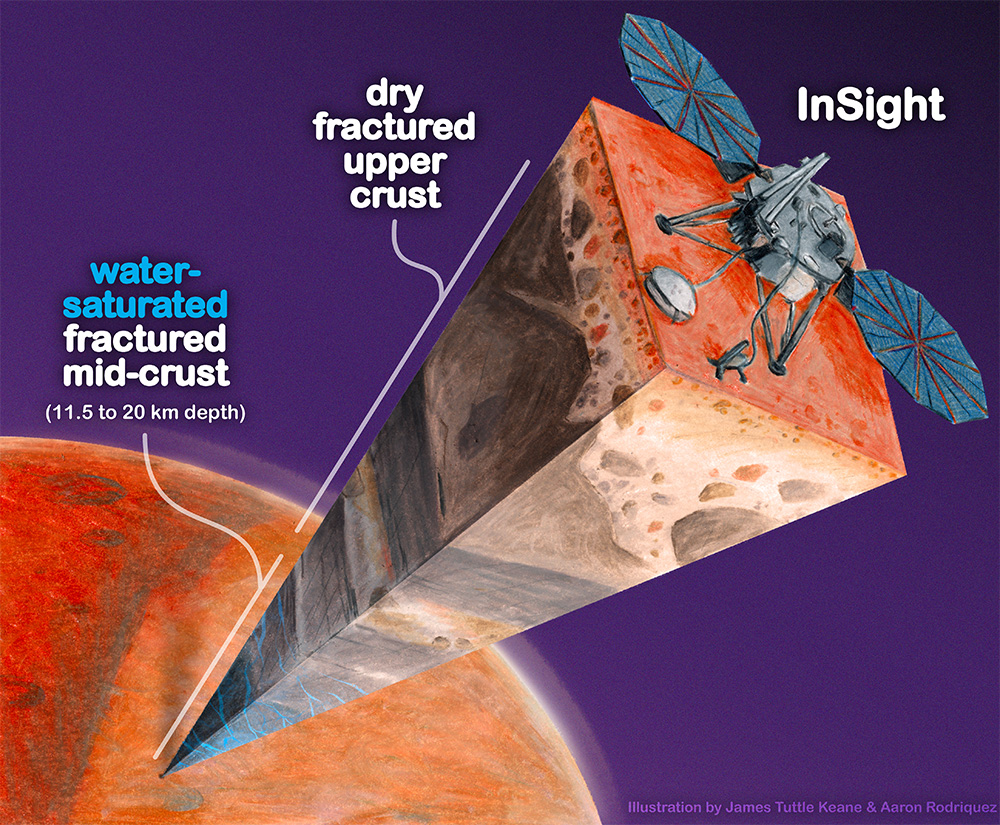
An artist’s illustration of NASA’s INterior Exploration Using Seismic Investigations, Geodesy and Heat Transport (InSight) lander on Mars (active: 2018-2022), which attempted to give the planet its first thorough check up since it formed 4.5 billion years ago. In particular, the mission sought to understand the planet’s interior composition and monitor things like tectonic activity (marsquakes), meteorite impacts, study how much heat is still flowing through the planet, and track Mars’ wobble as it orbits the Sun. Credit: NASA/JPL

The subject of water on Mars has been a topic of scientific debate and speculation for well over 100 years. Since the earliest reliable observations of Mars via telescope, it had been thought that water ice and water vapour existed on the planet and in its atmosphere as a result of the seeing the polar ice caps (although we now know the major stakeholder in these is carbon dioxide) and cloud formations.

However, the idea that Mars was still subject to liquid water flowing across its surface in our modern era became popularised in the late 1800s. In  1877, respective Italian Astronomer  Giovanni  Schiaparelli – already noted for his observations of Mars in which he correctly identified and named multiple visible surface features – used the Great Opposition of 1877 (when Mars and Earth were both on the same side of the Sun relative to one another and Earth was effectively “overtaking” Mars in their respective orbits, thus bringing the two into “close” proximity to one another) to carry out further observations. During these he noted the presence of multiple canali  on Mars.

One of Schiaparelli’s 1877 surface maps of Mars. Note the looping canali (“channels”) he thought he observed in the northern hemisphere of the planet, and which he saw as entirely natural phenomena, although most were later shown to be optical illusions / the misidentification of other features. Credit: Public domain

Canali is an innocent term, meaning “channel”, and Schiaparelli simply used this term to differentiate what he thought is saw from other features he observed. But in English-speaking newspapers it was later translated as canals, evocative of artificial and intelligent construction. This resulted in wealthy Bostonian businessman Percival Lowell, following his return to the United States in the early 1890s to establish an observatory in Flagstaff, Arizona, specifically (initially at least) so he could observe these “canals” for himself.

Over the course of 15 years (1893-1908), Lowell saw his canals, which grew into a globe-spanning network and led to the publication of three books (Mars (1895), Mars and Its Canals (1906), and Mars As the Abode of Life (1908 – an original copy of which I actually own!) in which he expounded his theory that Mars had a network of canals built by an ancient civilisation in a last-ditch effort to carry liquid water from the planet’s poles to their equatorial and temperature cities as the planet increasingly became more desert-like.

A manuscript globe of Mars made by Danish amateur astronomer, Emmy Ingeborg Brun, presenting an image of Lowell’s network of Martian “canals” (together with the names he assigned individual “canals”), and made by combining sketches of his observations and which were published in Mars and Its Canals (1906), and Mars As the Abode of Life (1908). Credit: Royal Greenwich Observatory

Lowell stuck to this belief throughout his observations in spite of increasing scientific evidence that Mars was likely incapable of supporting liquid water on its surface and observations from other observatories with larger telescopes than his which could not find any evidence of “canals”, and that at least some of what he was seeing was actually (as Schiaparelli had believed) lines of demarcation between different elevations / terrains.

As a result of this belief, Lowell has become regarded as a bit of a crackpot  – which is a same, as he led a remarkable life with multiple achievements as a traveller, diplomat, writer and armchair scientist, and did gain recognition in his lifetime for his work – He was elected a Fellow of the American Academy of Arts and Sciences in 1892 and then to the American Philosophical Society in 1897, whilst the volume of work he carried out as an astronomer outside of his theories about Mars saw him receive the Prix Jules Janssen, the highest award of the Société Astronomique de France, in 1904.

Lowell pictured in 1914 seated at the 61-cm (24-in) Alvan Clark & Sons refracting telescope at the Lowell Observatory, Flagstaff, Arizona, as he observes Venus. Credit: Unknown and reconstructed

This volume of work include daytime studies of Venus and the search for “planet X”, a planetary body believed (and still believed by some) to be orbiting the Sun far out beyond the orbit of Neptune. In fact, the Lowell Observatory became a centre for this work, for which it was rewarded in 1930 when Clyde Tombaugh located Pluto using the observatory’s telescopes and equipment.

Of course, whilst liquid water does not exist on the surface of Mars today and hasn’t for billions of years, we have found plenty of evidence for its past presence on the planet’s surface.

In my previous Space Sunday article, for example, I wrote about the Great Lake of Mars, Lake Eridania, whilst both the Mars Science Laboratory Curiosity and Mars 2020 rover Perseverance have literally been following the evidence for free flowing water in both of the locations on Mars they are exploring. Prior to them, the Mars Exploration Rovers Spirit and Opportunity both uncovered evidence of past liquid water on Mars, as have orbital vehicles from NASA, Europe and other nations. But the two big questions have always been – where did it go, and where did it come from?

In terms of where it went, the most common theories are that the water either evaporated and was lost to space along with Mars’ vanishing atmosphere relatively early in the planet’s life or retreated down into the Martian crust where it froze out into icy “reservoirs”. The first is likely for a certain volume of water, whilst subterranean tracts of water ice have been located not too far under the surface of Mars. However, the latter cannot possibly account for the amount of water believed to have existed on the surface of Mars in its early history, not could simple evaporation account for the disappearance of to greater majority of it. So where did the rest go? And where did it come from originally?

Well, in a new report published this month a team of scientists believe they have the answer, and it lay within data obtained by NASA’s InSight (INterior exploration using Seismic Investigations, Geodesy and Heat Transport) lander.

This ambitious craft landed on Mars in 2018, with the mission running from November of that year through until the end of December 2022. In particular, the lander carried with it two unique instruments it deployed onto the Martian surface using a robot arm. One of these was the French-lead Seismic Experiment for Interior Structure (SEIS), designed to measure marsquakes and other internal activity on Mars and things like the response to meteorite impacts, in order to better understand the planet’s internal structure. The data continues to be studied, and has revealed much about the planet’s internal structure and its history.

Most recently, a US team from the Scripps Institution of Oceanography at the University of California, San Diego and the University of California, Berkeley, have been reviewing the SEIS findings specifically to try to answer the question of where the water went. In particular, they have been using mathematical models employed here on Earth to locate aquifers and oil and gas fields deep underground. By adjusting the models so they provided results consistent what is largely known about the Martian crust down to a depth of several kilometres below the surface, they ran a series of passes on data gathered from deeper and deep within the planet’s crust, In particular, the came across two interesting results. The first indicated that while deposits of water ice do exist below the surface of Mars, and less than 5 km from the surface, they are likely to be far less commonplace than had been thought. The second result they took note of was consistent with those indicative of layers of water-saturated igneous rock deep within the Earth’s crust.

Most interestingly, the results of the SEIS data modelled suggest this deep layer of rock and water – laying some 11.5 to 20 km below the surface of Mars could be widespread across the planet to the extent that it could contain more water than would have been required to fill the oceans and seas of ancient Mars.

Taken together, these result indicate that while the theories about water on Mars being lost to space or frozen into subsurface ice are still valid, the vast majority of the water most likely retreated deep down into the planet, possibly returning to the reserves from which it might have originally burst forth to flood parts of Mars during the planet’s late Noachain / early Hesperian period of extreme volcanic activity.

A “core sample” of the Martian interior beneath NASA’s InSight lander from the Scripps / UC Berkeley study. The top 5km of the crust appear to be dry, with limited large-scale deposits of water ice, while a water-saturated zone of fractured rock lies some 11.5 to 20 km below the surface. This is believed to by a widespread layer within the crust, potentially containing more liquid water than the volume believed to have been present in ancient Martian oceans. Credit: J Tuttle; Keane and Aaron Rodriquez, via Scripps Institution of Oceanography

One intriguing question that arises from this work is related to the potential for Mars to have harboured life, and what happened to it as the water vanished. if the modelling in the study is correct, and the water did retreat deep under the surface of Mars and form aquifers and pools with the rocks there, did any ancient microbial life gone with it, and if so – might it have survived? The pressure and temperatures at the depth which the water appears to reside would keep it both liquid and warm and provide energy, as would mineral deposited within the rock; so the question is not without merit.

Establishing that there is a big reservoir of liquid water provides some window into what the climate was like or could be like. And water is necessary for life as we know it. I don’t see why [the underground reservoir] is not a habitable environment. It’s certainly true on Earth — deep, deep mines host life, the bottom of the ocean hosts life. We haven’t found any evidence for life on Mars, but at least we have identified a place that should, in principle, be able to sustain life.

– Michael Manga, Professor of Earth and Planetary Science, UC Berkeley

But the is a question that’s unlikely be to answered any time soon. Determining if the environment is at the very least amenable to life, much less actually finding evidence for life within it – or even simply reaching any of the water deposits –is going to be pretty much impossible for a good while yet. Current deep drilling techniques here on Earth for extracting oil and gas only go down to around 2 km; getting that sort of equipment to Mars and enabling it to dill down at least 11-12 km will pretty much remain the stuff of dreams for a good while to come.

 JUICE to Swing by the Moon and Earth

The European Jupiter Icy Moons Explorer (JUICE) mission will be making a first-of-its kind fly-by of the Moon and Earth this week, the first in more than 5 gravity assist manoeuvres the vehicle will make (excluding those made while orbiting Jupiter) during its mission to study the icy moons on the Jovian system.

An artist’s impression of ESA’s Juice mission approaching the Jovian system in 2031. Credit: ESA

Such manoeuvres are often used with space missions and for a variety of reasons. With JUICE, it means the craft could be flown into space using a medium-lift launch vehicle and make (and albeit relatively sedate) flight to Jupiter, involving a total of three fly-bys of Earth and one of Venus to accelerate it to a peak velocity of 2.7 km per second using the minimum of fuel and then slingshot it out to a point in space where it will intercept the Jovian system, and they use further flybys of the planet and its Moons to both slow itself down into orbit around them and then adjust its course so it can study the icy moons of Jupiter – GanymedeCallisto, and Europa.

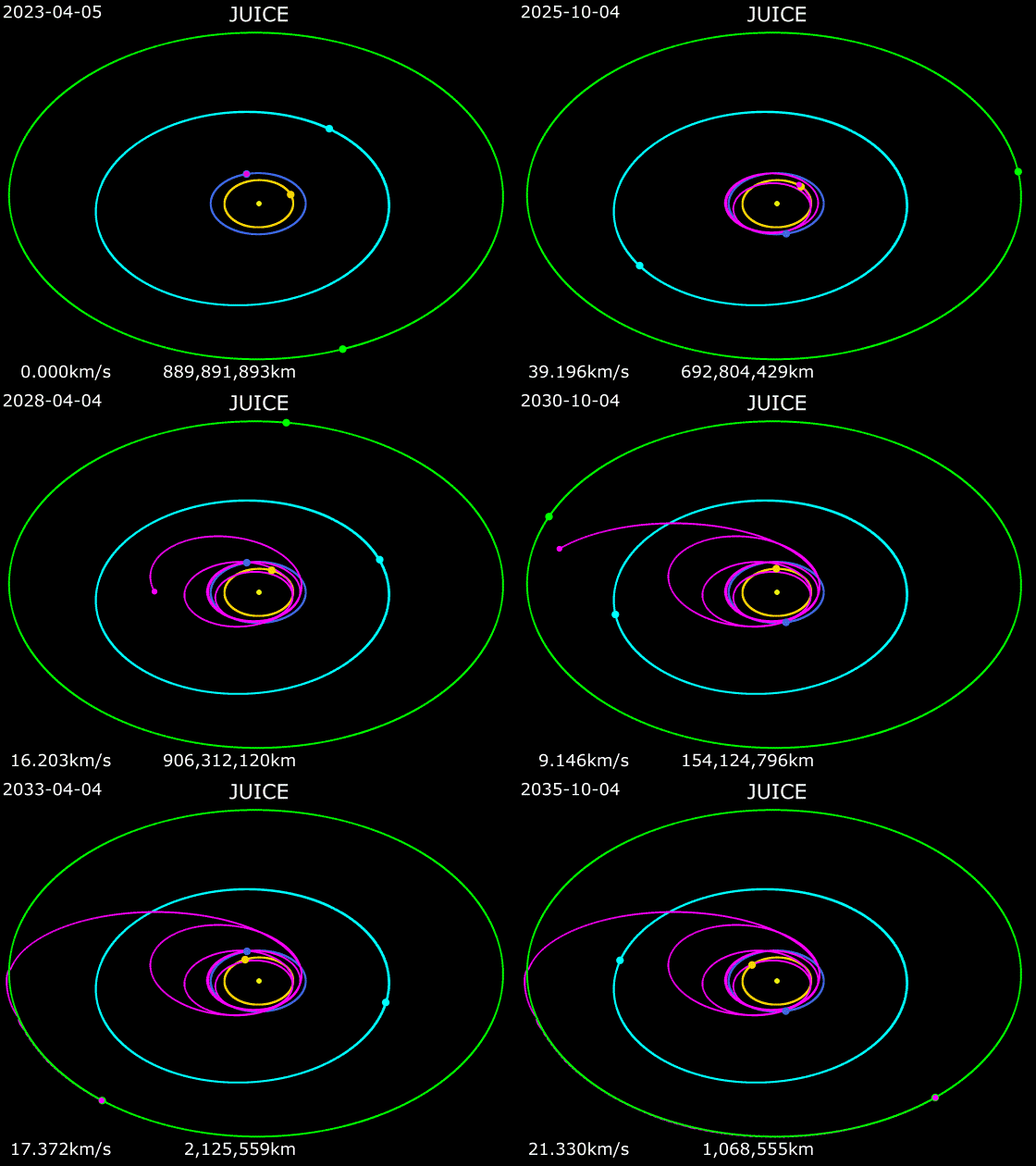
This first fly-by comes 16 months since the launch of the vehicle, and will be the very first Earth gravity assist which also employs the Moon as a critical component. On August 19th, Juice will as around the Moon at a distance of just 700 km (reaching the altitude at 21:16 UTC), using the Moon’s gravity to swung it onto a trajectory that will see it pass by Earth just over 24 hours later, passing over north-eastern Asia and the Pacific at an altitude of just 6,807 km on the morning of August 20th (local time) before heading back out to loop around the Sun. After this it will get a further gravity assist from Venus in August 2025 and then two more from Earth (without the Moon helping) in 2026 and 2029, that latter of which will  slingshot the vehicle on it way to rendezvous with Jupiter and its moons.

An animated GIF showing Juice’s flightpath as it loops around the inner solar system (2023-2029 – Yellow= Venus; blue = Earth) prior to gain the velocity required to slingshot out to intercept Jupiter, passing by way of asteroid 223 Rosa (teal). Credit: Phoenix777, using NASA HORIZONS system data, via Wikipedia

On August 15th, Juice briefly caused a stir when it was mistaken as a near-Earth object (NEO) on a potential collision course with Earth. At 27 metres across, most of which is some 85 square metres of solar arrays, Juice is a strong reflector of sunlight, and this briefly confused systems at the ATLAS Sky Survey, Hawai’i, which attempts to locate, identify and track potentially threatening NEOs. However, the system’s confusion was quickly identified as actually being the Juice spacecraft and the alert corrected.

This was actually the second time an ESA deep-space vehicle has been mistaken as a hazardous NEO; in November 2007, and as it approached Earth for a flyby, Europe’s Rosettta mission spacecraft  – also with a large span of solar arrays – was also briefly mis-identified as a NEO on a possible collision course with Earth. On that occasion, it was mis-identified by a human observer, and further manual checking was required before it was confirmed the object being tracked was actually the Rosetta spacecraft and not of any threat to Earth.

Following its arrival at the Jovian system, Juice will spend 1259 days orbiting the system, the majority of which will be in Jupiter-centric orbits that will allow it to study Ganymede, Callisto and Europa, with numerous gravity-assists of both Ganymede and Callisto used to alter its trajectory and velocity, allowing it to study them from different orbital inclinations and also to dip down into the inner Jovian system to study Europa.

However, the final 284 days of the time (from early 2035) will be spent in a dedicated orbit around Ganymede, allowing the spacecraft to complete some 6 months of dedicated studies of the moon once it has settled into a 500 km circular orbit around Ganymede. By the end of 2035, the spacecraft is expected to have expended the last of its 3 tonnes of manoeuvring propellants, bringing the mission to an end. without the ability to manoeuvre, Juice is expected to quickly fall victim to further Jupiter gravitational perturbations and crash into Ganymede within weeks of running out of propellants.

Space Sunday: observatories, rockets and capsules

An artist’s impression of the Chandra X-Ray Observatory orbiting Earth. Credit: NASA

Twenty-five years ago, on July 23rd, 1999, the Chandra X-Ray Observatory was launched aboard the Space Shuttle Columbia as a part of STS-93. At the time of its launch, it was the third of NASA’s four Great Observatories, the other three being the Hubble space Telescope (HST), launched in 1990; the Compton Gamma Ray Observatory (1991–2000) and the Spitzer Space Telescope launched after Chandra, in 2003 and operating through until 2020.

Originally called the Advanced X-ray Astrophysics Facility (AXAF), Chandra can trace its history back to the mid-1970s. Originally intended for operations in an orbit similar to that of Hubble, thus making its servicing and upgrade possible using the space shuttle, the observatory went through various design changes during the 1980s and 1990s, with its overall mission being redefined in 1992. This saw Chandra have four of it planned 12 mirrors eliminated from the telescope, together with two of the six planned science payloads. To compensate for this, the telescope’s mission was revised so that it could be placed in an orbit well above Earth and well clear of the planet’s radiation belts, allowing it to have a clearer view of deep space.

The Chandra X-ray observatory, wrapped it its thermal protection blanket, attached to its IUS space launcher, images from the space shuttle Columbia shortly after the latter had deployed them from its payload bay, July 23rd, 1999. Credit: NASA

Renamed in 1998 in honour of Nobel Prize-winning astrophysicist Subrahmanyan Chandrasekhar, Chandra was deployed from Columbia’s payload the same day as it launched, attached to a 2-stage Boeing  Inertial upper Stage (IUS) space launch system. Together, they represented the heaviest payload ever carried to orbit by the shuttle system, massing 22.75 tonnes.

Once the shuttle had moved to a safe distance, the IUS first stage fired for 125 seconds, boosting Chandra away from Earth (and beyond any capacity for it to be upgraded or serviced), followed by a 117-second burn of the IUS upper stage motor. The later placed Chandra into a geocentric orbit with a perigee some 14,307.9 km from Earth and an apogee of 134,527.6 km, roughly one-third of the way to the Moon.

Following a short period of commissioning, Chandra started returning data to Earth within a month of launch, and has continued to do so almost without interruption through to 2024 – although its primary mission period was placed at a conservative 5 years. Through this time, only one system on board has suffered significant damage, but it is still operational alongside the other science instruments, and only one significant glitch – lasting three days in October 2018 – when the observatory entered a safe mode as a result of a short-term issue with one of the gyroscopes used for pointing it at targets and holding it steady during observations. All science functions were fully restored once the issue had been resolved.

Chandra X-Ray Observatory diagram. Credit: NASA Chandra Space Centre

Over the years, Chandra’s import and discoveries have tended to be overshadowed by Hubble and, more recently, the James Webb Space Telescope (JWST). These have included the first observations of a “mid-sized” black hole, claimed to be the “missing link” between stellar-sized black holes and the super massive black holes found at the centres of galaxies; making one of the most accurate measurements of the Hubble constant; observing the most massive X-ray flare yet recorded from the super massive black hole Sagittarius A* (pronounced “Sagittarius A star”) at the centre of our galaxy; and making possibly the first observation of an object (possibly an asteroid) crossing the black hole’s event horizon; and also making potentially the first indirect observations of an exoplanet in another galaxy.

In additional to all of this, Chandra has supported Hubble in making significant observations of the planet and dwarf planets and moons in our own solar system, and also like Hubble, has benefitted the work of early career researchers, helping them to become established in the fields of astronomy, astrophysics and space science.

To mark Chandra’s 25th anniversary, NASA has issued a wallpaper featuring 25 of Chandra’s most stunning images captured in the X-ray wavelengths. The official announcement of the images can be found on the Chandra website, and the images are previewed in the video below, as well as being available for download as a wallpaper mosaic for computers.

Sadly, the celebration is a potentially bitter-sweet affair. Currently, Chandra has the ability to remain operational for at least another decade – possibly long enough to see the European Space Agency launch what might be seen as its successor, the Advanced Telescope for High-ENergy Astrophysics (Athena), which is due to be launched sometime in the early-to-mid 2030s. Unfortunately, this is may not now be the case; Chandra could cease operations within the next 12 months.

The reason for this is that NASA’s space science budget is being tightly squeezed, largely as a result of the rising costs associated with Project Artemis and returning humans to the surface of the Moon. In 2024, the space science budget had been due to get a US $500 million boost. Instead, Congress actually cut it by that amount. For 2025, Congress is looking to cut NASA’s space science directorate’s budget by almost US $1 billion.

Cassiopeia A, a supernova remnant 11,000 light-years away, imaged in X-ray & Infrared light, with the x-ray image produced by Chandra. Credit: NASA / ESA / CXC

As a result NASA has been looking at programmes to cut – and Chandra has been one to top the lists, with NASA management suggesting its US $67 million budget could be cut by 40%. The reaction to this was swift, with those managing Chandra both from within and without NASA pointing out that a cut that large would effectively end Chandra’s science mission forthwith. Thus, in an attempt to find some middle ground that would allow both Chandra and Hubble to continued to be operated, various ideas were put forward as to how Chandra’s costs could be reduced and / or how both the Chandra and Hubble science missions could be redefined, in order to allow both to continue for the next few years.

In response to this efforts, NASA authorised an Operations Paradigm Change Review (OPCR) to look at all of the suggested options and make a determination on their viability to reduce costs. The findings of this review were presented on the very day of the 25th anniversary of Chandra’s launch, during a meeting of the Astrophysics Advisory Committee, or APAC, the body, chartered to provide advice to NASA’s astrophysics programme. And the news was not good.

Having reviewed all the options weighted the costs and saving, the OPCR has essentially concluded that while they believe Chandra could be operated a a budget smaller than its present allocation, it would still require funding beyond what the new science directorate budget can afford – at least not without putting programmes and missions outside of it and Hubble at risk. Therefore, it may not be feasible for Chandra to continue from 2025 onwards.

When a massive star exploded in the Large Magellanic Cloud LMC), a satellite galaxy to the Milky Way, it left behind an expanding shell of debris called SNR 0519-69.0. This image shows a composite of the debris gas field using Chandra to reveal the multimillion degree gas cloud (blue) and Hubble to reveal the expanding edge of the explosion (red) and the stars of the The outer edge of the explosion (red) and stars of the LMC. Credit: NASA / STScl / CXC

The OPCR findings drew some frustration from APAC members, in part because APAC was itself excluded from any involvement in the OPCR process and was not given the opportunity to review the report ahead of the announcement. In response, OPCR members stated the review had to be handled on a short-term turn-around so that if a way forward could be identified and which offered a reasonable compromise on costs, it had to be published rapidly, so as to allow NASA and the agencies responsible for both Chandra and Hubble (the Chandra X-Ray Centre and Space Telescope Science Institute) to assess the overall feasibility ahead of staff layoffs across both programmes that are due to commence in September 2024.

The report does not automatically seal Shandra’s fate, options may yet arise where it is allowed to continue – such as through the support of one or both of the houses in Congress – but right now, it does make Chandra’s future appear to be grim.

SpaceX Resumes Starlink Flights with Falcon 9; Announces Dragon Splashdowns to Move back to US West Coast

In my previous Space Sunday article, I noted that SpaceX Falcon 9 flights were suspended pending the results of a Federal Aviation Administration (FAA) Mishap Investigation relating to the loss of a Falcon 9 upper stage and its Starlink payload during a July 11th/12th launch.

On July 25th, SpaceX announced the root cause of the loss had been traced to fatigue causing a a crack in a redundant “sense line” in the upper stage, resulting in “excessive cooling” of engine components, causing the rocket motor to fail. A near-term fix – removing the redundant line – has been identified pending a more in-depth fix, and this has been enough for the FAA to clear Falcon 9 to resume commercial launches. As a result, on July 27th, a Falcon 9 lifted-off from Kennedy Space Centre’s Launch Complex 39A, carrying 23 of the company’s own Starlink satellites.

One Falcon 9 stands on the pad at Space Launch Complex 40 while another lifts off from nearly by Launch Complex 39A early July 27th, 2024, marking the resumption of non-NASA related Falcon 9 launches. Credit: SpaceX

Whilst successful, the flight does not mean Falcon 9 flights to the International Space Station will necessarily immediately resume. NASA still plans for a “rigorous certification” of Falcon 9 and the software associated with the sensor to which the sense line had been connected, once SpaceX has completed all modifications to the upper stage of the vehicle. As such, the agency is not committing to going ahead with the launch of the 4-person Crew 9 mission to the ISS, due to lift-off on August 18th, 2024. However, whether this also means the planned launch of an automated Cygnus resupply vehicle to the station due on August 3rd remains on hold, is unclear; NASA’s had previously indicated all Falcon 9 flights to the ISS would be suspended pending re-certification, but following the July 27th launch, the agency specifically only mentioned the Crew 9 flight.

In a separate press release, SpaceX has indicated it will be switching Dragon splashdowns to off the west coast of the United States from 2025 onwards, rather than bringing them down off the Florida coast.

The decision is in the wake of significant pieces of debris from the Dragon vehicle’s trunk (effectively the power and propulsion “service module”) surviving re-entry into the denser atmosphere to fall to ground in places as wide apart as Australia, North Carolina and Saskatchewan. The change means that from 2025, instead of being used in the initial de-orbit burn and and then jettisoned from the Dragon capsule, which then performs its own final de-orbit burn, leaving the trunk to decay in its orbit and later re-enter the atmosphere a burn up, dragon vehicles will remain attached to the trunk throughout both de-orbit burns, with the trunk being jettisoned just before both reach the re-enter interface.

This means the the capsule and trunk will come down over the Pacific Ocean, rather than passing over the North American continent, with any trunk debris surviving its re-entry hitting the water somewhat up-range from where the capsule will splash down under parachutes.

Boeing Starliner Remains at ISS Amidst More Media Alarmism

The past week saw NASA provide an update on the Boeing Starliner situation, in which the CST-100 Calypso remains docked at the International Space Station, where it has been for some 50 days, despite the first planned crewed flight of the vehicle only being intended to last some 6 days in total following its launch in early June 2024.

As noted previously in these pages, issues occurred during the vehicle flight to the ISS, when it suffered a series of thruster failures – an issue that has been dogging the Starliner programme for some time. While the vehicle, carrying astronauts Barry “Butch” Wilmore and Sunita “Suni” Williams managed to safely docked with the ISS, its return has been repeatedly delayed leading to highly inaccurate references in the media and on social media to the idea that Wilmore and Williams are somehow “stranded” in space.

A time-lapse photograph of the CST-100 Starliner Calypso docked at the International Space Station as both orbit the Earth. Credit: NASA

This is far from the case, again as I noted as recently as June 30th (see: Space Sunday: of samples and sheltering); the delays have been purely to allow Boeing and NASA to conduct further comparative tests between systems on the ground and those aboard the Starliner docked at the ISS to better understand precisely where the issue lies. These tests are necessary inasmuch as the service module of the vehicle – which is home to the problematic thruster systems –will not be returning to Earth, but will burn-up in the atmosphere when Calypso does eventually make its return. Ergo, keeping it in space and carrying out these tests is the only means of verifying the findings of on-going Earthside investigations.

With further tests taking place over the weekend of July 27th/28th, both NASA and Boeing believe they are honing into on the root cause. Starliner has four clusters of thrusters gathered around the outside of the service module. These clusters, comprising a mix of four larger orbital manoeuvring and attitude control (OMAC) thrusters and smaller reaction control system (RCS) thrusters (28 in total, of which only one has completely failed) are housed in protective units call “doghouses”. Both the OMACs and RCS units are required during flight operations, often firing in sequence.

What appears to be happening is that under orbital conditions, pulse-firing the RCS thrusters (a rapid series of short, sharp burst of firing) immediately following the use of the OMACs thrusters in a doghouse can cause the temperatures inside the unit to rise well above anticipated levels. This causes the helium purge valves to leak, causing problems.

Boeing’s Starliner capsule is seen docked to the International Space Station in this zoomed-in and slightly pixelated view of an image captured by Maxar Technologies’ WorldView-3 satellite on June 7th, 2024. Credit: Maxar Technologies

Because of this, engineers, together with Wilmore and Williams, have been looking to make operational changes to how the OMCS and RCS system are used – such as by reducing the number of pulses the RCS makes when fired, or by reducing the number of times OMACs and RCS need to be fired either individually or in sequence, thus preventing the temperature spikes within the doghouse units.

During the update, NASA clearly stated that if the July 27th/28th tests yield good results, then an agency-level review on clearing Starliner for a return to Earth could take place within a week of the test results being confirmed. However, this still didn’t stop some media continuing to report Wilmore and Williams as continuing to be “stuck” or “stranded” in orbit, because drama maketh the headline.

Space Sunday: of “planet” and planets

Celestial bodies from our solar system and beyond – although technically, only two meet the current IAU definition of the term “planet”. Credit: NASA

What is a “Planet”? This might sound like a catch question, but in fact it has been the cause for debate for almost two decades at least, and its roots go back as far as – wait for it – 1801.

Up until the start of the 21st century, everyone was reasonably comfortable with the idea of what a planet was: we’d discovered a total of nine making their way around our star over the previous centuries, including the somewhat oddball Pluto. The general (and informal) agreement was that a “planet” was that of a large, roundly spheroid / round object moving in an orbit around the Sun.

Then, in 1801 Ceres was discovered. Whilst tiny by comparison to the like of our Moon, it was nevertheless almost circular in shape and bumbling around the Sun in its own orbit. Hence, many argued, it was a planet – that in fact it was the so-called “missing planet” believed to exist between Mars and Jupiter. However, by 1851 the discovery of yet more bodies within this region of space had pushed the total number of “planets” in the solar system to 23; the eight large planets of Mercury through Neptune, and all these “little” planets, many of which weren’t entirely circular in shape (but others, like Juno, Vesta and Pallas) came pretty close. It was also clear the number was liable to keep on growing.

Thus, astronomers started cataloguing these smaller bodies in their own right and, effectively, the idea of the asteroid belt was born, with Ceres becoming the first asteroid within the belt to be discovered. Problem solved; not even Clyde Tombaugh’s discovery of Pluto in 1930 didn’t upset this approach too much, nor the definition of “satellite / moon”. But then in 1978, someone had to go and find Pluto’s Moon Charon, a body so large, it broke the traditional view of a “moon”, coming close to being a twin planet to Pluto. Then, in 2005, Eris was discovered, and the wheels really started coming off the wagon.

Whilst two other relatively large, “planet-like” Kuiper Belt bodies had been discovered orbiting the Sun – Quaoar (2002) and Sedna (2004) – prior to Eris, they were comparatively small and easy to lump into the “asteroid” container alongside Ceres. But Eris turned out to be around the size of Pluto, and more massive; so, either it was a planet (and was actually referenced the “tenth planet” of the solar system immediately following its discovery) – or Pluto wasn’t a planet. Cue astronomical bun fight.

Planets, dwarf planets, satellites, oh my! Credit: M. Özgür Nevres

The fight between classifying Eris as a planet or downgrading Pluto to “not a planet” became quite heated relatively quickly, prompting much debate within the International Astronomical Union (IAU) which wrestled mightily with the question of how all the various celestial bodies in the solar system should be formally classified – starting with was should be meant by “planet”.   In the end, and possibly fearful of the sudden blossoming of planetary bodies within the Kuiper Belt following the discovery of Eris, as had been seen 200 years ago with the asteroid belt following the discovery of Ceres, in 2006 the IAU settled on the side of downgrading Pluto’s status from “planet” to “dwarf” planet.

In doing so, the organisation also sought to ratify the term “planet”, eventually settling on three criteria, published under what id now referred to as Resolution 5B, as found within GA26-5-6. Clause 1 of which holds:

Is it a dwarf planet? A TNO? A Plutoid? An Euler Diagram showing the IAU Executive Committee conception of the types of bodies in the Solar System during the 2006 General Assembly. Credit: Holf Weiher

A planet is a celestial body that:

  • is in orbit around the Sun;
  • has sufficient mass so as to assume hydrostatic equilibrium (aka “a round shape”);
  • has “cleared the neighbourhood” around its orbit.

The decision caused (and still causes) a lot of emotional upset where Pluto is concerned, and this masked a potentially bigger issue with Resolution 5B-1: be defining a planet and a “celestial body orbiting the Sun”, it immediately excluded the term being formally used with regards to planets orbiting other stars.

Oops.

In fairness, while astronomers have been locating exoplanets since 1992, by the time the IAU arrived at their definition in 2006 the number discovered was measured in the handful, so considering them didn’t really factor into the IAU’s thinking. Since then, of course, things have changed dramatically: we’re fast approaching 6,000 planets known to be orbiting other stars.

Again, being fair to the IAU, they did try to address the issue of exoplanets (the term simply means planet outside the solar system, rather than having any meaningful definition) in 2018. However, the effort never got beyond the “working” phase. In fact, the 2018 discussions revealed that even when applied to just the solar system, Resolution 5B-1 was pretty woolly and unquantifiable; something better was needed. Things weren’t much better by the time of the next IAU General Assembly in 2021.

Potentially, the best way to offer a properly unquantifiable definition for planets wherever they might be found, do this is via mathematical modelling, removing any subjectivity from how both the term and planets are defined.

This is precisely what a team from the USA and Canada has attempted to do. AS they note in their study, published in The Planetary Science Journal, they sought to break down the the potential taxonomy of planetary bodies – both solar and extra-solar – in terms of critical physical characteristics: mass, density, etc., local dynamical dominance within their orbits, the bodies they orbit (single stars, brown dwarfs, binary systems, etc.). Using mathematical models to quantify these measures, they have been able to show that celestial bodies tend to fall in to distinct clusters, and this has enabled them to develop a far more quantifiable definition of the term “planet”, thus:

A planet is a celestial body that:
a.       Orbits one or more stars, brown dwarfs or stellar remnants and
b.       Is more massive than 1023 kg and
c.       Is less massive than 13 Jupiter masses (2.5 x 1026 kg)

This definition is due to be presented at the 32nd IAU General Assembly being held in Cape Town, South Africa in August. If adopted, it will establish a meaningful framework by which planets, dwarf planets and natural satellites – wherever they might be found – can be quantitatively defined in  manner that could objectively, rather than subjectively, help shape our understanding of the universe and our place in it.

VIPER Cancelled

On July 17th, NASA announced it has cancelled its Volatiles Investigating Polar Exploration Rover (VIPER) mission due to cost increases and schedule delays.

Roughly the size of a golf cart (1.4m x 1.4m x 2m), VIPER was a relatively lost-cost (in the overall scheme of things) rover charged with an ambitious mission: to carry out extensive prospecting the permanently shadowed areas of the Moon’s South Polar Region, seeking resources and mapping the distribution and concentration of water ice. However, the project has been repeatedly hit by delays and increasing costs, both with the rover (built by NASA) and its Griffin lander vehicle, supplied by commercial space company Astrobotic Technology Inc., and which was due to fly with additional payloads to the rover.

VIPER (Volatiles Investigating Polar Exploration Rover) was to be robotic lunar rover tasked to prospect for natural lunar resources within a permanently shadowed region near the lunar south pole. Rendering credit: NASA

In 2022, these delays resulted in the mission being pushed back to a late 2024 launch date from a planned 2023 date. This was then further pushed back to September 2025. At the time this decision was made, the overall cost for the rover had risen from US $250 million to US $433.5 million and would likely exceed US $450 million by the 2025 launch date. More recently, a review found that whilst the rover is largely completely, it has yet to undergo environmental testing and still lacked proper ground support systems, noting that delays with either of these could quickly eliminate any chance of meeting the 2025 launch date and push the costs up even further.

At the same time, the cost to NASA for the development of the Griffin lander has risen by over 30% (from some US $200 million to US $323 million). These are likely to rise even further as a result of NASA’s requested additional testing of the lander in the wake of the January failure with Astrobiotic’s smaller Peregrine One lunar lander, test which could have also impacted the lander’s readiness for a 2025 launch.

VIPER being assembled in a clean room at NASA’s Johnson Space Centre, Texas. Credit: NASA

The problem here is that the VIPER mission can only be launched at certain times in order to capitalise on favourable lighting conditions in its proposed landing zone; any delay beyond November 2025 for mission launch would therefore mean the mission could not take place until the second half of 2026. As a result, overall costs for the mission could be nudging US $1 billion by the time it is launched. Given NASA’s overall science budget for 2025 has already been tightly constrained by Congress, this was seen as unacceptable by the review board, as it potentially meant putting other missions at risk. Ergo, the decision was made to cancel VIPER.

That said, the Griffin lander flight to the Moon will still go ahead with NASA support, allowing it to fly its planned commercial payloads, together with a payload simulator replacing the rover. In addition, NASA is also seeking to get the rover to the Moon by offering it to any USA company and / or any of NASA’s international partners willing to fly it to the Moon at their own cost. If no such offers are received by August 1st, 2024, then the rover will be dissembled and its science instruments and other components put aside for use with other missions.

NASA Confirms Use of SpaceX for ISS Deorbit Whilst Suspending  Falcon 9 Station  Launches

On July 17th, 2024, NASA supplied further information on the planned use of SpaceX hardware to de-orbit the International Space Station (ISS) when it reached its end of life in 2030, whilst simultaneously effectively suspending SpaceX launches to the space station pending its own review of Falcon 9 following the recent loss of a Falcon 9 upper stage and its payload.

NASA originally awarded the contract for the United States Deorbit Vehicle (USDV) – the vehicle that will physically de-orbit the ISS – was awarded to SpaceX on June 26th, 2024 with little in the way of specifics, other than NASA aimed to obtain the vehicle for no more than US $843 million. In the more recent statement, NASA confirmed that SpaceX will provide NASA with an “enhanced” version of their Dragon vehicle, comprising a standard capsule with a lengthened “trunk” (the service module providing propulsion and power) equipped with a total of 46 Draco motors and 16 tonnes of propellants.

An artist’s impression of the enhanced SpaceX Dragon docked with the Harmony module on the International Space Station and using its Draco engines to de-orbit the station. Credit: SpaceX

Under NASA’s plans, the USDV will be launched prior to the final crew departing. At this point, the station’s orbit will be allowed to naturally decay to around 330 km, at which point the last crew will depart. The station’s orbit will then be allowed to decay for a further six months prior to the USDV being used to orient the ISS for re-entry in a manner that will see much of the station burn-up in the atmosphere, and what survives falling into the south Pacific.

The contract awarded to SpaceX is for the Dragon vehicle only, not for its launch or operation; on completion, the vehicle will be handed over to NASA to operate. However, given the 30-tonne mass of the USDV and the fact it is a Dragon vehicle makes the SpaceX Falcon Heavy a strong contender as a potential launch vehicle (unless superseded by the company’s Starship / Super Heavy combination by the time USDV is ready for launch).

In the meantime, NASA has suspended all Falcon 9 launches to the ISS pending their own reauthorisation review in the wake of the July 11th loss of a Falcon 9 upper stage and its payload of Starlink satellites.

That loss is already under investigation on behalf of the US Federal Aviation Administration, however, on July 17th, NASA confirmed it will carry out its own review once the FAA’s work in concluded, although preparations for upcoming flights – notably a launch of a Cygnus resupply vehicle via Falcon 9 due on August 3rd and the launch of the Crew 9 rotation due later in August – will continue.

Screenshot from the webcast of a SpaceX Starlink launch on July 11th, 2024, showing a build-up of white material on the upper stage of a Falcon 9 rocket. This is thought to be ice from a liquid oxygen propellant leak, and may have led to the loss of the vehicle. Credit: SpaceX

The suspension of operations is normal when a launch vehicle utilised by the space agency is involved, and NASA made it clear that none of the crew currently on the ISS are in danger or at risk of running out of supplies.

SpaceX has sought to limit the impact of the FAA investigation citing that given the fault occurred in the vehicle’s upper stage and when it was entering orbit, it posed no threat to public safety and so other launches should not be discriminated against as a result. However, NASA has indicated that even if the FAA agreed with SpaceX and allowed Falcon 9 launches to continue during the mishap investigation, the NASA suspension of operations would remain in place until such time as its own review has been completed.

Crew safety and mission assurance are top priorities for NASA. SpaceX has kept the agency informed as it works closely with the Federal Aviation Administration throughout the investigation, including the implementation of any corrective actions necessary ahead of future agency missions. NASA and its partners also will implement the standard flight readiness review process to ensure we fly our crew missions as safely as possible.

NASA statement on ISS-related Falcon 9 launches in the wake of the July 11 loss of a Falcon 9 upper stage