Space Sunday: of molecules, meteorites and missions

In 1996, amidst a huge fanfare which included a statement by then US President Bill Clinton, a team of researchers announced they had discovered evidence of past Martian microbial life within a meteorite called ALH84001, discovered in the Allen Hills of Antarctica in 1984.

The claim lead to a high degree controversy, with many scientists disputing the findings of the original team. While that discovery has never been conclusively disproved, it has never been verified, either. However, it has – alongside the controversial results from two of the Viking Lander experiments in the 1970s – encouraged teams researching the potential for microbial life on Mars to be cautious in their work.

So it was with a sense of excitement that on Thursday, June 7th, 2018, NASA announced that the Mars Science Laboratory (MSL) Curiosity rover has once again found potential evidence of both organic molecules and methane on Mars. The news came via two papers Organic matter preserved in 3-billion-year-old mudstones at Gale crater, Mars and Background levels of methane in Mars’ atmosphere show strong seasonal variations.

In the first paper, the authors indicate how Curiosity’s Sample Analysis at Mars (SAM) suite detected traces of methane in drill samples it took from Martian rocks in 2016. Once these rocks were heated, they released an array of organics and volatiles similar to how organic-rich sedimentary rocks do on Earth – where similar deposits are indications of fossilised organic life.

What is particularly exciting is the first paper indicates that the material discovered on Mars is similar to terrestrial kerogen, a solid organic matter found in sedimentary rocks. Comprising an estimated 1016 tons of carbon, Kerogen on Earth exceeds the organic content of all living matter on Earth by a factor of 10,000.

NASA’s Curiosity rover has discovered ancient organic molecules on Mars, embedded within sedimentary rocks that are billions of years old. Credit: NASA Goddard Space Flight Centre

Essentially, want happens on Earth is that organic material gets laid down within the sedimentary layers, then over the aeons, fluid flowing thought the rock initiates chemical reactions to break down the organic deposits until only the insoluble  kerogen is left. It has already been established that Gale Crater was once the home of several liquid water lakes, and also that perchlorate salt – particularly good at breaking down organics – is present on Mars. Hence why the discovery of the kerogen-like material on Mars is a cause for excitement – it could be a similar process to that seen on Earth is present.

While the team responsible for the styudy point out the material SAM has found is similar to an insoluble material discovered in tiny meteorites known to fall on Mars, that it might have formed naturally on the planet is somewhat strengthened by the fact Curiosity has previously confirmed Gale Crater contains the chemical building blocks and energy sources that are necessary for life. However, the legacy of ALH84001 urge caution when dealing with these findings from the rover, as one of the authors of the first paper explained.

Curiosity has not determined the source of the organic molecules. Whether it holds a record of ancient life, was food for life, or has existed in the absence of life, organic matter in materials holds chemical clues to planetary conditions and processes… The Martian surface is exposed to radiation from space. Both radiation and harsh chemicals break down organic matter. Finding ancient organic molecules in the top five centimetres of rock that was deposited when Mars may have been habitable, bodes well for us to learn the story of organic molecules on Mars with future missions that will drill deeper.

Jennifer Eigenbrode, co-author, Organic matter preserved in 3-billion-year-old mudstones at Gale crater, Mars

In the second paper, scientists describe the discovery of seasonal variations in methane in the Martian atmosphere over the course of nearly three Mars years, which is almost six Earth years. This variation was also detected by Curiosity’s SAM instrument suite over the 3-year period.

This image illustrates possible ways methane might get into Mars’ atmosphere and also be removed from it. Credit: NASA Goddard Space Flight Centre / University of Michigan

Water-rock chemistry might have generated the methane, but scientists cannot rule out the possibility of biological origins. Methane previously had been detected in Mars’ atmosphere in large, unpredictable plumes. This new result shows that low levels of methane within Gale Crater repeatedly peak in warm, summer months and drop in the winter every year.

This is the first time we’ve seen something repeatable in the methane story, so it offers us a handle in understanding it. This is all possible because of Curiosity’s longevity. The long duration has allowed us to see the patterns in this seasonal ‘breathing.’

Chris Webster, co-author, Background levels of methane in Mars’ atmosphere show strong seasonal variations

In 2013, SAM detected organic molecules in rocks at the deepest point in the crater. These more recently findings, gathered further up the slopes of “Mount Sharp” add to the inventory of molecules detected in the ancient lake sediments. Thus, finding methane in the atmosphere and ancient carbon preserved on the surface gives scientists confidence that NASA’s Mars 2020 rover and ESA’s ExoMars rover will find even more organics, both on the surface and in the shallow subsurface.

NASA Successfully Transfers Sample

Following my last two Space Sunday updates concerning attempts to resume the collection of rock samples using Curiosity’s drilling mechanism, the US space agency has indicated a successful transfer of material gathered within the rover’s hollow drill bit into the rover’s on-board science suite (which includes the SAM instrument referred to above).

The new drilling capability is referred to as Feed Extended Drilling (FED), designed to bypass a formerly critical, but at risk of failure, piece of the rover’s drill system called the drill feed mechanism. This mechanism also used to form a part of the means by which samples used to be transferred from Curiosity’s arm-mounted turret to the on-board science suite. As it can no longer be used, engineers instead determined the sample could potentially be transferred to the science suite by positioning the drill bit directly over the sample intake ports and then running the drill in reverse, causing the gathered sample to (hopefully) trickle backwards and into one of the hoppers.

Referred to as Feed Extended Sample Transfer, the approach was tested on May 31st, 2018, and successfully saw the transfer of part of a sample obtained on May 19th into the hopper serving the rover’s Chemistry and Mineralogy (CheMin) unit.

Curiosity’s drill bit (upper right) positioned over one of the sample inlets on the rover’s deck leading to the on-board science suite. This image was captured on May 31st, 2018 (Sol 2068) by the rover’s Mast Camera (Mastcam). Credit: NASA / MSSS

The approach had already been successfully tested on Earth, but there were concerns the thin, dry atmosphere of Mars might not produce the same results. There’s also a matter of balance. Previously, any sample gathered by the drill would pass through the rover’s CHIMRA sieving system, which helps ensure the right amount is transferred to the on-board instruments. Without this, transfers become a matter of judgement, as engineer John Moorokian explained following the transfer:

On Mars we have to try to estimate visually whether this is working, just by looking at images of how much powder falls out. We’re talking about as little as half a baby aspirin worth of sample.

John Moorokian, lead developer of the FEST delivery method

The problem here is, were too little materials transferred, and CheMin and SAM would not be able to provide accurate analyses, but transfer too much of the unsorted material, and it could either clog instruments or remaining unused, potentially contaminating measurement of future samples. So far, it appears the first attempt has succeeded, although it will still be a while before the outcome of any analysis is known.
Continue reading “Space Sunday: of molecules, meteorites and missions”
Space Sunday: drills, telescopes, pictures and doubts

In March I reported that NASA’s Mars Science Laboratory rover Curiosity had taken an important step in recovering its ability to drill into Martian rocks to collect samples. Now it looks like drilling operations could be resuming.

Use of the sample-gathering drill was suspended in December 2016, after problems were encountered with the drill feed mechanism – the motor used to extend the drill head between two “contact posts” designed to steady the rover’s turret during drilling operations. In particular, there was concern that continued use of the drill feed mechanism would see it fail completely, ending the use of the drill.

Since then, engineers have been trying to develop a means of using the drill without and reliance on the drill feed mechanism, and at the end of February 2018, a new technique was tested. Called Feed Extended Drilling, or FED,  it keeps the drill bit and head extended, and uses the weight of the rover’s robot arm and turret to push the bit into a target rock. This is harder than it sounds,as it requires the weight of the rover’s arm to provide the necessary pressure to help push the drill bit into a rock – something it is not designed to do, and might actually break the drill bit or cause it to become stuck. However, the rover passed the February test with flying colours.

This success meant that engineers could focus on recovering the drill’s percussive action. This assists in both helping the drill cut into a rock and in breaking the contact area under the bit up into a fine powder that can be collected by the collection tube surrounding the bit.

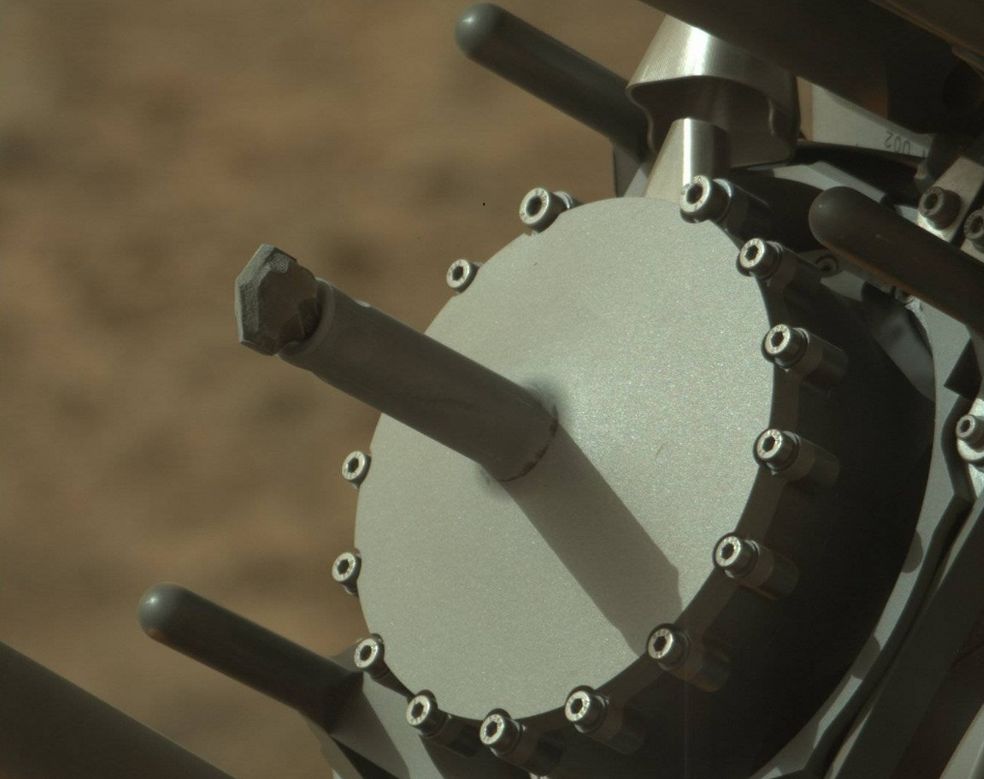
A close-up of the drill mechanism. In the centre is the hollow drill bit, which cuts into rock and gathers sample powder. The drum at the base of the drill is the first part of the sample collection mechanism. Also of this used to be extended up against a rock sample by the drill feed mechanism. Just visible cutting across the bottom right corner of the image is one of the two contact posts. The second post can be seen in part in the top right corner of the image. These are used to hold the rover’s robot arm steady against a target rock surface while the drill is extended for sample-gathering operations. Credit: NASA

On Saturday, May 19th, and following further tests using Curiosity’s Earth-base test bed twin, the command was sent to Mars for Curiosity to carry out a second drilling test using both the FED approach and with the drill percussive action enabled. Unlike the February test, however, this one has an additional goal: to actually recover a special sample of rock.

For the last couple of months, the rover has been making its way along a feature on “Mount Sharp” dubbed “Vera Rubin Ridge”, toward an uphill area enriched in clay minerals that the science team is eager to explore. In doing so, the rover passed a distinct rock formation that could fill a gap in the science team’s knowledge about Mount Sharp and its formation.

Testing the FED / percussion approach to drilling on Earth using Curiosity’s test-bed “twin”. Not how the drill head (centre) is fully extended, so the contact posts cannot be used. Forward pressure on the drill is being provided entirely by the rover’s robot arm. Credit: NASA/JPL

Given the progress made in trying to get the drill working again, the decision was made to reverse Curiosity’s course in mid-April and drive back to the rock formation in the hope that the May 19th test could gather a sample from it. Commenting on the decision, Curiosity principal scientist Ashwin Vasavada  said, “Every layer of Mount Sharp reveals a chapter in Mars’ history. Without the drill, our first pass through this layer was like skimming the chapter. Now we get a chance to read it in detail.”

If the new technique has allowed Curiosity to gather a sample – at the time of writing this article, NASA had yet to provide an update on the operation – the engineering team will immediately begin testing a new process for delivering that sample to the rover’s internal laboratories. This is again a complex process, which in the past has involved the drill feed mechanism to transfer material gathered by the drill to another mechanism called CHIMRA (Collection and Handling for In-Situ Martian Rock Analysis), also mounted on the rover’s turret. CHIMRA sieves and sorts the material, grading it by size and coarseness before transferring it to the rover’s science suite, located in Curiosity’s main body.

Curiosity’s “fingers”: the five instruments on the rover’s turret, including the drill with the feed mechanism motors behind it and the two angled contact posts clearly visible, and the CHIMRA system used for sieving and sorting sample material gathered by both its own scoop (for surface material) and the drill (for rock samples). Credit: NASA 

Success with both the drilling operation and same transfer will mean – allowing for fine-tuning and other adjustments – the drill could be re-entering regular use in the near future.

Continue reading “Space Sunday: drills, telescopes, pictures and doubts”

Space Sunday: SpaceX – balloons, bouncy castles and rockets

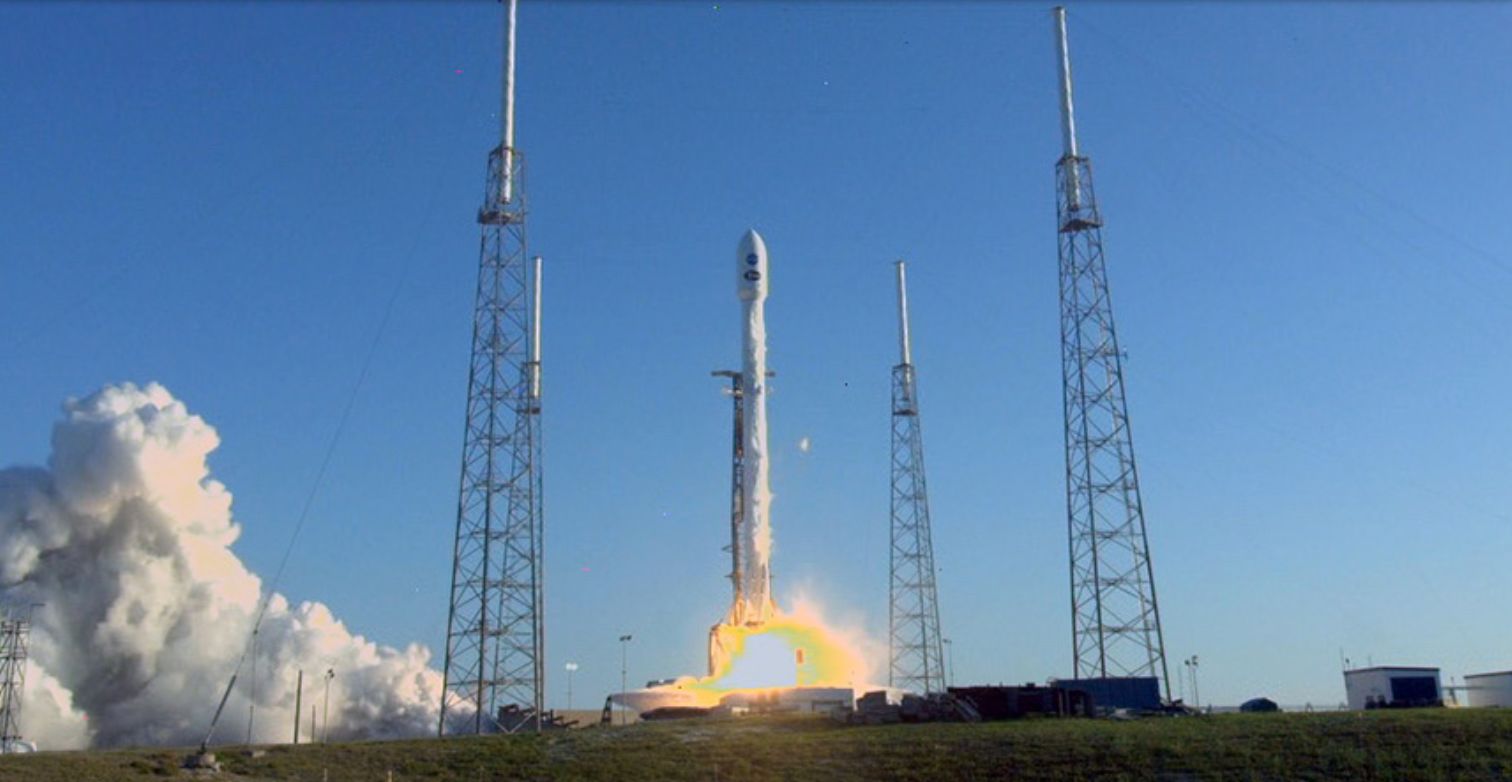
The Falcon 9 carrying TESS lifts-off from Launch Complex 40, Canaveral Air Force Station, Florida, on Wednesday, April 18th

After a two-day delay, NASA’s Transiting Exoplanet Survey Satellite (TESS) launched from Cape Canaveral Air Force  Station atop a SpaceX Falcon 9 booster on Wednesday, April 18th.

As I previewed in my previous Space Sunday report, TESS is designed to seek out exoplanets using the transit method of observation – looking for dips in the brightness of stars which might indicate the passage of an orbiting planet between the star and the telescope. Once in its assigned orbit and operational, TESS will work alongside the Kepler space observatory – now sadly nearing the end of its operational life, and eventually the James Webb Space Telescope – in seeking worlds beyond our own solar system.

It will be another 56 days before TESS has reached its unique orbit, a “2:1 lunar resonant orbit“, which will allow the craft to remain balanced within the gravitational effects of the Moon and Earth, thus providing a stable orbital regime which should last for decades. However, the launch was perfect after issues with the Falcon 9’s navigation systems prompted the initial launch attempt on Monday, April 16th. Once it had lifted the upper stage and its tiny payload – TESS is just 365 kg in mass and about the size of an upright fridge / freezer combination – the Falcon 9’s first stage completed a successful burn back manoeuvre and made a successful at-sea landing on the SpaceX Autonomous Drone Ship Of Course I Still Love You, waiting some 300 kilometres off the Florida coast.

The Block 4 Falcon 9 first stage captures an image of the autonomous Drone Ship Of Course I Still Love You just 3 seconds from touch-down. Credit: SpaceX live stream

The second stage of the rocket placed TESS into an initial 250 km circular orbit about the Earth before shutting its motor down for a 35-minute cruise period which correctly positioned the vehicle to allow the engine to be re-lit and send TESS on its way towards a 273,000 km apogee orbit. Over  the next several weeks, the instruments aboard TESS will be powered-up and calibrated, including the four cameras it will use to imaged the stars around us in an attempt to locate planets orbiting them.

The first exoplanet – the ” hot Jupiter” 51 Pegasi B, unofficially dubbed Bellerophon, later named Dimidium and some 50 light years away –  was discovered in 1995. In the 23 years since that event, some 3,708 confirmed planets (at the time of writing) have been found, with a list of several thousand more awaiting verification. Most of these have been discovered by using the transit method, with the vast majority by the Kepler space observatory. Such are the capabilities of TESS, it could double this count during its whole-sky survey, the first phase of which will last two years.

The count of confirmed exoplanets over the past 23 years. The sharp rise in 2016 is as a result of extensive follow-ups to observations made by the Kepler observatory in the K2 phase of its mission. Credit: NASA

TESS’s primary mission is scheduled to last two years – but it orbit means it could study the skies around us for decades, seeking out planets amount the 200,000 stars that are the nearest to us.

SpaceX: Party Balloons and Bouncy Castles?

Elon Musk loves to tease. He’s also generally in earnest when discussion space flight. Sometimes the two things combine in unusual ways. Take a trio of tweets he sent on April 16th, 2018, for example:

This is gonna sound crazy, but … SpaceX will try to bring rocket upper stage back from orbital velocity using a giant party balloon. And then land on a bouncy house.

Elon Musk’s trio of tweets, April 16th, 2018

Precisely what he meant has been the subject of much Twitter debate and theorising in various space-related blogs, but the CEO of SpaceX is now keeping mum on the subject; most likely enjoying the feedback and making plans.

SpaceX has serious ambitions to make their launch vehicles pretty much fully reusable. As we already know, the company has pretty much perfected the successful landing, refurbishment and re-use of Falcon 9 first stages (also used in triplicate on their Falcon Heavy booster), and plan to use the same approach with their upcoming BFR – standing for Big Falcon (or at least, a word that sounds close to “Falcon” but with a cruder meaning) Rocket – formerly, the Interplanetary Transport System.

To date, SpaceX has successfully recovered 24 Falcon 9 first stages, with almost half of those recovered now refurbished and either re-flown, or awaiting re-use. But the first stage – which does all the heavy lifting, is perhaps the “easiest” element of the vehicle to recover. It does not achieve orbital velocity (around 7,820 metres per second, or 17,500 mph), but instead tends to reach a peak velocity of around 1,716 metres per second (roughly 3,800 mph or Mach 5).

While this is still enough to generate a significant amount of heat and cause a first stage to break-up / burn-up in an uncontrolled descent, it is “slow” enough to avoid the need for extensive (and heavy) shielding to protect against the friction heat of passage back into the denser part of Earth’s atmosphere, providing the stage can be oriented correctly so three out of its set of nine motors can be re-lit. The exhaust plume from these forces the atmospheric compression generated by the rocket’s penetration of the upper layers of the denser part of the atmosphere (and which actually generates the associated re-entry heat), to occur away from the rocket, so the need for additional heat shielding is avoided.

However. recovering the upper stage of the rocket is altogether a different proposition. This does reach orbital velocity, and so finding a way in which it can be safely recovered without relying on expensive and heavy heat shielding which would both increase launch costs and reduce the payload carrying capabilities of both the Falcon 9 and the Falcon Heavy is a doozy of a problem. So much so, that SpaceX have twice cancelled attempts to make the rocket’s upper stage recoverable – and as recently as late 2017, it was believed further attempts at trying to get the stage to a point where it could be recoverable had been abandoned in favour of focusing on the BFR’s massive upper space ship stage – which as a crew / passenger carrying vehicle needs to be able to make safe landings.

So what do Musk’s tweets mean? how could a balloon be used to slow a vehicle and help it through the searing heat of orbital re-entry (where the heat load is around 27 times hotter than the heat experienced by the first stage)? The most likely explanation is that SpaceX are exploring the potential of using a ballute – a portmanteau of balloon and parachute – with the upper stage.

Continue reading “Space Sunday: SpaceX – balloons, bouncy castles and rockets”

Space Sunday: of exoplanets and naming Charon’s features

Transiting Exoplanet Survey Satellite (TESS) – due to hunt for exoplanets potentially orbiting hundreds of thousands of stars around us. Credit: NASA’s Goddard Space Flight Center/CI Lab

On Monday, April 16th, 2018, after being delayed from a planned December 2017 lift-off, the launch window opens for NASA’s Transiting Exoplanet Survey Satellite (TESS).

As its name implies, TESS is designed to seek out exoplanets using the transit method of observation – looking for dips in the brightness of stars which might indicate the passage of an orbiting planet between the star and the telescope. Once in its assigned orbit and operational, TESS will work alongside the Kepler space observatory – now sadly nearing the end of its operational life and eventually the James Webb Space Telescope – in seeking worlds beyond our own solar system.

Roughly the size of an upright ridge/freezer combination, the 356 kg (800 lb) TESS is due to be launched on its way atop a SpaceX Falcon 9 booster from Launch Complex 40 at Canaveral Air Force Station, Florida, on April 16th, 2018, in a launch window that opens at 18:32  EDT (22:32 UT).  The rocket – sans it’s payload – underwent a static rocket motor test on Wednesday, April 9th, prior to it being returned to the launch preparation facility, where the Payload system and fairings containing TESS were mated to it in readiness for the launch. As well as launching TESS, SpaceX plan to recover the Falcon 9’s first stage.

The diminutive TESS satellite being enclosed in the Falcon 9 payload fairing at NASA’s Payload Hazardous Servicing Facility at Kennedy Space Centre prior to transfer to Canaveral Air Force Station for mating with the launch booster. Credit: NASA

Once on its way, Tess will take 60 days to reach its unique orbit, a “2:1 lunar resonant orbit“, which will allow the craft to remain balanced within the gravitational effects of the Moon and Earth, thus providing a stable orbital regime which should last for decades. In addition, the orbit means that TESS will be able to survey both the northern and southern hemispheres.

During this initial 60-period, scientists and engineers will spend the first week re-establishing contact with TESS and confirming its operational status as its instruments are cameras are powered-up. The instruments will then go through an extended commissioning and calibration phase, as engineers monitor the satellite’s trajectory and performance. After that, TESS will begin to collect and downlink images of the sky.

While Kepler has so far found the most exoplanets in our galaxy, it has done so by surveying relatively small arcs of the space visible to it. TESS, however, will do things differently. It will scan the galaxy in hundreds of light-years in all directions, a sphere of space containing some 20 million stars, paying particular attention to the brightest stars around us in the hope of detecting planetary bodies in orbiting them.

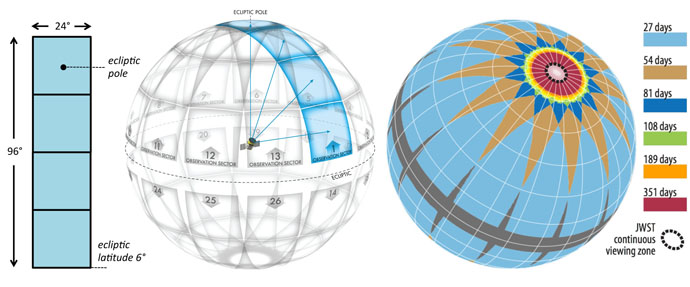
Left: The combined field of view of the four TESS cameras. Middle: Division of the celestial sphere into 26 observation sectors (13 per hemisphere). Right: Duration of observations on the celestial sphere. The dashed black circle enclosing the ecliptic pole shows the region which JWST will be able to observe at any time. Credit: NASA Goddard Spaceflight Centre

This will be achieved by dividing space into 26 individual “tiles”, allowing the four imaging systems on the craft to repeatedly observe a “strip” of four tiles at a time for a minimum of 27 days each (and parts of some for up to a year at a time) before moving to the next strip, working its way around the sky. In this way, it is estimated TESS will be able to survey up to 200,000 stars in both the northern and southern hemispheres over multiple years.

Amid this extrasolar bounty, the TESS science team aims to measure the masses of at least 50 small planets whose radii are less than four times that of Earth. Many of TESS’s planets should be close enough to our own that, once they are identified by TESS, scientists can zoom in on them using other telescopes, to detect atmospheres, characterize atmospheric conditions, and even look for signs of habitability.

In this latter regard, TESS will pave the way for detailed studies of candidate exoplanets by the James Webb Space Telescope (JWST), now scheduled for launch in 2020. While TESS cannot look for atmospheric or other signs of life on the distant worlds it locates, JWST will be able to do just that. So, even as we prepare to say a sad goodbye to Kepler, the hunt of exoplanets is actually just hotting up.

Continue reading “Space Sunday: of exoplanets and naming Charon’s features”

Space Sunday: Tiangong-1’s return and going to the Moon

Tiangong-1, imaged from a docked Shenzhou spacecraft. Credit: CMSE

China’s first orbital laboratory, Tiangong-1 (“Celestial Palace 1”) is due to re-enter the Earth’s atmosphere within the next 24 hours.

Launched in 2011, the 10.4-metre-long (34-foot) unit weighing 8.5 tonnes, was the first phase in China’s project to gain experience in Earth-orbit operations in order to establish a space station in the 2020s. It  operated for four-and-a-half-years, and was visited by two crewed missions before operations were officially brought to a close in 2016, following the launch of the Tiangong-2 orbital module.

Originally, it had been anticipated that Tiangong-1 would be de-orbited and allowed to burn-up in the upper atmosphere in late 2017. However, it was also claimed that the Chinese had lost attitude control over the unit, and that it would de-orbit some time in March 2018. These claims that control had been lost – strongly denied by the Chinese, led to over-the-top reports that the Earth was in imminent danger of the station forming a fireball and crashing to the ground within a city.

Tiangong 1. Credit: CMSE

While it is true that the unit could re-enter the atmosphere anywhere between 43-degrees north and 43-degrees south, the fact is that much of the laboratory’s orbit takes it over open sea, so the risk than any part of it which might survive re-entry and disintegration in the upper atmosphere could strike a populated centre is considered low.

At the time of writing, orbital tracking suggested that Tiangong-1 will re-enter the denser part of Earth’s atmosphere and start to break-up no earlier than 00:18 UTC on Monday, April, 2nd, 2018 (roughly 17:18 EST) +/- 1.7 hours.  As Tiangong-1 descends into the atmosphere it will be subject to frictional heat and vibration which will combine to start breaking it apart. As this happens, it is liable it will start tumbling, speeding the process of disintegration and encouraging more of it to burn-up due to frictional heat. The hope is that almost nothing of the station will survive this burn-up process to actually reach the surface of the planet.

Tiangong’s rate of orbital decay and predictability

But even if some do, again, the chances of them hitting a populated area and causing a loss of life appear somewhat remote. In this, Tiangong-1 reflects the US Skylab mission in 1979 and the Russian Salyut 7 / Cosmos 1686 combination of 1991. Both of these where much larger than Tiangong 1 (77 tonnes and 40 tonnes respectively), and made uncontrolled re-entries into Earth’s atmosphere. In both cases, wreckage did not cause loss of life. It’s also worth pointing out that something equal to, or approaching, the size and mass of Tiangong-1 re-enters Earth’s atmosphere approximately every 3 or 4 years – all without harm to those below.

Those interested in tracking the laboratory’s orbit in real-time can do so via Aerospace Corporation’s Tiangong-1 re-entry dashboard .

The Moon: Gateway or Direct?

As NASA considers whether or not to acquire more than one propulsion module for the proposed Lunar Orbital Platform-Gateway (LOP-G, previously known as the Deep Space Gateway), more are adding their voices to concern that NASA’s idea of establishing a human presence on the Moon’s surface by way of an orbital facility is not the most ideal way to go.

The proposed Lunar Orbit platform-Gateway (LOP-G, formerly the Deep Space Gateway): NASA hopes to have it operating by 2024 with international support. In his Space News Op-Ed, Robert Zubrin believes that humans could be on the surface of the Moon within that time frame. Credit: NASA

The LOP-G has taken various forms over the course of the last several years. envisaged as a small space station occupying a near-rectilinear halo orbit (NRHO) around the Moon, it was previously known as the Deep Space Gateway, intended to support the (now-cancelled) Asteroid Redirect Mission. It was then seen as a means of supporting lunar missions and – eventually – missions to Mars. The reasons for the station have always been pretty thin, and in an Op-Ed written for Spacenews.com, Robert Zubrin offers an alternative approach to a return to the Moon which forgoes the need for LOP-G.

Zubrin, along with David Baker, is the author of  Mars Direct, a proposal for establishing a human presence on Mars. It was conceived in the 1990s in response to NASA’s Space Exploration Initiative of 1989. Also called the 90-Day Report, this sought to set-out a roadmap for reaching Mars. This involved developing orbital facilities around Earth which would in turn allow for a return to the Moon, where large-scale facilities could be built from which humans could embark on missions to Mars. With a 30-year time frame and an estimated cost of US $450 billion, it was a plan built on the specious idea that the Moon offered the “easiest” route to reaching Mars, and which ultimately went nowhere.

Robert Zubrin addresses staff at NASA’s Ames Research Centre, California, in 2014. Credit: NASA

Mars Direct, on the other hand, presented the means to reach Mars with an initial human mission in just 10 years from inception, and at a cost of some US $30 billion overall. This included all the development costs of the launch vehicle and the required crew infrastructure which, once developed, could be used to undertake subsequent missions (launched every 2 years, to take advantage of Earth’s and Mars’ orbits) at a cost of US $1 billion a year. The mission profile also provided the means to use local resources on Mars to reduce overheads (such as using the Martian atmosphere to produce fuel stocks) and establish a permanent presence on the planet, as well as offering crews an assurance of getting back to Earth if anything went wrong with a particular mission.

Continue reading “Space Sunday: Tiangong-1’s return and going to the Moon”

Space Sunday: water, water everywhere

NASA’s Mars Curiosity rover celebrated its two-thousandth Martian day, or Sol, on the Red Planet on March 22nd, 2018. In celebration, NASA issued a new photo-mosaic of images captured by the rover in January 2018, which have been processed to provide a offers a preview of what comes next.

Looming over the image is Mount Sharp, the mound Curiosity has been climbing since September 2014. In the centre of the image is the rover’s next big, scientific target: an area scientists have studied from orbit and have determined contains clay minerals.

Clay minerals requires water to form. Curiosity has already revealed that the lower layers of Mount Sharp formed within lakes that once spanned Gale Crater’s floor. The area the rover is about to survey could offer additional insight into the presence of water in the region, how long it may have persisted, and whether the ancient environment may have been suitable for life.

Key to examining the area will be the rover’s drill mechanism, which the science team hope will be able to draw samples pulled from the clay-bearing rocks so their composition can be determined. As I recently reported, a new process for obtaining samples via the drill and getting them to the rover’s on-board science suite was recently tested to overcome a long-term issue with the drill feed mechanism, and the approach is being refined on Earth in preparation for the excursion into the clay region.

The 2,000 Sol celebration mosaic, published on March 22nd. It is made up of dozens of images captured by the rover’s Mastcam on Sol 1931 back in January. The mount of “Mount Sharp” (Aeolis Mons) dominates the mosaic, while the area outlined in white marks the region of clay minerals the rover is going to explore in the weeks and months ahead. The image has been white-balanced to match Earth normal lighting. Credit: NASA/JPL / MSSS

In the meantime, a new study seeking to explain how Mars’ putative oceans came and went over the last 4 billion years implies that the oceans formed several hundred million years earlier than previously thought, and were not as deep as had been assumed. In particular, it links the existence of oceans early in Mars history to the rise of the massive Tharsis volcanoes on Mars and highlights the key role they may have played in the ancient oceans of the Red Planet.

A common objection to Mars ever having oceans of liquid water is that estimates of the size of the oceans doesn’t marry-up with estimates of how much water is retained within the planet’s polar caps, how much could be hidden today as permafrost underground, and how much could have escaped into space. In the new study, from the University of California, Berkeley, it is proposed that Mars’ oceans first formed before, or at the same time as, the massive volcanoes of the Tharsis bulge, 3.7 billion years ago, rather than after them.

“The assumption was that Tharsis formed quickly and early, rather than gradually, and that the oceans came later,” Michael Manga, professor of earth and planetary science and senior author of the study, said. “We’re saying that the oceans pre-date and accompany the lava outpourings that made Tharsis.”

This would mean that the plains that cover most of the northern hemisphere, which are the presumed to be an ancient seabed, would have extended into the area later deformed as the Tharsis Ridge expanded, and lava flows cut into the plains. Thus, the initial oceans on the planet would have been more widespread – but shallower – than originally thought, providing a smaller overall volume of water.

The early ocean known as Arabia (left, blue) would have looked like this when it formed 4 billion years ago on Mars, while the Deuteronilus ocean, about 3.6 billion years old, had a smaller shoreline. Both coexisted with the massive volcanic province Tharsis, located on the unseen side of the planet, which may have helped support the existence of liquid water. The water is now gone, perhaps frozen underground and partially lost to space, while the ancient seabed is known as the northern plains. Credit: Robert Citron images, UC Berkeley

The model also counters another argument against oceans: that the proposed shorelines are very irregular, varying in height by as much as a kilometre, when they should be level, like shorelines on Earth. However, this irregularity could be explained if the first ocean, called Arabia, started forming about 4 billion years ago and existed, if intermittently, during as much as the first 20% of Tharsis’s growth. The growing volcanoes would have depressed the land and deformed the shoreline over time, leading to the irregular heights seen today. This would also apply to the subsequent ocean, called Deuteronilus, if it formed during the last 17% of Tharsis’s growth, about 3.6 billion years ago.

Tharsis, now a 5,000-km-wide eruptive complex, contains some of the biggest volcanoes in the solar system and dominates the topography of Mars. Its bulk creates a bulge on the opposite side of the planet (the Elysium volcanic complex), and the canyon system of Valles Marineris in between. This explains why estimates of the volume of water the northern plains could hold based on today’s topography are twice what the new study estimates based on the topography 4 billion years ago.

This new theory has two further points in its favour. Firstly, it can account for the valley networks (cut by flowing water) that appeared around the same time.Secondly, both Arabia and Deuteronilus would have existed at a time when the Tharsis volcanoes and those of Elysium would have been active, throwing greenhouse gases into the Martian atmosphere, warming it and increasing its density.

The authors of the study admit it is just a hypothesis at this point in time, and Manga invites others to follow-up on it. “Scientists can do more precise dating of Tharsis and the shorelines to see if it holds up.”

Too Much Water To Be Habitable?

The latest study to be published concerning TRAPPIST-1, the 7-exoplanet star system 39 light-years from our Sun, suggests the exoplanets may be too wet to have ever supported life – which might sound a little surprising. It also suggests the planets have migrated closer to their planet red dwarf star since their formation.

The study was led by Cayman T. Unterborn, a geologist with the School of Earth and Space Exploration (SESE), and used data from prior surveys that attempted to place constraints on the mass and diameter of the TRAPPIST-1 planets in order to calculate their densities, one of which I mentioned in January 2018.

Artist’s concept showing what each of the TRAPPIST-1 planets may look like. Credit: NASA

Using this data as a starting point, the team constructed mass-radius-composition models to determine the volatile contents of each of the TRAPPIST-1 planets. They found the 7 planets are light for rocky bodies, suggesting a high content of volatile elements. On similar low-density worlds, this volatile component is usually thought to be atmospheric gases. However the TRAPPIST-1 planets are too small in mass to hold onto enough gas to make up the density deficit.

Because of this, Unterborn and his teams determined that the low-density component of the seven planets was most likely water. To determine just how much water, the team used ExoPlex, software for calculating interior structure and mineralogy and mass-radius relationships for exoplanets. This allowed the researchers to combine all of the available information about the TRAPPIST-1 system.

The results revealed that all of the TRAPPIST-1 planets have high percentages of water by mass: 15% for the two inner worlds, b and c, rising to more than 50% for the outer planets, f and g. To put this into context, Earth has just 0.02% water by mass. Thus, the TRAPPIST-1 planets have the equivalent of hundreds of Earth-sized oceans trapped within their volumes. Had this water been liquid at any point in the past, or simply frozen ice enveloping the surfaces of them, it would likely to have been far too much to support life, as Natalie R. Hinkel, an astrophysicists from Vanderbilt University, Nashville, explained:

We typically think having liquid water on a planet as a way to start life, since life, as we know it on Earth, is composed mostly of water and requires it to live. However, a planet that is a water world, or one that doesn’t have any surface above the water, does not have the important geochemical or elemental cycles that are absolutely necessary for life.

In addition, the study also suggests that all seven planets in the system most likely formed father away from their star and migrated inward over time – something which has been noted with other exoplanet systems. In the case of TRAPPIST-1, the planets are distributed either close to, or within, the star’s “ice line”. This is a boundary where, within which, ice on planets tends to melt and either form oceans (if sufficient atmosphere is present) or vaporise. Beyond this line, water will take the form of ice and can be accreted to form planets.

An artist’s impression of the sky from the outermost of the three TRAPPIST exoplanets in the star’s habitable zone.

Given the relative positions of the outer planets to their star’s ice line, the research team determined all seven of TRAPPIST-1’s planets must have formed beyond the ice line, but over the aeons migrated inwards, with the inner planets losing much of their water content through their surface ice vaporising – but leaving a high volume of water still being retained within their rocky crusts.

Working out how far – and when – the planets might have formed is made more complicated by the fact that M-type red dwarf stars like TRAPPIST-1 burn brighter and hotter early in their lives before cooling and dimming – so its “ice line” would have contracted inwards as well.  Based on how long it takes for rocky planets to form, the team estimated that the planets must have originally been twice as far from their star as they are now.

Overall, the study leans weight to the view that TRAPPIST-1 worlds are unlikely to be habitable. Early on, as Natalie Hinkel noted above, they may well have been ice or water covered, but lacking the geochemical and elemental cycles essential for life. Any period in which surface conditions might have been more favourable for life on the inner planets as their ice melted would likely have been comparatively short as a result of the star’s solar activity stripping most of their atmospheres away.

Kepler Observatory Nears End of Life

To date, around 3,743 exoplanets have been discovered in our galaxy – 2,649 of them by the Kepler Space Observatory, but we’re now approaching the end of life for this veritable planet hunter.

Launched in 2009, Kepler occupies an Earth-trailing heliocentric orbit, from which it has sought out exoplanets using the transit method – monitoring a star over a period of time for periodic dips in brightness caused by a planet transiting (passing in front of) the star.

In 2012 and 2013, the observatory suffered failures and issues with two of the observatory’s four reaction wheels used to hold it steady while observing distant stars. As a result, a new mission profile, K2 Second Light, was developed in order to compensate for the issues. Unfortunately this required the observatory to use small amounts of its propellant reserves to help hold it steady during operations – and those fuel reserves are almost expended.

Mission engineers are uncertain as to precisely when the observatory’s fuel will run out, other than it will likely happen in the next several months.  The hope is that there is still enough time to gather as much data a possible from the current observation campaign.

For the first four years of its primary mission, the space telescope observed a set star field located in the constellation Cygnus Since 2014, Kepler has been collecting data on its second mission, observing fields on the plane of the ecliptic of our galaxy. Credit: NASA / Wendy Stenzel

“Without a gas gauge, we have been monitoring the spacecraft for warning signs of low fuel— such as a drop in the fuel tank’s pressure and changes in the performance of the thrusters,” Charlie Sobeck, a system engineer for the Kepler space telescope mission, explained. “But in the end, we only have an estimate – not precise knowledge.”

The end of Kepler’s mission does not mark the end of the search for Exoplanets from space. April 2018 will see the launch of  the Transiting Exoplanet Survey Satellite (TESS), will conduct transit surveys on a large scale, and in 2019 the James Webb Space Telescope (JWST) will also have part of its mission devoted to the hunt for exoplanets. Both will help build on Kepler’s legacy.