K2-18b as it might appear in orbit around its red dwarf parent star and with the other known planet in the system – K2-18c – also visible. Credit: ESA/Hubble, M. Kornmesser
I first wrote about K2-18, a red dwarf star some 11 light-years from Earth, and its two companion planets in December 2017. At that time, the outermost of the two planets, called K2-18b or EPIC 201912552 b and discovered in 2015, was the subject of a study to determine its mass in an attempt to better understand the planet’s possible atmospheric properties and bulk composition. This was of particular interest to scientists as K2-18b lay within its parent star’s habitable zone – where liquid water might exist on the planet’s surface.
That study ultimately revealed K2-18b has a mass of around 8 times that of Earth, putting it in the “super-Earth” category of rocky worlds, with a diameter roughly 2.3 times greater than Earth’s (see: Space Sunday: Exoplanets Update). Since then, K2-18b has continued to be the subject of study – and it has now become the first exoplanet thus far discovered confirmed to have water vapour, mostly likely liquid water clouds, within its atmosphere.
The news came via two independent studies that have been carried out using the data gathered by the Hubble Space Telescope (HST). The first study, written by the team who originally gathered the data, appeared on September 10th, 2019 on arXiv.org, but has not been peer-reviewed. The second study – which has been peer-reviewed – appeared in the September 11th edition of Nature Astronomy.
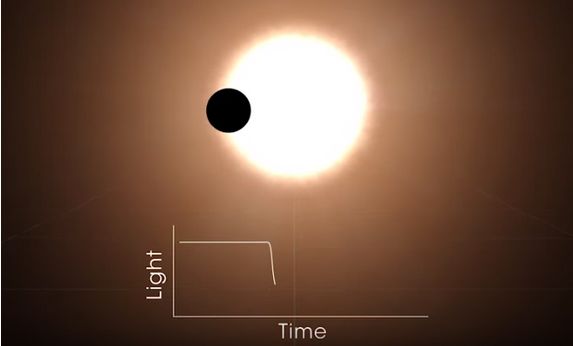
The team responsible for gathering the data – led by Björn Benneke, a professor at the Institute for Research on Exoplanets, Université de Montréal – did so after applying to use Hubble to observe K2-18b shortly after its discovery. They were ultimately granted telescope time in in 2016 and 2017, using Hubble to gather data in the light from the red dwarf star, and how that light changed under the influence of any atmosphere surrounding K2-18b as it transited in front of the star. Spectrographic analysis of the data confirmed the planet has a fairly dense atmosphere rich in hydrogen and helium – and which also contains the molecular signature of water.
Researchers gathered data on K2-18b’s atmosphere by using the Hubble Space Telescope to observe changes in the light from its parent star as it passed through the planet’s atmosphere during transits. Credit: NASA / ESA simulation
After gathering the data, Benneke’s team wanted time to carry out further observations to both confirm what they had found and make additional discoveries. In the meantime, their findings were available for others to study – which is exactly what a team led by Dr. Angelos Tsiaras based at the University College London (UCL), UK did.
Using independent means of analysing the data, both teams reached the same overall conclusions concerning the major finds within K2-18b’s atmosphere – although they come to different conclusions as to the planet’s likely form. The UCL specify K2-18b as a rocky planet with a dense atmosphere, between 0.01% and 50% of which is water vapour. By comparison, the amount of water vapour in our atmosphere is put at between 0.1% and 4% – so, K2-18b could have anything from a comparable amount of water vapour in its atmosphere to Earth through to being a completely flooded world.
By contrast, Benneke’s team believe the planet is more of a “mini-Neptune”: a planet with a small, solid core surrounded with a thick atmosphere that is predominantly hydrogen / helium in nature, with only trace amounts of water vapour – albeit enough to create liquid water clouds, and possibly even rain. However, the idea that the planet is a mini-Neptune is somewhat at odds with other findings about the planet – such as the December 2017 study.
There is also some tension between the two teams. While Benneke acknowledges his team’s research was open to others to use, he is somewhat aggrieved the UCL team did not bother to contact him or his team concerning their work or their intentions. However, he also sees the results of the UCL’s work as positive in respect to understanding the nature of K2-18b.
The presence of liquid water in the planet’s atmosphere doesn’t automatically mean it is home to life. There are some significant issues around this. For one thing, while the plant is within the habitable zone, the precise surface temperature has yet to be determined, and could range from -73ºC to +47ºC (-100ºF and +116ºF), meaning it could be colder or hotter than the coldest / hottest places on Earth.
There’s also the fact that the planet is so close to its parent, orbiting once every 33 days, that it is likely tidally-locked with its star. This means one side of the planet will be in perpetual sunlight, and the other in perpetual darkness – something that could well give rise to extreme weather conditions. Finally, there’s the fact that K2-18 is a red dwarf star. These, as I’ve noted before, can be exceptionally violent, and flares and coronal mass ejections from the star are likely to both expose the planet to high levels of radiation and could strip away its atmosphere over time, although it is possible K2-18b’s atmosphere might be dense enough to help it withstand at least some of this stripping away.
Finding water on a potentially habitable world other than Earth is incredibly exciting. K2-18b is not ‘Earth 2.0’ as it is significantly heavier and has a different atmospheric composition. However, it brings us closer to answering the fundamental question: Is the Earth unique?
– Dr. Angelos Tsiaras (UCL Centre for Space Exochemistry Data)
co-author of the UCL study on K2-18b
The next phases in studying K2-18b will likely come in the mid-to-late 2020s. Benneke and his team are already planning to continue their work using NASA’s James Webb telescope, due to be launched in 2021, while Giovanna Tinetti, a member of the UCL team studying K2-18b also happens to be the Principal Investigator for Europe’s Atmospheric Remote-sensing Infra-red Exoplanet Large-survey (ARIEL). She has already indicated the planet will be target for study by that mission when it launches in 2028.
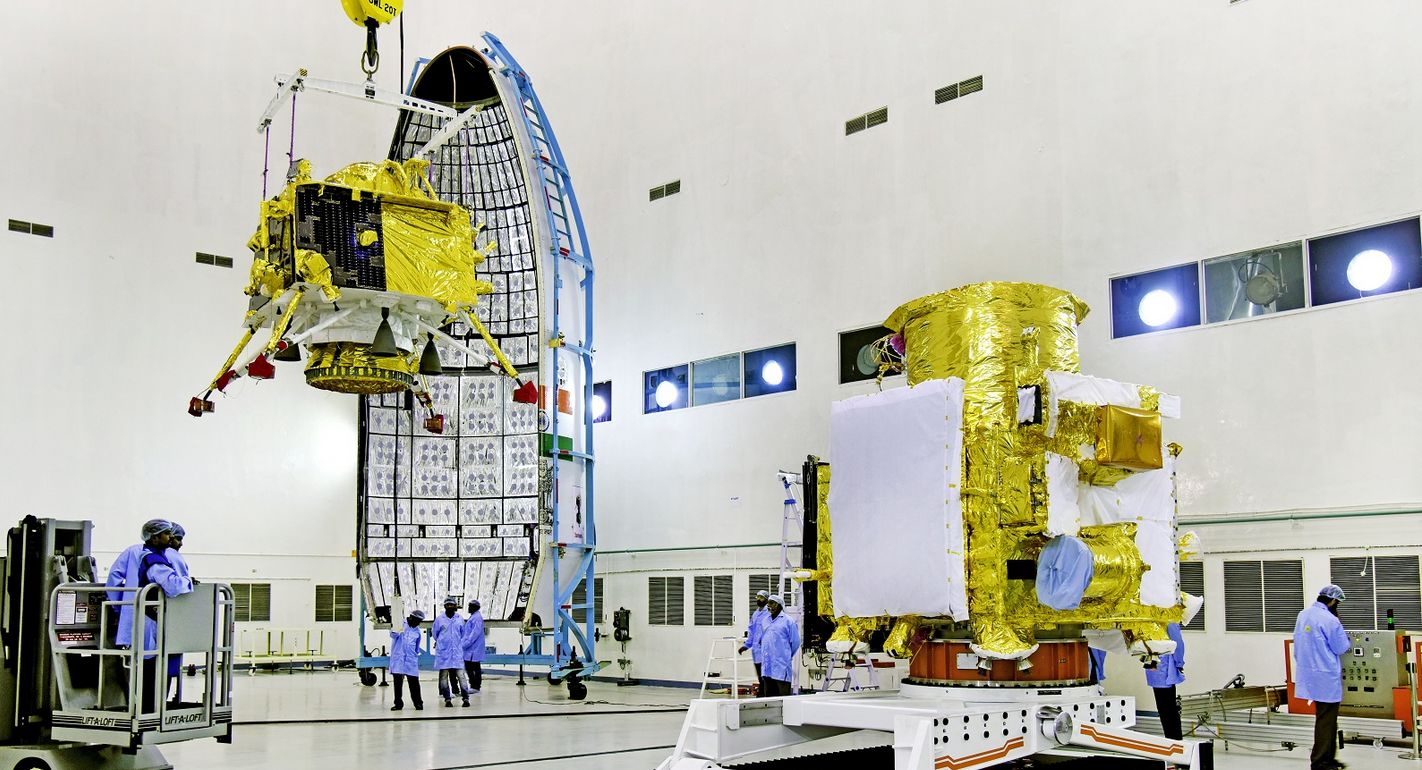
The bulky Vikram lander, with the Pragyan rover”garaged” inside, is hoisted aloft in a clean room, ready to be mated to the “top” of the Chandrayaan-2 orbiter (right). One section of the payload fairing that enclosed the craft during launch is visible in the background. Credit: ISRO
On Friday, September 6th, India was due to become the fourth country to successfully reach the surface of the Moon, with the touch-down of the Vikram lander, part of the Chandrayaan-2 (“moon craft-2” in Hindi) mission.
Launched in late July 2019, Chandrayaan-2 was set to be the latest in a series of high-profile missions undertaken by the Indian Space Research Organisation (ISRO) over the course of the last 11 years, which have included the Chandrayaan-1 lunar orbiter (2008/2009) and the Mangalayaan (“Mars-craft”), launched in 2013 and still operational today.
As I’ve noted in recent Space Sunday articles, Chandrayaan-2 comprises three parts: the orbiter vehicle, the Vikram lander and a small rover called Pragyan (“Wisdom” in Hindi) carried by the lander. Vikram departed the orbiter vehicle on Monday, September 2nd, allowing it to begin a series of manoeuvres in readiness for a final decent and landing, scheduled for Friday, September 6th (western time, the early hours of Saturday, September 7th for India) in the Moon’s South polar region.
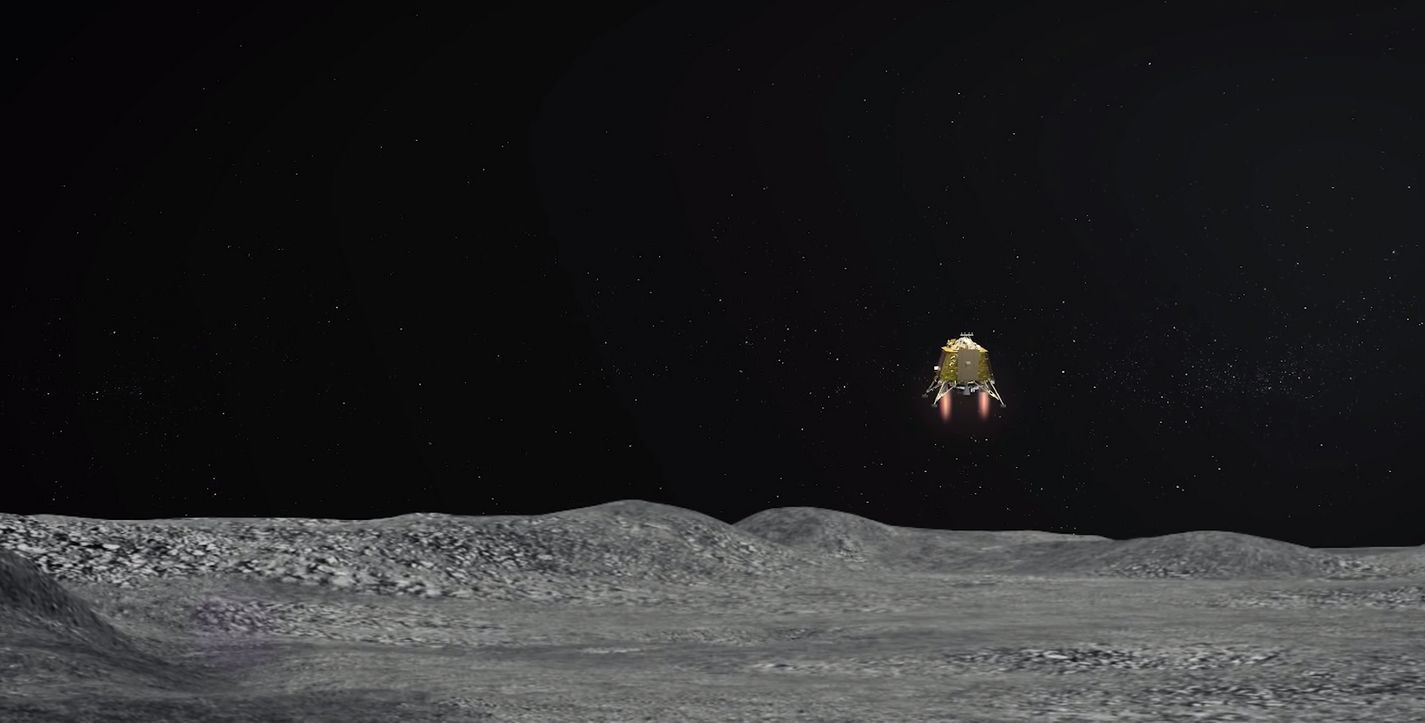
An artist’s impression of the Vikram lander coming in to land in the Moon’s south polar region. Credit: ISRO official video
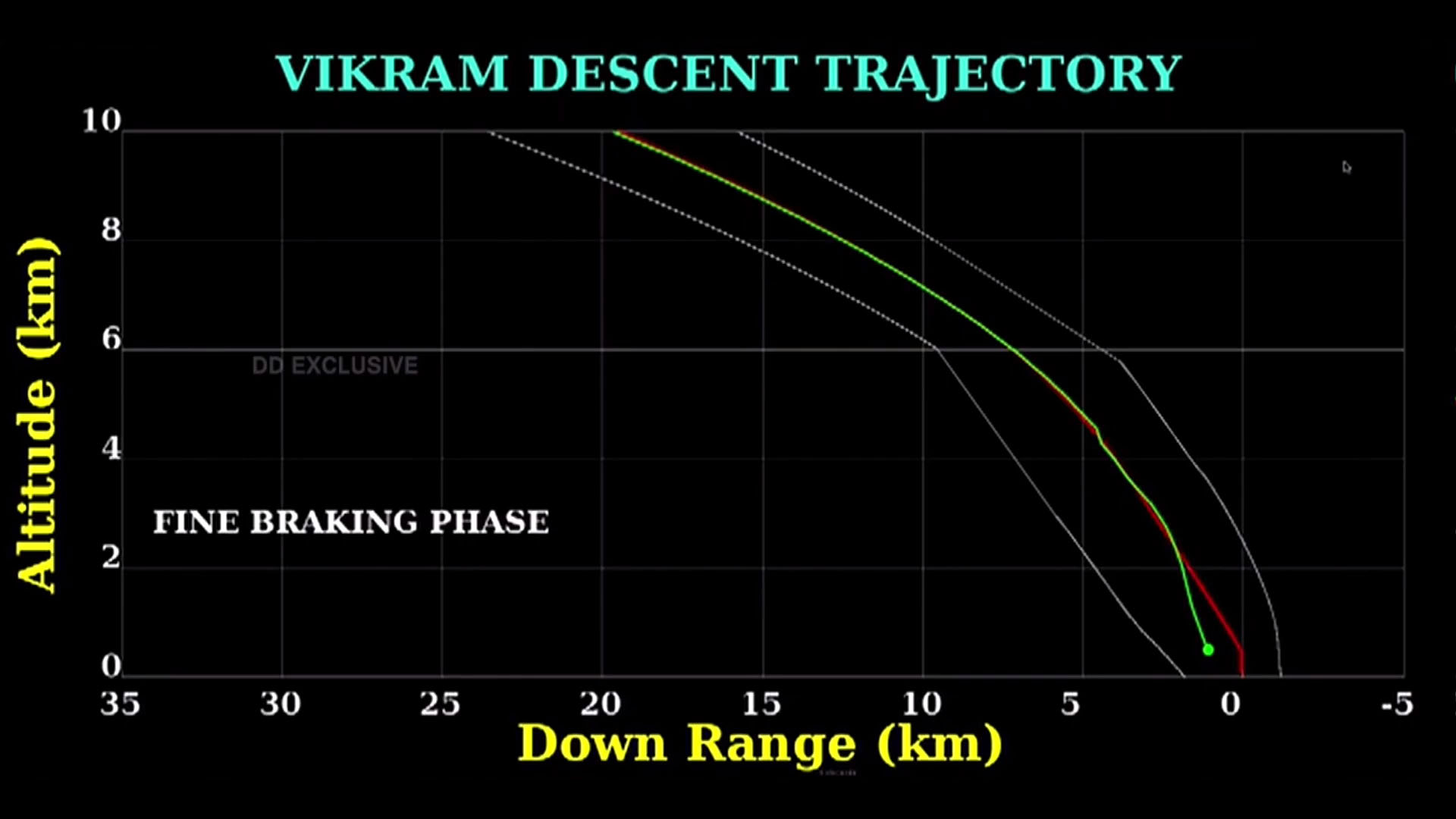
Initially, that final descent started well enough, with the lander about 550 km (344 mi) from the south pole as it fired its descent motor start the start of its final approach. At an altitude of 6 km (3.75 mi), it started a final sequence of engine burns referred to as the “fine braking phase”. Then all communications ceased.
ISRO issued a statement that the vehicle was performing nominally until around 2.1 km above the Moon, when the loss of communications occurred. However, images of the data received from the vehicle and released by ISRO appeared to suggest telemetry was being received when the lander was within 400 m of the lunar surface – and altitude at which it would be fully under its automatic guidance and landing software, and not reliant on commands from Earth. This seemed to suggest Vikram may have made a landing.
ISO stated communications with the Vikram lander were lost some 2.1 km above ground. However, a graphic of the vehicle’s descent towards the Moon (green above), appears to suggest telemetry was lost when the vehicle was between 300-400m above the lunar surface, and that it had drifted perhaps a mile from its planned descent track (red). If accurate, this suggests Vikram was in the fully automated terminal descent phase of its landing. Credit: ISRO
This idea gained ground as this article was being prepared, when an article published by Asia News international suggested Vikram has been spotted on the surface of the Moon, possibly 500m to 1 kilometre from its designated landing point. The article quotes ISRO’s director, Kailasavadivoo Sivan as saying:
We’ve found the location of Vikram Lander on lunar surface & orbiter has clicked a thermal image of Lander. But there is no communication yet. We are trying to have contact. It will be communicated soon.
Since then, the report has been repeated numerous times through various media (including an entirely UNofficial and unverified “ISRO Official Update” Twitter account) without (at the time of publication) official confirmation. This has made it hard to determine the veracity of the ANI report. Hopefully, the situation will become clearer in the coming days. One thing that could help define the lander’s condition would be an image captured by Chandrayaan-2’s main imaging camera. With a resolution of a third of a metre, it is the highest resolution camera in operation around the Moon.
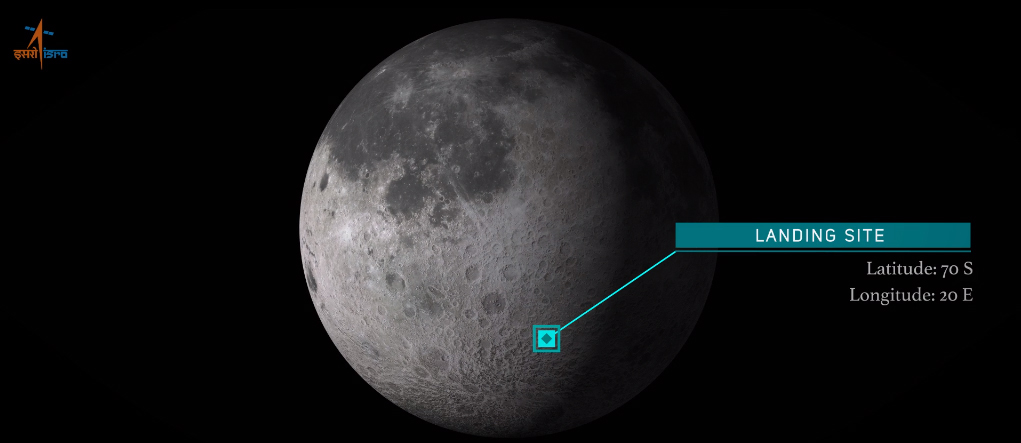
The planned landing site for the Vikram lander. Credit: ISRO
But even though the lander and rover may have been lost, the mission is far from over; the orbiter continues to function perfectly. It also carries the bulk of the mission’s science experiments – eight of the 13 carried by the mission. he data gathered by these systems should enable scientists to compile detailed maps of the lunar surface, revealing key insights about the Moon’s elemental composition, formation and evolution, and potentially help in assessing the moon’s stores of water ice.
In this latter regard, the mission builds on work performed by Chandrayaan-1, which revealed water is present at the lunar poles, with subsequent studies suggesting much of this water is ice on the floors of polar craters, which have been in permanent shadow for billions of years. If this ice is easily accessible, it could be a critical enabling resource for the eventual human settlement of the moon, providing water, oxygen and fuel (hydrogen).
In all, Chandrayaan-2 is expected to operate for some 7 years.
Proxima Centauri: An Angry Star with Bad News for its Planet
In 2016, I wrote about Proixma b, a planet roughly 1.5 times the mass of Earth orbiting our nearest stellar neighbour, Proxima Centauri, 4.25 light years away (see: Exoplanets, dark matter, rovers and recoveries). Since then, and as a result of the planet being within the star’s zone of habitability, there has been a lot of debate about the potential for it to support life.
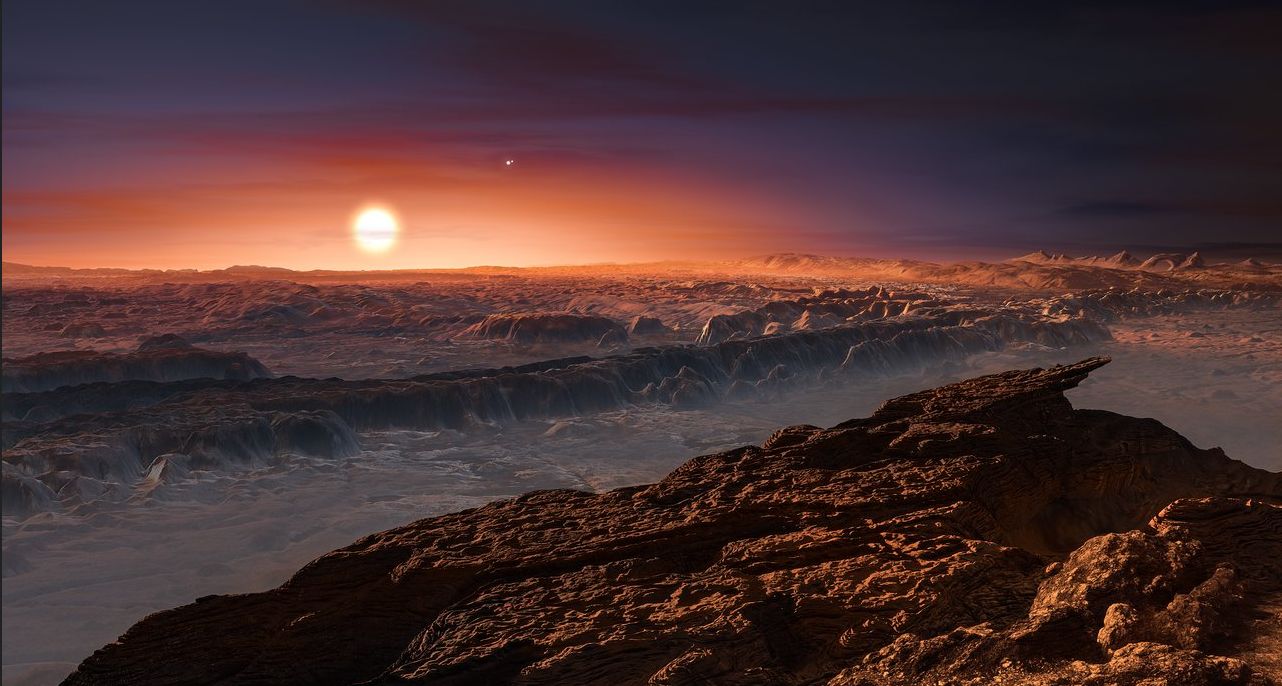
An artist’s impression of Proxima b with Proxima Centauri low on the horizon. The double star above and to the right of it is Alpha Centauri A and B. Credit: ESO
Numerical models have indicated that Proxima b probably lost a large amount of its water in its early life stages, possibly as much as one of Earth’s oceans. however, those models also suggest liquid water could have survived in warmer regions of the planet – such as on the side of the planet facing its star (Proxima b is potentially tidally locked with its parent star, always keeping the same face towards it). This means other factors that might affect habitability must be examined. Chief among these is the overall activity of the parent star – notably flares, coronal mass ejections and strong UV flux -, all of which can erode a planet’s atmosphere, rendering it uninhabitable in the long term.
That Proxima Centauri is very active with flares has been known for some time, as has been the star’s ability to generate “super-flares”, one of which in 2016 briefly raised the star’s brightness to the point of making it briefly visible to the naked eye from Earth. This activity has suggested that Proxima b is unlikely to support life (see: Curiosity’s 5th, Proxima b and WASP-121b). But the debate has remained.
Over the past year, a team of scientists at the Konkoly Observatory in Hungary have been using data from the Transiting Exoplanet Survey Satellite (TESS) to observe Proxima Centauri’s flare activity over a two month period, split between April and June 2019. They found that in the roughly 55-day period, the star pent around 7% of its time violently flaring, with a total of 72 relatively large-scale flares observed. In particular, the energy of the eruptions put them as not far below “super flare” status, suggesting the star could produce a super flare perhaps once every two years.
TESS data on flare activity on Proxima Centauri: yellow triangles indicate flare activity, green triangles show particularly violent flare events. Credit: Krisztián Vida / Konkoly Observatory
Such frequent, high-energy eruptions almost certainly have a severe impact on the atmosphere of Proxima Centauri b, disrupting it to a point where it cannot reach any steady state, leaving it continuously in a state of disruption and alteration, making the potential for the planet to support life even more remote. However, it also raises a curiosity about the star: the underlying magnetic frequency evidenced by Proxima Centaur. Such activity is normally associated with fast-rotating stars with periods of a few days. However, Proxima Centauri has a rotation period of ~80 days; so why it should be so active is now a subject for investigation.
The “Flying Water Tank”, aka “R2D2’s Dad”, otherwise know as the Starhopper – rises to 120m (500ft) during its second major test flight, August 27th, 2019. Credit: SpaceX
SpaceX successfully flew their Starhopper vehicle – designed to prove the viability of their upcoming Starship space vehicle – on August 27th, in its most complex test flight to date.
The Starhopper craft, dubbed “the flying water tank” on account it both lacks its conical nose (damaged beyond repair during a storm at the start of the year) and the fact it was fabricated for SpaceX by a company that specialises in building water tanks, lifted off from a pad at SpaceX’s test site in Boca Chica, Texas, rising vertically to a height of 150 metres (488 ft) before translating to horizontal flight to crab across to another pad at the test facility and then descended under power to touch down once more.
While the flight lasted less than a minute, it has, according to Musk, paved the way for two dramatic follow-up flights. As well as the Starhopper vehicle, SpaceX is currently building two full-size Starship prototypes – “Mk 1” is being built at Boca Chica, with “MK 2” under construction in Florida. It appears that the “Mk 1” vehicle will be used for the 20km flight.
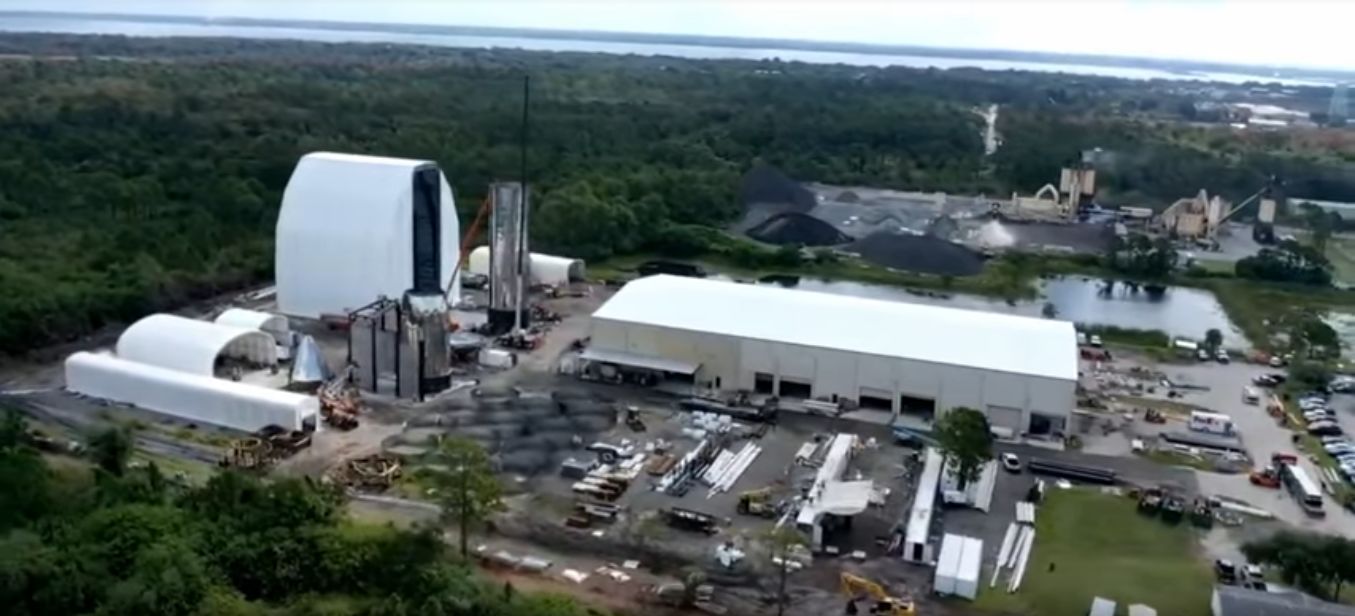
Starship Mk 2 on the left of the image, standing upright and with additional elements nearby, under construction in Cocoa, Florida. Credit: SpaceX
Musk’s announcement of a potential attempt to reach orbital altitude drew questions on whether SpaceX plan to use their Super Heavy – essentially the “first stage” for Starship launches – with one of the Starship prototypes, or just make the attempt with the Starship on its own. In the past, Musk has indicated that a fuelled but unladen Starship should have the power to achieve orbit, but that would presumably be using all six of an operational Starship’s Raptor engines. By comparison, the Starhopper has a single Raptor motor and the Starship Mk 1 and Mk 2 craft will have 3 Raptors – at least initially.
As it stands, the “first generation” of Starship / Super Heavy is designed to be 9m (29 ft) in diameter and stand around 118m (390 ft) tall on the launch pad. Super Heavy is to be powered by 31 Raptor engines and the 48m tall Starship by 6 Raptors. Together, SpaceX stated that they will be capable of lifting around 100 tonnes of payload to orbit, with Starship capable of reaching the Moon or Mars with that payload or up to 100 crew and passengers.
All of that is pretty mind-boggling. If possible, it will make Starship / Super Heavy the most powerful launch system ever built in terms of thrust. But SpaceX is apparently going to go beyond that. Following the Starhopper test, and responding to a question, Musk indicated that a “next generation” craft based on Starship / Super Heavy could follow in “several years”. While planning a follow-up to Starship / Super Heavy is not surprising, the scale of the follow-up version is: in a further tweet, Musk suggested it will be 18m (60 ft) in diameter – twice that of Starship / Super Heavy.
Mathematics tells us that doubling the diameter of a circle quadruples its area. This means that if the current ratio of dimensions for Starship / Super Heavy is retained, the “next generation” version would stand 230 m (780 ft) tall and have eight times both the surface area and propellant tank volume of the current Starship / Super Heavy. All of which leads to a fuelled launch mass of around 40,000 tonnes. All of which is, frankly, entering the realm of idiocy; as I’ve previously (and subjectively) opined, it’s hard to see a launch vehicle with a 100-tonne payload mass being commercially viable unless the launch costs are such that it can turn a profit lifting around 5-10 tonne to orbit for the majority of its flights. As such, a vehicle twice the size (even if possible) has little to no chance, outside of highly specialised (and limited) launch roles.
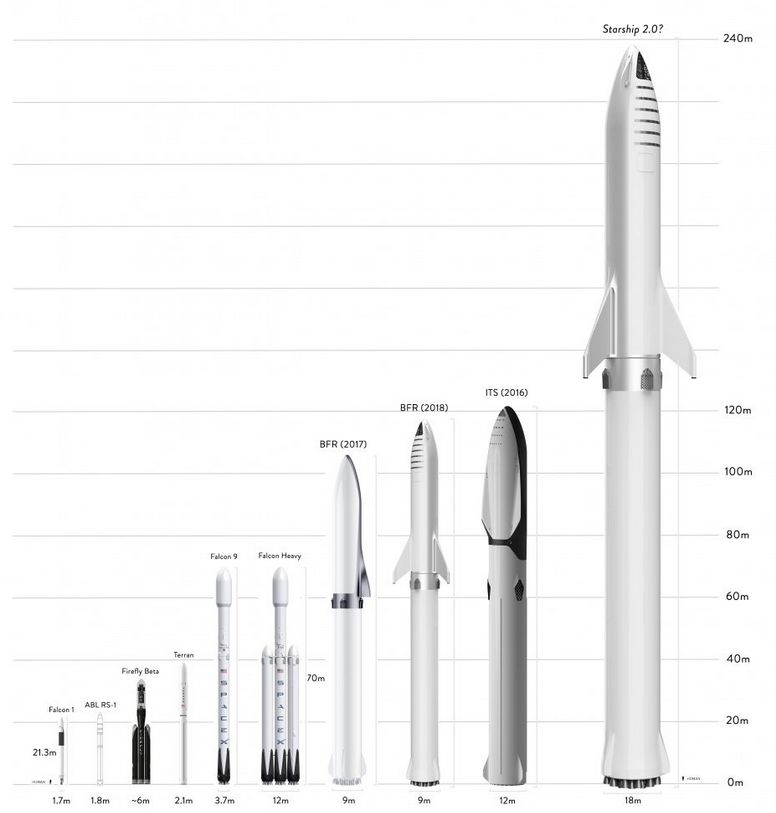
An artist’s impression of a future “next generation” Starship / Super Heavy launch combination compared to SpaceX’s current family of launch vehicles, the current (2018) and previous (2016 and 2017) BFR designs. This assumes the “next generation” vehicle will have Musk’s stated 18m diameter and retain the same proportions as the current Starship / Super Heavy combination. Credit: Teslerati.
At such a size and mass, the new vehicle would require 100 Raptor motors just to get off the pad – or a system of engines several times more powerful. Take the noise and vibration issues this would introduce to the system, and I’ll say that it just isn’t going to happen. In the meantime, Musk is promising a public update on the status of Starship / Super Heavy on September 28th, 2019.
The 14 new surface feature names (in yellow) approved for Pluto by the International Astronomical Union on August 8th, 2019. The names in white were approved by the IAU in 2017. Credit: NASA / JHU/APL
On August 8th, 2019, the International Astronomical Union (IAU) approved the names for 14 more significant features on the surface of Pluto, imaged by the New Horizons space vehicle as it flew past the Pluto-Charon system in 2015.
The IAU claimed the authority to officially name or approve the name of planets, dwarf planets, moons, asteroids and planetary features in our solar system during its inaugural General Assembly, held in Rome in May 1922, 3 years after it had been formed by the founding nations of Belgium, Canada, France, Great Britain, Greece, Japan, and the United States, and by which point its membership had grown to 19 nations around the world (today membership stands at 82 nations).
As the sole authority, it means that any names given to things like planetary surface features – such as “Mount Sharp” on the surface of Mars are entirely unofficial, hence why they are referred to in quotes in these Space Sunday articles. The IAU may determine names on things like surface features entirely by itself (as is the case with “Mount Sharp”, which is officially designated Aeolis Mons), or they may take recommendations from other organisations or groups.
In the case of the 14 names first assigned to features on Pluto by the IAU in 2017, the organisation ratified the suggestions made by the New Horizons mission team. Keeping with this “tradition”, the August 8th, 2019 announcement of the 14 “new” names for surface features first employed by the mission team.
The first 14 names to be approved by the IAU (2017) for features on Pluto include the Tombaugh Regio, named for Clyde Tombaugh, who first identified Pluto as a planetary body; the great frozen nitrogen lake of Sputnik Planitia, and the Hillary and Tenzing mountains, named for the two men formally recorded as the first to reach the summit of Mount Everest. Credit: NASA / JHU/APL
All 14 represent people and missions that contributed to the understanding of Pluto and the Kuiper Belt, as well as drawing on figures from mythology and aerospace exploration in general. They cover a range of surface features on Pluto images by the New Horizons vehicle as it dashed through the Pluto-Charon system that include entire regions of the planet and items such as mountain ranges, plains, valleys and craters. They comprise (in alphabetically order):
Alcyonia Lacus, possibly a frozen nitrogen lake, it is named for the “bottomless” lake in the vicinity of Lerna, Greece, and regarded as one of the entrances to the underworld in Greek mythology.
Elcano Montes, a mountain range named for Juan Sebastián Elcano (1476–1526), the Spanish explorer who in 1522 completed the first circumnavigation of the Earth (a voyage started in 1519 by Magellan).
Hunahpu Valles, a system of canyons named for after one of the Mayan Hero Twins who defeated the lords of the underworld in a ball game.
Khare crater honours planetary scientist Bishun Khare (1933–2013), who specialised in the chemistry of planetary atmospheres and who published several seminal papers on tholins, the organic molecules that probably account for the darkest and reddest regions on Pluto.
Kiladze crater is named for Rolan Il’ich Kiladze (1931–2010), who made pioneering early investigations the dynamics, astrometry and photometry of Pluto.
Lowell Regio, is a large region honouring Percival Lowell (1855–1916), founder of the Lowell Observatory and organiser of the search that eventually led Clyde Tombaugh to locate Pluto.
Mwindo Fossae, a network of long, narrow depressions named for the Mwindo Epic of the Nyanga people.
Piccard Mons, a mountain and suspected cryovolcano named for Swiss inventor and physicist and high altitude balloon pioneer, Auguste Piccard (1884–1962).
Pigafetta Montes, a mountain range honouring Antonio Pigafetta (c. 1491–c. 1531), the Italian scholar and explorer who chronicled the discoveries made during the first circumnavigation of the Earth, aboard Magellan’s ships.
Piri Rupes, a range of cliffs named for Piri Reis (also Ahmed Muhiddin Piri c. 1470–1553), an Ottoman navigator and cartographer known for his world map. He also drew some of the earliest existing maps of North and Central America.
Simonelli crater, name after astronomer Damon Simonelli (1959–2004), whose wide-ranging research included the formation history of Pluto.
Vega Terra, a large land mass named after the Soviet Vega 1 and 2 missions, the first spacecraft to fly balloons on another planet (Venus) and to image the nucleus of a comet (1P/Halley).
Venera Terra, named for the Venera missions sent to Venus by the Soviet Union from 1961–1984; they included the first human-made device to enter the atmosphere of another planet, to make a soft landing on another planet and to return images from another planetary surface.
A computer-generated image showing New Horizons’ location in our solar system on August 10, 2019. The green line shows where the vehicle has travelled since its 2006 launch, the red indicates its future path. This perspective is from above the Sun and “north” of Earth’s orbit. Credit: JHU/APl
Since its flyby of the Pluto-Charon system, the New Horizons vehicle has continued its voyage out through the Kuiper Belt. Most of this has been with the vehicle in a state of hibernation to conserve power, however, in January 2019, the craft encountered Kuiper Belt Object (KBO) Ultima Thule, aka 2014 MU69 (see my January 28th 2019 Space Sunday article), and data from that encounter is still being transmitted back to Earth.
Currently, the New Horizons mission is funded until April 2021, and may well be extended beyond that date. The vehicle’s radioisotope thermoelectric generator (RTG), which uses the heat from the radioactive decay of plutonium 238 to provide it with electrical power, is expected to provide sufficient energy for its science instruments until the mid-to-late 2030s. So the science team responsible for the mission at the John Hopkins University Applied Physics Laboratory are currently seeking potential KBO targets the craft could fly by in the mid or late 2020s.
Ultima Thule from a distance of 6,700 km, January 1st, 2019. Credit: NASA / JHU/APL / SwRI
Should the vehicle retain sufficient power for some of its instruments, it may be able to study the outer heliosphere (the “bubble” of space surrounding our solar system and created by the outward flow of energise particles from the Sun) in the late 2030s. If it does, it will add to the data gathered on that distant region of space, 100+ AU from Earth (1 AU = the average distance of the Earth from the Sun) by the Voyager spacecraft.
Parker Solar Probe: One Year In
August 12th, 2019, marked the first anniversary of NASA’s Parker Solar Probe. As I reported in Space Sunday: to touch the face of the Sun, this is an ambitious mission to repeatedly fly through the Sun’s corona – the hazardous region of intense heat and solar radiation in the Sun’s atmosphere that is visible during an eclipse – to gather data that could help answer questions about solar physics that have puzzled scientists for decades.
Named for Eugene Parker, the physicist who first theorised the solar wind, the constant outflow of particles and magnetic fields from the sun, the mission is now into its third orbit of the Sun, and due to make a further close solar approach on September 1st, 2019.
The spacecraft carries four suites of scientific instruments to gather data on the particles, solar wind plasma, electric and magnetic fields, solar radio emission, and structures in the Sun’s corona. This information will help scientists unravel the physics driving the extreme temperatures that make the corona hotter than the “surface” of the Sun – and the mechanisms that drive particles and plasma out into the solar system.
So much information has been gathered by the probe during its first two orbits of the Sun that the mission team on Earth is still analysing it. They hope to have the first results available before the end of the year – not that they are complaining!
We’re very happy. We’ve managed to bring down at least twice as much data as we originally suspected we’d get from those first two perihelion passes.
– Nicky Fox, director of NASA’s Heliophysics Division
An artist’s impression of the Parker Solar Probe swinging around the Sun at a distance of 6.2 million km (3.85 million mi) . Credit: NASA
Nor is that all; the probe’s elliptical 170-188 day orbit means that it has just 11 days per orbit in which to gather data – and these coincide with perihelion, when the craft must withstand temperatures of around 1,370ºC (2,500ºF). To achieve this, the probe is equipped with a 2.3m hexagonal solar shadow-shield that performs three tasks: it absorbs and reflects sunlight away from the vehicle whilst also preventing radiation penetrating its instrument bay and burning-out its circuits and instruments (incident solar radiation at perihelion is approximately 475 times the intensity at low Earth orbit) and also casting a long shadow in which the rest of the vehicle can remain relatively “cool”. Data on the shadow-shield and from within the vehicle as it passes through the corona reveal the shield is working better than anticipated.
So, with another six years of its planned 7-year primary mission, the Parker Solar Probe is set to revolutionise our understanding of the Sun’s corona and the mechanisms powering it.
The data we’re seeing is showing us details about solar structures and processes that we have never seen before. Flying close to the sun—a very dangerous environment—is the only way to obtain this data, and the spacecraft is performing with flying colours.
– Nour Raouafi, Parker Solar Probe project scientist, JHU/APL
June 2011: a pristine assembled MSL Curiosity rover sits within its assembly clean room at NASA’s Jet Propulsion Laboratory prior to being stowed and mounted within its delivery system in preparation for its December 2011 launch to Mars. Credit: NASA/JPL
Seven years ago on August 6th, 2012 at 05:17 UTC, NASA’s Mars Science Laboratory rover Curiosity arrived in Gale Crater on Mars. I’ve covered the progress of the mission throughout (just follow my MSL / Curiosity tag), and those articles in fact gave birth to this Space Sunday column; but it’s been a while since I’ve last updated on things.
Since its arrival on Mars, Curiosity has driven a total of 21 km (13 mi) from its landing point to the base of the crater’s central mound, Aeolis Mons, and has ascended 368 metres (1,207 ft) up the side of the mound, which NASA informally call “Mount Sharp” to its current location.
How Curiosity Reached Mars, (1) cruise stage – provided power and data collection during flight from Earth to Mars; (2) aeroshell protecting rover and skycrane during journey and during entry into the Martian atmosphere, with parachute system (6); (3) the skycrane used to winch the rover down to the ground whilst hovering a few metres in the air; (4) the rover in its stowed configuration; (5) the heat shield that protected the vehicle during its entry into the Martian atmosphere. Credit: NASA/JPL
Along the way, Curiosity has revealed a lot about Mars – including confirmation that Gale Crater has been host to multiple bodies of water during its early life, and that the conditions were suitable for microbial life to have potentially arisen on the planet.
Nor did the rover have to wait to make the discovery: it did so literally within weeks of its hair-raising arrival when it had barely started on its journey and was exploring an ancient riverbed on the floor of Gale Crater (dubbed “Yellowknife Bay”), when analysis of samples gathered revealed all the essential ingredients which – if mixed with water (that once flowed through the riverbed) – might have given life a kick-start and to have been enough to possibly sustain it during the warmer, wet periods of Mars’ early history.
As well as this, Curiosity has revealed much about the ancient conditions on Mars, has found hematite (which requires the presence of water to form), done much to reveal atmospheric processes at work on the planet, and helped track Martian weather and climate processes.
There have been a few causes for concern along the way. Early on in the mission it was revealed that the rover’s six aluminium wheels had suffered more wear and tear than had been anticipated, prompting some changes to the rover’s route as it approached “Mount Sharp”.
Most particularly, the rover’s drill mechanism has had its share of issues, some of which have required changes to how the drill is operated.
However, none of this has really impacted on the rover’s mission – in fact, Curiosity has recently obtained its 22nd drill sample from Mars, as it examines a region the mission team call the “Clay Unit”, one of several closely packed areas with strong differentiators scientists want to examine. Clay forms in the presence of water, and the area has sufficient enough clay deposits to be detected from orbit, and Curiosity has recovered samples with the highest amounts of clay minerals found to date by the mission.
This area is one of the reasons we came to Gale Crater. We’ve been studying orbiter images of this area for 10 years, and we’re finally able to take a look up close.
– Kristen Bennett, U.S. Geological Survey and co-lead for Curiosity’s clay-unit campaign
A panoramic view of “Teal Ridge” in the “Clay Unit” showing sharp differentiations in rock and surface material that suggest the evolution of a lake-like environment. June 18, 2019, the 2,440th Martian day, or sol, of the mission. Credit NASA/JPL
Quite why this particular area is so rich in clay deposits is unclear, but the area is home to complex geologic features, such as “Teal Ridge” and “Strathdon,” a rock made of dozens of sediment layers that have hardened into a brittle, wavy heap. Unlike the thin, flat layers associated with lake sediments Curiosity has studied, these wavy layers in these features suggest a more dynamic environment. Wind, flowing water or both could have shaped this area.
Both “Teal Ridge” and “Strathdon” represent changes in the landscape suggestive of the evolution of the ancient lake environment. This is further exemplified by the area above the “Clay Unit”, and towards which Curiosity is slowly making its way. It’s an area rich is sulphate deposits, indicative that it was drying up or becoming more acidic in ancient times whilst the lower slopes were still rich in water.
The Clay and Sulphate bearing regions on “Mount Sharp” and the proposed path Curiosity is following through them. Credit: NASA/JPL
Cutting down slope through the “Sulphate Unit” is the Gediz Vallis and Ridge, which appears to have been form by water running down “Mount Sharp” at some period after both the Clay Unit and Sulphate Units before spreading into the “Greenheugh Pediment”. This points to the area having seen some considerable changes as a result of climate changes on Mars.
We’re seeing an evolution in the ancient lake environment recorded in these rocks. It wasn’t just a static lake. It’s helping us move from a simplistic view of Mars going from wet to dry. Instead of a linear process, the history of water was more complicated. It’s finally being able to read the paragraphs in a book — a dense book, with pages torn out, but a fascinating tale to piece together.
– Valerie Fox, Division of Geological and Planetary Sciences, Caltech
Curiosity is powered by a radioisotope thermoelectric generator (RTG) that uses a core of plutonium-238. The heat given off by the decay of the isotope is converted into electric voltage by thermocouples and stored within two lithium-ion batteries that directly power the rover’s systems. This ensures the rover obtains constant power during all seasons and through the day and night, with waste heat is also passed through the vehicle’s interior to keep systems and instruments at their operating temperature and without the need for additional electric heating systems.
However, over time, the amount of electrical voltage the RTG can generate decreases. Overall, Curiosity’s RTG is expected to provide sufficient power (100+ Watts) to run all of the rover’s systems for 14 years – so 2019 marks the half-way point. Which is not to say that Curiosity only has seven more years of operations. Rather, it means that in around 7 years power generation is going to fall below the 100 watts mark, and it may become necessary for rationing power between systems on the rover, reducing some of its capacity.
The mission included the first stage of a privately-funded initiative to transfer living DNA to the Moon – a kind of “Noah’s Ark Mark II”, providing a repository from which plants and animals could be regenerated to repopulate the Earth should a catastrophe akin to a flood of biblical proportions overtake the planet. In particular for this first phases of the project, a 30-million-page archive of human history viewable under microscopes, as well as human DNA were carried by the lander in a DVD-like “Lunar Library” – which also includes tardigrades.
The tardigrade. Credit: 3DStock/Shutterstock
Science fiction fans might recognise this name from the television series Star Trek: Discovery. However, far from being the stuff of sci-fi shows and stories, tardigrades are very real (if a lot, lot smaller than their Star Trek “breathren”) and also exceptionally hardy.
Known colloquially as water bears or moss piglets, tardigrades are a phylum of water-dwelling eight-legged segmented micro-animals that can be found almost anywhere on Earth, from the tops of mountains to the bottoms of the oceans, from the tropical stew of rain forests to the frozen wastes of the polar regions. They can survive extremes of temperature and pressure (both high and low), air deprivation, radiation, dehydration, and starvation and exposure to outer space.
The tardigrades were stored dehydrated tardigrade – which puts them into a state of suspended animation – and “encased in an epoxy of Artificial Amber”. In this state, they could in theory be revived if exposed to heat and moisture. But even without these, the tardigrade could survive for years on the Moon – specimens have been recovered after being in a dehydrated state for decades. Such is the design of the unit in which they are stored, those responsible for the project believe it “highly likely” it survived Beresheet’s impact on the surface of the Moon.
Sadly, it is unlikely we’ll ever get to know if this is the case; the crash point for the Israeli lander puts in it in an area of the Moon’s south polar region far removed from any planned destinations for NASA’s Artemis missions, making recovery very unlikely.
Steam Powered Satellites and Autonomous Exploration
Am August press release from NASA reveals the agency has completed tests of what is effectively the world’s first steam-propelled satellite in Earth’s orbit. Admittedly, it not a particularly big vehicle being tested – it is small enough to compete with a box of tissues – but the test is an important step in examining technologies for future automated space exploration.
The test took place on June 21st, 2019, and was part of a coordinated manoeuvre between two CubeSats operating in low-Earth orbit, carried out as part of NASA’s Optical Communications and Sensor Demonstration (OCSD) mission.
The steam-propelled CubeSat in an artist’s impression. Credit: NASA
The two tiny vehicles were orbiting the Earth around 9 km (5.8 mi) apart when they automatically established a radio communications cross-link with one another. One then ordered the other to fire its thruster and close the gap between them. Rather than using a traditional hypergolic propellant or inert gas, both of the CubeSats carry small tanks of water which can be heated to produce steam that is ejected through an engine nozzle to generate propulsion.
This demonstration is important on two counts. The first is that it shows the potential for a series of small satellite drones to command one another to carry out assorted operations entirely independently of control from Earth. Such a group of drones could work cooperatively on a mission – say a survey of the asteroid belt or the icy moons of Jupiter. They could operate in unison, commanding one another, or under the autonomous control of a “mother ship” that could have facilities for storing (and returning) samples to Earth.
The second is that, in using water as a means of propulsion, these vehicles could in theory be easily fuelled and refuelled with water – water which might in turn be obtained from the frozen bodies these craft are exploring.
Demonstrations such as this will help advance technologies that will allow for greater and more extended use of small spacecraft in and beyond Earth-orbit. It is exciting to think about the possibilities enabled with respect to deep space, autonomously organizing swarms of small spacecraft.
– Roger Hunter, programme manager,
NASA Small Spacecraft Technology Programme
Perseid Meteor Shower
Every July / August, the Earth passes through a haze of stellar debris left by Comet 109P/Swift-Tuttle. The result is of this passage is the Perseid meteor shower (called this because they appear to originate from the constellation of Perseus), is one of the brightest meteor displays one can see in the northern hemisphere. The shower tends to last around a month, from July 17th (ish) through to August 24th.
Observing the Perseids in 2019
This year, the peak period for activity should be August 12th and 13th, when between 60 and 100 meteors an hour might be visible streaking across the night sky. In Europe, the best time to see them is after midnight, while America gets it a little easier and earlier. To check time in your location try timeanddate.com, which should give local observation times.
Unfortunately, the moon will be very close to full on the night of the peak, and this will affect the visibility of the fainter meteors. Of course, you’ll also need to be somewhere that’s dark enough to see the night sky without it being blotted too heavily by surrounding Earthly light pollution.
To help people observe the peak period, there are a number of planned livestreams on the web – including the two below.
“Flight”: Christopher C. Kraft Jr. (February 1924 – July 2019), the man who created NASA’s mission control and the role of the flight director. Credit: NASA
During the celebrations marking the 50th anniversary of the Apollo 11 mission in July, came a note of sadness: the passing of Chris Kraft.
This is a name that may not be familiar to some, but Christopher C. Kraft, Jr., was one of the most influential figures of NASA’s pioneering early years of America’s human space flight, who joined the agency from its forebear, the National Advisory Committee for Aeronautics (NACA).
Born in Virginia in February 1924, to Bavarian immigrants, Kraft began his studies at Virginia Polytechnic Institute and State University (Virginia Tech) studying aeronautical engineering. During this time he applied to join the US Navy, but was rejected due to an injury to his right hand that occurred during childhood. He graduated in December 1944 with a Bachelor of Science degree.
On graduation, he applied to both the Chance Vought aircraft company and NACA. On arrival at the former on his first day of work, he was told that he could not be hired without his birth certificate, which he had not brought with him. Annoyed, he returned home and accepted the offer from NACA instead.
At NACA he was assigned to the flight research division, working under Robert Gilruth, who was to become his mentor. Most of Kraft’s work was theoretical – although it did lead him to be the original discoverer of wingtip vortices causing the majority of turbulence behind an aircraft. While he enjoyed it, he also found it taxing to the point of considering leaving, when the NACA was subsumed by NASA.
Kraft (l) and mentor Robert Gilruth (r) celebrate the first orbital rendezvous between two crewed vehicles, Gemini 6 and 7, December 1965. Astronaut L. Gordon Cooper Jr stands behind them, centre, with arms folded. Credit: NASA
Gilruth then invited Kraft to join a new project he was heading – the Space Task Group – charged with putting a man in orbit. As a result, Kraft became one of the original thirty-five engineers to be assigned to Project Mercury. In his new role, he was assigned to the flight operations division at NASA, charged with determining how the Mercury missions would be managed and operated from the ground. He was reporting in to Chuck Matthews, who essentially passed off the division’s requirements to Kraft in a throwaway comment:
Chris, you come up with a basic mission plan. You know, the bottom-line stuff on how we fly a man from a launch pad into space and back again. It would be good if you kept him alive.
Kraft realised that just like test pilots, whom he had supported through the X-1 flight programmes, astronauts would need a system of communications and support back on Earth during critical phases of the mission. He also knew they would also require a ground-based tracking system and instrumentation for the telemetry of data from the spacecraft. Through this, he came up with the idea of a single control centre to monitor and operate missions in real-time; a concept never before tried.
I saw a team of highly skilled engineers, each one an expert on a different piece of the Mercury capsule. We’d have a flow of accurate telemetry data so the experts could monitor their systems, see and even predict problems, and pass along instructions to the astronaut.
– Chris Kraft, Flight: My Life in Mission Control, 2001
Within this structure, Kraft particularly identified the need for a single individual who would have overall control and coordination over the flight centre engineers, and make the real-time decisions about the conduct of the mission. He called that role the Flight Director, and nominated himself as the man for the role.
The first iteration of the mission control concept was the Mercury Control Centre at Cape Canaveral. During this time, Kraft continued to define and refine the role of the flight director, gaining the singular title Flight as a mark of respect, although his own stubbornness that could make him something of a controversial figure in the eyes of management – but not enough to prevent him being awarded the NASA Outstanding Leadership Medal on the recommendation of the NASA Administrator, and awarded by President John F. Kennedy.
During Mercury, Kraft selected and trained three engineers to become the first generation of flight directors with him: Glynn Lunney, John Hodge and man who also grew into a legend as he followed Kraft, Gene Kranz. As the more intensive Gemini missions took place, Kraft took on a new role: head of mission operations, but remained entirely hands-on with the flight director programme, continuing to select and train other flight directors and continuing a flight director in his own right.
Kraft, lower right, with his hand-picked team of original NASA flight directors, Gene Krantz (bottom left), Glynn Lunney, (top left) and John Hodge (top right). Credit: NASA
Mid-way through the Gemini programme, Kraft was asked to oversee the design and implementation of the brand-new mission control centre that would form a part of the new Manned Spacecraft Centre, near Houston, Texas (now the Johnson Space Centre), which would become the nerve centre for all of NASA’s human spaceflight operations.
Kraft, Lunney and Kranz worked directly on the requirements for the new mission control centre, located at Building 30 at the new space centre, liaising with contractors and determining the design of the two primary Mission Operations Control Rooms (each referred to as MOCR, or “moe-ker”).
By the mid-1960s, Kraft was made Director of Flight Operations, and closely involved in planning the Apollo programme. He joined with Gilruth, now the head of the Manned Spacecraft Centre and possibly the most powerful man in NASA next to the agency’s administrator, George Low, the manager of the Apollo Spacecraft Programme Office and Donald Kent “Deke” Slayton, the head of the Astronaut Office, to take on an entirely unofficial, but essential role:
The four of us … had become an unofficial committee that got together often in Bob’s [Gilruth’s] office to discuss problems, plans and off-the-wall ideas. Not much happened in Gemini or Apollo that didn’t either originate with us or with our input.
– Chris Kraft, Flight: My Life in Mission Control, 2001
Kraft at the flight director’s console during Gemini IV, June 1965, despite having been promoted to Director of Flight Operations. Credit: NASA
In 1969, Kraft officially became Gilruth’s deputy in running the Manned Spacecraft Centre, and succeeded him as overall facility director in January 1972. He remained in that role past his due retirement in 1980, remaining firmly embedded in the space shuttle programme. However, his stubborn and outspoken nature in matters relating to that programme brought him into conflict with NASA Administrator James M. Beggs and others, and he suddenly announced his belated retirement at the end of 1982.
Kraft indirectly returned to the shuttle programme in 1994, when he was appointed chairman of an independent review committee with the remit to investigate ways in which NASA could make that programme more cost effective. His report, published in February 1995, recommended NASA’s should outsource shuttle operations to a single private contractor.
Christopher J. Kraft Jr., February 1924-July 2019 in his official NASA portrait, 1979. Credit: NASA
More contentiously, it was sharply critical of the post-Challenger accident safety regime at NASA, claiming it was “duplicative and expensive”, while claiming the shuttle had become “a mature and reliable system”.
NASA’s own Aerospace Safety Advisory Panel responded that, “the assumption that the Space Shuttle systems are now ‘mature’ smacks of a complacency which may lead to serious mishaps.” Nonetheless, responsibility for shuttle operations was turned over to United Space Alliance.
In 2003, the investigation into the Columbia accident, directly cited the recommendations made by Kraft’s committee as potentially contributing to that accident, by encouraging NASA to view the shuttle as an operational, rather than experimental vehicle and distracting attention from continuing engineering anomalies. In typical form, Kraft defended his report, insisting thespace shuttle was “the safest space vehicle ever built”.
Kraft received numerous awards throughout his career, and in on April 4th, 2011, he was guest of honour at a ceremony at Johnson Space Centre’s Building 30 Mission Control Centre when it was renamed the Christopher C. Kraft, Jr., Mission Control Centre, in recognition of the facility’s 50 years managing US human space flight, and Kraft’s unique place in both NASA’s and the building’s histories.
Christopher Kraft passed away on July 22nd, 2019 at the age of 95 and leaving his wife of 69 years, Betty Anne, and son and daughter Gordon and Kristi-Anne, and their families.