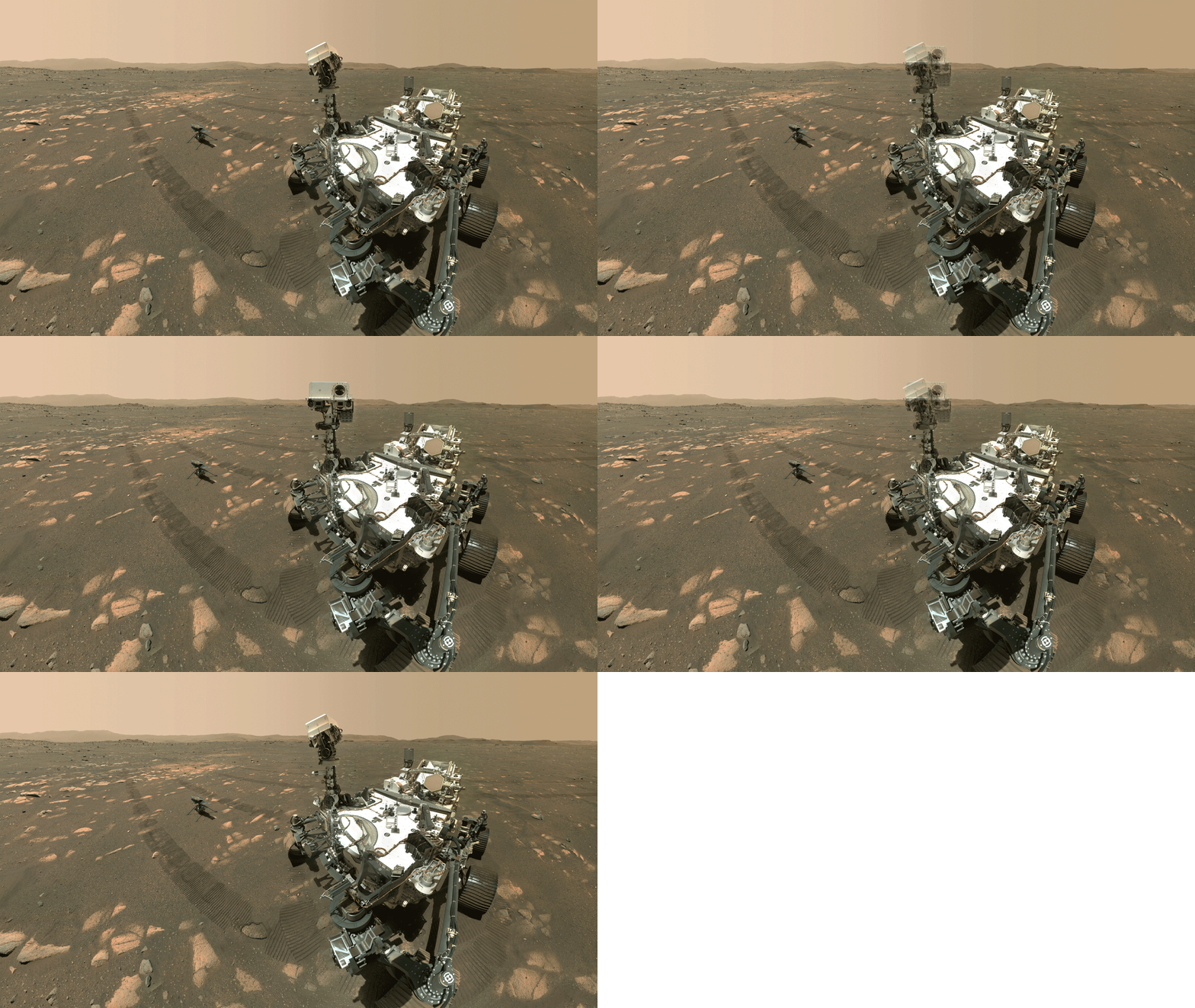
Mars 2020 mission Sol 46 (April 6th), 2021, a series of 62 images captured using the WATSON imager on the robot arm of the Perseverance rover were used to create this “selfie” of the rover “looking” at the camera, then back at the Ingenuity helicopter sitting on the ground some 4 metres away. Credit: NASA/JPL
NASA has delayed the first flight of the Ingenuity helicopter on Mars after the vehicle detected an issue during one of its pre-flight tests.
For the past week, the agency has been preparing the little helicopter drone, part of the Mars 2020 mission, for the first of a series of 5 pre-planned test flights within Jezero Crater. It had been hoped the flight could take place on Sunday April 11th / Monday April 12th, 2021 (depending on where you are in the world); however it will now not take place until Wednesday, April 14th at the earliest.
After being dropped on the surface of Jezero Crater by the Mars 2020 Perseverance rover (see my previous space Sunday report), Ingenuity successfully recharged its batteries using solar energy and survived its first night alone on Mars without incident. This was a major milestone for the project, as there were fears that if the batteries couldn’t be fully charged and generate sufficient heat, the extreme cold of the Martian night could freeze the vehicle’s electronics, and even crack the batteries themselves.
Since that first night, the helicopter has shown it can keep itself warm and the flight team has spent the week conducting a range of pre-flight checks, including unlocking Ingenuity’s pair of contra-rotating propellers and then testing them under power and at low speeds, then speeding up to higher speeds, including an attempt to reach the 2400 rpm required for take-off.
Part of testing Ingenuity included taking a low-resolution image via its downward-looking camera system while it was still sitting under the rover. April 3th, 2021 / Sol 42. Credit NASA/JPLAll of these tests were completed successfully, with the exception of the final full-speed test attempted on Friday, April 9th. This aborted during the phase when the command programme on Ingenuity was supposed to switch from “pre-flight” to “flight” mode, as will be required ahead of the actual flights. However, a guardian “watchdog” timer designed to oversee the correct execution of command sequences expired before the switch-over occurred, prompting Ingenuity to safely shut-down its motor and await further instructions from Earth.
Following a full evaluation of telemetry received following the curtailed test, the flight team were confident that no actual damage had occurred to the helicopter, stating the full spin-up test of the rotors would be postponed and the flight itself delayed until April 14th. They also indicated that assuming the first flight was completed without incident, the second flight will take place on Sunday, April 18th.
The rotor tests took place once Perseverance was well clear of the helicopter – the rover is gradually making its way to the look-out point where it will record Ingenuity’s flights. However, before it did so, engineers took the opportunity to use the WATSON (Wide Angle Topographic Sensor for Operations and eNgineering) camera on the rover’s robot arm to capture a series of 62 images that were stitched together to produce a picture of Perseverance apparently “looking” back at the helicopter using its mast cam imaging systems, and which can be seen at the top of this article.
Another image Perseverance took that recently caused excitement was one that appeared to show a “rainbow” arcing across the dusty Martian sky. Captured on April 4th (Sol 43), the image spread quickly across social media, as did the “rainbow” explanation.
Captured on April 4th (Sol 43), this image via the rear-facing Hazcam system on Perseverance caused excitement in the media, being described as a “rainbow”. However, it wasn’t any such thing, as NASA was forced to explain. Credit: NASA/JPL
The only problem being, rainbows are impossible on Mars, as NASA quickly stepped in to note through social media:
Many have asked: Is that a rainbow on Mars? No. Rainbows aren’t possible here. Rainbows are created by light reflected off of round water droplets, but there isn’t enough water here to condense, and it’s too cold for liquid water in the atmosphere.
Rather, the “rainbow” was the result of lens flare – light being scattered by the lens of the Hazcam (HAZard avoidance CAMera) that captured the image, to strike the imaging sensor in multiple places like an arc of machine-gun bullets. Such effects are prevented on the front-facing Hazcams (the ones most frequently used by the rover, as they are equipped with sunshades; however, similar shades were deemed superfluous on the rear-facing Hazcams, and so lens flares like this are actually quite common should the system be in use and the Sun happens to be in the right position.
Ingenuity hangs under the belly of Perseverance at the end of several days of initial deployment.Credit: NASA/JPL
This past week has seen the Mars helicopter Ingenuity successfully deployed onto the surface of Mars in readiness for its first flight – although NASA has announced the flight itself has been delayed.
As I noted in my previous Space Sunday report, the helicopter was unpacked over several days (the work actually commencing prior to that report appearing). It took several days because each stage of the deployment had to be verified to ensure it had been correctly completed using the WATSON camera on the rover’s robot arm imaging the helicopter from several angles after each phase of the deployment so that engineers on Earth could confirm everything looked correct. However, everything went as expected, and by March 31st (UTC), Ingenuity was in an upright position under the rover, but still connected to it via the power umbilical and backplane support.
At this point proceedings were paused whilst systems were given a final check-out prior to the command being given to release the helicopter to drop the 10-13cm down onto the Martian surface. Once released, Ingenuity would be on its own power-wise, with a limited period in which to charge up its batteries using sunlight, so the engineering team wanted to run through final verification that everything was OK.
On Sunday, April 4th, the Jet Propulsion released images revealing that final step of deployment had been completed, and Ingenuity is standing on Mars, Perseverance having moved several metres away to establish line-of-sight communications with the helicopter.
Caught by the Hazcam system on Perseverance, Ingenuity sits on the surface of Mars after the rover had initially moved away from it following release. This image was taken on mission Sol 43 (Sunday, April 4th, 2021) at a local mean solar time of 15:14. It is a raw image that has not been white balanced for Earth lighting. Credit: NASA/JPL
The next challenge is to ensure the solar cells that the very top of the rotor mast are able to provide energy to the batteries, which can only survive 25 hours without recharge now Ingenuity has been separated from the rover.
It had been hoped that the first in a sequence of five planned flight tests would commence on Thursday, April 8th. However, this has now been delayed until Sunday, April 11th, at the earliest.
A further view of Ingenuity sitting in Jezero Crater after the rover has moved further away. Sol 43 (April 4th, 2021)
The delay is to allow for a full regime of tests to be carried out on the helicopter – which has gained the nickname “Ginny” among the engineering and flight team at JPL – including its ability to survive the harsh cold of Martian nights and then recharge its batteries during daylight hours. Should all go according to plan, Perseverance will capture the flight, and images / video from both the rover and the helicopter will be released on or shortly after April 12th.
Providing the first straight-up-hover-straight-down flight is a success, the flight team will move on to the remaining four pre-flights for the helicopter, which the hope to complete well inside the 30-day window allowed for the tests – and potentially complete more, if there is sufficient time left before Perseverance must turn to its now duties and say “bye-bye” to Ingenuity.
Following the first flight, Ingenuity will perform a more complex series of flights, such as the one shown above. Credit: NASA/JPL
When it does commence its own science work, Perseverance may not initially travel too far from the helicopter’s flight zone: whilst Ingenuity was unfolding beneath it, the rover’s team became increasingly intrigued by a green-tinted rock a short distance away.
The yet-to-be-dubbed rock is thought to be a possible meteorite or a piece of bedrock that may have been “popped” up from under the layers of sedimentary rock on which the rover is parked. However, the science team will not be drawn on any conclusions until Perseverance has had the chance to get up close to the rock and focus all of its attention on it. Thus far, the rover has only been able to image the rock using its Mastcam-Z system and zap it a few times with the SuperCam laser system.
That the rock – roughly 15 cm in length – might be a meteorite is not beyond the bounds of possibility: Perseverance’s “sister” rover, Curiosity, happened upon a similar odd rock sitting on the landscape in 2014. Once its duties watching over Ingenuity have ended, Perseverance will be able to devote its full attention on the rock, further utilising its SuperCam laser and spectrometer, as well as the SHERLOC and WATSON combination on its robot arm in an attempt to decipher the rock’s mystery.
The interesting rock – possibly a meteorite – Perseverance has been studying from a distance whilst the Ingenuity helicopter deployment has been underway. Credit: NASA/JPL
Meanwhile, and half a world away, Curiosity has been busy as it continues its investigations of “Mount Sharp”, the 6 km high mound of deposits left in the centre of Gale Crater, the result of multiple periods of flooding.
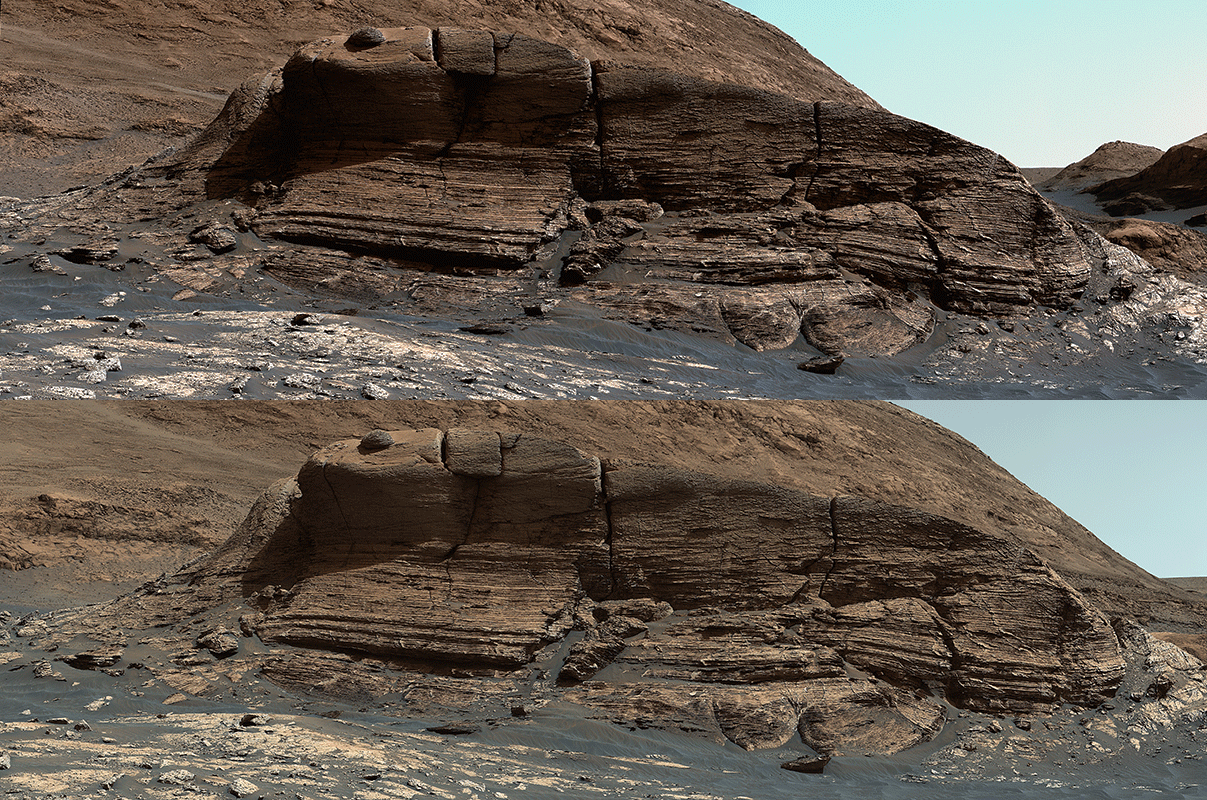
At the start of March, Curiosity commenced it most recent science campaign, examining an impressive 6 metre high rock formation dubbed “Mont Mercou” after a mountain in France close the village of Nontron, which is being used to generate monikers for features in the area the rover is exploring due to the presence of nontronite, a type of clay mineral (also named for the village) within the area.
A 3D view of “Mont Mercou” created from a total of 32 images captured by Curiosity on Sol 3049 of its mission – March 4th, 2021. It was made by taking 16 images from one location and then moving 4 metres to take a second set. The resulting stereoscopic effect helps scientists get a better idea of the geometry of the mound’s sedimentary layers, as if they’re standing in front of the formation. This finished view has been coloured balanced to match Earth-type lighting conditions. Credit; NASA/JPL
An art’s impression of the Ingenuity helicopter on Mars. Credit: NASA
If all goes according to plan, on Thursday, April 8th, we could be witnessing the first powered flight of an aerial vehicle on another planet as the blocky Ingenuity helicopter, part of NASA’s Mars 2020 mission, takes to the air for the first of what should be at least five proof-of-concept flights.
The helicopter itself is not a particularly exciting thing to look at: a cube-like fuselage no more than 20 cm across on its longest side that contains the vehicle’s avionics, a heater system to keep the sensitive circuitry warm and operating, a battery system to provide energy to the headers and the vehicle’s propellers, and its science systems. It is supported by four spindly legs just 38 cm long, and is topped by a mechanism of two contra-rotating co-axial rotor systems measuring 1.2 metres from tip-to-tip, with the main communications antennae above them, topped by the solar panels hat will be used to recharge the vehicle’s batteries.
Ingenuity and its systems. Credit: NASA
However, looks can be deceptive. Ingenuity is actually a highly capable aircraft and spacecraft combined. Its systems were designed to withstand 6+ months of interplanetary space travel , while its flight systems have been designed to get it into the air on a planet where the atmosphere is only about 1⁄100 as dense as Earth’s.
To put that in perspective: Ingenuity will be attempting to lift off in an atmospheric density that matches our own at 30,000 metres – that’s almost four times the height of Mount Everest and a height well beyond the capabilities of any Earthbound helicopter. And where the lower gravity of Mars means Ingenuity ways just one third as much as it does when measured on Earth, this offers little in the way of compensation for the rarefied atmosphere.
Hence why Ingenuity is a proof-of-concept vehicle: just getting aloft with be a tremendous achievement – but if it can be shown to do so repeatedly, and to manoeuvre successfully, it could dramatically alter future robotic and human missions to Mars by providing aerial support for them as terrain scouts or standalone science vehicles carrying their own payloads operating remotely or – in the case of human missions – flown drone-like from a base of operations.
The first phase of operations for the mission was for Perseverance to scout the land close to its landing point – Octavia E. Butler Landing – to find a suitable area of level ground over which Ingenuity can fly. This required finding an area some 90 metres in length and roughly 12-15 metres wide relatively clear of significant obstacles that might limit landing options., and with an area 10 metres on a side from which the first flight will be made and which has been dubbed “the airfield”.
The flight zone and “the airfield”, the area in which Ingenuity will be test flown. Credit NASA
This deployment requires a number of actions to occur, the first of which came on Sunday, March 21st, when the cover that had been protecting Ingenuity was dropped from under the rover (see my previous Space Sunday update). Once Perseverance is correctly positioned at the centre of “the airfield”, the rest of the deployment will take place over a period of 6 Martian sols (days):
Sol 1: restraining bolts locking Ingenuity in place under the rover will be released.
Sols 2 and 3: a cable also holding the helicopter will be explosively released, triggering a motor that will gently rotate the helicopter down into an upright position beneath the rover, allowing two of Ingenuity’s landing legs to spring into their deployed position in the process.
Sol 4: the remaining two legs on Ingenuity will be released to snap into place. At this point, the helicopter will be slung under the rover, held in place by a single bolt and a set of power connectors.
Sol 5: Perseverance will carry out a full charge cycle of Ingenuity’s batteries – until now, the rover has only charged the batteries to around one-third their capacity, enough to keep the helicopter’s system warm.
Sol 6: The rover will be commanded to release the helicopter, allowing it to drop the 13 centimetres to the ground.
At this point, things will get a little risky: there will be no means to communicate with the helicopter, and its batteries can only supply it with power for 25 hours without recharge. In this time, a final visual check on Ingenuity must be carried out using the WATSON imager on the rover’s robot arm, and then the rover must carefully reverse away from the helicopter to a distance of 5 metres.
Once at this distance, the rover will be able to act as a communications relay between mission control and the helicopter, allowing mission control to command the helicopter to switch to charging its batteries from its solar cells and upload the required flight software.
In all, the flight team have 30 days from the moment Ingenuity is released from Perseverance to complete the planned five flights. After this time, the rover must commence its own science programme. The flight team will therefore be looking to complete those five flights in as short a space of time as possible. For the first flight, Ingenuity will do little more than attempt to rise to a height of 3 metres, hover for 30 seconds and then land safely. After this, the remaining four flights will be for longer and to heights of around 5 metres, and for increasing distances down “the airfield”.
If we get past those [flights], we will assess: did we meet all our objectives during those flights? Do we want to go back and retry some of those things? Or, if everything goes really well, then we might try to stretch our capabilities beyond those basic capabilities.
– Ingenuity chief pilot Håvard Grip
The late Jakob van Zyl after whom the elevated position from which Perseverance will observe Ingenuity’s flights has been named. Credit: NASA
All of the flights will hopefully be documented by Perseverance its powerful Mastcam-Z camera system and two on-board microphones from an observation point some 60 metres from “the airfield”, which it will drive to prior to the first flight.
This observation point has been dubbed the Van Zyl Overlook in honour of key Ingenuity team member Jakob van Zyl, the former director for solar system exploration and associate director for project formulation and strategy at NASA’s Jet Propulsion Laboratory, who passed away unexpectedly in August 2020.
When it makes its flights, Ingenuity will both make history and carry a piece of history with it: attached to the Helicopter is a small piece of fabric taken from the Wright Brother’s 1903 biplane, credited with making the he first powered, controlled flight on Earth on December 17th, 1903.
‘Oumuamua is Likely a Piece of a Planet
In 2017 the Pan-STARRS astronomical observatory in Hawaii identified an object of extra-solar origin on a course that would carry it around the Sun. Named ‘Oumuamua, meaning “scout” or “messenger” in Hawaiian, it was the first such object to be positively identified as coming from beyond the solar system, although it is now believed that as many as five such object could pass through the solar system every year.
‘Oumuamua, however, was not only the first to be positively identified, it was also highly unusual – so much so that it couldn’t be classified as either an asteroid or a comet, as it exhibited behaviour common to both – and behaviour and attributes not found in either. This has lead to a variety of possible theories being put forward for it might be – up to and including the idea it was actually an interstellar probe created by an alien intelligence.
An artist’s impression of 1I/2017 U1 (or `Oumuamua), which was first seen by the Pan-STARRS 1 telescope in Hawaii on October 19th, 2017, and subsequently studied by a number of telescopes around the world, including the VLT of the European Southern Observatory (ESO). Credit: ESO / M. Kornmesser
However, two astrophysicists from Arizona State University believe they now have solved the mystery of ‘Oumuamua.Taking the more comet-like behaviours of the object, Steven Desch and Alan Jackson started looking for combinations of ices and volatiles that, when affected by the heat of the Sun, who produce the kind of reactions seen with ‘Oumuamua.
Their research lead them to a combination of nitrogen-dominant ices that, under computer modelling, not only produced the kind of non-tail generating outgassing seen with ‘Oumuamua, they they closely match combinations of nitrogen, methane and other ices found on Pluto and Neptune’s moon Triton.
These findings, coupled with further computer modelling, tend to suggest ‘Oumuamua is likely a part of a Pluto-like planet orbiting a star somewhere in our stellar neighbourhood (separate estimates of data gathered on the object suggest it is around a billion years old, so must has originated fairly close to us, given its observed velocity through the solar system). If correct, then Densch and Jackson may not only have solved the nature of ‘Oumuamua , they may have shown that a new class of exo-planets exists: so-called “exo-Plutos”.
A stunning image of Starship SN9 standing on the Boca Chica launch platform framed by a low Sun. Credit: Mary “BocaChicaGal”
In December 2020, and following the not-quite-successful flight of Starship prototype SN8, SpaceX suffered what might have been a further setback in their flight test plans for the Starship vehicle, when prototype SN9 toppled sideways whilst in the stacking facility at the company’s Boca Chica, Texas, construction and flight test centre (see: Space Sunday: the flight of SN8 and a round-up).
However, the vehicle was quickly righted and following examination, work commenced on repairing / replacing the damaged elements (notably one of the forward aerodynamic surfaces). This work proceeded at a surprising pace; so much so that on December 22nd, 2020, it was delivered to he Starship launch platform.
Since then work has continued at the same rapid pace, such that within the two weeks since its arrival on the stand, SN9 has completed the majority of its pre-flight checks that took around 2 months to complete for SN8. These included initial fuel tank pressurisation tests using inert liquid nitrogen (to test the tanks and structure for leaks), partial and fuel test fuelling operations, vent system tests, testing of the reaction Control system (RCS) thrusters that help maintain the vehicle’s orientation in the atmosphere and will provide manoeuvring capabilities in space, and even a full static fire test of the vehicle’s three Raptor engines, which took place on January 6th.
SN9 static fire engine test. Credit: Mary “BocaChicaGal”
Two tests were skipped in the process – but this is seen as not so much because the company is trying to make up for any “lost time”, but rather the result of growing confidence in the process of taking a prototype vehicle from fabrication to test flight. However, while the engine firing was successful, it was somewhat shorter than those for SN8 – the Raptors fired for less than 2 seconds – so it is not clear whether or not an issue was encountered, forcing a premature shut-down. If this is the case, then it might be that further static fire tests may be announced ahead of any flight; if the brief firing was intentional, then it is possible a flight test could come within the next week or so.
As it is, the exact date of any actual flight test for SN9 – which will seek to repeat the 12.5 km altitude reached by SN8, but hopefully follow it with a successful landing – hasn’t been confirmed. However, to avoid a repeat of the SN8 crash, SpaceX CEO Elon Musk confirmed that the Methane header tank – a smaller tank designed to feed fuel to the Raptor motors during the landing sequence – for SN9 and at least some of the prototypes that follow it will be “pressed” with helium (this is, helium will be forced into the tank in order to force the methane out and to the engines) in order to avoid any pressurisation issues. However, it is not clear if this will be the permanent solution to the problem, or an interim update to allow test flights to continue whilst SpaceX develop a more permanent solution to the problem.
A diagram showing Starship and Super Heavy prototype development. On the left, SN9 is complete, and awaiting its flight. SN10 is awaiting Raptor motor installation and the attachment of its aft flaps, and SN11 has yet to have its upper sections installed and is awaiting its tail flaps and motors. All of the major hull elements of SN12 have been fabricated but have yet to be assembled. The diagram also show the assembly of SN15, which is will in advance of SN13 and SN14, while to the right is the status (as of January 9th) of the first Super Heavy prototype. Credit Brendan Lewis
At the same time as pre-flight tests have been continuing with Starship SN9, work has been continuing with a number of further prototypes. SN10 very close to completion, with just engines and aft aerodynamic flaps to be mounted, and SN11 will be receiving its upper sections in the coming week. Further down the chain, SN15 is also progressing, as is SN16. These will likely be the first two prototypes fully fitted with the thermal protection system used to safeguard the vehicle’s hull during atmospheric entry. This doesn’t necessarily mean either will make an orbital flight – SpaceX will doubtless want to text how the entire thermal system holds up under atmospheric flight prior to committing to an orbital attempt.
However, work currently appears to be on hold for vehicles SN13 and SN14, and SN12 has yet to be stacked. Whether these vehicles will be completed remains to be seen: Musk has previously indicated that the SN15 vehicle and beyond will include “significant upgrades” compared to earlier vehicles, so it is possible SpaceX may opt to skip from SN11 to SN15 in the flight test programme.
An image demonstrating the relative size of SpaceX vehicles and the shuttle. Left: the Crew Dragon – capable of flying up to 7 into LEO; right: a starship vehicle with a shuttle orbiter alongside. The orbiter could carry up to 7 into LEO with up to 28 tonnes of cargo. Starship can carry up to 100 people + cargo or up to 100 tonnes (cargo variant) to LEO. A Tesla 4×4 and human are included for scale. Credit: Dale Rutherford
Puerto Rico Governor Supports Rebuilding Arecibo
The outgoing governor of Puerto Rico, Wanda Vázquez Garced, signed an executive order on December 28th, 2020 backing the rebuilding of the 305-m diameter Arecibo radio telescope that collapsed in November 2020 (see: Space Sunday: returns and a collapse).
The order states that US $8 million is to be “assigned and allocated” for removing the debris of the collapsed telescope and “remedial environmental” work be completed at the site. It further states that the Puerto Rico government wishes to see the development of a telescope with a larger effective aperture, wider field of view and a more powerful radar transmitter to replace the original, thus providing the nucleus of “a world class science and education facility”.
Arecibo as it was: visible is the main dish with the central receiving platform suspended over it via the three towers. Credit: NASA
However, things are not as clear cut as this. For one thing, the construction of a new telescope is liable to cost more than ten times the funding stated in the order. It’s also not clear where the $8 million will come from; the order only suggests it could be provided through “state, federal and private sources (including public-private partnerships and state-federal partnerships)”.
More particularly, Arecibo is not under the funding auspices of the Puerto Rican government, but rather that of the National Science Foundation (NSF), which it turn is funded directly by the US government. Thus far, the NSF has not committed to any rebuilding / replacement at the site, nor have any funds been allocated by Congress in the 2021 federal budget – although the NSF has been directed to prepare a study / report on the telescope’s collapse, the clean-up operation and to determine whether a replacement / comparable facility should be established at the sit, together with the associated costs for doing so.
After the fall: the telescope after the collapse of the receiving platform (the wreckage of which can be see to the right of the disk. Also clearly visible is the scar where the collapsing platform and cables tore through the disk. Credit: NASA
NSF has a very well-defined process for funding and constructing large-scale infrastructure, including telescopes. It’s a multi-year process that involves congressional appropriations and the assessment and needs of the scientific community. So, it’s very early for us to comment on the replacement.
– Ralph Gaume, director of NSF’s Division of Astronomical Sciences
Jupiter (bottom and brighter) and Saturn as seen between the sails of the post windmill at Brill, Buckinghamshire, UK. Credit: Jim Dyson / Getty Images
Monday, December 21st, the winter solstice, saw Jupiter and Saturn reach their closest point of mutual approach to one another when viewed in our evening skies, in what is referred to as a great conjunction.
I covered the event in some detail in my previous Space Sunday report, noting that 2020 would see the two planets appear to come with 6 arc minutes of one another as they lay low over the south-western horizon in last light following sunset.
Caught via a camera with telephoto lens is Jupiter (l) with the Galilean moons also visible (from top left: Calisto, Io, Europa, and furtherest out, lower right, Ganymede). Saturn, to the right, appears as a distinct oval due to its ring system not being sufficiently resolved by the camera lens. Credit: Peter Jay / Getty Images.
Unfortunately, British weather being what it tends to be, I didn’t get to see things on the night thanks to cloud and rain. To add insult to injury, the skies were clear just 40 km away, allowing friends to witness the event on the night, while the rain and cloud continued here most of the rest of the week, preventing me from getting a further look at the two planets as they dropped ever closer to the horizon. Ho hum.
Not of this Earth: Jupiter and Saturn with rings visible, as seen on December 21st from lunar orbit in an image captured by NASA’s Lunar Reconnaissance Orbiter. Credit: NASA
Fortunately, however, many around the world did have clear skies and captured the event using cameras equipped with telephoto lenses or attached to telescopes. I’ve included a handful of my favourites shots here.
The event was also captured on film by Jason De Freitas, who captured the space between Jupiter and Saturn being neatly “cut” by the passage of the International Space Station.
ET Probably Isn’t Radioing Us
A radio signal detected in a part of the sky that neatly aligns with our closest stellar neighbour, Proxima Centauri, is unlikely to be of extra-terrestrial origin.
The radio burst was detected in April-May 2019 by the Parkes Radio Telescope in Australia, one of two radio telescopes used by the Breakthrough Listen project, which since 2015 has been listening to the one million closest stars to our own in an attempt to pick up artificial radio signals that might indicate extraterrestrial intelligence.
The primary 64-metre radio telescope dish of the Parke observatory, New South Wales. Credit: John Sarkissian
At the time the signal was detected, the telescope was engaged in radio observations of Proxima Cantauri, some 4.2 light years away, and a star known to have two planets orbiting it, one of which – Proxima b – is a rocky world about 1.7 times the size of Earth that sits within the star’s habitable zone.
Parkes wasn’t listening for radio signals at the time they were picked up, but was engaged in radio observations of flare activity from the star. However, when detected, the signal was immediately intriguing due to its relatively narrow frequency – 982.002Mhz – which ruled out it being caused by known natural phenomena. In order to verify it, the Breakthrough Listen team received permission to “nod” the telescope dish.
This is a common technique used to verify radio signals that involves deliberately swinging the receiving dish away from a signal for a period of time, and then back towards it in order to see if it can be re-acquired (indicating it is not an artefact of the telescope itself), and to measure whether the signal has moved relative to the dish (which would indicate the source is likely in Earth’s orbit). In this case, the signal was reacquired, with measurements suggesting it could be emanating from Proxima b.
When news of the signal, and the on-going analysis to try to determine it’s likely point of origin / cause, was anonymously leaked recently, it was picked up by a number of media outlets and caused something of a stir. However, before ET Hunters get too excited, there are a number of additional facts to consider.
Firstly, it is devoid of any modulation – and so is likely devoid of any meaningful data, were it indeed to by an extra-terrestrial, which makes sending it a little pointless. Secondly, it was entirely transient; following the period of initial detection in April / May 2019, it was “lost”, and has never been re-acquired. Were it a deliberate signal, it would not be unreasonable to expect it to remain fairly constant in terms of detection, either by Parkes or (preferably) other centres around the world.
But the biggest counts against it being ET “‘phoning home” (or at least us), lies with the fact that the signal came from the general direction of Proxima Centauri. As our nearest, and oft-observed stellar neighbour, the star has been under observation for decades, and nary a once have we received anything amounting to an peep out of it that might suggest aliens are playing with radio systems there.
More particularly, however, is the fact that Proxima Centauri is a red dwarf star. As I’ve noted numerous times in these pages, these M-class stars are prone to exceptionally violent solar flare. Given the close proximity of Proxima b to its star, these flares would likely, at a minimum, be bathed in hard radiation, and at worse, completely rip away the planet’s atmosphere within a period of around 100-200 million years. Therefore, it is highly unlikely the planet really is the point of origin for the signal.
An artist’s impression of Proxima b with Proxima Centauri low on the horizon. The double star above and to the right of it is Alpha Centauri A and B. Credit: ESO
instead, the most likely explanations for the signal are that it might either be something like the carrier wave from a long-forgotten piece of orbital debris of human manufacture or – mostly likely – actually originated on Earth, with conditions in the upper atmosphere serving to “bounce” it into the Parkes Telescope sphere of detection.
The Breakthrough Listen team and their partners certainly lean towards the latter as an explanation, although as noted, they are still analysing the data gathered on the signal.
This is not a natural phenomenon—I haven’t seen the data, but if it passed BL’s tests then it’s too narrowband to be natural. It’s definitely caused by technology. But it’s almost certainly our own technology.
– Jason Wright, Professor of Astronomy and Astrophysics at Penn State University
For those who have not already seen it, the next two weeks present an opportunity to witness a unique event – a very close conjunction between Jupiter and Saturn.
“Conjunction” is the term astronomers used to describe two astronomical objects or spacecraft having either the same right ascension or the same ecliptic longitude, and thus when seen from Earth, appear to be close together.
With the planets, such events are not especially rare – in fact as they and the Earth circle the Sun, conjunctions between Jupiter and Saturn tend to occur once every 20 years. However, most of these only see Jupiter and Saturn close to around one degree of one another, or about one-fifth the diameter of the Moon as seen from Earth. But sometimes they appear to get much closer, creating what is referred to as a “great conjunction”. This year, the two planets will appear to be just 6 arc minutes apart as seen from Earth on December 21st, 2020; so “close” (remembering that their respective orbits around the Sun will still be separated by 883 million km), they will almost, but not quite, appear as a single point of light when seen with the naked eye.
The great conjunction between Jupiter and Saturn,, tracked from October through to December 21st. Credit: Pete Lawrence
These “great conjunctions” occur, on average, once every 300-400 years, although such is the nature of orbital mechanics, they can actually occasionally occur more frequently, or have longer time gaps between them. As it is, the last time Jupiter and Saturn appeared as close as the will be between December 20th and 22nd was in 1623, not long after Galileo had observed both planets – although he was unable to witness the event, as the rising Sun would have rendered them invisible in its glare.
What is most rare is a close conjunction that occurs in our night time sky. I think it’s fair to say that such an event typically may occur just once in any one person’s lifetime, and I think ‘once in my lifetime’ is a pretty good test of whether something merits being labelled as rare or special.
Astronomer David Weintraub
However, the two planets can appear to be much closer. In 1226, and in the skies over the Mongol Empire, when the planets appear to be just 2 arc minutes apart.
Jupiter (again, the brighter object) and Saturn, seen in the sky over the Shenandoah National Park, Virginia, on December 13th, 2020. Credit: Bill Ingalls/NASA
Tracing these great conjunctions back in time reveals that Jupiter and Saturn may well have played a role in the legend of the Star of Bethlehem. In 7 B.C. not one, but three great conjunctions occurred, with the two planets again being within 2 arc minutes of one another as seen from Earth.
The first occurred in May of that year, when Jupiter and Saturn appeared as a morning star over the middle east. As the Magi were practitioners of (among other things) astronomy and astrology – both at that time pretty much joined at the hip – such an event may well have caused them to start out on their long journey towards Judea, the second conjunction, in September of the year, encouraging them to continue. The third conjunction occurred in December, 7 B.C., the time at which they were said to have met with Herod the Great.
Using Stellarium, open-source astronomy software, it is possible to reproduce how the great conjunctions of the 6th century B.C. might have looked to the Magi, as a wondrous new star, causing them to set out for Judea. Credit: Stellarium
This year’s conjunction will be not long after sunset, with the two planets located low over the south-west horizon. With a reasonable telescope or good pair of binoculars, you’ll have an ideal opportunity to see both planets and their major moons in the same field of view. Should you do so, you’ll be looking at over 90% of the planetary mass of the entire solar system.
Beyond the 21st, the two planets will gradually move “apart” as noted, until by the 25th December, they’ll be separated in the night sky by roughly the diameter of a full Moon, and will continue to draw apart relative to Earth as they pass below the horizon.
How to see the “great conjunction” of Jupiter an Saturn
And if you miss this close conjunction between the two, the next will be along in a relatively (and unusually) short period, occurring on March 15th 2080. The next time they’ll be as apparently close as they were in 7 B.C. will be on Christmas Day, 2874.







 Inara Pey: Living in a Modemworld