Space Sunday: SpaceX, NASA and interstellar visitors

SpaceX Starbase, Boca Chica, September 7th, 2021: to the left, Booster 4 stands on the launch table, the launch support tower standing over it. To the top right is Starship 20 sitting on sub-orbital pad B, with the lower half of Booster 3 (the upper tank section of which was cut off and removed in August. Credit: RGV Aerial Photography

SpaceX is continuing to move towards a first flight-test ready stack of its massive Super Heavy vehicle and a proof-of-concept Starship payload carrier – although there is still some way still to go before an actual launch attempt can be made.

Following the test stacking of Booster 4 and Starship 20 on the launch table back in August (see Space Sunday: the Ups and Downs of Space Vehicle Development), Booster 4 was rolled back to the production facilities at the company’s Starbase centre at Boca Chica, Texas, to undergo a number of revisions.

Chief among these has been modification to the vent valve system, nominally used to allow excesses gaseous oxygen and methane to be vented from the rocket’s tanks as it naturally “boils off” due to temperature differentials the vehicle experiences when fuelled ahead of a launch. In particular, the vents for the booster’s lower tank now have covers that direct any gas downwards along the rocket’s body, and the vents for the upper tank force the gas outwards and away from the rocket.

Booster 4 re-departs the production facilities at Starbase to drive the 1.5 km down the road to the launch facilities Credit: StarshipGazer.com

This suggests that SpaceX plan to use the release of gas from the tanks as a means to help control the orientation of the rocket during its descent back through the atmosphere in a manner similar to a more traditional reaction control system (RCS). If this proves to be successful, it means SpaceX have further reduced Super Heavy’s mass by avoiding the need for separate RCS systems and tankage.

Another issue with rockets is that as the fuel tanks empty they lose internal pressure, and this can interrupt the steady flow of propellants to the engines. To prevent this, most launch systems utilise a reserve of helium that can be fed into the tanks as the propellants are burnt, maintaining the necessary tank pressure. To remove the mass created by a helium system, SpaceX have opted to use the rarer option of autogenous pressurisation. This draws a small flow of heated propellants before they reach the engines, and feeds this flow – in gaseous form – back up the outside of the rocket via dedicated pipes to be returned to the fuel tanks to re-pressure them.

The new vent systems and the piping of the autogenous pressurisation feeds where clearly visible as Booster 4 was rolled back to the orbital launch facilities on Tuesday, September 7th, and hoisted back onto the launch table, with the speculation iit may remain there until the actual launch attempt.

Two views of Booster 4 showing the revised excess gas vents from the top of the lower tank tank and the autogenous pressurisation feed pipes, Also visible is the black mass of the QD Arm. Credit: What About It

When this will be is unclear; the operation to hoist the booster into position showed the launch table itself is still being completed, being wrapped in scaffolding. It’s also not clear how much of the necessary propellant and electrical feeds have been installed in the launch support tower – although the Quick Disconnect (QD) arm that actually feeds propellants into the starship vehicle and provide it and the booster with electrical power has been installed (with further additions to come). Similarly, the actual tank farm that will supply consumables – water, propellants, etc., – to the pad to enable launches.

Even so, SpaceX CEO Elon Musk has suggested an initial static fire test with Booster 4 could come within the next week. Even if the majority of the required plumbing, etc., is in place, this seems possibly ambitious,  given that such a test will likely only come after at least one each of cryogenic propellant loading / pressurisation tests to ensure the system is ready for any static fire test.

How many static fire tests might be run is unclear; its unlikely that SpaceX will want to fire all 29 engines in the first test but will likely build up to it – perhaps starting with the three motors at the centre of vehicle, followed by a firing of all nine of the middle engines before progressing to firing all 29 engines. And it should be remembered any of these tests, from pressurisation through the engine firings, could result in the rocket sustaining damage or even being completely destroyed.

Booster 4 being gently lowered into the launch table ring mount at the Starbase orbital launch pad. Notes the amount of construction scaffolding still in place. Credit: Nic Ansuini / NASASpaceflight.com

After the August stack test, Starship 20 was moved from the the orbital launch pad to sub-orbital launch pad B, where it has been undergoing an extensive examination of its thermal protection system (TPS) designed to protect it during entry into the atmosphere. The tiles on this system appear to have suffered more than the anticipated amount of stress / damage due to it being lifted up onto the booster by its snout in order to be stacked on the booster, requiring a lot of them to be replaced and others refitted / re-aligned. This work is now drawing to a close, but does point to a need for the tile system to be more robust during vehicle moving / operations.

Most recently, the vehicle has been receiving the six Raptor motors that will power it. This has sparked speculation that once this work is complete, Starship 20 could be ready to start its cryogenic and fuel pressurisations tests ahead of static firing test – again, possibly the inner three first, then all six.

How it started and how it is going: two shots indicating the number of Starship 20 heat shield tiles that needed to be completely replaced (red tags) or which required refitting / realigning (green tags) following the operation to stack and remove the vehicle on its booster in August. Credit: NASASpaceflight.com

A final element key to any launch attempt (and the full booster static fire test) is the granting of permission and a licence by the Federal Aviation Administration, which appears to be rightly determined not to be rushed into giving the OK whilst it is still conducting an extensive review of the Starbase facilities and their overall suitability for Super Heavy / starship launches  in the event of an accident (particularly after the airborne explosion of SN11in march 2021 resulted in debris falling to earth 8 km from the SpaceX facilities and close to a populated area).

Continue reading “Space Sunday: SpaceX, NASA and interstellar visitors”

Space Sunday: the ISS, SLS, brown dwarfs and other bits

The ISS as of September 2021, showing the newly-arrived SpaceX CRS 23 resupply vehicle docked alongside the Crew Dragon Endeavour. At the far end of the station are the Russian modules: the recently-arrived Nuaka, Zvezda and Zarya, which has been found to have small fissures in its outer skin. Credit: NASA

Some sections of the tabloid media became excited this week about “cracks” being discovered “on the International Space Station”, with one or two predicting the end of the ISS is now nigh.

The cause of the reports was the announcement by Energia NPO, the company responsible for fabricating the Russian-built elements of the ISS, that “superficial fissures” have been found in the outer skin of the Zarya module.

The Zarya module imaged from the space shuttle Endeavour in December 1998, as the shuttle approach the module in preparation to attach the US Unity module. Credit: NASA

Zarya – also called the Functional Cargo Block (FCB) – was the first module of the ISS to be launched (November 1998), and was initially responsible for providing electrical power, storage, propulsion, and guidance to the ISS during the early years of assembly. However, as more specialised units, notably the Russian Zvezda module (attached to the aft end of Zarya), were launched, the role of the Zarya module has been gradually downgraded to the point where today it is primarily used for internal and external storage space.

Thus far, neither NASA nor Roscosmos have indicated whether or not the fissures have caused any internal pressurisation issues for the station. However, similar fissures – likely the result of exposure to extremes of temperature as the ISS passes between direct sunlight and the cold shadow of Earth and back every 45 minutes – were discovered on the Zvezda Module in 2019, and despite repairs in 2020 and 2021, they continue to be an annoyance.

Whether the Zarya fissures will become a similar issue can only be determined in time – but they are a reminder that while the ISS is not in imminent risk of a major failure, it is genuinely showing its age, particularly the three original modules – Zvezda, Zarya and Unity – all of which are at least 25 years old (including fabrication / construction time), and are potentially becoming increasingly vulnerable to fatigue. Such issues might also cause Russia to make further noises about withdrawing from the ISS after 2024, this time of the grounds of the station’s increasing age, so they can start work on their own space station.

The Accident – the Strangest Brown Dwarf

Brown Dwarfs are sometimes called “failed stars”, in that they have a mass that sits above the most massive gas giant planets we have so far discovered, but below that of the smallest stars. This leaves them incapable of achieving hydrogen fusion, hence the idea they have “failed” as stars. However, they are massive enough to give off considerable infra-red radiation, which tends to point to them being extremely old.

In reviewing data returned by the Near-Earth Object Wide-Field Infrared Survey Explorer (NEOWISE), citizen scientist Dan Caselden has discovered the strangest brown dwarf to so far be discovered – so strange it has been given the nickname “The Accident”.

Located around 50 light years from Earth, it is officially called WISEA J153429.75-104303.3 and classified a Class Y substellar object – the oldest and coolest classification of such brown dwarfs. All of which is really not that interesting; astronomers have discovered many brown dwarfs in local space around our solar system over the last 30 years.

A comparison between a “typical” brown dwarf and other stellar and planetary objects. Credit: NASA

What is strange about The Accident is firstly, it is spinning about its axis at a speed of 200 kilometres a second (that’s 720,000 km/h)- 25% faster than the next fastest stellar object of its kind.

The second – and more intriguing – thing is that The Accident has the oddest brightness pattern of any brown dwarf. Due to their nature, these objects only give off light in the infra-red wavelengths, and The Accident’s output is – at least in part – at the end of that part of the spectrum that points to it being really old: perhaps 13 billion years old – almost as old as the galaxy itself (13.6 billion years. This extreme age is also supported by The Accident’s rotational speed, something that could only be achieved via  thousands of encounters with massive stellar objects down the aeons.

But there’s a twist: The Accident is not consistent in its infra-red brightness, as it also “shines” in parts of the infra-red that indicate that it is a lot, lot, younger than the other data suggest, making the object an anomaly – and accident of nature, so to speak, hence its nickname. This difference in brightness has puzzled scientists, and has led to The Accident starting to get a lot of attention to determine what might be going on inside it.

Some of this attention is also devoted to studying it on the basis of its age – if it really is 13 billion years old, then it formed at a time when the galaxy was a very different place in terms of chemistry, a time when many elements we take for granted (carbon and methane being just two) simply could not exist. Thus, understanding its nature and composition could reveal more about the galaxy’s formation and birth. What’s more, that so strange an object should be found so relatively close to Earth suggests there could be many of these unusual brown dwarfs awaiting discovery.

Virgin Group Ups and Downs

Sir Richard Branson is having some ups and downs in his space endeavours.

The ups are with Virgin Orbit, the smallsat launching service that uses the LauncherOne rocket, lifted to altitude by a modified 747 before being launched, to place payloads of up to 300 KG to a Sun-synchronous orbit or 500 KG to low Earth orbit.

Following the first successful launch of a commercial payload to orbit at the end of June, the company has now passed a critical Federal Aviation Administration (FAA) environmental review that could allow it to use Andersen Air Force Base, on the island of Guam in the western Pacific Ocean, as a base for launch operations.

Virgin Orbit has passed an FAA environmental review that could pave the way for the company to offer payload launchers out of the US territory of Guam in the western Pacific Ocean. Credit: Virgin Orbit

If final approval is granted – and the FAA do have reservations about Virgin Orbit being able to operate from such a remote location – the company plan to use Guam to make up to 25 air launches over a period of 5 years, possibly commencing before the end of 2021.

Following the success of the June launch, Branson noted that Virgin Orbit is to be capable of highly responsive launches from almost any point in the world. To this end, the company has already signed an agreement with Spaceport Cornwall (Newquay Airport) in the UK, and the Brazilian government has selected the company to provide launch services out of that country’s Alcântara Space Centre. These, together with Guam and their existing facilities at the Mojave Air and Space Port mean that Virgin Galactic may soon have four launch locations around the world from which it can reach a variety of orbital inclinations as required by customers.

VSS Unity drops clear of its air launcher, MSS Eve during the Unity 22 mission, ahead of engine ignition. Credit: Virgin Galactic

The down is with Virgin Galactic, the sub-orbital, tourist-focused service. Following its first successful passenger-carrying flight in July (see: Space Sunday: Unity 22 Flies), the FAA announced on September 2nd that the the sub-orbital VSS Unity is grounded, following a review of that flight, forcing a halt to the company’s operations.

The review has been triggered following an article appearing in The New Yorker magazine stating the pilots on VSS Unity ignored a warning triggered during the vehicle’s powered ascent that should have caused them to abort the flight and return the the ground. The warning indicated the vehicle was not climbing at a sufficiently steep angle to remain within it’s “entry glide cone” – the volume of space in which it can make a safe unpowered glide back to a successful runway landing at the end of the flight – during its return to Earth, and so could miss the runway entirely.

While the company has defined The New Yorker’s report as “inaccurate”, telemetry from the Unity 22 mission shows that the vehicle did exceed the limits of FAA-defined “protected airspace” for one minute and 41 seconds during the descent to landing, further justifying the FAA’s decision to order the grounding, preventing any further operations by Virgin Galactic for the next few weeks.

Virgin Galactic had been gearing-up for its next crewed flight for VSS Unity, a dedicated research flight for the Italian Air Force that would carry aloft Colonel Walter Villadei, Lt. Colonel Angelo Landolfi and aerospace engineer Pantaleone Carlucci, alongside Virgin Galactic’s chief astronaut instructor Beth Moses and pilots Michael Masucci and C.J. Sturckow when the ground of the spacecraft was announced. The mission will now not fly until the FAA concludes their review of the Unity 22 flight.

Continue reading “Space Sunday: the ISS, SLS, brown dwarfs and other bits”

Space Sunday: an “existential” rocket, Mars, and a bit on JWST

The Astra LV0006 launch literally goes sideways…

On August 28th, 2021, Astra Aerospace attempted to make the fourth launch of its Rocket 3 vehicle designed to place payloads of up to 150 kg to Sun-synchronous orbits 500 km altitude.

After two unsuccessful and one partially-successful flights of the launch system, it was hoped that this flight, carrying an instrumentation payload for the United States Space Force under the Space Test Program (and which was not designed to separate from the launch vehicle), would be a complete success.

Lift-off from Pacific Spaceport Complex – Alaska on Kodiak Island (high northern latitudes being ideal for polar orbital launches) came at 22:35 UTC, and it was immediately clear the rocket was having something of an existential moment, experimenting with moving sideways away from the launch pad, rather than upwards.

After almost 20 seconds of moving thus, the vehicle decided that “up” was perhaps the better option, and proceeded to climb into the sky, performing more-or-less perfectly through an ascent to 50 km altitude, successfully passing “max-Q” (the period when a launch vehicle experiences the maximum dynamic pressures across its frame) in the process and throttling to full power in a press for orbit.

Sadly, due to the post-lift-off incident, the vehicle had exceeded its range safety limits, risking passage over populated areas on mainland Alaska. The order with therefore given to shut down the first stage motors let it crash back into the sea.

Subsequent analysis of data suggests that one of the 5 Astra-built Delphin motors powering the rocket’s first stage failed at launch, likely resulting in off-centre thrust that caused the vehicle to strike one of its launch mounts, resulting in the sideways tilt and motion. However, despite the loss of the vehicle, the fact that it autonomously recovered to make a successful ascent to a point where, but for range safety concerns, it would likely have achieved a successful orbit, is seen as a remarkable testament to the rocket’s guidance and flight control systems.

Further launches will be pending a complete view of this flight.

Mars Updates

The Mars 2020 rover Perseverance is getting ready to make a second attempt to obtain rock samples for analysis and storage.

As I recently reported, a first attempt at sample gathering didn’t end successfully when it was discovered after-the-fact that the rock selected for the sample was made up of material too fine to be retained within the rover’s drill / sample mechanism following drilling.

Abandoning that attempt, the rover was directed to travel 455 metres to a small ridge dubbed “Citadelle”, where it will now attempt to gather a fresh sample. The area was selected as it appears to be able to withstand erosion by the Martian wind better than the surrounding ground, and has a number of interesting rock formations in it.

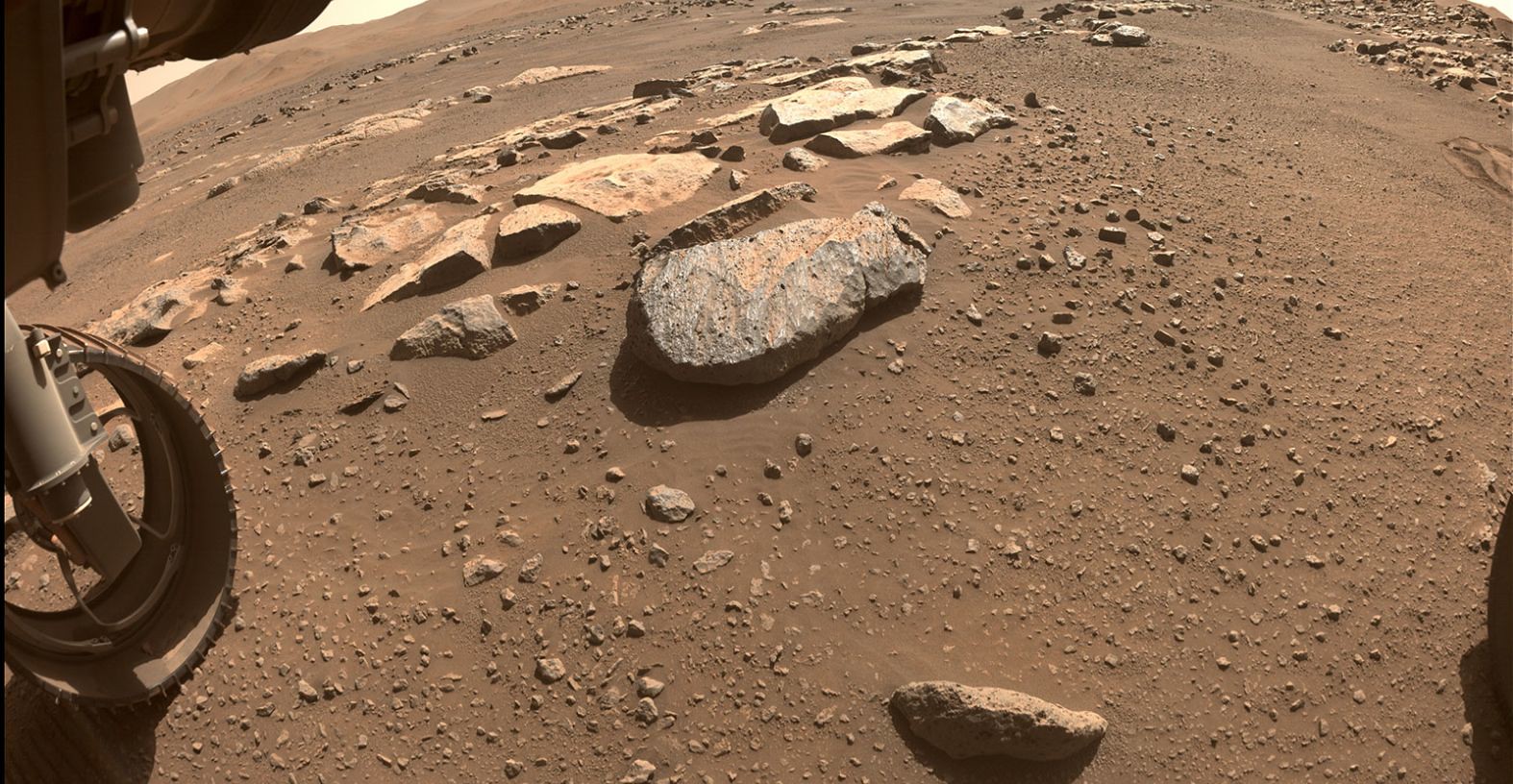
A look at the rock dubbed “Rochette” (image centre) at the “Citadelle” ridge that has been selected as the next target for an attempt by Perseverance to gather samples for analysis / caching. This image was captured on August 26th, 2021. Credit: NASA/JPL

In order to help ensure a sample has been collected post-drilling, a new step has been introduced into the process: once drilling has been completed, the arm and turret will be raised and positioned to allow the rover’s MastCam-Z cameras to image as a visual confirmation that there is material within it. Once confirmed, processing of the sample tube through to the rover’s on-board storage area will then be allowed.

Nor has the first “empty” tube been an entire waste – it now contains a sample of pristine Martian atmosphere, something the mission had intended to collect at some point, and so it will form a part of a sample cache of tubes the rover will at some point deposit on the surface of Mars in anticipation of collection by a future sample return mission.

While atop Citadelle, Perseverance will use its subsurface radar, called RIMFAX – the Radar Imager for Mars’ Subsurface Experiment – to peer at rock layers below it. The top of the ridge will also provide a great vantage point to look for other potential rock targets in the area.

NASA has also confirmed the next mission to Mars, due to be launched in 2024. In keeping with the agency’s approach to alternating surface missions with orbital missions, it has approved the ESCAPADE mission of twin satellites for launch in 2024.

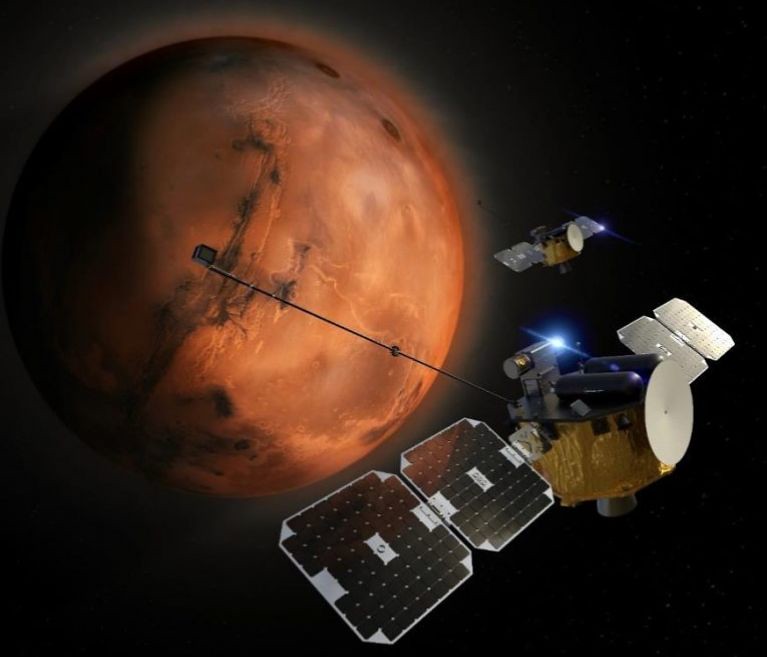
Led by the University of Berkeley, California, the Escape and Plasma Acceleration and Dynamics Explorers mission is a relatively low-cost (under US $80 million including launch costs) attempt to put two small satellites, dubbed “Red” and “Blue” into orbit around Mars to further study the Martian atmosphere and its interactions with the solar wind.

An artist’s impression of the ESCAPADE satellites approaching Mars. Credit: NASA

The satellites will be launched using two Rocket Lab Electron rockets, with the company’s Photon satellite bus used to protect / power them during a low-energy, 11-month cruise to Mars. This marks a significant increase in Photon’s capabilities, the bus originally having been designed to support the launch of satellites into Earth or cislunar orbits. As such, the mission is seen as a “high risk” venture – but as the team behind ESCAPADE note, most missions to Mars come with a price tag of US $800 million or more, and roughly a 90-95% chance of success in reaching Mars / Mars orbit. ESCAPADE is estimated as having an 80% chance of success in doing the same – but at one-tenth the cost, thus making the increased risk in using Rocket Lab systems worth the effort.

Once in orbit, the mission will collect data that could help reconstruct the climate history of Mars and determine how and when it lost its atmosphere. ESCAPADE also will study the ionosphere of Mars, which can interfere with radio communications on the surface and between Earth and Mars colonists. Finally, with simultaneous two-point observations of the solar wind and Mars’s ionosphere and magnetosphere, ESCAPADE will provide a “stereo” picture of this highly dynamic plasma environment in the planet’s upper atmosphere.

And when it comes to human missions to Mars, a new study from the University of California Los Angeles proposes a novel way of reducing the impact of radiation during the journey to / from Mars: by launching during periods of high solar activity, notably the periods immediately following that of solar maximum, when the Sun is at its most active. While launching missions during periods of high solar radiation to reduce the risk of radiation exposure might sound counter-intuitive, there is some logical to the idea.

Simply put, interplanetary missions face two radiation risks – solar, which can be reasonably well mitigated against in a variety of ways (but not entirely avoided or made “safe”) and galactic cosmic rays (GCRs), which are considerably harder to deal with, and more devastating in their impact. However, during periods of high solar activity, the more energetic solar radiation actually deflects GCRs away from the solar system. So the UCLA study suggests that by launching crewed missions in the years immediately following a period of solar maximum could massively reduce exposure to GCRs without significantly increasing the risk from solar radiation.

Just how practical it would be to restrict missions to Mars to certain time frames within the Sun’s 11-year cycle is debatable. If we are to practically explore and possibly establish a permanent presence on Mars, missions will need to be a lot more frequent; so more practical research into things like garment materials, materials used in space vehicle design, etc., that could help mitigate both primary and secondary radiation would likely be far more practical. However, the bright spot in the UCLA study does suggest that if missions are kept to below 4 years duration, then radiation exposure could be seen as “acceptable” – and currently, the more favoured “opposition” class of mission of 2.5 to 3 years duration falls inside that limit.

Continue reading “Space Sunday: an “existential” rocket, Mars, and a bit on JWST”

Space Sunday: balloons to space, Mars movies and alien water clouds

Space Perspective: balloon rides to (almost) the edge of space (see below). Credit: Space Perspective

Virgin Galactic is now very close to commencing passenger-carrying sub-orbital flights with their SpaceShipTwo vehicle after the Federal Aviation Administration (FAA) updated the company’s existing launch licence which had previously restricted them to only flying a crew and “non-deployable” payloads aboard the vehicle.

The updated licence was awarded on June 25th, after the FAA had completed a review of the May 22nd SpaceShipTwo test flight, the first such flight to be flown from Spaceport America in New Mexico, Virgin Galactic’s base for commercial operations in the United States.

The granting of the licence doesn’t mean passenger flights will be commencing immediately, however. The company has three more test flights to complete, some of which will see them flying additional crew aboard the vehicles to help gain further experience in flying with a full compliment of people on the vehicle. One of these flights is liable to include Virgin Galactic’s founder, Sir Richard Branson.

We’re incredibly pleased with the results of our most recent test flight, which achieved our stated flight test objectives. Today’s approval by the FAA of our full commercial launch license, in conjunction with the success of our May 22 test flight, give us confidence as we proceed toward our first fully crewed test flight this summer.

-Michael Colglazier, Chief Executive, Virgin Galactic

Virgin Galactic SpaceShipTwo VSS Unity drops clear of the MSS Eve carrier aircraft at the start of the May 22nd test flight over New Mexico, data from which led to the FAA updating the company’s licence to fly the craft. Credit: Virgin Galactic

The price of a ticket for a 90-minute flight with Virgin Galactic is estimated to be US $250,000 – although this figure was first given in 2014, and may have changed in the interim, and the company hopes to bring the cost down to around US $40,000 within a decade. In the meantime, the likes of Angelina Jolie, Brad Pitt, Lady Gaga and Leonardo DiCaprio are said to be among the rumoured 700 initial bookings.

Given the additional test flights, Virgin Galactic will probably not start fare-paying flights until after Blue Origin has completed its first passenger flight. This is due to take place on July 20th, the 55th anniversary of Apollo 11 landing on the Moon, and will include one individual (yet to be named) who has paid US $28 million to be a passenger (see: Space Sunday: selfies, missions, budgets and rockets).

VSS Imagine, the first of of the SpaceShip III vehicle Virgin Galactic plan to operate, was rolled out on 30rh March, 2021. It will be followed by VSS Inspire, currently under construction. These are an updated design of the SpaceShipTwo vehicle the company has been flying to date, but have yet to be test flown. Credit: Virgin Galactic

Nor are space vehicles alone to be used for high altitude tourism. Space Perspective, a relatively new space tourism company, being founded in 2019, has confirmed it plans to offer flights of up to six hours in duration and to a maximum altitude of 32 km starting in 2024 using a balloon and capsule system.

The nature of the flights mean passengers will not experience a micro-gravity environment during the flight, but they will travel high enough to clearly see the planet’s curvature, and their experience will be a lot more sedate and with greater comfort.

This is because ascents will be at a gentle 20km an hour, thus taking 90 minutes to reach their maximum altitude,  and the capsule will offer comfortable couches, room to move around, a bar and provide wi-fi connectivity with the ground. Once at altitude, the balloon will remain aloft for around 2 hours, prior to commencing a descent, splashing down close to a support ship that will lift the capsule out of the water to allow the passengers disembark, prior to them being returned to shore.

How Space Perspective plan to operate their balloon flights. Credit: Space Perspective

Space Perspective first announced their plans over a year ago, and on June 18th, they carried out a test flight of their Neptune One scale prototype capsule over Florida. In a 6-hour 39-minute flight, the capsule, slung beneath a helium balloon, lifted-off in the early morning, rising to a maximum altitude of over 33 km.  After two hours, and in what mirrors planned operational flight, it then descended over the Gulf of Mexico to splash down 80 km off the coast of Florida, where it was recovered by ship.

This test flight of Neptune One kicks off our extensive test flight campaign, which will be extremely robust because we can perform tests without a pilot, making Spaceship Neptune an extremely safe way to go to space.

– Taber MacCallum, Co-CEO, Space Perspective

As well as passengers, Space Perspective plan to offer room aboard the capsule(s) for those wishing to carry out high-altitude studies of the atmosphere and weather.

An image released by Space Perspective and captured by a camera aboard their Neptune One scale prototype, some 33 km above the surface of Earth. Credit: Space Perspective

Hubble Still Down as Glitch Proves Hard to Resolve

NASA is continuing to diagnose a problem on the Hubble Space Telescope (HST). As I noted in my previous Space Sunday report, the primary payload computer stopped responding on June 13th, causing the science instruments to enter a “safe” mode. At the time, it was believed the problem was caused  by a fault with one of the computer’s four 64 Kb read/write  memory modules. however, and as I reported, an attempt to switch to using one of the other memory modules was unsuccessful.

As a result, further tests were carried out on June 23rd / 24th, with mixed results. On the one hand, they revealed that the core elements of the computer and its back-up, including the memory modules, have no significant issues. However, the tests also showed attempts to write data to any of the memory modules from either computer were failing.

NASA continues to try to diagnose the Hubble space Telescope’s recent issues. Credit: NASA

This tends to suggest the problem lies outside of the payload computers, so plans are being drawn-up to test other systems.

Chief among these are the Command Unit/Science Data Formatter (CU/SDF) and the primary power regulator circuits. The CU/SDF relays command through HST to specific systems and instruments, and also reformats data from the science instruments ready for transmission to Earth, while the main power regulator should deliver a consistent voltage to systems and instruments. If either are subject to issues, then they can trigger a switch to safe mode operations, as has happened. If the root cause can be traced to either, NASA will test the back-up and attempt a switch-over.

Continue reading “Space Sunday: balloons to space, Mars movies and alien water clouds”

Space Sunday: China, Mars and the Drake Equation revisited

A colour close-up captured by China’s Zhurong rover via its high-resolution cameras as they look over the rear deck, showing the main communications relay and one of the unfolded solar arrays. This image was captured before the rover deployed from its lander. Credit: CNSA

China’s Zhurong rover has commenced operations on the surface of Mars. The rover, which is slightly larger and heavier than NASA’s MER rovers Spirit and Curiosity, arrived on the surface of the planet on May 16th atop its lander vehicle (see: Space Sunday: China on Mars, JWST and a space tourist).

Since that time, the rover has been put through its first battery charging cycle after unfolding its solar panels, and then entered an initial telemetry-based check-out and commissioning phase that saw some of its core systems powered-up in readiness to commence operations, with similar checks being carried out on the lander.

An infographic on China’s Zhurong rover via AFP, with original material via CNSA and Chinese state media

This meant that it was not until May 19th that the China National Space Administration (CNSA) released the first images taken by the rover’s camera systems.

The first images to be released were those captured by Zhurong’s hazard avoidance cameras, which – and like their American counterparts – operate primarily in black and white. In particular, these images showed that the lander vehicle had successfully deployed the ramp Zhurong needed to descend onto the planet’s surface from the back of the lander.

The black-and-white images were followed by colour pictures captured by both the rover’s hazcam system and its high-resolution imaging system which is, again like US designs (and the upcoming EuroMars rover, Rosalind Franklin, mounted on a mast located on the rover’s forward section and capable of taken images of all of the rover’s surroundings.

China’s Zhurong (l) and America’s Perseverance (r) in a comparison image by CNSA

China has been fairly close-lipped about the lander and rover – although the entire Tiawen-1 mission is seen as an “international” mission by Chinese authorities -,  only releasing images via social media, etc., after the fact, with little or no fanfare beforehand. This meant it was Twitter snoops who first spotted the rover had actually deployed from this lander vehicle some time in the early hours of Saturday, May 22nd, UTC.

Andrew Jones was one of the first to spot CNSA images that showed the rover had rolled off the lander. However, CNSA quickly followed-up with more images captured by the rover, some of which were colour, and others were put together to form a “video” of the deployment process.

Andrew Jones was one of the first to spot China had announced Zhurong had driven off of its lander.

Now it is on the surface of Mars, Zhurong is expected to operate for a primary mission period of 90 sols (93 days) – which is likely to be extended if the rover completes that mission successfully. It will explore the area around its lander, using both it and the Tianwen-1 orbiter as communications relays, while carrying out research into the Martian weather and climate, and surface and sub-surface conditions.

The return of the first images from the rover sparked an appeal to the US Congress from NASA’s new Administrator, Bill Nelsen, who asked for a boost to the agency’s funding so that it might better manage deep space research and the planned return to the Moon in the face of the growing competition from China.

A colour picture from Zhurong’s hazcams as it roles down the ramp from the lander on May 22nd. Credit: CNSA

It has not all been smiles and roses for China, however. As  I previously reported, the country can in for international criticism for failing to handle the uncontrolled return to Earth of the 23-tonne core stage of the long March 5B core stage used to lift the Tianhe primary module of the country’s new Tiangong space station. Following up from that mission, China had planned to launch its first mission to Tianhe on May 19th.

This was to be the Tianzhou-2 automated resupply vehicle. A fully automated, 13-tonne vehicle, Tianzhou-2 was supposed to make an automatic rendezvous  and docking with Tinahe in advanced of the first crewed mission to the fledgling space station, which is due to occur in June, 2021; however, the launch was scrubbed as a result of “technical issues”. Initially re-scheduled for lift-off on Thursday, May 20th, the launch was again postponed, and has now been pushed back until Friday, May 29th.

A Chinese Long March 7 rocket carrying the Tianzhou-2 cargo ship rolls out to a launch pad at the country’s Wenchang Satellite Launch Centre on Hainan Island. Credit: CASC.

When Tianzhou-2 does eventually lift-off atop its Long March 7 booster, it will be carrying 6.5 tonnes of equipment and supplies for the first crew to visit Tianhe, and consumables for the station itself, and will remain docked through the 3-month period of the Shenzhou-12 crewed mission. During the crew’s visit, Tianzhou-2  will perform a set of automated undocking, free flight and rendezvous / docking manoeuvres as rehearsals in readiness for when the station’s science modules are launched.

Tianzhou-2 will depart Tianhe ahead of the Shenzhua-12 crew. The station will then be visited by a further automated res-supply vehicle and the Shenzhou-13 crew, over late 2021 / early 2022, for the Chinese are calling the “Critical Technology Validation Phase” of the station’s commissioning, verifying it is ready for the launch of the two science modules. These will take place in 2022, paving the way for full operations to commence from 2023.

Continue reading “Space Sunday: China, Mars and the Drake Equation revisited”

Space Sunday: Mars, galaxies and starships

 Mars 2020 mission Sol 46 (April 6th), 2021, a series of 62 images captured using the WATSON imager on the robot arm of the Perseverance rover were used to create this “selfie” of the rover “looking” at the camera, then back at the Ingenuity helicopter sitting on the ground some 4 metres away. Credit: NASA/JPL

NASA has delayed the first flight of the Ingenuity helicopter on Mars after the vehicle detected an issue during one of its pre-flight tests.

For the past week, the agency has been preparing the little helicopter drone, part of the Mars 2020 mission, for the first of a series of 5 pre-planned test flights within Jezero Crater. It had been hoped the flight could take place on Sunday April 11th / Monday April 12th, 2021 (depending on where you are in the world); however it will now not take place until Wednesday, April 14th at the earliest.

After being dropped on the surface of Jezero Crater by the Mars 2020 Perseverance rover (see my previous space Sunday report), Ingenuity successfully recharged its batteries using solar energy and survived its first night alone on Mars without incident. This was a major milestone for the project, as there were fears that if the batteries couldn’t be fully charged and generate sufficient heat, the extreme cold of the Martian night could freeze the vehicle’s electronics, and even crack the batteries themselves.

Since that first night, the helicopter has shown it can keep itself warm and the flight team has spent the week conducting a range of pre-flight checks, including unlocking Ingenuity’s pair of contra-rotating propellers and then testing them under power and at low speeds, then speeding up to higher speeds, including an attempt to reach the 2400 rpm required for take-off.

Part of testing Ingenuity included taking a low-resolution image via its downward-looking camera system while it was still sitting under the rover. April 3th, 2021 / Sol 42. Credit NASA/JPL
All of these tests were completed successfully, with the exception of the final full-speed test attempted on Friday, April 9th. This aborted during the phase when the command programme on Ingenuity was supposed to switch from “pre-flight” to “flight” mode, as will be required ahead of the actual flights. However, a guardian “watchdog” timer designed to oversee the correct execution of command sequences expired before the switch-over occurred, prompting Ingenuity to safely shut-down its motor and await further instructions from Earth.

Following a full evaluation of telemetry received following the curtailed test, the flight team were confident that no actual damage had occurred to the helicopter, stating the full spin-up test of the rotors would be postponed and the flight itself delayed until April 14th. They also indicated that assuming the first flight was completed without incident, the second flight will take place on Sunday, April 18th.

The rotor tests took place once Perseverance was well clear of the helicopter – the rover is gradually making its way to the look-out point where it will record Ingenuity’s flights. However, before it did so, engineers took the opportunity to use the WATSON (Wide Angle Topographic Sensor for Operations and eNgineering) camera on the rover’s robot arm to capture a series of 62 images that were stitched together to produce a picture of Perseverance apparently “looking” back at the helicopter using its mast cam imaging systems, and which can be seen at the top of this article.

Another image Perseverance took that recently caused excitement was one that appeared to show a “rainbow” arcing across the dusty Martian sky. Captured on April 4th (Sol 43), the image spread quickly across social media, as did the “rainbow” explanation.

Captured on April 4th (Sol 43), this image via the rear-facing Hazcam system on Perseverance caused excitement in the media, being described as a “rainbow”. However, it wasn’t any such thing, as NASA was forced to explain. Credit: NASA/JPL

The only problem being, rainbows are impossible on Mars, as NASA quickly stepped in to note through social media:

Many have asked: Is that a rainbow on Mars? No. Rainbows aren’t possible here. Rainbows are created by light reflected off of round water droplets, but there isn’t enough water here to condense, and it’s too cold for liquid water in the atmosphere.

NASA, via the @NASAPersevere Twitter account.

Rather, the “rainbow” was the result of lens flare – light being scattered by the lens of the Hazcam (HAZard avoidance CAMera) that captured the image, to strike the imaging sensor in multiple places like an arc of machine-gun bullets. Such effects are prevented on the front-facing Hazcams (the ones most frequently used by the rover, as they are equipped with sunshades; however, similar shades were deemed superfluous on the rear-facing Hazcams, and so lens flares like this are actually quite common should the system be in use and the Sun happens to be in the right position.

Continue reading “Space Sunday: Mars, galaxies and starships”