
NASA has rolled out the first of what is intended to be both the first of its new “super rocket”, the Space Launch System, and the vehicle to start the United States and its international partners on the road back to the Moon.
At 21:47 UTC on March 17th, the huge rocket, mounted on its mobile launch platform, slowly crept out of one of the high bays of the Vehicle Assembly Building (VAB), the iconic cube sitting within NASA’s Kennedy Space Centre which was used as an integral part of Project Apollo and which is now fulfilling a similar role for Project Artemis, on the back of a massive crawler-transporter at the start of a 6.72 km journey to Kennedy Space Centre’s Lunch Complex pad 39B.
It was not a swift journey, taking some 11 hours to complete – albeit with stops along the way for checks to be carried out – the crawler-transporter finally reaching the top of the incline of the launch pad 04:15 UTC on Friday, March 18th.
The move of the rocket from VAB to pad was not in readiness for the launch of Artemis 1 – the mission this SLS vehicle will carry to orbit – but rather for the final series of tests to be carried out on the fully integrated rocket and its Orion Multi-Purpose Crew Vehicle (MPCV) payload to ensure both are ready for that launch, which is currently set for a provisional window in mid-May 2022.

As I noted in my last Space Sunday update, the focus of these tests will be a full wet dress rehearsal, due to take place in April. This will see the rocket fully fuelled and go through a full launch countdown that will stop just nine seconds prior to an actual launch. The intention is to make sure everything with the rocket, the payload and the launch systems are all ready for a launch attempt, and will be followed by a further 8-9 days of additional pad tests. After this, the rocket will be returned to the VAB and assessed ready for final flight clearance.
When it does take flight, SLS will become the most powerful launch system built by NASA. The Block 1 vehicle being capable of delivering up to 95 tonnes to low Earth orbit, and the upcoming Block 1B up to 105 tonnes, and the future Block 2 vehicle up to 130 tonnes – putting it in the same lifting class as SpaceX’s Starship / Super Heavy launch system, but potentially far more flexible in turns of specialised launches, SLS being capable of launching smaller payloads (e.g. 23-45 tonnes, depending on the launcher variant) directly to the Moon, or other payloads out into the solar system without any need for on-orbit refuelling.
However, as I’ve noted before, there are some significant cost issues for SLS that may impact its use, the most notable being that of ongoing costs. Development work on the SLS system has thus far eaten US $23.01 billion, and while NASA would claim a lot of that (US $14 billion) has gone directly into work creation, it nevertheless means that as a non-reusable system, SLS is terribly expensive: NASA’s own Office of Inspector General (OIG) estimates each launch will cost some US $4 billion, twice NASA’s launch cost estimate, and will never fall below US $1 billion as the agency has suggested.
This cost factor has already seen NASA turn to other launch systems for missions originally earmarked for SLS. The Europa Clipper mission, for example, has been move to a SpaceX Falcon Heavy launcher on the ground of launch costs (and the fact that SLS generates so much vibration at launch, it is unsuitable to fly certain sensitive instruments into space).
As it is, five SLS missions in support for Artemis have thus far been confirm, with vehicles for three more after Artemis 1 already under construction:
- Artemis 1: uncrewed mission to cislunar space to test the Orion MPCV; duration: some 25.5 days – mid 2022.
- Artemis 2: crewed mission to lunar orbit; duration: 10 days – 2024.
- Artemis 3: crewed lunar obit / lunar landing mission; duration:30 days – 2025/26:
- Artemis 4: crewed mission to a lunar near-rectilinear halo orbit (NRHO) in support of the Lunar Gateway station and the core I-HAB deployment – 2026/27
- Artemis 5: crewed mission to a lunar near-rectilinear halo orbit(NRHO) in support of the Lunar Gateway station and the European System Providing Refuelling, Infrastructure and Telecommunications (ESPRIT) module, together with a lunar surface mission – 2027-28.
Starship HLS: NASA Updates
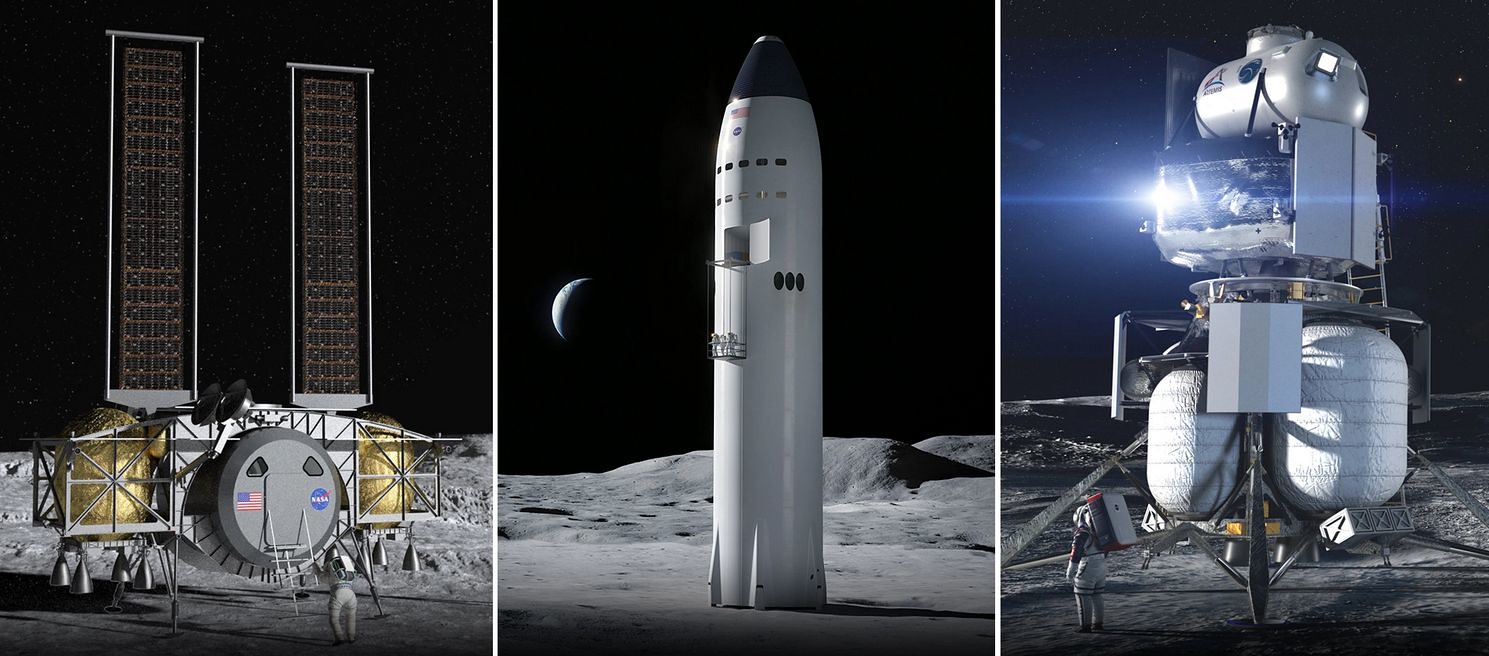
A further key component for Project Artemis is the Human Landing System (HLS), the vehicle that will be used to transfer crews between lunar orbit and the surface of the Moon and (initially) provide them with living space whilst on the Moon. Currently, only one contract has been issued for HLS, and as I’ve noted before, it is to SpaceX for the use of a lunar variant of their Starship vehicle, although the agency has more recently been order to acquire HLS vehicles from other sources.

Coinciding with the SLS roll-out at Kennedy Space Centre, NASA issued an update on the SpaceX HLS programme, including the work going into some key elements, such as the elevator that will carry the 2-person crew of Artemis 3 the 30-40 metres down the side of the vehicle to the Moon’s surface and back after landing, together with the airlock through which they’ll leave / enter HLS during surface operations and some of the living / working facilities inside the vehicle.
The update also confirms that HLS will require some six starship / super heavy launches:
- The launch of a special “tanker” Starship that will be parked in Earth orbit and used for a wide range of Starship propellant transfer operations.
- Four further launches of re-usable Starship vehicles equipped with additional fuel tanks that will carry propellants to be transferred to the orbital “tanker”.
- The HLS starship itself and the cargo needed for Artemis 3. This will dock with the “tanker” and take fuel from it that can be used to boost the HLS vehicle to lunar orbit and to both land it on the Moon and then get it back to lunar orbit.

Once the HLS is in lunar orbit, the 4-person Artemis 3 crew will then launch to the Moon aboard an Orion MPCV lifted by SLS, and rendezvous with HLS so two can transfer to it and then travel to / from the lunar south pole. After transferring back to Orion, the crew will return to Earth, leaving the HLS starship in lunar orbit, potentially with either fuel to be used by the crew of Artemis 5, the second lunar landing mission.
However, whilst SpaceX HLS is earmarked for this mission (and will likely be the only HLS craft capable of supporting Artemis 5 in 2027/28), some in Congress are pushing NASA to use an alternative HLS design for the second lunar landing (which is which Artemis 4 was switched from a join lunar gateway / lunar landing mission to being solely a lunar gateway mission.
Continue reading “Space Sunday: a big rocket, a telescope & yellow and blue”









 Inara Pey: Living in a Modemworld