Space Sunday: Artemis 2 and a Blue Moon lander

An infographic outlining the Artemis 2 mission, during to take place in the first quarter of 2026. Credit: CSA

2026 is set to get off to an impressive start for US-led ambitions for the Moon, with the first three months intended to see the launch and completion of two key missions in the Artemis programme.

In fact, if the principal players in both missions get their way, the missions could be completed before the end of February 2026 and between them signal the opening of the gates that lead directly to the return of US astronauts to the Moon in 2028. Those two missions are the flight of the Blue Origin Pathfinder Mission to the lunar surface, and the first crewed flight to the vicinity of the Moon since the end of the Apollo era: Artemis 2.

Blue Moon Pathfinder

As I’ve previously noted in this column, Blue Moon Pathfinder is intended to fly a prototype of the Blue Moon 1 cargo lander to the Moon’s South Polar Region to demonstrate key elements and capabilities vital to both the Blue Moon Mark 1 and its larger, crew-capable sibling, Blue Moon Mark 2.

These goals include: the firing / re-firing of the BE-7 engine intended for use in both versions of Blue Moon; full use of the planned cryogenic power and propulsion systems; demonstration of the core avionics and automated flight / landing capabilities common to both Blue Moon Mark 1 and Blue Moon Mark 2; evaluate the continuous downlink communications; and  confirm the ability of Blue Moon landers to guide themselves to a targeted landing within 100 metres of a designated lunar touchdown point.

An artist’s rendering of the Blue Moon Mark 1 (foreground) and larger Blue Moon Mark 2 landers on the surface of the Moon. Credit: Blue Origin

Success with the mission could place Blue Origin and Blue Moon in a position where they might take the lead in the provisioning of a human landing system (HLS) to NASA in time for the Artemis 3 mission, currently aiming for a 2028 launch. A similar demonstration flight of Blue Moon Mark 2 is planned for 2027, involving the required Transporter “tug” vehicle needed to get Blue Moon Mark 2 to the Moon. If successful, this could potentially seal the deal for Blue Moon in this regard, given both they and SpaceX must undertake such a demonstration prior to Artemis 3 – and currently, SpaceX has yet to demonstrate the viability of any major component of the HLS design beyond the Super Heavy booster.

Of course, as others have found to their cost in recent years, making an automated landing on the Moon isn’t quite as easy as it may sound, so the above does come with a sizeable “if” hanging over it.

A comparison between the the Apollo Lunar Module, Blue Moon Mark1 and Blue Moon Mark 2. Note that the bulk of the latter comprises the massive Liquid hydrogen (LH2) tank (at the top, with the four large thermal protection / heat dissipation panels needed to help keep the propellant in a liquid form liquid), with the liquid oxygen (LOX) tanks between it and the crew module at the base of the vehicle. Credit: NASA / Blue Origin / David Leonard

The Blue Moon landers are between them intended to provide NASA with a flexible family of landing vehicles, with Blue Moon Mark 1 capable of delivering up to 3 tonnes of materiel to the Moon, and Blue Moon Mark 2 crews of up to four (although 2 will be the initial standard complement) or between 20 tonnes (lander to be re-used) or 30 tonnes (one-way mission) of cargo.

Currently, the Blue Moon Pathfinder flight is scheduled for Q1 2026 – and could potentially take place before the end of January.

Artemis 2: Four People Around the Moon and Back

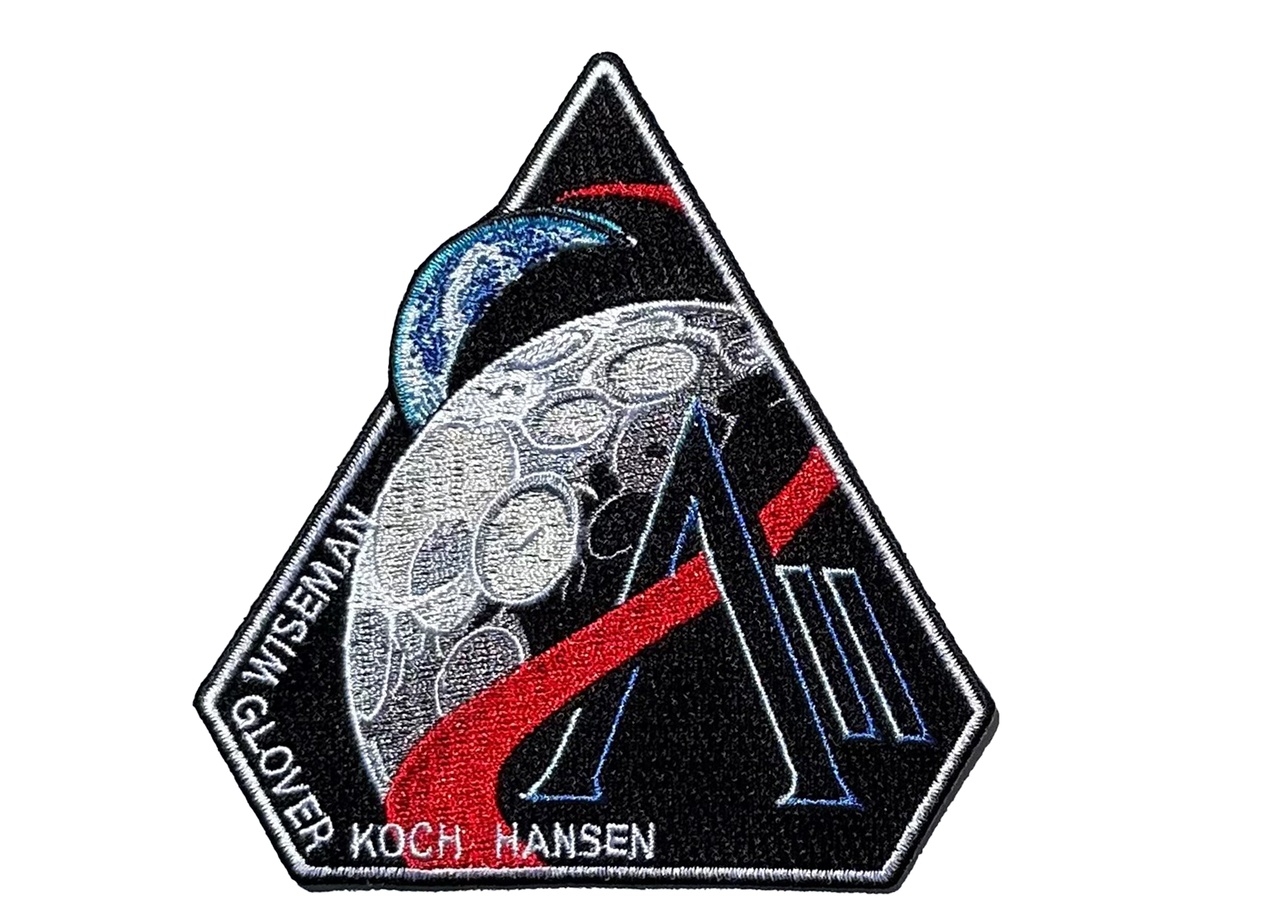
Artemis 2, meanwhile is targeting a February 5th, 2026 launch. It will see the first crew-carrying Orion Multi-Purpose Crew Vehicle (MPCV) head to cislunar space with three Americans and a Canadian aboard in a 10-11 day mission intended to thoroughly test the vehicle’s crew systems, life support, etc. Despite all the negative (and in part unfair) criticism of the Orion system and its SLS launch vehicle, 21 of the 22 pre-launch milestones have now been met. This leaves only the roll-out of the completed SLS / Orion stack to the launch pad and the full booster propellant tanking testing order for the green light to be given to go ahead with a launch attempt.

An infographic shown by Brad McCain, VP and Programme Manager, Armentum Space Operations Division – a company providing critical support to NASA for SLS ground operations – during a December 15th Webinair on Artemis 2. Note both of the December 2025 items were achieved shortly after the webinair. Credit: Armentum / CDSE

No date has been publicly released for the roll-out, but given the issues experienced with Artemis 1, when helium purge leaks caused problems during the propellant load testing, it is likely that even with the high degree of confidence in the updates made to the propellant loading systems since Artemis 1, NASA will want as much time as possible to carry out the test ahead of the planned launch date.

Whilst Orion did fly to the Moon in 2022, the vehicle being used for Artemis 2 is very different to the one used in Artemis 1. This will be the first time Orion will fly all of the systems required to support a crew of 4 on missions of between 10 and 21 days in space (as is the initial – and possibly only, giving the calls to cancel Orion, despite its inherent flexibility as a crewed vehicle – requirements for the system). As such, Artemis 2 is intended to be a comprehensive test of all of the Orion systems, and particularly the ECLSS – Environmental Control and Life Support System; the vehicle’s Universal Waste Management System (UWMS – or “toilet”, to put it in simpler terms); the food preparation system and the overall crew living space for working, eating, resting and sleeping.

The Artemis 2 crew (l to r: Canadian Space Agency astronaut Jeremy Hansen and NASA astronauts Christina Koch, Victor Glover, and Reid Wiseman) outside the Astronaut Crew Quarters inside the Neil Armstrong Operations and Checkout Building, Kennedy Space Centre, during an integrated ground systems test for the mission, September 20th, 2023. Credit: Kim Shiflett

These tests are part of the reason the mission is set to have a 10-11 day duration compared to the average of 3 days the Apollo missions took to reach, and then return from, the vicinity of the Moon: NASA want to carry out as comprehensive a series of tests as possible on Orion “real” conditions prior to committing to launching the 30-day Artemis 3 mission.

The mission will also be a critical test for Orion’s heat shield. During Artemis 1, the Orion heat shield suffered considerable damage during re-entry into the Earth’s atmosphere, in what was called “char loss” – deep pitting in the heat shield material. Analysis of the damage reviewed the gouges to be the result of “spalling”. In short, in order to shed some of its enormous velocity prior to making a full re-entry into the atmosphere, Orion had been designed to make several “skips” into and out of the atmosphere, allowing it to lose speed without over-stressing the heat shield all at once.

Unfortunately, the method used to manufacture the original heat shields resulted in trace gases being left within the layers of ablative material. When repeatedly exposed to rapid heating as the Artemis 1 Orion vehicle skipped in and out of the upper atmosphere, these gases went through a rapid cycle of expansion, literally blowing out pieces of the heat shield, which were then further exacerbated as the vehicle make its actual re-entry, resulting in the severe char loss.

Two of the official NASA images showing the severe pitting and damage caused to the Orion MPCV heat shield following re-entry into Earth’s atmosphere at 36,000 km/h at the end of the uncrewed Artemis 1 mission, December 11th, 2022. They show the “char loss” pitting caused by “spalling” within the layers of heat shield material. Credit: NASA / NASA OIG

As a result of the Artemis 1 heat shield analysis, those now destined to be used on Artemis 3 onwards will be put through a different layering process to reduce the risk of residual gases becoming trapped in the material. However, because the heat shield for Artemis 2 was already cast, the decision was made to fly it with the mission, but to re-write the Orion’s atmospheric re-entry procedures and software to limit the number of atmospheric skips and the initial thermal stress placed on the heat shield, thus hopefully preventing the spalling.

The Orion vehicle to fly on Artemis 2 is the second fully-completed Orion system – that is, capsule plus European Service Module – and the first vehicle to ne formally named: Integrity. It is functionally identical to the vehicles that will fly on Artemis 3 onwards, with the exception that it is not equipped with the forward docking module the latter vehicles will require to mate with their HLS vehicles and / or the Gateway station.

The SLS booster to be used in the mission is the second in a series of five such boosters being built. Three of these – the vehicle used with Artemis 1 and those for Artemis 2 and 3 are of the initial Block 1 variant, using the Interim Cryogenic Propulsion Stage (ICPS) as their upper stages. This is an evolution of the well-proven – but payload limited – Delta Cryogenic Second Stage (DCSS) developed in the 1990s, and powered by a single RL-10B motor.

Artemis 4 and 5 are intended to be Block 1B versions of SLS, using the purpose-built and more powerful Exploration Upper Stag (EUS), powered by 4 of the uprated RL-10C version of the same engine, enabling them to lift heavier payloads to orbit and the Moon. This means that both Artemis 4 and Artemis 5 will each lift both an Orion MPCV with a crew of 4 and a 10-tonne module intended for the Gateway station intended to be the lunar-orbiting waystation for crews heading to the Moon from Artemis 4 onwards.

A comparison between the SLS ICPS and future EUS. Credit: NASA

However, to return to Artemis 2: as noted, it will be the second SLS rocket to be launched, and like Artemis 1, will fly using the venerable and (up until SLS at least) reusable RS-25 motor developed by Rocketdyne for the US space shuttle vehicles. Sixteen of these engines survived the end of the shuttle programme, and Artemis 2 will see the use of both the most reliable of them ever built. and the only one to be built for the shuttle programme but never used.

Engine 2047 has flown more missions than any other RS-25 – 15 shuttle missions in which it gained a reputation for being the most reliable space shuttle main engine (SSME), consistently out-performing all other motors to come off the original production line. It proved so reliable that not only did it help lift 76 astronauts from the US and around the world into orbit, it was often specifically requested for complex mission such as those involved construction of the International Space Station and servicing the Hubble Space Telescope. By contrast, engine 2062 will be making its first (and last) flight on Artemis 2, being the last of the original RS-25’s off the production line.

The four RS-25 engines to be used on Artemis 2, with 2047 highlighted. Credit: Helen Lewin, RS-25 Launch Support Lead, Aerojet Rocketdyne, via the December 15th, 2025 CDSE webinair

Such is the engineering behind these engines and their control systems that is worth spending a few paragraphs on exactly how they work at launch. While it may seem that all the motors on a multi-engine rocket fire at the same time, this is often not the case because of issues such as the sudden dynamic stress placed on the vehicle’s body and matter of balance, as well as the need to ensure the engines are running correctly.

For the SLS system, for example, engine preparation for launch starts when the propellant tanks are being filled, when some liquid hydrogen is allowed to flow through the engines and vent into the atmosphere in a process called chill down. This cools the critical parts of the engines – notably the high pressure turbopumps – to temperatures where they can handle the full flow of liquid hydrogen or liquid oxygen without suffering potentially damaging thermal shock.

Actual ignition starts at 6.5 seconds prior to lift-off, when the engines fire in sequence – 1, 4, 2, and 3 – a few milliseconds apart (for Artemis 2 engine 2047 is designated flight engine 1 and 2062 flight engine 2, and so these will fire first and second).  Brief though the gap is, it is enough to ensure balance is maintained for the entire vehicle and the four engines can run up to power without creating any damaging harmonics between them.

A diagram of the RS-25 rocket engine used in both the space shuttle system and SLS. Credit: Helen Lewin, RS-25 Launch Support Lead, Aerojet Rocketdyne, via the December 15th, 2025 CDSE webinair

The low and high pressure turbopumps on all four engines then spool up to their operating rates – between 25,000 and 35,000 rpm in the case of the latter – to deliver propellants and oxidiser to the combustion chamber at a pressure of 3,000psi – that’s the equivalent of being some 4 km under the surface of the ocean. During the initial sequence, only sufficient liquid oxygen is delivered to the engines to ignite the flow of liquid hydrogen, causing the exhaust from the engines to burn red. This high pressure exhaust is then directed as thrust through the engine nozzles, meeting the air just beyond the ends of the engine bells.

The counter-pressure of the ambient air pressure is enough to start pushing some of the exhaust gases back up into the engine nozzles, causing what is called a separation layer, visible as a ring of pressure in the exhaust plume. This back pressure, coupled with the thrust of the engines, is enough to start flexing the engine exhaust nozzles, which in turn can cause the exhaust plume on each engine to be deflected by up to 30 centimetres.

Images of a Space Shuttle Main Engine (SSME) ignition sequence showing the formation of the separation rings (arrowed left) and the cleaner-burning half-diamonds (right) as the engines come to full thrust. Credit: NASA

To counter this, the flight control computers initiate a cycle of adjustments throughout each engine, which take place every 20 milliseconds. These adjust the propellant flow rate, turbopump speeds, combustion chamber pressure and the movement of the engines via their gimbal systems in order to ensure all of the engines are firing smoothly and all in a unified direction and pressure, symbolised by a “half diamond” of blue-tinged exhaust (the colour indicating the flow of liquid oxygen) as the separation layer is broken, the thrust of the engines fully overcoming ambient air pressure resistance. All this occurs in less than four seconds, the flight computers able to shut down the engines if anything untoward is monitored. Then, as the countdown reaches zero, the solid rocket boosters (SRBs) ignite and the vehicle launches.

Once underway, Artemis 2 will carry its crew of 4 into Earth orbit for a 24-hour vehicle check-out phase, during which the orbit’s  apogee and perigee are raised. Check-out involves the crew completing a series of tests on the vehicle and its systems, including piloting it, both before and after the ICPS is jettisoned. Completion of this initial check-out phase will conclude with the firing on the ESM’s motor to place Orion on a course for the Moon.

Orion includes the ability for the crew to stow their flight seats flat once in orbit in order to give themselves more room in the capsule. This includes allowing them to rig four shuttle-style sleeping bags in the cabin, each of them positioned in a way that also maximises space for the crew, whilst also positioning them close to the vehicle’s “glass” command and control systems. Credit: NASA

The flight to the Moon will be undertaken using what is called a free return trajectory. That is, a course that will allow the vehicle to loop around the Moon, using its gravity to swing itself back onto a trajectory for Earth without using the main engine to any significant degree. This is to ensure that if the ESM were to suffer a significant issue with its propulsion system, the crew can still be returned to Earth; only the vehicle’s reaction control system (RCS) thrusters will be required for mid-course corrections.

This also means that the mission will only make a single pass around the Moon, not enter orbit. It will pass over the Moon’s far side at a distance of  some 10,300 kilometres and then head back to Earth. On approaching Earth, the Orion capsule will detach from the ESM, perform the revised re-entry flight to hopefully minimise any risk of spalling / char loss, prior to splashing down in the Pacific Ocean off the coast of California.

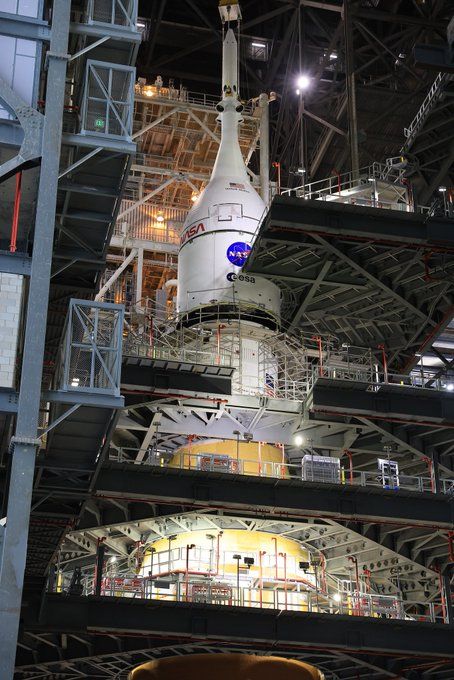
Orion MPCV 003 Integrity, the vehicle that will carry 4 astronauts on Artemis 2 at Kennedy Space Centre in 2025. The capsule is mated to its ESM, which is in turn mounted on the conical Spacecraft Adapter and awaiting the installation of the three Encapsulated Service Module Panels. Credit: NASA 

I’ll have more on the actual mission and the flight itself as it takes place. In the meantime, my thanks to the Coalition for Deep Space Exploration (CDSE) for hosting a special webinair on Artemis 2 in December 2025, from which portions of this article – particularly some of the graphics – were drawn.

Space Sunday: of Artemis 3 and NASA administrators

Artemis Human Landing Systems (HLS): is Blue Origin’s Blue Moon (l) likely to usurp SpaceX’s Starship HLS (r) for Artemis 3? Credit: Blue Origin / SpaceX

What has long been recognised by many who follow the US-led Project Artemis programme to return humans to the Moon now appears to be becoming recognised within the upper echelons of NASA’s management. Namely, that the biggest hold-up to the programme’s primary goal of safely landing a crew on the surface of the Moon and returning them to lunar orbit remains the inability of SpaceX to meet NASA’s – or even its own – time frames and deadlines in the development its Starship-derived Human Landing System (HLS) vehicle.

SpaceX was awarded the contract to develop the initial vehicle intended to deliver crews from cislunar space to the Moon’s South Pole and then return them back to cislunar space over five years ago, in May 2020. At the time, the announcement was controversial for a numbers of reasons:

  • It was both a last-minute entry into the competition to provide NASA with a suitable HLS vehicle, and the most technically complex of the three major proposal which went forward to the final selection process, requiring up to 14 launches of the SpaceX Starship / Superheavy system just to get it to lunar orbit.
The SpaceX HLS system for Artemis 3, comprising an orbital “refuelling depot” (far left) plus multiple Starship tanker launches (centre left) and the Starship HLS itself in order to deliver a 2-person crew launched by SLS / Orion (centre) to / from the surface of the Moon, with Orion returning them to Earth with their fellow Orion crew (right). Note that while only 4 “tanker” launches are shown in this graphic, given current projected Starship payload capacities, the number is more likely to be 8-12 such launches. Credit: SpaceX
  • Despite NASA stating two options for the initial HLS would be selected, only the SpaceX option was carried forward in the so-called “Option A” contract, with NASA providing SpaceX with an initial US $2.89 billion for vehicle development, with both Blue Origin and Dynetics effectively being frozen out.
  • The driving force behind the decision to go exclusively with SpaceX was NASA associate Administrator Kathryn Lueders, who had a long-standing relationship with SpaceX, and who subsequently retired from NASA in 2023 to join SpaceX. Whilst highly speculative in nature, there have been fingers pointed towards this chain of events as being more than coincidental.
  • The decision to go with SpaceX alone for at least the Artemis 3 mission (the first planned crewed landing) was upheld by the US Government Accountability Office (GAO) in July 2021 after both Blue Origin and Dynetics filed complaints about the handling of the contract on NASA’s part. This decision came in spite of NASA’s own Office of Inspector General (OIG) having already reporting that the agency’s own estimates for the development time frame for HLS (four years) was entirely unrealistic, and that due to its complexity the SpaceX HLS approach would potentially result in the most severe of anticipated delays in HLS development, requiring up to 4 additional years of development and testing in order to be flight-ready.
  • In December 2023, a NASA Key Decision Point (KDP) review for Artemis 3, intended to assess whether or not the programme was on course to meet its intended targets, rated SpaceX as having only a 70% of achieving a required uncrewed demonstration test flight of their HLS vehicle (including landing it on the Moon and returning it to lunar orbit) by February 2028, some two years behind the Option A contract goal of flying this mission in mid-2026.

Oddly, both SpaceX and NASA placed part of the blame for the delay to the demonstration test with on-going (at the time) issues with the Orion crew capsule heat shield – even though Orion is an entirely separate vehicle to HLS, and does not form part of the contracted SpaceX HLS demonstration flight.

Further, while SpaceX has pointed to the 30 HLS development milestones it has achieved, these relate to hardware needed for power generation, communications, guidance and navigation, propulsion, life support, and space environments protection, rather than the vehicle as a whole, with some of these milestones either relating purely to the definition of some of this hardware, rather than any form of development and / or integrated testing.

Whilst SpaceX points to having achieved some 30 hardware milestones for its HLS vehicle, several of these milestones refer to system definitions, rather than hardware development, whilst other elements – such as the elevator system required to get the down the 30 metres separating the vehicle’s crew section from the surface of the Moon – has largely been driven by NASA rather than SpaceX. Credit: NASA / SpaceX

By the start of 2024, concerns around SpaceX’s ability to actually deliver on their promises for their HLS vehicle were such that Jim Free, the man then at NASA charged with overseeing the Artemis programme, was openly talking in terms of potentially swapping the Artemis 3 and Artemis 5 missions, the latter intended to be the first use of the Blue Moon HLS system in development by Blue Origin, and which at the time was seen as much further along in its development cycle than the SpaceX system.

Whilst Free has since retired from NASA, the acting administrator for the agency, Sean Duffy, echoed Free’s point of view on October 20th, 2025, indicating that he is now open to reviewing the Artemis 3 HLS contract. In particular, he has also suggested shifting to using Blue Origin’s Blue Moon lander on the basis of growing scepticism that SpaceX will have their HLS system ready for Artemis 3 by 2028/29.

Whilst Artemis 3 remains mired in conflict, Artemis 2, the first crewed mission for the programme using NASA’s Space Launch System (SLS) and Orion, achieved a further milestone on it wat to the launch pad on October 20th, 2025, when the Orion vehicle, encased in its launch shroud and topped by the Launch Abort System, was lowered from a high bay within the Vehicle Assembly Building (VAB) at Kennedy Space Centre, Florida, and mated to its adaptor on the top of the SLS rocket. Artemis 2 is currently expected to launch in March 0r April 2026 on a 10-day mission around the Moon. Credit: NASA

Unsurprisingly in this age of politics by insult, Duffy’s comments were met with childish name-calling on the part of the SpaceX CEO. To be sure, Duffy is perhaps not the best qualified to be leading NASA even on an interim basis (and has made a fair number of gaffes as head of the Department of Transportation); but as per the reasons noted above, there is good reason to question whether SpaceX can meet its obligations for HLS even within the revised times frame for the Artemis 3 mission (which is now looking to a possible 2028 launch).

Nor did the SpaceX CEO limit his scorn to Duffy; in the same string of social media posts he took aim at Blue Origin, claiming the company “has never delivered a payload to orbit, let alone the Moon” (which he later refined to mean “useful payload”). Given that the launch vehicle for Blue Moon – Blue Origin’s New Glenn rocket – both successfully achieved Earth orbit and deployed a payload demonstrator on its maiden flight, both of which Starship has yet to do in a single launch despite (at the time of writing) 11 flights, this critique came over as little more than a petulant outburst than a reasoned defence of Starship HLS.

Following Duffy’s statements – which appear to also be driven in part by concerns over China’s stated aim to place taikonauts on the Moon by 2030 – speculation was rife in some circles as to whether NASA might seek to an alternative to SpaceX and Blue Origin as the Artemis 3 HLS provider. This speculation encapsulated both the idea that NASA might try for a “home-grown” HLS, or bring-in another company – such as Lockheed Martin (which has made no secret of its desire to supply an HLS alongside of its Orion crew vehicle) – to provide a suitable HLS.

However, given the lead-times involved in seriously moving forward with either of these options (which would likely see Artemis 3 pushed back well beyond a 2029), coupled with the costs involved when the Trump Administration is aggressively trying to reduce NASA’s budget, it would seem unlikely that either of these options would be seriously taken-up. As it stands and in the wake of Duffy’s comments, NASA has confirmed that both Blue Origin and SpaceX have been given until October 29th, 2025 to submit “accelerated proposals” for HLS development, but no other proposals for “alternate” HLS vehicles are currently being sought.

Exactly where this will all lead is also open to debate. As does, ironically enough, the overall leadership of NASA. Whilst only appointed Acting Administrator for the agency, Duffy has spent some of his time in the role floating the idea that NASA should be folded into his Department of Transportation. Were this to happen, it would effectively cement his position as the person in overall charge of the agency and its budget – although the idea has already received widespread pushback from the US space industry as a whole. At the same time, the White House has indicated it is possibly going to re-nominate Jared Isaacman for the role of NASA Administrator.

As I reported at the time in this pages, Isaacman was on the verge of being confirmed to the role earlier in 2025, when Trump’s White House abruptly withdrew his name as their nominee following a public spat between Trump and the SpaceX CEO (with whom Isaacman has had a close working relationship for several years), who at the time was coming to the end of his tenure as a “special advisor” to the White House. However, on October 14th, it was revealed that the Trump Administration has again been in talks with Isaacman about a potential resumption of his nomination to lead NASA, which he apparently is still interested in doing.

Space Sunday: of Artemis and Administrators

November 16th, 2022: the Space Launch System (SLS) rocket lifts-off on its maiden flight, lifting an uncrewed Orion MPCV capsule on the Artemis 1 mission to test the latter on an extended flight to cislunar space and back to Earth. Credit: Joel Kowsky

NASA has announced the push-back of Project Artemis missions in the continuing efforts to return to the Moon with human missions, and with the announcement has come renewed calls for the cancellation of the Space Launch System rocket.

During a December 5th, 2024 briefing, NASA management confirmed that Artemis 2 – the mission to fly a crew of four around the Moon and return them to Earth – will now not occur until April 2026, slipping from the target launch month of September 2025. As a result, the first attempt at a crewed landing under the project – Artemis 3 – has been rescheduled for a mid-2027 launch.

The most significant reason for delaying the missions relates to issues with the primary heat shield on the Orion MPCV (multi-purpose crew vehicle). As I’ve reported in these pages, this heat shield suffered greater than expected wear and tear during the unscrewed test of Orion on a flight around the Moon in December 2022 – something first release to the public in detail in May 2024.

The Artemis 2 crew (l to r: Canadian Space Agency astronaut Jeremy Hansen and NASA astronauts Christina Koch, Victor Glover, and Reid Wiseman) outside the Astronaut Crew Quarters inside the Neil Armstrong Operations and Checkout Building during an integrated ground systems test at Kennedy Space Centre, September 20th, 2023. Credit: Kim Shiflett

More recently, NASA has indicated that it has identified the root cause of the issues, with comments at that time appearing to suggest part of the solution might involve charges in the construction of the heat shield itself, particularly as the October 2024 update on the issues, Lori Glaze, acting deputy associate administrator, NASA Exploration Systems Development Mission Directorate indicated that while NASA were confident about the cause, as the heat shield for this mission “is already built”, the agency was at that time unsure as to how best to protect the crew during the critical re-entry into the Earth’s atmosphere at the end of the mission.

For assorted reasons, the Orion capsule operates differently to the Apollo Command Module capsule. As it returns to Earth at a high velocity than Apollo, the Orion vehicle does not perform a single re-entry into the atmosphere as Apollo did; instead, it performs what is called “skip guidance”. This involved dipping briefly into the upper atmosphere and using it to reduce speed, prior to making a final re-entry.

The overall goal of this approach is to allow the Orion vehicle to experience somewhat lower temperatures (although still in the order of around 2,700oC) during its “proper” re-entry, than would otherwise be the case were it to simply slam into the atmosphere a-la Apollo and use the friction of that re-entry to slow itself.

A view of the heat shield used on the Orion vehicle during the Artemis 1 mission. The scoring and surface damage to the surface of the heat shield was expected as a part of the ablative process during atmospheric re-entry. However, the large areas of deeper pitting and cratering – called “char loss” – were not. Credit: NASA

However, following the investigations into the excessive pitting (called “char loss”) seen with the heat shield used with Orion on Artemis 1, was an unforeseen result of the skip guidance approach.

While the capsule was dipping in and out of the atmosphere as part of that planned skip entry, heat accumulated inside the heat shield outer layer, leading to gases forming and becoming trapped inside the heat shield. This caused internal pressure to build up and led to cracking and uneven shedding of that outer layer.

– NASA Deputy Administrator Pam Melroy, December 5th, 2024

During the briefing, it was confirmed that no significant redesign of the heat shield is required to overcome this problem; rather the re-entry trajectory for all Artemis crewed missions must be altered in order to minimise the char loss seen with Artemis 1 (remembering that while severe, the damage done to the heat shield in that mission did not reach a point of threatening the overall integrity of the Orion capsule).

For Artemis 2, engineers will limit how long Orion spends in the temperature range in which the Artemis 1 heat shield phenomenon occurred by modifying how far Orion can fly between when it enters Earth atmosphere and lands.

– NASA Artemis FAQ, December 5th, 2024

While an adjustment to the mission parameters is not as drastic as having to build an updated version of the heat shield, it does still require significant computer modelling, updates to flight software on Orion and a re-training of the Artemis 2 crew so they are familiar with the new flight envelope, control protocol and dealing with any alarms / emergencies during the revised re-entry phases of the mission. Hence pushing back Artemis 2 until early-to-mid 2026.

While this does have a knock-on effect for Artemis 3, other factors have come into play which have also contributed to the delay in that mission; some of which many observing Artemis and the choices made (myself included) have long anticipated.

Whilst announced on December 5th, 2024, slippage of the Artemis 3 mission to land a crew of two on the surface of the Moon was seen as inevitable by many thanks to the slow development of the SpaceX HLS vehicle the sheer complexities of the launch system on which it depends. Credit: SpaceX

Chief among these is the fact that the SpaceX Human Landing System (HLS) vehicle – a modified SpaceX Starship just wasn’t going to be ready for use in 2026; in fact, there is much to suggest the vehicle will not be ready for any planned 2027 launch of Artemis 3, and that a more reasonable expectation for any Artemis 3 launch would be late 2028, earliest.

However, there are some other factors involved in the Artemis 3 delay; given the changing dynamics and plans for Artemis lunar missions, there is a requirement to make improvements to Orion’s on-board environmental systems. These will not take as long as getting the SpaceX Starship system to the point where it can properly carry out the roughly 12-16 launches required just to get the HLS vehicle to the Moon (leave alone actually construction and testing of the lunar landing vehicle ahead of and use by the crew), but they are a issue which need to be factored into the mission delays.

“Scrap SLS”

The December 5th Artemis announcement saw a further renewed expectation of, and calls for, the cancellation of NASA’s Space Launch System (SLS).

The largest calls for this have come from the SpaceX fan community who frequently (and unfairly) compare the cost of SLS to that of the SpaceX Starship, although there have also been repeated concerns raised from within the US government, such as buy the Government Accountability Office (GAO) and NASA’s own Office of Inspector General (OIG) that the overall cost of SLS is entirely unsustainable.

The core stage of the first SLS rocket to fly being moved between facilities at NASA’s Michoud Assembly Facility in New Orleans in January 2020, as part of preparation for it to be loaded onto a shipping barge for transport to Kennedy Space Centre, Florida. Credit: NASA

In particular, the latter offices note that SLS launches will cost around US $2.5 billion each. This includes all elements of a vehicle and the facilities required to launch it – the rocket, its boosters, the re-usable Orion crew vehicle + its service module, the cost of all launch support facilities, etc., together with the cost of future enhancement to the system, such as the Exploration Upper Stage (EUS) which will allow SLS to carry even heavier payloads to orbit. The cost per launch also takes into account the on-going expenditure in developing the system (US $26.4 billion, 2011-2023). As such, and while by no means cheap, its high cost is perhaps better understood.

However, cost isn’t actually the issue here. Rather it is capability. Simply put, there is no other launch system available that is either capable of launching a crewed Orion vehicle to the Moon or rated to do so.

To get to the Moon, the 26.52-tonne Orion and its European Service Module require an additional booster to send them on their way to the Moon. Currently, this booster is the 32.74 tonne Interim Cryogenic Propulsion System (ICPS) for the Space Launch System. It is the only human-rated upper stage capable of boosting the Orion+ESM mass to the Moon and it is only designed to be used by SLS.

The Interim Cryogenic Propulsion Stage (ICPS) of the SLS – a crucial component in getting Orion to the Moon. Credit: NASA

And therein lies the rub; whilst people have been bandying ideas of “alternatives” to SLS around like sending human-rated payloads to the Moon is akin to playing with Lego  – just stick the bits together you need and away you go, this just isn’t the case.

For example, Falcon Heavy might well be able to lob Orion+ESM+ICPS to LEO off its own back when used in fully expendable mode, a) it must be rated for human flight first; b) it will require significant, potentially costly, and certainly time-consuming, modifications to its core stage and (likely) to the ICPS. These latter points remain true even if the launch is split (e.g. one vehicle to launch Orion+ESM and a second to launch ICPS), which would allow the core and booster stages of Falcon Heavy to be recovered.

And while a split launch might also allow the use of Blue Origin’s New Glenn as an alternative to Flacon Heavy, (a) and (b) remain constraining factors. This is also true of another idea: launching Orion + ESM on New Glenn and then use the Centaur stage of ULA’s Vulcan-Centaur as the kick stage to send them on to the Moon after a rendezvous and docking. But again, again, Centaur is not human rated, and Orion+ESM are not designed to be used with Centaur off-the-shelf. Also, Neither system (nor the ICPS for that matter) are designed for the necessary kind of on-orbit rendezvous and docking, thus, these proposals all add complexity to each and every mission.

An artist’s impression of an Orion vehicle and its European Service Module attached to the ICPS of a Space Launch System, as they orbit Earth. Credit: NASA

This is not to say such alternatives cannot be made possible; it isn’t even necessarily (in the face of SLS launch costs) how much they will cost to bring about; it is the time they would require in order to become feasible, particularly in adapting the disparate system (Orion+ESM (and possibly the ICPS) and Falcon Heavy and/ or New Glenn, and / or the Centaur upper stage) to all play nicely together and reach a point where human missions using them can start. I would venture to suggest reaching such a point in the 2-2.5 years between now and the launch of any Artemis 3 mission (the SLS for Artemis 2 having already been fabricated + currently undergoing assembly / stacking at Kennedy Space Centre) probably isn’t that realistic.

And time is the critical issue here; no programme or project is really “too big to fail”; the more the time frame for Artemis and getting humans back onto the surface of the Moon get repeatedly drawn out (+ the more it is seen to be sucking up available budgets), then the greater the risk an administration and / or Congress could pull the plug to cut losses.

Which is not to say NASA and its incoming new Administrator shouldn’t take a good look at alternate strategies over SLS (and potentially even Orion); rather, they should have a very good game-plan and very realistic numbers on how to proceed and make good on their lunar aspirations before they simply yank out the plug on SLS.

Isaacman Nominated as New NASA Administrator

On December 4th, 2024, the incoming Trump administration announced its choice for the post of NASA Administrator: Billionaire Jared Isaacman, the founder of Shift4, a Payment financial technology company he founded whilst just 16 and which he turned into a multi-billion dollar success.

Jared Isaacman in the cockpit of one of his just fighters

Passionate about flying and (at least) the human exploration of space, Isaacman is a qualified jet fighter pilot (although has not served in the US military), operating one of the largest fleeting of privately-held jet fighters through another of his ventures, Draken International, a company contracted to provide pilot training to the United States armed forces. He also flies as a part of the Black Diamond Jet Team air display team, and as a solo air show pilot flying a MiG-29UB. And if that weren’t enough, he set a world record in 2009 for circumnavigating the world in a light jet (a Cessna Citation), taking just less than 62 hours to complete the flight, operating the aircraft with two others.

In terms of space activities, his is best known for leading the Inspiration4 private mission to space in 2021, and more recently, the first in a series of planned Polaris missions to orbit, Polaris Dawn, which saw him become the first private citizen to complete what is called a SEVA – or stand-up EVA -, partially-exiting the Crew Dragon space vehicle, a feat also completed by SpaceX employee Sarah Gillis in the same mission.

All of this has resulted in many responding to his nomination as positive movet – and again, some circles see it as a sign that SLS will likely be cancelled: Isaacman has been a strong critic of the system, and clearly leans towards more partnerships such as the one directly benefiting SpaceX. Indeed, his closeness to SpaceX and the fact he has consistently refused to reveal his own financial ties to he company has already caused some concern on Capitol Hill.

Isaacman has also used his position as an “independent space entrepreneur” to call into question NASA pursuing similar deals it has made with SpaceX with other commercial entities, such as Blue Origin. In particular, he is highly critical of NASA working with Blue Origin to develop the latter’s alternative – and potentially more practical / cost-effective and certainly more sustainable – Blue Moon family of lunar landing vehicles, openly stated he “doesn’t like” the fact NASA awarded a second contract for reusable human and cargo lunar landing systems.

Given this, some senators are concerned over questions of Isaacman’s overall neutrality when it comes to NASA contracts, and have indicated this is liable to factor into any confirmation hearings involving him.

Space Sunday: Artemis, asteroids and a bit more Artemis

NASA Moon to Mars, 2020. Credit NASA

The Biden Administration has published further details on it 2024 budget proposal in support of NASA in which further details of the agency’s “Moon to Mars Manifest were revealed. Key points on the latter include:

  • The crewed Artemis 2 mission, intended to fly a crew around the Moon in an extended mission similar to that of the successful Artemis 1, confirmed for November 2024.
  • Artemis 3, the first mission to return humans to the surface of the Moon by the United States, is scheduled for 2025.
  • Artemis 4, the second crewed landing on the Moon now pushed back to 2028, with annual landings from there on through to the end of 2031.
  • Both Artemis 3 and Artemis 4 will utilise the SpaceX Starship-based Human Landing System (HLS) for carrying crews to / from the lunar surface and lunar orbit, after which crew activities will switch to the (still to be contracted) “sustainable human landing system”.
  • 2024 will also – in theory – see a demo flight of the SpaceX HLS, whilst the end of 2025/start of 2026 will see work commence on the Lunar Gateway station with the launch of the power module and habitation module to their extended lunar orbit.
  • 2028-2031 will also see work continue on the Gateway station alongside of the lunar landings.
  • Automated mission to the Moon in 2027 will demonstrate lunar construction techniques for developing a base, extracting usable commodities from the lunar surface, and testing power systems. Further demonstrations of these will take place in 2030.
The NASA Moon to Mars infographic, which formed a part of the White House NASA 2024 budget proposal. Crew NASA – click for full size

In support of the above will be a series of demonstrator missions in Earth orbit, as well as development work on Earth for longer-term goals. These include:

  • In-space propellant replenishment and storage for reusable lunar landers and deep space transportation vehicles under a programme referenced as CFM: Cryogenic Fluid Management, involving SpaceX (optimistically in 2023), Lockheed Martin (2025) and United Launch Alliance (2025).
  • Development and flight test of the NASA/DARPA DRACO nuclear thermal engine (see: Space Sunday: propulsion, planets and pictures), with the design to be completed by the end of 2024, together with a conceptual design for a nuclear electric engine.
  • Development and delivery of a nuclear fission power unit demonstrator for use on the Moon or Mars, to the surface of the Moon in 2030.
An artist’s impression of the NASA/DARPA DRACO NTP demonstrator, included in the NASA 2024 budget proposal. Credit: NASA

The budget proposal includes an immediate request for US $180 million for the agency to start seeking proposals for a “deorbit tug” for the International Space Station (ISS). This would be a vehicle developed over multiple years and at a total cost of around US $1 billion specifically designed to dock with the ISS in 2030 and the proceed to gently push it back into Earth’s atmosphere along s pre-planned course so that it burns-up and the large element splashdown at Point Nemo.

Also within the 2024 allocation is US $30 million in support of Europe’s ExoMars rover, and an increased request for NASA’s side of the proposed NASA / ESA Mars Sample Return Mission.

 ExoMars Back on Track /  Sample Return on Track for Budget Overrun

The US $30 million requested in NASA’s 2024 budget is in part to provide ESA with a launch service for Rosalind Franklin, ESA’s ExoMars rover vehicle, together with various technology support activities for a lander vehicle.

This project has had its share of issues over the past two decades, and up until 2022, the plan had been for a joint mission with Russia, the latter providing the launch vehicle and a lander to deliver the rover to the surface of Mars. However, Russia’s invasion of Ukraine ended all ESA / Roscosmos cooperation.

Since then, ESA has remained relatively close-lipped about the rover’s future, but in a recently update, mission personnel confirmed 2028 is now being targeted for the mission’s launch. In addition they indicated that the agency will now build a dedicated lander for the rover which will leverage NASA’s expertise in propulsion, power and heat shield development. In addition, ESA has resumed testing of Amalia, the rover’s test bed vehicle.

The video below provides an inside look at Rosalind Franklin, and what marked the ExoMars rover mission unique among Mars missions.

In the meantime, the ambitious NASA / ESA Mars Sample Return (MSR) mission is threatening to overwhelm other elements of NASA’s science programme.

For the 2024 budget proposal, the White House has requested US $949.3 million for MSR – 19% more than the budget projection. It also notes that expenditure on the project will increase over projections through to the planned launch in 2028.

Working in concert with NASA’s Perseverance rover, which has been collecting samples from its travels across Jezero Crater and has recently started caching them for collection by MSR, the sample mission is designed as a two-part mission using a ESA-developed Mars orbiter to return the Perseverance samples to Earth, after they have been collected from the surface by a lander / recovery / ascent vehicle, primarily built by NASA.

An artist’s impression of the NASA / ESA Mars Sample Return mission. Credit NASA / ESA

NASA has already delayed the Venus Emissivity, Radio Science, InSAR, Topography, and Spectroscopy (VERITAS) mission, which had been due for launch in 2028 prior to being put on hold in November 2022 over concerns about MSR costs, and will now not launch before 2031 – if at all. Now, the Geospace Dynamics Constellation (GDC) mission, a 2013 heliophysics decadal survey recommendation, will now also be suspended. MSR itself was expected to exceed US $7 billion prior to it being revised in an attempted to lower costs – however, it was approved for continuance in 2022 under the  Planetary Science Decadal Survey, on the understanding total costs would not exceed US 5.2 billion – which it still might.

Continue reading “Space Sunday: Artemis, asteroids and a bit more Artemis”

Space Sunday: JWST, Artemis, DKIST and starship

Caught by the NIRCam on the James Webb Space Telescope, this image reveals the details at the very heart of 30 Doradus. Credit: NASA / ESA

The above image is of a region of space officially called 30 Doradus, located in the south-east corner (from Earth’s perspective) of the Large Magellanic Cloud (LMC), one of the “satellite” galaxies to our own.

Known more familiarly as the Tarantula Nebula, the region has long been a subject for study by astronomers as it is the largest and brightest star-forming group in our local group of galaxies. Its popular name originates in the way the dusty filaments within it suggest the web found within the holes of burrowing tarantulas, the black “holes” within the suggesting the spider lying in wait in its hide, ready to pounce on any prey passing by.

Even though it and other nebulae have been imaged many times over the years, the Tarantula and its cousins still contain many secrets about the processes involved in the formation of stars. As such, they remain targets of considerable interest to astronomers, and the these images, captured by the Near-Infrared Camera (NIRCam) and processed by the Near-Infrared Spectrograph (NIRSpec), and also by the Mid-infrared Instrument (MIRI) on the James Webb Space Telescope (JWST), reveal the Tarantula Nebula in never-before seen details.

A mosaic view of 30 Doradus, assembled from Hubble Space Telescope photos, The focus of the JWST image is the smaller of the two dark areas within the nebula. Credit: NASA, ESA, ESO.

Visible in depth for the very first time are thousands of young stars, distant background galaxies, and the detailed structure of the nebula’s gas and dust formations as they are pushed, pulled and twisted by the solar winds within the nebula. Such is the unprecedented power of Webb’s imaging systems; it was even able to capture one young star in the act of shedding a cloud of dust from around itself, dust which may eventually form one or more planets orbiting the star.

Processing of the images by (NIRCam), combined with the NIRSpec data show that the cavity at the centre of the nebula is the result of powerful solar winds radiating outwards from a cluster of massive young stars, which appear as pale blue dots.

Only the densest surrounding areas of the nebula resist erosion by these stars’ powerful stellar winds, forming pillars that appear to point back toward the cluster. These pillars contain forming protostars, which will eventually emerge from their dusty cocoons and take their turn shaping the nebula.

– Part of a statement on the Tarantula Nebula image by the JWST imaging team

This image is one of the most recent to the published from the cache JWST has already gathered and transmitted back to Earth – but it is not among the more recent to be received. Ironically, despite its beauty, it was one of those received following the telescope completing its commissioning and starting formal science operations. However, it was passed over as one of the images to be selected for the very first release of JWST images back in July on the ground NASA / ESA had “more interesting” subjects to be included in the initial release and press conference!

Artemis Update

Following the September 3rd launch attempt scrub for the Artmis-1 mission, featuring NASA’s new Space Launch System, engineers have been hard at work. The scrub was the result of a significant liquid hydrogen leak during the propellant loading process, and following the scrub, it was unclear as to whether the rocket would be rolled back to the Vehicle Assembly Building (VAB) for repairs or an attempt would be made to fix matters on the pad.

On September 6th, the decision was made to try the latter, and would focus on replacing the seal on the 20-cm liquid hydrogen feed within the quick disconnect system that connects the propellant feeds from the mobile launch platform to the rocket. Work on replacing the seal commenced on September 8th, and was successfully concluded on September 9th.

The Base of the Artemis 1 SLS rocket on the mobile launch platform at Pad-39B,  Kennedy Space Centre. To the left is the quick disconnect system with its protective rocker cover. It was the seals at the end of the pipes connecting this to the rocket which failed to prevent liquid hydrogen leaks during propellant loading. Credit: NASA

At the same time, a smaller 10-cm bleed valve located between the rocket’s core and upper stage was also replaced as a precautionary repair; this valve refused to obey ground instructions when engineers were trying to use an overpressure of the liquid hydrogen pipe to try and force the feed seal to work. With both repairs successfully completed, NASA looked towards possible dates for a third launch attempt, settling on either September 23rd or September 27th.However, these are dependent on a couple of significant requirements.

The first is a fuelling test designed to ensure the propellant feeds are now working correctly, and will involve loading both liquid hydrogen and liquid oxygen in a revised propellant loading process. This will take place on September 17th and will involve loading the tanks of both the core stage and the upper stage of the SLS. This test will also be used to perform a “kick-start bleed test” on the SLS rocket’s four main engines. That test is designed to chill the engines down to a temperature of -251º Celsius) to prepare them for their super-chilled propellant during a launch.

The second requirement is the granting of a waiver by the U.S. Space Force for the vehicle’s flight termination system (FTS). This is the package designed to destroy the rocket if it veers off course during launch. Powered by batteries, the FTS needs periodic checks, and the current certification period ended on September 6th. Therefore is the USSF do not agree to a waiver, the SLS will need to be rolled back to the Vehicle Assembly Building in order for the FTS packages to be inspected, and possibly replaced; all of which would mean missing the September launch dates.

A close-up of the base of the SLS rocket, showing engineers working on the quick disconnect system, demonstrating the sheer scale of the rocker and its boosters. Credit: NASA

If Artemis 1 were to launch on September 23rd, it will be on a so-called “short class” mission lasting 26 days, with splashdown on October 18th. However, if the 27th launch date is used, it would mark a “long class” mission, with splashdown not occurring until November 5th for total mission duration of 41 days.

Prior to the repair attempt on the Artemis 1 SLS, NASA announced the contract for the Artemis space suits due to be used with the Artemis 3 mission and the first lunar landing for the programme.

As I’ve previously noted, the development of an entirely new space suit NASA could use to replace the current suits – themselves based on the Apollo design – started in 2007. however, development was riddled with issues to the point where even after a “final” design was announced, NASA’s own Office of Inspector General (OIG) rated it as unsuitable and unlikely to be ready for the then-planned 2025 lunar landing of Artemis 3 (see: Space Sunday: Mars, Starliner woes, accusations & spacesuits).

Because of this, earlier in 2022, NASA turned to Axiom Space – who are already engaged in space station activities; and to Collins Aerospace + ILC Dover – a team that has decades of experience with the current EVA suits used by NASA – and offered them the opportunity to put forward initial designs for a new EVA suit,  with potential to gain a US $3.4 billion contract to supply NASA with suits through until 2035.

That contract has now – somewhat surprisingly, given the track record Collins / ILC Collins have in space suit design – gone to Axiom, who will supply NASA with a “moonwalking system” of suits and support systems to be used as a part of the Artemis programme, starting with Artemis 3. Neither NASA nor Axiom have been particularly forthcoming as to why the latter was chosen, and few details on their suit – outside of a partial image and the idea that it will be “evolvable”  – have been provided.

The only image available of the new lunar space suit to be developed by Axiom Space for NASA. Credit: Axiom Space

By contrast, and prior to the announcement, Collins / ILC Denver presented concepts of their suit designs, and opened a new facility for suit development and construction on August 31st.

However, documentation suggests that pricing has been a major consideration: Axiom’s pricing is said to have been some 23% below NASA’s cost estimate for suit development, and Collins / ILC Dover’s pricing was just 2% below the estimate – which may actually reflect a more realistic estimate for suit development.

Continue reading “Space Sunday: JWST, Artemis, DKIST and starship”