An Asperger’s Mood Diary in Second Life

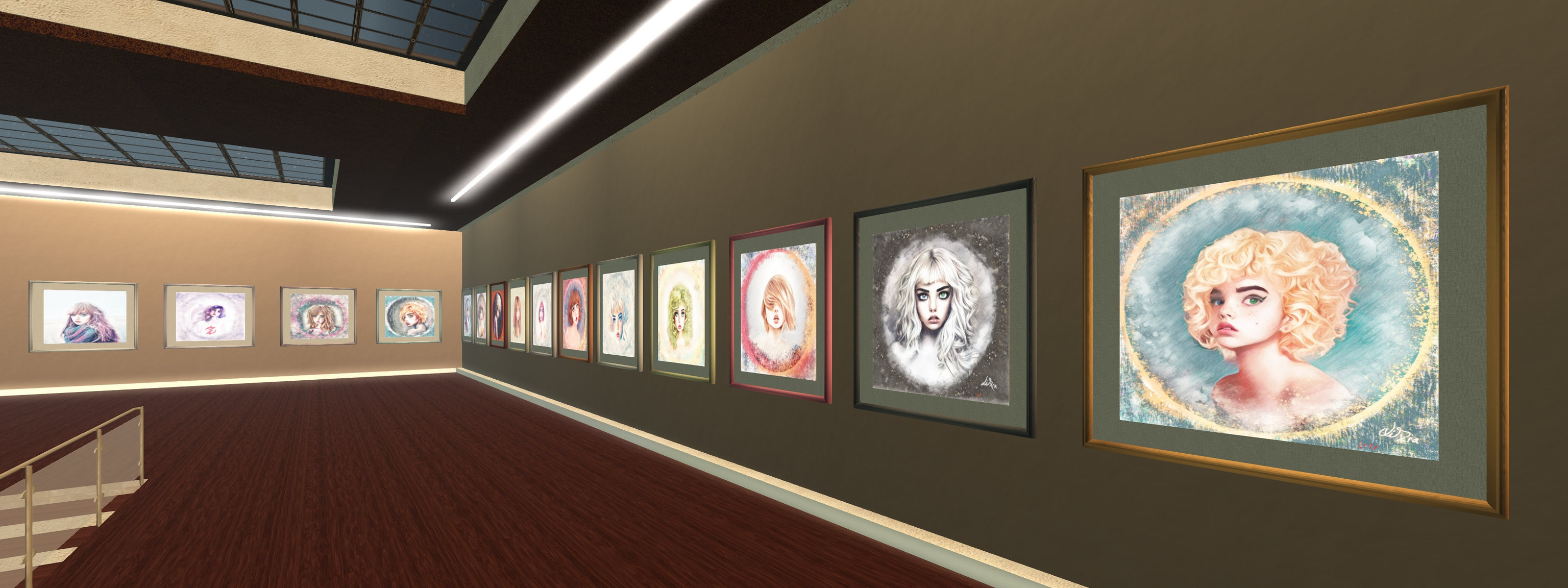
Desideratum Art Gallery: Xia Chieng – Assburguer’s Mood Diary

Asperger Syndrome (AS or sometimes referred to just as Asperger’s (without the “syndrome” when used with the apostrophe)) is an autism spectrum disorder (ASD) characterised by significant difficulties in social interaction and nonverbal communication, along with restricted and repetitive patterns of behaviour and interests. As a pervasive developmental disorder, Asperger syndrome is distinguished by a pattern of symptoms rather than a single symptom, and can be demonstrated by sufferers in a variety of ways, and also presents them with numerous means of dealing with it in their daily lives.

Xia (Xia Chieng), for example, has found a means of addressing the condition through art, using oils and watercolours to express the feelings and emotions she experiences and to give a sense of the her personal situations, outlook and experiences.

This is something I’ve covered twice in the past with regards to her work – the first in 2019 with Life through Xia’s Diary in Second Life, and the second in 2021 with Art and Asperger’s in Second Life, back in September of the year. However, for those who missed those exhibitions, Xia now offers Assburguer’s [sic] Mood Diary, now open at Desideratum Art Gallery.

Desideratum Art Gallery: Xia Chieng – Assburguer’s Mood Diary

If anything, this is a more expressive exhibition that either of the previous two; not because there is more art on offer through this exhibition, but because Zia herself provides a commentary on her art and her life that takes us deeper into her art and her exploration of self.

I see artistic creation as a tool for self-transformation and healing, a way to dialogue with my internal demons and those of our culture, a means to create my own myths with which one moves through the world. 
I am on a personal journey; personal exploration into the essence of life, the relationship between the relationship between my senses, ideas and perceptions and the external world; my conception of space and substance. Only things that are personal can be truly real for me. 

– Xia Chieng

Desideratum Art Gallery: Xia Chieng – Assburguer’s Mood Diary

As a result, this is a powerful series of self-portraits that delve into Xia’s world, each telling a specific tale or mood whilst also being placed into groups defined by both style of the art itself and a collective narrative that flow through them. In this, there is an incredible amount of care and thought that has gone into this exhibition – up to and including Xia’s spelling of “Assburguer’s”, which she notes is a common mis-spelling of the syndrome used by those afflicted by it), all of which further deepens the power and personal nature of the art in display, making it an exhibition best explored through Xia’s words more than my own.

My art is narrative, but not literary, it tells stories but does not create their meaning. It may not mean anything more than we can individually feel. My work is a thing, an object, presented to you for your pleasure and for my relief. It just is what it is. It is not explained alone. I found in art and Second Life a way to escape from the ordinary world, creating my own worlds.

– Xia Chieng

Hence why these are images that should not just be taken physically or literally, there is a metaphorical / symbolic element to them as well – hence the use of the keyhole in Xia’s forehead in several of the images in the case of the latter, and with pieces like Memento Mori, Shadowman, The Keys and Lying Mirror.

But it was in art that I found away to express my feeling and thought. with this I do not pretend that others understand me, but that I find in it a way of knowing myself and transcending what torments me. 

– Xia Chieng
Desideratum Art Gallery: Xia Chieng – Assburguer’s Mood Diary

Thus, Assburguer’s Mood Diary is an exceptionally powerful, emotive selection of art, and one that I – again – highly recommend.

SLurl Details

Art in the snow in Second Life

Templeton Farm: UNITY art exhibition

Currently open through December 2021 within a winter themed sky platform at Templeton Farm, is the UNITY art exhibition, featuring the work of 21 artists and photographers from across Second Life, each of whom presents (on average) two pieces of art for us to appreciate.

Offering a mix of art from the physical world and Second Life photography, the exhibition leans towards scenes of winter – not surprising given the overall setting – but is not exclusively so. Matt Thompson, for example, presents two of his abstract paintings, Happy Campers, which suggests much warmer times that the depths of winter, and Magical Nature, a richly evocative piece that can speak to winter in its colours, but which also has more than a hint of the sea about it.

Templeton Farm: UNITY art exhibition
Similarly, Sheba Blitz presents two of her marvellous mandala paintings, each of which, whilst capturing the essence of beauty that might be found in the crystalline form of a single snow flake, also carry us away to the warm on comfort of more spiritual realms.

Among those taking part are names that will be instantly familiar, and perhaps those who might offer a first chance encounter with their work. This was certainly the case for me with Amaya Mavinelli, whose work is tucked into the corner for the skating rink around which the first part of the exhibition is arranged. Softly and lightly post-processed, her two works, Bunny and Back Then, sit between pieces by Sisi Biedermann and Michiel Bechir, two artists whose works span the digital and the physical.

Templeton Farm: UNITY art exhibition

Dante Helios (Dantelios) is another artists with whom I’ve been unfamiliar, and his two pieces captured from within SL guard the path that links the ice rink with a snow-covered field around which the second major part of the exhibition can be found, with art also lining one side of the short walk between the two.

The complete list of artists participating in UNITY are: Carelyna, Dante Helios (Dantelios), Dragon (DragonAngelvs), Matt Thomson (MTH63), Pepper (PepperQuinn), Sparkle (SparkleSherbert), Michiel Bechir, Sisi Biedermann, Sheba (Sheba Blitz), Zia Sophia (Zia Branner), Ule (Uleria Caramel), Jaelle Faerye, Mareea Farrasco, Amaya Mavinelli, Moora (Moora McMillan), Robbyn (Robbyn Poliak), Jamee Thomson (Jamee Sandalwood), Viktor Savior (ViktorSavior), AmandaT Tamatzui, Vita Theas and Holly (Hollywood Topaz).

Templeton Farm: UNITY art exhibition

As well the art, the platform also offers walks through the snowy landscape. some lead to what appears to be a dance floor, one to a open-air store, and another to a winter garden that makes for a charming visit as well. All of which makes UNITY an engaging visit.

SLurl Details

Clay and Seed in Second Life

Clay and Seed

It has been a fair while since I’ve had the pleasure of viewing Haveit Neox’s 2D artwork in SL outside of the entertainment regions he and Lilia Artis produce annually for Fantasy Faire. So when Akiko Kinoshi (Akiko Kiyori) informed me he and Lilia would be teaming with another artist I admire – Bamboo Barnes – to present a new installation at her Akimori art centre, I knew I’d have to pay it a visit.

Located within is own skybox, Clay and Seed takes as its core theme the erosion of the environment and human relationships, with the work of all three artists interwoven, each taking inspiration from the other two. But before getting into specifics, it is worth noting some key points: you should use the local EEP settings (World → Environment → Use Shared Environment); you’ll need to have ALM enabled (Preferences → Graphics → make sure Advanced Lighting Model is checked) and you should set your draw distance to 256m so that the entire skybox remains rendered during your visit, as it is a part of the overall installation.

Clay and Seed

This skybox offers a desert scene centred around a single body of water, the dunes rolling away into the distance under a sky rich in fields of clouds, the Sun low in the west. The predominant colour caught by the clouds is red, as if the light of the lowering sun is illuminating them from below. But the more one looks at it, the more the red, the more it speaks to rusting metal, its surface bubbled and marrred.

Together, the desert and sky speak to that theme of erosion of the environment, and each supports various elements making up the core of the installation. On the desert sits a number of structures. In particular, sitting close to the lake – possibly the last body of water in this realm? – is a combined 2D and 3D mini-installation by Bamboo Barnes that utilises lighting projectors within cube-like spaces visitors can wall through to experience her 2D art.

Clay and Seed

Around this are several structures placed by Akiko. Through the largest of these – a Japanese style house that partially extends out over the water – a train of horses prance before they snake their way up into the sky to where the second element of the installation, a pair of citadels, are floating.

Linked by curling paths that wind about both buildings and around a central set of net-covered rings over which fish-ships float, the two citadels are home to more of Bamboo’s art whilst their high windows offer poems by Lilia. Their combination of words and images further convey commentaries on destructiveness, growth, abuse, hope, gratefulness and loneliness. Follow the paths that roll and wrap themselves around the two citadels, and further vignettes by Haveit, each with its own symbolism.

Clay and Seed

And symbolism is very much the key here. Whilst offering something of a fantastical scene with centaurs and merfolk, Haveit’s city in the sky offer echoes of our own religious mythology. These range from painting on the outer walls of the citadels, and are also formed by the the likes of the the procession of horses that rise from the desert to climb the steps leaving up to the fish-ships in what might be seen as an echo of the story of Noah’s ark.

Further metaphor might be seen in the manner the the citadels and their surroundings float in the sky like a kind of New Jerusalem with all its promise of salvation. But the the desert below and sky above, together with the centaur vignettes speak the the reality of the matter, as do the images and words by Bamboo and Lilia: we, and we alone, are responsible for the fate that might befall us – just as we alone might yet be able to lift ourselves into a form of salvation (or at least, one of recovery), if we are prepared to work together.

Clay and Seed

Or that is my interpretation at least. Your might well be entirely different. And that is the marvel and beauty of Clay and Seed, in presenting the interwoven work of three superb artists, it has the power to speak with many voices.

SLurl Details

Kraven Klees: a digital master In Second Life

Janus Gallery III: Kraven Klees

Towards the start of the year I wrote about the simply brilliant art of Kraven Klees, at the time being exhibited at Chuck Clip’s Janus Gallery I, Sinful Retreat (see: The digital mastery of Kraven Klees in Second Life). It therefore seems only right that as the year draws to a close, I return to Sinful Retreat and the Janus Gallery III, where Kraven is again the guest artist – and once again, presents a simply magnificent select of his work.

While it is a term more usually applied to the world of film and the idea of cinematic collaboration, it’s hard to look at Kraven’s digital art and not see him as a auteur. By taking photographs and combining them with both fractal generating software and assorted art genres – impressionism, abstractionism, surrealism, Kraven works subjectively to bring together multiple ideas and techniques to create pieces that are stunningly layered and narratively rich.

Janus Gallery III: Kraven Klees

Within Twisted Imagery, we are treated to all of this and more. Whether a piece utilises an iconic image as its basis – such as with Shhh, featuring Pete Humphreys’ finger-on-lips David Bowie – or offers a landscape that offers us a glimpse of autumnal warmth not only through the use of colour, but also through the manner in which the use of fractals creates a sense of flow within its lines (Autumn Road), all of the the pieces on display are an utter delight to behold. Wrapped within all them is not only a use of fractal generation, but also touches of abstraction, impressionism, realism and surrealism.

In terms of narrative, these are pieces are as equally as engaging. In some, the narrative is as layered as the piece; in others it forms a symbiosis with the art. Take Welcome My Son on the upper level of the gallery, for example, together with Peyote alongside of it. In the first, we have a richly layered narrative: there’s the natural protectiveness and comfort in the way the father is holding his baby son, the suggestion that the babe is either new or recently born; there’s then the sense of wonder and confusion in the baby’s eyes while his overall expression of calm suggests he is being comforted by that parental warmth, and finally the colours and swirls give the depth of emotion and feeling – pride from the father, and trust and peace from the child.

Janus Gallery III: Kraven Klees

Beside it, Peyote sits as a piece and title that both inform one another, working in a symbiosis that carries us into the world of native American Indians. Both evoke the manner in which the spineless cactus, rich in psychoactive alkaloids, has played a central medicinal roles in American Indian culture, and also its use without non-medicinal “vision quests”. Meanwhile, those seeking a rich presentation of surrealism need look no further than the exotic Clockhead, whilst on the lower level, 101st Airborne presents a richly evocative piece that draws on paintings that commemorate the US military, thus taking us in yet another direction.

All of the above really just scratches the surface of Kraven’s art, both as a whole and within Twisted Imagery as an exhibition of selected pieces. I say this because all of his work has a depth – in content, colour, narrative, and style – that is genuinely unique. As such, this is (again) an exhibition that should not be missed by anyone with a passion or interest in art.

Janus Gallery III: Kraven Klees

SLurl Details

Art and Virtual Identity in Second Life

Nitroglobus Roof Gallery: Margherita Hax, Virtual Identity

To round out what has been another year of totally flawless exhibitions at Nitroglobus Roof Gallery, Dido Haas has invited Margherita Hax to present the first ever gallery exhibition of her SL photography, which will be up through the month of December.

Entitled Virtual Identity, this is a fascinating series of black-and-white avatar studies that are in and of themselves, a demonstration of the art of photography in its truest. From framing through the use of focus, depth of field, filters, cropping, to post-processing, these are images that are visually engaging. Within them, can be found both single-frame narratives and threads of broader stories and themes.

While the title of this exhibition suggests a focus purely on a matter of the “real” and “virtual” identity dichotomy, it does so from a broader perspective than we might normally view it:  purely from how an individual presents themselves through their avatar, actions and words to create a character. While this is part of Virtual Identity, so to is the other – oft overlooked  – aspect of identity: how we overlay what we see through projection, being overly focused on our own emotions and even idolatry. In doing so, it also touches on subjects such as honesty and filtering.

Nitroglobus Roof Gallery: Margherita Hax, Virtual Identity

Within Second Life, much has been made about the freedom of expression we have: one to another, the majority of us are very much anonymous, with complete agency over how we choose to present ourselves via our avatar’s appearance and – more intrinsically –  what we chose to reveal of our actual natures and selves. Many commentators have seen this as something that leans very much towards the beneficial, with a  quote by Oscar Wilde often being used to underline this point:

Man is least himself when he talks in his own person. Give him a mask, and he will tell you the truth.

– Oscar Wilde, The Critic as Artist (1891)

However, as a truism, this quote is actually a double-edged sword; whilst broadly taken as a being a “good” thing for our freedom of expression in Second Life; Wilde’s words also underline the fact that that very anonymity can be used to detriment; not only in the more obvious ways we all think of, but also in one-to-one interactions and relationships, in that the likes of avatar appearance and the use of text make it both next to impossible to judge intent. Thus, within it lies a paradox, as Margherita notes:

I have always felt the fascination of this paradoxical combination of emotions which, although limited and contained by an important filter in one sense, flow even stronger into the other. Thus, suspended from judging what is true or fake, in my photos, through portraits, gazes, stories and attitudes, I try to show and narrate emotions, lifestyle, relationships and (why not) love in 3D.

Through a central story – told down one arm of the gallery, and more individual pieces down the other, Margherita tells both the story of a Second Life relationship from beginning to end, whilst also opening up questions of what level of reality that can be found purely through a screen / text relationship. Both are somewhat linked through the use of mythological figures: Narcissus, Eros and Athena.

Nitroglobus Roof Gallery: Margherita Hax, Virtual Identity

In particular, the former is used in an emphasis of what the artist calls “fake love”. It actually sits well with Projections, the two underlining how projecting our own needs / wants / desires into a relationship as a result of what we see is something that can result in heartache and hurt, regardless of any intent on the part of the other within the relationship. Eros, meanwhile, is used as a symbol of true love, and in the process perhaps offers a pairing with Athena and PinkPower in expressing the natural outflow of emotion and contentment that can be brought to the fore when our real personalities and heartfelt feelings are brought to the fore, and honesty forms the basis of our interactions with one another.

By using different avatars throughout, Margherita offers a reminder of how the two sides of identity and its role in a relationship and who we are. That something as simple as a change in appearance  – from skin tone through to gender – can completely alter perceptions, responses and personal outlook. This further underlines her central tenet of Margherita’s description of the exhibition: that when we are reliant purely on a single filter, emotions and projection also become singular; something that can be, depending on the intent of both parties, potentially harmful  – or actually unifying.

Remarkable in its power, this is an exhibition that offers multiple opportunities for discussion, there is simply so much wrapped within the images and the themes. As individual pieces, the images at Nitroglobus are all inspiring in their presentation and depth; by using the west-east arm of the gallery to focus on a core story of love (and regret), and the north-south arm for more “individual” pieces that can also help to underline the motifs and emotions of the other arm, Margherita offers an exhibition of two intertwined halves that might be said to present a metaphor that again underlines her idea of paradox.

Nitroglobus Roof Gallery: Margherita Hax, Virtual Identity

As this is the end of the year, and  – as I’ve noted – another superb series of exhibitions at Nitroglobus, I’d like to close with a personal note with regards to Dido herself. Her approach to the exhibitions she hosts – invitation, collaboration, encouragement, the use of additional 3D to offer contrast or emphasis, her sheer enthusiasm for art, makes any visit to Nitroglobus a consistent delight and an absolute pleasure to write about in these pages.

SLURL DETAILS

Jeanie’s summer moments in Second Life

KonectART Gallery: Jeanie – Wishes and Wanderings

Jeanie (jeanienabottle) is the manager of Art Korner gallery in Second Life. – and she is also an excellent photographer-artist herself. Proof of this can currently be seen – for a while longer at least – via an exhibition of her work on display at KonectART Gallery.

Entitled Wishes and Wanderings, for anyone who is already tired of snow, snow, and more snow in regions, it might be a welcome harkening back to summer days and times outdoors or the warm colours of early autumn.

What I particularly like about Jeanie’s art is that whilst most of us (myself included) tend to keep to a single frame size when exhibiting their art for a sense of uniformity, she is not afraid to mix her canvas sizes, offering pieces that are cropped to precisely the narrative she wishes to present.

KonectART Gallery: Jeanie – Wishes and Wanderings

Thus we have marvellous pieces such as Plough, sitting against a backdrop of a 1940s/50s vintage pick-up truck; it captures a sense of history down the decades, from the era of the horse as the engine of the farm, to the era of the internal combustion engine through the opening decades of the 20th century.

Elsewhere, Jeanie provides more panoramic pieces that capture an entire landscape or the beauty of flowers sitting in the sun and all points between. Take, for example, the marvellous pairing of Peace; within it is a soft sense of autumnal comfort and romance. Throughout the selection are pictures that offer tales of childhood, times past, and stories of possible mystery (Summerland).

For someone who notes in her Profile that she specialises in avatar-centric studies, through Wishes and Wanderings Jeanie demonstrates she has a gifted eye for landscape and natural images and for cropping, together with a lightness of touch in post-processing that is utterly engaging.

KonectART Gallery: Jeanie – Wishes and Wanderings

Having opened on November 17th, 2021, I believe Wishes and Wanderings will be around for another couple of weeks – and it is an exhibition that genuinely should not be missed. To reach it, take the elevator alongside the landing point.

SLurl Details