Opening on Friday, July 5th, 2019 at the Lost Unicorn Gallery, curated by Natalie Montagne, is an exhibition entitled A Kaleidoscope of Colour: Postcards from Second Life, featuring the photography of friend and fellow Second Life traveller, Miro Collas (who also regularly points us towards regions we can explore).
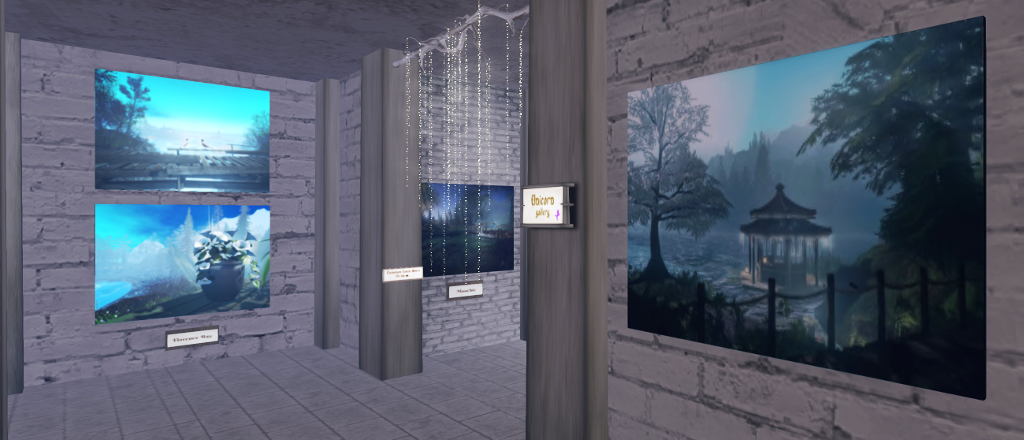
Located in the main hall of the gallery’s magnificent castle, the exhibition features an extensive selection of Miro’s photography taken – as the sub-title for the exhibition indicates – during his travels around Second Life. In all, over thirty photographs are presented, both within the main hall and within some of the rooms leading off of it.
However, the thing that draws one to the pictures is Miro’s use of tone, colour and soft focus.
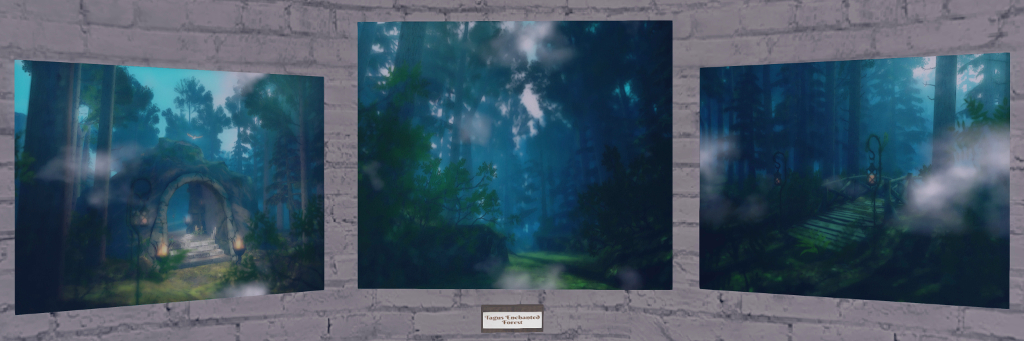
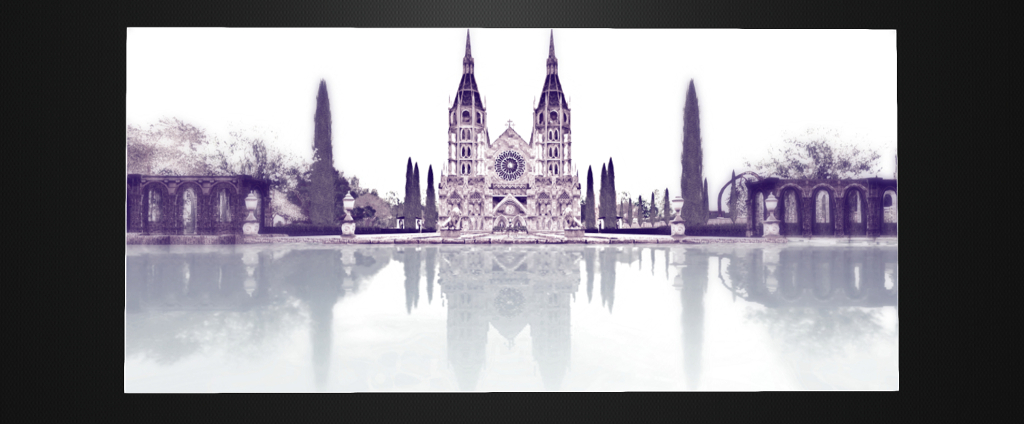
The colour and tone are clearly evident in these pieces, which has been set within the rooms in reflection of this. In the main hall, for example, blue is the predominant hue seen in his images. This gives the pieces a particular tonal quality evocative of fantasy moods and setting. In this, the choice of colour often reflects the locations where with the photos were taken, as with those for The Sanctuary and Tagus Enchanted Forest. Elsewhere, the blue presents a sense of enchantment or mystery to a place one might not necessarily associate with a fantasy setting – such as with Florence Bay.
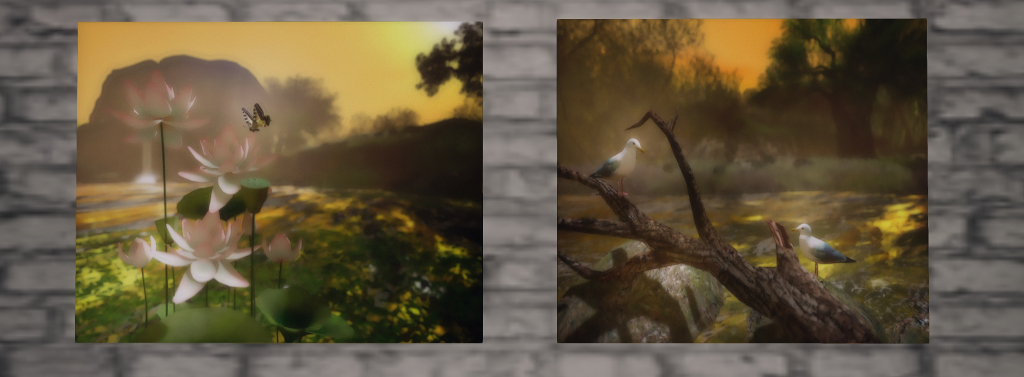
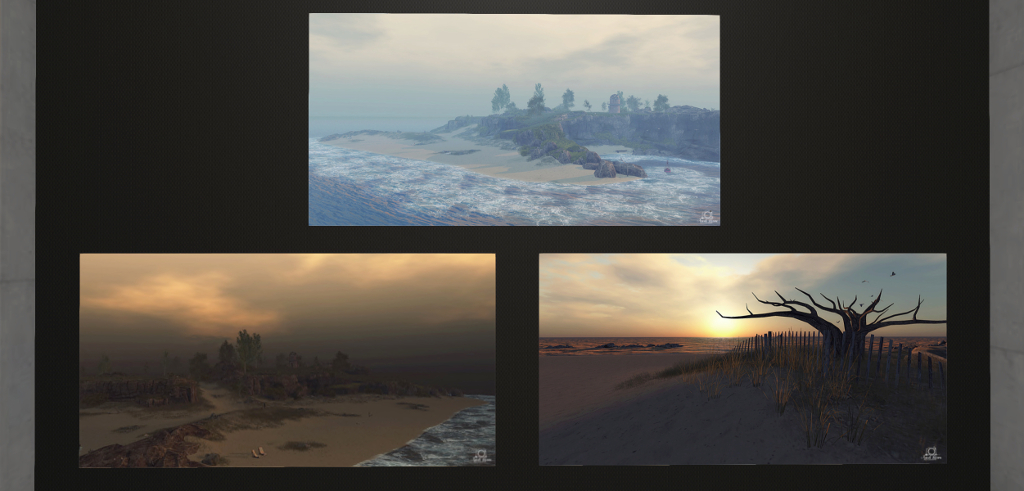
Brighter tones are evident in the selections found in the adjoining rooms as well, notably yellow and orange. Warm colours, these add a sense of homeliness, warmth and familiarity to the locations which, again, is fully in keeping with their nature when visited, or which presents the subject location in a new perspective, such as with his picture of sunrise / sunset over the shoulder of Ukivok.
Miro’s use of depth of field and soft focus adds a further nuance to many of the images, giving them a painting-like aspect. This really brings each piece to life, as well as adding a great sense of narrative to each piece.
All told, an extraordinary exhibition by a Second Life explorer whose work should be displayed far more in Second Life. The formal opening for the exhibition will be marked by a live performance by Phemie Alcott from 15:00 SLT, dress code: “classy casual”.
DiXmiX Gallery: Masquerade – Lou Shadow and Calypso Applewhyte
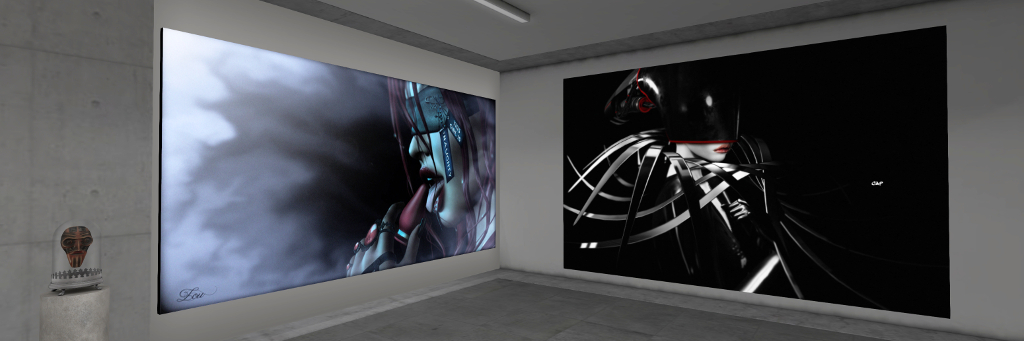
Masquerade is the title of an ensemble exhibition at DiXmiX Gallery that opened on June 20th, 2019. It features images by 34 Second Life photographers that have been selected by Dixmix Source, the gallery’s curator, along the theme of masks (which also encompasses the likes of helmets face masks, gas masks, make-up as a mask, as well as the more traditional masquerade mask suggested by the title.
Occupying all three halls of the gallery, the exhibition comprises a one or two pieces from each of the selected artist; they in turn comprise: Algezares Magic, Aniki Seetan, ByrneDarkly Cazalet, Calypso Applewhyte, Catherine Nikolaidis, Edie Horngold, Ember Adored, Gaus, Génesis Rodriguez, Guen Gothly, Izabela Navarathna, Jaggy, Kimmy Littleboots, Kimmy Ridley, Krizze Sparrowhawk, Laura Mrs S, Lou Shadow, Maloe Vansant, Megan Prumier, Mila Maesar, Ornella Batriani, Pam, Purple Leonis, Ryleigh Theas, Shocoon, Sinon Vale, Sonic, Tania Tebaldi, Tiya Aura, Tralala Loordes, Valenska Voljeti, Vallys, Wicca Merlin and Dixmix himself.
DiXmiX Gallery: Masquerade – ByrneDarkly Cazalet and Tiya Aura
Given the broad spread of photographers, this is unsurprisingly a richly mixed exhibition with wide-ranging styles and themes, with one or two of the images perhaps stepping into the realm of NSFW. Given the focus is headgear, the themes touch on science-fiction, fantasy (notably some darker shades, rather than perhaps the more wistful), adult games, etc.
Such is the volume of work here that this could easily be the kind of exhibition that desensitises the visitor to the subject matter (“Oh, look another avatar wearing a mask!”). However, through his selection and curation of the images, Dixmix utterly avoids this, putting on a display so richly diverse, and with the majority of the images offering a depth of narrative that extends well beyond their frames, that the exhibition is captivating throughout.
The diversity of work on display means that picking out individual pieces is an impossible task: each has its own attraction and most – as noted – have their own distinct story to tell. As such, this very much is an exhibition that should be witnessed first-hand.
It was back to Kultivate’s in-world base of operations for me once more at the start of July 2019, following the opening of the newly-named Kultivate AIR Gallery (formerly part of the Windlight Gallery).
Standing for Artist In Residence, the gallery brings together Angyel Resident, Anouk Lefavre, CalystiaMoonshadow, DreamMakerXDreamBreaker Resident, GlitterPrincess Destiny, Jamee Sandalwood, JolieElle Parfort, Kody Meyers, Maaddi Benazzi, Marcel Mosswood, Myra Wildmist, Pam Astonia, Sevant Anatra and Wintergeist in a broad-ranging art display occupying one wing of the galley’s lower floor.
Mixing Second Life landscapes with physical world art, monochrome with colour, paintings with drawings, abstracted pieces with experimentalist – and with just a hint of avatar-focused studies in the form of Pam Astonia’s eye-catching Profile portraits, this is a richly engaging exhibition that demonstrates the full roundness of Second Life as a medium for displaying art.
As is always the case with ensemble exhibitions, limiting comments to just some of the artists can seem a little unfair; such is the depth and quality of art on show here, this is perhaps doubly so. However, I must admit that I did find myself particularly drawn to certain pieces.
The five photographs of SL landscapes by Anouk Lefavre, for example, framing marvellous horizon images with an opulent use of light and shadow contrasts or natural blending of haze to produce vistas that pull at the motions. Then there is Venice – Italy and England – Time of Henri VIII and Anne Boleyn (seen in the banner image for this article) by Angyel Resident. The latter of these, I believe, captures part of Tahiti Rae’s 2015 LEA installation, Love, Henry (read here for more), but both offer such a marvellous contrast of style and colour, they cannot fail to draw the eye and mind into them.
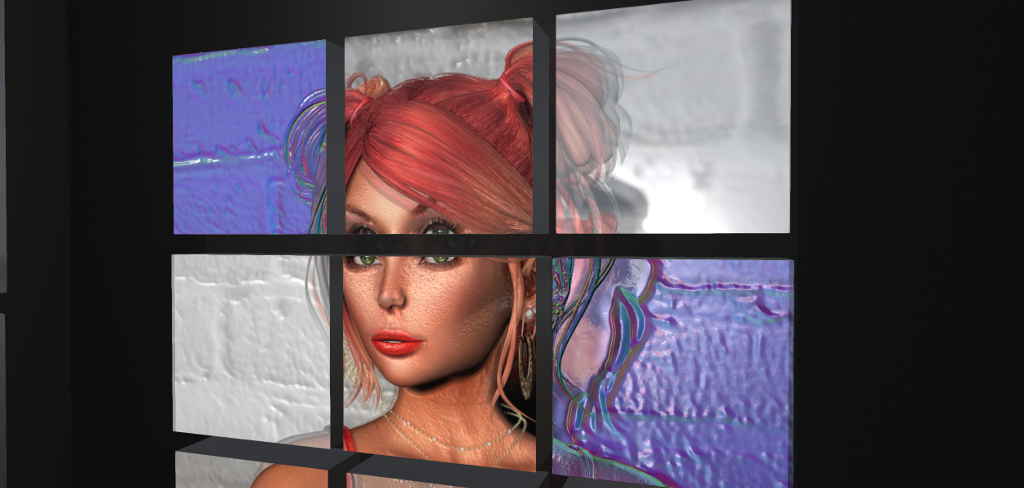
Myra Wildmist, meanwhile offers an experimental piece entitled Material Girl. You’ll need to have your viewer’s Advanced Lighting Model (ALM) enabled via Preferences > Graphics to see this piece correctly, as the nine tiles use various normal (bump) and specular (shine) maps to produce different finishes to the piece.
As a part-time builder / kitbasher, I’ve long enjoyed using materials in various builds, and normal maps in particular – if used correctly – can add depth to SL photos where post-processing has been used to make it appear as if they have been painted, sometime which is demonstrated (if on a slightly exaggerated scale, given it is designed to bring the materials to the fore) within Myra’s piece.
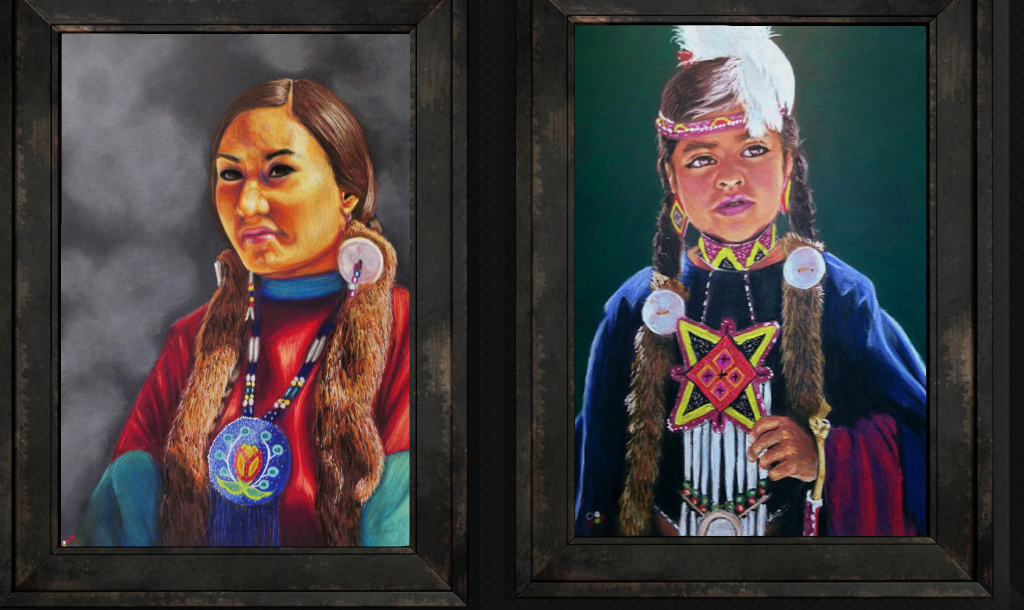
Then there are Sevant Anatra’s paintings of Native Americans. From portraits to capturing a part of the Anishinaabe creation story, these are marvellous, evocative studies with (again) a sense of depth and life that holds one’s attention and allows the imagination to unfold stories.
And that’s just my pick of four artists from what is a superb selection of art, so do take the time to hop over to the Kultivate AIR Gallery and take a look for yourselves.
The July exhibition at Kultivate Edge Gallery opened on June 23rd and will run through until late July 2019.
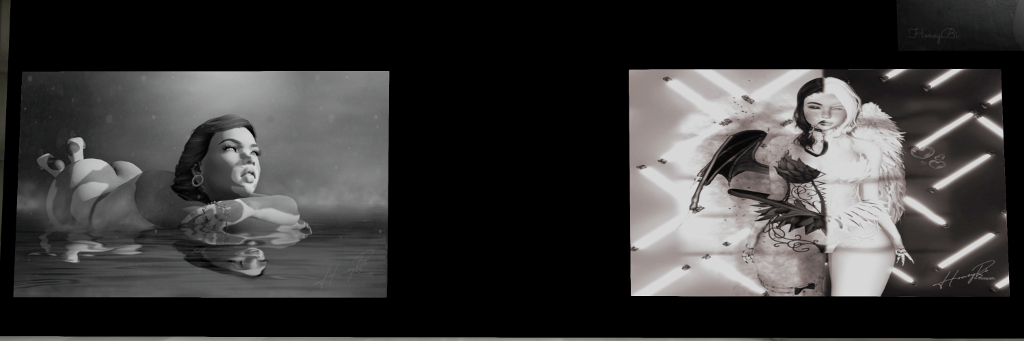
Specialising in monochrome art and photography, the gallery’s roll of artists comprises aht1981, DrusillaGwind, honeyBi, KodyMeyers, understandingcomplexity, John Brianna, Eucalyptus Carroll, Davenwolf Dagger, Lena Kiopak, Nodome Resident, and Veruca Tammas.
As is always the case with The Edge, there is a rich mix of art on offer with this exhibition, from physical world photographs, as presented by John Brianna with a fascinating set of locomotive images featuring five diesel engines positioned around a marvellous picture of an old-style steam locomotive, through to evocative avatar portraits, such as those presented by KodyMeyers on the lower floor of the gallery alongside John’s display.
In many ways, I’ve always found monochrome studies of avatars to be more attractive than colour studies; its not that I have anything against the latter, its just that for me, the former carries a degree of life in the use of light and shadow that draws me in. This is true of all of the avatar studies presented here.
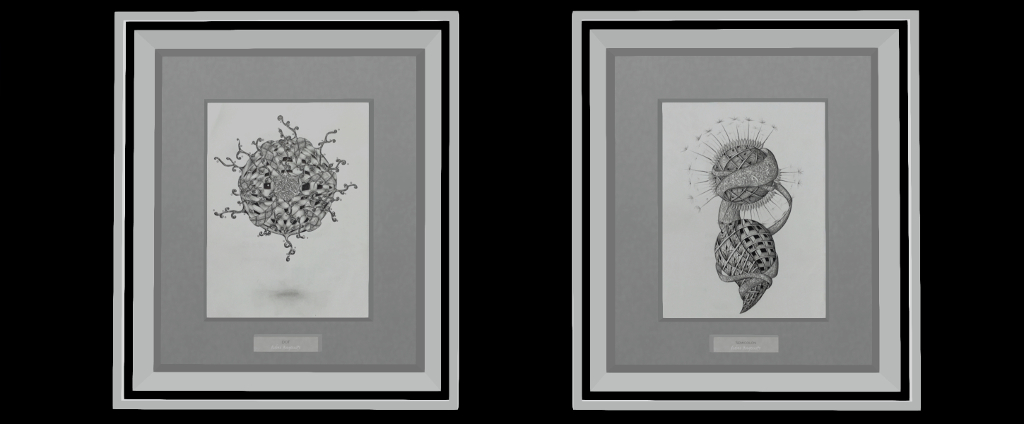
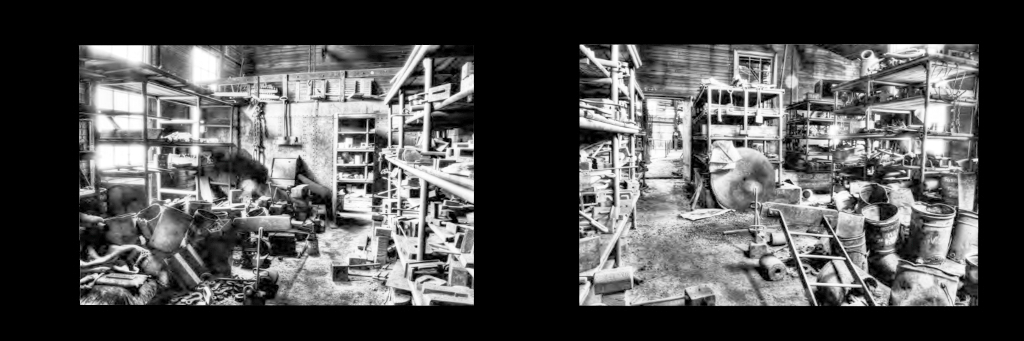
However, for this exhibition I found myself drawn to the physical work art on offer – John’s locomotives, together with an almost triptych of drawings by Nodome Resident and a set of eight images entitled The Blacksmith Series presented by Davenwolf Dagger.
Admittedly, part of my attraction to the latter is the fact they were taken in Launceston in Tasmania, a place (along with Richmond on the southern side of the island) for which I have happy memories. As such, the photos presented by Davenwolf piqued my curiosity and stirred those memories. But it’s not just that; each and every one of these photos is rich in detail and narrative. Similarly, Nodome’s drawings are wonderfully intricate and captivating.
But whatever your preferences for art in Second Life, the mix of physical world photos, avatar studies, art and landscapes make this a must-see exhibition.
As the old, old saying goes, “I have some bad news and some good news.”
The bad news is that if you were hoping to visit Cica Ghost’sLuna Park (see Cica’s Luna Park in Second Life), that build has now gone from Second Life, the result of low visitor figures, possibly as a result of clashing with SL16B.
The good news is that Cica has replaced it with something that is quite dynamically wacky (literally, if you wander across the landscape!), a piece she calls Cubes.
Occupying the same region as Luna Park, Cubes is a curious piece, comprising a barren landscape under a bright sky, occupied by a few bare trees, but which is periodically deluged by downpours of … huge steel reinforced concrete blocks.
These appear a handful of metres above the dry land, hover for a few seconds as if waiting for gravity to notice them and question just what the heck do they think they are playing at, before yanking them down to the ground, where they tumble and roll against one another and build random mounds and towers before silently poofing and starting over.
With the lines of steel bars embedded within them creating checkerboard patterns on their face, these great cubes look like a certain cubic puzzle game, albeit one usually made up of smaller cubes with coloured faces. Hence why, perhaps, Cica gives Cubes a quote from that game’s creator:
The Cube is an imitation of life itself – or even an improvement on life.
And, given these cubes are physical, they can have quite an – impact, shall we say – on life should you happen to wander out and stand when they are falling!
There is something very faintly Petrovsky Flux-ish (for those who remember that installation) about Cubes. The way the Cubes fall is mindful of the destruction of each Flux build – be here, all the pieces are regular, and the fantastical forms they create are entire as a result of their dropping from the sky, rather than the starting point for their collapse. Watching them, like the parts Petrovsky Flux, can be oddly hypnotic.
I’m not sure how long Cubes will be open, but like Luna Park, it’s meant in fun.
Currently open through until July 20th is a celebration of pre-Christian Russia entitled Slavic Rebirth, the opening of which was intentional timed to coincide with the summer solstice. I was alerted to the event by ViktorSavior, who will also be presenting his art at the event, combined with the poetry of AlenaPit.
Occupying floating islands bearing builds by Arin Bellios that float high above Isles of Devotion, the Full region held by Djembe Dragonfire and Jay Abernathy, who have donated the space to the event free of charge, Slavic Rebirth is a multi-faceted event featuring art, music, workshops, a fashion show, and a market. The organisers describe the event thus:
This is the world BEFORE the arrival of Christianity in the Russian lands. This is paganism in its best manifestation, unity with nature and native gods. This is the strength of the spirit, purity of thoughts, the beauty of the body, the awareness of walking the right path. This is a world of fairy tales and epics. This is our ancient memory that you need to wake up and open your eyes.
There are a number of landing points associated with the event, but I’m focusing on the art gallery area here, as this is what particularly drew me to the event.
Slavic Heaven: the location alongside the gallery where music events will be held and where people can relax
Occupying a large central island that is linked to, and within eyesight of, two small event spaces, the gallery is open-air, but has a strong element of what might be regarded as classic Russian architecture which, despite the pre-Christian focus of the event, perhaps carried echoes of a church-like structure.
The art is displayed within the open arches of the tiered walls and is actually deceptive: what at first glance appears to be the works of a single artist is in fact three (or four, once Viktor’s art is added!) individual switchable displays of art: a board close to the landing point allows visitors to select which of the artists’ work is on display. Allowing for the addition of Viktor’s art, the three artists currently on display are:
Roman Papsuev (aka Amok): a contemporary Russian artist who may be known to some for his work depicting scenes and individuals from George R.R. Martin’s A Song of Ice and Fire books (note not the TV series Games of Thrones, so don’t expect images of Kit Harrington or Emily Clarke, etc). The pieces presented in Slavic Rebirth are from his collection Tales of Old Rus’, featuring line drawings presented in monochrome.
Vsevolod Borisovich Ivanov: another contemporary Russian artist inspired by the traditions and history of Russia – particularly that of medieval Russia, and pagan mythologies of old Russia. His paintings are rich in colour and content, covering a wide range of subjects: heroes, gods, creatures, architecture and the harsh beauty of old Russia.
Viktor Anatolyevich Korol’kov: a classically trained artist whose work has encompassed the history and myths of Europe (Germany, Scandinavia, Italy, Greece), Egypt, the books of the Bible and more. All of this led him to a fascination with Slavic history, art and mythology – which led him to the main thrust of his art, as seen in Slavic Rebirth, a celebration of that old history, presented here under the title Enchanted by Old Rus’.
When switching between the artists via the control board, the art on display on the two sides of the gallery will change in unison, as will the exhibition title board on display (each of which offers a profile of each of the artists. How well this might would with multiple people viewing the art might require some coordination to prevent conflicting changes, but the approach is interesting. Note, as well, that touching individual pieces of art will deliver a note card to you, offering information on the art itself.
Throughout the month of the event there will be a number of musical performances taking place at the Slavic Heaven floating island to the south of the art gallery (use the touch-to-teleport portal at that end of the gallery to reach it). These include: Italian SL singer Malesh, who will be appearing at 13:00 SLT on both Tuesday, June 25th and DJ Dalilu who will be appearing at 12:00 noon on Wednesday, June 26th.
Also to be found via the teleport arch at the north end of the art gallery (and closest to the landing point) is the Slavic market built around an ancient temple of Goddess Lada.
The final part of the event spaces for Slavic Rebirth is the Seasons Island. Offering ” all seasons of Russian nature”, this is the focus of a photo exhibition that forms part of the event – details from the event information boards – and for the Slavic Rebirth Fashion Show and Contest that will be taking place on Friday, June 28th at 12:00 noon. The theme for this is Slavic history and fairy-tales, and members of the public can participate; again, details are available at the event spaces, and there are two workshops / rehearsals for those interested in joining in: Sunday June 23rd at 10:00 (so very short notice here!) and Monday, June 24th, at 11:00 SLT.
Further activities taking place at Slavic Rebirth will, I believe, be posted through the event spaces. In the meantime, here’s the full set of SLurl for this event.





 Inara Pey: Living in a Modemworld