Sansar 2019 Product Meetings week #6

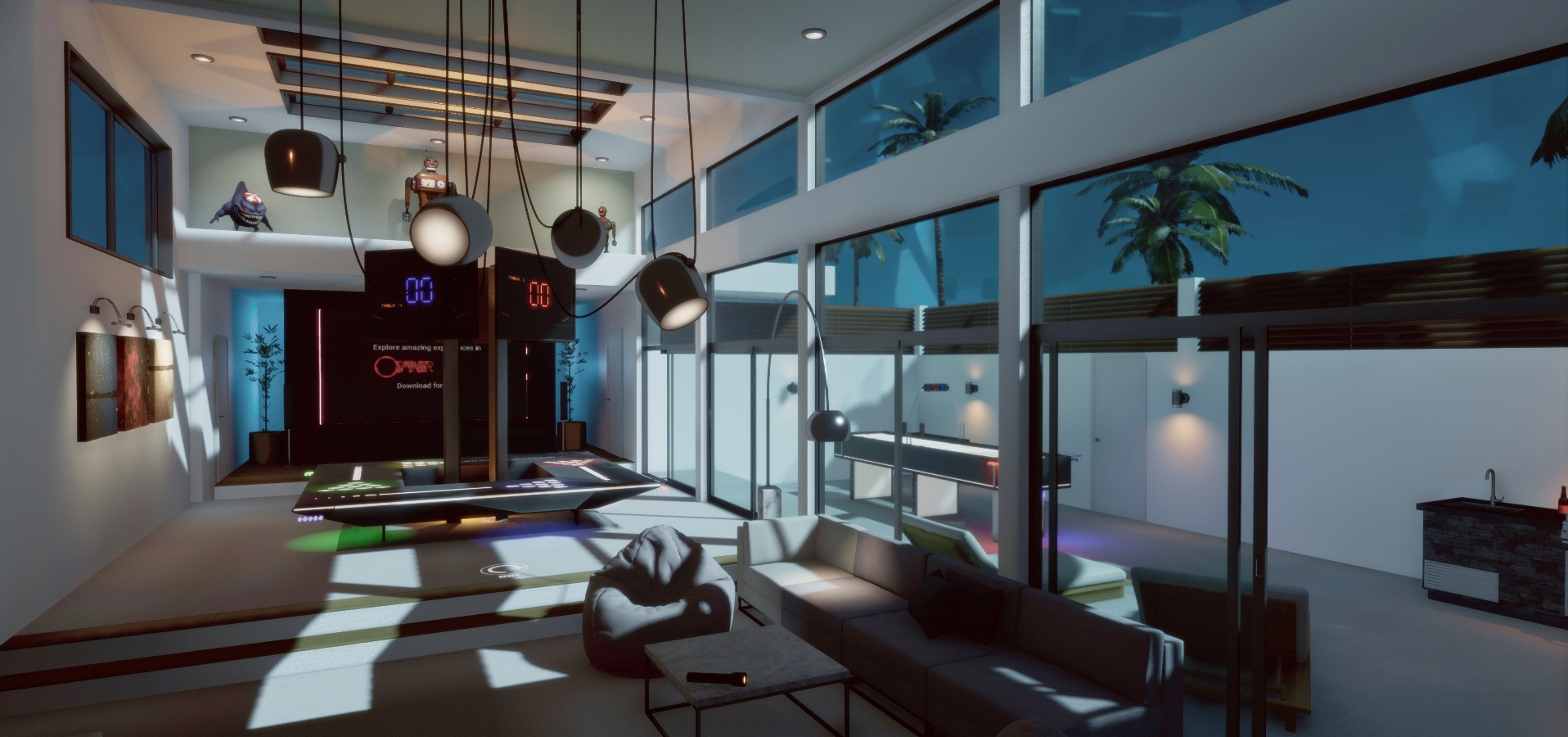
The Sansar Games Room by Sansar Studios

The following notes were taken from the Sansar Product Meeting held on Thursday, February 7th. The full video of the meeting is available here. This meeting was attended by Ebbe Altberg, so the primary discussion points were around Sansar as seen from the CEO’s standpoint, with some riffing (or should that be Ebbing?) on ideas.

R29 Feedback

The R29 Release was made on Tuesday, February 5th (see here for more). This has largely been positively received. The ability to spawn teleport portals has largely been favourably received, although some experience creators would like an option to block it (to avoid cheating in games, etc.). Ebbe Altberg also expressed some dissatisfaction with it (how it looks, where it appears, what is required to spawn it, etc.), so this could well be changing in the future.

There were some issues with the release, and as a result an update was deployed on Friday, February 8th with fixes for:

  • Frequent crashing issues caused by various factors.
  • Some experiences appeared darker or brighter based on the user’s video card.
  • Unexpected text inputs and modals with no input options may appear when saving store-bought items back into the inventory in edit mode.
  • Saving an object back to inventory that contains an inventory cluster resource would contain unlicensed info and cannot be sold.

Avatar Turning

The latest release has re-enabled a left-handed snap-turn capability for those in VR (the F5 key). This appears to be related to some aspects of VR control  (e.g. a “basic” and “advanced” control mode, although one of them hasn’t really been followed through on.

Strafing vs Avatar Turning

There was further debate on strafing vs. avatar turning. In Sansar, as with SL, the camera is generally positioned behind the avatar and facing in the same direction as the avatar. However, when walking left or right, rather than turning to face the direction of travel, the avatar “strafes” sideways by default with the camera still behind them (see below), unless a mouse / right-click combination is used to turn the avatar / camera.

The default “strafing” motion in Sansar – see as confusing for some new users

While common among various games, this is causing confusion for incoming users (including those from Steam). A suggested solution is to keep the current “strafing” motion the default action, but add a capability to have the avatar / camera turn automatically that users can enable, if preferred.

Ebbe’s Comments

Immediate Focus for the Lab

There are two key areas that the Lab will be focusing on for Sansar over the next (roughly) six months.

“Day Three retention” – increasing the number of users engaging in Sansar beyond their first one or two exposures to the platform.

  • The introduction of the Home Space / social hub apparently increased “day three” retention by some 50%.
  • The quest / rewards / achievements system being considered / developed (see my previous Product Meeting notes) is a part of this work.
    • As per those notes the idea is to boost interest in the platform by propelling users into a space where they are doing and earning things whilst also making friends and discovering other places in Sansar as along the way.
    • This system will over time be opened up to allow experience creators to also leverage it / participate within it, but this will not be possible straight off the bat.
    • First step is for LL to build the required infrastructure needed to provide such a system (back-end tools, possible HUD system, etc.), and then get things running.

Avatar enhancements – LL acknowledge there is a lot can could be done to improve the Sansar avatar (.e.g. attachments on custom avatars, MD clothing on custom avatars, skinning, bone deformation, and so on). Some of these may be small-scale projects, others more complex. Time is being given to determining the order in which this work is to be handled and how it should be progressed, which includes seeking feedback from creators.

Avatars will likely be the first element in Sansar to get a level of Detail (LOD) implementation.

One aspect of avatars related to user retention is providing a flow by which incoming users can easily see and understand how they can access the Sansar Store and buy avatar accessories / custom avatars, how they can use the items they have brought on their avatar, etc. It’s not directly clear to first-time users that any of this can be done, and so thought is being given to making it clearer.

Other Points of Discussion

“Sansar is A Virtual World”

The idea that Sansar is a virtual world was a concept that LL has steered away from, referencing it as a “platform for virtual experiences”.

“World” was seen as problematic, as it suggests a wholly contiguous space, a-la Second Life, which Sansar clearly isn’t. It was also hoped that by positioning Sansar as a “platform”, it would maximise the platform’s appeal to a broad cross-section of audiences. However, the Lab are now viewing Sansar as a “world”. This will feed back into into things like user retention, how some capabilities are implemented in Sansar in order to give consistency of expectation / function / immersion across experiences), etc.

An example of the latter is teleport portals. On the one hand, the Lab would like to see these use more for moving between experiences, but on the other they are currently immersion breaking, due to the experience load screen being displayed. Ergo, attempts might be made to try to lessen the impact of scene / experience loading when teleporting between experiences.

Thought also needs to be given to balancing how far experience creators can limit “expected” functionality within Sansar (e.g. preventing free camming or teleport portal spawning) without confusing users. One suggestion is to add icons to the Sansar client to indicate when core options are disabled at experience level (as with Second Life). Ebbe Altberg appeared unfavourable to this idea, citing people don’t look at the icons – something I would personally dispute; if people are made aware of the icons, they will refer to them.

Atlas Sorting

The Atlas initially sorts experiences in a complex manner. In the first place, those experiences currently being visited are listed. After that, a number of factors come into play to determine the listed order of experiences (has the experience had a high volume of traffic recently? what’s the number of likes it has received? etc.).

This has led to some experiences generating regular traffic being pushed down in the Atlas listing in favour of those that have a “one-time” spike in visitors who only stay for a few minutes. LL is aware of this issue, and is working to adjust the algorithm used to sort the experiences ordering in the Atlas (outside of those currently with visitors) help expose those generating steady traffic engagement much earlier in the default listings.

However, a major effort isn’t being put into refining the Atlas overall, as LL would rather have people moving between experiences and discovering places to go from within Sansar (e.g. using portals to link experiences) rather than hopping between immersion and the Atlas.

Collaborative Building

When the Edit mode was moved server-side it was seen as the “first step” towards collaborative building in Sansar. This is still something LL want to provide, but with the focus on user retention, enabling people to work easily together within Sansar’s Edit mode has now slipped to “some day”.

In Brief
  • Nvidia bug: the Lab has a workaround for the bug in the latest Nvidia drivers that is affecting some Sansar users. It’s not clear whether this fix will be released as part of a patch release or the next major release.
  • There is a bug that means that if avatars in the scene are not moving (e.g. they are seated), they may not be seen by those entering the experience until such time as they do move.
  • As well as LOD capabilities, more intelligent use of textures, etc., to reduce the number of draws, and other back-end changes that can be made to help improve performance within experiences, LL also hope to provide creators with more tools that will inform them and help them to make performance-related choices when building their scenes.

Sansar 2019 Product Meetings week #5: release R29 summary

Scurry Canyon shooting game by FullSpectrum

The following notes were taken from the Sansar Product Meeting held on Thursday, January 31st. The full video of the meeting is available here. These notes highlight information pertaining to the upcoming R29 release, and user engagement discussions.

Upcoming Release Highlights

Emotes  / Animations Fix: there is an issue with the current release that can see some odd behaviour with animations, particularly for those in VR. There will be a fix for this in the next release, however, it will mean that users with custom animations will have to re-assign them to their perferred emotes. This will only have to be done once.

Teleport Portal Feature: the next release will include a new chat-driven teleport portal feature. This allows a limited time portal to be created in an experience that can be used by anyone to teleport to another experience. The command will take the format “/portal”, and the portal will exist for around 2 minutes.

So, for example, if you are with friends in an experience and decide you all want to visit Aech’s Garage, one person in the group can type:

/portal https://atlas.sansar.com/experiences/sansar-studios/ready-player-one-aech-s-garage

The rezzed portal can then be clicked on by those wishing to use it to transfer to the other experience until the portal times-out and vanishes. Should this prove intrusive, the Lab will consider adding an option for experience creators to block the capability, if required.

VR IK Improvements: updates to the IK system should mean that hand movements will not lag so noticeably behind actual hand movements when in VR. This is part of work to improve overall IK responsiveness.

R29 should also see the removal of the height calibration menu and storing a person’s height when using VR. There will still be options for setting it, if required (such as when a headset is being used by two different people); but where the headset is only used by the one individual, once height is set, it will be saved, and it will no longer be necessary to re-calibrate in different sessions. In addition, it will also include the ability to manually adjust the recorded height.

Hidden surface removal algorithm: this should seem significant improvements when selecting / updating your avatar looks (the in progress spinner shouldn’t appear for quite so long – the reduction in time estimated to be from the current 20-30 seconds to around 7 seconds.

Edit Server Fixes: R29 will include a number of Edit Server fixes. It is hoped these will help reduce the number of Edit Server disconnects experience creators can be faced with when working on a scene. This work is part of the overall effort being put into stability across the entire platform.

User Engagement

Avatar Movement / Controls

There have been complaints (and still are) about various aspects of Sansar’s control options (many of the complaints on Steam, for example, target the “non-intuitive” set-up of the VR  hand controller options).

One area of frustration many have is in avatar movement. In SL, for example, using the D key will orient the avatar and camera so the avatar is clearly facing the direction it is walking in. In Sansar, the camera will remain in place as the avatar walks to the left or right, giving what can be an odd “strafing” slide to the camera until it is re-oriented.

The problem here is which sort of controls are best: it might be argued that the “strafing” approach is something common in games, while the SL approach is more “non-standard”. However, users coming via Steam seem to be experiencing issues with turning their avatars when walking. So, the lab is seeking feedback on how best to consider possible improvements.

Quest / Progress System and user Engagement

To help new users, LL are working on a “quest / progression” system for Sansar.

  • Initially this will be a tutorial style option for new users, designed to take them through a basic quest and learn to use the basic controls (VR and keyboard), carry out tasks (pick things up, use them, drop them, teleport, etc), complete with some form of rewards / progress system that will deliver them to their Home Space on completion.
  • It will likely include a “come back and do this later” opt-out to allow people who are joining Sansar to attend a specific event (e.g. a show or performance) to log-in and get directly to the event, rather than being diverted into this on-boarding process.
  • Over time, the Quest / progress system will be opened out to experience creators, so they can embed it within their own games / quests, offer their own rewards / prizes (initially via the store), etc.
  • This system will (eventually) include infrastructure and capabilities that will include: information on the current quest a user is playing; how far they have progressed; what their upcoming task(s) is / are, etc.
  • Ideas put forward by both the Lab and creators at the meeting) for quest / game environments that might be built on this system include:
    • Hunts of some description, which also might be across multiple experiences, should experience creators have their builds included and add rewards to the quest.
    • Escape Room style games.
    • Story-based quests  – mysteries to be solved, etc.
    • More social-style games were also suggested, such as board games, card games, etc., that can easily be played by a group of friends.

For new users, there needs to be a clear distinction between goals and achievements. For example, Making 10 new friends might be considering an (unadvertised?) “achievement” within a quest, were a new user happen to do this as they played it; but it would not be a stated goal of the quest (as in, “you must now gain 10 friends in order to proceed to the next level”). This is to avoid new users lobbing multiple friend requests every time they come across other people and possibly annoying them. However, going to X, solving Y / overcoming Y to receive Z from the store, would be a goal / reward.

Another idea put forward is a system of badges / medals that can be received through repeated engagement in the platform. This type of system is used within Steam and is apparently popular there, and High Fidelity utilise a similar system as well.

Platform Promotion: VR AND Desktop Accessibility

One issue seen with Sansar gaining new users is that it is frequently perceived as “VR only” (this is a common form of feedback among Second Life users – I’ve seen it in comments on this blog).

In 2018, the Lab adjusted some of their advertising to de-emphasise the VR aspect of Sansar (such as removing some of the VR bias from the Sansar.com homepage); but conversely, there are still events that are promoted with this bias – Comedy Gladiators being a case in point (e.g. Comedy Gladiators, from Comedian Steve Hofstetter, Takes Live Entertainment to New Heights with Real-Time Ticketing & Physical Merchandise Sales in VR – Linden Lab press release, November 29th, 2018).

It’s been acknowledged by the Lab, that more needs to be done to emphasise the fact that Sansar can be enjoyed directly from the PC desktop without the need for a VR headset.

In Brief

  • Simple Scripts: it is widely felt these are under-utilised by experience creators. One issue is the lack of detailed documentation / tutorial material to go with them. This is apparently being addressed by the Sansar team.
  • 3D Mouse systems: following repeated requests from creators and machinima makers, initial steps have been taken to investigate whether support can be added to Sansar.
  • Other points of discussion, such as bugs, questions on specific aspects of content creation, etc., can be obtained by watching the video.

Sansar 2019 Product Meetings week #3 w/audio

Sansar Social Hubblog post

The following notes were taken from the Sansar Product Meeting held on Thursday, January 17th. The meeting was chaired by Stanley, the Director of Product for Sansar at Linden Lab and who was marking his first time leading a product meeting. Also in attendance (who I noted) were Cara, Aleks, Leslie, Nix and Stretch Linden.

Stanley has been with the Lab for some six months, and has been working closely with the Product team with a focus on improving the consumer experience, particularly the integration with Steam.

Sansar Dollars To US Dollar Conversions

On Wednesday, January 16th, 2019, Linden Lab published a Sansar blog post outlining Sansar Dollar to US dollar conversions. The post follow-on from changes announced in December related to Sansar becoming available on Steam – specifically the closure of the SandeX, which has been replaced by a flat-rate exchange rate for S$<>USD transactions.

The latest blog post outlines the key points of the new exchange process. In short:

  • Sansar dollars can be converted to USD at the rate of S$250 to $1.00. However, anyone who created their Sansar account before December 31, 2018, can exchange at the legacy rate of S$143 to $1.00 through until  December 31, 2019, after which the conversion rate for all accounts will be S$250 to $1.00.
  • The Process Credit page has been re-enabled for moving USD to PayPal accounts. However, to allow for processing of funds that may come via Steam, processing may take up to 30 days to complete a request.

However, there is more – and it has been somewhat negatively received.

  • Only “Earned Dollars” can be cashed out. That is, only S$ obtained via the sale of goods / services. S$ that are purchased or received as a gift / tip cannot later be cashed out (although all S$ held before the January 16th blog post have been converted to Earned Dollar Status).
  • It has been calculated that, even allowing for easements elsewhere in the system, creators are losing some 60% of potential income when cashing out.

This latter point was of particular concern at the Product Meeting, but the Lab’s hand is forced on the matter due to Sansar now also being provisioned through Steam, there is also concern as to whether the S$ > USD exchange rate might undergo further adjustments other than that planned for the end of 2019.

There are currently no plans to introduce adjustments to the cash-out exchange rate beyond those indicated in the blog post, which amount to anyone cashing-out paying around 60% in commissions. To help offset this, the Lab no longer takes a commission on any store-based transactions between users; they only take a commission on the cashing-out of S$.

Even so, and not unreasonably, creators feel that the shifting of fee payments to the cashing-out process means they are effectively subsidising the Steam integration, particularly given that – by the Lab’s own admission – the majority of users in Sansar are still coming directly into the platform, rather than via Steam, yet Steam still take a cut of the cash-out transactions.

The Lab acknowledge this is currently one-sided, but given they have no means at this point in time to accurately judge how much of an impact Steam will have on Sansar’s usage, they have erred on the side of caution. But whether in time the commission percentages could be adjusted, very much depends on how traffic flow through Steam develops over time, with changes to the cash-out process liable to be considered very carefully before being implemented.

It was asked whether Sansar could be provisioned through Steam “without the money part” in order to simplify matters. The problem seen with this approach is it would exclude Steam users from any economic engagement in the platform (as their transactions must come via the Steam wallet), reducing their interest in using the platform (no ability to buy avatar accessories, good, etc.).

The Future With Steam and Other Providers (e.g. Oculus)

Linden Lab see Steam as the “industry standard” for accessing games and for using VR with games. As such, they are unlikely to move away from the current partnership. However, if over time the relationship with Steam does not prove beneficial to Sansar in terms of growth, use, economy, etc., the platform is not in any way locked-in to Steam on a permanent basis, and so a future separation is not impossible.

The Oculus store has also been looked at as a potential channel for Sansar, and talks have been held. However, because of the relationship between Oculus and Facebook, this had proven a lot harder, but is still being worked on.

New User Experience

New User Experience Steam “versus” Sansar

There still seems to be a perception that users coming to Sansar via Steam have a different new user experience to those coming via Sansar.com. Aside for the sign-up process, this is incorrect. Sansar as provided through Steam is no different to Sansar accessed via the website / direct client download: all users go through the same on-boarding experience with their Home Space and the client tutorial, and the new Social Hub.

Enhancing the New User Experience

There are internal discussions at the Lab on further enhancements to the new user experience, such as adding some form of achievements / cosmetic awards system or similar, in order to encourage engagement (particularly among Steam users).

One of the issues Sansar faces (like Second Life) is how it should be pitched, simply because the potential use-cases are so vast and different. Creators, for example, have different reasons to try the platform to consumers; even gamers with an interest in modding view things differently to those purely interested in game play. Thus, the Lab is still juggling with approaches.

In terms of Steam, one of the most basic areas in determining how the appeal of the platform could be improved is via the constructive feedback offered through reviews, given that when provided, these most frequently involve comments on the “non-standard” approach to how control options are laid out on the hand controllers.

Gaming Templates

In keeping with previous Product Meeting summaries in these pages, the Sansar Team is working on various game-style Sansar templates (e.g. shooting games). It is hoped that when these become available, they will encourage creators / users to utilise them within their own experiences, further helping to drive engagement in Sansar.

These templates have also seen the Lab considering issues such as scoring mechanisms, persistence of scores / progress between sessions, etc.

Upcoming R29 Changes

The upcoming R29 release (the first for 2019) includes some further VR updates related to a user’s “connection” to their avatar.

  • One of these will be for the avatar to be more in sync with a users body movements, rather than lagging behind, as can be the case at the moment.
  • Another is to provide better control of arm movements (although this wasn’t clear to me, I assume this is related to keeping the arms more naturally in line with the avatar’s body when moving the hand controllers around).

R29 should also see the removal of the height calibration menu and storing a person’s height when using VR. There will still be options for setting it, if required (such as when a headset is being used by two different people); but where the headset is only used by the one individual, it shouldn’t be necessary to re-calibrate between sessions.

Continue reading “Sansar 2019 Product Meetings week #3 w/audio”