The following notes cover the key points from the Web User Group (WUG) meeting, held on Wednesday December 4th, 2024. They form a summary of the items discussed and is not intended to be a full transcript. A video of the meeting, recorded by Pantera Północy, is embedded at the end of this summary – my thanks as always to Pantera for recording it and making it available.
The Web User Group exists to provide an opportunity for discussion on Second Life web properties and their related functionalities / features. This includes, but is not limited to: the Marketplace, pages surfaced through the secondlife.com dashboard; the available portals (land, support, etc), the forums.
As a rule, these meetings are conducted:
On the first Wednesday of the month and 14:00 SLT.
Meetings are open to anyone with a concern / interest in the above topics, and form one of a series of regular / semi-regular User Group meetings conducted by Linden Lab.
Dates and times of all current meetings can be found on the Second Life Public Calendar, and descriptions of meetings are defined on the SL wiki.
Marketplace UI: work on updating the marketplace with a new user interface is described as being in the final stages of internal testing and thus “very close”.
Second Life Dashboard (secondlife.com): this is also being updated to a new design, and there is a chance it may be deployed in the next month / during January 2025.
Web Log-in and Multi-Factor Authentication (MFA): this is ongoing work to update the Second Life web log-in splash screen to a new design which will will work better on all devices, and will support MFA.
Marketplace MFA: work is continuing on adding MFA to the Marketplace.
Also in the works:
Changes to Linden Home store, adding some UI updates.
Updating the Second Life web maps – described as “still in early design”. Some of this work was mentioned in the November meeting – also see below.
Single Sign-On
[Video: 5:28-5:58] The subject of single sign-on (SSO) – allowing a user to log-in with a single ID to several related but independent services (e.g. SL dashboard, the Marketplace, (possibly) the viewer, etc.), just once (and possibly with unified authentication factors) Has often bee requested – and looked at – by the Lab. In response to SSO being raised at this meeting, Sntax Linden responded:
SO and Federated login is something we have been looking at doing in the future. The MFA on web login and marketplace will just be reusing the existing MFA we have on viewer and mobile.
This has been discussed at past meetings. Gifting is seen as confusing for some (having the Add to Cart as Gift and Buy Now buttons so close together suggests Buy Now must be clicked when gifting); plus the Shopping Cart is often used as a means of storing things people might be interested in purchasing, but as gifting is tied to it, carts must be cleared of anything stored therein.
As such, requests have been made for a direct means of gifting items in a manner similar to the Buy Now button (e.g. an “Gift Now”) button.
Commenting on this, Juniper Linden said:
We do have some updates to the gift UI coming out soon-ish; minor changes to that flow that might be better but nothing like “gift now”
Sntax indicated the MP team will get to gifting as soon as they can.
The basic requirement for this was seen as a simple button within listings, per above.
However, maintaining the ability to still add gifts to the cart as an option was also seen as useful – so having the “Gift Now” button present the current steps for gifting (enter recipient’s name + an optional message) followed by options to send the gift directly or add it to the Shopping Cart was seen as the optimal solution.
The main pressure from the meeting was to have some form of “band-aid” solution for direct gifting, and then refine things after-the-fact. This was seen as the preferable course of action.
This conversation also spiralled into use of legacy (user) names over Display Names and mis-gifting people.
As noted above, LL are looking at updating the Second Life web maps (https://maps.secondlife.com/), and to this end, a series of questions were asked on the functionality they provide:
Do people use the web maps or just the in-viewer World Map. Probably fair to say the if a broad audience were asking, there would be a reasonable split between “viewer” and “both”.
Is the Create Your Own SLurl option in the viewer World Map a useful option?
Do people use the Destination Guide element of the web maps to find places?
Do people use the Search option on web maps?
A Second Life web map (https://maps.secondlife.com/) showing: 1. the Create Your Own Map Link option (opens a dialogue box), 2. search bar option and 3. the Picks Destination Guide
That those at the meeting assumed that these questions were focused on the viewer’s World Map (with ensuing confusion as to the Search and Destination Guide questions) is possibly indicative as to how often the web maps are directly used (although eight people at a meeting is far too small a sample from which to draw meaningful conclusions).
Web Maps are frequently used, however – and possibly without people realising they are a map system – when clicking on SLurls included in things like blog posts, etc., in order to locate and teleport to the region / location in question.
The above spread to a discussion on sharing SLurls and how people go about it (including the misconception that the viewer World Map does not allow for the copying / creation of SLurl, despite the large button at the bottom of the Map legend).
A request was made for possible information to be added to the SL maps. Replies focused on the viewer World Map and included:
A “show rez zones” option.
A “show Set Home locations” option to help new users to find regions where they can set their home position.
Ability to find out more about location via the map. Fore example, clicking on a location on map.scondlife.com gives a default dialogue (which LL have stated will be updated to actually reflect the region information) – having this available for regions / parcels on the viewer World Map was suggested (on a mouse-over hover?).
Whether or not a location is open to public teleporting / a user’s ability to teleport (e.g. whether there is a minimum age set for access, or access is controlled by having Payment Information on File).
General Discussion
The last 10 minutes of the meeting focused on issues around links to outdated videos on web properties such as Where Next? the Support portal, etc., and the potential negative impact they have on new users / incoming new users.
Luane’s World – Le Monde Perdu, December 2024 – click any image for full size
‘Twas off back to Luane’s World at Le Monde Perdu for me at the start of December, and a visit to LuaneMeo’s always-engaging public region.
As one might expect given it’s the end of the year, the region has been redressed for a northern hemisphere winter, with Luane working with Gorba McMahon to bring visitors a lot to see and do within and snow-covered landscape.
Luane’s World – Le Monde Perdu, December 2024
A white winter blanket has settled over Luane’s World, a Nordic-inspired haven with charming red houses by a frozen lake. Explore the illuminated Christmas market in the village, then take a chairlift to a cosy mountain bar. Ski or sledge through snowy forests and down to the rocky shore to uncover a stunning ice cave with a museum of ice statues. On the island’s other side, visit a quaint fishing hamlet with a rugged, captivating atmosphere. Wonders await—so wander, explore, and enjoy!
– Luane’s World – Le Monde Perdu Winter 2024 description
For this iteration of the region, the land forms and inverted U around a cold water bay, watched over from the south by two mountainous off-region islands. The landing point is located on the western headland, where stands a little Nordic-style village with something of a carnival atmosphere about it. A Ferris wheel offers rides, the houses are cosy and warm, and a little skating rink has been set-up, complete with little stalls selling refreshments and goodies to keep people warm, with plenty of seating scattered around.
Luane’s World – Le Monde Perdu, December 2024
Low-lying, the headland and village overlook the semi-frozen waters of the bay, with the second headland away to the east also marked by buildings, these built right against the shoreline. To reach them, people can either make their way around the region on foot (or using one of the forms of land transport dotted around!), or they can cross the bay directly using either an inflatable boat or – in quite a novel option – by taking a bumper car over the ice!
When crossing the water, I’d advise saying clear of the polar bears out on the larger ice floes; they might look cuts and cuddly, but my experience (such as it is) is that you can never be sure that if one mentions “lunch” to you, it is and invitation or a recognition that you’re edible 😀 .
Luane’s World – Le Monde Perdu, December 2024
The buildings on the far side of the bay form a little fishing locale; it appears to be largely closed for the season in terms of actual fishing, but the cabins are warm and the puffins are hopeful you might have a treat for them!
A well-defined track runs between the village and the fishing shacks, following the curve of the bay as it does so. Along the way, the path passes a chai lift climbing up the local peak. At the top, a bar awaits as Santa flies past outside, and people can catch a drink or head out skiing or sledding. Two routes for the latter ware available: either back downslope or a little backcountry skiing / sledding along the northern ridgeline of cliffs.
Luane’s World – Le Monde Perdu, December 2024
Another trail zig-zags down the eastern extent of the ridge, linking once more with the lowland trails and paths. Little cottages sit in the lee of the cliffs, each one offering a warm welcome – and one with a slightly lewd snowman outside! The last of these cottages forms a literal log house. It sits across the lane from a tall A-frame cabin, complete with a red and white jacket, pants and hat are drying on the line, suggesting that prior to taking to the air in his sleigh once more, Santa may have stopped off for a change of clothes!
Throughout all of this, the landscaping is simply perfect, the snow falls gently and the wildlife obligingly poses for photographs. As well as all the activities available, the setting offers opportunities to simply sit and pass the time, either indoors or outdoors, with some nicely tucked away for those wanting a little privacy.
Luane’s World – Le Monde Perdu, December 2024
Luane notes that PBR materials are used within the region, and the note suggests these may not have Blinn-Phong fallbacks; so if you are on a non-PBR viewer, you may see “missing textures”.
It’s always a pleasure to visit Luane’s world at Le Monde Pedu, so I have no hesitation in recommending it as a winter destination for your travels. While visiting, keep your eyes open for the little touches of humour scattered around – the aforementioned snowman, for example, together with the little birds dressed for the festive season; but most of all – enjoy!
The following notes were taken from the Tuesday, December 3rd, 2024 Simulator User Group (SUG) meeting. They form a summary of the items discussed, and are not intended to be a full transcript, and were taken from Pantera’s video of the meeting, which is embedded at the end – my thanks to her for providing it.
Meeting Overview
The Simulator User Group (also referred to by its older name of Server User Group) exists to provide an opportunity for discussion about simulator technology, bugs, and feature ideas.
Meetings are open to anyone with a concern / interest in the above topics, and form one of a series of regular / semi-regular User Group meetings conducted by Linden Lab.
Dates and times of all current meetings can be found on the Second Life Public Calendar, and descriptions of meetings are defined on the SL wiki.
Simulator Deployments
On Tuesday, December 3rd, 2024, the simulators on the Main SLS channel were updated to release 2024-11-25.12013542687.
On Wednesday, December 4th:
The BlueSteel RC is due to be restarted with no deployment.
The remaining RC channels will see a “small” update to the Barbeque (BBQ) updates, presumably bringing them to parity with the version of BBQ currently on BlueSteel.
Upcoming Simulator Releases
Apple Cobbler currently remains in testing on Aditi (regions of Mauve and Jigglypuff for those wishing to test), but is now due to start an initial deployment to the BlueSteel RC in week #50 (commencing Monday, December 9thm, 2024). Apple Cobbler includes:
llTransferOwnership which enables a prim give itself to a new user (subject to owner permissions already set). The version on Aditi has been updated. To quote Rider Linden:
The prototype for llTransferOwnership has changed slightly. There is a new list parameter tacked to end. It does nothing at the moment, but I’ve got plans to add a few things there early in the New Year. The wiki has been updates with the new data. You will need to recompile any test scripts you might have had. [Also] For llTransferOwnership, I’d like to add an exclusion list (transfer the item and all its contents EXCEPT for these items).
An extended llGiveInventory to allow for a destination folder (system folders + RLV/a) to be specified as well (+ the use of a parameter list, so further options can be added in the future).
llMapBeacon – like llMapDestination, but a) does not necessarily open the map window; b) can optionally open the map, with or without focus. This will also require a viewer update.
A new function for detecting attachments. If it is running with an experience it will be able to detect HUDs that also have scripts with the same experience (e.g. to ensure the correct HUDs are being used – this will not allow anyone to script to find out all the HUDs someone is using).
Following Apple Cobbler, the next simulator update is code-named Banana Bread, but its contents have yet to be defined. However Rider Linden conducted a quick poll on what those at the meeting might like to see included. – please refer to the video (29:48-35:32).
SL Viewer Updates
No updates to start the week with the current official viewers:
Release viewer: version 7.1.10.10800445603, formerly the DeltaFPS RC (multiple performance fixes, etc), dated September 11, promoted September 17 – No change.
Release Candidate: ExtraFPS RC, version 7.1.11.12041172537, November 27.
Performance improvements: enhanced texture memory tracking, broader hardware compatibility and higher FPS gain; additional code to improve texture streaming on rigged attachments (e.g. if an earring is made with 2K textures, the viewer will correctly calculate the required resolution for the textures and download them, rather than downloading the full 2K textures), etc.
Aesthetics improvements: new Antialiasing setting – SMAA; Contrast Adaptive Sharpening; Khronos Neutral Tone Mapping (can be changed to ACES via the RenderTonemapType Debug setting).
UI Optimisations.
2K Bakes On Mesh (BOM)
Pepper Linden provided this update:
We were hoping to get 2K BOM out by the end of November [as] its been stuck in QA a while now. Unfortunately, an issue came up recently where the viewer wasn’t properly showing the lower resolutions for avatars that weren’t close up (e.g. far away). So a fix had to be made on the viewer for that (we were seeing VRMA use double for highly complex avatars with dozens upon dozens of wearables).
There’s a few other minor things that came up, but they should all be addressed very soon [but] unfortunately I have no idea when 2K BOM will make its way here at this time, though as soon as I know, I’ll be sure to let everyone know.
In Brief
Please refer to the video below for the following:
Leviathan Linden implemented a fix to llModPow(), noting the older implementation was inefficient and that with the update, it should now run faster under the hood.
It was noted the one second sleep requirement made the function fairly unusable, and Leviathan noted it could now be relaxed, and will aim to do that as a part of the Banana Bread simulator update.
Further discussion on llTransferOwnership().
A general discussion on Combat 2.0 updates.
A note that Monty Linden has been put on to poking at why avatars take time to load / de-cloud.
A discussion on media support and Media on a Prim (MOAP) / CEF.
† The header images included in these summaries are not intended to represent anything discussed at the meetings; they are simply here to avoid a repeated image of a rooftop of people every week. They are taken from my list of region visits, with a link to the post for those interested.
Logos representative only and should not be seen as an endorsement / preference / recommendation
Updates from the week through to Sunday, December 1st, 2024
This summary is generally published every Monday, and is a list of SL viewer / client releases (official and TPV) made during the previous week. When reading it, please note:
It is based on my Current Viewer Releases Page, a list of all Second Life viewers and clients that are in popular use (and of which I am aware), and which are recognised as adhering to the TPV Policy. This page includes comprehensive links to download pages, blog notes, release notes, etc., as well as links to any / all reviews of specific viewers / clients made within this blog.
By its nature, this summary presented here will always be in arrears, please refer to the Current Viewer Release Page for more up-to-date information.
Note that for purposes of length, TPV test viewers, preview / beta viewers / nightly builds are generally not recorded in these summaries.
Official LL Viewers
Release viewer: version 7.1.10.10800445603, formerly the DeltaFPS RC, dated September 11, promoted September 17 – NO CHANGE.
Release Candidate: ExtraFPS RC, version 7.1.11.12041172537, November 27 – New.
I think that you will all agree that we are living in most interesting times. I never remember myself a time in which our history was so full, in which day by day brought us new objects of interest, and, let me say also, new objects for anxiety.
Some believe that the above quote is most likely the root for that hoary old “Chinese curse” may you live in interesting times – the “interesting” being an ironic metaphor for “times of trouble”. This is quite possibly apocryphal, given there is no similar curse in Chinese; however, Chamberlain’s original words have never really ceased to have meaning in the 116 years since they were first uttered.
Indeed, given the state of play in the modern world: wars, invasions, authoritarianism rearing its head even here in the west, pseudo-Christian nationalism, the open “othering” – or alienating – anyone daring to go against the perceived political doctrine. Perhaps more particularly, we are living in an age which is, more than ever before, being shaped by the second part of Chamberlain’s 1898 statement: we are faced with new objects of interest, which are increasingly new objects for anxiety, due to the way they have been used to amplify misinformation, divisiveness, false nationalistic pride and that over-arching alienation of differing values / belief systems / viewpoints.
Nitroglobus Roof Gallery: Adwehe: Alienated
In this, two of the most obvious objects of anxiety being used today are social media and AI. With its global reach and ease of availability, coupled with the relative ease with which it can be manipulated both directly (fiddling with the underlying algorithms) and indirectly (flooding with bots), social media is perhaps the most manipulated channel of mass consumption in the world today; whilst with its shallow artistic derivativeness and raping of genuine art, AI has become a primary means of reinforcing falsities through visual manipulation whilst corroding objective creativity.
It is thought like these which have been foundational to Alienated, an exhibition of art by Adwehe, which forms the final exhibition for 2024 in the main hall at Nitroglobus Roof Gallery, curated and operated by Dido Haas.
Nitroglobus Roof Gallery: Adwehe: Alienated
A multi-faceted expressionist artist working in 2D, 3D lighting, colour and sound, Adwehe uses Alienated to understand two intertwined ideas: the aforementioned ways in which tools such as social media are being used exploitatively for the benefit of a few and the detriment of the many; and her own entirely natural unease at the way tools such as AI all too often stifle genuine creativity and alienating us from genuine originality by presenting us with shortcuts to an end result by way of derivative re-use of elements and ideas appropriated by copying any and all digital images in the world.
The way in which she does so is through both artistic counterpoint and revelation through words. The images presented through Alienated are in no way dark or foreboding as one might expect from my statements above; nor are they laden with excessive narrative. Instead, they are rich in colour and free-flowing originality. As such, they speak out against the demands of black-and-white uniformity of thinking (where even grey edges of thinking are not permitted) and speak to the beauty of genuine creativity and artistic thinking AI simply cannot replicate – but all too often can smoother.
Nitroglobus Roof Gallery: Adwehe: Alienated
At the same time, the words of the accompanying text speak to the love / hate relationship which can evolve around such apps and tools. On the one hand there is promise of new worlds of information, engaging potential for expression and exploration of technique and abilities; on the other there is the fear of the unknown and the anxiety of having to “start over” when faced with a new tool and library of content, leading to a sense of self-alienation with one’s own creativity.
Thus, the text adds a further layer of meaning and insight / interpretation to Alienated, marking it as a multi-layered collection of images which are engaging both individually and within the overall context of the exhibition.
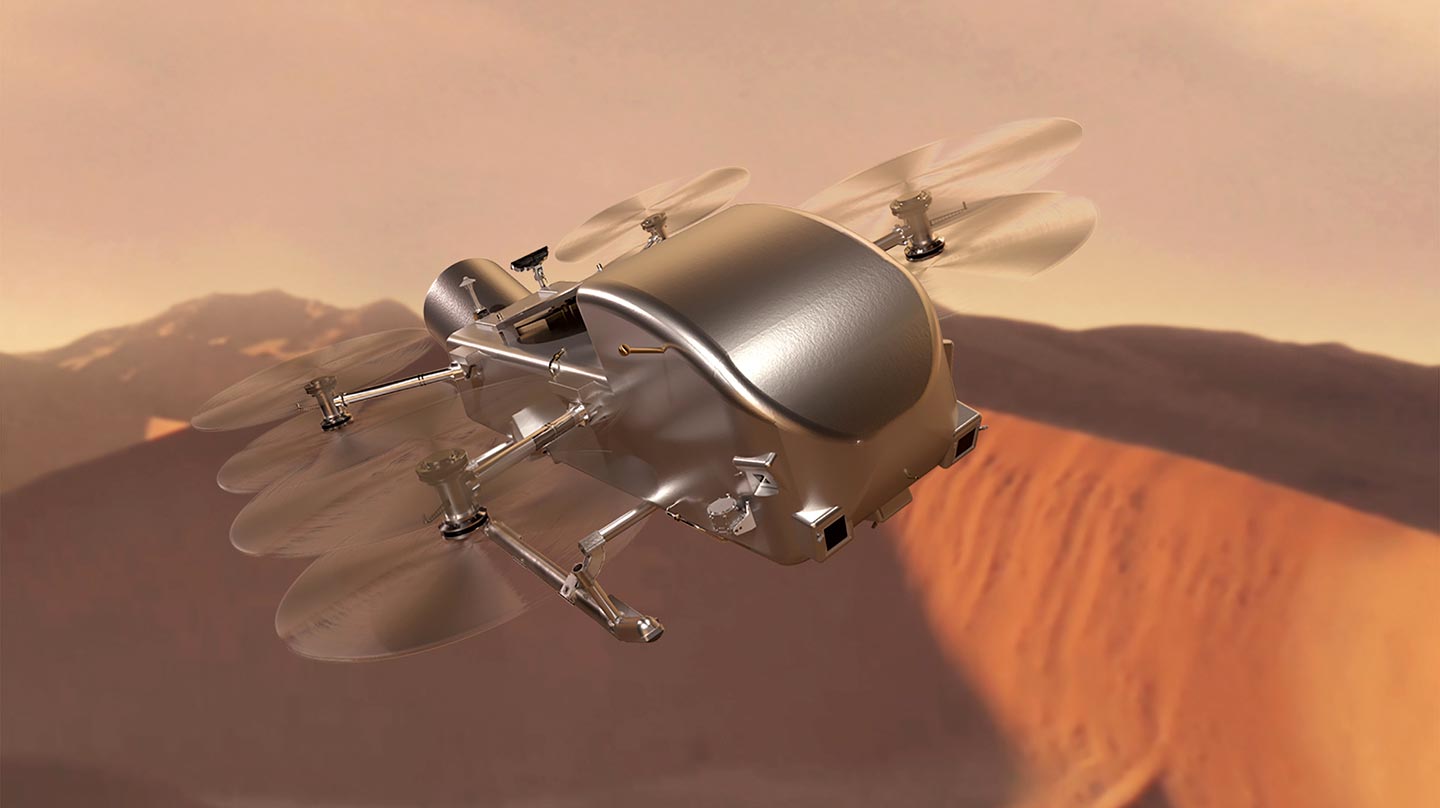
An artist’s impression of the Dragonfly vehicle operating over Saturn’s Moon Titan. Credit: JHU/APL
For the last few years, and as news arises, I’ve been covering the ambitious plans developed by a team at the Applied Physics Laboratory (APL) of Johns Hopkins University (JHU) to send a flying rover vehicle to Saturn’s largest moon, Titan.
The mission, using a octocopter called Dragonfly has been in development for several years, being formally greenlit for full-scale development by NASA earlier in 2024 (see: Space Sunday: flying on Titan; bringing home samples from Mars), after initially selecting it for evaluation and conceptual development as a part of the space agency’s Frontiers programme in 2019.
The idea of sending a flying – or at least floating, as proposals have also included the potential use of balloons to explore Titan from within it dense atmosphere – has been around for some time. In fact, Ralph Lorenz, of JHU/APL, one of the proposers of the mission, first considered using rotary craft on Titan back in 2000. His idea then was to use a battery-powered rotor craft equipped with a radioisotope power source.
Montgolfiere balloon and ESA lake lander – a European Space Agency (ESA) concept mission for Titan
That vehicle would spend the daylight hours on Titan (equivalent to 8 terrestrial days) in flight or carrying out surface science. during the hours of darkness (again, lasting the equivalent of 8 terrestrial days), the vehicle would sit on the ground and use the radioisotope to both keep itself warm and recharge the batteries.
It is to this idea that Lorenz returned whilst having dinner with Jason W. Barnes of University of Idaho in 2017, with the two of them agreeing to work on a baseline proposal for a large rotorcraft capable of flying on Titan. Together, they formed a nucleus of a team of scientists largely from APL’s staff of space scientists, including Elizabeth “Zibi” Turtle, who would be the mission’s principal investigator, as well as expertise from both NASA and other universities and space science institutes such as Malin Space Science Systems (MSSS), another long-time NASA partner.
Their initial proposal was published in 2018, and pretty much laid out the entire concept. Put before NASA for consideration, the proposal went through a series of changes prior to acceptance as a Frontiers mission. Initially targeting a 2027 launch, the mission was hit (like most things) by the COVID 19 pandemic, with all parties agreeing to push back the launch until July 2028.
These delays actually pushed the Dragonfly mission outside of the parameters of the Frontiers guidelines – missions under its auspices are supposed to be developed and flown for no more that US $1 billion (including all launch operator costs); currently, Dragonfly is expected to hit a total cost of around $3.35 billion throughout its lifetime. In all, the primary mission is expected to last some 10 years, 3.3 years of which will by at Titan.
But why go so far and at such cost in the first place? Well, as I noted back in April:
Titan is a unique target for extended study for a number of reasons. Most notably, and as confirmed by ESA’s Huygens lander and NASA’s Cassini mission, it has an abundant, complex, and diverse carbon-rich chemistry, while its surface includes liquid hydrocarbon lakes and “seas”, together with (admittedly transient) liquid water and water ice, and likely has an interior liquid water ocean. All of this means it is an ideal focus for astrobiology and origin of life studies – the lakes of water / hydrocarbons potentially forming a prebiotic primordial soup similar to that which may have helped kick-start life here on Earth.
As both the Huygens lander and Cassini probe showed, Titan is similar to the very early Earth and can provide clues to how life may have arisen on Earth; it is also an aerodynamically benign world. Its dense atmosphere (around 1.45 times that of Earth’s) is ideally suited to the use of rotary vehicles – considered superior to balloons, dirigibles and aircraft because their ability to hover in place whilst carrying out ground observations and their VTOL (vertical take-off and landing) capabilities mean that can easily set down for surface science activities / at the onset of night. Further, Titan has low gravity (around 13.8% that of Earth) and little wind, making automated flight a lot easier.
Titan, lower left, compared to Earth and the Moon. A composite image comprising an Apollo 17 picture of the whole Earth; a NASA Telescopic image of the full Moon, a Gregory H. Revera image of Titan: NASA/JPL/Space Science Institute. Via Wikimedia
Most crucially of all, flight allows the vehicle to move with relative ease between locations of interest for study, even if they are geographically widespread, separated by distances (and potential obstacles) a surface rover might find insurmountable.
Of course, we’re all now familiar with the idea of helicopter drones flying on other worlds, courtesy of NASA’s plucky little Ingenuity on Mars. However, The Dragonfly vehicle is something else all together. For a start, it is the size of a small car, and is expected to have an all-up mass of around 450kg. A good portion of that will be taken up by its Multi-Mission Radioisotope Thermoelectric Generator (MMRTG), its large lithium-ion battery system and its four electric motors, each driving two pairs of 1.4 metre diameter contra-rotating rotor blades. When flying, the vehicle will be able to reach speeds of up to 36 km/h, with a maximum airborne time of 30 minutes at that speed.
Initial descent. After release from the entry system and parachute, the vehicle can traverse many kilometres at low altitude using sensors to identify the safest landing site. This schematic from the original proposal uses an aerial image of the Namib sand sea, a geomorphological analogue of the Titan landing site, with ~100-m-high dunes spaced by several kilometres. Credit: Lorenz, Barnes, et al
Obviously, given the distances between Earth and Saturn / Titan render two-way real-time communications impossible without considerable lag, the vehicle will be equipped with a fully autonomous flight and navigation system capable of flying it along a selected flight path, making its own adjustments to account for local conditions whilst in flight, and with sensors capable of recording potential points of scientific interest along or to either side of its flight path, so the information can be relayed to Earth and factored into planning for future excursions. Flights over new terrain will likely be of an “out and back” scouting nature, the craft returning to its point of origin, allowing controllers on Earth to plan follow-up flights to locations where they might wish to set down and carry out ground-based science studies.
In terms of the latter, the vehicle will carry a number of science instruments, including two coring drills and hoses mounted within is landing skids, allowing it to gather tailings from the moon’s regolith and surface for on-board analysis by the vehicle’s on-board laboratory.
Most recently, as well a working on the full-scale development of the vehicle, APL has also been carrying out further tests with a half-scale flight-capable model, which has been used for the last year to help test and refine flight systems and avionics. This has seen the vehicle put through its paces at near-to-ground flight tests and at reasonable altitudes (but not as high as the four kilometres maximum ceiling the full-size version is expected to operate at during deployment!
In particular, this works builds on work carried out inside a special wind tunnel at NASA’s Langley Research Centre during 2023, which was used to simulate the aerodynamic loads that would likely be placed on the vehicle’s rotors and motors during a wide range of flight operations – ascending, descending, hovering – allowing engineers to determine things like the amount of rotor pitch required during different types of flight operations, providing data which can be fed into the final design requirements for the actual vehicle.
Much of this testing has been around flight hardware redundancy – APL plan to have the vehicle capable of sustained flight even if one set of rotors fails or even a motor supplying power to two sets of rotors dies. These tested have also allowed for direct assessment of the vehicle’s handling and determining where the centre of mass / centre of gravity should be placed (remembering that the drum-like thing at the back of the vehicle is a nuclear generator and all its associated shielding) to ensure good flight handling across a range of dynamic flight situations.
Also, on November 25th, 2024, NASA confirmed that SpaceX Falcon Heavy launch vehicle will be used to send Dragonfly on its way to Saturn. This caused some mis-reporting (notably among SpaceX fans) that the mission is somewhat a NASA / SpaceX venture, or has only been made possible by SpaceX, with some SpaceX-biased commentators going to so far as to call the decision “unexpected”. However, Falcon Heavy is the only launch vehicle currently certified for launching NASA high-value missions – particularly those carrying an MMRTG; United Launch Alliance (ULA) having retired both of its certified launch vehicles – Atlas and Delta – and have yet to achieve the required NASA certification with their Vulcan-Centaur (as is the case with Blue Origin’s New Glenn). As such, and with the prohibitive cost of using NASA’s own SLS rocket, Falcon Heavy has been the only real contender for the job.
At a cost of US $256.6 million, the contract to launch Dragonfly is significantly more than the $178 million NASA paid for the launch of the equally complex Europa Clipper, and the $117 million for the launch of the Psyche mission (although admittedly, that was agreed in 2020), both of which utilised Falcon Heavy. What was new with the announcement was the selected launch window and flight trajectory. The mission is slated to launch some time between July 5th and July 25th, 2028 (inclusive), in a window that will require the vehicle to make a fly-by of Earth in order to acquire the velocity required to reach Saturn in 2034. In this, the flight does differ from the originally planned 2027, which would likely have included a flyby of Jupiter, rather than Earth; however, for the 2028 launch, Jupiter will not be in a position to provide a gravity assist, hence the use of Earth, marking the mission as the first dedicated mission to the outer solar system to not use Jupiter in this way.
Progress MS-29 Update
In my previous Space Sunday update, I covered the detection of a “toxic smells” within the Russian section of the International Space Station (ISS), requiring the atmosphere throughout the station to be scrubbed. The first outlet to cover the news – as it was breaking – was the highly-reliable Russian Space Web, operated by respected space journalist and author, Anatoly Zak, and it was through that source I first read of the situation.
During the past week other outlets have taken up the story, but it is Anatoly who continues to lead with updates. While there was no immediate danger to any of the ISS crew, the hatches to the Progress vehicle were sealed and the atmosphere throughout the station scrubbed – on the international side of the station, the use of the Trace Contaminant Control Sub-assembly (TCCS) system was imitated after NASA astronaut Don Petit reported a “spray paint-like” smell in the Node 3 module of he station.
Progress MS-29 approaching the ISS, November 23rd, 2024. Credit: Roscosmos
In Anatoly’s most recent update in the story, he confirmed that after recycling the atmosphere in the Progress vehicle, the hatches had been reopened between it and the Poisk module against which its docked and off-loading of supplies had commenced. Anatoly also noted the the current working hypothesis from Roscosmos is that the smell did not originate from within the Progress MS-29 vehicle.
Instead, the Russian space agency believe the smell came from within the docking mechanism on the Poisk module. The Russian docking mechanisms include fuel lines for both off-loading hypergolic propellant supplies from a newly-arrived resupply vehicle carrying them, and to transfer propellants to Soyuz vehicles to “top off” the tanks of their thrusters prior to making a return to Earth.
Because of this, and while docking operations involving Progress and Soyuz are automated, after any departure from the Russian section of the ISS, ground control should perform a purging of the inner chamber of a docking mechanism to ensure any leak of hypergolic propellant that have been in the feed lines at the time which might otherwise be contained within the chamber is removed. This appears not to have been done following the departure of the last vehicle to use this particular docking port, Progress MS-27, potentially leaving traces of highly toxic propellant caught between the newly-arrived MS-29 and the interior of the Poisk module, releasing them into the latter when the inner hatch was opened.







 Inara Pey: Living in a Modemworld