The following notes were taken from the Tuesday, April 1st, 2025 Simulator User Group (SUG) meeting. They form a summary of the items discussed, and are not intended to be a full transcript, and were taken from my chat log of the meeting and Pantera’s video, embedded at the end of this piece.
Meeting Overview
The Simulator User Group (also referred to by its older name of Server User Group) exists to provide an opportunity for discussion about simulator technology, bugs, and feature ideas.
Meetings are open to anyone with a concern / interest in the above topics, and form one of a series of regular / semi-regular User Group meetings conducted by Linden Lab.
Dates and times of all current meetings can be found on the Second Life Public Calendar, and descriptions of meetings are defined on the SL wiki.
Simulator Deployments
On Tuesday April 1st, the SLS Man Channel was updated with the Durian Scones update, which includes the SSL certificate renewal, making it grid-wide.
On Wednesday, April 2nd, the RC channels will be restarted without any deployment, other than a WebRTC update which will be deployed to the Preflight RC channel.
Planned Updates – LI Calculation Change (Recap)
Signal Linden highlighted a Feedback Ticket he has raised, proposing the removal of scale from Land Impact calculations.
This is being possibly earmarked for a simulator update after Durian Scones.
This essentially means that the LI of object should not dramatically change as a result of resizing (particularly when increased in size). It could also mean that some large objects in world could see LI reductions.
Understandably, this announcement led to a lot of discussion / debate throughout the meeting.
Please refer to the the video for details on the following.
A request was made for linkset larger than the current 64m limit. This would have to be “thought about”, although it led to an extensive discussion on the idea (including issues of linkset visibility / draw distance / limits on older hardware).
Arbitrary link distances sounds like a neat idea, however I suspect such a change would only exacerbate some interest list bugs. I wonder what would happen if two 1cm^3 cubes were linked at 256m. The “position” of the linked object would be one of the prims. Its measure of “visibility” should be… what? The size of one or the size of the linked set?
– Leviathan Linden
The above led to a broad conversation on prim / object types, physics, prim torturing, etc.
Signal linden noted on the status of SLua:
Updates on SLua may slow down as we got a lot of good information from the alpha. We need to make some changes and prepare for a beta and production rollout.
Rider Linden also dropped a request into the meeting:
I’m looking for someone to write an extension. When I open a script file using VSCode check the current workspace. If it finds a file with the same base name, “link” the two files. 1) Copy the file from the workspace to the SL script temp file every time the WS file is saved.
† The header images included in these summaries are not intended to represent anything discussed at the meetings; they are simply here to avoid a repeated image of a rooftop of people every week. They are taken from my list of region visits, with a link to the post for those interested.
I have a genuine love of poetry; be it Wordsworth, Shakespeare’s sonnets, Poe’s laments, T.S. Eliot’s journeys in verse, or evocative pieces from the likes of Masefield (Sea Fever) or William Blake’s The Tyger.
Both of the latter are perhaps populist pieces; there are few, if any, lovers of poetry who cannot quote at least their opening lines. However, both contain a wealth of imagery and a depth of reflection on life – something often missed when reading either, such is the strength of the overlying imagery within them.
Of the two, Blake’s the Tyger is perhaps the more structurally and visually impressive, mixing as it does trochaic tetrameter and iambic tetrameter, alliteration and focused imagery, whilst also containing a deeper questioning which reaches beyond its own form, notably in reference to its “sister” (and potentially less well-known) piece The Lamb.
The Tyger is also the subject of a new poetic experience by the master of visual poetry in Second Life, Sheldon Bergman (SheldonBR).
I’ve covered Sheldon’s work in this pages, both in its own right, and with regards to his collaborations with Angelika Corrall, both as artists at and curators of, the former DaphneArts Gallery in Second Life. As such, I was delighted to receive a personal invitation from Sheldon to visit The Tyger, and took the first opportunity I could to immerse myself within it.
Now, when I say poetic experience with regards to Sheldon’s work, I mean just that; The Tyger is powered by a Second Life Experience, and it is essential you accept it on arrival at the installation if you are to proceed further, and then ensure your viewer is set as instructed in the pop-up (with the caveat that you only perhaps need to set Advanced Light Model (Preferences → Graphics) if you are running a non-PBR capable viewer and don’t run ALM as standard). Once you are set, click the Continue option on the HUD pop-up to deliver you to the installation proper.
The Tyger, Sheldon Bergman, April 2025
A quick point of none here is that your screen will go into a “letterbox” display format, courtesy of the HUD – and it is essential you should leave it in place. A second note here is that I’m not going to go into a deeply analytical piece on Blake’s works, by they The Tyger, The Lamb, or the volumes from which they are drawn (Songs of Innocence and Songs of Experience), nor am I going to dwell overlong on Blake’s use of The Tyger as an exploration and questioning of 18th/19th century Christian religious paradigms. While these all fold into Sheldon’s The Tyger, they have all been written about extensively elsewhere.
Rather, what I will do here is offer thoughts on what appears to be a much broader canvas on which Sheldon paints, using The Tyger and its religious reflections as his foundation; a canvas which – to me at least – appears to offer thoughts not so much on our relationship with God, but our place within, and relationship as a whole with, the cosmos around us.
The installation initially begins within a twilight setting, at one end of a path formed by the waters of a stream rushing outwards from high waterfalls. The watery path is lit at intervals by pairs of candles, one to each bank. As well as lighting the way, they perhaps suggest the opening line of the poem and the flashes of colour one might see of a tiger passing through the shadows of the jungle. However, of more practical tone-setting (to my way of thinking, at least), is the initial quote offered by the HUD on arrival:
The clearest way into the Universe is through a forest wilderness.
– John Muir, environmentalist and philosopher
The Tyger, Sheldon Bergman, April 2025
This offers an intrinsic link between Sheldon’s use of the poem and its ability to question Christian tenets and paradigms with his broader theme as intuited above. One which grows as we follow the watery path as it travels through the gorge its has cut (symbolic, perhaps of the path we cut through life?) before the water turns to the left and enters a broad pool, and the visitor is left facing the open maw of a tunnel.
This opening, into which the flicking eyes of the candles lead us, is prefaced with a quote oft attributed to Joseph Campbell (although so far as I’m aware is not something he wrote):
The cave you fear to enter holds the treasure you seek
It’s a statement that potentially takes us in several directions: caves can be thought of of dangerous and the home of predators; thus we remain rooted somewhat in the poem: whilst not a cave dweller itself, the tiger is perhaps the apex predator among land animals today. Further, caves can represent a journey into darkness and the unknown – just as life itself is a daily journey into the unknown; just as we have no idea what awaits at the end of our walk through the tunnel, we cannot comprehend what awaits at the end of our journey through life. Might it be the “treasure” of the kingdom of heaven as Christianity and its ilk would have us believe? Or might it be a quiet return to the nothingness of the Cosmos which, ultimately, birthed us?
Within Sheldon’s tunnel we have the opportunity to reflect both on Christian thinking – and the joining of Blake’s The Tyger with The Lamb – complete with the opening lines of the latter (look for the side tunnel after passing the seaward opening in the tunnel walls). This is itself a layers element within the installation, encouraging us to consider Christian tenets (the Lamb of God, the Christian flock, etc.), whilst also underscoring Blake’s reflections on God’s apparently capricious nature as the creator of both the defenceless lamb and the deadly tiger:
When the stars threw down their spears, And water’d heaven with their tears, Did he smile his work to see? Did he who made the Lamb make thee?
The Tyger, Sheldon Bergman, April 2025
It is also here – or at least, a little further down the tunnel – that the installation opens more fully onto questions of our place in the universe, starting with a further quote. This one from one of the great thinkers of the 20th century (and one of my heroes), Carl Sagan. It is a image he used a number of times in his writings, but it appears here in what is perhaps its most widely-quoted form:
The cosmos is within us. We are made of star-stuff. We are a way for the universe to know itself.
Carl Sagan, Cosmos: A Personal Voyage: The Shores of the Cosmic Ocean (1980)
It is a quote that leads us, figuratively and literally, to a god’s-eye view of a spinning galaxy, a further marvellous metaphor and visual prompt for all that we might ascribe to Sheldon’s installation. It is also the perfect means to embody our unity with the universe, because to proceed, we must step through it.
The Tyger, Sheldon Bergman, April 2025
To do so is to enter the core of The Tyger, a space filled with the most incredible symbolism, questioning and statements for those willing to listen. From a vocal rendition of Blake’s poem, through the use of the Lacrimosa from Zbignew Preisner’s Requiem for My Friend (1998) to the lifting of the veil of blackness and revelation of Sheldon’s floating Tyger and its potential for layered interpretation, it is utterly breath-taking.
To itemise in words the richness and depth of all that’s offered here – from the poem, through the particular selection of Preisner’s Lacrimosa (hint: the piece has perhaps most memorably used to overlay the birth of the universe at the start if The Tree of Life, and we are perhaps particularly focused on the cosmos within this space) as well as its role within Zbignew’s Requiem (and indeed, the Catholic Requiem mass as a whole) to the presence of the floating Tyger and all that surrounds it – would be to defeat the purpose of the installation’s purpose.
Instead, I urge you to go and witness it; immerse yourself in The Tyger, its imagery, the richness of the poem itself and of Sheldon’s installation, and allow it to speak to you directly. It is magnificent.
Logos representative only and should not be seen as an endorsement / preference / recommendation
Updates from the week through to Sunday, March 30th, 2025
This summary is generally published every Monday, and is a list of SL viewer / client releases (official and TPV) made during the previous week. When reading it, please note:
It is based on my Current Viewer Releases Page, a list of all Second Life viewers and clients that are in popular use (and of which I am aware), and which are recognised as adhering to the TPV Policy. This page includes comprehensive links to download pages, blog notes, release notes, etc., as well as links to any / all reviews of specific viewers / clients made within this blog.
By its nature, this summary presented here will always be in arrears, please refer to the Current Viewer Release Page for more up-to-date information.
Note that for purposes of length, TPV test viewers, preview / beta viewers / nightly builds are generally not recorded in these summaries.
Official LL Viewers
Default viewer: 7.1.12.13550888671, formerly the ForeverFPS, dated March 1, 2025, promoted March 5th – No change.
Numerous crash and performance fixes.
Water exclusion surfaces.
Water improvements.
Second Life Release Candidate viewer 2025.03 version 7.1.13.14115832189, March 28th – NEW.
New UI element for water exclusion surfaces: Build / Edit floater → Texture Tab → Hide Water checkbox.
The maximum amount of Reflection Probes can now be adjusted to better accommodate low VRAM scenarios.
Values will be set automatically depending on your chosen graphics quality. OR
Use Preferences → Graphics → Advanced Settings → Max. Reflection Probes to manually set.
An issue with being unable to see Sky Altitude values in the Region/Estate window has now been resolved.
Preferences → Graphics → Max. # of Non-Imposters has been renamed Max. # of Animated Avatars for clarity.
Bug and performance fixes and memory optimisations.
Second Life Project Lua Editor Alpha, version 7.1.12.13973830462, March 20th, 2025 – No change.
Reality Escape, March 2025 – click any image for full size
In June 2023 I dropped in to Tripty’s (triptychlysl’s) Reality Escape. At the time, it celebrated some of my favourite things: coffee, a good book, somewhere to curl up and appreciate both, and a pleasant setting in which to enjoy all three (see: Books, Coffee and Chairs in Second Life, oh my!). Chance recently caused me to make a return to see what might have changed – and it made for an enjoyable visit.
Remaining as a full region a Full region, Reality Escape still offers those three comforts – coffee, chairs and books – all wrapped within a photogenic environments caught under a custom EEP sky (although I’ve opted to use one of my own in the images herein so that you might enjoy Tripty’s).
Reality Escape, March 2025
Comprising four islands (with a couple of little outcrop islets), with two clearly separated one from the other and the remaining two hugging the coast of the largest, it is a serene place where gulls circle lazily and, if you use the Shared Environment, contrail-like ribbons divide the sky, seemingly left by airliners passing high overhead in silence and with little interest in the haven below.
The largest of the islands is home to the setting’s Landing Point, located on a deck raised over the land and bordered on three sides by wooden buildings. One of these forms a coffee house and another a reading room-come-music lounge, and the third a greenhouse. Part of this deck extends over the water to form a landing stage for a ferry – suggesting more land might not be too far away.
Reality Escape, March 2025
A narrow brook runs under the main deck, north-to-sea, technically making the island not one but two. As it passes under the deck, so it feeds a vibrant little garden visible from the tables set out on the deck, whilst steps lead down to the boulder-and-shingle shoreline.
A second deck extends to the south, in turn providing access to the rest of the island as it offers a series of walks and trails across itself.
Reality Escape, March 2025
Which of these paths you follow is up to you – but make your way far enough eastwards, and you’ll find further decks providing seating and access to the two small littoral islands, themselves connected by both decking and two imaginative little bridges.
Another bridge spans the water north to the second of the large islands.
Reality Escape, March 2025
Long and low, this island is largely given over to grassland and shrubs – and a few trees. It is here, among the supports holding up the region’s name, that a memory of Books, Coffee and Chairs can be found in the form of artistically arranged and suspended chairs. The view back towards the main island, when seen under the Shared Environment is almost dream-like, and can be appreciated from some of the chairs.
The beauty of this setting is in the serenity I mentioned earlier; wherever you wander, there is a sense of peace and natural beauty. From little camp sites to bubbling brook and flashes of flower blooms among the grass and rock, to the pools of bright wildflowers and Sakura in bloom, everything just feels right. And throughout it all lay a plethora of detail which further brings the setting to life.
Reality Escape, March 2025
With multiple places to sit, indoors and out, its multiple trails to follow and little touches to be discover – even the the donation taker in the greenhouse is likely to bring a smile to the faces of visitors, this is a setting to be savoured. A perfect escape from the realities of life.
But don’t just take my word for it – go and see for yourself.
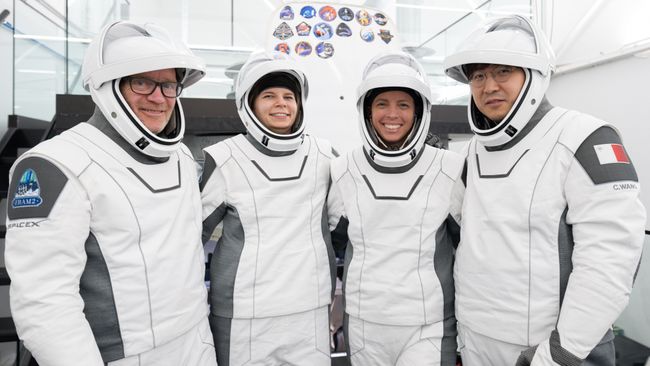
The Fram2 crew (l to r): Eric Philips, Rabea Rogge,Jannicke Mikkelsen and Chung Wang
If all goes according to schedule, a SpaceX Falcon 9 / Crew Dragon combination is due to lift-off from Kennedy Space Centre’s LC-39A on March 31st, 2025, carrying four private citizens into space for a 4-5 day mission.
Aboard Crew Dragon Resilience will be Chinese-born, but Maltese citizen and crypto currency entrepreneur Chung Wang, who will be the mission’s commander and is a co-bankroller of the flight; Jannicke Mikkelsen, a Scottish-born Norwegian cinematographer and a pioneer of VR cinematography, 3D animation and augmented reality, who is the other co-bankroller for the flight; Eric Philips, a 62-year-old noted Australian polar explorer, who will be the first “fully” Australian national to fly in space, and Rabea Rogge, a German electrical engineer and robotic expert.
What is particularly notable about this flight is that it will be the first time any human space mission will be launched into a high-inclination (90º) polar orbit at an altitude of some 420-425 km (giving it a 93-minute orbital period). The aim of the flight is to carry out research on the Earth’s poles and their space environment, hence its name: Fram2. This celebrates the ship used by (among other Norwegian polar explorers), Roald Amundsen. In fact, in a further tie to polar exploration, mission was originally due to be flown aboard Crew Dragon Endurance, named for Ernest Shackleton’s vessel, until scheduling issues meant the mission has to switch to using Resilience.
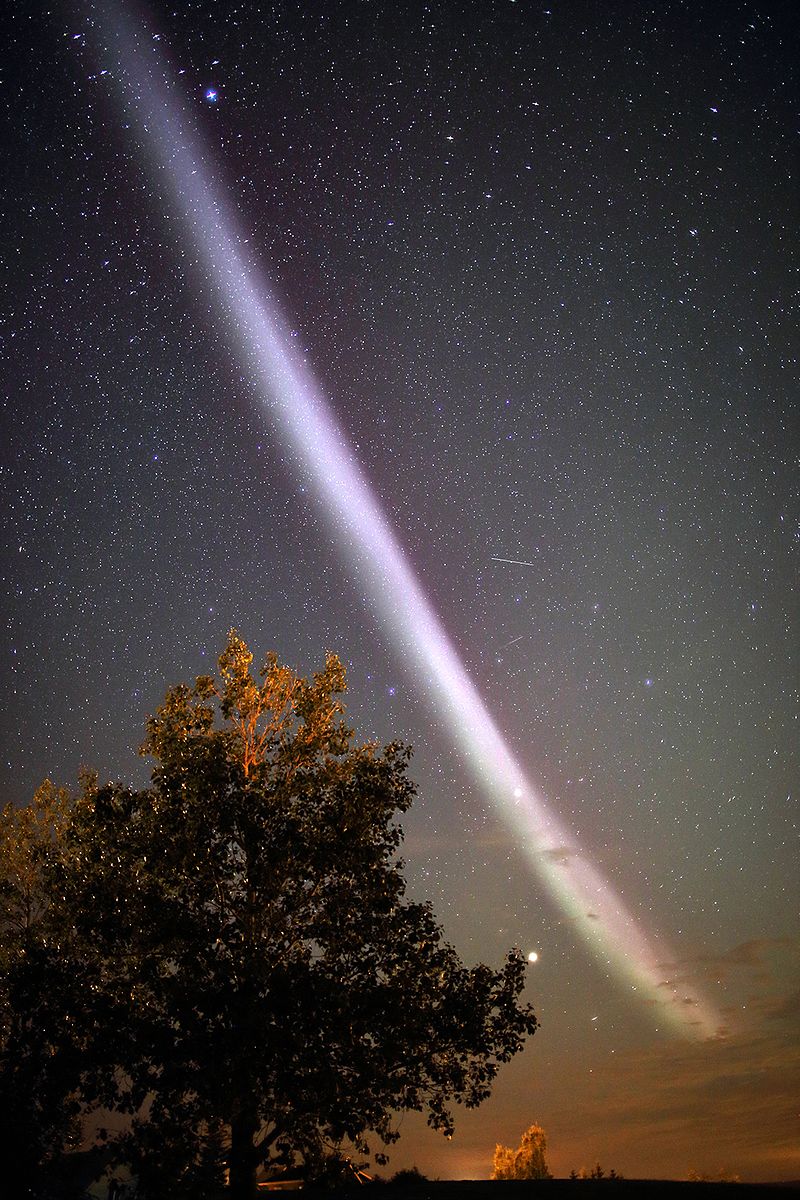
A STEVE over Little Bow Resort, Alberta, in August 2015. Credit: Elfiehall via Wikipedia
Given the time of year of the mission, flights over the North Pole and arctic will be carried out in daylight, allowing for direct observations of Arctic ice melt, whilst passage over Antarctica and the South Pole will be in darkness, during which times the crew hope to be able to more clearly study the phenomena known as STEVE.
According to data gathered by the European Space Agency (ESA), STEVEs are caused by a 25 km wide ribbon of hot plasma at an altitude of 450 km, with a temperature of 3,000 °C flowing at a speed of 6 km/s (compared to 10 m/s outside the ribbon). They appear as a very narrow arc extending for hundreds or thousands of kilometres, aligned east–west, and generally last for twenty minutes to an hour. STEVEs can appear in both southern and northern skies, and are a phenomenon with a quaintly curious history.
As an observable event, records on STEVEs go back at least as far at 1705 – but throughout that time, they have had always largely been dismissed as an off-shot of aurora because (until October 2024) one had never been observed in the absence of any aurora. However, this changed in 2016 thanks in part (and possibly inevitably) to social media.
It was in that year that a group of amateur aurora photographers in Alberta, Canada noticed the appearance of a nightly whilst observing aurora, and they started taking photographs of the events and posting them to Facebook, with one of them referring to the ribbon in his photos as “Steve”, in reference to the comic series (and film) Over the Hedge. The photographs rapidly went viral and sparked a lot of discussion as to what the ribbon might be.
In particular, the photos and discussions drew the attention of a couple of planetary physicists, one of whom connected the photos to the data gathered on the phenomenon by ESA, leading another – Robert Lysak – to come up with the backronym of STEVE, for Strong Thermal Emission Velocity Enhancement, which is the term now used to reference the ribbon scientifically. It is now hoped that that physical observations from orbit of STEVE events by the Fram2 crew will help further our understanding of the phenomenon.
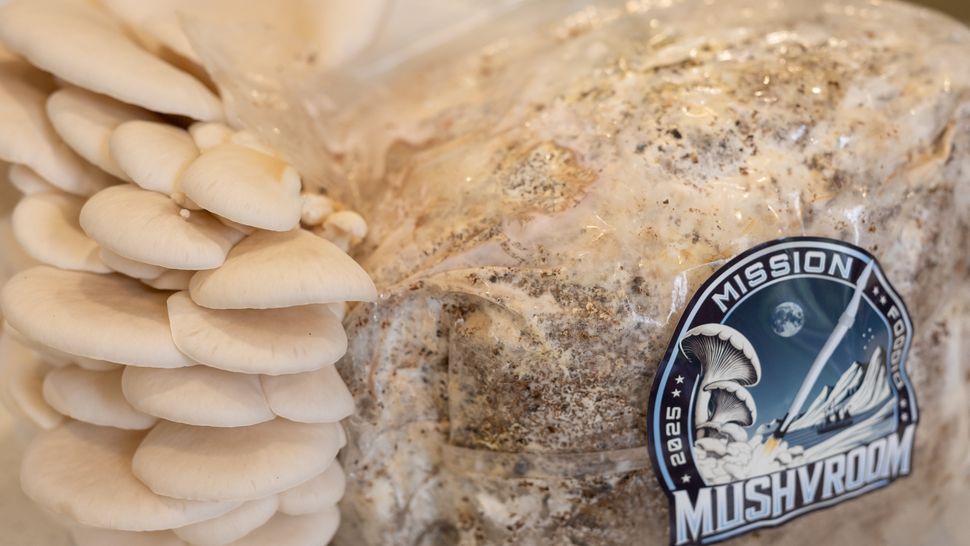
In addition to this, the mission’s science programme includes the first attempt to grow mushrooms in space in an effort to further research into the ability to provide sustainable nutrition on space missions – something seen as key to missions to Mars.
The vacuum-packed oyster mushroom substrate that will be flown of Fram2 in an attempt to cultivate it into mushrooms. Credit: FOODiQ Global
While there have been successful efforts to grow foodstuffs on the International Space Station (ISS) such as red Russian kale, chilli peppers, dragoon lettuce, dwarf wheat, mustard, they have not been without their drawbacks. For one thing, even relatively small amounts of food cultivation require space and other resources quite out of keeping with the results: while a cubic metre of growing space can generate a small crop of food in just 30-35 days, the amount produced tends to only be enough to help supplement a single meal (or perhaps two) for 7-8 people.
Mushrooms – in this case oyster mushrooms – potentially offer a more viable means of dietary supplement. They grow at a rapid pace (doubling in size every day), do not require an enormous amount of space, they have a rich nutrient profile and – when grown under UV lighting (as these will), they can produce the daily dose of vitamin D required by astronauts. They can also grow in inedible plant waste, do not require intensive cultivation in order to grow.
For Fram2, the plan is for the crew to prepare an oyster substrate in orbit, and then study its growth and fruiting process and then monitor the rate of the developing mushrooms, record their growth characteristics in microgravity and monitor for any unusual contamination. The fungi will then be returned to Earth for further studies, including whether or not the mushrooms are still safely edible and can deliver on their nutritional promise.
With a battery of human science objectives set for the mission – including testing a portable MRI unit, carrying out x-rays of the human body, studies into blood and bone health, and glucose regulation in the body in micro-gravity – Fram2 is set to be one of the most science-intensive short-during human space flight missions yet undertaken.
ISAR Spectrum Maiden Flight Ends with a Ka-Boom
Europe’s commercial launch companies are not having a lot of success. In 2024, German company Rocket Factory Augsburg (RFA) hoped to be the first European commercial launcher to get a rocket to orbit from European soil (excluding Russia) with its RFA One vehicle. However, that hope ended in August 2024, when the first stage of the vehicle was lost after it exploded during a static fire engine test at the UK’s SaxaVord Spaceport (see: Commercial activities and a fly-by).
The Isar Spectrum rocket falling back towards Earth 30+ seconds after launch. Credit: Isar Aerospace
That loss in turn came on top of the 2023 failure of a (now defunct) Virgin Galactic airborne launch of the company’s LauncherOne from their carrier aircraft, Cosmic Girl, flying out of Spaceport Cornwall (aka Newquay Airport) – see: Space Sunday: Exoplanets and updates. Now, a further company has added to the list.
Thus, Germany’s Isar Aerospace had – with finger’s crossed – hoped to claim the crown by reaching orbit from the Andøya Spaceport in northern Norway, and albeit using a vehicle without any payload. The aim of the launch was intended to be a fully integrated test of the company’s two-stage Spectrum rocket and launch and flight systems to determine the vehicle’s readiness to commence payload carrying operations. Given this, the company did indicate actually reaching orbit would be a bonus.
Spectrum is designed to operate from multiple launch sites –notably Andøya, targeting Sun-synchronous (SSO) and polar orbits, and Guiana Space Centre (Spaceport Europe) for equatorial and medium inclination orbits. It is capable of lifting up to a metric tonne to low-Earth Orbit (LEO) and up to 700 kg to SSO. The first operational flight is expected to be out of the Guiana Space Centre, carrying seven small satellites, later in 2025.
The Spectrum rocket on the launch pad at Andøya, March 26th, 2025. Credit: Isar Aerospace
The test flight – calling Going Full Spectrum – out of Andøya on March 30th, appeared to start off smoothly enough. The vehicle lifted-off cleanly at 10:30 UTC, the rocket and climbed away from the launch pad. But as the rocket commenced its programmed ascent roll at 18-seconds in the flight, attitude control was lost, the rocket pitching over onto its side.
At this point the webcast video froze, but the sound continued to play, and the rocket was heard exploding. Initial reports stated that the vehicle’s flight termination system (FTS) had been triggered. However, separate footage recorded from a cell phone and posted by Norwegian publication VG, showed the rocket falling horizontally to strike the waters close to the launch facilities and explode. Later video of the released to various organisations euphemistically referred to the vehicle’s fall and explosion as being in “a controlled manner”. That said, the flight did yield data.
Two more Spectrum rockets are currently being fabricated, but the company has yet to indicate whether either of these will be used for a further flight test or whether they will seek to go ahead with a payload launch.
China’s Planetary Exploration Roadmap
As I’ve noted in numerous past Space Sunday pieces, China is developing a multi-faceted robotic and human space exploration programme, with the latter focusing on Earth-orbital activities using the Tiangong space station (soon to be joined by a new crew-carrying space vehicle), then missions to the lunar South Polar Region commencing in the early 2030s, prior to progressing to human-to-Mars flights some time thereafter.
On the robotic front, China has already achieved a lot re: the Moon and Mars, and on March 26th, 2025, the country’s Deep Space Exploration Laboratory (DSEL), part of the China National Space Administration (CNSA), unveiled what appears to be a roadmap of upcoming missions, to the general public. In a slide offered during a presentation, DSEL highlighted a number of goals, commencing with the already in-development Tianwen-3 Mars sample return mission. In all, the slide disclosed the following mission ideas:
~2028 (launch): Tianwen-3 Mars Sample Return.
~2029 (launch) Tianwen-4 Jupiter / Callisto orbiter mission investigating the potential habitability of the latter.
~2030: Earth-based platform for simulating planetary environments and their habitability.
~2038 (launch): untended, automated Mars science outpost for long-term biology and environmental research (precursor to human missions).
~2039 (launch): Neptune / Triton mission to investigate habitability of outer planets and water worlds.
The DSEL slide showing China’s roadmap for robotic / Earth-based missions. Credit: DSEL / CNSA
Also mentioned in the presentation was the Earth 2.0 Exoplanet Investigator – a TESS-like observatory for studying exoplanets, particularly those referred to a “exo-Earths” – planets of a size and location around their parent stars considered suitable for the potential development of life. Earth 2.0 (referred to as “ET” – geddit?) is currently due for a 2028 launch to operate at the Sun-Earth Lagrange point 2 (the same gravitationally-stable region of space on the far side of the Earth relative to the Sun in which the James Webb Space Telescope operates). Once there, it will attempt to continuously monitor 2 million stars within the Kepler mission star field in an attempt to locate more exoplanets.
To achieve this, ET will use a set of 6 28-cm aperture telescopes working in unison. Due to its location and optical capabilities, ET will be able to study large areas of our galaxy for extended periods, increasing its ability to both locate more planets and to do so across wider areas. In this respect, ET will not only try to detect “exo-Earths” but also characterise them – determine their size, atmospheric composition, potential for bearing liquid water, etc., working in collaboration with ground-based and other facilities. It further hoped that these studies will increase our understanding of the mechanisms at work in the formation of exoplanets, particularly given that the mechanisms observed without our own solar system do not necessarily seem to apply to all other planetary systems.
A conceptual diagram of China’s Earth-2, and how it will use both optical means in an attempt to locate and characterised “exo-Earths” and gravitational lensing to location rogue planets. Credit: CAS
In addition, ET is to be equipped with a 35 cm microlensing telescope it will use in an attempt to locate “rogue” (aka “wandering”) planets. These are planetary bodies no longer tied to orbiting a particular star, but instead wander freely in interstellar space.
As such planets do not lend themselves to detection via the transit method – regularly passing between the observer and their parent star, causing the brightness of the latter to dip relative to the observer – ET will focus its 35-cm telescope on around 30 million stars within the galactic bulge in an attempt to detect gravitational lensing effects caused by the passage of rogue planets somewhere between the observatory and the “cloud” of background stars.
In all, ET is slated for a 4-year primary mission once launched and operational – although clearly, it could run for much longer than this. It is also the only high-volume, in-depth mission with a specific focus on worlds with potential habitability slated for launch in the near future; whilst NASA is developing the Habitable Worlds Observatory (HWO), this is still very much at the conceptual stage, and unlikely to be ready for launch within the next 15-20 years.
Quirklewick Hollow, March 2025 – click any image for full size
In December 2024, I visited Alpha Auer’s marvellous Gingerbread and the Woodies (see here for more), which Alpha described as a “sort of” continuation of her Ragville. At the time I noted that even without knowledge of Ragville, Gingerbread and the Woodies stood on its own two feet as a delightful place to visit.
Well, for spring 2025, Alpha has kind-of offered us a sort-of reimagining of the Gingerbread and the Woodies setting to present us with another whimsical and engaging setting of villages, boats and local inhabitants, in the form of Quirklewick Hollow. However, this is not merely a re-vamp of Gingerbread, it is an entirely new – and interactive – environment located somewhere in the imagination.
Quirklewick Hollow, March 2025
But before getting too deeply into things, be sure that on arrival you have a word with the notecard giving tree for a lot of worthwhile background information on the setting, and also make sure you are using the region’s Shared Environment.
The interactive element of the setting starts close to the Landing Point in the form of a pushy trampoline(!) – other aspects are more subtle (hint: read one of the notecards offered by the tree mentioned above!). However, it is the local inhabitants and their homes within the setting that draw attention.
Quirklewick Hollow, March 2025
The former are the most remarkable group of individuals … critters … creatures … aliens … take your pick of descriptions. Running from insectoid-like characters through somewhat anthropomorphic dog-like individuals and what might be animal-bird cross-overs to a multi-limbed alienesque fellow (and all points in between!), they all have one thing in common: they are a happy-go-lucky bunch enjoying all that life has to offer as they get together for a little shindig or sit down for afternoon tea on the grass or wander the local park in happy conversation and / or with (what I assume to be) their pets.
As to the homes, these are all as equally as varied and colourful. If you’ve ever encountered the expression walls have ears, then you might be semi-prepared for these houses, in as much as their walls (and roofs and eaves and windows) have eyes – quite literally. Some even have the suggestion of having feet they might waddle around on when you’re not looking! In addition, some appear to be melting and others seem to have giant faucets extending out of them (although one could quite easily be an elephant’s trunk given the partial face protruding from the same window!).
Quirklewick Hollow, March 2025
Are they alive? That’s up for your imagination to decide; some certainly look to be animated / agitated about something, at least in the larger of the villages, which I gather is called Upper Quirklewick. This is where the locals are all out and having a bit of a dance party (perhaps that’s the reason for some of the grumbly expressions on the houses – they don’t appreciate all the music and fun?).
Along the coast it is possible to find a little fishing village somewhat reminiscent of the one within Gingerbread and the Woodies, whilst it also has a character all its own. Here, too, the houses keep an eye on things whilst some of the little boats in the two harbour coves might additionally be noted for their eyes – and teeth!
Quirklewick Hollow, March 2025
The park mentioned above lies closer to the Landing Point, occupying a little flat island of its own. Reached via stepping stones cross the water, it makes for a pleasant little walk. The trees and grass here (and in many places across the setting) are unusual, in that they are not all by Alpha, but are items she has purchased for landscaping Quicklewick Hollow. This does in any way lessen the setting – Alpha using does everything herself – but rather gives the location more a sense that it straddles the line between reality and imagination; the kind of place one might pop into when drifting into dreamland.
This sense of being on the edge of reality is further increased by the presence of very Earthly cats, both on a couch alongside one of Quirklewick’s meandering footpaths and keeping watch from one of the houses in Upper Quirklewick – perhaps a reminder that no matter where we go, our Feline Overlords will always be ready to keep an eye on things!
Quirklewick Hollow, March 2025
As noted above, do obtain the introductory folder from the Landing Point – there are multiple places to set awaiting discovery, and the information in the pack will advise you on how to make use of them using the poseball included in the pack. But above all – do visit Quirklewick Hollow, and be sure to visit Alpha’s store there as well.







 Inara Pey: Living in a Modemworld