Currently available at Frank Atisso’s Art Korner is an exhibition of avatar studies by a artist whose work is new to me: Tiya Aura, who presents a series of images under the title The Art of Portraiture, and it is a fascinating collection to view.
Avatar studies are one of – if not the – most popular forms of art and photography produced through Second Life. images take many forms, from straightforward portraiture intended for use within Profiles to complex posed pieces, often with an backdrop of some form and intended to reflect a theme (generally the title of the piece) and / or tell a single-frame story. Sill others focus on the avatar itself, tightly-focused and intended (again) to convey a narrative and / or emotional content, and so on.
Within The Art of Portraiture, Tiya very much focuses on that category of studies intended to convey emotion, offering 21 images of her own avatar and those of her friends (some subjects featured in more than one image), split between the two display spaces within the skybox gallery. Some of the images are captured in the “traditional” style of a portrait image, with the subject looking directly at the camera or in profile. Others are offset in both cropping and angle, suggesting a sudden moment caught by chance. Throughout all of them there is a deep of character.
Art Korner: Tiya Aura – The Art of Portraiture
These are images that not only capture an emotional element, many offer insight into the nature of the subject within the image, and by extension, the persona behind it. This is perhaps more evident within Tiya’s self-portraits, but is also very notable in several of the other pieces as well. Thus, this is a collection where the life – the humanness – of the avatar subjects is prevalent, and with a depth that suggests it was as much captured within the raw image as brought to the fore by considered and practiced post-processing that more than demonstrates Tiya’s artistry with digital tools.
In terms of post-processing, lighting and contrast are perhaps the most powerful tools Tiya uses to complete her work. Several of the pieces utilise lighting overlays and effects to help bright forth the emotional content, either by framing the subject so as to cast illumination around but perhaps not directly on the face, or by providing a seen, a projection of light and softer colours we must look through. Both approaches are utterly effective, as they causes one to focus in on the subject, to study eye, expression, direction of gaze, tilt of head, and thus become drawn into the sentiment Tiya saw when creating each piece.
In this the pictures within The Art of Portraiture not only offer a richness of emotion within the study of an avatar or present a glimpse of the persona projected by an avatar’s looks, they provide a subtle insight into the artist herself and how she responded to these images as she post-processed them.
Art Korner: Tiya Aura – The Art of Portraiture
Rich in form, colour, content and presentation, The Art of Portraiture is a genuinely bewitching collection of images; one that is offered – as is becoming increasingly popular within SL art circles – for sale on the basis of “pay as you feel” – the buyer set the amount they wish to pay for a given piece, rather than the artist setting the price.
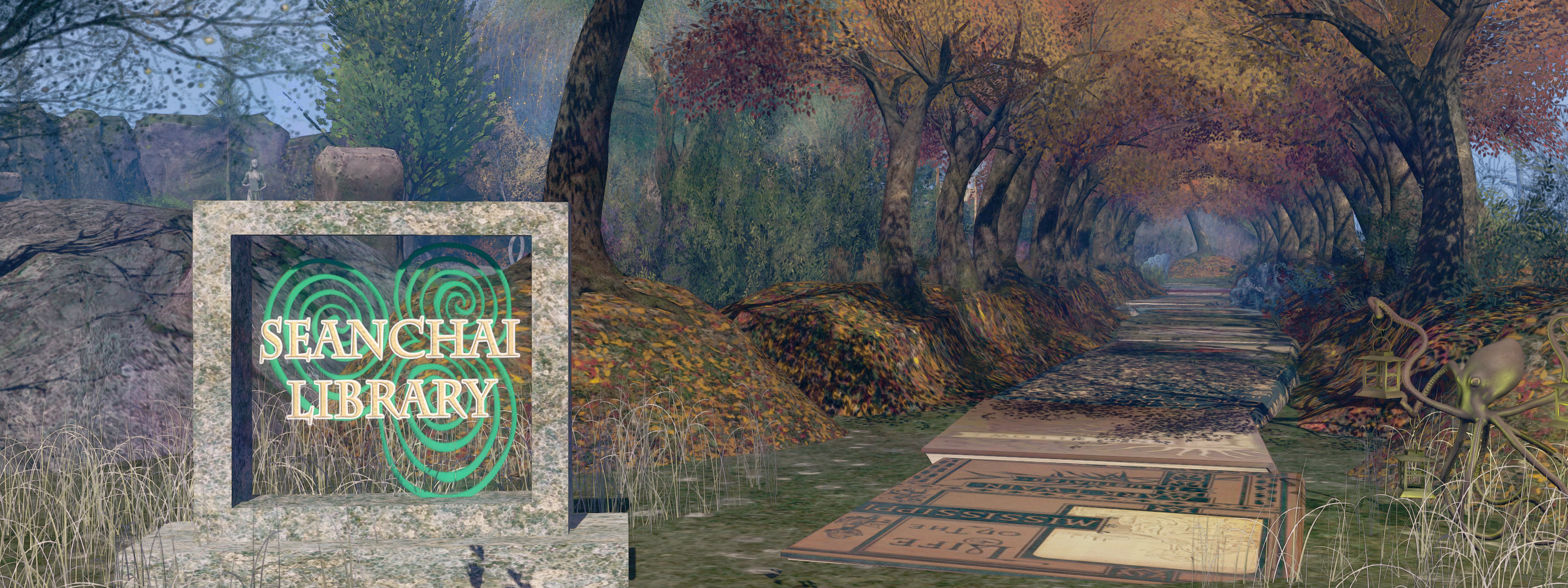
It’s time to highlight another week of storytelling in Voice by the staff and volunteers at the Seanchai Library. As always, all times SLT, and events are held at the Library’s home in Nowhereville, unless otherwise indicated. Note that the schedule below may be subject to change during the week, please refer to the Seanchai Library website for the latest information through the week.
Monday, September 20th 19:00: The Weigher
A world dominated by sentiment big cats where the rule of law is enforced by the Weighers, a combination of judge, peacemaker and accountant through a brutal code of honour and combat. Without their violent intervention in things, all-out war and anarchy would ensue.
When two human explorers – fragile, weak and potentially easy prey – arrive on that world, Slasher, a Weigher of skill and talent in physical combat, finds herself defending them. In doing so, she finds herself a disgraced outcast.
Join Gyro Muggins as he resumes the story by Eric Vinicoff and Marcia Martin.
Twig lives in Sidwell, where people whisper that fairy tales are real. After all, her town is rumoured to hide a monster. And two hundred years ago, a witch placed a curse on Twig’s family that was meant to last forever. But this summer, everything will change when the red moon rises. It’s time to break the spell.
Willow Moonfire read’s Alice Hoffman’s novel.
Wednesday, September 22nd, 19:00 Autumn in Music and Poetry
With Caledonia Skytower and Ktadhn Vesuvino in Ceiluradh Glen.
Thursday, September 23rd
19:00: Selections from Terry Pratchett’s Wyrd Sisters
With Caledonia Skytower.
21:00: Seanchai Late Night
Contemporary science fiction and fantasy with Finn Zeddmore.
Logos representative only and should not be seen as an endorsement / preference / recommendation
Updates from the week ending Sunday, September 19th
This summary is generally published every Monday, and is a list of SL viewer / client releases (official and TPV) made during the previous week. When reading it, please note:
It is based on my Current Viewer Releases Page, a list of all Second Life viewers and clients that are in popular use (and of which I am aware), and which are recognised as adhering to the TPV Policy. This page includes comprehensive links to download pages, blog notes, release notes, etc., as well as links to any / all reviews of specific viewers / clients made within this blog.
By its nature, this summary presented here will always be in arrears, please refer to the Current Viewer Release Page for more up-to-date information.
Note that for purposes of length, TPV test viewers, preview / beta viewers / nightly builds are generally not recorded in these summaries.
Official LL Viewers
Release viewer: version 6.4.22.561752, formerly the CEF update viewer, dated July 24th, promoted August 10th – No change.
Release channel cohorts:
Maintenance RC viewer version 6.4.23.563789, issued on September 16th – combines the Grappa and Happy Hours RCs.
Wo Qui Non Coin, September 2021 – click any image for full size
Update, January 3rd: Wo Qui Non Coin has a new home.
Shawn Shakespeare recently passed on a landmark to me for a Homestead region design by Maasya entitled Wo Qui Non Coin. Given my interest in the orient (and parts of Asia!), the region’s About Land description – simply “Japan” – had me intrigued enough to hop over and take a look to get a start to the week – although admittedly, I was already curious about the name given to the setting.
While I’m very far from an expert in should matters, I gather the name Wo Qui Non Coin belongs to song from Cowboy Bebop, an animated Japanese franchise covering television, movies and assorted media cantered on the adventures of a gang of bounty hunters in space. In particular, the song is sung by Radical Edward (aka Edward Wong Hau Pepelu Tivruski IV as she likes to call herself), originally from Earth and who hacked her way aboard the show’s titular spaceship, the Bebop.
Whether or not the setting is designed as a reflection of the song or Edward’s earthbound origins or because Maasya is a fan of the series or simply likes the term, I have no idea – but the name is certainly catches one’s attention!
Wo Qui Non Coin, September 2021
Although it sits within its own Homestead region, the setting actually takes up perhaps half of the available landmass, forming a central island separated from a surrounding ring of off-region mountains by water. Caught under a default night-time sky, the island forms a long finger pointing west to east, with the landing point – although not enforced – sitting at the western end.
Two routes across the island extend outwards from the landing point. The first runs pretty much due east along a busy street lit by lamps and signs; the second arcs around the northern coast, a paved footpath that follows the line of the land under lights that float in the air like drifting pollen, its waterside edge marked by vertical light posts formed from hollow bamboo.
Wo Qui Non Coin, September 2021
The latter ends in a small shrine – although reaching it to light incense might need a little care, as a small field of katana has been planets on the path and just to either side of it, and a couple of stone cats look like they might make an objection or two should you try to move the blades!
The path though the rows of shops and businesses, however, has no such obstacle blocking it as it proceeds eastward, lit by more of the bamboo posts as well as the lanterns strung overhead and the neon signs on walls and over doorways. Most of the buildings are simple façades, but they do carry a sense of place: seats stand or are folded outside of some, suggesting that when business is slack during the day, the owners might take to sitting outdoors. Others remain tightly shuttered or gated – which is not surprising, given the setting is caught under a night-time sky, suggesting business hours are over for the day.
Wo Qui Non Coin, September 2021
Towards the eastern end of the street the path rises by way of steps to pass between two businesses one might reasonably expect to be open at night. The first of these is a small open-air bar which faces the, second, the local cinema. Going by the posters outside and the wording on the awning over the entrance, the latter is showing a series of films showcasing action movie stars, although the most notable film on offer (or at least featured on a poster) is 1983’s Blow the Night! (more fully: Blow the Night! Let’s Spend the Night Together), a docu-drama exploring the youth street gang culture of Japan in the late 1970s / early 1980s.
Beyond the bar and cinema, further steps lead up to a walled garden, the way barred by a gate (touch the left side to slide it open). The garden is caught in the colours of autumn (colours that can be found beyond the garden walls as well), the ground carpeted in fallen leaves. A small, lightly-furnished house sits within this garden to offer a reasonably comfortable living space, although the cats in residence might have a say in where you sit and what you do when visiting :). Behind the house, the garden drops quickly to a small beach.
Wo Qui Non Coin, September 2021
The island is a cosy, inviting setting that encourages exploration, and while it is by default sitting under a night sky, it does allow itself to be imaged under different environment settings – as I hope one of the images here shows. There is also a a local sound scape, but it is not the usual sounds of birds, waves and the like. Rather, it is a low hum mixed with a repeatedly whistling sound that fades in and out of hearing. It’s an unnatural sound that sits at odds with the rest of the setting. Whether it is intended to represent power humming along the overhead power lines or give a sense of alienness to the setting (or indeed has something to do with Cowboy Bebop, I’ve no idea; what I will say is that for me, it was the one distraction in a setting I enjoyed visiting – but one easily solved by turning off local sounds, and not something that should deter a visit.
A time-lapse image of the Inspiration4 launch captured from Cape Canaveral Space Force Centre south of Kennedy Space Centre, tracing the rocket’s curved ascent to orbit. Credit: unknown
The SpaceX Inspiration4 has completed the first non-professional astronaut flight into space, carrying aloft four people aboard the Crew Dragon Resilience, The second completed Crew Dragon vehicle, Resilience was used in the first operational SpaceX crew mission – Crew-1 – that flew to the International Space Station (ISS) in November 2020.
Intended as a fund-raising effort in support of St. Jude Children’s Research Hospital with the goal of raising US $200 million to expand the hospital’s childhood cancer research programme; and along the way the flight set some significant milestones, including being:
The first flight crewed by civilians who had not been put through the full spectrum of astronaut selection and training routines.
The first “all rookie” crew (none having flown into space previously) since China’s Shenzhou 7 in 2008, and the first NASA all-rookie crew since STS-2 in 1981 (Joe Engle, the commander of that flight had earned his USAF astronaut wings flying the X-15, but the mission marked his first trip into orbit, and so considered a NASA rookie).
The highest-orbiting US crewed space mission since STS-125 in 2009, reaching an orbital apogee of 585 km (or around 185 km higher than the ISS), and the fifth highest crewed mission to orbit the Earth overall (the highest apogee of 1,368 km being reached by Gemini 11 in 1966 – and Inspiration4 actually overlapped the 55th anniversary of that mission).
The first orbital flight of a crewed US vehicle not to dock with the ISS since STS-125.
The first time two Crew Dragon vehicles have orbited the Earth simultaneously, with the Endeavour currently docked at the ISS as part of the Crew-2 mission, and the first time three Dragon vehicles have been in space at the same time, with the uncrewed Dragon CRS-23 mission also docked at the ISS.
The first time Crew Dragon has operated in “free flight” with a crew without any docking with the ISS.
The largest contiguous window ever flown in space (the cupola, protected during launch and re-entry by the capsule’s hinged nose cone.
The mission also helped set a new record for the most people orbiting the Earth at the same time, with 14 split between this mission (4), the Chinese Shenzhou-12 mission and the ISS (7) – although the Chinese crew were o their way back to Earth when Inspiration4 launched, landing on September 17th.
An external camera on the hull of Resilience captures an image of the exposed cupola. Credit: Inspiration4 / SpaceX
The mission launched at :02:56 UTC on Thursday, September 16th, 2021 (20:02:56 EDT, Wednesday, September, 15th, 2021 in the US), atop a SpaceX Falcon 9 booster making its third launch from Pad 39A at Kennedy Space Centre, Florida. Ten minutes after lift-off, the booster was back on Earth, having successfully seen Resilience on its way to orbit (still attached to the rocket’s upper stage), before performing a “boost back” manoeuvre and a landing on the SpaceX autonomous drone ship Just Read The Instructions.
Aboard the Resilience were:
Jared Isaacman (38), a billionaire entrepreneur and businessman, who founded Shift4 Payments and Draken International, a private air force provider. He underwrote the flight and provided US $100 million for the fund-raising effort (Elon Musk has stated he’ll donate a further US $50 million). He is an experienced jet pilot qualified to fly military aircraft (including jet fighters). He served as the mission’s commander.
Sian Proctor (51), the eldest member of the crew and a geology professor and science communicator with unique ties to the US space programme: her father was a NASA engineer during the Apollo programme, and in 2009 she was one of 3,500, people who applied for one of nine places as an astronaut candidate, making it through to the last 47 from whom the 9 were selected. Her interests in space also saw her serve as a member of the mission control team for HI-SEAS (Hawaii Space Exploration Analogue and Simulation), a remote research facility on the slopes of Mauna Loa, Hawaii. She won the Inspiration4 entrepreneurial competition to come up with an idea for the best use of Isaacman’s SHIFT4 platform, and served as the mission pilot. Her presence on the flight made her only the 4th African-American woman to fly into space, and the first to take the role of a mission pilot.
Hayley Arceneaux (29), a physician’s assistant at St. Jude’s. A a child she suffered from bone cancer, and received treatment at St. Jude’s receiving treatment that include the replacement of a length of leg bone with a prosthetic. She became an unofficial member of “staff” at the hospital during her long-term treatment, and in adult life returned to work at the hospital in a professional capacity. She was select for the mission by the hospital to both represent it and to serve as an inspiration to children receiving cancer treatment there. She served as the mission’s medical officer, becoming the youngest American to go into orbit, the first paediatric cancer survivor to fly into space, and the first person to fly to space with a prosthetic.
Christopher Sembroski (42) an American data engineer with a BSc in aeronautics. He served in the US Air Force, and currently works for Lockheed-Martin. An amateur stargazer, he has also volunteered as a Space Camp counsellor helping to conduct simulated space shuttle flights and in support of STEM-based teaching. He entered the Inspiration4 sweepstake for the final seat on the mission – but was awarded the seat after a close (and unnamed friend) won the seat and then gave it to him.
From left: Isaacman, Arceneaux, Sembroski and Proctor during a livestream with St. Jude’s Hospital patients, carried out from orbit. Credit: Inspiration4 / SpaceX / St. Jude’s Hospital
While Isaacman and Protor fulfilled the roles of mission commander and mission pilot, Resilience flew in a fully automated mode. This allowed them, together with Arceneaux and Sembroski, to complete a highly-compressed training regime based on that given to qualified astronauts using the Crew Dragon vehicles to fly to / from the ISS. This training encompassed lessons in orbital mechanics, operating in a microgravity environment, stress testing, emergency preparedness training, and mission simulations.
Following the shutdown of the Falcon’s second stage motor, crew member Hayley Arceneaux produced the mission’s “fifth” crew member from a pouch in her space suit in the form of a plush doll puppy intended to represent the golden retriever assistance dogs at St. Jude’s, and which, tethered so as not to drift around too much, served as the mission’s “zero-gee” indicator. Following this, as the vehicle reached orbit, the hinged nose of the capsule opened to expose the cupola that had been fitted in place of the vehicle’s docking mechanism, which has been removed as Resilience would not be docking with the ISS.
A keen stargazer and photographer, Chris Sembroski is caught by the external camera on Resilience as he takes a photograph of Earth. Credit: Inspiration4 / SpaceX
After reaching orbit, the mission appeared to go quiet, with almost 24 hours passing before word was heard directly from the crew. In an age when we are used to more-or-less continuous livestreaming during ground-breaking missions (ironically very much fuelled by SpaceX’s own coverage of their missions), the silence promoted some social media speculation that something had gone awry with the mission.
However, the silence was simply down to the fact that as a privately-funded mission, how much (or little) of the time in space was livestreamed was the choice of Isaacman and the crew – and they elected to spend the first 24 hours in space in a combination of acclimatising themselves, appreciating and sharing in their unique situation, and in carrying out several of their planned experiments. A further practical reason for not livestreaming the entire flight is that the Inspiration4 mission is also working with Time Studios and Netflix on a documentary about the flight called Countdown: Inspiration4 Mission to Space, the final episode of which will air later this month and likely feature footage from the flight.
With the Earth “above” her, Hayley Arceneaux talks to Earth. Credit: C. Sembroski / Inspiration4
In terms of science, a key part of the mission was to serve as a pathfinder flight for research into “ordinary” people flying into space, albeit on a limited basis, given the brevity of the mission.
To this end, the crew carried with with a range of experiments In this, the mission included a wide range of in-flight health experiments arranged by the Translational Research Institute for Space Health (TRISH) at Baylor College of Medicine and Weill Cornell Medicine, and which included measuring fluid shifts, recording ECG activity, blood oxygen levels, heart rates, etc., taking ultrasounds and carrying out microbe sample research. All of the experiments were
In addition, the crew also extended the inspirational aspect of the mission and its ties with St. Jude’s Children’s Research Hospital, by conducting a video conference with children at the hospital who are being treated for cancer.
I just want you all to know that we’re doing this for you. We are thinking about you so much, I wanted to tell you that I was a little girl going through cancer treatment, just like a lot of you. If I can do this, you can do this, and I’m so proud of each and every one of you.
– Hayley Arceneaux to children with cancer being treated by St. Jude’s Hospital
A low-resolution airborne thermal image of Resilience, surrounded by plasma, as it enters the denser part of the atmosphere. Credit: SpaceX
After some 70 hours in space, Resilience commenced its return to Earth on September 18th. This commenced with the capsule separating from its trunk – the lower service module that provided power and life support during the orbital phase of the mission, followed by a 15-minute burn of its de-orbit motors as the vehicle approached the Pacific coast of the central Americas, causing the vehicle to start to drop into the denser part of the atmosphere as it continued onwards towards the Gulf of Mexico.
At 80km altitude, the vehicle entered a period of maximum plasma interference, interrupting all communications with the ground for a period of 4.5 minutes. Re-entry slowed the vehicle from 28,000 km/h to around 560 km/h, exposing the crew to up to 5G in the process. Once travelling at 560 km/h, the vehicle’s twin drogue parachutes deployed, further slowing it to 192 km/h over a period of about a minute, allowing the four main parachutes to deploy. These then slowed the craft through the final two kilometres of descent, allowing it to splashdown off the coast of Florida at a “gentle” 24 km/h.
Splashdown occurred at 23:06 UTC (19:06 EDT) on September 18th, and marked the first time a US crewed space vehicle has splashed down in the Atlantic ocean since Apollo 9 in March 1969 (both the SpaceX Demo-2 and Crew-1 missions splashed down in the Gulf of Mexico). Support boats from the recovery vessel Go Searcher were immediately on the scene, their crews working to both “safe” the capsule and prepare it for lifting aboard the recovery vessel.
With support boats racing towards it, Resilience is captured a split second before splashdown by photographer John Kraus aboard the recovery ship Go Searcher. Credit: Inspriation4
Inspiration4, on behalf of SpaceX, welcome to planet Earth. Your mission has shown the world that space is for all of us, and that everyday people can make extraordinary impacts in the world around them. Thank you for sharing your leadership, hope, generosity and prosperity — and congratulations.
– Kris Young, SpaceX Space Operations Director, mission control, California, following the Inspiration4 splashdown
The recovery operations took some 40 minutes, and included further checks on the vehicle once it was aboard Go Searcher, prior to the side hatch being opened and the crew allowed to egress. Hayley Arceneaux exited first, followed by Proctor, Sembroski and Isaacman. They were escorted to the medical facilities on the recovery ship for an initial check-up and a wash and change of clothes before taking a helicopter to Kennedy Space Centre to undergo further post-flight checks.
With its return to Earth, Inspiration4 has potentially paved the way for more civilian flight opportunities aboard Crew Dragon vehicles, if of a more space tourist style – both Axiom and Space Adventures have contracted with SpaceX to fly fare-paying passengers into space, with Axiom taking them to the ISS, and Space Adventures offering four seats aboard a Crew Dragon free-flying orbital flight similar in format to Inspiration4.
The Inspiration4 crew – Hayley Arceneaux , Jared Isaacman, Sian Proctor and Chris Sembroski – after their return to Earth. Credit: Inspiration4
In the meantime, the Inspiration4 mission will continue to raise funds for St. Jude’s Hospital through the sale by auction of a series of items carried on the flight, including NFTs, collectibles and personal items such as artwork created by Sian Proctor during the flight.
Chinese Crew Returns Home As Space Station Supply Mission Readied
September 17th saw the Chinese 3-man crew of Shenzhou 12 make a successful return to Earth after a 3-month stay aboard China’s nascent Tiangong space station.
Commander Nie Haisheng, Liu Boming and Tang Hongbo touched down inside the designated landing zone near Dongfeng in the Gobi Desert, Inner Mongolia, at around 05:34 UTC, and were quickly met by the recovery teams who “safed” the capsule before helping all three out for a Russian-style seated photo-op (the seats to prevent any accidents as the crew started to get reacquainted with gravity in their bulky pressure suits).
Nie Haisheng, Liu Boming and Tang Hongbo – are seen after exiting their Shenzhou capsule after landing in n the Gobi Desert in Inner Mongolia on Sept. 17th, 2021 to end a 92-day mission to China’s Tianhe module, the first piece of the Tiangong space station. Credit: CMSE
During their 92-day stay in orbit, the crew did much to ready the Tianhe-1 core module of the new space station in preparation for it to receive additional science modules in the coming 18 months. In particular, they verified Tianhe 1’s regenerative life support systems are running smoothly, carried out the installation of equipment both inside the module and on its exterior, and which had been carried to the station by the automated Tianzhou 2 re-supply vehicle ahead of their flight to the station, as well as carrying out research and experiments.
The universe is so vast, beautiful and fascinating. I was fortunate and happy to have the chance to fly up into the sky again and take a spacewalk on our own space station.
– Chinese tiakonaut Liu Boming
At the same time as Shenzhou-12 was departing Tianhe-1 on Wednesday, September 15th in preparation for its 2-day return to Earth, China rolled out what will be the 4th of 11 missions to complete their new space station.
Mounted on a Long March 7 launch vehicle, the Tianzhou 3 re-supply vehicle is expected to depart the Wenchang Satellite Launch Centre in Hainan, China, some time on Monday, September 20th, for an automated flight and docking with Tianhe-1. It will carry about six tonnes of cargo and consumables to the module ahead of the next planned crew mission. The latter mission, Shenzhou 13, is due to launch in mid-October and will see a crew of three spend 6 months at the station.
A Long March 7 rocket topped with China’s Tianzhou-3 cargo spacecraft rolls out to its launch pad on September 15th, 2021, and is expected to launch on Monday, September 20th, 2021. Credit: China Manned Space Engineering Office CMSE)
Prior to the mission Tianzhou 3 arriving at Tinahe-1, the Tianzhou 2 module will detach itself from the aft docking port on the module to re-dock at the forward multi-docking adaptor, where it will complete a propellant transfer to top-up the tanks for Tianhe’s orientation and orbital thrusters. It will remain docked with the station through the arrival of Tianzhou-3, and will be used as a target test for manipulating large objects using the module’s external robot arm.
It seems like only a few days since I was writing about Cica’s Sandcastles, so I was surprised to receive an invitation to return to her installation region and witness Waiting, which opened on September 19th.
This is a very different environment to Cica’s most recent installations – Sandcastles, Lollipop, Summer Day – in that the theme here is darker, both in tone and potential meaning. However, before going into specifics, while Cica’s environment settings are always central to her work, it is particularly important that Waiting is viewed under its intended environment settings, or an important detail will be lost.
On the one hand, this is a setting where the orientation seems clear: across a desolate, parched landscape with desiccated trees hills rise hump-like or broad and flat, and on which what might be the remnants of a town stand: tall, aging buildings that stand without glass in windows or roofs on top. This all seems straightforward enough. But then there is the sky.
Cica Ghost: Waiting
Stretching from horizon to horizon, the sky is a frozen expanse of flat, parched ground hanging over the setting. And while it may be difficult to initially discern, not only are the trees towards the centre of the land stretching up towards this desolate sky – they also appear to be reaching down from it, branches interwoven like bony fingers. It is a disquieting sight, once noticed, but its and the desolate land below (or is that above, if you flip your perspective to match the “sky”?) are just the start.
As well as the empty buildings and dried-out trees, this is a setting that is home to tall figures. Stone-like grey, emaciated and with faces largely caught in shadows frowns, they are almost golem-like, looking as if they have been formed out of the clay of the Earth beneath the feet of the majority as they sit atop of the central hill (although individuals might be found elsewhere). Why they are huddled together is unclear, but they sit under the tangle of branches “growing” down from the sky – but whether the latter are trying to grasp them or simply form a canopy over them?
Thus, this is a setting with many potential interpretations. These might be aided by consideration of the quote Cica includes with the installation: time waits for no-one. It’s a truism we’re all familiar with, but how might it be applied here? Could it be a reference to the idea that while we have been caught within the worry of the pandemic, life and the world have continued to move forward without us, or might the installation reflect the idea that life is something that happens whilst we sit around waiting for something to happen, or might it mean something more personal, is a matter for how the installation speaks to you as a visitor.
Cica Ghost: Waiting
However, when visiting, do be sure to look around carefully and mouse-over things: there are some interesting characters awaiting discovery – check the trees for a couple of them; and there are the expected sit points and dances that mark Cica’s settings, but which many also not always been easy to spot (but as a clue: when all you have is a hammer…).





 Inara Pey: Living in a Modemworld