
Firestorm 6.5.3: performance and photos (and more!)

On Monday, March 21st, 2022, the Firestorm team released version 6.5.3 of their viewer.

This is a significant update to Firestorm, containing major new elements aimed at helping to improve viewer performance / the user experience.  As such, these elements for the major focus for the notes below.

As per usual, it also brings Firestorm closer to the current official SL release viewer by including a number of updates and capabilities previously released by LL. Again, from an end-user perspective, one of the most noticeable of this is likely to the incorporation of the 360º snapshot capability,  which is also looked at in detail below.

Also as per usual, Firestorm 6.5.3 includes additional fixes and updates directly from the Firestorm team to also improve the user experience. Not all of these are covered in the notes below, and readers are referred to the official release notes alongside of this article.

Table of Contents

Installation

  • There is no need to perform a clean install with this release if you do not wish to.
  • Do, however, make sure you back-up all your settings safely so you can restore them after installing 6.5.3.

Splash Screen Update

Whilst not strictly part of the 6.5.3 release, having been prototyped with and added to the 6.4.21 release, Firestorm now has a new splash / log-in screen. It incorporates elements familiar to Firestorm users and also to users of viewers that use splash screens more closely modelled on Lab’s own.

In all, the “new” Splash screen can be split into five elements:

  • A set of six panels at the top, four of which are Firestorm-specific (version details, wiki and  Jira links, and on the far right, Firestorm social media links), and two related to official SL information (grid status data and links to information on current grid issues, LL support and grid status updates).
  • A three-panel selection of blog links from the Firestorm blog, the official SL Featured News blog and the SL Blogger’s Network.
  • An expandable scrollable list of currently-popular destinations in Second Life (complete with a count of recent visitors).
    • These are drawn from the What’s Hot Now (default), Recently Added, Featured Events and Editors Picks sections of the Destination Guide (the corresponding links on the right of the panel to select these).
    • Clicking on any of the displayed thumbnails will provide further information on the destination in a pop-up floater, complete with the option to Visit This Destination after logging-in.
  • The Firestorm & associated software logos.
  • The log-in panel at the bottom (unchanged, and not shown below).
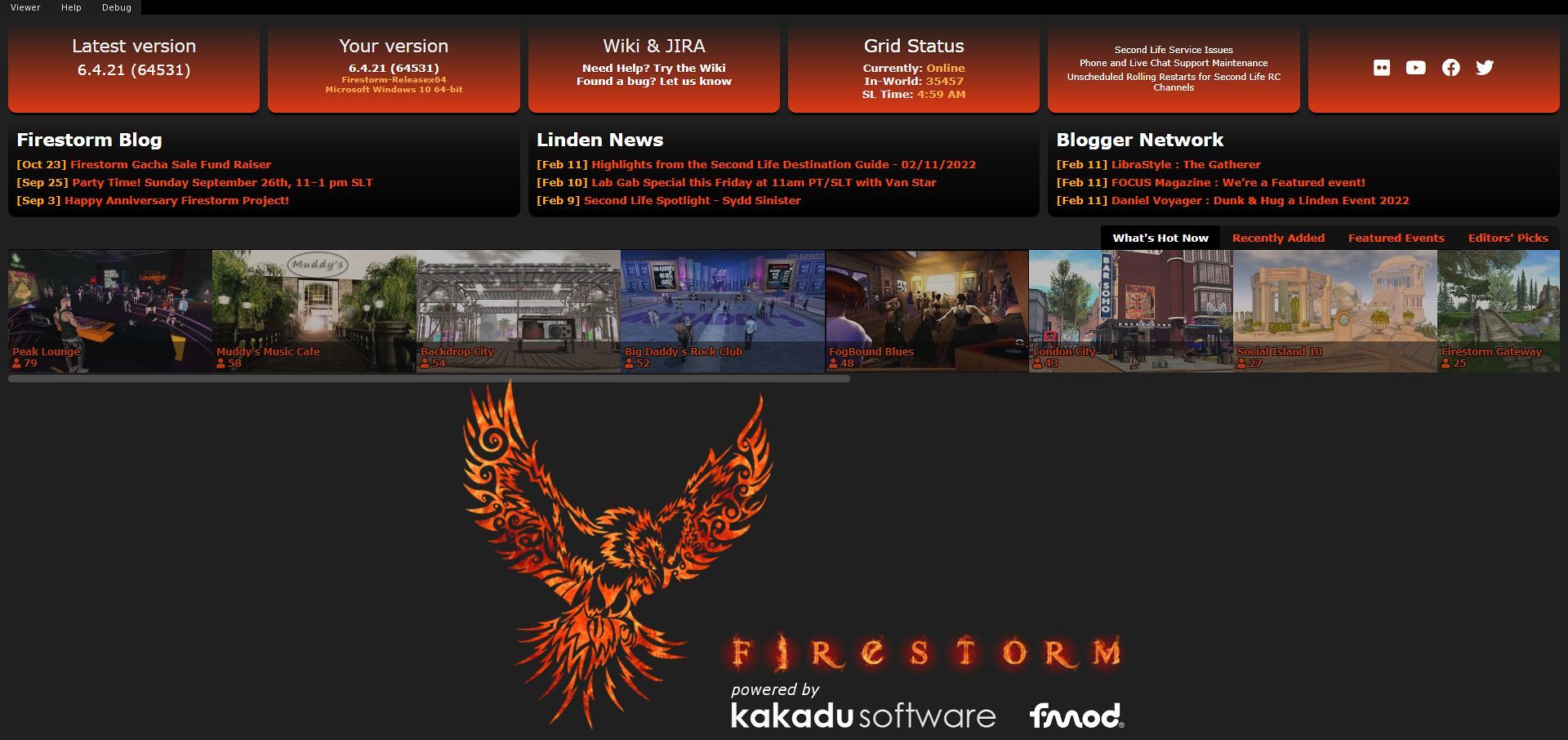
The updated Firestorm splash screen (click for full size)

Linden Lab Viewer Parity

This release brings Firestorm up to parity with the official viewer release 6.5.2, and so includes updates seen in the following official viewer releases:

  • Mac Voice hotfix viewer, version 6.5.2.567427, dated January 13th, 2022.
  • Cache + 360º Capture viewer, version 6.5.1.566335, dated December 7th, promoted December 15th – see below for more on the 360º capture.
  • Maintenance RC viewer version 6.5.0.565607, dated November 10th, promoted November 15th, 2021.
  • The Apple Notarisation Fix viewer, version 6.4.23.564172, issued September 24th and promoted October 15th, 2021.
  • CEF update viewer, version 6.4.22.561752, dated July 24th, promoted August 10th, 2021.
  • Fernet Maintenance RC, version 6.4.21.561414, dated July 14th, promoted July 19th,  2021.

More Robust Encryption of Login Credentials

In line with changes from Linden Lab, the way Firestorm encrypts your log-in credentials has been changed  to make it more robust and to reduce the number of times stored passwords will have to be re-entered. The update to the new method is automatic on logging-in to SL for the first time using Firestorm 6.5.3; however, it means that should you switch back to using an older version of Firestorm, you will have to re-enter your credentials.

Note: this update is not in any way related to multi-factor authentication in the viewer, which is currently in RC testing in the official viewer.

360º Snapshots

Linden Lab’s 360º snapshot capability allows you to capture of 360º degree panoramic images of environment around your avatar / camera position (if freecamming). The images are automatically processed by the viewer so that they can be uploaded to most platforms supporting 360º panoramic images (e.g. Flickr, Meta), and for embedding into blogs that support 360º images (such as WordPress).

Within Firestorm, the capability can be accessed in one of three ways (Firestorm have disabled the shortcut option of CTRL-ALT-SHIFT-S, as this combination is bound to opening the viewer’s Debug settings):

  • Via Avatar → 360 Snapshot.
  • By clicking on the links seen in the expanded Preview image view of the Snapshot floater.
  • Via a toolbar button (when enabled in a toolbar area).
The 360º snapshot viewer and two of the means of accessing in – via the the Avatar menu and the toolbar button (must be added to your toolbar)

Taking an image comprises a few simple steps:

  1. Position your camera.
  2. Select the image quality – for finished images you’ll need to set High or Maximum quality using the radio buttons.
  3. Click the Create 360º Image button to generate a preview in the floater’s preview panel.
  4. Click on the preview image and drag it around to ensure what you’re seeing is what you want / that things like textures have actually rendered correctly.
  5. Check the Hide All Avatars option, if required – if not, the process to include all avatars present, which could be blurred if they are moving at the time the image elements are  captured.
  6. When you are satisfied with the preview, click Save As… to save it to your hard drive, renaming it if / as required.

Note: if you change the image quality, you must also click Create 360 button to update the preview AND image capture process to the new image quality, before clicking Save As… once more.

Further information on the capability can be found in the following blog posts :

Improve Graphics Speed (Experimental)

Overview (please read!)

This is a new UI floater Developed by Beq Janus. It brings together a range of viewer graphics options and is intended to help keep you better informed of the viewer’s performance in terms of frame rates, rendering, etc.), and make your own adjustments to suit the environment you’re in. It is also intended to help users be better informed about viewer performance.

The floater comprises three core elements:

  • The Frame / Performance Summary.
  • An Auto Tune Capability.
  • Four additional floater panels that can be used together / individually and independently of Auto Tune. These bring together some of the most commonly-user graphics / rendering options, allowing you to make changes quickly and easily to manually adjust performance, including defining how avatars around you are individually rendered, and lowering to load your own avatar places on both your system and those of the people around you.

This section is intended to provide an overview to the new floater, and offer general notes on the various options and their use. When reading it, please remember:

  • The entire panel – and particularly the Auto Tune capability – is experimental. Options presented may well change over time (such as in reference to LL’s own performance improvement work).
  • While intended to try to optimise the viewer’s performance, please note: these options  will not magically make elderly (e.g. 6+ year old) computers with outdated CPUs / GPUs suddenly zoom along at rates seen with the latest high-end gaming rigs; everything is very much dependent on the capabilities of your hardware.
  • Also, and in respect of Auto Tune:
    • While it will try to maintain your frame rate at the expense of other settings (such as overall graphics quality). So, depending on your system, the frame rate selected, the complexity of the scene, you may find other aspects of your experience suffering.
    • Does not run on Mac M1 systems at present.
  • If you experience particularly awkward results or are unhappy with how the in-world scene looks, you can disable all performance optimisation, and the floater includes the means to quickly load / revert to any Graphics Presets you have previously set-up.

Accessing the Floater

The Improve Graphics Speed floater can be accessed in two ways:
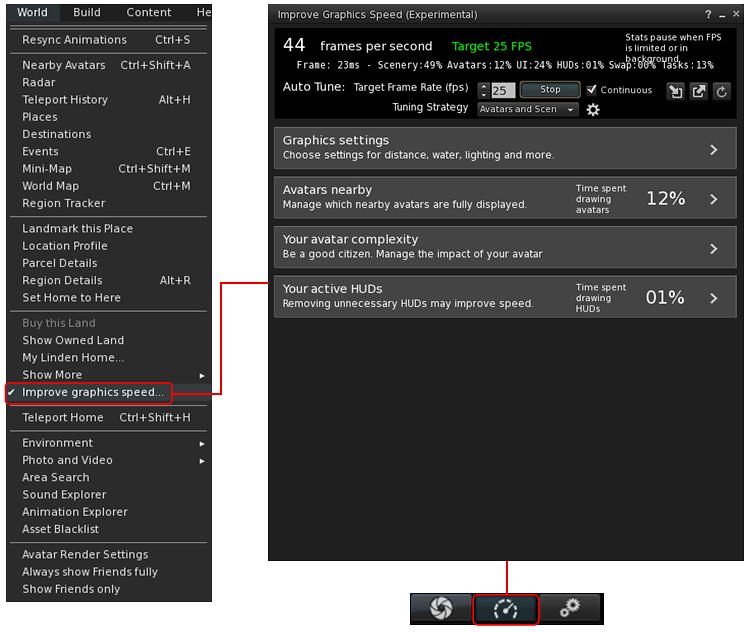
  • Via World → Improve Graphics Speed.
  • Via a toolbar button (when enabled in a toolbar area).
Accessing the Improve Graphics Speed floater

The various options and panel displays are examined in the sections below.

Continue reading “Firestorm 6.5.3: performance and photos (and more!)”
The week with Seanchai Library – March 21st-27th

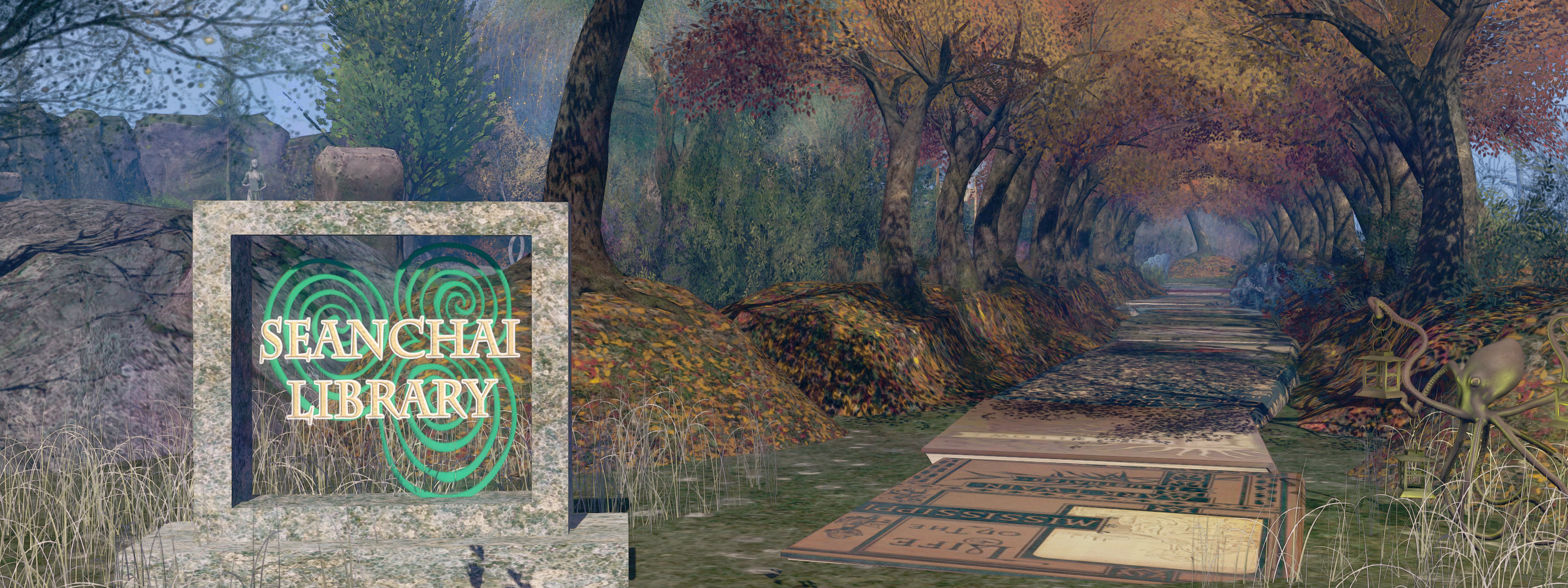
Seanchai Library

It’s time to highlight another week of storytelling in Voice by the staff and volunteers at the Seanchai Library. As always, all times SLT, and events are held at the Library’s home in Nowhereville, unless otherwise indicated. Note that the schedule below may be subject to change during the week, please refer to the Seanchai Library website for the latest information through the week.

Monday, March 21st, 19:00: When They Saw

Having graduated from the juvenile education system, Ana Mia decides to join her sister as a part of Fort Hope’s Midnight Guard. Fort Hope is a stronghold, protecting its inhabitants from Earth’s alien invaders; and the Midnight Guard forms the eyes, ears and guardians of the stronghold’s Wall.

Without the Guard and without the Wall of the stronghold, the aliens would be free to harvest humanity, using their ships and the Coyotes who form their eyes and ears in opposition to the Midnight Guard.

But now things have changed. Now Ana is something more, as she notes herself:

I never expected to be abducted. But here I am, standing onboard Their ship, facing Them down for the first time in my life, seeing the true face of the Earth’s invaders from another world.
My task is simple: to act as Earth’s emissary and negotiate peace. But it is far more complicated than it seems. I know nothing of politics, and even little of persuasion, but I have no choice. I must do this to keep my friends, and my world, safe. I cannot afford to fail humanity.

Join Gyro Muggins as he reads the second volume of Kody Boye’s When They… saga.

Tuesday, March 22nd

12:00 Noon: Russell Eponym

With music, and poetry in Ceiluradh Glen.

19:00: Haroun and the Sea of Stories

Caledonia Skytower reads the fifth of Salman Rushdie’s major publications and his first since The Satanic Verses. 

Written for the younger reader, but with plenty with it suited to older ears, it is of an allegorical nature and addresses a number of societal problems, particularly those found in the Indian subcontinent.

Dedicated to Rushdie’s son, the book looks at the issues it raises – including that of censorship (unsurprisingly, given the reaction following the publication of The Satanic Verses in 1988) – through the eyes of Haroun Khalifa, the son of a doctor and master storyteller.

Both father and son are struck by afflictions related to Haroun’s mother deserting them; Haroun has a form of attention-deficit disorder, whilst his father is prone to bouts of depression. Both can only be relieved of their afflictions should Haroun’s mother, Soraya, return.

Before then, however, Haroun is set for an adventure and discovery.

Wednesday, March 23rd: Dark

No readings.

Thursday, March 24th 19:00: Thursday Night Science Fiction

With Finn Zeddmore.

Sunday, March 27th: Volume XIV

Seanchai Library Celebrates 14 Years of Stories in Virtual Worlds – check the Seanchai blog for further details.

Purple’s Artistic Dark Paradise in Second Life

Art Street Gallery: Purple Leonis – Dark Paradise

Currently open for viewing at Vally Ericson’s (Valium Lavender’s) Art Street Gallery is a small, engaging exhibition of art by Purple Leonis (Nel4481). Entitled Dark Paradise, it comprises just ten images (more’s the pity, given the gallery space and the beauty of the art), each of which is rich in motif and story, touching on period settings and fantasy.

I have always enjoyed Purple’s work, as she always uses pose, colour, light and setting in her images to communicate with us by painting an entire story within each image. It is an approach Purple uses to both provide single-framed narratives and entire tales spread across multiple images. Within Dark Paradise, she provides a mix of both.

On entering the wing of the gallery where the exhibition is framed, one encounters a trio of images, a couple in formal wear, he standing, she sitting, in a traditional photographic pose oft seen in the early days of photograph, a closer shot of the woman seen in the first image, this time with her eyes covered by what appears to be a jewel-encrusted mask, and the third a woman in red, surrounded by billowing waves of red fabric. All three are in many respects “classic” portraits and might be taken as such.

Art Street Gallery: Purple Leonis – Dark Paradise

From here the images change in tone, becoming more fanciful – and I use this word in terms of “fantasy” – as we progress, introducing magical motifs (mushrooms, ravens); genuine flights of fancy (drifting on a bunch of hand-held balloons), to genuine trips of fantasy (alien creatures, centaurs) and finally a series suggestive of vampires. Thus, we appear to have thematically frame images that exist individually or in smaller groups connected by theme (the couple and the woman in the first two images, the vampire theme in the final three).

However, all ten images are linked in a broader theme: the entire setting suggests that we are within a room within a grand house; the pictures of the walls a mix of family portraits and strangely themed images chosen by whoever live here – perhaps the couple in the first image.

Thus we have something of a sense of the familial here, while the furnishings, colours and fixtures learn into the Gothic in a way, leading us toward the vampiric elements in the final three images, and so we’re gently led into the idea we are perhaps in a dream, an unfolding story, progressing from the first image which (either deliberately or not is down to the artist to say) is called The Beginning, and progressing around the final trio and their darker theme of blood and death / the undead.

Art Street Gallery: Purple Leonis – Dark Paradise

True, some of the images appear out-of-place to theis core vampire idea – floating on a bunch of balloons, centaurs, strange creatures – but how many dreams are entirely linear and without non-sequitur flashes? Plus, look at the tone of the more fantastical images: the centaur is linked to death (and thus the undead), for example, the monster in Cavaliere could be mindful of a vampire in its “true” form as beloved of monster movies) so even these images are perhaps not so far removed from the idea that we are entering the dark paradise of dreams and imagination.

I would have personally preferred to have seen this exhibition continued through more of the gallery space, such is the depth of narrative in the images, but don’t let the brevity put you off; Dark Paradise is a thoroughly engaging pocket exhibition.

SLurl Details

2022 viewer release summaries week #11

Logos representative only and should not be seen as an endorsement / preference / recommendation

Updates from the week ending Sunday, March 20th, 2022

This summary is generally published every Monday, and is a list of SL viewer / client releases (official and TPV) made during the previous week. When reading it, please note:

  • It is based on my Current Viewer Releases Page, a list of all Second Life viewers and clients that are in popular use (and of which I am aware), and which are recognised as adhering to the TPV Policy. This page includes comprehensive links to download pages, blog notes, release notes, etc., as well as links to any / all reviews of specific viewers / clients made within this blog.
  • By its nature, this summary presented here will always be in arrears, please refer to the Current Viewer Release Page for more up-to-date information.
  • Note that for purposes of length, TPV test viewers, preview / beta viewers / nightly builds are generally not recorded in these summaries.

Official LL Viewers

  • Release viewer: version version 6.5.3.568554 – formerly the Maintenance J&K RC viewer, promoted Monday, February 28 – no change.
  • Release channel cohorts:
    • MFA RC viewer, version 6.5.4.569309, issued on March 15.
    • Performance Improvements RC viewer version 6.6.0.569349, dated March 14.
  • Project viewers:
    • Performance Floater project viewer updated to version 6.5.4.569531, on March 18.

LL Viewer Resources

Third-party Viewers

V6-style

  • No updates.

V1-style

Mobile / Other Clients

  • MetaChat updated to version 1.2.9137 on March 17 – release notes.

Additional TPV Resources

Related Links

Space Sunday: a big rocket, a telescope & yellow and blue

Artemis 1: the SLS rolls slowly out of the Vehicle Assembly Building (VAB) and out to pad 39B at Kennedy Space Centre. Credit: NASA / Artemis- 

NASA has rolled out the first of what is intended to be both the first of its new “super rocket”, the Space Launch System, and the vehicle to start the United States and its international partners on the road back to the Moon.

At 21:47 UTC on March 17th, the huge rocket, mounted on its mobile launch platform, slowly crept out of one of the high bays of the Vehicle Assembly Building (VAB), the iconic cube sitting within NASA’s Kennedy Space Centre which was used as an integral part of Project Apollo and which is now fulfilling a similar role for Project Artemis, on the back of a massive crawler-transporter at the start of a 6.72 km journey to Kennedy Space Centre’s Lunch Complex pad 39B.

It was not a swift journey, taking some 11 hours to complete  – albeit with stops along the way for checks to be carried out – the crawler-transporter finally reaching the top of the incline of the launch pad 04:15 UTC on Friday, March 18th.

The move of the rocket from VAB to pad was not in readiness for the launch of Artemis 1 – the mission this SLS vehicle will carry to orbit – but rather for the final series of tests to be carried out on the fully integrated rocket and its Orion Multi-Purpose Crew Vehicle (MPCV) payload to ensure both are ready for that launch, which is currently set for a provisional window in mid-May 2022.

Another view of Artemis 1 SLS emerging on its mobile launch platform from the VAB at Kennedy Space Centre. Credit: NASA / Artemis 1

As I noted in my last Space Sunday update, the focus of these tests will be a full wet dress rehearsal, due to take place in April. This will see the rocket fully fuelled and go through a full launch countdown that will stop just nine seconds prior to an actual launch. The intention is to make sure everything with the rocket, the payload and the launch systems are all ready for a launch attempt, and will be followed by a further 8-9 days of additional pad tests. After this, the rocket will be returned to the VAB and assessed ready for final flight clearance.

When it does take flight, SLS will become the most powerful launch system built by NASA. The Block 1 vehicle being capable of delivering up to 95 tonnes to low Earth orbit, and the upcoming Block 1B up to 105 tonnes, and the future Block 2 vehicle up to 130 tonnes – putting it in the same lifting class as SpaceX’s Starship / Super Heavy launch system, but potentially far more flexible in turns of specialised launches, SLS being capable of launching smaller payloads (e.g. 23-45 tonnes, depending on the launcher variant) directly to the Moon, or other payloads out into the solar system without any need for on-orbit refuelling.

However, as I’ve noted before, there are some significant cost issues for SLS that may impact its use, the most notable being that of ongoing costs. Development work on the SLS system has thus far eaten US $23.01 billion, and while NASA would claim a lot of that (US $14 billion) has gone directly into work creation, it nevertheless means that as a non-reusable system, SLS is terribly expensive: NASA’s own Office of Inspector General (OIG) estimates each launch will cost some US $4 billion, twice NASA’s launch cost estimate, and will never fall below US $1 billion as the agency has suggested.

This cost factor has already seen NASA turn to other launch systems for missions originally earmarked for SLS. The Europa Clipper mission, for example, has been move to a SpaceX Falcon Heavy launcher on the ground of launch costs (and the fact that SLS generates so much vibration at launch, it is unsuitable to fly certain sensitive instruments into space).

As it is, five SLS missions in support for Artemis have thus far been confirm, with vehicles for three more after Artemis 1 already under construction:

  • Artemis 1: uncrewed mission to cislunar space to test the Orion MPCV; duration: some 25.5 days – mid 2022.
  • Artemis 2: crewed mission to lunar orbit; duration: 10 days – 2024.
  • Artemis 3: crewed lunar obit / lunar landing mission; duration:30 days – 2025/26:
  • Artemis 4: crewed mission to a lunar near-rectilinear halo orbit (NRHO) in support of the Lunar Gateway station and the core I-HAB deployment – 2026/27
  • Artemis 5: crewed mission to a lunar near-rectilinear halo orbit(NRHO) in support of the Lunar Gateway station and the European System Providing Refuelling, Infrastructure and Telecommunications (ESPRIT) module, together with a lunar surface mission – 2027-28.

Starship HLS: NASA Updates

A further key component for Project Artemis is the Human Landing System (HLS), the vehicle that will be used to transfer crews between lunar orbit and the surface of the Moon and (initially) provide them with living space whilst on the Moon. Currently, only one contract has been issued for HLS, and as I’ve noted before, it is to SpaceX for the use of a lunar variant of their Starship vehicle, although the agency has more recently been order to acquire HLS vehicles from other sources.

As a part of their Artemis HLS update, NASA provides images of astronauts working with prototype elements that will be used within the vehicle, which SpaceX are due to build. Credit: NASA

Coinciding with the SLS roll-out at Kennedy Space Centre, NASA issued an update on the SpaceX HLS programme, including the work going into some key elements, such as the elevator that will carry the 2-person crew of Artemis 3 the 30-40 metres down the side of the vehicle to the Moon’s surface and back after landing, together with the airlock through which they’ll leave / enter HLS during surface operations and some of the living / working facilities inside the vehicle.

The update also confirms that HLS will require some six starship / super heavy launches:

  • The launch of a special “tanker” Starship that will be parked in Earth orbit and used for a wide range of Starship propellant transfer operations.
  • Four further launches of re-usable Starship vehicles equipped with additional fuel tanks that will carry propellants to be transferred to the orbital “tanker”.
  • The HLS starship itself and the cargo needed for Artemis 3. This will dock with the “tanker” and take fuel from it that can be used to boost the HLS vehicle to lunar orbit and to both land it on the Moon and then get it back to lunar orbit.
Artemis 3 / HLS operations concept graphic. Credit: NASA

Once the HLS is in lunar orbit, the 4-person Artemis 3 crew will then launch to the Moon aboard an Orion MPCV lifted by SLS, and rendezvous with HLS so two can transfer to it and then travel to / from the lunar south pole. After transferring back to Orion, the crew will return to Earth, leaving the HLS starship in lunar orbit, potentially with either fuel to be used by the crew of Artemis 5, the second lunar landing mission.

However, whilst SpaceX HLS is earmarked for this mission (and will likely be the only HLS craft capable of supporting Artemis 5 in 2027/28), some in Congress are pushing NASA to use an alternative HLS design for the second lunar landing (which is which Artemis 4 was switched from a join lunar gateway / lunar landing mission to being solely a lunar gateway mission.

Continue reading “Space Sunday: a big rocket, a telescope & yellow and blue”

Danni and Traci: portraits and colour in Second Life

Art Korner, March 2022: Dannika Dryke

Update, June 27th, 2022: Art Korner has Closed.

Wednesday, March 9th, 2022 saw the opening of an exhibition at Frank Atisso’s Art Korner Main Gallery that features images by two artists on a shared theme, but which are strikingly different in their style and visual impact.

The artists in question are Dannika Dryke and Traci (Traci Ultsch), who have split the gallery between themselves, with Danni’s images located on the lower floor, and Traci’s on the upper. The central theme is that of portraits, but the two styles offered by the artists are extraordinarily different.

Art Korner, March 2022: Dannika Dryke

On the lower level, Danni presents a series of large format images that might been seen as “traditional” modern portraits: the subject the centre of the image sans and background distractions, (largely) minimal visible posing, the colours clean and natural in tone. These are images that allow us to focus solely on the subject, drawing us into a study of their look and appearance and – oh, so gently – into a wider consideration of their nature as revealed (or imposed, depending on your viewpoint) by the pose they have struck.

These are picture that speak to the art of photography as form of modern portraiture that has largely taken over from the more formalised use of paint and canvas to immortalise an individual. With most images presented as head and shoulders / chest level, they reveal the avatar-as-a-person, someone who exists independently from any human operator behind the screen. Within the eyes, we can perceive life and mood, within the expression there lies emotion and and intelligence, within the choice of clothing a glimpse of character and nature. Such is the depth of life within each image, were the subject to lean out of the monitor and offer an introduction, it wouldn’t be in the least bit surprising!

Art Korner March 2022: Traci Ultsch

Life and vitality are also very much in evidence in the images presented by Traci on the gallery’s upper level – but in a very different way. Where Danni opts to go the more “traditional” route of portraiture, Traci leans into a more expressive presentation, the images swept with brush-like swirls of light or splattered with dark tones a-la Pollock or stamped with blocks of Warhol-esque colour to present bold statement of life in which the entire image speaks – subject, colour, contrast – to present not so much the individual, but the sense of mood / emotion, and presence / vitality of the subject.

These are images in which there is a lot going on, the very depth of elements drawing us into each picture, not so much to decrypt or understand it, but simply to flow with the narrative as it forms ideas and stories that are as unique and individual as the images and their colours.

Art Korner March 2022: Traci Ultsch
Taken individually, each of these displays of art has much to attract the eye; taken together, and they offer a marvellous juxtaposition and conjoining of style and content that is  wholly engaging.

SLurl Details
