Space Sunday: Starship, ExoMars and sundry news

What it might look like: an animation of the first Starship orbital flight. Credit: C-Bass Production / Neopork

Such is the pace of development, the first orbital flight of the SpaceX Starship / Super Heavy combination will now not take place as originally planned.

It had been thought that the flight, which has been repeatedly delayed for a number of factors, including slippages in the Federal Aviation Administration being able to publish the final version of its study into the impact of SpaceX’s operations in Boca Chica on the surrounding environment, would be made by Starship No. 20 (“Ship 20”), and Super Heavy booster No 4 (Booster 4), both of which have been going through a wide range of cryogenic and static fire tests since mid-2021, the most recent of the cryogenic tests occurring just over a week and a half ago, with both vehicles stacked together on the launch platform.

However, on Saturday, March 22nd, Starship 20 was “destacked” from Booster 4 and removed from the orbital launch facilities, and 24 hours later, Booster 4 was also removed, with Elon Musk Tweeting that neither would now play a role in the first orbital flight attempt. The reason for this is simple: work on developing and enhancing the design of both the Starship vehicle and the Super Heavy booster now means that Booster 4 and Ship 20 are essentially obsolete.

March 22nd, 2022: Mechazilla on the orbital support tower lowers Starship 20 following its disconnect from Booster 4. Credit: NASA Spaceflight

The major cause for this is that – despite a scary e-mail from Musk at the end of 2021 stating SpaceX could go bankrupt if issues with the powerful Raptor 2 engine were not quickly sorted out and production ramped – the company is now solely focused on boosters and ships built to mount the much more compact Raptor 2 motors, the sea level versions of which (primarily used to power Super Heavy, but three are also used in each Starship) are considerably smaller and less complicated than their Raptor 1 cousins, and generate far more thrust (from 230 to 250 tonnes per Raptor 2 compared to a maximum 185 tonnes for a Raptor 1).

Left: a sea-level Raptor 2 engine compared to its much larger Raptor 1 equivalent. Credit: Nic Ansuni / NASA Spaceflight

The more compact size of the Raptor 2 makes it possible for SpaceX to increase the total compliment of engines on a Super Heavy from 29 to the planned 33. The reduction in their complexity also makes all of the plumbing required  to feed them propellants and the electronics needed to control them  a lot easier to manage. For starship vehicles, the smaller Raptor 2 motors should make it easier to increase the number of engines from 6 to the planned 9 (3 sea-level and 6 vacuum engines with their much large exhaust bells).

Booster 7 and Ship 24 are also the first of each design to incorporate other critical design changes. Some of these are to easy the fabrication and assembly process, others are to help improve performance or meet the demands of having more engines, and still other to improve aerodynamics.

In the case of the Super Heavy booster, one of the cleverest – and most visible – changes is in the number and positioning of the Composite Overwrapped Pressure Vessels (COPVs).

COPV are tanks of hydrogen used in the ignition process for the outer ring of Raptor motors on a Super Heavy. With Booster 4, four pairs of COPVs were placed equidistantly around the base of the booster, covered by steel aeroshells.

However, with the increased number of Raptor engines, Booster 7 and those that follow it require 10 COPVs each. Were the extra two COPV to be paired at the base of the rocket, they would work with the other four pairs to disrupt airflow over the tail of the booster during ascent, generating both drag and potential buffeting / vibration.

To prevent this, Booster 7 is the first Super Heavy to have the COPV stacked vertically along its sides in two sets of five. Not only does this remove the risk of additional drag / buffeting during ascent, it also simplifies the overall plumbing to supply hydrogen to the Raptors, as each set of 5 can use common feedlines down the the engines. However, what is particularly clever is that offsetting each stack of COPVs slightly from the rocket’s centreline, their aerodynamic covers can actually help generate a degree of lift around the base of the rocket during its descent back through the atmosphere, helping to both slow it and provide a greater degree of control during the descent.
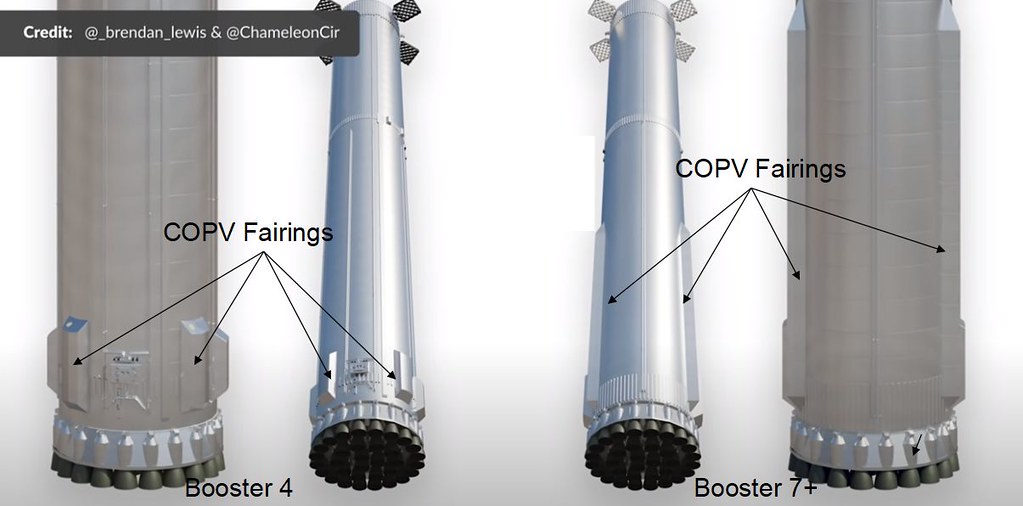
The COPV changes: left, as they were on Booster 4, and as they are on Booster 7. Credit: Brendan Lewis / ChameleonCir

As it is the closest to completion, Starship 24 would appear to be the primary candidate for joining booster 7 on the orbital flight attempt (work on ships 21 through 23 having been abandoned / bypassed) – but this far from certain. Recent work on the vehicle has seen it installed with a small prototype payload bay door, suggesting it has been earmarked for a payload bay test flight, something yet to be scheduled. As such, it is possible that Ship 25, also being assembled at Boca Chica, might be selected for the first orbital attempt.

Although the switch to using more recent versions of Super Heavy and Starship means that the first orbital flight attempt is now unlikely to occur before late May 2022, when it does happen, it will allow SpaceX to gather more relevant data on vehicle performance, which should help benefit the programme overall. It also means that by the time the booster / ship combination is ready to go, the FAA’s report on its environmental review of the Boca Chica site should have been published (the release date was recently pushed back again from the end of March to the end of April), and SpaceX should be in a position to know whether or not they are to be granted a licence for their orbital launches from the site.

Continue reading “Space Sunday: Starship, ExoMars and sundry news”

Haveit’s Golden Light in Second Life

Ribong Artspace: Haveit Neox – Golden Light
What fascinates me about ritual is its primal essence, reaching way back to a culture’s birth. They may be highly decorative or stylized versions of cherished concepts. These inflexible portraits of a culture are meant to endure the tests of time.

– Haveit Neox, Golden Light

With these words Haveit Neox introduces Golden Light, a small-scale installation that opened on March 19th, 2022 within the Ribong Artspace 2336, curated by San (Santoshima). While the scale might be comparatively small, this is an installation that offers a personally stylised and richly layered exploration of the subject of ritual, with symbolism that may well reach beyond what might first be apparent.

The core installation takes the form of a large bowl set beneath a dome of stars (whilst not expressly required, I set my viewer’s time to Midnight as the stars suggest – like many rituals – this is one undertaken after the Sun has set). The walls of the bowl bear four large paintings whilst its floor is largely given over to a vast pit, dark and foreboding and crossed by a single tightrope. It is a setting that can be best summed up using Haveit’s own words:

Draped chairs of giants stand among the plant life. The plants have yet to bloom; the seats have yet to be occupied. The landscape is portrayed entirely in 2D, except for the tightrope apparatus suspended over the deep pit. A supplicant brings a pinecone offering from the real world. Perched precariously on a tightrope over a deep, dark pit, perfect balance must be maintained for the ceremony to succeed.

– Haveit Neox, Golden Light

Ribong Artspace: Haveit Neox – Golden Light

All of this is plain from looking at the installation, marking it as a statement on ritual; however, it is what is presented rather than what is going on that brings forth the richness of the piece.

Take how the tightrope is held across the pit by a pair of stags. Whilst perhaps superseded in some respects by the likes of bears, boars, great cats, raptors etc., as the totemic animals of deities across Indo-European cultures and civilisations, the stag nevertheless was of importance to the Scythians and the Kurgans, associated with strength and fertility; concepts that were carried westward, embraced by paganism. Similarly, across the Atlantic, the stag was seen as totemic of numerous tribal gods, and a harbinger of fertility. Additionally, white stags have oft been seen as symbolic of protectors watching over the land, the tribe, etc., and thus venerated.

Similarly, the pine cone, with its natural Fibonacci sequence has, throughout multiple civilisations from Ancient Egypt and Assyria on one side of the world, the Mayans and Incas on the other, and all the way through to modern paganism, been seen as both a symbol of fertility and of enlightenment;  And I need hardly mention the physical and symbolic importance of trees to many cultures. Meanwhile the four paintings are placed at the cardinal points, so-called because they are the chief – or true – directions, whilst the reference to gold enfolds the idea of purity (of both ritual and self).

Ribong Artspace: Haveit Neox – Golden Light

Thus, by including these specific elements, Haveit encompasses symbolise that have played a role in humanity’s cultures down civilisations down through the halls of time – and which continue to be a part of our cultures, rituals and religions to this day, even if we don’t always recognise them as such.

For example, we are all familiar with the role of trees within the Christian religions: humanity’s separation from God started with a tree (Eden’s tree of the knowledge of good and evil), with the path to redemption marked by a tree (the cross upon which Christ was nailed). However, what might not be so well recognised is that both the pine cone and the stag also have their places in Christian religions; the stag for example, is seen as representative of Christ, standing in opposition to the snake’s totem in representing Satan, with the white stag symbolic of God’s protection.

This continuing need for (/appropriation of) rituals and symbols down the ages is further marked by the fact the supplicant within the installation carries not an actual pine cone across the tightrope, but the image of a pine cone. It is symbolic of all that has happened down the ages, and which still happens in various ways and forms today, allowing it to stand as a symbol for future ritual, whatever form it might take (and in this, I was stuck by the way the paint itself resembles a tablet, something that has both ancient and modern connotations for ritual!).

Ribong Artspace: Haveit Neox – Golden Light

Simple in style, complex is interpretation, Golden Light is another wonderful mix of art, metaphor and meaning from Haveit.

SLurl Details

Cherishville’s 2022 Spring in Second Life

Cherishville, March 2022 – click any image for full size

Back in late 2021, I revisited Lam Erin’s Cherishville, which at the time was dressed for winter. Unfortunately I didn’t blog about it at following my visit for assorted reasons, and by the time I did hop back to refresh my memory, I knew I’d be better holding off until the region had been redressed for 2022. So when Lam re-opened for spring 2022, I made sure to hop over at the earliest opportunity, and this time make sure I completed a write-up, even though by doing so, I was leaving almost exactly a year between covering Cherishville in these pages.

At that time of my 2021 visit, Cherishville presented a coastal setting that perhaps leaned towards being somewhere in North America more than, say, northern Europe (although it could perhaps have been part of the latter). For this year’s spring, the setting shares some of that past life; it again has a waterfront area, this a little more established than in 2021 in terms of the working buildings that back the wharves, although at least a couple of the the boats also offer a link back to that former build.

Cherishville, March 2022

However, this time I’d say that we I to hazard a guess as to where this iteration of Cherishville might be were it to exist in the physical world, I’d likely point more to Europe and perhaps the Baltic coastlines of the northern European counties, simply because of the overall styling on buildings, landscape and vehicles. Although that said, there are elements that suggest we could be in North America, perhaps somewhere around the great lakes, rather than on the coast.

To the south of the region a single-track road loops around a small town nestled on the upland to the region, the upper reaches dominated by a chapel with what appears to be a rather extensive manse sitting alongside it, the tall tower of an ancient stone gatehouse sitting just across the intervening passage of the road. Down slope from these, the houses and shops are partially furnished to give them a sense of depth and life from the roadside, but the chapel and the buildings around it that share the hilltops are shells, their presence also giving depth to the setting but without burdening viewer with yet more to render.

Cherishville, March 2022

The land to the north of the town is largely flat and broken by the passage of waters that drop from just below the town to cut a broad, rocky path north and west until they meet a substantial opponent in the form of a humped rise of land which forces them to branch west and north in order to reach more open waters, which a further, narrower channel even tracking back eastwards.

This narrower streams splits the region’s northlands into an island on their own, home to large, wood-build house that sits upon it as a further empty shell reached by a single, frail-looking bridge. The L of the house are positioned so the wings look west to the low, stubborn hill that forces the river’s waters to split, and the windmill that sits upon it, sails turning lazily. Reaching this windmill most directly is best achieved going via the wharves on the region’s west side. However, at some point in the past, it appears some started putting together a very makeshift bridge to cross the rocky waters between house and hill, leaving it unfinished and apparently abandoned.

Cherishville, March 2022

Extending northwards and bounded on one side by the broader passage of the river whilst end at the banks of the east flowing stream, is a tongue of land, a branch of the single-track road winding into it. Here, guarded by the dropping arms of weeping willows and the hunched forms of aged trees, is a place given over to festivities lights having been strung from a central raised post to a ring of posts surrounding it. Caravans and makeshift shacks have been circled here, tables and benches of food and drink scattered between them in readiness for music and dancing. All that is missing are the revellers themselves, frolicking through the knee-high grass – although even without them, the imagination conjures the sounds of bows and penny whistles giving life to a happy tune.

This is a setting that has been put together with the photographer in mind – hardly surprising, given Lam is himself an accomplished landscape photographer – with details large and small awaiting discovery and lending themselves to lens, angle and lighting, all set under a spring sky with clouds lit by the Sun. For those who love photographing SL architecture, there is particularly a lot to appreciate within this version of Cherishville, as I hope the images here show!

Cherishville, March 2022

That said, the very fact there is so much detail packed into the region means there is a lot for the viewer to tackle, particularly if you’re running with settings at the high-end for photography and are not on a high-end system. At the time of my visit, there were also some rough edges that could do with some smoothing as well – some elements floating in the air, some prims / mesh elements with overlapping textures (the stone courtyard around the chapel, and part of the waterfront area), a car sitting somewhat sunken in the road; but these can be ignored with suitable camera angles (if noticed at all), leaving the region ready to be appreciated.

With thanks to Shawn Shakespeare for the reminder.

Cherishville, March 2022

SLurl Details

Walking The Inner Path in Second Life

Art Korner Gallery: Selen Minotaur – The Inner Path

Update, June 27th, 2022: Art Korner has Closed.

Who looks outside, dreams; who looks inside awakes

Carl Jung, October 1916, Letters, Vol 1, page 33

These are the words Selen Minotaur has chosen to frame her exhibition The Inner Path, which opened within a skybox gallery space at Frank Atisso’s Art Korner Gallery on March 17th 2022.

The quote is from one of a series of letters Jung wrote during correspondence with Fanny Bowditch Katz, an American woman who had suffered a severe breakdown following the death of her father in 1911 (she she was 37 at the time), and who was referred to Jung for treatment in 1912. At the time Jung wrote these words, she had actually ceased direct therapy under his guidance (for which she had travelled from the US to Switzerland in order to receive), but she and Jung continued to correspond in regards to her condition for several years.

Art Korner Gallery: Selen Minotaur – The Inner Path

Over the years these words have become relatively well-known, appearing as they do on posters and pictures of the motivational kind. This is actually a shame, because in reducing Jung’s words to something to be framed and / or hung on a wall, we reduce their essential truth from something to be genuinely explored to a statement we can look at and nod towards sagely in a strokey-chin moment and without ever progressing further towards understanding and moving beyond that affliction.

And what is that affliction? Our increasing inability to really understand who we are by looking within. We are complex beings, each with his or her struggles, hurts, wants, needs, conflicts. At some point, we all have what Jung refers to as a “confrontation with the unconscious” that can leave us lost, vulnerable, uncertain, lonely, depressed, isolated, empty, and more. Indeed it is something that can happen ore than once through our lives – and something increasingly exacerbated in the way we are persistently bombarded by ideas that the path to happiness and peace lay through the acquisition of wealth and things, that we can never truly or fully be happy unless we have X, Y or Z and / or that spirituality can never be achieved unless we conform to this or that doctrine, and so on.

Yet, as Jung knew only too well – thanks to his own experiences in 1913, and which affected him through the next several years, helping to formulate his ideas through self-examination, military service and in trying to help patients like Fanny Bowditch Katz – the genuine path to understanding ourselves, to gaining balance (mental and spiritual)  – lies within ourselves.

Art Korner Gallery: Selen Minotaur – The Inner Path
I realise the under the circumstances you have described you feel the need to see clearly. But your vision will become clear only when you can look into your own heart.
Without, everything seems discordant; only within does it coalesces into unity. Who looks outside, dreams; who looks inside awakes.

Carl Jung, October 1916, Letter, Vol 1, page 33.

Through the seven rooms of The Inner Path, Selen similarly challenges us through images and props and metaphor to look within, to understand what makes us who we are, and undertake a journey of self and release. Starting in greyscale monochrome and progressing through the first hints of tone and hues and finally arriving in full colour, these are images that reflect elements of the journey, the rooms in which they hang additionally presented with sculptures and pieces intended to tip our thinking back and forth, encouraging responses and interpretations rather than presenting outright directions.

Art Korner Gallery: Selen Minotaur – The Inner Path

Some of the symbolism might at first seem easy to grasp: the progression from greyscale to colour reflecting our rise to self-awareness, the presence of yin/yang representing acceptance of the “negatives” and “positives” we possess, and so on. However, things here are far more nuanced, the metaphors more subtle than might at first seem to be the case, as with the words within the first room and the sculpture of the caged figure (the latter, for example juxtapositioning the idea that as long as we look inward, we will remain caged and confused, trapped within self, with the reality of Jung’s words that only through continued navigation of self heart (/soul), can we genuinely start to reach any sense of understanding, balance and release).

The inner path we travel when we look within ourselves is unique to each of us, even if  – should we compare – there are similarities in encounters we each have along the way. As such, just as Selen offers suggestions and uses visual metaphors throughout The Inner Path, and prompts rather than explicitly directs, so I am reluctant to impinge more of my own thinking on all that is offered through this installation.

Instead, I encourage you to go along yourself when free of physical distractions, and walk the halls of The Inner Path with open eyes and mind, giving your inner self a chance to speak as the images and setting prompt. And don’t be surprised if you find yourself passing through the rooms more than once, as this is an installation which, if we allow it, will speak to us constantly.

Art Korner Gallery: Selen Minotaur – The Inner Path

SLurl Details

Serene’s Dyrhólaey in Second Life

Dyrhólaey, March 2022 – click any image for full size

For some reason, my favourite places on Earth seem to be islands. On numerous occasions in these pages I’ve mentioned that facts that I have spent time in Hong Kong both in childhood and as an adult, and that I consider Sri Lanka a kind of “spiritual home”. Another place – vastly different to either of these two – that holds a special attraction for me is Iceland.

Dyrhólaey, March 2022

It’s a place I’ve been fortunate to be able to visit several times, most of them initially spent in and around Reykjavík on arrival before heading north by air to Akureyri (the so-called “Capital of North Iceland” with a spectacular approach to the airport running down the fjord), and thence onwards by road to the Mývatn region and the great volcanic caldera and fissure zone of Krafla (where tours are available of the geothermal power plant as well as out onto the lava landscape that is indescribably stunning). So when Shawn Shakespeare informed me Serene Footman has settled on another part of Iceland for his latest region offering, I had to hop across and take a look.

For his latest 2022 build, Serene has chosen Dyrhólaey (“Door Hill Island”), a place almost directly opposite my stomping ground (so so speak) of Akureyri, being located on Iceland’s southernmost reach of coastline. It’s a part of the island I’ve not personally visited – although it, the village of  Vík í Mýrdal and the area around Katla have been on the list of potential visits for a future return to the island.

Dyrhólaey, March 2022

Dyrhólaey started life around 100,000 years ago as an island resulting from a volcanic eruption. Today, it forms a small promontory sitting between the North Atlantic to the south and the Dyrhólaós estuary to the north. Rising some 120 metres above sea level, it runs eastwards and links to the Reynisfjara, the black sand beach that runs west from the mainland, and which in 1991 was ranked one of the ten most beautiful non-tropical beaches in the world, and in 2021, the 6th best beach in the world.

With views across the beach towards the Reynisdrangar that sit off-shore to the east and inland toward the glacier Mýrdalsjökull and the uplands of Katla, Dyrhólaey is a popular attraction for both tourists and Icelanders alike, being a 2-hour drive from Reykjavík. However, the two things that make it most notable is the sweep of the beautiful – if at time treacherous – Reynisfjara sands, complete with their basalt columns, and the a gigantic black arch of lava standing in the sea that gave the promontory its name.

Dyrhólaey, March 2022

The latter two – the basalt columns and the great arch – are features of Serene’s build, but rather than confining himself to the landscape around Dyrhólaey, he brings together elements from across Iceland (and another from the imagination) to capture the sprit of the island. As  he notes in his own blog post, Iceland has many waterfalls, a good many of which are stunning.

To honour theses waterfalls, Serene includes a set of high falls within the build whilst also mentioning the glorious Svartifoss (“black waterfall”) which lay 140 km east of Dyrhólaey. It’s an apt choice to mention: the falls drop over a set of basalt columns of a similar nature to those at Reynisfjara – columns that have influenced many an Icelandic architects, one of whom built the unmistakable Hallgrímskirkja church in Reykjavík (a building with which I’m very familiar, the bed and breakfast we use during visits being located a short walk away, on the route down to the harbour area.

Dyrhólaey, March 2022

Iceland is a genuinely dramatic country – and one that isn’t the easiest to visualise, not when it comes to trying to fit that drama into the 65,536 square metres and just 5,000 LI available within a Homestead region.

However, from the high cliffs through gathering the black sands of the beach around the base of the cliffs, from the tough grass that makes a good portion of the island’s vegetation to representing its rich diversity of wildfowl and birds – and even the hardy Icelandic ponies – to the off shore rocks that capture the spirit of Reynisdrangar, this is a region that does so admirably. Even the touch of American architectural visualisation inspired by  Alex Hogrefe fits right into the setting; while he may not be a son of Iceland, Hogrefe’s  work is very mush in the style of forward-thinking Icelandic architects.

Once again, a marvellous visualisation by Serene – so be sure to see it while you can!

Related Links

2022 SUG meetings week #12: summary

Sous le ciel de Paris, February 2022 – blog post

The following summary notes were taken from the Tuesday, March 22nd, 2022 Simulator User Group (SUG) meeting. It forms a summary of the items discussed, and a video of the entire meeting is embedded at the end of the article – my thanks to Pantera for recording it.

Server Deployments

There are no planned deployments for week #12,  although all channels will be restarted  – Main on Tuesday, March 22nd, RCs on Wednesday, March 23rd, 2022.

Available Official Viewers

All official viewer pipelines remain as follows:

  • Release viewer: version version 6.5.3.568554 – formerly the Maintenance J&K RC viewer, promoted Monday, February 28 – No Change
  • Release channel cohorts (please see my notes on manually installing RC viewer versions if you wish to install any release candidate(s) yourself).
    • MFA RC viewer, version 6.5.4.569309, issued on March 15.
    • Performance Improvements RC viewer version 6.6.0.569349, dated March 14.
    • Lao-Lao Maintenance RC viewer, version 6.5.4.569191, issued on March 11.
  • Project viewers:
    • Performance Floater project viewer, version 6.4.23.562625, September 2, 2021.
    • Mesh Optimizer project viewer, version 6.5.2.566858, dated January 5, issued after January 10.
    • Legacy Profiles viewer, version 6.4.11.550519, dated October 26, 2020.
    • Copy / Paste viewer, version 6.3.5.533365, dated December 9, 2019.

In Brief

  • BUG-231876 “llRequestSimulatorData() frequently and silently fails” – a fix has been developed for this issue and is currently with QA for testing. If all goes well, the fix should be in an RC update in the next week or two. Leviathan Linden described the issue thus:
The problem was introduced after overhaul to the ScriptDataCache implementation.In short: when the cache was full then pending requests could sometimes be invalidated by a new request. There was not enough distinction between a valid but not yet expired value and a valid but not yet harvested by its request value.
The ScriptDataCache is currently limited to 8192 slots. Not all dataserver functions use it, but yes the only data therein are dataserver requests. Some dataserver requests used to use the cache but have been migrated over the years to use different web services instead of actually hitting the dataservers themselves. the DataServerCache size with my recent fix: only 1024 slots. The size of the cache shouldn’t really matter all that much when it is working correctly. That is… its size is really there to protect the dataservers from overload.
  • Monty Linden is poking at region crossing issues, but no updates.  This sparked further general discussion on region crossings.  Please refer to the video.
  • General discussion about two bugs that occur when the viewer is minimised, but where the simulator should really have authority (and thus the issue not occur):
    • BUG-202856 “Rotating a sitter’s rotation by script does not update their global rotation at the server if the sitter has their viewer minimised.”
    • BUG-230616 “A user’s scripts and attachments do not load in a region if they are teleported while their viewer is minimized. The server shows no attachments, scripts, script memory or timing.”